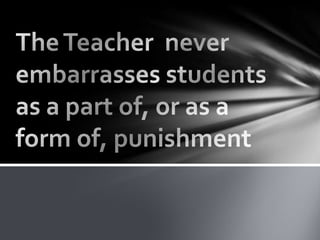
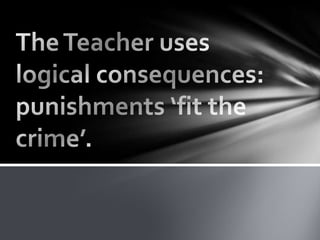
Source: Cope, 2005, p. 5-6. How to
make a classroom management plan.
Australia: Person SprintPrint
Students never take over. Where they
want to argue, students are given a
choice so that power struggles can be
avoided; for example: ‘You may finish
your work now or during lunch’.
Every teacher has rules but some do
not tell the students what they are.
Having a say in rule development, limit setting and consequence
development leads student to ownership and responsibility. Students who
have a say are no longer merely compliant, and less likely to be rebellious.
In secondary school, however, students may suffer rule discussion fatigue
and teachers may simply present them for possible discussion.
Most schools rely on the counterbalancing of rights and responsibilities.
Teachers in higher grades tend to only have one rule framed around the
notion of respect for others.
For minor problems, teachers should practice non-verbal's, prompting or
simply reminding students and allowing them to self-correct. Prompting
and reminders should, if at all possible, be given quietly.
The whole class is not punished. This
i particularly disliked by students and
is patently inequitable.
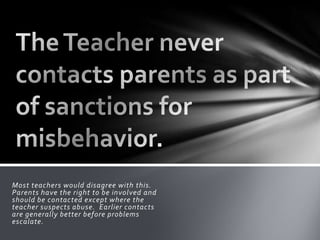
Most teachers would disagree with this.
Parents have the right to be involved and
should be contacted except where the
teacher suspects abuse. Earlier contacts
are generally better before problems
escalate.
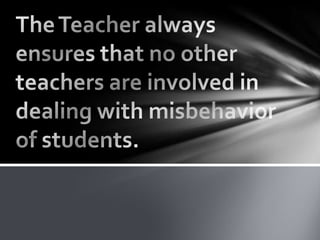
The implementation of this depends
on school procedures and is also a
safety issue.
The implementation of this depends
on school procedures and is also a
safety issue.
This is strongly endorsed by pupils.
Students, especially secondary
students, believe that teachers are
rarely positive enough.
Pupils believe they should be heard for
their side of the story in order to follow
due process... There may be perfectly
good reasons, for example, for being
late.
This refers to student’s personal
difficulties. Each student should have
at least one teacher in the school to
whom she or he can consult about
personal problems.

Students’ perspective on behaviour management in the classroom

  • 1.
    Source: Cope, 2005,p. 5-6. How to make a classroom management plan. Australia: Person SprintPrint
  • 2.
    Students never takeover. Where they want to argue, students are given a choice so that power struggles can be avoided; for example: ‘You may finish your work now or during lunch’.
  • 3.
    Every teacher hasrules but some do not tell the students what they are.
  • 4.
    Having a sayin rule development, limit setting and consequence development leads student to ownership and responsibility. Students who have a say are no longer merely compliant, and less likely to be rebellious. In secondary school, however, students may suffer rule discussion fatigue and teachers may simply present them for possible discussion.
  • 5.
    Most schools relyon the counterbalancing of rights and responsibilities. Teachers in higher grades tend to only have one rule framed around the notion of respect for others.
  • 6.
    For minor problems,teachers should practice non-verbal's, prompting or simply reminding students and allowing them to self-correct. Prompting and reminders should, if at all possible, be given quietly.
  • 7.
    The whole classis not punished. This i particularly disliked by students and is patently inequitable.
  • 12.
    Most teachers woulddisagree with this. Parents have the right to be involved and should be contacted except where the teacher suspects abuse. Earlier contacts are generally better before problems escalate.
  • 13.
    The implementation ofthis depends on school procedures and is also a safety issue.
  • 14.
    The implementation ofthis depends on school procedures and is also a safety issue.
  • 15.
    This is stronglyendorsed by pupils.
  • 16.
    Students, especially secondary students,believe that teachers are rarely positive enough.
  • 17.
    Pupils believe theyshould be heard for their side of the story in order to follow due process... There may be perfectly good reasons, for example, for being late.
  • 18.
    This refers tostudent’s personal difficulties. Each student should have at least one teacher in the school to whom she or he can consult about personal problems.