
Jones & Jones (2007)
RESPONDING TO BEHAVIOR THAT
DISRUPTS THE LEARNING
PROCESS
CONTENT
Jones & Jones (2007)
 Who are we?
 Gantt cart
 Matrix Diagram
 The problem
 Literature Review
 Fishbone
 Survey
 Ideas&Strategies
 References
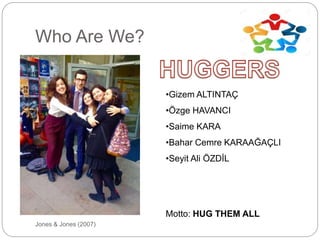
Who Are We?
Jones & Jones (2007)
•Gizem ALTINTAÇ
•Özge HAVANCI
•Saime KARA
•Bahar Cemre KARAAĞAÇLI
•Seyit Ali ÖZDİL
Motto: HUG THEM ALL
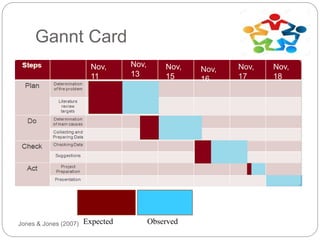
Gannt Card
Jones & Jones (2007) Expected Observed
Nov,
11
Nov,
13
Nov,
15
Nov,
16
Nov,
17
Nov,
18
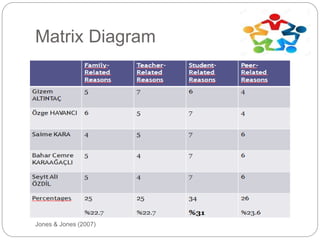
Matrix Diagram
Jones & Jones (2007)
Problem
Jones & Jones (2007)
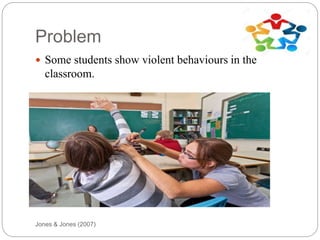
 Some students show violent behaviours in the
classroom.
Jones & Jones (2007)
LITERATURE
REVIEW
-The typical prekindergarten
classroom has an average of
three students who display
disruptive behavior (Gordon,
Henry, Mashburn, & Ponder,
2001).
-Between 10 percent and 20
percent of students have
behavior problems that require
structured interventions (Sugai,
Horner, Lewis & Cheney, 2002).
- African American students are
much more likely to receive
harsher punishment in response
to rule violations than are other
students (Skiba, Michael, Nardo,
and Peterson, 2002)
Jones & Jones (2007)
 The relationship-based discipline involving
greater use of nonembarrassing cues and
discussions with with students was associated with
more responsible student behavior. Lewis (2001).
 public reprimands, being asked to leave the class,
and group consequences for the misbehavior of
one or a few students, are perceived unacceptible
and ineffective (Hoy&Weinstein, 2006 )
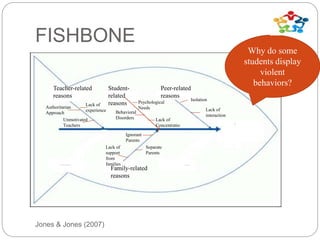
FISHBONE
Jones & Jones (2007)
Student-
related
reasons
Teacher-related
reasons
Peer-related
reasons
Family-related
reasons
Authoritarian
Approach
Lack of
experience
Unmotivated
Teachers
Psychological
Needs
Behavioral
Disorders Lack of
Concentratio
n
Isolation
Lack of
interaction
Ignorant
Parents
Separate
Parents
Lack of
support
from
families
Why do some
students display
violent
behaviors?
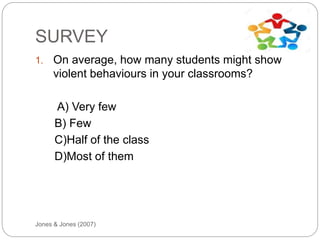
SURVEY
Jones & Jones (2007)
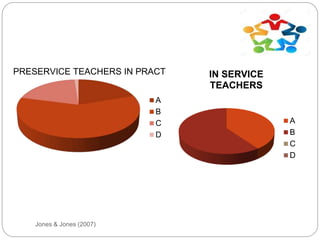
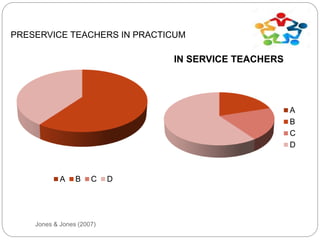
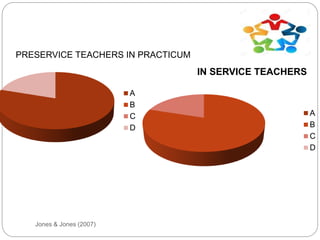
1. On average, how many students might show
violent behaviours in your classrooms?
A) Very few
B) Few
C)Half of the class
D)Most of them
Jones & Jones (2007)
A
B
C
D
PRESERVICE TEACHERS IN PRACTICUM IN SERVICE
TEACHERS
A
B
C
D
Jones & Jones (2007)
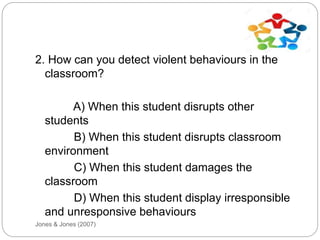
2. How can you detect violent behaviours in the
classroom?
A) When this student disrupts other
students
B) When this student disrupts classroom
environment
C) When this student damages the
classroom
D) When this student display irresponsible
and unresponsive behaviours
Jones & Jones (2007)
A B C D
PRESERVICE TEACHERS IN PRACTICUM
IN SERVICE TEACHERS
A
B
C
D
Jones & Jones (2007)
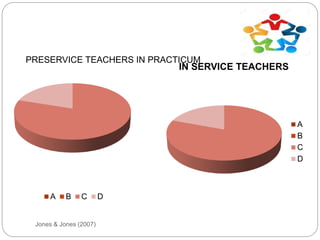
3. How do you respond disruptive behaviour?
A) Punishing students physically
B) Punishing students verbally
C) Talking to the student in person
D) Doing collaboration with their peers
Jones & Jones (2007)
A B C D
PRESERVICE TEACHERS IN PRACTICUM
IN SERVICE TEACHERS
A
B
C
D
Jones & Jones (2007)
4. What are the main reasons of violent behaviour
in general?
A) Student-related problems
B) Family-related problems
C) Teacher-related problems
D) Peer-related problems
Jones & Jones (2007)
A
B
C
D
PRESERVICE TEACHERS IN PRACTICUM
IN SERVICE TEACHERS
A
B
C
D
Jones & Jones (2007)
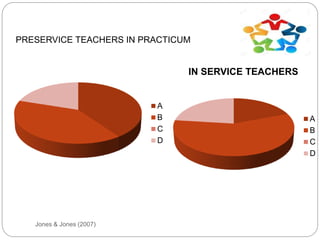
5. Have you ever received help from someone to
overcome such situation?
A) Consulting parents
B) Collaborating with consultants
C) Collaborating with school administrations
D) Collaborating with colleagues
Jones & Jones (2007)
PRESERVICE TEACHERS IN PRACTICUM
A
B
C
D
IN SERVICE TEACHERS
A
B
C
D
SOLUTIONS & STRATEGIES
Ensure that your requests have been
made clearly, politely and firmly.
“GET BACK TO YOUR SEAT KID, RIGHT
NOW!”
Polite way: “Jonas, please turn to your seat if you
want to ask a question.”
REMINDER-WARNING DIFFERENCE
How different feelings do you have when you are
reminded with a classroom rule or you are just
warned about not doing that behavior?
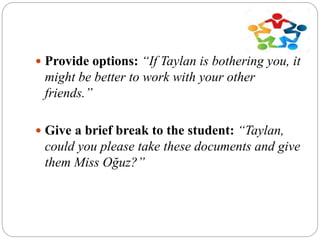
 Identify the feelings: “It sounds like you’re
frustrated with how difficult the work is.”
 Send an I message: “Katja, I expect all students to
treat classmates respectfully.”
 Offer assistance: “It looks like I didn’t explain that so
you could understand. Would you like me to go over
that again?”
 Provide options: “If Taylan is bothering you, it
might be better to work with your other
friends.”
 Give a brief break to the student: “Taylan,
could you please take these documents and give
them Miss Oğuz?”
Handling Violent Student
Behavior
 Some news about violence
http://www.memurlar.net/haber/468557/
http://www.dailymail.co.uk/indiahome/indianews/
article-2104039/The-stabbing-class-9-teacher-
student-shocked-nation-revealed-anger-outbursts-
increase-pupils-school.html
How to handle violence?
 Make a firm but polite statement:
“I know you two are angry but we use other
ways to solve problems in this school.”
 Be calm and do not be aggressive.
 Lower your voice
 Slow your rate of speech
 Try to make the student calm as well.
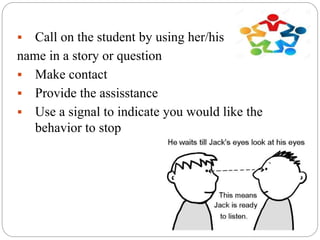
 Call on the student by using her/his
name in a story or question
 Make contact
 Provide the assisstance
 Use a signal to indicate you would like the
behavior to stop
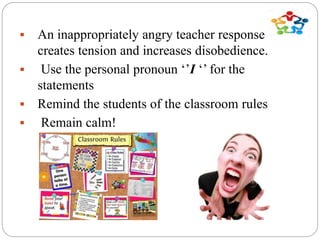
 An inappropriately angry teacher response
creates tension and increases disobedience.
 Use the personal pronoun ‘’I ‘’ for the
statements
 Remind the students of the classroom rules
 Remain calm!
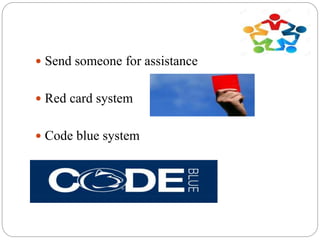
 Send someone for assistance
 Red card system
 Code blue system
Using time-out
 “The removal of reinforcement that may be
contributing to the inappropriate behavior”
 Why controversial?
Because ıt isolates the student but not solving the
problem.
Instead of “time out”;
RESOLUTION- PROBLEM SOLVING TIME
References
İmece Circles by Dr. Hayal Köksal
Jones, V. F. & Jones, L. S.(2007). Comprehensive Classroom Management: Creating communities of
support and solving problems, 8th edition. Boston: Pearson/Allyn & Bacon.
http://artelista.s3.amazonaws.com/obras/big/7/2/3/7641462980017561.jpg
http://img.haberler.com/manset/5/ogretmenden-ogrencilere-gorulmemis-ceza_x_7374051_52.jpg
http://nuhveli.blogcu.com/kirmizi-kart/4157145
http://st.depositphotos.com/3332767/4585/i/450/depositphotos_45856733-Angry-teacher-yelling-at-
student.jpg
http://vidyomani.tv/kiz-ogrenciye-yumruk-atan-ogretmen
http://www.dailymail.co.uk/indiahome/indianews/article-2104039/The-stabbing-class-9-teacher-student-
shocked-nation-revealed-anger-outbursts-increase-pupils-school.html
http://www.gopsusports.com/studentcentral/code-blue.html
http://www.kentonline.co.uk/faversham/news/are-you-gay-then-die-46361/
http://www.memurlar.net/haber/468557/
http://www.news.cornell.edu/stories/2013/04/classes-use-energy-dashboard-study-conservation
http://tr.123rf.com/photo_27041266_young-teacher-shouting-through-megaphone-on-university-students-
in-classroom.html
http://tr.123rf.com/photo_27041266_young-teacher-shouting-through-megaphone-on-university-students-
in-classroom.html
https://yazkurtulyapkurtul.wordpress.com/page/68/
Jones & Jones (2007)
Special thanks to Dr. Hayal Köksal!

2016 leading seagulls 8 huggers

  • 1.
    Jones & Jones(2007) RESPONDING TO BEHAVIOR THAT DISRUPTS THE LEARNING PROCESS
  • 2.
    CONTENT Jones & Jones(2007)  Who are we?  Gantt cart  Matrix Diagram  The problem  Literature Review  Fishbone  Survey  Ideas&Strategies  References
  • 3.
    Who Are We? Jones& Jones (2007) •Gizem ALTINTAÇ •Özge HAVANCI •Saime KARA •Bahar Cemre KARAAĞAÇLI •Seyit Ali ÖZDİL Motto: HUG THEM ALL
  • 4.
    Gannt Card Jones &Jones (2007) Expected Observed Nov, 11 Nov, 13 Nov, 15 Nov, 16 Nov, 17 Nov, 18
  • 5.
  • 6.
    Problem Jones & Jones(2007)  Some students show violent behaviours in the classroom.
  • 7.
    Jones & Jones(2007) LITERATURE REVIEW -The typical prekindergarten classroom has an average of three students who display disruptive behavior (Gordon, Henry, Mashburn, & Ponder, 2001). -Between 10 percent and 20 percent of students have behavior problems that require structured interventions (Sugai, Horner, Lewis & Cheney, 2002). - African American students are much more likely to receive harsher punishment in response to rule violations than are other students (Skiba, Michael, Nardo, and Peterson, 2002)
  • 8.
    Jones & Jones(2007)  The relationship-based discipline involving greater use of nonembarrassing cues and discussions with with students was associated with more responsible student behavior. Lewis (2001).  public reprimands, being asked to leave the class, and group consequences for the misbehavior of one or a few students, are perceived unacceptible and ineffective (Hoy&Weinstein, 2006 )
  • 9.
    FISHBONE Jones & Jones(2007) Student- related reasons Teacher-related reasons Peer-related reasons Family-related reasons Authoritarian Approach Lack of experience Unmotivated Teachers Psychological Needs Behavioral Disorders Lack of Concentratio n Isolation Lack of interaction Ignorant Parents Separate Parents Lack of support from families Why do some students display violent behaviors?
  • 10.
    SURVEY Jones & Jones(2007) 1. On average, how many students might show violent behaviours in your classrooms? A) Very few B) Few C)Half of the class D)Most of them
  • 11.
    Jones & Jones(2007) A B C D PRESERVICE TEACHERS IN PRACTICUM IN SERVICE TEACHERS A B C D
  • 12.
    Jones & Jones(2007) 2. How can you detect violent behaviours in the classroom? A) When this student disrupts other students B) When this student disrupts classroom environment C) When this student damages the classroom D) When this student display irresponsible and unresponsive behaviours
  • 13.
    Jones & Jones(2007) A B C D PRESERVICE TEACHERS IN PRACTICUM IN SERVICE TEACHERS A B C D
  • 14.
    Jones & Jones(2007) 3. How do you respond disruptive behaviour? A) Punishing students physically B) Punishing students verbally C) Talking to the student in person D) Doing collaboration with their peers
  • 15.
    Jones & Jones(2007) A B C D PRESERVICE TEACHERS IN PRACTICUM IN SERVICE TEACHERS A B C D
  • 16.
    Jones & Jones(2007) 4. What are the main reasons of violent behaviour in general? A) Student-related problems B) Family-related problems C) Teacher-related problems D) Peer-related problems
  • 17.
    Jones & Jones(2007) A B C D PRESERVICE TEACHERS IN PRACTICUM IN SERVICE TEACHERS A B C D
  • 18.
    Jones & Jones(2007) 5. Have you ever received help from someone to overcome such situation? A) Consulting parents B) Collaborating with consultants C) Collaborating with school administrations D) Collaborating with colleagues
  • 19.
    Jones & Jones(2007) PRESERVICE TEACHERS IN PRACTICUM A B C D IN SERVICE TEACHERS A B C D
  • 20.
    SOLUTIONS & STRATEGIES Ensurethat your requests have been made clearly, politely and firmly. “GET BACK TO YOUR SEAT KID, RIGHT NOW!” Polite way: “Jonas, please turn to your seat if you want to ask a question.” REMINDER-WARNING DIFFERENCE How different feelings do you have when you are reminded with a classroom rule or you are just warned about not doing that behavior?
  • 21.
     Identify thefeelings: “It sounds like you’re frustrated with how difficult the work is.”  Send an I message: “Katja, I expect all students to treat classmates respectfully.”  Offer assistance: “It looks like I didn’t explain that so you could understand. Would you like me to go over that again?”
  • 22.
     Provide options:“If Taylan is bothering you, it might be better to work with your other friends.”  Give a brief break to the student: “Taylan, could you please take these documents and give them Miss Oğuz?”
  • 23.
    Handling Violent Student Behavior Some news about violence http://www.memurlar.net/haber/468557/ http://www.dailymail.co.uk/indiahome/indianews/ article-2104039/The-stabbing-class-9-teacher- student-shocked-nation-revealed-anger-outbursts- increase-pupils-school.html
  • 24.
    How to handleviolence?  Make a firm but polite statement: “I know you two are angry but we use other ways to solve problems in this school.”  Be calm and do not be aggressive.  Lower your voice  Slow your rate of speech  Try to make the student calm as well.
  • 25.
     Call onthe student by using her/his name in a story or question  Make contact  Provide the assisstance  Use a signal to indicate you would like the behavior to stop
  • 26.
     An inappropriatelyangry teacher response creates tension and increases disobedience.  Use the personal pronoun ‘’I ‘’ for the statements  Remind the students of the classroom rules  Remain calm!
  • 27.
     Send someonefor assistance  Red card system  Code blue system
  • 28.
    Using time-out  “Theremoval of reinforcement that may be contributing to the inappropriate behavior”  Why controversial? Because ıt isolates the student but not solving the problem. Instead of “time out”; RESOLUTION- PROBLEM SOLVING TIME
  • 29.
    References İmece Circles byDr. Hayal Köksal Jones, V. F. & Jones, L. S.(2007). Comprehensive Classroom Management: Creating communities of support and solving problems, 8th edition. Boston: Pearson/Allyn & Bacon. http://artelista.s3.amazonaws.com/obras/big/7/2/3/7641462980017561.jpg http://img.haberler.com/manset/5/ogretmenden-ogrencilere-gorulmemis-ceza_x_7374051_52.jpg http://nuhveli.blogcu.com/kirmizi-kart/4157145 http://st.depositphotos.com/3332767/4585/i/450/depositphotos_45856733-Angry-teacher-yelling-at- student.jpg http://vidyomani.tv/kiz-ogrenciye-yumruk-atan-ogretmen http://www.dailymail.co.uk/indiahome/indianews/article-2104039/The-stabbing-class-9-teacher-student- shocked-nation-revealed-anger-outbursts-increase-pupils-school.html http://www.gopsusports.com/studentcentral/code-blue.html http://www.kentonline.co.uk/faversham/news/are-you-gay-then-die-46361/ http://www.memurlar.net/haber/468557/ http://www.news.cornell.edu/stories/2013/04/classes-use-energy-dashboard-study-conservation http://tr.123rf.com/photo_27041266_young-teacher-shouting-through-megaphone-on-university-students- in-classroom.html http://tr.123rf.com/photo_27041266_young-teacher-shouting-through-megaphone-on-university-students- in-classroom.html https://yazkurtulyapkurtul.wordpress.com/page/68/
  • 30.
    Jones & Jones(2007) Special thanks to Dr. Hayal Köksal!