
Developing Effective Behaviour and
Classroom Management Strategies

Monday 24th April

B.Heath

I saw the angel in the marble and
carved until I set him free.

Michelangelo
Developing Effective Behaviour
and Classroom Management
Strategies
Aims:
What is good classroom management?
What do teachers use that already works?
How do I get ‘difficult’ students to behave?
How do I get students to produce better quality work?
Why don’t students do as I say?
What practical strategies can I use tomorrow in my lessons that will work?
A Definition of Classroom
Management
Classroom management is a method by which
a teacher creates a positive and productive
learning environment for his or her students
by preventing and effectively dealing with
inappropriate behaviour.
I believe the teacher has the ability to create
the learning environment they want if they
use the right strategies.
Be Positive: Reflection on the times article
(starter)
Research has shown that children receive 10 negative comments
to every positive one
Give positive attention
Some students are so starved for attention they
don’t care what kind of behaviour they display
It is easier and more dependable to get
attention from negative behaviour
Which students get most of your
attention in your lessons?
Practical Strategy: Turn negatives into positives
(avoid questions, confrontations and manage conflict)
“Why are you late?”
Harry, that’s not normally like you to be late, your normally on time? I’d like you
to make every effort to get here earlier next week, as I don’t want you to
miss out on any aspects of the lesson.
“Why aren’t you working?”
Billy, I was really impressed with your homework
last week. I’d like you to focus on what you are
doing as I’m sure you can reproduce that
standard in lesson time.
“Will you stop talking?”
Fred, I spoke to your Mum last week and mentioned
how pleased I was with your improved attitude in class,
now don’t let me down by chatting.
Classroom Management
How should you organise the classroom?
How do you prepare a lesson to maintain good
classroom management?
How can you improve the relationship
between you and your students?
How do you actually teach?
The classroom
Classroom environment and temperature
Seating arrangements and seating plans
Physical layout
ICT
Litter
Sitting up, space to work, bags, dress code
Chewing gum
School Expectations
Appropriate displays (students work)
Lesson preparation and
structure
You have to be organised and ready to teach
Start of the lesson: can you arrive before the bell?
Starter activity: (if behaviour is a problem avoid getting students to stand)
Matching the content to the ability of the students: challenge, variety, pace,
enthuse
Avoid too many transitions
Register when students are on task (in the middle of the lesson)
Homework: set and collect in the middle of the lesson (combine 2 homeworks
where possible)
Use AfL and give appropriate marking and feedback
End of lesson (timing) Do not keep the whole class back
Students
Know your students
–
–
–
–

Names
Strengths and weaknesses
Interests
Needs

Differentiate instructions and time to act

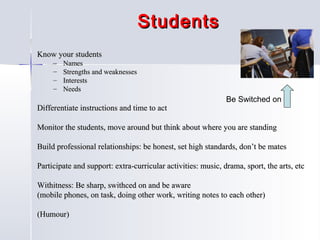
Be Switched on

Monitor the students, move around but think about where you are standing
Build professional relationships: be honest, set high standards, don’t be mates
Participate and support: extra-curricular activities: music, drama, sport, the arts, etc
Withitness: Be sharp, swithced on and be aware
(mobile phones, on task, doing other work, writing notes to each other)
(Humour)
Why students don’t do what you want them to
1.
2.
3.
4.
5.
6.
7.

They don’t know what to do.
They don’t know how to do it.
They don’t know why they should do it.
They aren’t suited or matched to the task.
There isn’t any consequence.
There isn’t any relevant feedback.
They get more attention by not doing it.
What do good motivators do?
1. Use novelty, mystery, puzzlement, and excitement to energise
their lessons.
2. Use colour, sound, movement, and student activity to attract and
hold attention.
3. Assign individual and group projects as a means of adding sense
of purpose to what is being learned.
4. State clear, reasonable expectations and requirements to avoid
confusion and enlist student cooperation.
5. Challenge and set high expectations
What good motivators don’t do
1. They don’t bore students with endless talking/instructions
2. They don’t confuse their students.
3. They don’t vacillate. (let mood affect how they treat them.)
4. They don’t frustrate their students.
5. They don’t intimidate their students.
6. They do not punish their students for failures or shortcomings.
7. They don’t use sarcasm, or put people down.
Practical Strategies
Sanctions at DGS
1. Speak clearly, quietly and calmly, have belief in what you are asking and
be almost perplexed at the thought the student may refuse to do what
you ask. Demand and set high standards for everything: Dress,
puntuality, politeness. Avoid confrontation, manage conflict.
2. Speak 1:1 (if possible – lesson content) always try to start the sanction
with a positive
3. Speak very clearly again stating fact: I have now spoken to you three
times. I’ve stated clearly what behaviour I expect. If I have to speak to
you again, you’ll need to see me after the lesson. (do not shout or even
raise voice)
4. That will be 5 mins off your break time.
5. This is not a discussion, or open to debate (if they answer back).
Practical Strategies
6. Hopefully student displays appropriate behaviour – speak to them and be
positive. Explain that the 5 mins can disappear if he/she continues to
show the correct behaviour. (equally state that the time can increase if
they continue to talk etc)
7. Take it up to 10 mins if necessary (extra work)- use HW diary
8. Hand out lunch time detention (15 – 30 mins)
9. Continual inappropriate behaviour – state that you will refer them for an
after school detention
10. Completely inappropriate behaviour (eg. Fighting, swearing at you) send
to reception
What helps: Contact immediately with parent by phone (I have just taught
Jimmy, and is behaviour was really disappointing. Is everything okay at
home, because he isn’t normally like this……)
Contact with form tutor. But try to deal with relatively minor issues yourself,
otherwise the student will pick up on you passing over control
Activity 1
Do you have an incident or a situation
they feel they dealt with very
effectively?
Do you have an incident or a situation
they feel they did not deal with
effectively?
Activity 2
Students in a class are repeatedly
talking when the class teacher is talking.
What do you do to eliminate this?
Activity 3
A pupil takes a long time to get on with
his/her work each lesson.
What do you do?
Activity 4
A student does not do as you ask.
What is your response?
Activity 5
A student has not produced homework
on two successive occasions.
What action do you take?
Activity 6
You are taking a new class for the first
time.
What are you going to do to ensure this
and future lessons are successful?
Activity 7
You are taking a cover lesson.
What are you going to do to ensure you
establish a positive learning
environment?
Activity 8
You are taking a lesson where you have
had trouble before with a particular
student.
What can you do to avoid a repeat
situation?
Activity 9
A class enter the classroom in a
boisterous manner.
What do you do?
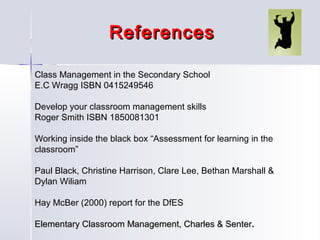
References
Class Management in the Secondary School
E.C Wragg ISBN 0415249546
Develop your classroom management skills
Roger Smith ISBN 1850081301
Working inside the black box “Assessment for learning in the
classroom”
Paul Black, Christine Harrison, Clare Lee, Bethan Marshall &
Dylan Wiliam
Hay McBer (2000) report for the DfES
Elementary Classroom Management, Charles & Senter.

Bh classroom management_13.3.06

  • 1.
    Developing Effective Behaviourand Classroom Management Strategies Monday 24th April B.Heath I saw the angel in the marble and carved until I set him free. Michelangelo
  • 2.
    Developing Effective Behaviour andClassroom Management Strategies Aims: What is good classroom management? What do teachers use that already works? How do I get ‘difficult’ students to behave? How do I get students to produce better quality work? Why don’t students do as I say? What practical strategies can I use tomorrow in my lessons that will work?
  • 3.
    A Definition ofClassroom Management Classroom management is a method by which a teacher creates a positive and productive learning environment for his or her students by preventing and effectively dealing with inappropriate behaviour. I believe the teacher has the ability to create the learning environment they want if they use the right strategies.
  • 4.
    Be Positive: Reflectionon the times article (starter) Research has shown that children receive 10 negative comments to every positive one Give positive attention Some students are so starved for attention they don’t care what kind of behaviour they display It is easier and more dependable to get attention from negative behaviour Which students get most of your attention in your lessons?
  • 5.
    Practical Strategy: Turnnegatives into positives (avoid questions, confrontations and manage conflict) “Why are you late?” Harry, that’s not normally like you to be late, your normally on time? I’d like you to make every effort to get here earlier next week, as I don’t want you to miss out on any aspects of the lesson. “Why aren’t you working?” Billy, I was really impressed with your homework last week. I’d like you to focus on what you are doing as I’m sure you can reproduce that standard in lesson time. “Will you stop talking?” Fred, I spoke to your Mum last week and mentioned how pleased I was with your improved attitude in class, now don’t let me down by chatting.
  • 6.
    Classroom Management How shouldyou organise the classroom? How do you prepare a lesson to maintain good classroom management? How can you improve the relationship between you and your students? How do you actually teach?
  • 7.
    The classroom Classroom environmentand temperature Seating arrangements and seating plans Physical layout ICT Litter Sitting up, space to work, bags, dress code Chewing gum School Expectations Appropriate displays (students work)
  • 8.
    Lesson preparation and structure Youhave to be organised and ready to teach Start of the lesson: can you arrive before the bell? Starter activity: (if behaviour is a problem avoid getting students to stand) Matching the content to the ability of the students: challenge, variety, pace, enthuse Avoid too many transitions Register when students are on task (in the middle of the lesson) Homework: set and collect in the middle of the lesson (combine 2 homeworks where possible) Use AfL and give appropriate marking and feedback End of lesson (timing) Do not keep the whole class back
  • 9.
    Students Know your students – – – – Names Strengthsand weaknesses Interests Needs Differentiate instructions and time to act Be Switched on Monitor the students, move around but think about where you are standing Build professional relationships: be honest, set high standards, don’t be mates Participate and support: extra-curricular activities: music, drama, sport, the arts, etc Withitness: Be sharp, swithced on and be aware (mobile phones, on task, doing other work, writing notes to each other) (Humour)
  • 10.
    Why students don’tdo what you want them to 1. 2. 3. 4. 5. 6. 7. They don’t know what to do. They don’t know how to do it. They don’t know why they should do it. They aren’t suited or matched to the task. There isn’t any consequence. There isn’t any relevant feedback. They get more attention by not doing it.
  • 11.
    What do goodmotivators do? 1. Use novelty, mystery, puzzlement, and excitement to energise their lessons. 2. Use colour, sound, movement, and student activity to attract and hold attention. 3. Assign individual and group projects as a means of adding sense of purpose to what is being learned. 4. State clear, reasonable expectations and requirements to avoid confusion and enlist student cooperation. 5. Challenge and set high expectations
  • 12.
    What good motivatorsdon’t do 1. They don’t bore students with endless talking/instructions 2. They don’t confuse their students. 3. They don’t vacillate. (let mood affect how they treat them.) 4. They don’t frustrate their students. 5. They don’t intimidate their students. 6. They do not punish their students for failures or shortcomings. 7. They don’t use sarcasm, or put people down.
  • 13.
    Practical Strategies Sanctions atDGS 1. Speak clearly, quietly and calmly, have belief in what you are asking and be almost perplexed at the thought the student may refuse to do what you ask. Demand and set high standards for everything: Dress, puntuality, politeness. Avoid confrontation, manage conflict. 2. Speak 1:1 (if possible – lesson content) always try to start the sanction with a positive 3. Speak very clearly again stating fact: I have now spoken to you three times. I’ve stated clearly what behaviour I expect. If I have to speak to you again, you’ll need to see me after the lesson. (do not shout or even raise voice) 4. That will be 5 mins off your break time. 5. This is not a discussion, or open to debate (if they answer back).
  • 14.
    Practical Strategies 6. Hopefullystudent displays appropriate behaviour – speak to them and be positive. Explain that the 5 mins can disappear if he/she continues to show the correct behaviour. (equally state that the time can increase if they continue to talk etc) 7. Take it up to 10 mins if necessary (extra work)- use HW diary 8. Hand out lunch time detention (15 – 30 mins) 9. Continual inappropriate behaviour – state that you will refer them for an after school detention 10. Completely inappropriate behaviour (eg. Fighting, swearing at you) send to reception What helps: Contact immediately with parent by phone (I have just taught Jimmy, and is behaviour was really disappointing. Is everything okay at home, because he isn’t normally like this……) Contact with form tutor. But try to deal with relatively minor issues yourself, otherwise the student will pick up on you passing over control
  • 15.
    Activity 1 Do youhave an incident or a situation they feel they dealt with very effectively? Do you have an incident or a situation they feel they did not deal with effectively?
  • 16.
    Activity 2 Students ina class are repeatedly talking when the class teacher is talking. What do you do to eliminate this?
  • 17.
    Activity 3 A pupiltakes a long time to get on with his/her work each lesson. What do you do?
  • 18.
    Activity 4 A studentdoes not do as you ask. What is your response?
  • 19.
    Activity 5 A studenthas not produced homework on two successive occasions. What action do you take?
  • 20.
    Activity 6 You aretaking a new class for the first time. What are you going to do to ensure this and future lessons are successful?
  • 21.
    Activity 7 You aretaking a cover lesson. What are you going to do to ensure you establish a positive learning environment?
  • 22.
    Activity 8 You aretaking a lesson where you have had trouble before with a particular student. What can you do to avoid a repeat situation?
  • 23.
    Activity 9 A classenter the classroom in a boisterous manner. What do you do?
  • 24.
    References Class Management inthe Secondary School E.C Wragg ISBN 0415249546 Develop your classroom management skills Roger Smith ISBN 1850081301 Working inside the black box “Assessment for learning in the classroom” Paul Black, Christine Harrison, Clare Lee, Bethan Marshall & Dylan Wiliam Hay McBer (2000) report for the DfES Elementary Classroom Management, Charles & Senter.

Editor's Notes