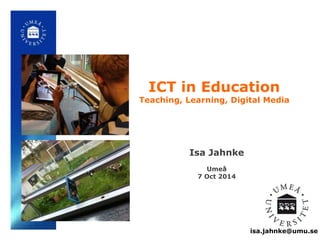
ICT in Education 
Teaching, Learning, Digital Media 
isa.jahnke@umu.se 
Isa Jahnke 
Umeå 
7 Oct 2014
isa.jahnke@umu.se 
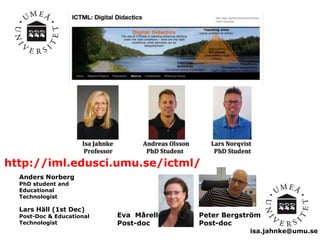
http://iml.edusci.umu.se/ictml/ 
Eva Mårell 
Post-doc 
Peter Bergström 
Post-doc 
Anders Norberg 
PhD student and 
Educational 
Technologist 
Lars Häll (1st Dec) 
Post-Doc & Educational 
Technologist
Twitter @isaja 
isa.jahnke@umu.se 
Road map for today 
Part 1 – Introduction 
Part 2 – Theoretical understandings 
Part 3 – Technological background and trends 
Part 4 – Examples from studies 
Learning Intentions 
• An overview 
• Inspiration 
• and “a wonderful confusion” (Karin Sporre)
Do we really need more 
research on digital media and 
learning? Why? 
Is there actually a problem? 
isa.jahnke@umu.se
isa.jahnke@umu.se 
TodaysMeet 
https://todaysmeet.com/isaja
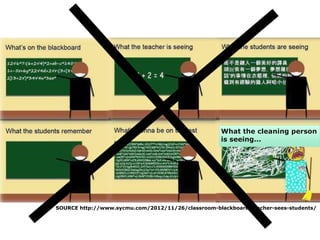
What the cleaning person 
is seeing... 
SOURCE http://www.sycmu.com/2012/11/26/classroom-blackboard-teacher-sees-students/
isa.jahnke@umu.se 
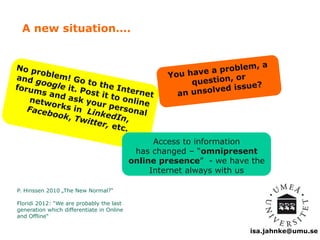
A new situation…. 
P. Hinssen 2010 „The New Normal?“ 
Floridi 2012: “We are probably the last 
generation which differentiate in Online 
and Offline“ 
Access to information 
has changed – “omnipresent 
online presence” - we have the 
Internet always with us
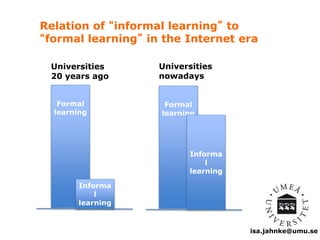
Relation of “informal learning” to 
“formal learning” in the Internet era 
isa.jahnke@umu.se 
Formal 
learning 
Informa 
l 
learning 
Formal 
learning 
Informa 
l 
learning 
Universities 
20 years ago 
Universities 
nowadays
isa.jahnke@umu.se 
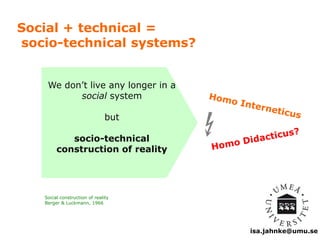
Social + technical = 
socio-technical systems? 
We don’t live any longer in a 
social system 
but 
socio-technical 
construction of reality 
Social construction of reality 
Berger & Luckmann, 1966
Vygotsky 1978 
Zone of Proximal Development 
isa.jahnke@umu.se 
Designing for teaching and learning 
in order to enable 
deeper learning 
more than 
surface learning 
- beyond surface levels 
Jahnke & Liebscher, 2013 
International Journal ELiSS
Jahnke et al. 
2010 
isa.jahnke@umu.se 
Assumption 
Designing for teaching and learning 
needs a „constructive alingment“ 
of different elements 
A sociotechnical-didactical (educational- 
)Design*** 
“Constructive alignment” 
Biggs, 1999 & 
Biggs & Tang, 2007
isa.jahnke@umu.se 
A new “design thinking”? 
Rethinking designs for 
technology-enhanced learning environments
Jahnke, Terkowsky, 
Pleul, & Tekkaya, 2010, 
DeLFI 
isa.jahnke@umu.se 
Research question 
What digital didactical designs do universities apply 
in order to support deeper learning („conceptual 
change“)? 
• Which elements are designable, which are not (social 
processes, didactical concepts, techn. systems), how? 
• What kind of quality of learning is addressed? 
• What are process-based, formative forms of assessment 
& feedback? 
Kember, 1997 
Burzan & Jahnke, 2011
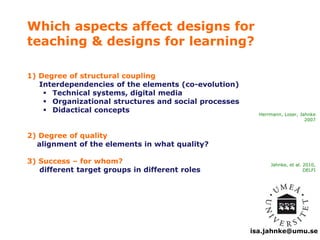
Which aspects affect designs for 
teaching & designs for learning? 
Herrmann, Loser, Jahnke 
2007 
isa.jahnke@umu.se 
1) Degree of structural coupling 
Interdependencies of the elements (co-evolution) 
 Technical systems, digital media 
 Organizational structures and social processes 
 Didactical concepts 
2) Degree of quality 
alignment of the elements in what quality? 
3) Success – for whom? 
different target groups in different roles 
Jahnke, et al. 2010, 
DELFI
isa.jahnke@umu.se 
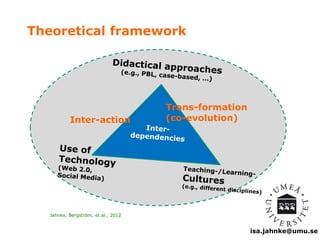
Theoretical framework 
Inter-action 
Trans-formation 
(co-evolution) 
Jahnke, Bergström, et al., 2012
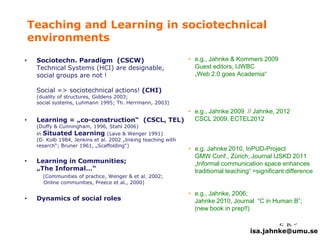
Teaching and Learning in sociotechnical 
environments 
isa.jahnke@umu.se 
• Sociotechn. Paradigm (CSCW) 
Technical Systems (HCI) are designable, 
social groups are not ! 
Social => sociotechnical actions! (CHI) 
(duality of structures, Giddens 2003; 
social systems, Luhmann 1995; Th. Herrmann, 2003) 
• Learning = „co-construction“ (CSCL, TEL) 
(Duffy & Cunningham, 1996, Stahl 2006) 
in Situated Learning (Lave & Wenger 1991) 
(D. Kolb 1984, Jenkins et al. 2002 „linking teaching with 
resarch“; Bruner 1961, „Scaffolding“) 
• Learning in Communities; 
„The Informal…“ 
(Communities of practice, Wenger & et al. 2002; 
Online communities, Preece et al., 2000) 
• Dynamics of social roles 
• e.g., Jahnke & Kommers 2009 
Guest editors, IJWBC 
„Web 2.0 goes Academia“ 
• e.g., Jahnke 2009 // Jahnke, 2012 
CSCL 2009, ECTEL2012 
• e.g. Jahnke 2010, InPUD-Project 
GMW Conf., Zürich; Journal IJSKD 2011 
„Informal communication space enhances 
traditiomal teaching“ =significant difference 
• e.g., Jahnke, 2006; 
Jahnke 2010, Journal “C in Human B”; 
(new book in prep!!)
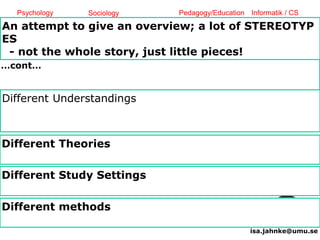
An attempt to give an overview; a lot of STEREOTYP 
ES 
- not the whole story, just little pieces! 
isa.jahnke@umu.se 
…cont… 
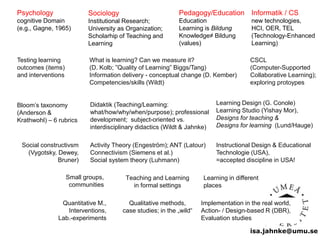
Different Understandings 
Different Theories 
Different Study Settings 
Quantitative M., 
Interventions, 
Lab.-experiments 
Implementation in the real world, 
Action- / Design-based R (DBR), 
Evaluation studies 
Qualitative methods, 
case studies; in the „wild“ 
Psychology 
cognitive Domain 
(e.g., Gagne, 1965) 
Pedagogy/Education 
Education 
Learning is Bildung 
Knowledge≠ Bildung 
(values) 
Sociology 
Institutional Research; 
University as Organization; 
Scholarhip of Teaching and 
Learning 
Informatik / CS 
new technologies, 
HCI, OER, TEL 
(Technology-Enhanced 
Learning) 
Testing learning 
outcomes (items) 
and interventions 
CSCL 
(Computer-Supported 
Collaborative Learning); 
exploring protoypes 
What is learning? Can we measure it? 
(D. Kolb; ”Quality of Learning” Biggs/Tang) 
Information delivery - conceptual change (D. Kember) 
Competencies/skills (Wildt) 
Bloom’s taxonomy 
(Anderson & 
Krathwohl) – 6 rubrics 
Didaktik (Teaching/Learning: 
what/how/why/when/purpose); professional 
development; subject-oriented vs. 
interdisciplinary didactics (Wildt & Jahnke) 
Learning Design (G. Conole) 
Learning Studio (Yishay Mor), 
Designs for teaching & 
Designs for learning (Lund/Hauge) 
Teaching and Learning 
in formal settings 
Small groups, 
communities 
Learning in different 
places 
Social constructivsm 
(Vygotsky, Dewey, 
Bruner) 
Instructional Design & Educational 
Technologie (USA), 
=accepted discipline in USA! 
Activity Theory (Engeström); ANT (Latour) 
Connectivism (Siemens et al.) 
Social system theory (Luhmann) 
Different methods
isa.jahnke@umu.se 
Quantitative M., 
Interventions, 
Lab.-experiments 
Implementation in the real world, 
Action- / Design-based R (DBR), 
Evaluation studies 
Qualitative methods, 
case studies; in the „wild“ 
Psychology 
cognitive Domain 
(e.g., Gagne, 1965) 
Pedagogy/Education 
Education 
Learning is Bildung 
Knowledge≠ Bildung 
(values) 
Sociology 
Institutional Research; 
University as Organization; 
Scholarhip of Teaching and 
Learning 
Informatik / CS 
new technologies, 
HCI, OER, TEL 
(Technology-Enhanced 
Learning) 
Testing learning 
outcomes (items) 
and interventions 
CSCL 
(Computer-Supported 
Collaborative Learning); 
exploring protoypes 
What is learning? Can we measure it? 
(D. Kolb; ”Quality of Learning” Biggs/Tang) 
Information delivery - conceptual change (D. Kember) 
Competencies/skills (Wildt) 
Bloom’s taxonomy 
(Anderson & 
Krathwohl) – 6 rubrics 
Didaktik (Teaching/Learning: 
what/how/why/when/purpose); professional 
development; subject-oriented vs. 
interdisciplinary didactics (Wildt & Jahnke) 
Learning Design (G. Conole) 
Learning Studio (Yishay Mor), 
Designs for teaching & 
Designs for learning (Lund/Hauge) 
Teaching and Learning 
in formal settings 
Small groups, 
communities 
Learning in different 
places 
Social constructivsm 
(Vygotsky, Dewey, 
Bruner) 
Instructional Design & Educational 
Technologie (USA), 
=accepted discipline in USA! 
Activity Theory (Engeström); ANT (Latour) 
Connectivism (Siemens et al.) 
Social system theory (Luhmann)
Ho-listic-TEL map 
learning theories in an overview 
(not all but many) 
• http://blog.richardmillwood.ne 
t/2013/05/10/learning-theory/ 
isa.jahnke@umu.se
isa.jahnke@umu.se 
Poll every where . com 
https://www.polleverywhere.com/isaja
isa.jahnke@umu.se 
Some technological trends 
and more
isa.jahnke@umu.se 
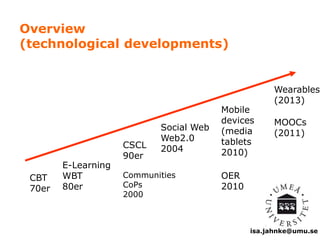
Overview 
(technological developments) 
E-Learning 
WBT 
80er 
CSCL 
90er 
OER 
2010 
CBT 
70er 
Wearables 
(2013) 
Mobile 
devices 
(media 
tablets 
2010) 
Social Web 
Web2.0 
2004 
Communities 
CoPs 
2000 
MOOCs 
(2011)
isa.jahnke@umu.se 
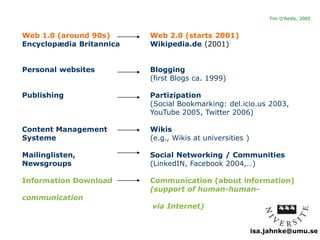
Web 1.0 (around 90s) Web 2.0 (starts 2001) 
Encyclopædia Britannica Wikipedia.de (2001) 
Personal websites Blogging 
(first Blogs ca. 1999) 
Publishing Partizipation 
(Social Bookmarking: del.icio.us 2003, 
YouTube 2005, Twitter 2006) 
Content Management Wikis 
Systeme (e.g., Wikis at universities ) 
Mailinglisten, Social Networking / Communities 
Newsgroups (LinkedIN, Facebook 2004,…) 
Information Download Communication (about information) 
(support of human-human-communication 
via Internet) 
Tim O'Reilly, 2005
Characteristics of Web 2.0, Social Media and Co. 
e.g., Jahnke & Koch, 2009 
isa.jahnke@umu.se 
Beliefs 
 Partizipation 
 „Architecture of Participation“ 
 „Everyone can be a publisher“ 
 “Wisdom of the Crowds” 
 Software systems that support 
 human collaboration 
 finding other people – building of social relations and 
networks 
 Me-Centricity, Human interaction via human-computer-interaction (HCI; CHI) 
 Easy to use, Interactive systems 
 Fun and Flow experience 
 Degree of freedom to act: informal [less rules, only few roles, no standardized 
behavior, still not formal – but on the way to become more formal]
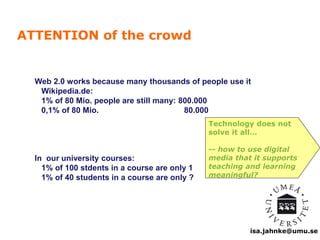
Web 2.0 works because many thousands of people use it 
Wikipedia.de: 
1% of 80 Mio. people are still many: 800.000 
0,1% of 80 Mio. 80.000 
isa.jahnke@umu.se 
In our university courses: 
1% of 100 stdents in a course are only 1 
1% of 40 students in a course are only ? 
Technology does not 
solve it all… 
-- how to use digital 
media that it supports 
teaching and learning 
meaningful? 
ATTENTION of the crowd
isa.jahnke@umu.se 
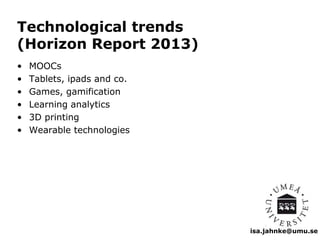
Technological trends 
(Horizon Report 2013) 
• MOOCs 
• Tablets, ipads and co. 
• Games, gamification 
• Learning analytics 
• 3D printing 
• Wearable technologies
isa.jahnke@umu.se 
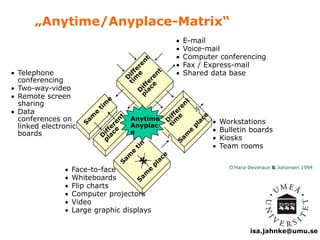
„Anytime/Anyplace-Matrix“ 
 Telephone 
conferencing 
 Two-way-video 
 Remote screen 
sharing 
 Data 
conferences on 
linked electronic 
boards 
 E-mail 
 Voice-mail 
 Computer conferencing 
 Fax / Express-mail 
 Shared data base 
 Workstations 
 Bulletin boards 
 Kiosks 
 Team rooms 
Anytime 
Anyplac 
e 
 Face-to-face 
 Whiteboards 
 Flip charts 
 Computer projectors 
 Video 
 Large graphic displays 
O’Hara-Deveraux & Johansen 1994
isa.jahnke@umu.se 
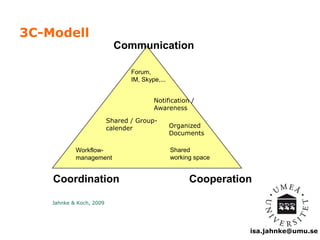
3C-Modell 
Communication 
Forum, 
IM, Skype,... 
Notification / 
Awareness 
Organized 
Documents 
Shared 
working space 
Workflow-management 
Shared / Group-calender 
Coordination Cooperation 
Jahnke & Koch, 2009
Mind-meister 
Communication 
(“express“) 
isa.jahnke@umu.se 
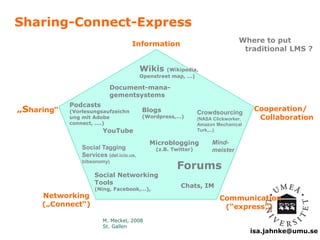
Sharing-Connect-Express 
Information 
Podcasts 
(Vorlesungsaufzeichn 
ung mit Adobe 
connect, ....) 
Networking 
(„Connect“) 
Cooperation/ 
Collaboration 
„Sharing“ 
Wikis (Wikipedia, 
Openstreet map, …) 
Blogs 
(Wordpress,…) 
Microblogging 
YouTube 
Social Tagging 
(z.B. Twitter) 
Services (del.icio.us, 
bibsonomy) Forums 
Where to put 
traditional LMS ? 
Social Networking 
Tools 
(Ning, Facebook,…), 
Crowdsourcing 
(NASA Clickworker, 
Amazon Mechanical 
Turk,...) 
Chats, IM 
Document-mana-gementsystems 
M. Meckel, 2008 
St. Gallen
McLuhan 1967 
“We shape our tools and then 
our tools shape us” 
isa.jahnke@umu.se
isa.jahnke@umu.se 
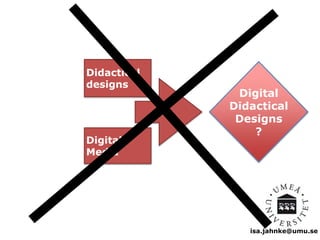
Didactical 
designs 
Digital 
Media 
Digital 
Didactical 
Designs 
?
• A process+time model (instead of focusing on places)? 
isa.jahnke@umu.se 
Alternative approaches? 
Isa Jahnke & Anders Norberg (2013). 
• Teachers as process designers? 
• … 
Digital Didactics - Scaffolding a new Normality of Learning. 
In: Visionary paper for 
http://blogs.ec.europa.eu/openeducation2030/ Online. 
Anders Norberg & Isa Jahnke (2014): 
Learning expeditions? 
Are you Working in the Kitchen? European Perspectives on Blended Learning. 
In: Charles Dziuban, Charles Graham, Anthony G. Picciano (Eds.), International 
Research Perspectives in Blended Learning (tentative title). Taylor and Francis.
isa.jahnke@umu.se 
An alternative perspective – 
ICT is more than just a tool 
The physical classroom and web-enabled mobile 
devices merge into multi co-located spaces – the 
expansion of communication spaces 
Co-located communication spaces
isa.jahnke@umu.se 
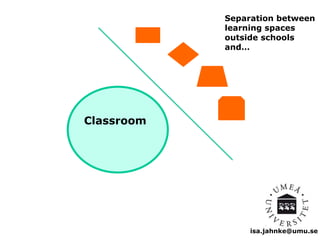
Classroom 
Separation between 
learning spaces 
outside schools 
and…
isa.jahnke@umu.se 
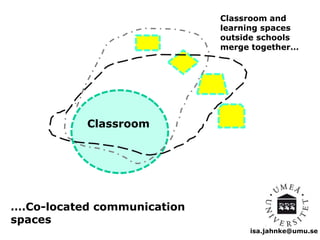
Classroom 
….Co-located communication 
spaces 
Classroom and 
learning spaces 
outside schools 
merge together…
isa.jahnke@umu.se 
Purpose 
In co-located communication spaces, 
we wanted to know, how the 
teachers design teaching-in-practice 
to enable student learning
isa.jahnke@umu.se 
Theoretical lens 
Design is the act of giving a form to the teaching 
practice; it is the act of modeling the teaching 
processes (sociotechnical-pedagogical) to enable 
student learning
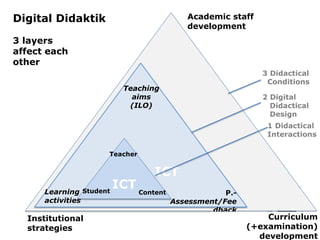
3 Didactical 
Conditions 
2 Digital 
Didactical 
Design 
isa.jahnke@umu.se 
Digital Didaktik 
3 layers 
affect each 
other 
Teaching 
ICT 
ICT 
ICT 
aims 
(ILO) 
Teacher 
ICT 
Student 
Content 
P.- 
Assessment/Fee 
dback 
Learning 
activities 
Academic staff 
development 
Curriculum 
(+examination) 
development 
Institutional 
strategies 
1 Didactical 
Interactions
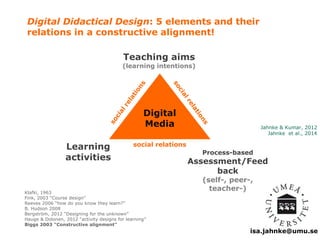
Digital Didactical Design: 5 elements and their 
relations in a constructive alignment! 
isa.jahnke@umu.se 
Teaching aims 
(learning intentions) 
Digital 
Media 
Learning 
activities 
Process-based 
Assessment/Feed 
back 
(self-, peer-, 
teacher-) 
social relations 
Jahnke & Kumar, 2012 
Jahnke et al., 2014 
Klafki, 1963 
Fink, 2003 “Course design” 
Reeves 2006 “how do you know they learn?” 
B. Hudson 2008 
Bergström, 2012 “Designing for the unknown” 
Hauge & Dolonen, 2012 “activity designs for learning” 
Biggs 2003 “Constructive alignment”
isa.jahnke@umu.se 
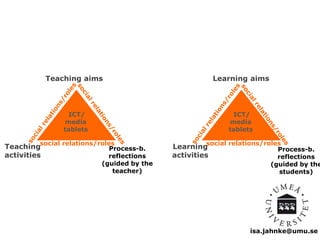
Teaching aims 
ICT/ 
media 
tablets 
Teaching 
activities 
Process-b. 
reflections 
(guided by the 
teacher) 
Learning aims 
ICT/ 
media 
tablets 
social relations/roles Learning 
activities 
Process-b. 
reflections 
(guided by the 
students) 
social relations/roles
TO 
enhanced 
by iPads 
social relations 
LA A-F 
isa.jahnke@umu.se 
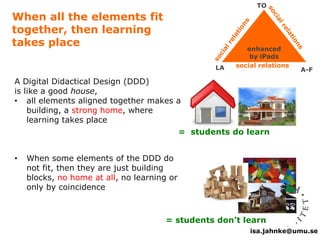
When all the elements fit 
together, then learning 
takes place 
A Digital Didactical Design (DDD) 
is like a good house, 
• all elements aligned together makes a 
building, a strong home, where 
learning takes place 
• When some elements of the DDD do 
not fit, then they are just building 
blocks, no home at all, no learning or 
only by coincidence 
= students do learn 
= students don’t learn
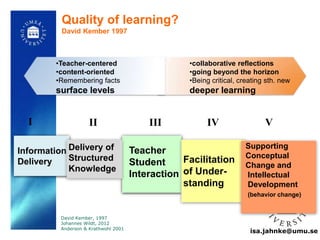
I II III IV V 
isa.jahnke@umu.se 
Information 
Delivery 
Delivery of 
Structured 
Knowledge 
David Kember, 1997 
Johannes Wildt, 2012 
Anderson & Krathwohl 2001 
Teacher 
Student 
Interaction 
Facilitation 
of Under-standing 
Supporting 
Conceptual 
Change and 
Intellectual 
Development 
(behavior change) 
Quality of learning? 
David Kember 1997 
•collaborative reflections 
•going beyond the horizon 
•Being critical, creating sth. new 
deeper learning 
•Teacher-centered 
•content-oriented 
•Remembering facts 
surface levels
isa.jahnke@umu.se 
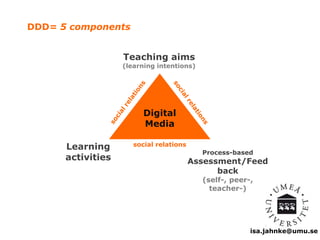
Teaching aims 
(learning intentions) 
Digital 
Media 
Learning 
activities 
Process-based 
Assessment/Feed 
back 
(self-, peer-, 
teacher-) 
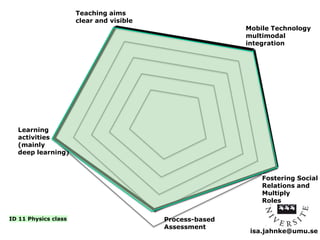
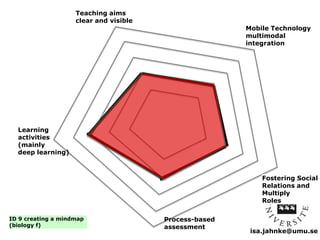
DDD= 5 components 
social relations
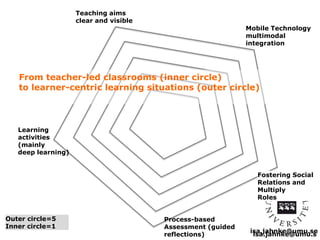
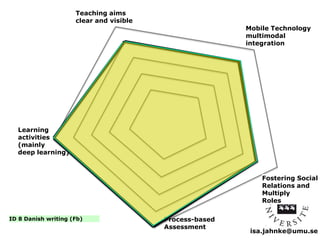
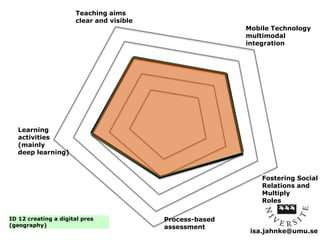
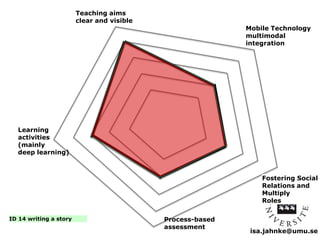
From teacher-led classrooms (inner circle) 
to learner-centric learning situations (outer circle) 
Fostering Social 
Relations and 
Multiply 
Roles 
isa.jahnke@umu.se 
Learning 
activities 
(mainly 
deep learning) 
Teaching aims 
clear and visible 
Outer circle=5 
Inner circle=1 
Mobile Technology 
multimodal 
integration 
isa.jahnke@umu.s 
e 
Process-based 
Assessment (guided 
reflections)
isa.jahnke@umu.se 
Learning 
activities 
(mainly 
deep learning) 
Process-based 
Assessment 
Mobile Technology 
multimodal 
integration 
Fostering Social 
Relations and 
Multiply 
Roles 
ID 11 Physics class 
Teaching aims 
clear and visible
isa.jahnke@umu.se 
Learning 
activities 
(mainly 
deep learning) 
ID 8 Danish writing (Fb) Process-based 
Assessment 
Teaching aims 
clear and visible 
Mobile Technology 
multimodal 
integration 
Fostering Social 
Relations and 
Multiply 
Roles
isa.jahnke@umu.se 
Process-based 
assessment 
Teaching aims 
clear and visible 
ID 12 creating a digital pres 
(geography) 
Mobile Technology 
multimodal 
integration 
Learning 
activities 
(mainly 
deep learning) 
Fostering Social 
Relations and 
Multiply 
Roles
isa.jahnke@umu.se 
Process-based 
assessment 
ID 14 writing a story 
Mobile Technology 
multimodal 
integration 
Teaching aims 
clear and visible 
Learning 
activities 
(mainly 
deep learning) 
Fostering Social 
Relations and 
Multiply 
Roles
isa.jahnke@umu.se 
Process-based 
assessment 
ID 9 creating a mindmap 
(biology f) 
Mobile Technology 
multimodal 
integration 
Teaching aims 
clear and visible 
Learning 
activities 
(mainly 
deep learning) 
Fostering Social 
Relations and 
Multiply 
Roles
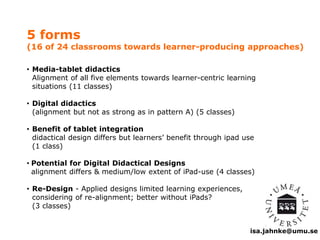
5 forms 
(16 of 24 classrooms towards learner-producing approaches) 
• Media-tablet didactics 
Alignment of all five elements towards learner-centric learning 
situations (11 classes) 
isa.jahnke@umu.se 
• Digital didactics 
(alignment but not as strong as in pattern A) (5 classes) 
• Benefit of tablet integration 
didactical design differs but learners’ benefit through ipad use 
(1 class) 
• Potential for Digital Didactical Designs 
alignment differs & medium/low extent of iPad-use (4 classes) 
• Re-Design - Applied designs limited learning experiences, 
considering of re-alignment; better without iPads? 
(3 classes)
isa.jahnke@umu.se 
Studies and examples
isa.jahnke@umu.se 
Research projects 
 Media tablets in Schools in Swedish schools 
(granted by VR.se) 2014-2016 
 Media tablets in Danish schools, 2012-2014 
 Media tablets in Preschool Teacher Education 
• DaVINCI, Creativity in Higher Education 
BMBF, 2008-2011 
• PeTEX, Remote Controlled Experiments in Engineering Education 
EU, 2008-2010 
• InPUD, Community Learning in Computer Science 
NRW, 2001-2004 & TUD 2005-2009 
Isa Jahnke, Lars 
Norqvist & Andreas 
Olsson, 2014
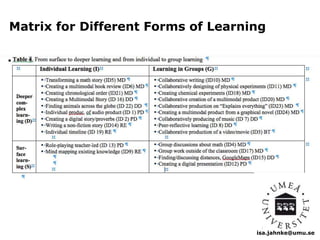
Matrix for Different Forms of Learning 
isa.jahnke@umu.se
isa.jahnke@umu.se 
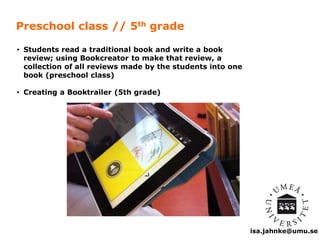
Preschool class // 5th grade 
• Students read a traditional book and write a book 
review; using Bookcreator to make that review, a 
collection of all reviews made by the students into one 
book (preschool class) 
• Creating a Booktrailer (5th grade)
isa.jahnke@umu.se 
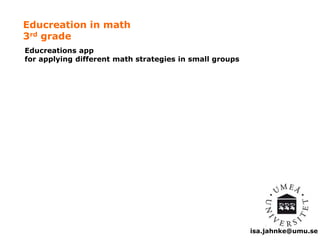
Educreation in math 
3rd grade 
Educreations app 
for applying different math strategies in small groups
isa.jahnke@umu.se 
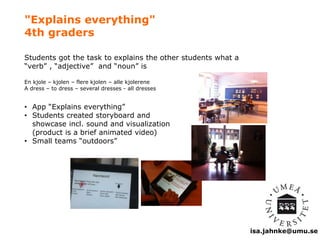
"Explains everything" 
4th graders 
Students got the task to explains the other students what a 
“verb” , “adjective” and “noun” is 
En kjole – kjolen – flere kjolen – alle kjolerene 
A dress – to dress – several dresses - all dresses 
• App “Explains everything” 
• Students created storyboard and 
showcase incl. sound and visualization 
(product is a brief animated video) 
• Small teams “outdoors”
isa.jahnke@umu.se 
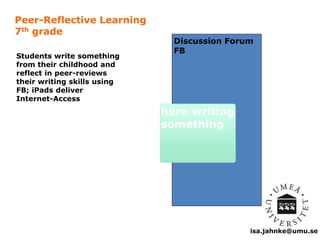
Peer-Reflective Learning 
7th grade 
Students write something 
from their childhood and 
reflect in peer-reviews 
their writing skills using 
FB; iPads deliver 
Internet-Access 
Discussion Forum 
FB 
here writing 
something
isa.jahnke@umu.se 
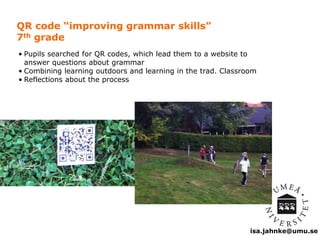
QR code “improving grammar skills” 
7th grade 
• Pupils searched for QR codes, which lead them to a website to 
answer questions about grammar 
• Combining learning outdoors and learning in the trad. Classroom 
• Reflections about the process
isa.jahnke@umu.se 
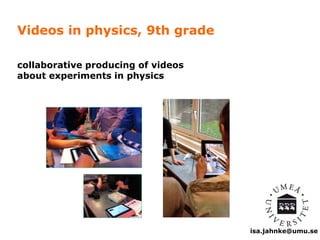
Videos in physics, 9th grade 
collaborative producing of videos 
about experiments in physics
Findings - A shift in teaching practices? 
isa.jahnke@umu.se 
Teachers' designs for learning… 
• Focus on action: Teachers activate the pupils' engagement through 
"producing" 
• Process-oriented learning 
• Information seeking in classrooms via online spaces => bringing the world into 
the schools 
• Connecting the learning process to a real audience 
• Different places 
• Designs for Learning: more than one answer/strategy is possible 
• Supporting learners to make learning processes visible: 
documenting the learning steps ("pupils express themselves in different ways") 
• choices of learning activities: "different ways are possible to build a product” 
• Different apps that are not built for education and combining traditional resources 
(books,pen, whiteboard...) and different apps
From traditional course-based learning 
to learning expeditions?! 
Learning expeditions stand for rather open-ended, problem-based 
learning paths which include aims-oriented learning to 
master X, or explore and understand the implications of N, in 
which the learning methods and instruments are very open, 
that take place in sociotechnical co-located communication 
spaces with reflecting peers where process-based assessment 
supports the learning progress. 
isa.isa.jahnke@jahnke@umu.se 
se 
Learning does take place in loops with back and 
forths; it is not a straight ahead way, rather it 
has detours
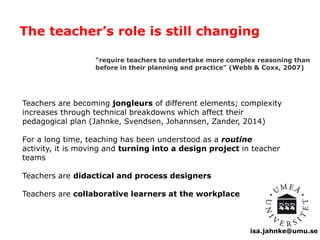
The teacher’s role is still changing 
"require teachers to undertake more complex reasoning than 
before in their planning and practice" (Webb & Coxx, 2007) 
Teachers are becoming jongleurs of different elements; complexity 
increases through technical breakdowns which affect their 
pedagogical plan (Jahnke, Svendsen, Johannsen, Zander, 2014) 
For a long time, teaching has been understood as a routine 
activity, it is moving and turning into a design project in teacher 
teams 
isa.jahnke@umu.se 
Teachers are didactical and process designers 
Teachers are collaborative learners at the workplace
isa.jahnke@umu.se 
Do we need a new teaching 
theory? 
Digital Didactical Designs as a new design for 
forming the sociotechnical-pedagogical teaching 
processes with the aim to enable quality learning
Thanks a lot! 
isa.jahnke@umu.se 
Professor Dr. Isa Jahnke 
Umeå University, Sweden 
Dep of Applied Educational Science 
ICT, media and learning (IML) 
isa.jahnke@.umu.se 
http://www.isa-jahnke.com (personal website) 
http://iml.edusci.umu.se/ictml/ (Team website) 
http://www.facebook.com/isajahnke 
Twitter isaja 
Publications 
online
isa.jahnke@umu.se 
http://iml.edusci.umu.se/ictml

2014-ICT-in-education

  • 1.
    ICT in Education Teaching, Learning, Digital Media isa.jahnke@umu.se Isa Jahnke Umeå 7 Oct 2014
  • 2.
    isa.jahnke@umu.se http://iml.edusci.umu.se/ictml/ EvaMårell Post-doc Peter Bergström Post-doc Anders Norberg PhD student and Educational Technologist Lars Häll (1st Dec) Post-Doc & Educational Technologist
  • 3.
    Twitter @isaja isa.jahnke@umu.se Road map for today Part 1 – Introduction Part 2 – Theoretical understandings Part 3 – Technological background and trends Part 4 – Examples from studies Learning Intentions • An overview • Inspiration • and “a wonderful confusion” (Karin Sporre)
  • 4.
    Do we reallyneed more research on digital media and learning? Why? Is there actually a problem? isa.jahnke@umu.se
  • 5.
  • 6.
    What the cleaningperson is seeing... SOURCE http://www.sycmu.com/2012/11/26/classroom-blackboard-teacher-sees-students/
  • 7.
    isa.jahnke@umu.se A newsituation…. P. Hinssen 2010 „The New Normal?“ Floridi 2012: “We are probably the last generation which differentiate in Online and Offline“ Access to information has changed – “omnipresent online presence” - we have the Internet always with us
  • 8.
    Relation of “informallearning” to “formal learning” in the Internet era isa.jahnke@umu.se Formal learning Informa l learning Formal learning Informa l learning Universities 20 years ago Universities nowadays
  • 9.
    isa.jahnke@umu.se Social +technical = socio-technical systems? We don’t live any longer in a social system but socio-technical construction of reality Social construction of reality Berger & Luckmann, 1966
  • 10.
    Vygotsky 1978 Zoneof Proximal Development isa.jahnke@umu.se Designing for teaching and learning in order to enable deeper learning more than surface learning - beyond surface levels Jahnke & Liebscher, 2013 International Journal ELiSS
  • 11.
    Jahnke et al. 2010 isa.jahnke@umu.se Assumption Designing for teaching and learning needs a „constructive alingment“ of different elements A sociotechnical-didactical (educational- )Design*** “Constructive alignment” Biggs, 1999 & Biggs & Tang, 2007
  • 12.
    isa.jahnke@umu.se A new“design thinking”? Rethinking designs for technology-enhanced learning environments
  • 13.
    Jahnke, Terkowsky, Pleul,& Tekkaya, 2010, DeLFI isa.jahnke@umu.se Research question What digital didactical designs do universities apply in order to support deeper learning („conceptual change“)? • Which elements are designable, which are not (social processes, didactical concepts, techn. systems), how? • What kind of quality of learning is addressed? • What are process-based, formative forms of assessment & feedback? Kember, 1997 Burzan & Jahnke, 2011
  • 14.
    Which aspects affectdesigns for teaching & designs for learning? Herrmann, Loser, Jahnke 2007 isa.jahnke@umu.se 1) Degree of structural coupling Interdependencies of the elements (co-evolution)  Technical systems, digital media  Organizational structures and social processes  Didactical concepts 2) Degree of quality alignment of the elements in what quality? 3) Success – for whom? different target groups in different roles Jahnke, et al. 2010, DELFI
  • 15.
    isa.jahnke@umu.se Theoretical framework Inter-action Trans-formation (co-evolution) Jahnke, Bergström, et al., 2012
  • 16.
    Teaching and Learningin sociotechnical environments isa.jahnke@umu.se • Sociotechn. Paradigm (CSCW) Technical Systems (HCI) are designable, social groups are not ! Social => sociotechnical actions! (CHI) (duality of structures, Giddens 2003; social systems, Luhmann 1995; Th. Herrmann, 2003) • Learning = „co-construction“ (CSCL, TEL) (Duffy & Cunningham, 1996, Stahl 2006) in Situated Learning (Lave & Wenger 1991) (D. Kolb 1984, Jenkins et al. 2002 „linking teaching with resarch“; Bruner 1961, „Scaffolding“) • Learning in Communities; „The Informal…“ (Communities of practice, Wenger & et al. 2002; Online communities, Preece et al., 2000) • Dynamics of social roles • e.g., Jahnke & Kommers 2009 Guest editors, IJWBC „Web 2.0 goes Academia“ • e.g., Jahnke 2009 // Jahnke, 2012 CSCL 2009, ECTEL2012 • e.g. Jahnke 2010, InPUD-Project GMW Conf., Zürich; Journal IJSKD 2011 „Informal communication space enhances traditiomal teaching“ =significant difference • e.g., Jahnke, 2006; Jahnke 2010, Journal “C in Human B”; (new book in prep!!)
  • 17.
    An attempt togive an overview; a lot of STEREOTYP ES - not the whole story, just little pieces! isa.jahnke@umu.se …cont… Different Understandings Different Theories Different Study Settings Quantitative M., Interventions, Lab.-experiments Implementation in the real world, Action- / Design-based R (DBR), Evaluation studies Qualitative methods, case studies; in the „wild“ Psychology cognitive Domain (e.g., Gagne, 1965) Pedagogy/Education Education Learning is Bildung Knowledge≠ Bildung (values) Sociology Institutional Research; University as Organization; Scholarhip of Teaching and Learning Informatik / CS new technologies, HCI, OER, TEL (Technology-Enhanced Learning) Testing learning outcomes (items) and interventions CSCL (Computer-Supported Collaborative Learning); exploring protoypes What is learning? Can we measure it? (D. Kolb; ”Quality of Learning” Biggs/Tang) Information delivery - conceptual change (D. Kember) Competencies/skills (Wildt) Bloom’s taxonomy (Anderson & Krathwohl) – 6 rubrics Didaktik (Teaching/Learning: what/how/why/when/purpose); professional development; subject-oriented vs. interdisciplinary didactics (Wildt & Jahnke) Learning Design (G. Conole) Learning Studio (Yishay Mor), Designs for teaching & Designs for learning (Lund/Hauge) Teaching and Learning in formal settings Small groups, communities Learning in different places Social constructivsm (Vygotsky, Dewey, Bruner) Instructional Design & Educational Technologie (USA), =accepted discipline in USA! Activity Theory (Engeström); ANT (Latour) Connectivism (Siemens et al.) Social system theory (Luhmann) Different methods
  • 18.
    isa.jahnke@umu.se Quantitative M., Interventions, Lab.-experiments Implementation in the real world, Action- / Design-based R (DBR), Evaluation studies Qualitative methods, case studies; in the „wild“ Psychology cognitive Domain (e.g., Gagne, 1965) Pedagogy/Education Education Learning is Bildung Knowledge≠ Bildung (values) Sociology Institutional Research; University as Organization; Scholarhip of Teaching and Learning Informatik / CS new technologies, HCI, OER, TEL (Technology-Enhanced Learning) Testing learning outcomes (items) and interventions CSCL (Computer-Supported Collaborative Learning); exploring protoypes What is learning? Can we measure it? (D. Kolb; ”Quality of Learning” Biggs/Tang) Information delivery - conceptual change (D. Kember) Competencies/skills (Wildt) Bloom’s taxonomy (Anderson & Krathwohl) – 6 rubrics Didaktik (Teaching/Learning: what/how/why/when/purpose); professional development; subject-oriented vs. interdisciplinary didactics (Wildt & Jahnke) Learning Design (G. Conole) Learning Studio (Yishay Mor), Designs for teaching & Designs for learning (Lund/Hauge) Teaching and Learning in formal settings Small groups, communities Learning in different places Social constructivsm (Vygotsky, Dewey, Bruner) Instructional Design & Educational Technologie (USA), =accepted discipline in USA! Activity Theory (Engeström); ANT (Latour) Connectivism (Siemens et al.) Social system theory (Luhmann)
  • 19.
    Ho-listic-TEL map learningtheories in an overview (not all but many) • http://blog.richardmillwood.ne t/2013/05/10/learning-theory/ isa.jahnke@umu.se
  • 20.
    isa.jahnke@umu.se Poll everywhere . com https://www.polleverywhere.com/isaja
  • 21.
  • 22.
    isa.jahnke@umu.se Overview (technologicaldevelopments) E-Learning WBT 80er CSCL 90er OER 2010 CBT 70er Wearables (2013) Mobile devices (media tablets 2010) Social Web Web2.0 2004 Communities CoPs 2000 MOOCs (2011)
  • 23.
    isa.jahnke@umu.se Web 1.0(around 90s) Web 2.0 (starts 2001) Encyclopædia Britannica Wikipedia.de (2001) Personal websites Blogging (first Blogs ca. 1999) Publishing Partizipation (Social Bookmarking: del.icio.us 2003, YouTube 2005, Twitter 2006) Content Management Wikis Systeme (e.g., Wikis at universities ) Mailinglisten, Social Networking / Communities Newsgroups (LinkedIN, Facebook 2004,…) Information Download Communication (about information) (support of human-human-communication via Internet) Tim O'Reilly, 2005
  • 24.
    Characteristics of Web2.0, Social Media and Co. e.g., Jahnke & Koch, 2009 isa.jahnke@umu.se Beliefs  Partizipation  „Architecture of Participation“  „Everyone can be a publisher“  “Wisdom of the Crowds”  Software systems that support  human collaboration  finding other people – building of social relations and networks  Me-Centricity, Human interaction via human-computer-interaction (HCI; CHI)  Easy to use, Interactive systems  Fun and Flow experience  Degree of freedom to act: informal [less rules, only few roles, no standardized behavior, still not formal – but on the way to become more formal]
  • 25.
    Web 2.0 worksbecause many thousands of people use it Wikipedia.de: 1% of 80 Mio. people are still many: 800.000 0,1% of 80 Mio. 80.000 isa.jahnke@umu.se In our university courses: 1% of 100 stdents in a course are only 1 1% of 40 students in a course are only ? Technology does not solve it all… -- how to use digital media that it supports teaching and learning meaningful? ATTENTION of the crowd
  • 26.
    isa.jahnke@umu.se Technological trends (Horizon Report 2013) • MOOCs • Tablets, ipads and co. • Games, gamification • Learning analytics • 3D printing • Wearable technologies
  • 27.
    isa.jahnke@umu.se „Anytime/Anyplace-Matrix“ Telephone conferencing  Two-way-video  Remote screen sharing  Data conferences on linked electronic boards  E-mail  Voice-mail  Computer conferencing  Fax / Express-mail  Shared data base  Workstations  Bulletin boards  Kiosks  Team rooms Anytime Anyplac e  Face-to-face  Whiteboards  Flip charts  Computer projectors  Video  Large graphic displays O’Hara-Deveraux & Johansen 1994
  • 28.
    isa.jahnke@umu.se 3C-Modell Communication Forum, IM, Skype,... Notification / Awareness Organized Documents Shared working space Workflow-management Shared / Group-calender Coordination Cooperation Jahnke & Koch, 2009
  • 29.
    Mind-meister Communication (“express“) isa.jahnke@umu.se Sharing-Connect-Express Information Podcasts (Vorlesungsaufzeichn ung mit Adobe connect, ....) Networking („Connect“) Cooperation/ Collaboration „Sharing“ Wikis (Wikipedia, Openstreet map, …) Blogs (Wordpress,…) Microblogging YouTube Social Tagging (z.B. Twitter) Services (del.icio.us, bibsonomy) Forums Where to put traditional LMS ? Social Networking Tools (Ning, Facebook,…), Crowdsourcing (NASA Clickworker, Amazon Mechanical Turk,...) Chats, IM Document-mana-gementsystems M. Meckel, 2008 St. Gallen
  • 30.
    McLuhan 1967 “Weshape our tools and then our tools shape us” isa.jahnke@umu.se
  • 31.
    isa.jahnke@umu.se Didactical designs Digital Media Digital Didactical Designs ?
  • 32.
    • A process+timemodel (instead of focusing on places)? isa.jahnke@umu.se Alternative approaches? Isa Jahnke & Anders Norberg (2013). • Teachers as process designers? • … Digital Didactics - Scaffolding a new Normality of Learning. In: Visionary paper for http://blogs.ec.europa.eu/openeducation2030/ Online. Anders Norberg & Isa Jahnke (2014): Learning expeditions? Are you Working in the Kitchen? European Perspectives on Blended Learning. In: Charles Dziuban, Charles Graham, Anthony G. Picciano (Eds.), International Research Perspectives in Blended Learning (tentative title). Taylor and Francis.
  • 33.
    isa.jahnke@umu.se An alternativeperspective – ICT is more than just a tool The physical classroom and web-enabled mobile devices merge into multi co-located spaces – the expansion of communication spaces Co-located communication spaces
  • 34.
    isa.jahnke@umu.se Classroom Separationbetween learning spaces outside schools and…
  • 35.
    isa.jahnke@umu.se Classroom ….Co-locatedcommunication spaces Classroom and learning spaces outside schools merge together…
  • 36.
    isa.jahnke@umu.se Purpose Inco-located communication spaces, we wanted to know, how the teachers design teaching-in-practice to enable student learning
  • 37.
    isa.jahnke@umu.se Theoretical lens Design is the act of giving a form to the teaching practice; it is the act of modeling the teaching processes (sociotechnical-pedagogical) to enable student learning
  • 38.
    3 Didactical Conditions 2 Digital Didactical Design isa.jahnke@umu.se Digital Didaktik 3 layers affect each other Teaching ICT ICT ICT aims (ILO) Teacher ICT Student Content P.- Assessment/Fee dback Learning activities Academic staff development Curriculum (+examination) development Institutional strategies 1 Didactical Interactions
  • 39.
    Digital Didactical Design:5 elements and their relations in a constructive alignment! isa.jahnke@umu.se Teaching aims (learning intentions) Digital Media Learning activities Process-based Assessment/Feed back (self-, peer-, teacher-) social relations Jahnke & Kumar, 2012 Jahnke et al., 2014 Klafki, 1963 Fink, 2003 “Course design” Reeves 2006 “how do you know they learn?” B. Hudson 2008 Bergström, 2012 “Designing for the unknown” Hauge & Dolonen, 2012 “activity designs for learning” Biggs 2003 “Constructive alignment”
  • 40.
    isa.jahnke@umu.se Teaching aims ICT/ media tablets Teaching activities Process-b. reflections (guided by the teacher) Learning aims ICT/ media tablets social relations/roles Learning activities Process-b. reflections (guided by the students) social relations/roles
  • 41.
    TO enhanced byiPads social relations LA A-F isa.jahnke@umu.se When all the elements fit together, then learning takes place A Digital Didactical Design (DDD) is like a good house, • all elements aligned together makes a building, a strong home, where learning takes place • When some elements of the DDD do not fit, then they are just building blocks, no home at all, no learning or only by coincidence = students do learn = students don’t learn
  • 42.
    I II IIIIV V isa.jahnke@umu.se Information Delivery Delivery of Structured Knowledge David Kember, 1997 Johannes Wildt, 2012 Anderson & Krathwohl 2001 Teacher Student Interaction Facilitation of Under-standing Supporting Conceptual Change and Intellectual Development (behavior change) Quality of learning? David Kember 1997 •collaborative reflections •going beyond the horizon •Being critical, creating sth. new deeper learning •Teacher-centered •content-oriented •Remembering facts surface levels
  • 43.
    isa.jahnke@umu.se Teaching aims (learning intentions) Digital Media Learning activities Process-based Assessment/Feed back (self-, peer-, teacher-) DDD= 5 components social relations
  • 44.
    From teacher-led classrooms(inner circle) to learner-centric learning situations (outer circle) Fostering Social Relations and Multiply Roles isa.jahnke@umu.se Learning activities (mainly deep learning) Teaching aims clear and visible Outer circle=5 Inner circle=1 Mobile Technology multimodal integration isa.jahnke@umu.s e Process-based Assessment (guided reflections)
  • 45.
    isa.jahnke@umu.se Learning activities (mainly deep learning) Process-based Assessment Mobile Technology multimodal integration Fostering Social Relations and Multiply Roles ID 11 Physics class Teaching aims clear and visible
  • 46.
    isa.jahnke@umu.se Learning activities (mainly deep learning) ID 8 Danish writing (Fb) Process-based Assessment Teaching aims clear and visible Mobile Technology multimodal integration Fostering Social Relations and Multiply Roles
  • 47.
    isa.jahnke@umu.se Process-based assessment Teaching aims clear and visible ID 12 creating a digital pres (geography) Mobile Technology multimodal integration Learning activities (mainly deep learning) Fostering Social Relations and Multiply Roles
  • 48.
    isa.jahnke@umu.se Process-based assessment ID 14 writing a story Mobile Technology multimodal integration Teaching aims clear and visible Learning activities (mainly deep learning) Fostering Social Relations and Multiply Roles
  • 49.
    isa.jahnke@umu.se Process-based assessment ID 9 creating a mindmap (biology f) Mobile Technology multimodal integration Teaching aims clear and visible Learning activities (mainly deep learning) Fostering Social Relations and Multiply Roles
  • 50.
    5 forms (16of 24 classrooms towards learner-producing approaches) • Media-tablet didactics Alignment of all five elements towards learner-centric learning situations (11 classes) isa.jahnke@umu.se • Digital didactics (alignment but not as strong as in pattern A) (5 classes) • Benefit of tablet integration didactical design differs but learners’ benefit through ipad use (1 class) • Potential for Digital Didactical Designs alignment differs & medium/low extent of iPad-use (4 classes) • Re-Design - Applied designs limited learning experiences, considering of re-alignment; better without iPads? (3 classes)
  • 51.
  • 52.
    isa.jahnke@umu.se Research projects  Media tablets in Schools in Swedish schools (granted by VR.se) 2014-2016  Media tablets in Danish schools, 2012-2014  Media tablets in Preschool Teacher Education • DaVINCI, Creativity in Higher Education BMBF, 2008-2011 • PeTEX, Remote Controlled Experiments in Engineering Education EU, 2008-2010 • InPUD, Community Learning in Computer Science NRW, 2001-2004 & TUD 2005-2009 Isa Jahnke, Lars Norqvist & Andreas Olsson, 2014
  • 53.
    Matrix for DifferentForms of Learning isa.jahnke@umu.se
  • 54.
    isa.jahnke@umu.se Preschool class// 5th grade • Students read a traditional book and write a book review; using Bookcreator to make that review, a collection of all reviews made by the students into one book (preschool class) • Creating a Booktrailer (5th grade)
  • 55.
    isa.jahnke@umu.se Educreation inmath 3rd grade Educreations app for applying different math strategies in small groups
  • 56.
    isa.jahnke@umu.se "Explains everything" 4th graders Students got the task to explains the other students what a “verb” , “adjective” and “noun” is En kjole – kjolen – flere kjolen – alle kjolerene A dress – to dress – several dresses - all dresses • App “Explains everything” • Students created storyboard and showcase incl. sound and visualization (product is a brief animated video) • Small teams “outdoors”
  • 57.
    isa.jahnke@umu.se Peer-Reflective Learning 7th grade Students write something from their childhood and reflect in peer-reviews their writing skills using FB; iPads deliver Internet-Access Discussion Forum FB here writing something
  • 58.
    isa.jahnke@umu.se QR code“improving grammar skills” 7th grade • Pupils searched for QR codes, which lead them to a website to answer questions about grammar • Combining learning outdoors and learning in the trad. Classroom • Reflections about the process
  • 59.
    isa.jahnke@umu.se Videos inphysics, 9th grade collaborative producing of videos about experiments in physics
  • 60.
    Findings - Ashift in teaching practices? isa.jahnke@umu.se Teachers' designs for learning… • Focus on action: Teachers activate the pupils' engagement through "producing" • Process-oriented learning • Information seeking in classrooms via online spaces => bringing the world into the schools • Connecting the learning process to a real audience • Different places • Designs for Learning: more than one answer/strategy is possible • Supporting learners to make learning processes visible: documenting the learning steps ("pupils express themselves in different ways") • choices of learning activities: "different ways are possible to build a product” • Different apps that are not built for education and combining traditional resources (books,pen, whiteboard...) and different apps
  • 61.
    From traditional course-basedlearning to learning expeditions?! Learning expeditions stand for rather open-ended, problem-based learning paths which include aims-oriented learning to master X, or explore and understand the implications of N, in which the learning methods and instruments are very open, that take place in sociotechnical co-located communication spaces with reflecting peers where process-based assessment supports the learning progress. isa.isa.jahnke@jahnke@umu.se se Learning does take place in loops with back and forths; it is not a straight ahead way, rather it has detours
  • 62.
    The teacher’s roleis still changing "require teachers to undertake more complex reasoning than before in their planning and practice" (Webb & Coxx, 2007) Teachers are becoming jongleurs of different elements; complexity increases through technical breakdowns which affect their pedagogical plan (Jahnke, Svendsen, Johannsen, Zander, 2014) For a long time, teaching has been understood as a routine activity, it is moving and turning into a design project in teacher teams isa.jahnke@umu.se Teachers are didactical and process designers Teachers are collaborative learners at the workplace
  • 63.
    isa.jahnke@umu.se Do weneed a new teaching theory? Digital Didactical Designs as a new design for forming the sociotechnical-pedagogical teaching processes with the aim to enable quality learning
  • 64.
    Thanks a lot! isa.jahnke@umu.se Professor Dr. Isa Jahnke Umeå University, Sweden Dep of Applied Educational Science ICT, media and learning (IML) isa.jahnke@.umu.se http://www.isa-jahnke.com (personal website) http://iml.edusci.umu.se/ictml/ (Team website) http://www.facebook.com/isajahnke Twitter isaja Publications online
  • 65.