


Session Information S-141 Key Presenter: David Peter, Director, CTL Vincennes University Session Format: Forum  Session Title: Technology, Teaching, and Learning From the Frontline Track: Teaching and Learning Date and Time: Sunday, Oct 19, 2008 (8:30 AM - 9:30 AM) Scheduled Location: 150 C, Lower Level
How does technology change the way we teach and the way students learn? Can technology really make a difference? These questions are used to start our exploration of the research around best practices. If you are involved in teaching and learning and are curious about integrating technology effectively, this session equips you with sound strategies you can implement immediately.
Technology, Teaching and Learning: From the Frontline David Peter, Director Center for Teaching and Learning Vincennes University
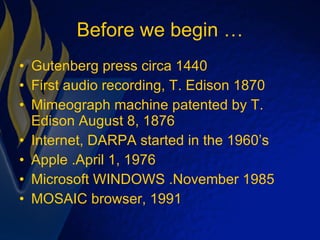
Before we begin … Gutenberg press circa 1440 First audio recording, T. Edison 1870 Mimeograph machine patented by T. Edison August 8, 1876 Internet, DARPA started in the 1960’s  Apple .April 1, 1976 Microsoft WINDOWS .November 1985 MOSAIC browser, 1991
Starting question(s)
Guiding questions How does technology change the way we teach? How does technology change the way students learn? Can technology really make a difference?
How does technology change the way we teach?
Profile of "new" environment Flexible, Mobile, Versatile - a change in environments, technology changed, students changed, role of education changed  Learning space concept – learner, learning focused – social in structure, collaborative. Evolution and development of technology – natural growth and expansion of technology, whether result of business, industry, or education.
Flexible, Mobile, Versatile Learning space - The term classroom implied a certain structure, physical structure, and certain expectations about the type of acceptable activities. These spaces are now for learning, hence learning space. Learning commons - A learning commons is a larger space, a larger and more expansive learning space.
GOOD Learning Space Intuitive Learning-focused (or Learner-focused) Unstructured Multipurpose Flexible ALWAYS USED
The “New(er)” Technologies
OLD vs. NEW OLD Technologies Chalk board, erasers Spiral binders Index or note cards 16mm movies Slide projectors New(er) Technologies Touch screen monitors Electronic paper “ Flash” cards Video on demand “ Slide shows”
Evolution of Technology Digital - Digital native – technology is seen as natural part or extension of life, and life’s activities Analog - Digital immigrant – technology is viewed as an extension or supplement to society, use may be determined by context
Digital and Analog Digital is two way Digital is mobile Digital is powerful Digital is portable Digital is flexible Analog is one way Analog is stationary Analog is powerful Analog may be portable Analog may be flexible
What is teaching technology? Is teaching technology ubiquitous, pervasive, and transparent? What are the expectations for this technology?
Ubiquitous, Pervasive, Transparent
Everywhere, Somewhere or Nowhere Is technology ubiquitous? Is it everywhere? Is technology everywhere? Do I find technology pervading EVERY  part of my environment? Have the lines between technology blurred?
Teaching and Technology Are there different "types" of technology for teaching? Instructional, Informational, Educational Role of technology in teaching –  as instructional innovation,  as social innovation  or adoption/adaptation
Styles and Technology
Teaching Styles and Technology Teaching versus Instruction Technology as the medium Technology as the message Process (Teaching/Learning) versus Product (Test score, assignment) Technology may help/improve … recall Technology may help/improve … retention Technology may help/improve … transfer
Today More media-rich and media-centric content is available today Technology has the POTENTIAL to make the act/art/science of teaching RICHER and more ENGAGING for students
How does technology change the way students learn?
Learning and Technology Can technology help all students learn equally? Does the use of technology require students to be technologically literate? digitally literate?
Evolution of Technology Digital - Digital native – technology is seen as natural part or extension of life, and life’s activities Analog - Digital immigrant – technology is viewed as an extension or supplement to society, use may be determined by context
Role of technology in learning Engagement Promote active learning Mobile Emulates or models “real” life Multi-modal Ubiquitous Pervasive Transparent
New Students, New Technology
What students want … Focus Direction Clarity Multi-sensory stimulation Sense of challenge and accomplishment
Learning styles Multi-tasking Multimedia rich Focused, just-in-time Social – local, and extended Collaborative Networked, connected Mobile, nomadic
Can technology really make a difference?
Can technology really make a difference? Matching technology to teaching and learning styles Incidental or qualitative differences Impact measured by student or learner perceptions
We have NO choice … students expect technology to be used in the classroom, in learning … it is a PREREQUISITE to learning … it can be used to GAIN and MAINTAIN attention
Guiding questions How does technology change the way we teach? How does technology change the way students learn? Can technology really make a difference?
Take away points Social technologies Create, develop, and sustain communities Networking technologies Provide connections to shared interests Collaborative technologies Provide platform for shared space, creating focused deliverables Transparent technologies No interference in daily “NORMAL” life
Take away points on …  Social technologies Create, develop, and sustain communities Allow faculty to connect with students in and OUT of class Provide students opportunities to feel a PART of class
Take away points on … Networking technologies Provide connections to shared interests Provide ACCESS to resources Open up more resources For faculty, provide a RICHER teaching opportunity For students, provide greater access, resources for learning
Take away points on … Collaborative technologies Provide platform for shared space, creating focused deliverables Provide “REAL WORLD” exposure to collaboration, group dynamics, and team dynamics For faculty, provide broader, and deeper teaching opportunities For students, provide growth opportunities, exposure to diverse viewpoints
Take away points on … Transparent technologies No interference in daily “NORMAL” life No need to “relearn” or “learn” new technologies Enhance the fluid connections between teaching, learning, life For faculty, increase teaching locations and opportunities For students, provide commonality between life and learning
Next Steps
First Things First The key mission – teaching and learning Old ways may NOT be the best ways Change is good AND necessary Find INNOVATORS for technology SUSTAIN SUPPORT
Concluding Thoughts Today’s (and tomorrow’s) students are more comfortable and confident with technology –  CAPITALIZE ON THIS Yesterday’s faculty MAY not be aware of technological opportunities WE must find ways to use, integrate, adapt, adopt technology, effectively, efficiently and instructionally
David Peter, Director Center for Teaching and Learning Vincennes University Email:  [email_address] Phone: 812-888-5815 URL:  www.vinu.edu/ctl

Technology, Teaching and Learning: From the Frontline

  • 1.
    Session Information S-141Key Presenter: David Peter, Director, CTL Vincennes University Session Format: Forum Session Title: Technology, Teaching, and Learning From the Frontline Track: Teaching and Learning Date and Time: Sunday, Oct 19, 2008 (8:30 AM - 9:30 AM) Scheduled Location: 150 C, Lower Level
  • 2.
    How does technologychange the way we teach and the way students learn? Can technology really make a difference? These questions are used to start our exploration of the research around best practices. If you are involved in teaching and learning and are curious about integrating technology effectively, this session equips you with sound strategies you can implement immediately.
  • 3.
    Technology, Teaching andLearning: From the Frontline David Peter, Director Center for Teaching and Learning Vincennes University
  • 4.
    Before we begin… Gutenberg press circa 1440 First audio recording, T. Edison 1870 Mimeograph machine patented by T. Edison August 8, 1876 Internet, DARPA started in the 1960’s Apple .April 1, 1976 Microsoft WINDOWS .November 1985 MOSAIC browser, 1991
  • 5.
  • 6.
    Guiding questions Howdoes technology change the way we teach? How does technology change the way students learn? Can technology really make a difference?
  • 7.
    How does technologychange the way we teach?
  • 8.
    Profile of "new"environment Flexible, Mobile, Versatile - a change in environments, technology changed, students changed, role of education changed Learning space concept – learner, learning focused – social in structure, collaborative. Evolution and development of technology – natural growth and expansion of technology, whether result of business, industry, or education.
  • 9.
    Flexible, Mobile, VersatileLearning space - The term classroom implied a certain structure, physical structure, and certain expectations about the type of acceptable activities. These spaces are now for learning, hence learning space. Learning commons - A learning commons is a larger space, a larger and more expansive learning space.
  • 10.
    GOOD Learning SpaceIntuitive Learning-focused (or Learner-focused) Unstructured Multipurpose Flexible ALWAYS USED
  • 11.
  • 12.
    OLD vs. NEWOLD Technologies Chalk board, erasers Spiral binders Index or note cards 16mm movies Slide projectors New(er) Technologies Touch screen monitors Electronic paper “ Flash” cards Video on demand “ Slide shows”
  • 13.
    Evolution of TechnologyDigital - Digital native – technology is seen as natural part or extension of life, and life’s activities Analog - Digital immigrant – technology is viewed as an extension or supplement to society, use may be determined by context
  • 14.
    Digital and AnalogDigital is two way Digital is mobile Digital is powerful Digital is portable Digital is flexible Analog is one way Analog is stationary Analog is powerful Analog may be portable Analog may be flexible
  • 15.
    What is teachingtechnology? Is teaching technology ubiquitous, pervasive, and transparent? What are the expectations for this technology?
  • 16.
  • 17.
    Everywhere, Somewhere orNowhere Is technology ubiquitous? Is it everywhere? Is technology everywhere? Do I find technology pervading EVERY part of my environment? Have the lines between technology blurred?
  • 18.
    Teaching and TechnologyAre there different "types" of technology for teaching? Instructional, Informational, Educational Role of technology in teaching – as instructional innovation, as social innovation or adoption/adaptation
  • 19.
  • 20.
    Teaching Styles andTechnology Teaching versus Instruction Technology as the medium Technology as the message Process (Teaching/Learning) versus Product (Test score, assignment) Technology may help/improve … recall Technology may help/improve … retention Technology may help/improve … transfer
  • 21.
    Today More media-richand media-centric content is available today Technology has the POTENTIAL to make the act/art/science of teaching RICHER and more ENGAGING for students
  • 22.
    How does technologychange the way students learn?
  • 23.
    Learning and TechnologyCan technology help all students learn equally? Does the use of technology require students to be technologically literate? digitally literate?
  • 24.
    Evolution of TechnologyDigital - Digital native – technology is seen as natural part or extension of life, and life’s activities Analog - Digital immigrant – technology is viewed as an extension or supplement to society, use may be determined by context
  • 25.
    Role of technologyin learning Engagement Promote active learning Mobile Emulates or models “real” life Multi-modal Ubiquitous Pervasive Transparent
  • 26.
  • 27.
    What students want… Focus Direction Clarity Multi-sensory stimulation Sense of challenge and accomplishment
  • 28.
    Learning styles Multi-taskingMultimedia rich Focused, just-in-time Social – local, and extended Collaborative Networked, connected Mobile, nomadic
  • 29.
    Can technology reallymake a difference?
  • 30.
    Can technology reallymake a difference? Matching technology to teaching and learning styles Incidental or qualitative differences Impact measured by student or learner perceptions
  • 31.
    We have NOchoice … students expect technology to be used in the classroom, in learning … it is a PREREQUISITE to learning … it can be used to GAIN and MAINTAIN attention
  • 32.
    Guiding questions Howdoes technology change the way we teach? How does technology change the way students learn? Can technology really make a difference?
  • 33.
    Take away pointsSocial technologies Create, develop, and sustain communities Networking technologies Provide connections to shared interests Collaborative technologies Provide platform for shared space, creating focused deliverables Transparent technologies No interference in daily “NORMAL” life
  • 34.
    Take away pointson … Social technologies Create, develop, and sustain communities Allow faculty to connect with students in and OUT of class Provide students opportunities to feel a PART of class
  • 35.
    Take away pointson … Networking technologies Provide connections to shared interests Provide ACCESS to resources Open up more resources For faculty, provide a RICHER teaching opportunity For students, provide greater access, resources for learning
  • 36.
    Take away pointson … Collaborative technologies Provide platform for shared space, creating focused deliverables Provide “REAL WORLD” exposure to collaboration, group dynamics, and team dynamics For faculty, provide broader, and deeper teaching opportunities For students, provide growth opportunities, exposure to diverse viewpoints
  • 37.
    Take away pointson … Transparent technologies No interference in daily “NORMAL” life No need to “relearn” or “learn” new technologies Enhance the fluid connections between teaching, learning, life For faculty, increase teaching locations and opportunities For students, provide commonality between life and learning
  • 38.
  • 39.
    First Things FirstThe key mission – teaching and learning Old ways may NOT be the best ways Change is good AND necessary Find INNOVATORS for technology SUSTAIN SUPPORT
  • 40.
    Concluding Thoughts Today’s(and tomorrow’s) students are more comfortable and confident with technology – CAPITALIZE ON THIS Yesterday’s faculty MAY not be aware of technological opportunities WE must find ways to use, integrate, adapt, adopt technology, effectively, efficiently and instructionally
  • 41.
    David Peter, DirectorCenter for Teaching and Learning Vincennes University Email: [email_address] Phone: 812-888-5815 URL: www.vinu.edu/ctl

Editor's Notes

  • #2 06/05/09 CIT-S-141-2008, DAVID M PETER, Vincennes University