Educational research and innovation:
The case of technology integration
Jo Tondeur
University de Luxembourg
6th May 2015
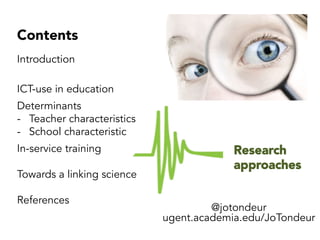
Contents
Introduction
ICT-use in education
Determinants
-  Teacher characteristics
-  School characteristic
In-service training
Towards a linking science
References
@jotondeur
ugent.academia.edu/JoTondeur
Research
approaches
ICT-use in education
	
  
Research
approaches
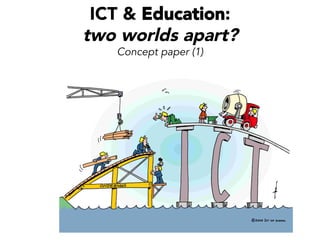
ICT & Education:
two worlds apart?
Concept paper (1)
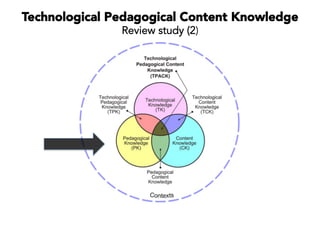
Technological Pedagogical Content Knowledge
Review study (2)
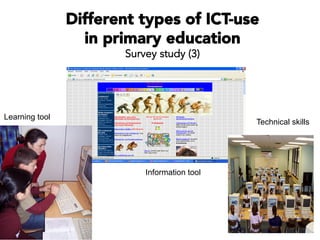
Different types of ICT-use
in primary education
Survey study (3)
Learning tool
Information tool
Technical skills
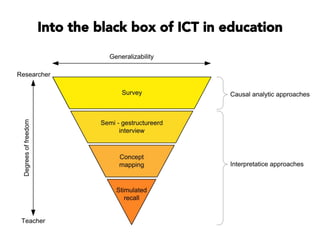
Into the black box of ICT in education
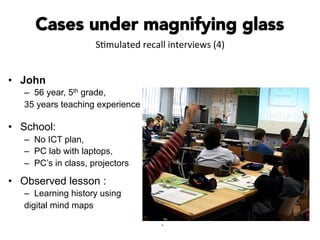
Cases under magnifying glass
•  John
–  56 year, 5th grade,
35 years teaching experience
•  School:
–  No ICT plan,
–  PC lab with laptops,
–  PC’s in class, projectors
•  Observed lesson :
–  Learning history using
digital mind maps
.
S#mulated	
  recall	
  interviews	
  (4)	
  
9
1.  Pupils	
  have	
  a	
  posi#ve	
  a;tude	
  towards	
  ICT,	
  and	
  are	
  willing	
  to	
  use	
  
ICT	
  to	
  support	
  their	
  own	
  learning	
  process.	
  
2.  Pupils	
  use	
  ICT	
  in	
  a	
  safe,	
  responsible	
  and	
  effec#ve	
  way.	
  
3.  Pupils	
  can	
  work	
  independently	
  in	
  a	
  ICT	
  enriched	
  learning	
  
environment.	
  
4.  Pupils	
  can	
  learn	
  independently	
  in	
  a	
  ICT	
  enriched	
  learning	
  
environment.	
  
5.  Pupils	
  can	
  use	
  ICT	
  to	
  elaborate	
  their	
  ideas	
  in	
  a	
  crea#ve	
  way.	
  	
  
6.  Pupils	
  can	
  use	
  ICT	
  to	
  search	
  for,	
  process	
  and	
  store	
  digital	
  
informa#on.	
  
7.  Pupils	
  can	
  use	
  ICT	
  to	
  present	
  informa#on	
  to	
  others.	
  
8.  Pupils	
  can	
  use	
  ICT	
  to	
  communicate	
  in	
  a	
  safe,	
  responsible	
  and	
  
effec#ve	
  way.	
  	
  
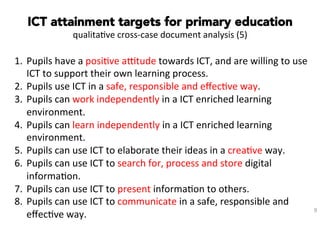
ICT attainment targets for primary education
qualita#ve	
  cross-­‐case	
  document	
  analysis	
  (5)	
  
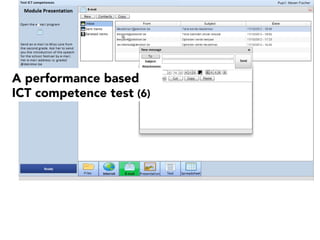
A performance based
ICT competence test (6) 	
  
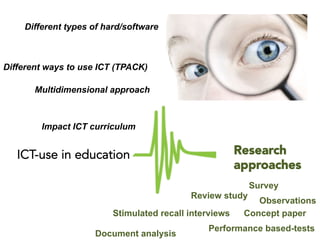
ICT-use in education
	
  
Research
approaches
Concept paper
Review study
Survey
Stimulated recall interviews
Performance based-tests
Multidimensional approach
Different types of hard/software
Different ways to use ICT (TPACK)
Document analysis
Impact ICT curriculum
Observations
Determinants of
ICT-integration in
education
	
  
Research
approaches
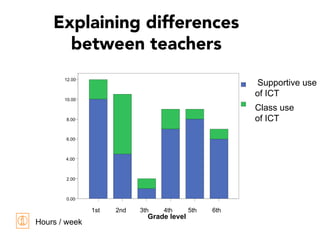
1st 2nd 3th 4th 5th 6th
Grade level
0.00
2.00
4.00
6.00
8.00
10.00
12.00
Supportive use
of ICT
Class use
of ICT
Explaining differences
between teachers
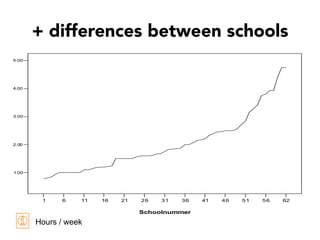
Hours / week
1 6 11 16 21 26 31 36 41 46 51 56 62
Schoolnummer
1.00
2.00
3.00
4.00
5.00
+ differences between schools
Hours / week
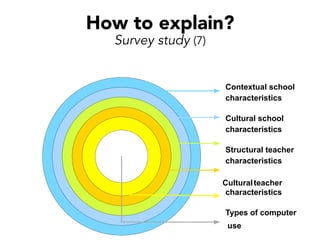
Types of computer
use
Culturalteacher
characteristics
Structural teacher
characteristics
Cultural school
characteristics
Contextual school
characteristics
How to explain?
Survey study (7)
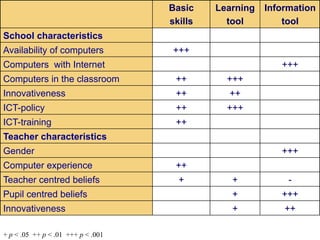
Basic
skills
Learning
tool
Information
tool
School characteristics
Availability of computers +++
Computers with Internet +++
Computers in the classroom ++ +++
Innovativeness ++ ++
ICT-policy ++ +++
ICT-training ++
Teacher characteristics
Gender +++
Computer experience ++
Teacher centred beliefs + + -
Pupil centred beliefs + +++
Innovativeness + ++
+ p < .05 ++ p < .01 +++ p < .001
17
Focus on
pedagogical
beliefs
	
  
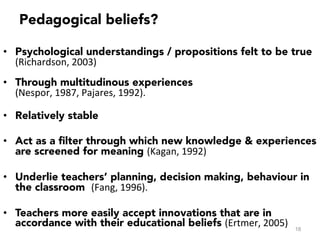
•  Psychological understandings / propositions felt to be true
(Richardson,	
  2003)	
  
•  Through multitudinous experiences
(Nespor,	
  1987,	
  Pajares,	
  1992).	
  	
  
•  Relatively stable
•  Act as a filter through which new knowledge & experiences
are screened for meaning (Kagan,	
  1992)	
  	
  
•  Underlie teachers’ planning, decision making, behaviour in
the classroom (Fang,	
  1996).	
  	
  
•  Teachers more easily accept innovations that are in
accordance with their educational beliefs (Ertmer,	
  2005) 18
Pedagogical beliefs?
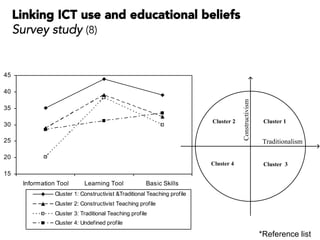
Traditionalism
Constructivism
Cluster 1
Cluster 3Cluster 4
Cluster 2
15
20
25
30
35
40
45
Information Tool Learning Tool Basic Skills
Cluster 1: Constructivist &Traditional Teaching profile
Cluster 2: Constructivist Teaching profile
Cluster 3: Traditional Teaching profile
Cluster 4: Undefined profile
Linking ICT use and educational beliefs
Survey study (8)
*Reference list


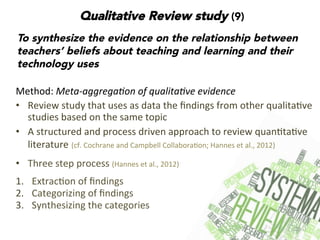
To synthesize the evidence on the relationship between
teachers’ beliefs about teaching and learning and their
technology uses


20
	
  
Method:	
  Meta-­‐aggrega)on	
  of	
  qualita)ve	
  evidence	
  
•  Review	
  study	
  that	
  uses	
  as	
  data	
  the	
  findings	
  from	
  other	
  qualita#ve	
  
studies	
  based	
  on	
  the	
  same	
  topic	
  
•  A	
  structured	
  and	
  process	
  driven	
  approach	
  to	
  review	
  quan#ta#ve	
  
literature	
  (cf.	
  Cochrane	
  and	
  Campbell	
  Collabora#on;	
  Hannes	
  et	
  al.,	
  2012)	
  
•  Three	
  step	
  process	
  (Hannes	
  et	
  al.,	
  2012)	
  
1.  Extrac#on	
  of	
  findings	
  
2.  Categorizing	
  of	
  findings	
  
3.  Synthesizing	
  the	
  categories	
  	
  
Qualitative Review study (9)
 
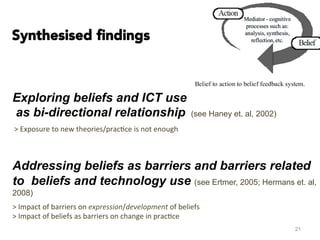
Exploring beliefs and ICT use
as bi-directional relationship (see Haney et. al, 2002)
	
  >	
  Exposure	
  to	
  new	
  theories/prac#ce	
  is	
  not	
  enough	
  
Addressing beliefs as barriers and barriers related
to beliefs and technology use (see Ertmer, 2005; Hermans et. al,
2008)
	
  
>	
  Impact	
  of	
  barriers	
  on	
  expression/development	
  of	
  beliefs	
  
>	
  Impact	
  of	
  beliefs	
  as	
  barriers	
  on	
  change	
  in	
  prac#ce	


21
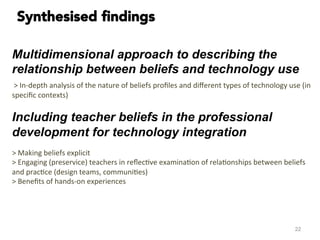
Synthesised findings
Multidimensional approach to describing the
relationship between beliefs and technology use
	
  >	
  In-­‐depth	
  analysis	
  of	
  the	
  nature	
  of	
  beliefs	
  profiles	
  and	
  different	
  types	
  of	
  technology	
  use	
  (in	
  
specific	
  contexts)	
  
Including teacher beliefs in the professional
development for technology integration	


>	
  Making	
  beliefs	
  explicit	
  
>	
  Engaging	
  (preservice)	
  teachers	
  in	
  reflec#ve	
  examina#on	
  of	
  rela#onships	
  between	
  beliefs	
  
and	
  prac#ce	
  (design	
  teams,	
  communi#es)	
  
>	
  Benefits	
  of	
  hands-­‐on	
  experiences	


22
Synthesised findings
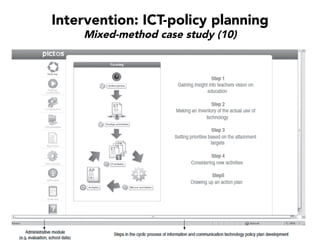
Intervention: ICT-policy planning
Mixed-method case study (10)
0
10
20
30
40
50
60
70
80
Inno -
vativeness
Supportive
leadership
Goal -
orientedness
ICT
Planning
ICT
support
Infra -
structure
Influence of school characteristics
Mixed-method study (11, 12)
Teachers from C1
Use sign. > ICT
School policy!
“Despite the effort of the ICT co-ordinatior
to set up a strategic plan,
teachers are not aware of the specifics of the plan.”
[Principal/School 17]
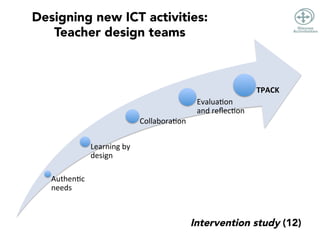
Designing new ICT activities:
Teacher design teams
Authen#c	
  
needs	
  
Learning	
  by	
  
design	
  
Collabora#on	
  
Evalua#on	
  
and	
  reflec#on	
  
TPACK	
  
Intervention study (12)
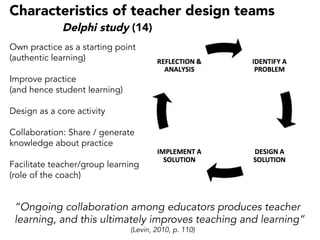
“Ongoing collaboration among educators produces teacher
learning, and this ultimately improves teaching and learning”
(Levin, 2010, p. 110)
Own practice as a starting point
(authentic learning)
Improve practice
(and hence student learning)
Design as a core activity
Collaboration: Share / generate
knowledge about practice
 
Facilitate teacher/group learning
(role of the coach)
Characteristics of teacher design teams
Delphi study (14)
Determinants of
ICT-integration in education
	
  
Research
approaches
Delphi study
Case study Surveys
Intervention study
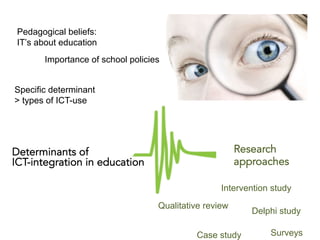
Pedagogical beliefs:
IT’s about education
Importance of school policies
Specific determinant
> types of ICT-use
Qualitative review
Delphi
study
Case study
Surveys
Intervention
study
Qualitative
Concept
paper
Review study
Performance
based-tests
Document
analysis
interviews
Observations
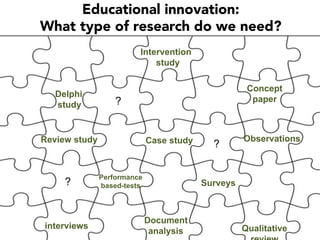
Educational innovation:
What type of research do we need?
?
?
?
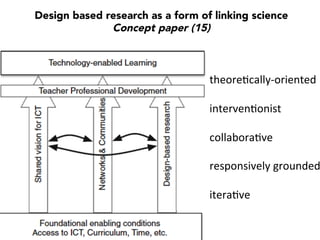
Design based research as a form of linking science
Concept paper (15)
theore#cally-­‐oriented	


interven#onist	


collabora#ve	


responsively	
  grounded
	
  
itera#ve
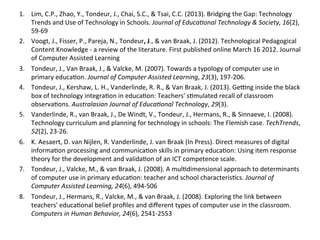
1.  Lim,	
  C.P.,	
  Zhao,	
  Y.,	
  Tondeur,	
  J.,	
  Chai,	
  S.C.,	
  &	
  Tsai,	
  C.C.	
  (2013).	
  Bridging	
  the	
  Gap:	
  Technology	
  
Trends	
  and	
  Use	
  of	
  Technology	
  in	
  Schools.	
  Journal	
  of	
  Educa)onal	
  Technology	
  &	
  Society,	
  16(2),	
  
59-­‐69	
  	
  
2.  Voogt,	
  J.,	
  Fisser,	
  P.,	
  Pareja,	
  N.,	
  Tondeur,	
  J.,	
  &	
  van	
  Braak,	
  J.	
  (2012).	
  Technological	
  Pedagogical	
  
Content	
  Knowledge	
  -­‐	
  a	
  review	
  of	
  the	
  literature.	
  First	
  published	
  online	
  March	
  16	
  2012.	
  Journal	
  
of	
  Computer	
  Assisted	
  Learning	
  	
  
3.  Tondeur,	
  J.,	
  Van	
  Braak,	
  J.,	
  &	
  Valcke,	
  M.	
  (2007).	
  Towards	
  a	
  typology	
  of	
  computer	
  use	
  in	
  
primary	
  educa#on.	
  Journal	
  of	
  Computer	
  Assisted	
  Learning,	
  23(3),	
  197-­‐206.	
  
4.  Tondeur,	
  J.,	
  Kershaw,	
  L.	
  H.,	
  Vanderlinde,	
  R.	
  R.,	
  &	
  Van	
  Braak,	
  J.	
  (2013).	
  Ge;ng	
  inside	
  the	
  black	
  
box	
  of	
  technology	
  integra#on	
  in	
  educa#on:	
  Teachers'	
  s#mulated	
  recall	
  of	
  classroom	
  
observa#ons.	
  Australasian	
  Journal	
  of	
  Educa)onal	
  Technology,	
  29(3).	
  
5.  Vanderlinde,	
  R.,	
  van	
  Braak,	
  J.,	
  De	
  Windt,	
  V.,	
  Tondeur,	
  J.,	
  Hermans,	
  R.,	
  &	
  Sinnaeve,	
  I.	
  (2008).	
  
Technology	
  curriculum	
  and	
  planning	
  for	
  technology	
  in	
  schools:	
  The	
  Flemish	
  case.	
  TechTrends,	
  
52(2),	
  23-­‐26.	
  
6.  K.	
  Aesaert,	
  D.	
  van	
  Nijlen,	
  R.	
  Vanderlinde,	
  J.	
  van	
  Braak	
  (In	
  Press).	
  Direct	
  measures	
  of	
  digital	
  
informa#on	
  processing	
  and	
  communica#on	
  skills	
  in	
  primary	
  educa#on:	
  Using	
  item	
  response	
  
theory	
  for	
  the	
  development	
  and	
  valida#on	
  of	
  an	
  ICT	
  competence	
  scale.	
  
7.  Tondeur,	
  J.,	
  Valcke,	
  M.,	
  &	
  van	
  Braak,	
  J.	
  (2008).	
  A	
  mul#dimensional	
  approach	
  to	
  determinants	
  
of	
  computer	
  use	
  in	
  primary	
  educa#on:	
  teacher	
  and	
  school	
  characteris#cs.	
  Journal	
  of	
  
Computer	
  Assisted	
  Learning,	
  24(6),	
  494-­‐506	


8.  Tondeur,	
  J.,	
  Hermans,	
  R.,	
  Valcke,	
  M.,	
  &	
  van	
  Braak,	
  J.	
  (2008).	
  Exploring	
  the	
  link	
  between	
  
teachers'	
  educa#onal	
  belief	
  profiles	
  and	
  different	
  types	
  of	
  computer	
  use	
  in	
  the	
  classroom.	
  
Computers	
  in	
  Human	
  Behavior,	
  24(6),	
  2541-­‐2553	
  	
  
9.	
  Tondeur,	
  J.,	
  van	
  Braak,	
  J,	
  Ertmer,	
  P.,	
  Onenbreit-­‐Leowich,	
  A.	
  (2013).	
  The	
  link	
  between	
  teachers’	
  
educa)onal	
  beliefs	
  and	
  technology	
  use	
  in	
  the	
  classroom:	
  A	
  mixed	
  method	
  review	
  of	
  the	
  literature	
  
Paper	
  accepted	
  for	
  presenta#on	
  at	
  the	
  European	
  Conference	
  on	
  Educa#on	
  Research	
  (ECER):	
  
Istanbul,	
  Turkey.	
  September	
  2013	
  	
  
10.	
  Vanderlinde,	
  R.,	
  van	
  Braak,	
  J.,	
  &	
  Tondeur,	
  J.	
  (2010).	
  Using	
  an	
  online	
  tool	
  to	
  support	
  school-­‐
based	
  ICT	
  policy	
  planning	
  in	
  primary	
  educa#on.	
  Journal	
  of	
  Computer	
  Assisted	
  Learning,	
  26	
  (5),	
  
296-­‐306	
  	
  
11.	
  Tondeur,	
  J.,	
  Devos,	
  G.,	
  Van	
  Houne,	
  M.,	
  van	
  Braak,	
  J.,	
  &	
  Valcke,	
  M.	
  (2009).	
  Understanding	
  
organisa#onal	
  and	
  cultural	
  school	
  characteris#cs	
  in	
  rela#on	
  to	
  educa#onal	
  change:	
  The	
  case	
  of	
  
ICT	
  integra#on.	
  Educa#onal	
  Studies,	
  35	
  (2).	
  	
  
12.	
  Tondeur,	
  J.,	
  Van	
  Keer,	
  H.,	
  van	
  Braak,	
  J.,	
  &	
  Valcke,	
  M.	
  (2008).	
  ICT	
  integra#on	
  in	
  the	
  classroom:	
  
Challenging	
  the	
  poten#al	
  of	
  a	
  school	
  policy.	
  Computers	
  &	
  Educa)on,	
  51(1),	
  212-­‐223.	
  
13.	
  hnps://www.academia.edu/6600239/Teacher_Design_Teams_for_technology_integra#on	
  
14.	
  	
  Becuwe,	
  Thys,	
  Tondeur,	
  Pareja	
  ,	
  van	
  Braak,	
  (2014).	
  Condi#ons	
  to	
  Implement	
  Collabora#ve	
  
Design	
  as	
  a	
  Strategy	
  for	
  Professional	
  Development:	
  The	
  Case	
  of	
  ICT-­‐Integra#on	
  in	
  Teacher	
  
Educa#on.	
  ECER,	
  Porto	
  
15.	
  Albion,	
  P.	
  R.,	
  Tondeur,	
  J.,	
  Forkosh-­‐Baruch,	
  A.,	
  &	
  Peeraer,	
  J.	
  (2015).	
  Teachers’	
  professional	
  
development	
  for	
  ICT	
  integra#on:	
  Towards	
  a	
  reciprocal	
  rela#onship	
  between	
  research	
  and	
  
prac#ce.	
  Educa)on	
  and	
  Informa)on	
  Technologies,	
  1-­‐19.	
  

Educational research and innovation: The case of Technology integration

  • 1.
    Educational research andinnovation: The case of technology integration Jo Tondeur University de Luxembourg 6th May 2015
  • 2.
    Contents Introduction ICT-use in education Determinants - Teacher characteristics -  School characteristic In-service training Towards a linking science References @jotondeur ugent.academia.edu/JoTondeur Research approaches
  • 3.
    ICT-use in education   Research approaches
  • 4.
    ICT & Education: twoworlds apart? Concept paper (1)
  • 5.
    Technological Pedagogical ContentKnowledge Review study (2)
  • 6.
    Different types ofICT-use in primary education Survey study (3) Learning tool Information tool Technical skills
  • 7.
    Into the blackbox of ICT in education
  • 8.
    Cases under magnifyingglass •  John –  56 year, 5th grade, 35 years teaching experience •  School: –  No ICT plan, –  PC lab with laptops, –  PC’s in class, projectors •  Observed lesson : –  Learning history using digital mind maps . S#mulated  recall  interviews  (4)  
  • 9.
    9 1.  Pupils  have  a  posi#ve  a;tude  towards  ICT,  and  are  willing  to  use   ICT  to  support  their  own  learning  process.   2.  Pupils  use  ICT  in  a  safe,  responsible  and  effec#ve  way.   3.  Pupils  can  work  independently  in  a  ICT  enriched  learning   environment.   4.  Pupils  can  learn  independently  in  a  ICT  enriched  learning   environment.   5.  Pupils  can  use  ICT  to  elaborate  their  ideas  in  a  crea#ve  way.     6.  Pupils  can  use  ICT  to  search  for,  process  and  store  digital   informa#on.   7.  Pupils  can  use  ICT  to  present  informa#on  to  others.   8.  Pupils  can  use  ICT  to  communicate  in  a  safe,  responsible  and   effec#ve  way.     ICT attainment targets for primary education qualita#ve  cross-­‐case  document  analysis  (5)  
  • 10.
    A performance based ICTcompetence test (6)  
  • 11.
    ICT-use in education   Research approaches Concept paper Review study Survey Stimulated recall interviews Performance based-tests Multidimensional approach Different types of hard/software Different ways to use ICT (TPACK) Document analysis Impact ICT curriculum Observations
  • 12.
  • 13.
    1st 2nd 3th4th 5th 6th Grade level 0.00 2.00 4.00 6.00 8.00 10.00 12.00 Supportive use of ICT Class use of ICT Explaining differences between teachers Hours / week
  • 14.
    1 6 1116 21 26 31 36 41 46 51 56 62 Schoolnummer 1.00 2.00 3.00 4.00 5.00 + differences between schools Hours / week
  • 15.
    Types of computer use Culturalteacher characteristics Structuralteacher characteristics Cultural school characteristics Contextual school characteristics How to explain? Survey study (7)
  • 16.
    Basic skills Learning tool Information tool School characteristics Availability ofcomputers +++ Computers with Internet +++ Computers in the classroom ++ +++ Innovativeness ++ ++ ICT-policy ++ +++ ICT-training ++ Teacher characteristics Gender +++ Computer experience ++ Teacher centred beliefs + + - Pupil centred beliefs + +++ Innovativeness + ++ + p < .05 ++ p < .01 +++ p < .001
  • 17.
  • 18.
    •  Psychological understandings/ propositions felt to be true (Richardson,  2003)   •  Through multitudinous experiences (Nespor,  1987,  Pajares,  1992).     •  Relatively stable •  Act as a filter through which new knowledge & experiences are screened for meaning (Kagan,  1992)     •  Underlie teachers’ planning, decision making, behaviour in the classroom (Fang,  1996).     •  Teachers more easily accept innovations that are in accordance with their educational beliefs (Ertmer,  2005) 18 Pedagogical beliefs?
  • 19.
    Traditionalism Constructivism Cluster 1 Cluster 3Cluster4 Cluster 2 15 20 25 30 35 40 45 Information Tool Learning Tool Basic Skills Cluster 1: Constructivist &Traditional Teaching profile Cluster 2: Constructivist Teaching profile Cluster 3: Traditional Teaching profile Cluster 4: Undefined profile Linking ICT use and educational beliefs Survey study (8) *Reference list
  • 20.
        To synthesizethe evidence on the relationship between teachers’ beliefs about teaching and learning and their technology uses     20   Method:  Meta-­‐aggrega)on  of  qualita)ve  evidence   •  Review  study  that  uses  as  data  the  findings  from  other  qualita#ve   studies  based  on  the  same  topic   •  A  structured  and  process  driven  approach  to  review  quan#ta#ve   literature  (cf.  Cochrane  and  Campbell  Collabora#on;  Hannes  et  al.,  2012)   •  Three  step  process  (Hannes  et  al.,  2012)   1.  Extrac#on  of  findings   2.  Categorizing  of  findings   3.  Synthesizing  the  categories     Qualitative Review study (9)
  • 21.
      Exploring beliefs andICT use as bi-directional relationship (see Haney et. al, 2002)  >  Exposure  to  new  theories/prac#ce  is  not  enough   Addressing beliefs as barriers and barriers related to beliefs and technology use (see Ertmer, 2005; Hermans et. al, 2008)   >  Impact  of  barriers  on  expression/development  of  beliefs   >  Impact  of  beliefs  as  barriers  on  change  in  prac#ce       21 Synthesised findings
  • 22.
    Multidimensional approach todescribing the relationship between beliefs and technology use  >  In-­‐depth  analysis  of  the  nature  of  beliefs  profiles  and  different  types  of  technology  use  (in   specific  contexts)   Including teacher beliefs in the professional development for technology integration     >  Making  beliefs  explicit   >  Engaging  (preservice)  teachers  in  reflec#ve  examina#on  of  rela#onships  between  beliefs   and  prac#ce  (design  teams,  communi#es)   >  Benefits  of  hands-­‐on  experiences         22 Synthesised findings
  • 23.
  • 24.
    0 10 20 30 40 50 60 70 80 Inno - vativeness Supportive leadership Goal - orientedness ICT Planning ICT support Infra- structure Influence of school characteristics Mixed-method study (11, 12) Teachers from C1 Use sign. > ICT School policy! “Despite the effort of the ICT co-ordinatior to set up a strategic plan, teachers are not aware of the specifics of the plan.” [Principal/School 17]
  • 25.
    Designing new ICTactivities: Teacher design teams Authen#c   needs   Learning  by   design   Collabora#on   Evalua#on   and  reflec#on   TPACK   Intervention study (12)
  • 26.
    “Ongoing collaboration amongeducators produces teacher learning, and this ultimately improves teaching and learning” (Levin, 2010, p. 110) Own practice as a starting point (authentic learning) Improve practice (and hence student learning) Design as a core activity Collaboration: Share / generate knowledge about practice   Facilitate teacher/group learning (role of the coach) Characteristics of teacher design teams Delphi study (14)
  • 27.
    Determinants of ICT-integration ineducation   Research approaches Delphi study Case study Surveys Intervention study Pedagogical beliefs: IT’s about education Importance of school policies Specific determinant > types of ICT-use Qualitative review
  • 28.
  • 29.
    Design based researchas a form of linking science Concept paper (15) theore#cally-­‐oriented       interven#onist       collabora#ve       responsively  grounded   itera#ve
  • 30.
    1.  Lim,  C.P.,  Zhao,  Y.,  Tondeur,  J.,  Chai,  S.C.,  &  Tsai,  C.C.  (2013).  Bridging  the  Gap:  Technology   Trends  and  Use  of  Technology  in  Schools.  Journal  of  Educa)onal  Technology  &  Society,  16(2),   59-­‐69     2.  Voogt,  J.,  Fisser,  P.,  Pareja,  N.,  Tondeur,  J.,  &  van  Braak,  J.  (2012).  Technological  Pedagogical   Content  Knowledge  -­‐  a  review  of  the  literature.  First  published  online  March  16  2012.  Journal   of  Computer  Assisted  Learning     3.  Tondeur,  J.,  Van  Braak,  J.,  &  Valcke,  M.  (2007).  Towards  a  typology  of  computer  use  in   primary  educa#on.  Journal  of  Computer  Assisted  Learning,  23(3),  197-­‐206.   4.  Tondeur,  J.,  Kershaw,  L.  H.,  Vanderlinde,  R.  R.,  &  Van  Braak,  J.  (2013).  Ge;ng  inside  the  black   box  of  technology  integra#on  in  educa#on:  Teachers'  s#mulated  recall  of  classroom   observa#ons.  Australasian  Journal  of  Educa)onal  Technology,  29(3).   5.  Vanderlinde,  R.,  van  Braak,  J.,  De  Windt,  V.,  Tondeur,  J.,  Hermans,  R.,  &  Sinnaeve,  I.  (2008).   Technology  curriculum  and  planning  for  technology  in  schools:  The  Flemish  case.  TechTrends,   52(2),  23-­‐26.   6.  K.  Aesaert,  D.  van  Nijlen,  R.  Vanderlinde,  J.  van  Braak  (In  Press).  Direct  measures  of  digital   informa#on  processing  and  communica#on  skills  in  primary  educa#on:  Using  item  response   theory  for  the  development  and  valida#on  of  an  ICT  competence  scale.   7.  Tondeur,  J.,  Valcke,  M.,  &  van  Braak,  J.  (2008).  A  mul#dimensional  approach  to  determinants   of  computer  use  in  primary  educa#on:  teacher  and  school  characteris#cs.  Journal  of   Computer  Assisted  Learning,  24(6),  494-­‐506       8.  Tondeur,  J.,  Hermans,  R.,  Valcke,  M.,  &  van  Braak,  J.  (2008).  Exploring  the  link  between   teachers'  educa#onal  belief  profiles  and  different  types  of  computer  use  in  the  classroom.   Computers  in  Human  Behavior,  24(6),  2541-­‐2553    
  • 31.
    9.  Tondeur,  J.,  van  Braak,  J,  Ertmer,  P.,  Onenbreit-­‐Leowich,  A.  (2013).  The  link  between  teachers’   educa)onal  beliefs  and  technology  use  in  the  classroom:  A  mixed  method  review  of  the  literature   Paper  accepted  for  presenta#on  at  the  European  Conference  on  Educa#on  Research  (ECER):   Istanbul,  Turkey.  September  2013     10.  Vanderlinde,  R.,  van  Braak,  J.,  &  Tondeur,  J.  (2010).  Using  an  online  tool  to  support  school-­‐ based  ICT  policy  planning  in  primary  educa#on.  Journal  of  Computer  Assisted  Learning,  26  (5),   296-­‐306     11.  Tondeur,  J.,  Devos,  G.,  Van  Houne,  M.,  van  Braak,  J.,  &  Valcke,  M.  (2009).  Understanding   organisa#onal  and  cultural  school  characteris#cs  in  rela#on  to  educa#onal  change:  The  case  of   ICT  integra#on.  Educa#onal  Studies,  35  (2).     12.  Tondeur,  J.,  Van  Keer,  H.,  van  Braak,  J.,  &  Valcke,  M.  (2008).  ICT  integra#on  in  the  classroom:   Challenging  the  poten#al  of  a  school  policy.  Computers  &  Educa)on,  51(1),  212-­‐223.   13.  hnps://www.academia.edu/6600239/Teacher_Design_Teams_for_technology_integra#on   14.    Becuwe,  Thys,  Tondeur,  Pareja  ,  van  Braak,  (2014).  Condi#ons  to  Implement  Collabora#ve   Design  as  a  Strategy  for  Professional  Development:  The  Case  of  ICT-­‐Integra#on  in  Teacher   Educa#on.  ECER,  Porto   15.  Albion,  P.  R.,  Tondeur,  J.,  Forkosh-­‐Baruch,  A.,  &  Peeraer,  J.  (2015).  Teachers’  professional   development  for  ICT  integra#on:  Towards  a  reciprocal  rela#onship  between  research  and   prac#ce.  Educa)on  and  Informa)on  Technologies,  1-­‐19.