

@isaja
Meaningful Learning With
Technologies
Prof. Dr. Isa Jahnke
@DGWF in Ulm, Deutschland
September 20th, 2019
@isaja
University of Missouri
Gegründet 1839
@isaja
Vollstaendig online seit 2003 (erster Onlinekurs 1999)
Studiengang meines Departments
Educational Technology (EdTech)  Learning Technologies Design (LTD)
https://sislt.missouri.edu/
Mein Hintergrund
Professorin in
• Deutschland (2008-2011)
• Schweden (2011-2015)
• U.S.A. (seit 2015)
Mein erstes blended learning seminar an
der TU Dortmund: 2001
Mein erster Onlinekurs: 2016
Forschungsprojekte zu Lehre/Lernen mit
Technologien Disziplinuebergreifend:
LehrerInnenbildung, Informatik, Ingenieurwiss.
@isaja
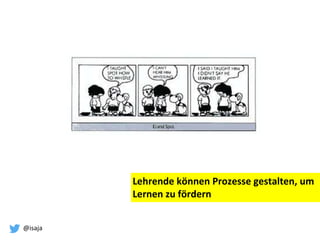
Lehrende können Prozesse gestalten, um
Lernen zu fördern
@isaja
1. Grundlage / Annahmen
• CrossActionSpaces
• Active, meaningful learning
• Lernen mit Technologien vs. Lernen durch Technologien
2. Kursdesign/Didaktik Rahmenkonzept: DDD
3. Beispiel (m)eines Online-Seminars
Übersicht
@isaja
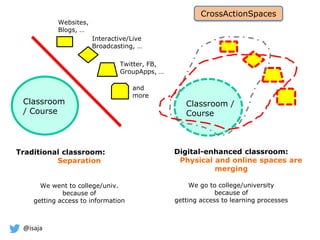
Classroom
/ Course
Classroom /
Course
Digital-enhanced classroom:
Physical and online spaces are
merging
We go to college/university
because of
getting access to learning processes
Twitter, FB,
GroupApps, …
Interactive/Live
Broadcasting, …
Websites,
Blogs, …
and
more
Traditional classroom:
Separation
We went to college/univ.
because of
getting access to information
CrossActionSpaces
@isaja
Aktive Lernstrategien (active learning) or
Activity-based model of instruction:
Studierende lernen nicht weil der Lehrende eine Aktivität
ausführt, sondern sie lernen durch ihre eigenen Aktivitäten
(mithilfe von Lernaufgaben/assignments)
Aktive Lern-Paedagogik
verbessert studentische Performance
Freeman et al., 2014
Chi, 2009: Active-Constructive-Interactive
Hodges, L.C. (2018). Contemporary issues in group learning in
undergraduate science classrooms: A perspective from student
engagement. CBE-Life Sciences Education, 17(2), es3.
https://www.lifescied.org/doi/full/10.1187/cbe.17-11-0239
@isaja
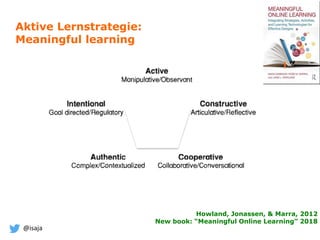
Aktive Lernstrategie:
Meaningful learning
Howland, Jonassen, & Marra, 2012
New book: “Meaningful Online Learning” 2018
@isaja
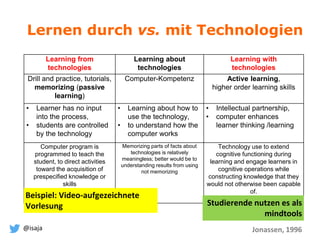
Lernen durch vs. mit Technologien
Jonassen, 1996
Learning from
technologies
Learning about
technologies
Learning with
technologies
Drill and practice, tutorials,
memorizing (passive
learning)
Computer-Kompetenz Active learning,
higher order learning skills
• Learner has no input
into the process,
• students are controlled
by the technology
• Learning about how to
use the technology,
• to understand how the
computer works
• Intellectual partnership,
• computer enhances
learner thinking /learning
Computer program is
programmed to teach the
student, to direct activities
toward the acquisition of
prespecified knowledge or
skills
Memorizing parts of facts about
technologies is relatively
meaningless; better would be to
understanding results from using
not memorizing
Technology use to extend
cognitive functioning during
learning and engage learners in
cognitive operations while
constructing knowledge that they
would not otherwise been capable
of.
Beispiel: Video-aufgezeichnete
Vorlesung Studierende nutzen es als
mindtools
@isaja
Veranstaltungs(Re)-Design
Rahmenkonzept:
Digitales Didaktisches Design
@isaja
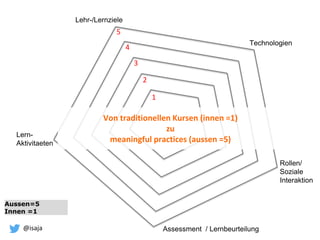
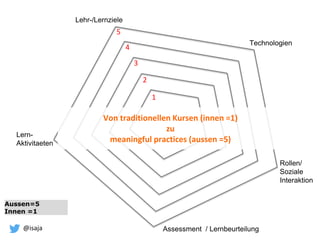
Rollen/
Soziale
Interaktion
Lern-
Aktivitaeten
Lehr-/Lernziele
Aussen=5
Innen =1
Technologien
Assessment / Lernbeurteilung
1
2
3
4
5
Von traditionellen Kursen (innen =1)
zu
meaningful practices (aussen =5)
@isaja
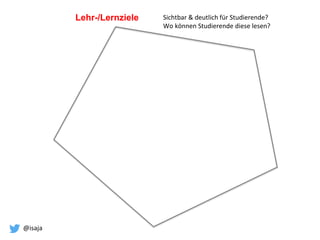
Lehr-/Lernziele Sichtbar & deutlich für Studierende?
Wo können Studierende diese lesen?
@isaja
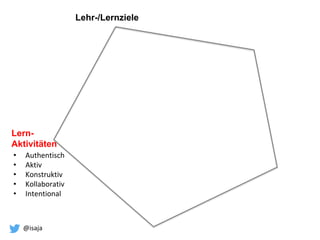
Lern-
Aktivitäten
• Authentisch
• Aktiv
• Konstruktiv
• Kollaborativ
• Intentional
Lehr-/Lernziele
@isaja
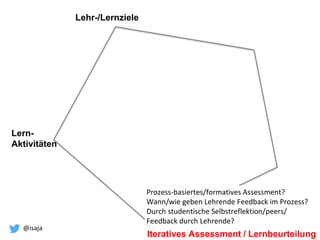
Iteratives Assessment / Lernbeurteilung
Prozess-basiertes/formatives Assessment?
Wann/wie geben Lehrende Feedback im Prozess?
Durch studentische Selbstreflektion/peers/
Feedback durch Lehrende?
Lehr-/Lernziele
Lern-
Aktivitäten
@isaja
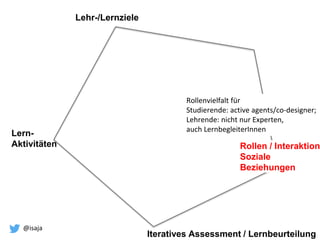
Rollen / Interaktion
Soziale
Beziehungen
Rollenvielfalt für
Studierende: active agents/co-designer;
Lehrende: nicht nur Experten,
auch LernbegleiterInnen
Iteratives Assessment / Lernbeurteilung
Lehr-/Lernziele
Lern-
Aktivitäten
@isaja
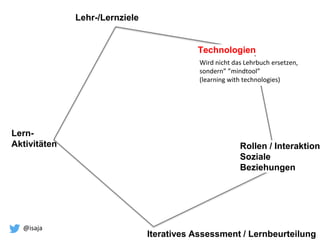
Technologien
Wird nicht das Lehrbuch ersetzen,
sondern” ”mindtool”
(learning with technologies)
Rollen / Interaktion
Soziale
Beziehungen
Iteratives Assessment / Lernbeurteilung
Lehr-/Lernziele
Lern-
Aktivitäten
@isaja
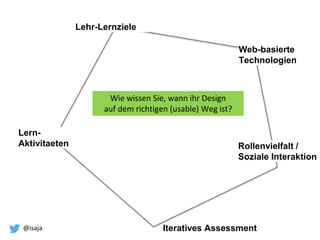
Lern-
Aktivitaeten
Lehr-Lernziele
Rollenvielfalt /
Soziale Interaktion
Web-basierte
Technologien
Wie wissen Sie, wann ihr Design
auf dem richtigen (usable) Weg ist?
Iteratives Assessment
@isaja
Rollen/
Soziale
Interaktion
Lern-
Aktivitaeten
Lehr-/Lernziele
Aussen=5
Innen =1
Technologien
Assessment / Lernbeurteilung
1
2
3
4
5
Von traditionellen Kursen (innen =1)
zu
meaningful practices (aussen =5)
@isaja 1
DDD component Description of Coding scheme
Character of
Teaching goals/ILO and
intended/expected learning
outcomes: clear and visible?
TA/ILO
1= Not clear, not visible, no communication about teaching aims or learning intentions; focus on content
2=
3= Oral communication
4=
5= Teaching aims are clear and visible for students; intended learning outcomes in forms of development of skills; a source
is available where the students can go and read aims and objectives; at best, co-aims of students are included, students know
the criteria for learning progress (available right form the start).
Character of
Learning activities: towards
producing in engaged,
authentic, deep, open
settings?
LA
1= Students hear what teachers read from the textbook (surface learning only; e.g. remembering/ repetition of facts);
theoretical problems without connecting it to a real world problem
2=
3= In-between (…) – signs are: students are not so engaged, too much time for doing other things (e.g. playing cards
instead)
4=
5= Learning activities have a range from surface to deep learning: students produce something, engaged classrooms,
collaboration with peers; the activities are connected to the students world and include a real-world problem (e.g. everyday
experience); a real audience, students critically reflect on existing content (e.g. evaluating/creating/making), relate
knowledge to new knowledge; “organize and structure content into coherent whole” (Marten & Säljö, 1979), students are
engaged in producing, using the Internet or other sources beyond the physical school walls (signs of crossactions)
Character of assessment:
process-based?
ASM
1 = Feedback only at the end (summative feedback); character of the feedback is rather summative, not formative
2=
3= Feedback during the class (not only technical help) by coincidence; teacher only gives feedback when they ask for
support; passive support
4=
5= Criteria for a learning progress are visible for students from the beginning of the learning process; Feedback/feed-
forward at the end but mainly process-based assessment for learner’s development; a plan exists for how the teacher creates
pro-assessment (formative evaluation); a range of forms such as self-assessment; peer-reflective learning and feedback by
the teacher, e.g. students document learning (electronically; a map or text, etc.), the teacher asks them to go back and reflect.
Character of
Social relations: multiple
roles (not only consumers?)?
RO
1= Teacher is in the traditional role of the expert only; students are only seen as consumers (of solving closed questions and
tasks where only one correct answer is possible)
2=
3= Teacher is in 1-2 roles but spends majority of time as expert; teacher does not support student engagement to be active
4=
5= TEACHER plays different roles, e.g., expert, process mentor, learning-companion, coach, she fosters students to be in
different roles such as consumers, producers, collaborators, critical reflectors, etc.; teacher engages students; teacher
activates the students to change their roles; STUDENTS are in several roles, e.g. teachers for their peers, finding own
learning aims, creating own learning tasks, etc., teacher supports student reflection of roles and development of new roles.
Character of
Web-enabled technology/
tablets for crossactions?
TAB
1= Low extent, drill and practice; students work primarily alone when using technology, not related to the real world (e.g.,
technology is substitute for pen and paper)
2=
3= Medium extent (e.g., new technology is substitute for existing media; for example, tablet substitutes a laptop)
4=
5= High extent, multimodal, beyond writing texts, camera app, digital paintings, apps for collaborative creation; students
construct, share, create, publish their knowledge (to a real audience); students use online resources, actively select topics
beyond the limitations of even the best school library, signs of crossaction (using online world to solve a learning activity).
@isaja
@isaja
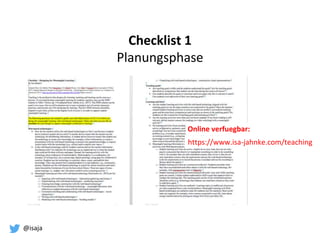
Checklist 1
Planungsphase
Online verfuegbar:
https://www.isa-jahnke.com/teaching
@isaja
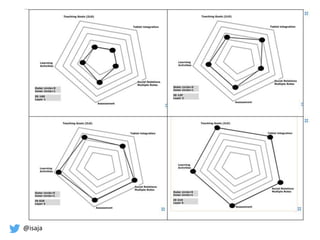
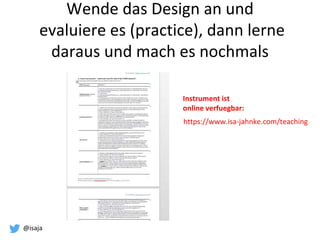
Wende das Design an und
evaluiere es (practice), dann lerne
daraus und mach es nochmals
Instrument ist
online verfuegbar:
https://www.isa-jahnke.com/teaching
@isaja
Online-Seminar
Beispiel
@isaja
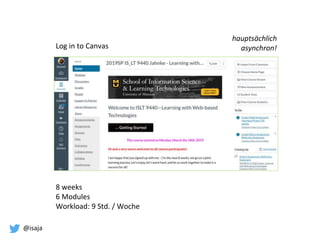
Log in to Canvas
8 weeks
6 Modules
Workload: 9 Std. / Woche
hauptsächlich
asynchron!
@isaja
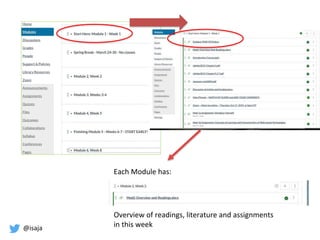
Each Module has:
Overview of readings, literature and assignments
in this week
@isaja
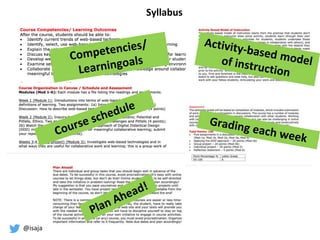
Syllabus
@isaja
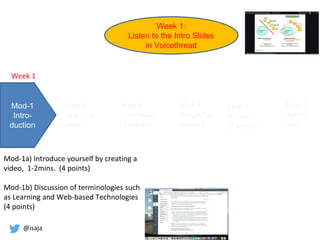
Modules
Mod-1
Intro-
duction
Mod-2
Your first
ideas
Mod-3
Team work
(2 weeks)
Mod-4
Design for
learning
Mod-5
Project
(2 weeks)
Mod-5
Reflec-
tion
Mod-1a) Introduce yourself by creating a
video, 1-2mins. (4 points)
Mod-1b) Discussion of terminologies such
as Learning and Web-based Technologies
(4 points)
Week 1
Week 1:
Listen to the Intro Slides
in Voicethread
@isaja
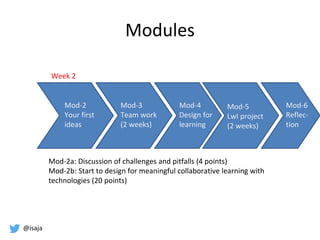
Modules
Mod-2
Your first
ideas
Mod-3
Team work
(2 weeks)
Mod-4
Design for
learning
Mod-5
LwI project
(2 weeks)
Mod-6
Reflec-
tion
Mod-2a: Discussion of challenges and pitfalls (4 points)
Mod-2b: Start to design for meaningful collaborative learning with
technologies (20 points)
Week 2
@isaja
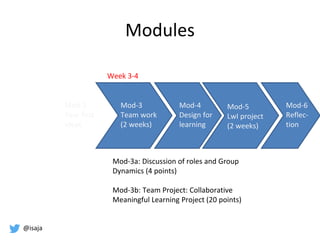
Modules
Mod-3a: Discussion of roles and Group
Dynamics (4 points)
Mod-3b: Team Project: Collaborative
Meaningful Learning Project (20 points)
Week 3-4
Mod-2
Your first
ideas
Mod-3
Team work
(2 weeks)
Mod-4
Design for
learning
Mod-5
LwI project
(2 weeks)
Mod-6
Reflec-
tion
@isaja
Modules
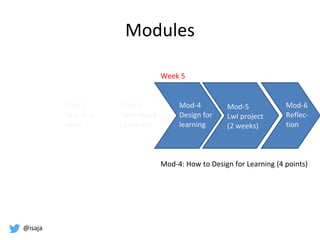
Mod-4: How to Design for Learning (4 points)
Week 5
Mod-2
Your first
ideas
Mod-3
Team work
(2 weeks)
Mod-4
Design for
learning
Mod-5
LwI project
(2 weeks)
Mod-6
Reflec-
tion
@isaja
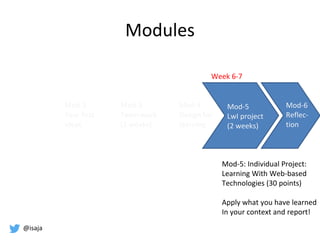
Mod-5: Individual Project:
Learning With Web-based
Technologies (30 points)
Apply what you have learned
In your context and report!
Week 6-7
Mod-2
Your first
ideas
Mod-3
Team work
(2 weeks)
Mod-4
Design for
learning
Mod-5
LwI project
(2 weeks)
Mod-6
Reflec-
tion
Modules
@isaja
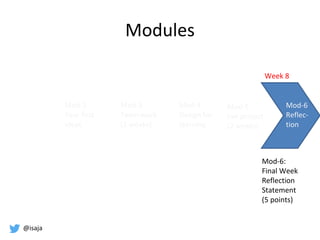
Mod-6:
Final Week
Reflection
Statement
(5 points)
Week 8
Mod-2
Your first
ideas
Mod-3
Team work
(2 weeks)
Mod-4
Design for
learning
Mod-5
LwI project
(2 weeks)
Mod-6
Reflec-
tion
Modules
@isaja
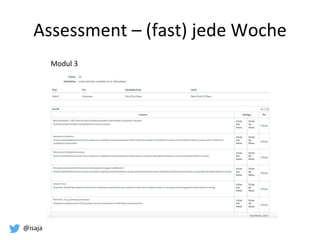
Assessment – (fast) jede Woche
Modul 3
@isaja
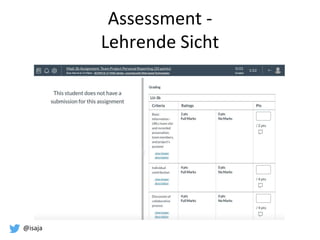
Assessment -
Lehrende Sicht
@isaja
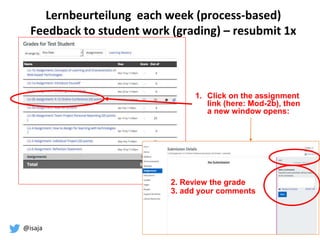
Lernbeurteilung each week (process-based)
Feedback to student work (grading) – resubmit 1x
1. Click on the assignment
link (here: Mod-2b), then
a new window opens:
2. Review the grade
3. add your comments
@isaja
Set rules for discussion board
• No claims without evidence!
– Add literature/references; AND: list of references in the end of your
post!
• Two parts: Your own post (usually due Thursday) AND reply to
others! (usually due Saturdays)
• How to engage with others online? Ask questions! 
• Don’t expect that others understand you. If you notice such an
issue, describe your viewpoint with other words.
@isaja
Important for teachers: Be present!
in online discussions, via messages or announcements;
have one synchronous online meeting in the first week
@isaja
Zusammenfassung
1)
pedagogy active-meaningful learning
technology ”with” not “from" technology
the social humanizing the online space
2)
Use the DDD for designing blended/online learning:
• Course design – teacher self-assessment
• Peer assessment of the course design
• Or, give the design to students to assess the course design
@isaja
The first principle of true teaching is that
Nothing can be taught
(Oscar Wilde)
….und dies meint:
Viel Spass beim Ausprobieren und Anwenden!
@isaja
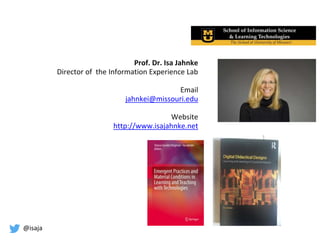
Prof. Dr. Isa Jahnke
Director of the Information Experience Lab
Email
jahnkei@missouri.edu
Website
http://www.isajahnke.net

Active-Meaningful Learning with Technologies

  • 1.
    @isaja Meaningful Learning With Technologies Prof.Dr. Isa Jahnke @DGWF in Ulm, Deutschland September 20th, 2019
  • 2.
  • 3.
    @isaja Vollstaendig online seit2003 (erster Onlinekurs 1999) Studiengang meines Departments Educational Technology (EdTech)  Learning Technologies Design (LTD) https://sislt.missouri.edu/ Mein Hintergrund Professorin in • Deutschland (2008-2011) • Schweden (2011-2015) • U.S.A. (seit 2015) Mein erstes blended learning seminar an der TU Dortmund: 2001 Mein erster Onlinekurs: 2016 Forschungsprojekte zu Lehre/Lernen mit Technologien Disziplinuebergreifend: LehrerInnenbildung, Informatik, Ingenieurwiss.
  • 4.
    @isaja Lehrende können Prozessegestalten, um Lernen zu fördern
  • 5.
    @isaja 1. Grundlage /Annahmen • CrossActionSpaces • Active, meaningful learning • Lernen mit Technologien vs. Lernen durch Technologien 2. Kursdesign/Didaktik Rahmenkonzept: DDD 3. Beispiel (m)eines Online-Seminars Übersicht
  • 6.
    @isaja Classroom / Course Classroom / Course Digital-enhancedclassroom: Physical and online spaces are merging We go to college/university because of getting access to learning processes Twitter, FB, GroupApps, … Interactive/Live Broadcasting, … Websites, Blogs, … and more Traditional classroom: Separation We went to college/univ. because of getting access to information CrossActionSpaces
  • 7.
    @isaja Aktive Lernstrategien (activelearning) or Activity-based model of instruction: Studierende lernen nicht weil der Lehrende eine Aktivität ausführt, sondern sie lernen durch ihre eigenen Aktivitäten (mithilfe von Lernaufgaben/assignments) Aktive Lern-Paedagogik verbessert studentische Performance Freeman et al., 2014 Chi, 2009: Active-Constructive-Interactive Hodges, L.C. (2018). Contemporary issues in group learning in undergraduate science classrooms: A perspective from student engagement. CBE-Life Sciences Education, 17(2), es3. https://www.lifescied.org/doi/full/10.1187/cbe.17-11-0239
  • 8.
    @isaja Aktive Lernstrategie: Meaningful learning Howland,Jonassen, & Marra, 2012 New book: “Meaningful Online Learning” 2018
  • 9.
    @isaja Lernen durch vs.mit Technologien Jonassen, 1996 Learning from technologies Learning about technologies Learning with technologies Drill and practice, tutorials, memorizing (passive learning) Computer-Kompetenz Active learning, higher order learning skills • Learner has no input into the process, • students are controlled by the technology • Learning about how to use the technology, • to understand how the computer works • Intellectual partnership, • computer enhances learner thinking /learning Computer program is programmed to teach the student, to direct activities toward the acquisition of prespecified knowledge or skills Memorizing parts of facts about technologies is relatively meaningless; better would be to understanding results from using not memorizing Technology use to extend cognitive functioning during learning and engage learners in cognitive operations while constructing knowledge that they would not otherwise been capable of. Beispiel: Video-aufgezeichnete Vorlesung Studierende nutzen es als mindtools
  • 10.
  • 11.
    @isaja Rollen/ Soziale Interaktion Lern- Aktivitaeten Lehr-/Lernziele Aussen=5 Innen =1 Technologien Assessment /Lernbeurteilung 1 2 3 4 5 Von traditionellen Kursen (innen =1) zu meaningful practices (aussen =5)
  • 12.
    @isaja Lehr-/Lernziele Sichtbar &deutlich für Studierende? Wo können Studierende diese lesen?
  • 13.
    @isaja Lern- Aktivitäten • Authentisch • Aktiv •Konstruktiv • Kollaborativ • Intentional Lehr-/Lernziele
  • 14.
    @isaja Iteratives Assessment /Lernbeurteilung Prozess-basiertes/formatives Assessment? Wann/wie geben Lehrende Feedback im Prozess? Durch studentische Selbstreflektion/peers/ Feedback durch Lehrende? Lehr-/Lernziele Lern- Aktivitäten
  • 15.
    @isaja Rollen / Interaktion Soziale Beziehungen Rollenvielfaltfür Studierende: active agents/co-designer; Lehrende: nicht nur Experten, auch LernbegleiterInnen Iteratives Assessment / Lernbeurteilung Lehr-/Lernziele Lern- Aktivitäten
  • 16.
    @isaja Technologien Wird nicht dasLehrbuch ersetzen, sondern” ”mindtool” (learning with technologies) Rollen / Interaktion Soziale Beziehungen Iteratives Assessment / Lernbeurteilung Lehr-/Lernziele Lern- Aktivitäten
  • 17.
    @isaja Lern- Aktivitaeten Lehr-Lernziele Rollenvielfalt / Soziale Interaktion Web-basierte Technologien Wiewissen Sie, wann ihr Design auf dem richtigen (usable) Weg ist? Iteratives Assessment
  • 18.
    @isaja Rollen/ Soziale Interaktion Lern- Aktivitaeten Lehr-/Lernziele Aussen=5 Innen =1 Technologien Assessment /Lernbeurteilung 1 2 3 4 5 Von traditionellen Kursen (innen =1) zu meaningful practices (aussen =5)
  • 19.
    @isaja 1 DDD componentDescription of Coding scheme Character of Teaching goals/ILO and intended/expected learning outcomes: clear and visible? TA/ILO 1= Not clear, not visible, no communication about teaching aims or learning intentions; focus on content 2= 3= Oral communication 4= 5= Teaching aims are clear and visible for students; intended learning outcomes in forms of development of skills; a source is available where the students can go and read aims and objectives; at best, co-aims of students are included, students know the criteria for learning progress (available right form the start). Character of Learning activities: towards producing in engaged, authentic, deep, open settings? LA 1= Students hear what teachers read from the textbook (surface learning only; e.g. remembering/ repetition of facts); theoretical problems without connecting it to a real world problem 2= 3= In-between (…) – signs are: students are not so engaged, too much time for doing other things (e.g. playing cards instead) 4= 5= Learning activities have a range from surface to deep learning: students produce something, engaged classrooms, collaboration with peers; the activities are connected to the students world and include a real-world problem (e.g. everyday experience); a real audience, students critically reflect on existing content (e.g. evaluating/creating/making), relate knowledge to new knowledge; “organize and structure content into coherent whole” (Marten & Säljö, 1979), students are engaged in producing, using the Internet or other sources beyond the physical school walls (signs of crossactions) Character of assessment: process-based? ASM 1 = Feedback only at the end (summative feedback); character of the feedback is rather summative, not formative 2= 3= Feedback during the class (not only technical help) by coincidence; teacher only gives feedback when they ask for support; passive support 4= 5= Criteria for a learning progress are visible for students from the beginning of the learning process; Feedback/feed- forward at the end but mainly process-based assessment for learner’s development; a plan exists for how the teacher creates pro-assessment (formative evaluation); a range of forms such as self-assessment; peer-reflective learning and feedback by the teacher, e.g. students document learning (electronically; a map or text, etc.), the teacher asks them to go back and reflect. Character of Social relations: multiple roles (not only consumers?)? RO 1= Teacher is in the traditional role of the expert only; students are only seen as consumers (of solving closed questions and tasks where only one correct answer is possible) 2= 3= Teacher is in 1-2 roles but spends majority of time as expert; teacher does not support student engagement to be active 4= 5= TEACHER plays different roles, e.g., expert, process mentor, learning-companion, coach, she fosters students to be in different roles such as consumers, producers, collaborators, critical reflectors, etc.; teacher engages students; teacher activates the students to change their roles; STUDENTS are in several roles, e.g. teachers for their peers, finding own learning aims, creating own learning tasks, etc., teacher supports student reflection of roles and development of new roles. Character of Web-enabled technology/ tablets for crossactions? TAB 1= Low extent, drill and practice; students work primarily alone when using technology, not related to the real world (e.g., technology is substitute for pen and paper) 2= 3= Medium extent (e.g., new technology is substitute for existing media; for example, tablet substitutes a laptop) 4= 5= High extent, multimodal, beyond writing texts, camera app, digital paintings, apps for collaborative creation; students construct, share, create, publish their knowledge (to a real audience); students use online resources, actively select topics beyond the limitations of even the best school library, signs of crossaction (using online world to solve a learning activity).
  • 20.
  • 21.
  • 22.
    @isaja Wende das Designan und evaluiere es (practice), dann lerne daraus und mach es nochmals Instrument ist online verfuegbar: https://www.isa-jahnke.com/teaching
  • 23.
  • 24.
    @isaja Log in toCanvas 8 weeks 6 Modules Workload: 9 Std. / Woche hauptsächlich asynchron!
  • 25.
    @isaja Each Module has: Overviewof readings, literature and assignments in this week
  • 26.
  • 27.
    @isaja Modules Mod-1 Intro- duction Mod-2 Your first ideas Mod-3 Team work (2weeks) Mod-4 Design for learning Mod-5 Project (2 weeks) Mod-5 Reflec- tion Mod-1a) Introduce yourself by creating a video, 1-2mins. (4 points) Mod-1b) Discussion of terminologies such as Learning and Web-based Technologies (4 points) Week 1 Week 1: Listen to the Intro Slides in Voicethread
  • 28.
    @isaja Modules Mod-2 Your first ideas Mod-3 Team work (2weeks) Mod-4 Design for learning Mod-5 LwI project (2 weeks) Mod-6 Reflec- tion Mod-2a: Discussion of challenges and pitfalls (4 points) Mod-2b: Start to design for meaningful collaborative learning with technologies (20 points) Week 2
  • 29.
    @isaja Modules Mod-3a: Discussion ofroles and Group Dynamics (4 points) Mod-3b: Team Project: Collaborative Meaningful Learning Project (20 points) Week 3-4 Mod-2 Your first ideas Mod-3 Team work (2 weeks) Mod-4 Design for learning Mod-5 LwI project (2 weeks) Mod-6 Reflec- tion
  • 30.
    @isaja Modules Mod-4: How toDesign for Learning (4 points) Week 5 Mod-2 Your first ideas Mod-3 Team work (2 weeks) Mod-4 Design for learning Mod-5 LwI project (2 weeks) Mod-6 Reflec- tion
  • 31.
    @isaja Mod-5: Individual Project: LearningWith Web-based Technologies (30 points) Apply what you have learned In your context and report! Week 6-7 Mod-2 Your first ideas Mod-3 Team work (2 weeks) Mod-4 Design for learning Mod-5 LwI project (2 weeks) Mod-6 Reflec- tion Modules
  • 32.
    @isaja Mod-6: Final Week Reflection Statement (5 points) Week8 Mod-2 Your first ideas Mod-3 Team work (2 weeks) Mod-4 Design for learning Mod-5 LwI project (2 weeks) Mod-6 Reflec- tion Modules
  • 33.
    @isaja Assessment – (fast)jede Woche Modul 3
  • 34.
  • 35.
    @isaja Lernbeurteilung each week(process-based) Feedback to student work (grading) – resubmit 1x 1. Click on the assignment link (here: Mod-2b), then a new window opens: 2. Review the grade 3. add your comments
  • 36.
    @isaja Set rules fordiscussion board • No claims without evidence! – Add literature/references; AND: list of references in the end of your post! • Two parts: Your own post (usually due Thursday) AND reply to others! (usually due Saturdays) • How to engage with others online? Ask questions!  • Don’t expect that others understand you. If you notice such an issue, describe your viewpoint with other words.
  • 37.
    @isaja Important for teachers:Be present! in online discussions, via messages or announcements; have one synchronous online meeting in the first week
  • 38.
    @isaja Zusammenfassung 1) pedagogy active-meaningful learning technology”with” not “from" technology the social humanizing the online space 2) Use the DDD for designing blended/online learning: • Course design – teacher self-assessment • Peer assessment of the course design • Or, give the design to students to assess the course design
  • 39.
    @isaja The first principleof true teaching is that Nothing can be taught (Oscar Wilde) ….und dies meint: Viel Spass beim Ausprobieren und Anwenden!
  • 40.
    @isaja Prof. Dr. IsaJahnke Director of the Information Experience Lab Email jahnkei@missouri.edu Website http://www.isajahnke.net

Editor's Notes

  • #4 I teach in a Master program that is entirely online, Ed Tech. My first blended learning course was in 2001. New trend: Learning Engineering (merging science and data)
  • #7 View 1 from traditional face-to-face classroom view