S C H O O L O F I N F O R M AT I O N S C I E N C E A N D L E A R N I N G
T E C H N O L O G I E S ( S I S LT ) @ C O L L E G E O F E D U C AT I O N
ZOOM Webinar
Teaching Online Courses:
Basic Principles for
Asynchronous Learning
Dr. Isa Jahnke &
Dr. Jane Howland
April/30, 2020
1
Introduction
• Learning Technologies Master’s program fully online since 2003
https://sislt.missouri.edu/certificates/online-educator/
• Dr. Jane Howland, Teaching Professor, Program Director,
20+ years of Online Teaching
• Dr. Isa Jahnke, Associate Professor,
20 years of hybrid/blended learning, 5 years of Online Teaching
2
Target Audience & Goals
for this webinar
• Educators, faculty/instructors in higher education and
teachers in K-12 schools
• Learning goals:
Basic principles for Asynchronous Online Learning
3
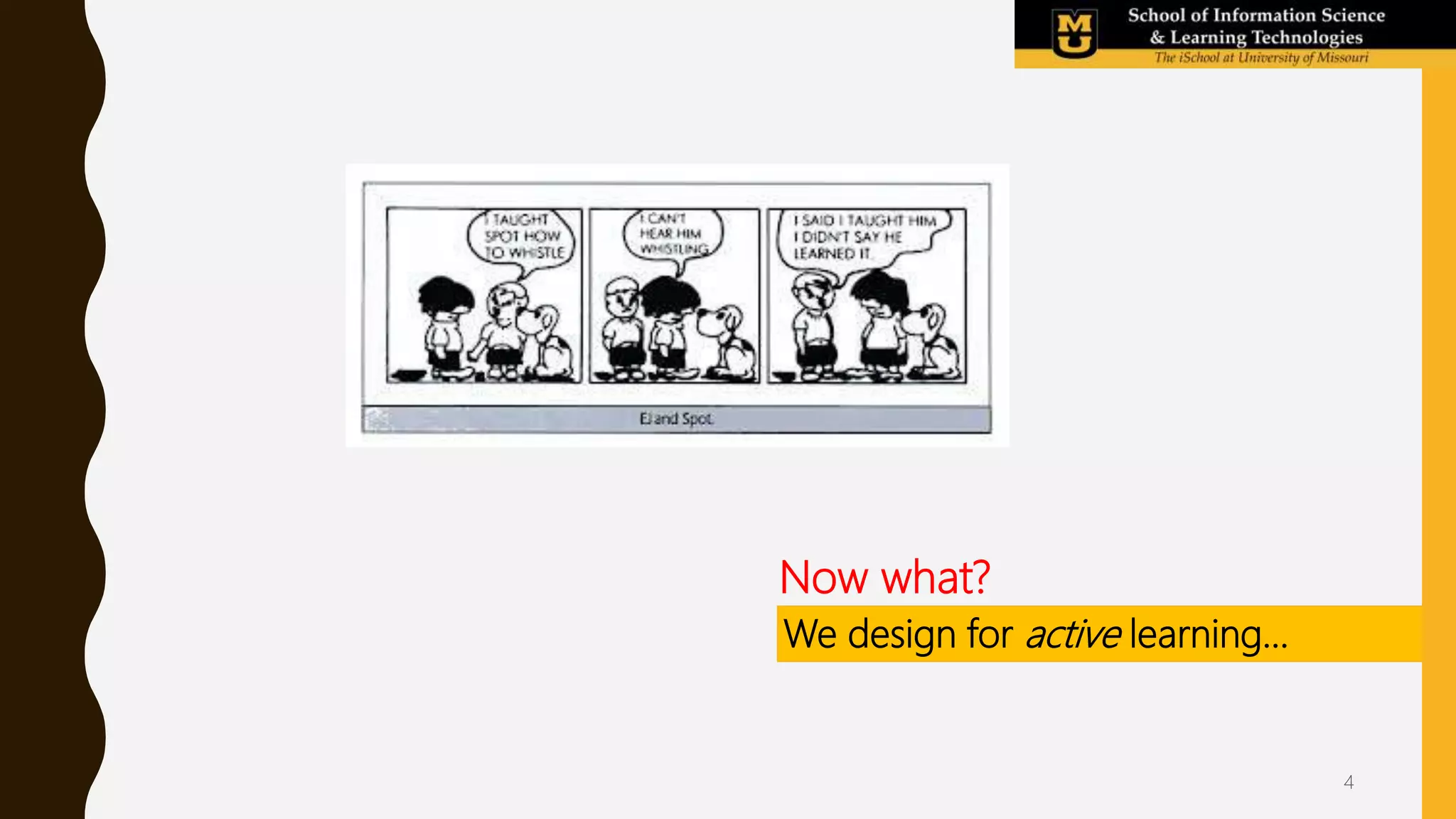
Now what?
We design for active learning…
4
Active Learning
increases positive student learning outcomes and student
performance
Why active learning?
What is active learning?
Freeman et al. (2014)
Chi (2009)
Hodges, L.C. (2018)
Activity-based model of instruction
Students don’t learn because the instructor does some
activity but students learn through their own activity
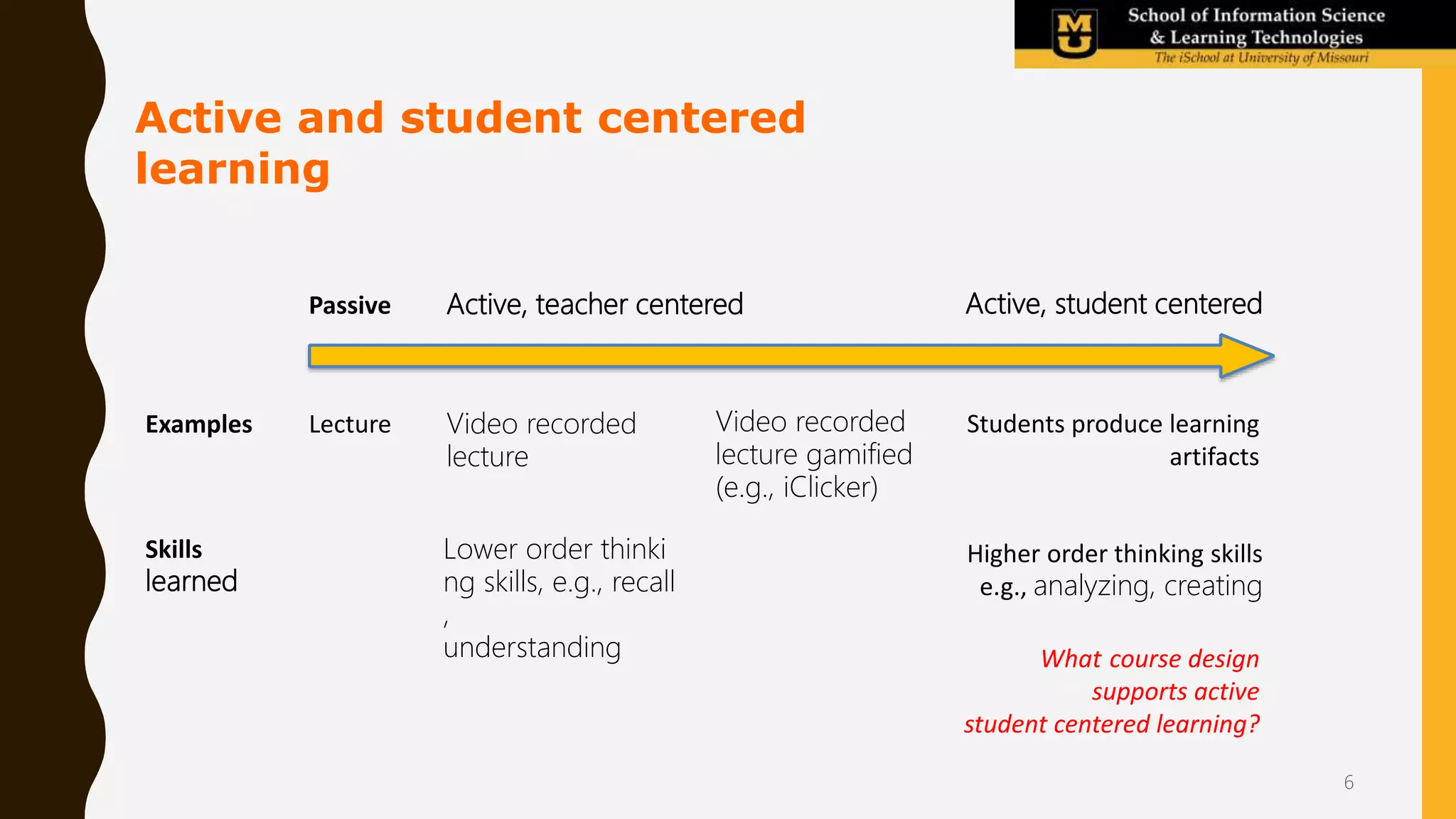
Passive Active, student centeredActive, teacher centered
Lecture Video recorded
lecture
Students produce learning
artifacts
What course design
supports active
student centered learning?
Active and student centered
learning
Examples
Lower order thinki
ng skills, e.g., recall
,
understanding
Skills
learned
Video recorded
lecture gamified
(e.g., iClicker)
Higher order thinking skills
e.g., analyzing, creating
6
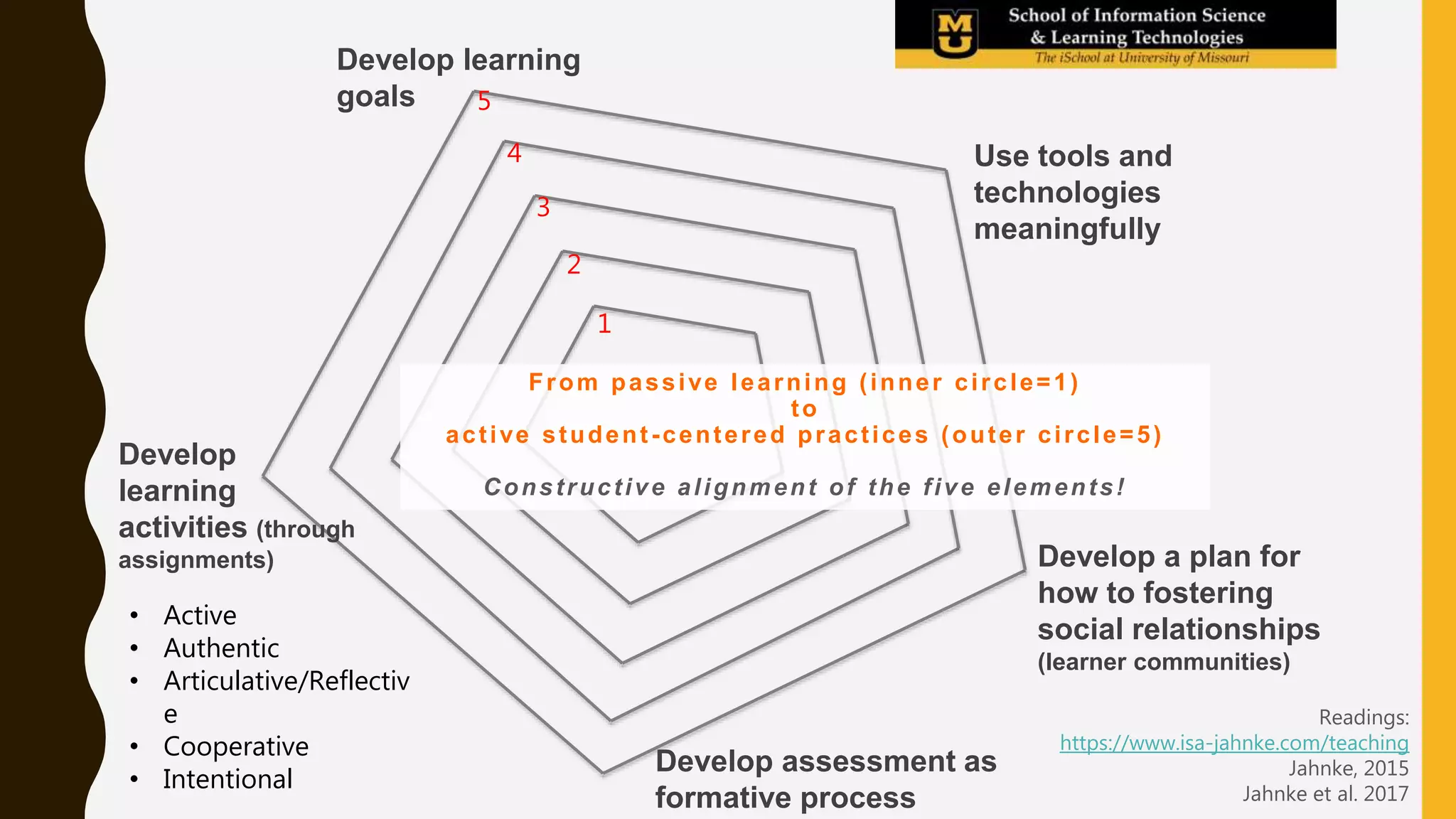
1
2
3
4
5
From passive learning (inner circle=1)
to
active student-centered practices (outer circle=5)
Constructive alignment of the five elements!
Use tools and
technologies
meaningfully
Develop assessment as
formative process
Develop
learning
activities (through
assignments)
Develop learning
goals
Develop a plan for
how to fostering
social relationships
(learner communities)
Readings:
https://www.isa-jahnke.com/teaching
Jahnke, 2015
Jahnke et al. 2017
• Active
• Authentic
• Articulative/Reflectiv
e
• Cooperative
• Intentional
8
BASIC PRINCIPLES
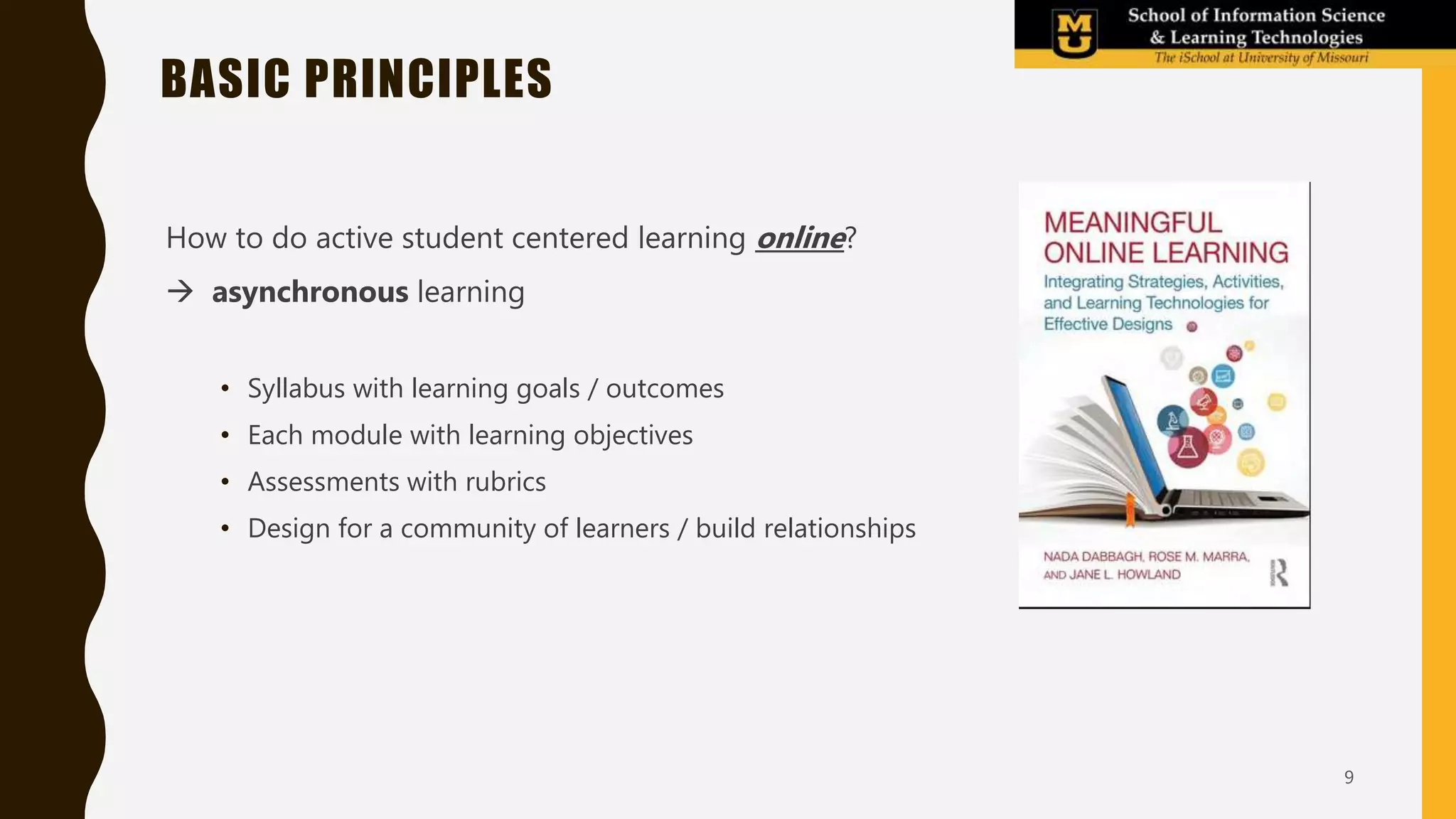
How to do active student centered learning online?
 asynchronous learning
• Syllabus with learning goals / outcomes
• Each module with learning objectives
• Assessments with rubrics
• Design for a community of learners / build relationships
9
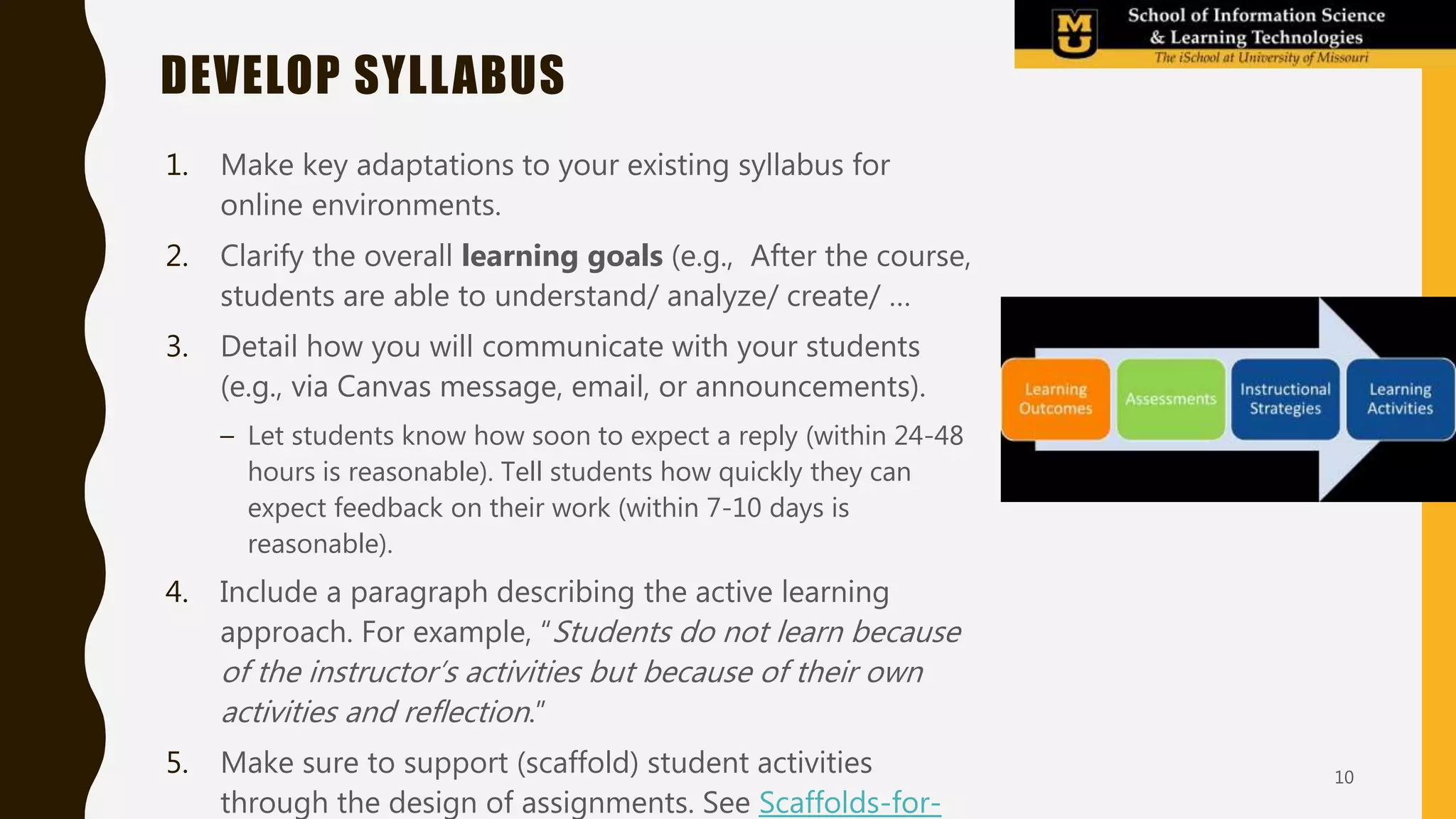
1. Make key adaptations to your existing syllabus for
online environments.
2. Clarify the overall learning goals (e.g., After the course,
students are able to understand/ analyze/ create/ …
3. Detail how you will communicate with your students
(e.g., via Canvas message, email, or announcements).
– Let students know how soon to expect a reply (within 24-48
hours is reasonable). Tell students how quickly they can
expect feedback on their work (within 7-10 days is
reasonable).
4. Include a paragraph describing the active learning
approach. For example, “Students do not learn because
of the instructor’s activities but because of their own
activities and reflection.”
5. Make sure to support (scaffold) student activities
through the design of assignments. See Scaffolds-for-
DEVELOP SYLLABUS
10
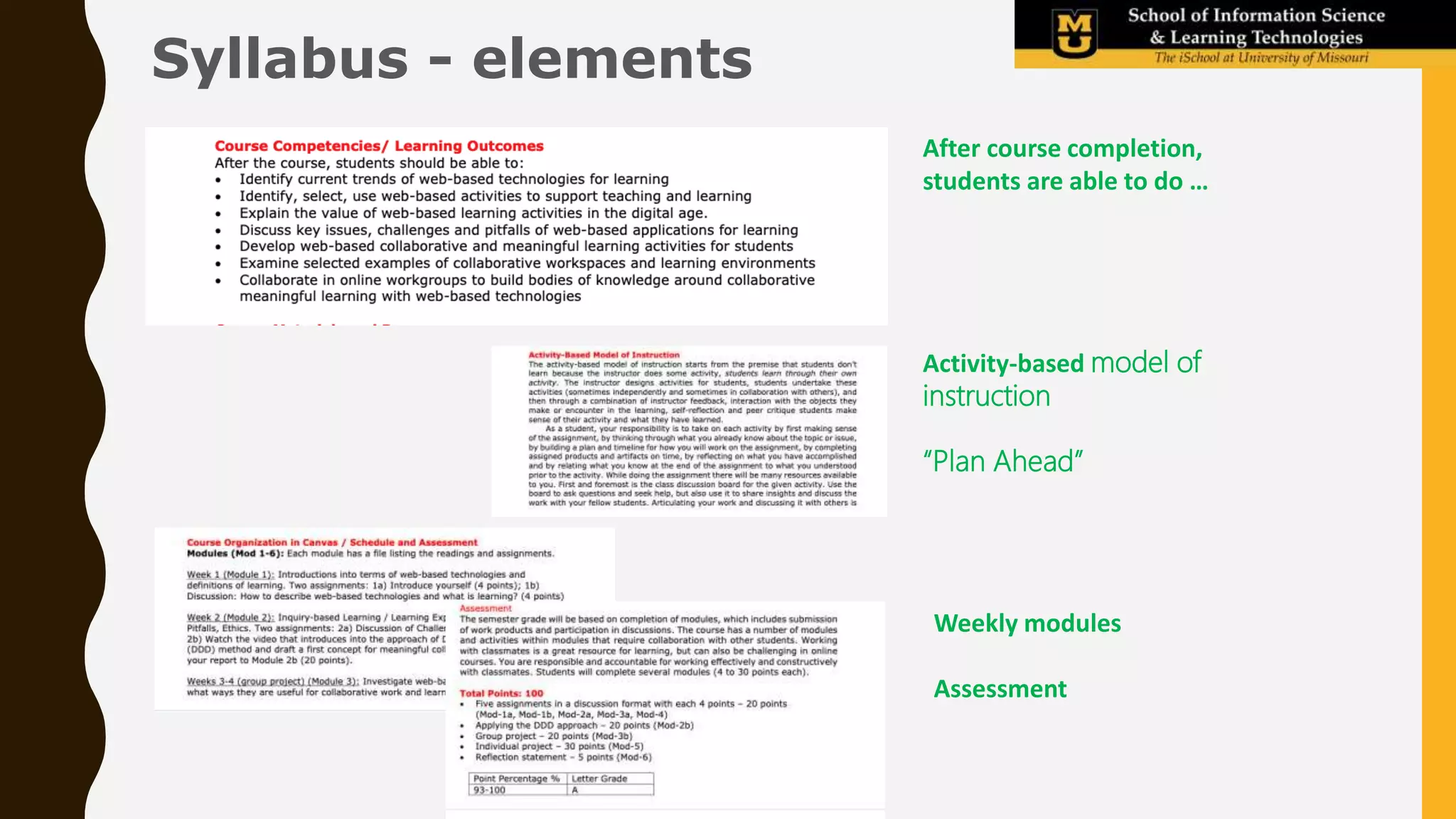
Activity-based model of
instruction
“Plan Ahead”
After course completion,
students are able to do …
Weekly modules
Assessment
Syllabus - elements
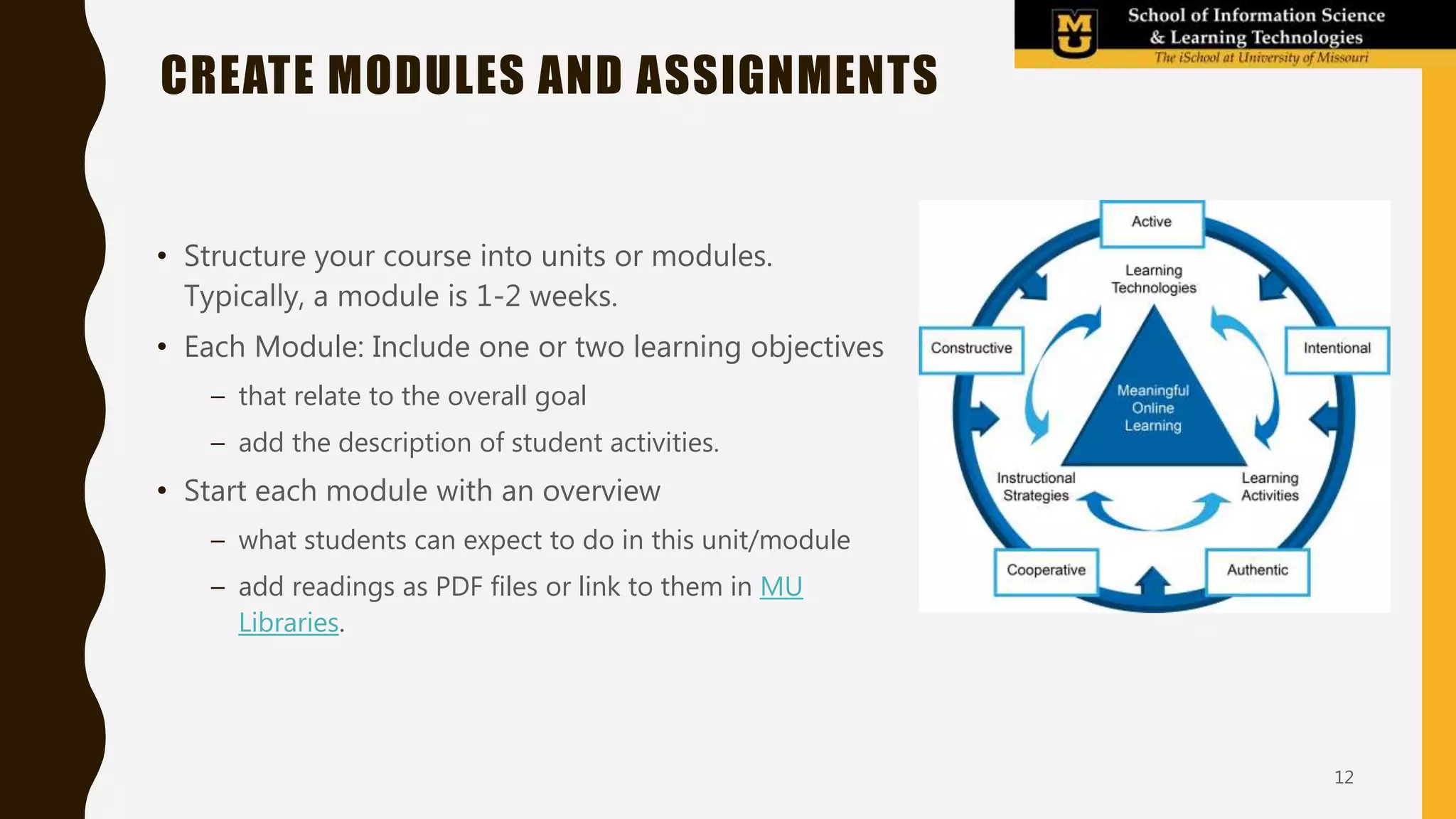
• Structure your course into units or modules.
Typically, a module is 1-2 weeks.
• Each Module: Include one or two learning objectives
– that relate to the overall goal
– add the description of student activities.
• Start each module with an overview
– what students can expect to do in this unit/module
– add readings as PDF files or link to them in MU
Libraries.
CREATE MODULES AND ASSIGNMENTS
12
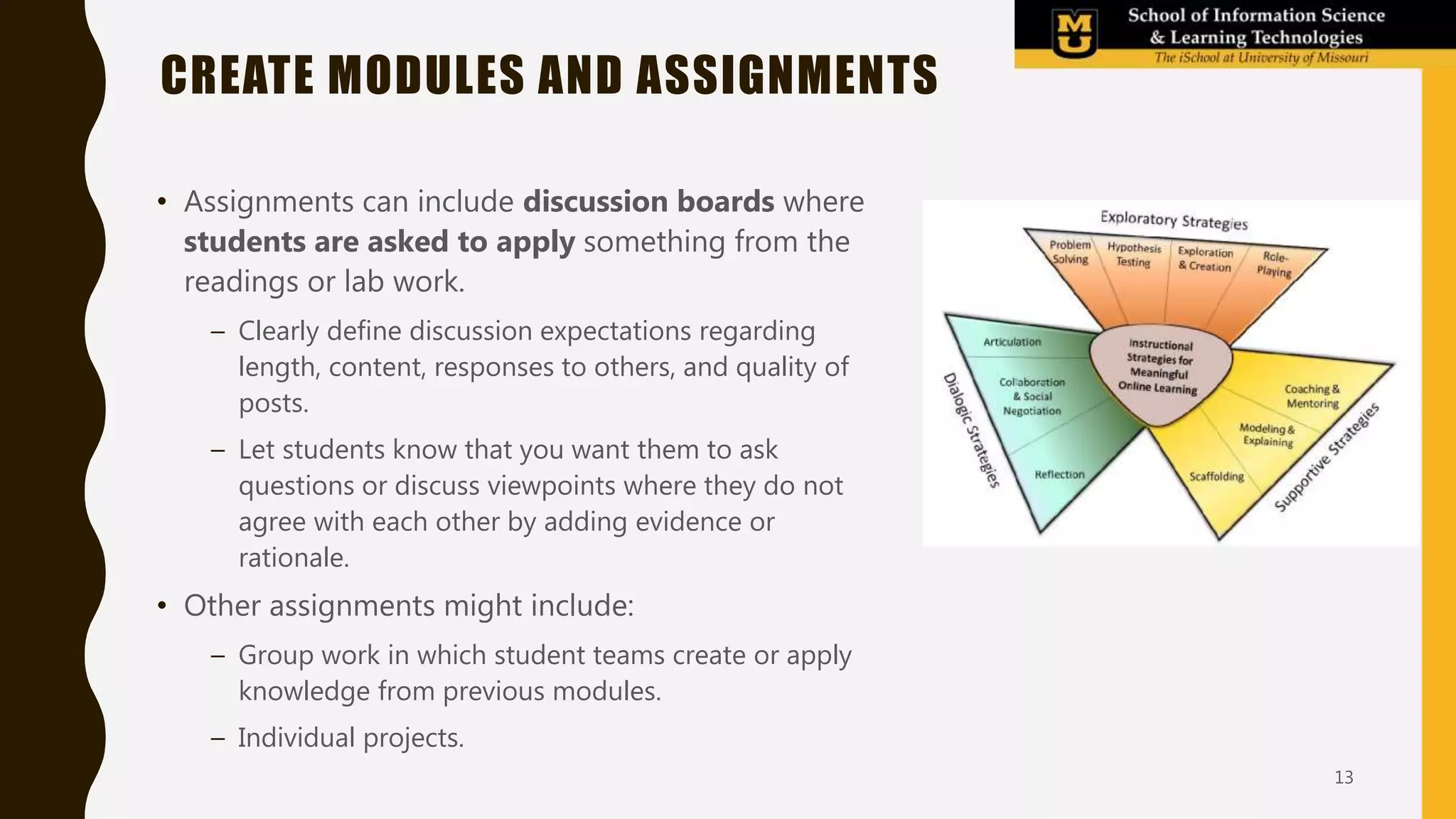
• Assignments can include discussion boards where
students are asked to apply something from the
readings or lab work.
– Clearly define discussion expectations regarding
length, content, responses to others, and quality of
posts.
– Let students know that you want them to ask
questions or discuss viewpoints where they do not
agree with each other by adding evidence or
rationale.
• Other assignments might include:
– Group work in which student teams create or apply
knowledge from previous modules.
– Individual projects.
CREATE MODULES AND ASSIGNMENTS
13
ASSESSMENT WITH RUBRICS
ALIGN learning objectives, student activities (through
assignment design) and assessment.
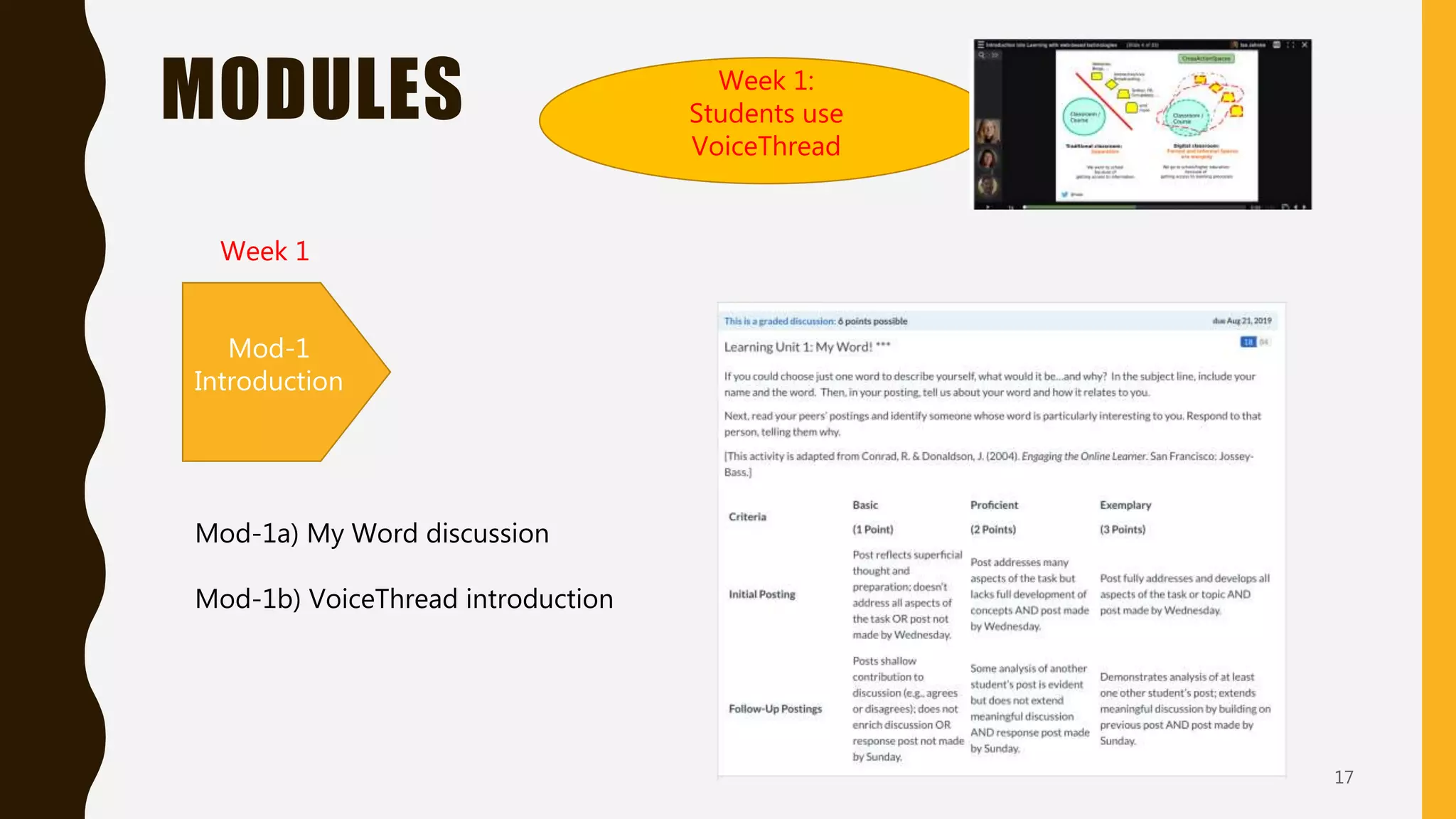
– Begin with learning objectives.
– Determine what evidence students will provide to demonstrate
they have achieved those outcomes.
– Design a scoring guide or rubric for each assignment to help
your students know what’s expected and what you will consider
as you grade their work. (site).
– You may choose to allow students to improve their work and be
re-graded within a specific time. Depending on the
assignment’s scope, students might be given 3-4 days to re-
submit.
– Finally, create activities that will support students in that
learning.
14
• Engage students! Create a Social Presence!
– Students feel the instructor is ‘there’ through an online social presence.
• Add short video messages in some modules.
• Post Announcements at least weekly
• For an interactive video experience, use VoiceThread (available in Mizzou Canvas).
– Upload slides and record audio or video on each one.
– Students can comment on slides after listening to the instructor.
– Include questions in your Voicethread or ask students to discuss content in the context
of relevant literature, personal experiences, etc.
– Use for student groups to present their work. Teams can comment on other teams’
VoiceThreads – a kind of peer review. Then teams might use the comments to revise
and improve their original work.
BUILD A PLAN TO FOSTER SOCIAL RELATIONSHIPS
15
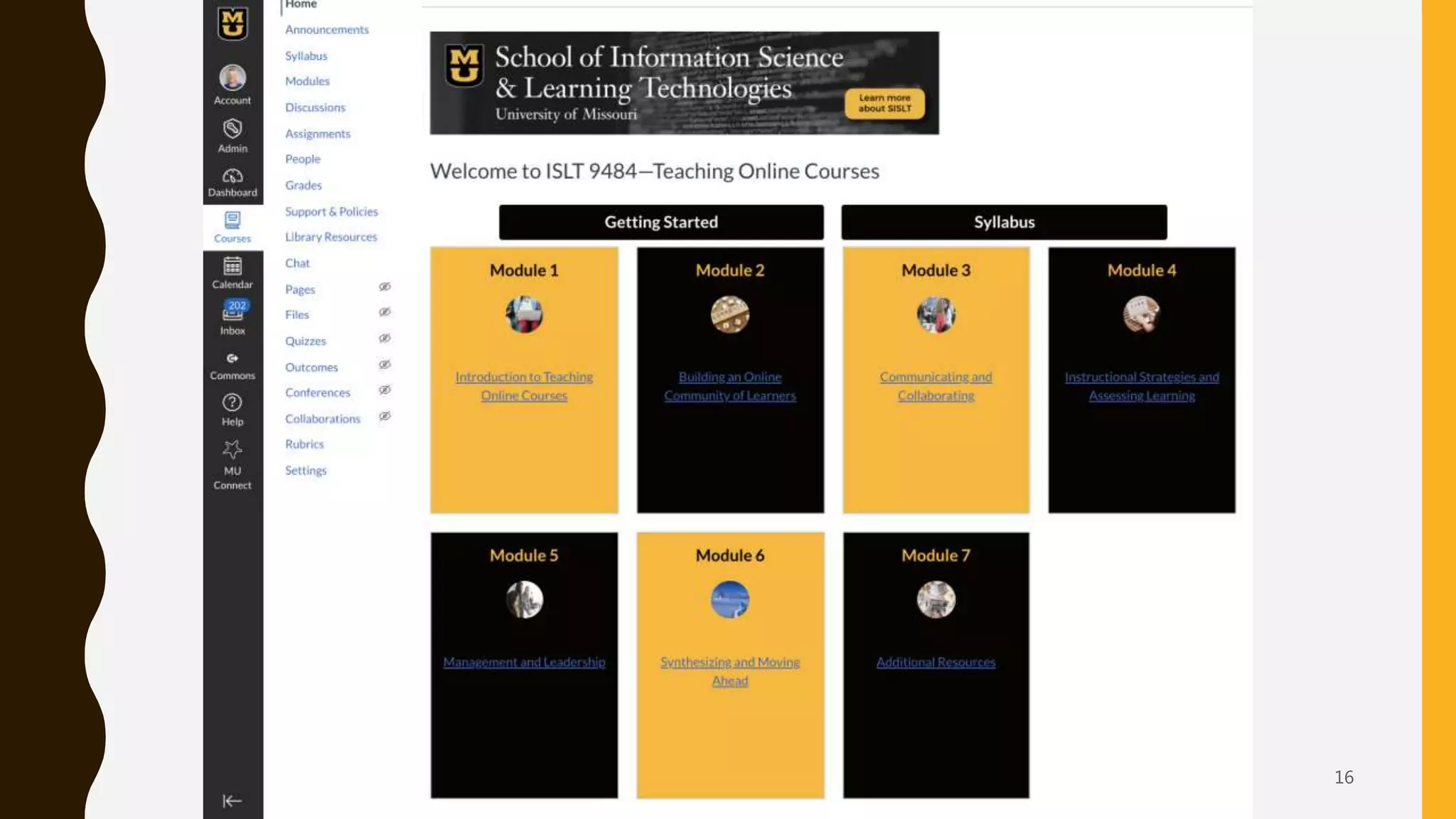
16
MODULES
Mod-1
Introduction
Mod-2
Your first
ideas
Mod-3
Team work
(2 weeks)
Mod-4
Design for
learning
Mod-5
Project
(2 weeks)
Mod-1a) My Word discussion
Mod-1b) VoiceThread introduction
Week 1
Week 1:
Students use
VoiceThread
17
MODULES
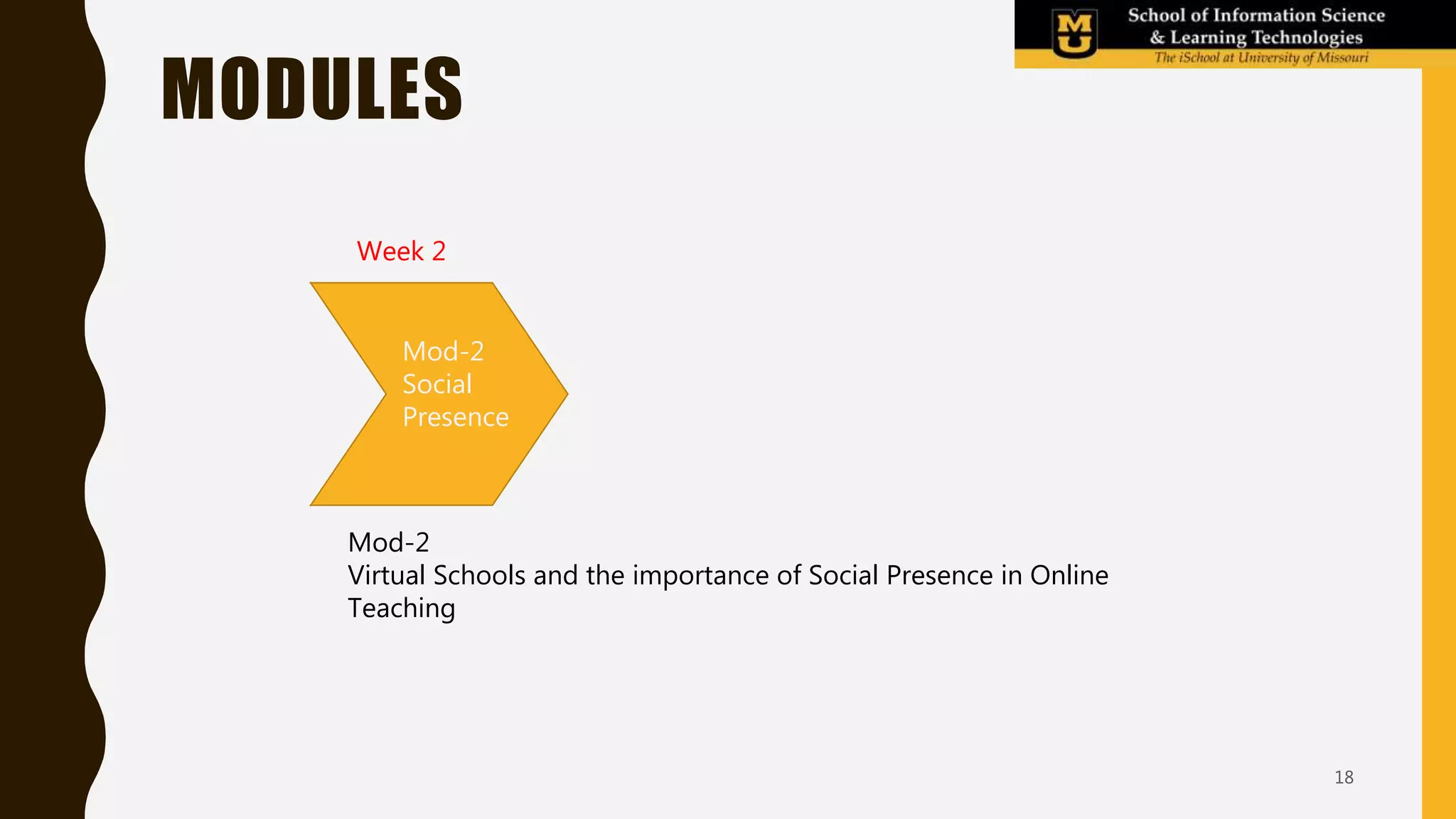
Mod-2
Social
Presence
Mod-2
Virtual Schools and the importance of Social Presence in Online
Teaching
Week 2
18
MODULES
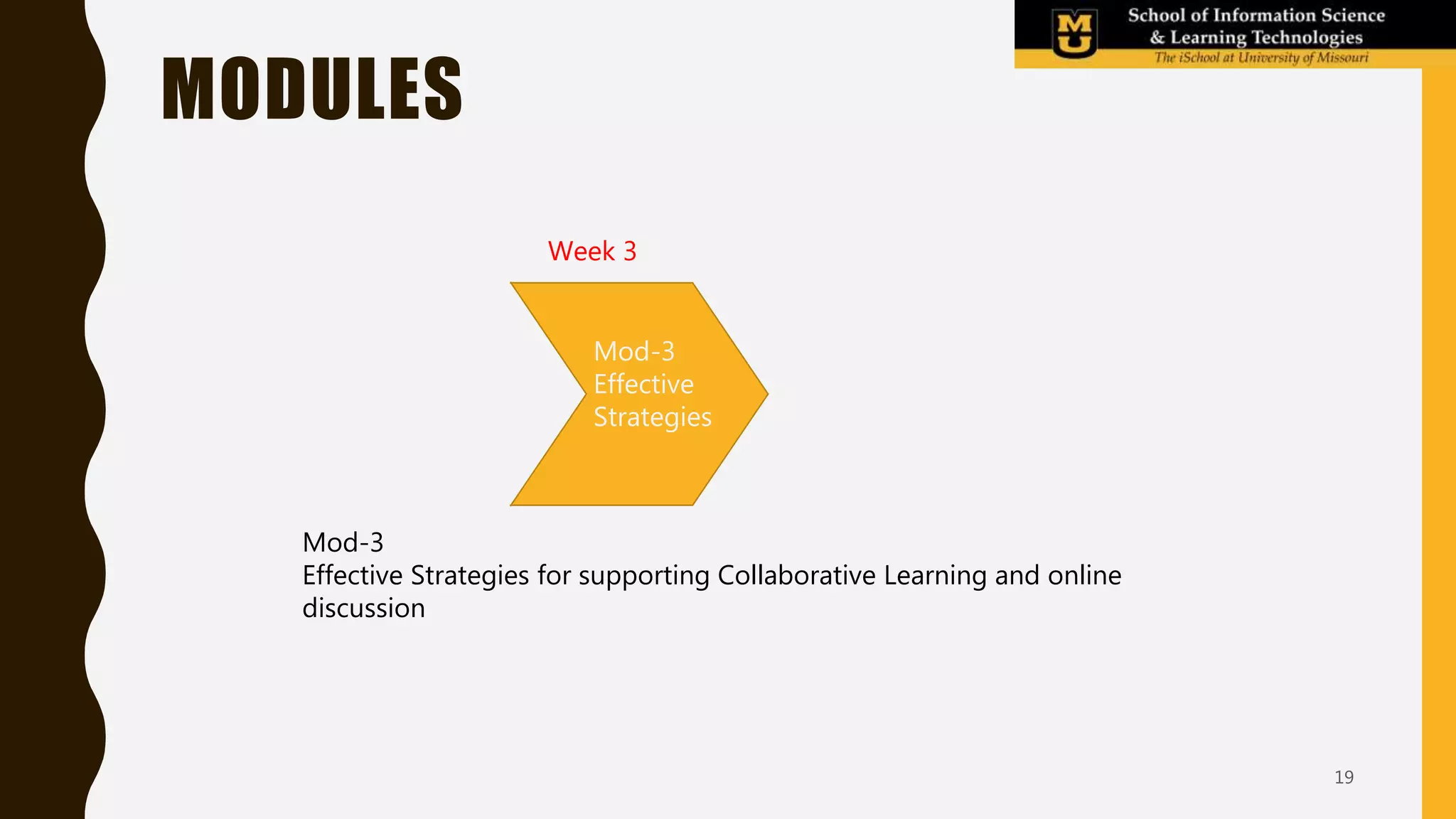
Mod-3
Effective Strategies for supporting Collaborative Learning and online
discussion
Week 3
Mod-2
Your first
ideas
Mod-3
Effective
Strategies
19
MODULES
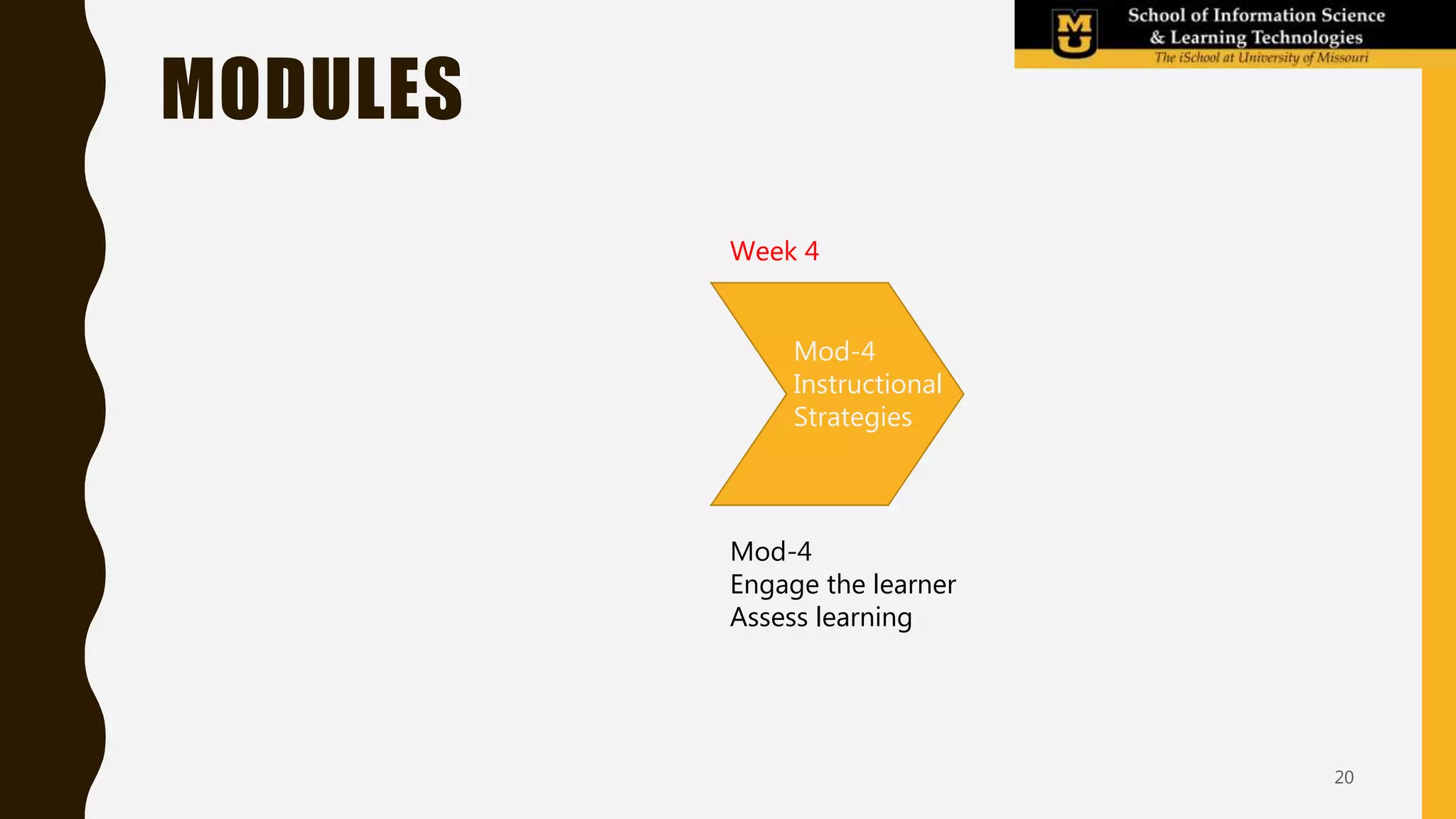
Mod-4
Engage the learner
Assess learning
Week 4
Mod-2
Your first
ideas
Mod-3
Team work
(2 weeks)
Mod-4
Instructional
Strategies
20
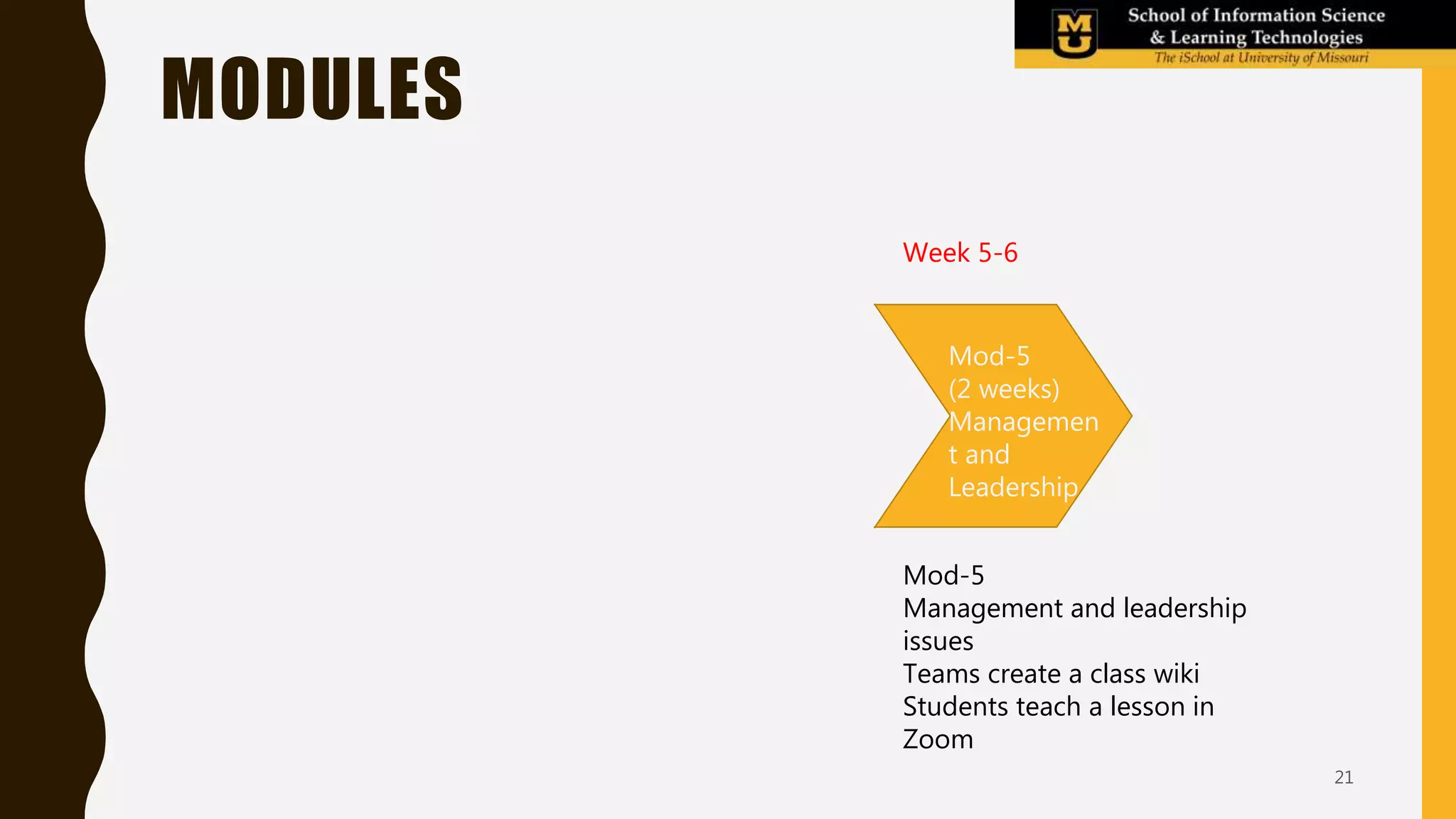
Mod-5
Management and leadership
issues
Teams create a class wiki
Students teach a lesson in
Zoom
Week 5-6
Mod-2
Your first
ideas
Mod-3
Team work
(2 weeks)
Mod-4
Design for
learning
Mod-5
(2 weeks)
Managemen
t and
Leadership
MODULES
21
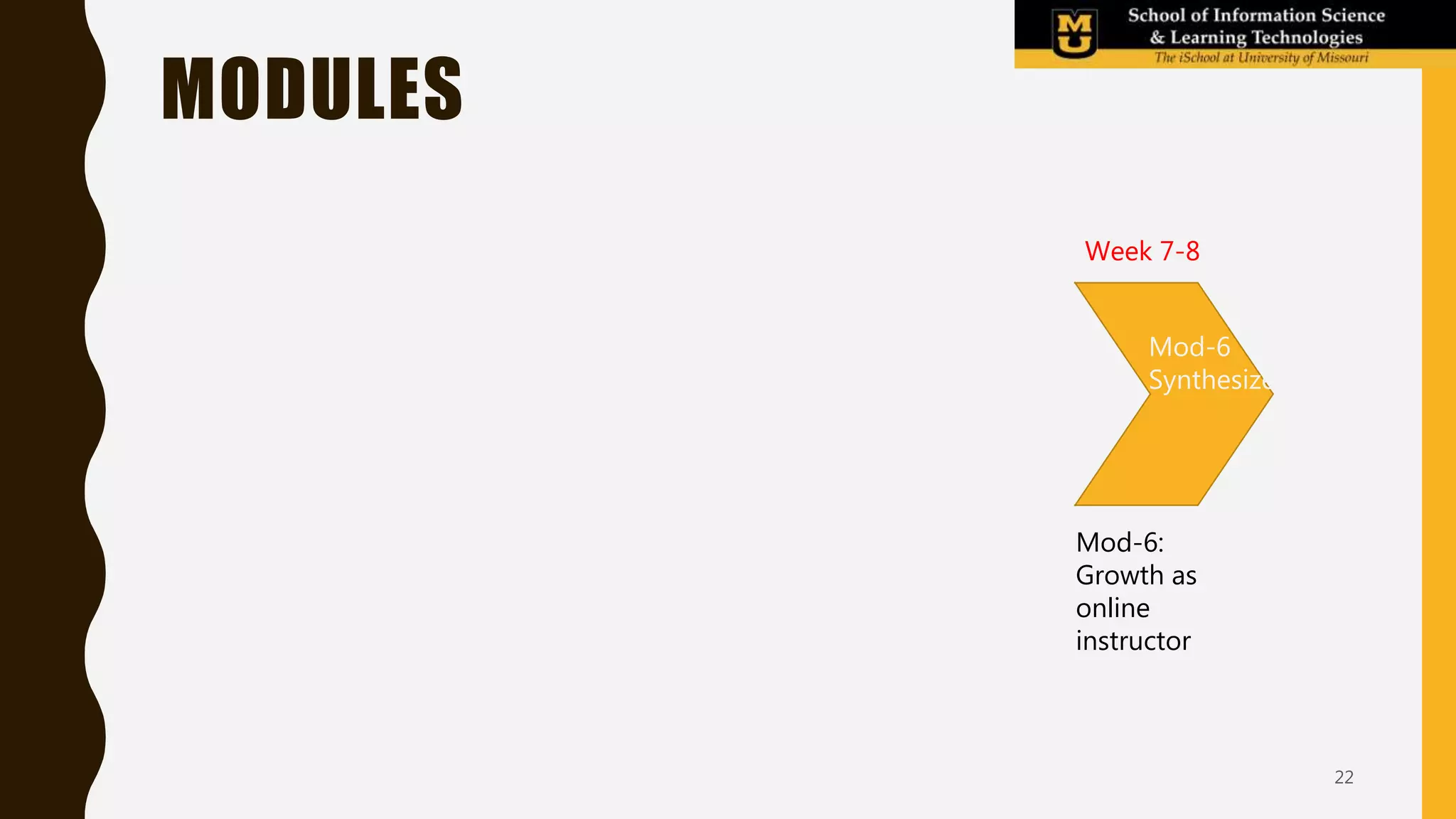
Mod-6:
Growth as
online
instructor
Week 7-8
Mod-2
Your first
ideas
Mod-3
Team work
(2 weeks)
Mod-4
Design for
learning
Mod-6
Synthesize
MODULES
22
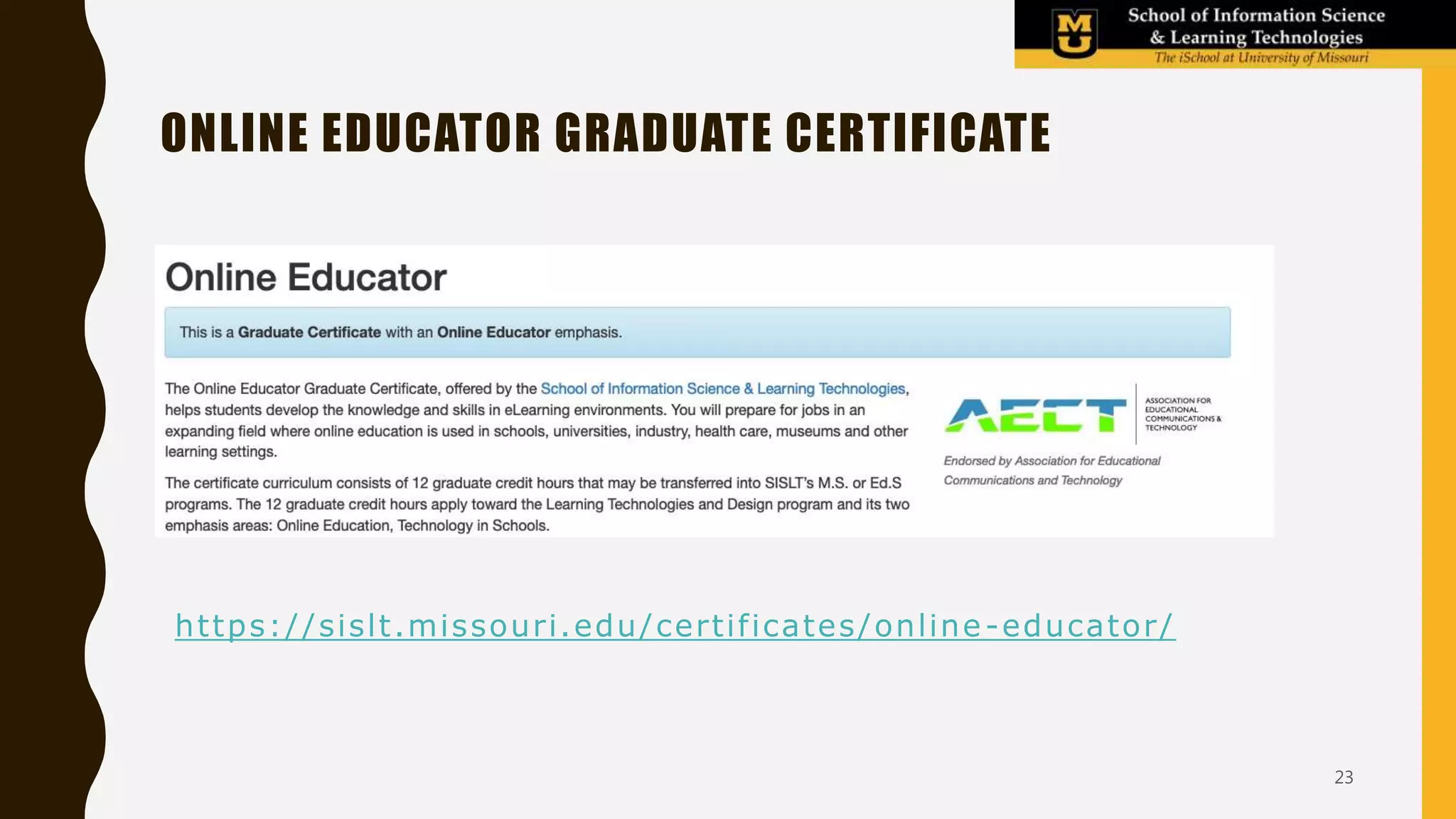
https://sislt.missouri.edu/certificates/online-educator/
ONLINE EDUCATOR GRADUATE CERTIFICATE
23
In the end, your students need to know
that you are ‘there’ and available for
them, supporting and helping them in
their learning trajectories.
The building of relationships and
learning communities are crucial for
both in-person and online learning.
In online learning, however, it can be
easier to forget this part. Thus, don’t
forget to humanize the online space!
24
Thank you and
contact us if you
need more … !
25
Dr. Isa Jahnke
jahnkei@missouri.edu
Dr. Jane Howland
howlandj@missouri.edu
Mod-3
Team work
(2 weeks)
Mod-4
Design for
learning
RESOURCES
26
MU SISLT Online Educator
https://sislt.missouri.edu/certificates/online-educator/
Scaffolding
http://www.ascd.org/publications/books/111017/chapters/Scaffolds-for-Learning@-
The-Key-to-Guided-Instruction.aspx
Rubrics
https://teaching.berkeley.edu/resources/improve/evaluate
-course-level-learning/rubrics
Team contract templates
https://uwaterloo.ca/centre-for-teaching-excellence/teaching-resources/teaching-
tips/developing-assignments/group-work/making-group-contracts

Teaching Online Courses - Basic Principles of Asynchronous Learning

  • 1.
    S C HO O L O F I N F O R M AT I O N S C I E N C E A N D L E A R N I N G T E C H N O L O G I E S ( S I S LT ) @ C O L L E G E O F E D U C AT I O N ZOOM Webinar Teaching Online Courses: Basic Principles for Asynchronous Learning Dr. Isa Jahnke & Dr. Jane Howland April/30, 2020 1
  • 2.
    Introduction • Learning TechnologiesMaster’s program fully online since 2003 https://sislt.missouri.edu/certificates/online-educator/ • Dr. Jane Howland, Teaching Professor, Program Director, 20+ years of Online Teaching • Dr. Isa Jahnke, Associate Professor, 20 years of hybrid/blended learning, 5 years of Online Teaching 2
  • 3.
    Target Audience &Goals for this webinar • Educators, faculty/instructors in higher education and teachers in K-12 schools • Learning goals: Basic principles for Asynchronous Online Learning 3
  • 4.
    Now what? We designfor active learning… 4
  • 5.
    Active Learning increases positivestudent learning outcomes and student performance Why active learning? What is active learning? Freeman et al. (2014) Chi (2009) Hodges, L.C. (2018) Activity-based model of instruction Students don’t learn because the instructor does some activity but students learn through their own activity
  • 6.
    Passive Active, studentcenteredActive, teacher centered Lecture Video recorded lecture Students produce learning artifacts What course design supports active student centered learning? Active and student centered learning Examples Lower order thinki ng skills, e.g., recall , understanding Skills learned Video recorded lecture gamified (e.g., iClicker) Higher order thinking skills e.g., analyzing, creating 6
  • 7.
    1 2 3 4 5 From passive learning(inner circle=1) to active student-centered practices (outer circle=5) Constructive alignment of the five elements! Use tools and technologies meaningfully Develop assessment as formative process Develop learning activities (through assignments) Develop learning goals Develop a plan for how to fostering social relationships (learner communities) Readings: https://www.isa-jahnke.com/teaching Jahnke, 2015 Jahnke et al. 2017 • Active • Authentic • Articulative/Reflectiv e • Cooperative • Intentional
  • 8.
  • 9.
    BASIC PRINCIPLES How todo active student centered learning online?  asynchronous learning • Syllabus with learning goals / outcomes • Each module with learning objectives • Assessments with rubrics • Design for a community of learners / build relationships 9
  • 10.
    1. Make keyadaptations to your existing syllabus for online environments. 2. Clarify the overall learning goals (e.g., After the course, students are able to understand/ analyze/ create/ … 3. Detail how you will communicate with your students (e.g., via Canvas message, email, or announcements). – Let students know how soon to expect a reply (within 24-48 hours is reasonable). Tell students how quickly they can expect feedback on their work (within 7-10 days is reasonable). 4. Include a paragraph describing the active learning approach. For example, “Students do not learn because of the instructor’s activities but because of their own activities and reflection.” 5. Make sure to support (scaffold) student activities through the design of assignments. See Scaffolds-for- DEVELOP SYLLABUS 10
  • 11.
    Activity-based model of instruction “PlanAhead” After course completion, students are able to do … Weekly modules Assessment Syllabus - elements
  • 12.
    • Structure yourcourse into units or modules. Typically, a module is 1-2 weeks. • Each Module: Include one or two learning objectives – that relate to the overall goal – add the description of student activities. • Start each module with an overview – what students can expect to do in this unit/module – add readings as PDF files or link to them in MU Libraries. CREATE MODULES AND ASSIGNMENTS 12
  • 13.
    • Assignments caninclude discussion boards where students are asked to apply something from the readings or lab work. – Clearly define discussion expectations regarding length, content, responses to others, and quality of posts. – Let students know that you want them to ask questions or discuss viewpoints where they do not agree with each other by adding evidence or rationale. • Other assignments might include: – Group work in which student teams create or apply knowledge from previous modules. – Individual projects. CREATE MODULES AND ASSIGNMENTS 13
  • 14.
    ASSESSMENT WITH RUBRICS ALIGNlearning objectives, student activities (through assignment design) and assessment. – Begin with learning objectives. – Determine what evidence students will provide to demonstrate they have achieved those outcomes. – Design a scoring guide or rubric for each assignment to help your students know what’s expected and what you will consider as you grade their work. (site). – You may choose to allow students to improve their work and be re-graded within a specific time. Depending on the assignment’s scope, students might be given 3-4 days to re- submit. – Finally, create activities that will support students in that learning. 14
  • 15.
    • Engage students!Create a Social Presence! – Students feel the instructor is ‘there’ through an online social presence. • Add short video messages in some modules. • Post Announcements at least weekly • For an interactive video experience, use VoiceThread (available in Mizzou Canvas). – Upload slides and record audio or video on each one. – Students can comment on slides after listening to the instructor. – Include questions in your Voicethread or ask students to discuss content in the context of relevant literature, personal experiences, etc. – Use for student groups to present their work. Teams can comment on other teams’ VoiceThreads – a kind of peer review. Then teams might use the comments to revise and improve their original work. BUILD A PLAN TO FOSTER SOCIAL RELATIONSHIPS 15
  • 16.
  • 17.
    MODULES Mod-1 Introduction Mod-2 Your first ideas Mod-3 Team work (2weeks) Mod-4 Design for learning Mod-5 Project (2 weeks) Mod-1a) My Word discussion Mod-1b) VoiceThread introduction Week 1 Week 1: Students use VoiceThread 17
  • 18.
    MODULES Mod-2 Social Presence Mod-2 Virtual Schools andthe importance of Social Presence in Online Teaching Week 2 18
  • 19.
    MODULES Mod-3 Effective Strategies forsupporting Collaborative Learning and online discussion Week 3 Mod-2 Your first ideas Mod-3 Effective Strategies 19
  • 20.
    MODULES Mod-4 Engage the learner Assesslearning Week 4 Mod-2 Your first ideas Mod-3 Team work (2 weeks) Mod-4 Instructional Strategies 20
  • 21.
    Mod-5 Management and leadership issues Teamscreate a class wiki Students teach a lesson in Zoom Week 5-6 Mod-2 Your first ideas Mod-3 Team work (2 weeks) Mod-4 Design for learning Mod-5 (2 weeks) Managemen t and Leadership MODULES 21
  • 22.
    Mod-6: Growth as online instructor Week 7-8 Mod-2 Yourfirst ideas Mod-3 Team work (2 weeks) Mod-4 Design for learning Mod-6 Synthesize MODULES 22
  • 23.
  • 24.
    In the end,your students need to know that you are ‘there’ and available for them, supporting and helping them in their learning trajectories. The building of relationships and learning communities are crucial for both in-person and online learning. In online learning, however, it can be easier to forget this part. Thus, don’t forget to humanize the online space! 24
  • 25.
    Thank you and contactus if you need more … ! 25 Dr. Isa Jahnke jahnkei@missouri.edu Dr. Jane Howland howlandj@missouri.edu
  • 26.
    Mod-3 Team work (2 weeks) Mod-4 Designfor learning RESOURCES 26 MU SISLT Online Educator https://sislt.missouri.edu/certificates/online-educator/ Scaffolding http://www.ascd.org/publications/books/111017/chapters/Scaffolds-for-Learning@- The-Key-to-Guided-Instruction.aspx Rubrics https://teaching.berkeley.edu/resources/improve/evaluate -course-level-learning/rubrics Team contract templates https://uwaterloo.ca/centre-for-teaching-excellence/teaching-resources/teaching- tips/developing-assignments/group-work/making-group-contracts