Individual (learner)
embedded network
position
Three overlapping and mutually
constituting dimensions
MOTIVATION
INVESTMENT
LEARNER-CENTRED
Mediated/Articuted through
INTERACTION via RELATIONSHIPS
and ROLES
RELATIONSHIPS
ROLES
Individual <-> Content
Individual <-> Tools
Individual <-> Others (people)
Individual as
LEARNER
Individual as
FACILITATOR
Individual as
CONTRIBUTOR
Learner <-> Learner
Learner <-> Facilitator
Facilitator <-> Learner
Contritutor <-> Contributor
Self-direction
Democtratic learning
Flattening of“the academy”
Teacher becomes facilitator
Relevance, acceptability
Technology & pedagogy matched to tasks & skills
Preferences / Organic usage
Transactional“sphere”
Expression
Personalization
Accountability
Role diversity (even within
the same connected environment)
Feedback
Network embeddedness
High/Low engagement
Pedagogical embeddedness
Authenticity; real-world relevance
Influence
Support
Skill/Knowledge development
Connection
Social capital
Resource Access
Autonomy
e.g. peer mentor
e.g. Community of Practice
Return on Investment
Learning Skills development
Knowledge acquisition
Inclusion
Skills development facilitated; guidance provided
Participation
(Co-)Contribution/creation of learning content
Job skills; professional development
e.g. peer feedback, formative feedback,
direct feedback from tool
Expression
Inclusion, participation
(Co-)Contribution/creation of learning content
Resource access “rights”
Collaboration
e.g. Individual may take on multiple roles
Learning tasks accomplished with technology that were previously inconceivable
SEE: “MOTIVATION”
SOCIAL MEDIA USE
IN HIGHER EDUCATION
(MAIS 701)
ResearchBackground
Research Review
Emerging Conceptual
Model
Social media (social software)
& social system relationships
(Dron, Anderson)
CONCEPTUAL FRAMEWORKS
Groups
Nets
Sets
Collectives
“Hard”Media
“Soft”Media
Social Network /
Social Network Analysis
Digital EcosystemEcological Cognition Framework
Communicative Ecology
Human-Computer Interaction
SAMR
(Puentedura)
Substitution
Augmentation
Modification
Redefinition
THEORIES
Connectivism
(Siemens, Downes)
Constructivist Approaches
(Dewey, Montessori, Piaget, Vygotsky)
SCOT (Social Construction of Technology)
(Bijker, Pinch, Mackenzie, Wajcman)
Actor-Network Theory (ANT)
(Latour, Callon, Law)
Activity Theory
Kharkov School
(Leont'ev, Vygotsky, Luria)
Scandinavian School
(Engeström, Nardi, Kuuttii, Verenikina)
Cultural-historical Psychology
(Vygotsky, Luria)
Cognitivism
(Piaget, Vygotsky)
Behaviourist Approaches
Behaviourism
(Pavlov, Watson, Thorndike, Skinner, Vygotsky)
Social Learning Theory
(Vygotsky, Bandura)
SOCIOLOGICAL APPROAHCES
Action Theory
(Parsons, Weber)
(Tönnies)
Gemeinschaft
Gesellschaft
ECOLOGICAL APPROAHCES
Media Ecology
(M. McLuhan, E. McLuhan, Postman, Innis)
Conservation Ecology,
Traditional Ecological Knowledge (TEK)
(Ingold, Berkes)
Environmental Embeddedness
Resource Commons
Open Access
ANTHROPOLOGICAL APPROACHES
Ethnography (Australian Aborigines):
Reciprocity/Renunciation as
principles of social organization
(DH Turner)
SYSTEMS THEORY
General Systems Theory,
Open & Closed Systems
Bertalanffy
Soft Systems Methodology
Checkland
Transactional Distance
(Moore)teacher-teacher interaction
teacher-content interaction
content-content interaction
(Anderson & Garrison)
learner-content interaction
learner-instructor interaction
learner-learner interaction
structure (design)
dialogue (interaction)
Community of Inquiry (CoI)
(Garrison, Anderson)
Dimensions of interaction:
social presence
cognitive presence
teaching presence
Immediacy
(Woods & Baker)
Surface vs Deep Learning
Garrison & Cleveland-Innes
Distrbuted Cognition
(Hutchins)
Self-determination Theory
(Ryan, Deci, Vallerand)
Innate psychological needs
(in learning contexts):
Competence
Relatedness
Autonomy
Networked Learning
(Illich, Wegner, Ravenscroft)
Technology integration in
teaching and learning
TPACK
(Mishra & Koehler)
Technological Knowledge
Pedalogical Knowledge
Content Knowledge
Technological Pedagogical Knowledge
Technological Content Knowledge
Pedagogical Content Knowledge
<-- Intersects <--
Enhancement
Transformation
(Interface) Design Principles -
”Design of Everyday Things”
(Norman)
Visibility
Feedback
Constraints
Mapping
Consistency
Affordance
Connectionism
(Downes)
General Learning Theories
Technology-mediated
Learning Theories
PSYCHOLOGICAL APPROACHES
Individual is unit of analysis
Collective/system is unit of analysis
ex. scaffolding
ex. zone of proximal development
Distance / Online Learning
COGNITIVE SCIENCE APPROACHES
INCLUSION criteria will be informed
by relationship/role factors and the
dimensions of interaction (described
above)
Preliminary Observations
re: study quality
SEARCH STRATEGY
EBSCO (Education
Research Complete)
Yield: 1,489 unique sources
Google Scholar
Yield*: 906 unique resources
*An internal Google Scholar
error prevented access to half
of the ~2000 sources returned
TOTAL: 2,395
1. Many have low subject numbers, Few are sufficiently powered.
5. Many with qualitative data incorporate content analysis,
phenomenology or case study. Some incorporate mixed
methods. None so far identified incorporate rounded theory.
4. Few consider academic outcomes such as grades.
3. Many based on subjective factors, such as preferences or self-
report of improved engagement.
2. Few incorporate experimental / controlled design.
6. Few represent novel research.
Social Media
(Social Software)
Search terms:
social media + higher education
(and various iterations)
TECHNOLOGICAL
ADVANCES
Web 2.0
“Social software is organic and self-organizing, underpinned by
dynamics that parallel natural processes. It is evolutionary,
replicating the successful and diminishing or killing the unsuccessful.
It is stigmergic: signs left in the environment communicate with
others who leave further signs in the environment. It has an
emergent structure, formed from bottom-up control rather than
top-down design.”
(Dron, J. (2006). Social software and the emergence of control.
Advanced Learning Technologies. IEEEE Conference IEEE; pg. 2.)

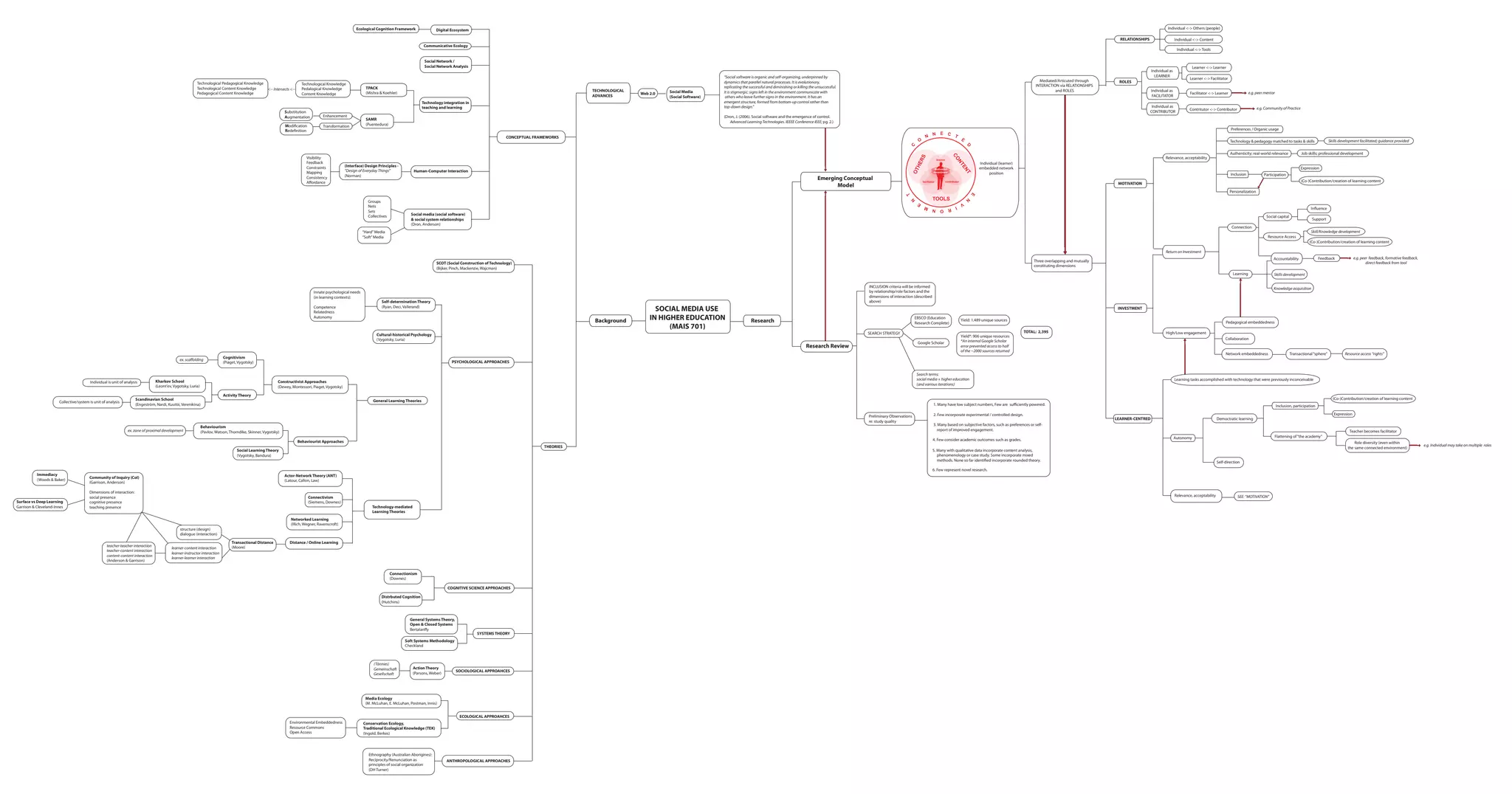
Cognitive map1

  • 1.
    Individual (learner) embedded network position Threeoverlapping and mutually constituting dimensions MOTIVATION INVESTMENT LEARNER-CENTRED Mediated/Articuted through INTERACTION via RELATIONSHIPS and ROLES RELATIONSHIPS ROLES Individual <-> Content Individual <-> Tools Individual <-> Others (people) Individual as LEARNER Individual as FACILITATOR Individual as CONTRIBUTOR Learner <-> Learner Learner <-> Facilitator Facilitator <-> Learner Contritutor <-> Contributor Self-direction Democtratic learning Flattening of“the academy” Teacher becomes facilitator Relevance, acceptability Relevance, acceptability Technology & pedagogy matched to tasks & skills Preferences / Organic usage Transactional“sphere” Expression Personalization Accountability Role diversity (even within the same connected environment) Feedback Network embeddedness High/Low engagement Pedagogical embeddedness Authenticity; real-world relevance Influence Support Skill/Knowledge development Connection Social capital Resource Access Autonomy e.g. peer mentor e.g. Community of Practice Return on Investment Learning Skills development Knowledge acquisition Inclusion Skills development facilitated; guidance provided Participation (Co-)Contribution/creation of learning content (Co-)Contribution/creation of learning content Job skills; professional development e.g. peer feedback, formative feedback, direct feedback from tool Expression Inclusion, participation (Co-)Contribution/creation of learning content Resource access “rights” Collaboration e.g. Individual may take on multiple roles Learning tasks accomplished with technology that were previously inconceivable SEE: “MOTIVATION” SOCIAL MEDIA USE IN HIGHER EDUCATION (MAIS 701) ResearchBackground Research Review Emerging Conceptual Model Social media (social software) & social system relationships (Dron, Anderson) CONCEPTUAL FRAMEWORKS Groups Nets Sets Collectives “Hard”Media “Soft”Media Social Network / Social Network Analysis Digital EcosystemEcological Cognition Framework Communicative Ecology Human-Computer Interaction SAMR (Puentedura) Substitution Augmentation Modification Redefinition THEORIES Connectivism (Siemens, Downes) Constructivist Approaches (Dewey, Montessori, Piaget, Vygotsky) SCOT (Social Construction of Technology) (Bijker, Pinch, Mackenzie, Wajcman) Actor-Network Theory (ANT) (Latour, Callon, Law) Activity Theory Kharkov School (Leont'ev, Vygotsky, Luria) Scandinavian School (Engeström, Nardi, Kuuttii, Verenikina) Cultural-historical Psychology (Vygotsky, Luria) Cognitivism (Piaget, Vygotsky) Behaviourist Approaches Behaviourism (Pavlov, Watson, Thorndike, Skinner, Vygotsky) Social Learning Theory (Vygotsky, Bandura) SOCIOLOGICAL APPROAHCES Action Theory (Parsons, Weber) (Tönnies) Gemeinschaft Gesellschaft ECOLOGICAL APPROAHCES Media Ecology (M. McLuhan, E. McLuhan, Postman, Innis) Conservation Ecology, Traditional Ecological Knowledge (TEK) (Ingold, Berkes) Environmental Embeddedness Resource Commons Open Access ANTHROPOLOGICAL APPROACHES Ethnography (Australian Aborigines): Reciprocity/Renunciation as principles of social organization (DH Turner) SYSTEMS THEORY General Systems Theory, Open & Closed Systems Bertalanffy Soft Systems Methodology Checkland Transactional Distance (Moore)teacher-teacher interaction teacher-content interaction content-content interaction (Anderson & Garrison) learner-content interaction learner-instructor interaction learner-learner interaction structure (design) dialogue (interaction) Community of Inquiry (CoI) (Garrison, Anderson) Dimensions of interaction: social presence cognitive presence teaching presence Immediacy (Woods & Baker) Surface vs Deep Learning Garrison & Cleveland-Innes Distrbuted Cognition (Hutchins) Self-determination Theory (Ryan, Deci, Vallerand) Innate psychological needs (in learning contexts): Competence Relatedness Autonomy Networked Learning (Illich, Wegner, Ravenscroft) Technology integration in teaching and learning TPACK (Mishra & Koehler) Technological Knowledge Pedalogical Knowledge Content Knowledge Technological Pedagogical Knowledge Technological Content Knowledge Pedagogical Content Knowledge <-- Intersects <-- Enhancement Transformation (Interface) Design Principles - ”Design of Everyday Things” (Norman) Visibility Feedback Constraints Mapping Consistency Affordance Connectionism (Downes) General Learning Theories Technology-mediated Learning Theories PSYCHOLOGICAL APPROACHES Individual is unit of analysis Collective/system is unit of analysis ex. scaffolding ex. zone of proximal development Distance / Online Learning COGNITIVE SCIENCE APPROACHES INCLUSION criteria will be informed by relationship/role factors and the dimensions of interaction (described above) Preliminary Observations re: study quality SEARCH STRATEGY EBSCO (Education Research Complete) Yield: 1,489 unique sources Google Scholar Yield*: 906 unique resources *An internal Google Scholar error prevented access to half of the ~2000 sources returned TOTAL: 2,395 1. Many have low subject numbers, Few are sufficiently powered. 5. Many with qualitative data incorporate content analysis, phenomenology or case study. Some incorporate mixed methods. None so far identified incorporate rounded theory. 4. Few consider academic outcomes such as grades. 3. Many based on subjective factors, such as preferences or self- report of improved engagement. 2. Few incorporate experimental / controlled design. 6. Few represent novel research. Social Media (Social Software) Search terms: social media + higher education (and various iterations) TECHNOLOGICAL ADVANCES Web 2.0 “Social software is organic and self-organizing, underpinned by dynamics that parallel natural processes. It is evolutionary, replicating the successful and diminishing or killing the unsuccessful. It is stigmergic: signs left in the environment communicate with others who leave further signs in the environment. It has an emergent structure, formed from bottom-up control rather than top-down design.” (Dron, J. (2006). Social software and the emergence of control. Advanced Learning Technologies. IEEEE Conference IEEE; pg. 2.)