R
@AECT17, Isa Jahnke / www.isajahnke.net
The SocioTechnical Walkthrough, STWT
Isa Jahnke, Alexander Nolte, So Mi Kim, Joi Moore
University of
Pittsburgh
University of
Missouri
University of
Missouri
University of
Missouri
R
@AECT17, Isa Jahnke / www.isajahnke.net
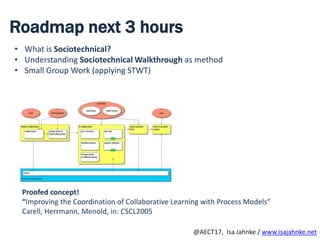
Roadmap next 3 hours
• What is Sociotechnical?
• Understanding Sociotechnical Walkthrough as method
• Small Group Work (applying STWT)
Proofed concept!
“Improving the Coordination of Collaborative Learning with Process Models”
Carell, Herrmann, Menold, in: CSCL2005
R
@AECT17, Isa Jahnke / www.isajahnke.net
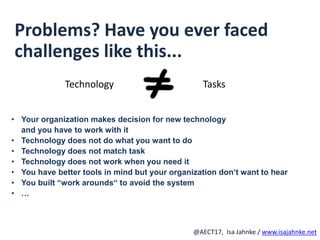
Problems? Have you ever faced
challenges like this...
• Your organization makes decision for new technology
and you have to work with it
• Technology does not do what you want to do
• Technology does not match task
• Technology does not work when you need it
• You have better tools in mind but your organization don‘t want to hear
• You built “work arounds“ to avoid the system
• …
Technology Tasks
R
@AECT17, Isa Jahnke / www.isajahnke.net
We can engineer/design and control
technical systems
(and technical system rules)…
…but social practices evolves!
We cannot control how people use technology
“Social Systems”, Niklas Luhmann, 1998
R
@AECT17, Isa Jahnke / www.isajahnke.net
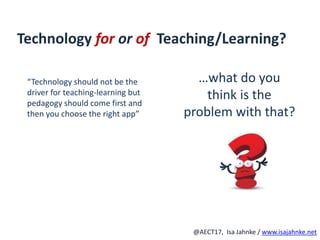
Technology for or of Teaching/Learning?
“Technology should not be the
driver for teaching-learning but
pedagogy should come first and
then you choose the right app”
…what do you
think is the
problem with that?
R
@AECT17, Isa Jahnke / www.isajahnke.net
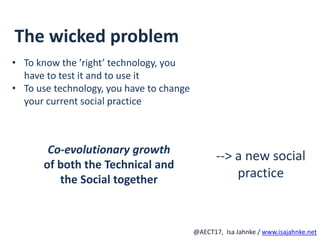
The wicked problem
• To know the ’right’ technology, you
have to test it and to use it
• To use technology, you have to change
your current social practice
--> a new social
practice
Co-evolutionary growth
of both the Technical and
the Social together
R
@AECT17, Isa Jahnke / www.isajahnke.net
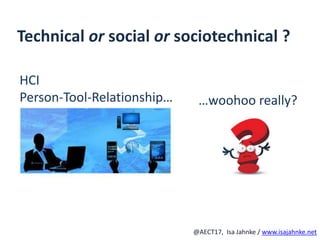
Technical or social or sociotechnical ?
HCI
Person-Tool-Relationship… …woohoo really?
R
@AECT17, Isa Jahnke / www.isajahnke.net
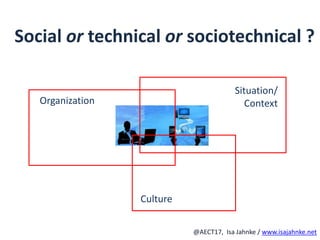
Social or technical or sociotechnical ?
Organization
Culture
Situation/
Context
R
@AECT17, Isa Jahnke / www.isajahnke.net
Elements of processes / coordination
– Actors
– Activities
– Interdependencies (between resources)
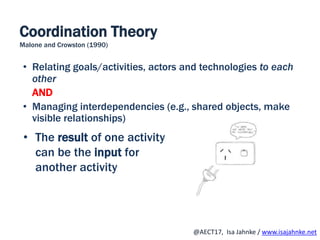
Coordination Theory
Malone and Crowston (1990)
R
@AECT17, Isa Jahnke / www.isajahnke.net
• Relating goals/activities, actors and technologies to each
other
AND
• Managing interdependencies (e.g., shared objects, make
visible relationships)
Coordination Theory
Malone and Crowston (1990)
• The result of one activity
can be the input for
another activity
R
@AECT17, Isa Jahnke / www.isajahnke.net
Our approach:
Shift from technical to sociotechnical design
The positive impact of a technical system on the Social
depends on its way of being integrated into organizational
processes, competence structures, and so forth …
R
@AECT17, Isa Jahnke / www.isajahnke.net
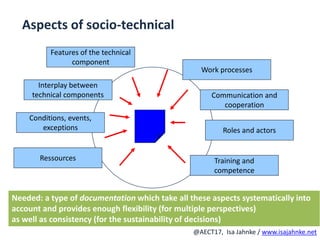
Aspects of socio-technical
Features of the technical
component
Communication and
cooperation
Work processes
Training and
competence
Roles and actors
Ressources
Conditions, events,
exceptions
Interplay between
technical components
Needed: a type of documentation which take all these aspects systematically into
account and provides enough flexibility (for multiple perspectives)
as well as consistency (for the sustainability of decisions)
R
@AECT17, Isa Jahnke / www.isajahnke.net
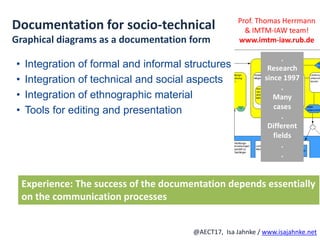
Documentation for socio-technical
Graphical diagrams as a documentation form
• Integration of formal and informal structures
• Integration of technical and social aspects
• Integration of ethnographic material
• Tools for editing and presentation
Experience: The success of the documentation depends essentially
on the communication processes
.
Research
since 1997
.
Many
cases
.
Different
fields
.
.
Prof. Thomas Herrmann
& IMTM-IAW team!
www.imtm-iaw.rub.de
R
@AECT17, Isa Jahnke / www.isajahnke.net
The example of ElevatED - A tool for strategic
improvement planning (SIP) in schools
• Goal: schools apply strategic improvement planning / SIP
• New technology called ElevatEd shall help
• With our IE Lab, we did a traditional usability study
• …and sociotechnical design (technology development and
preparation for implementation) with 3 teachers and 3 principals
We wanted to know:
1. What kind of activities exist in current SIPs, in what ways
are users (principals, teachers, and others) involved, and
what kind of digital systems are connected to the SIPs
workflows?
2. What challenges do principals and teachers face while
carrying out the SIP in schools?
Any ideas
how the
models
look?
R
@AECT17, Isa Jahnke / www.isajahnke.net
STWT
Founder: Prof. Dr. Thomas Herrmann & team, Univ. of Bochum, IMTM-IAW Germany
Sociotechnical Walkthrough is
a method to design and develop
technology use in groups (small-big)
by identifying and documenting current
social practices and then to identify and
document how technologies can help
toward new social practices (processes)
in a participatory design setting.
R
@AECT17, Isa Jahnke / www.isajahnke.net
Communication-oriented intervention method
(preparation for change management)
• Structured
• Focused
• Facilitated
• Continuous
• Sustainable
 Socio-technical Walkthrough (STWT)
… communication and
documentation
(aims to integrate technical,
social, organizational,
cultural aspects
R
@AECT17, Isa Jahnke / www.isajahnke.net
Outcome of a STWT
• Decisions about the features of the socio-technical system –
and about the work processes of the future
• Decisions about decisions which are postponed or left open
• Start of a learning process
• Sustainable description about the characteristics of the
socio-technical system
R
@AECT17, Isa Jahnke / www.isajahnke.net
Background of STWT, combination of…
• Observations…
– Allow for an unobstructed view on a process and allow to easily identify deviations
– Only works for processes that are visible and observed subjects are prone to
behave differently than they would without observation
• Interviews…
– Allow for identifying aspects of processes that cannot be observed
– Only one perspective on a process is considered at a time and ones perspective on
a process might be obstructed or biased.
• Workshops…
– Allow for exchanging perspectives and building common ground
– Scheduling could be hard and only a limited number of people can reasonably
participate
R
@AECT17, Isa Jahnke / www.isajahnke.net
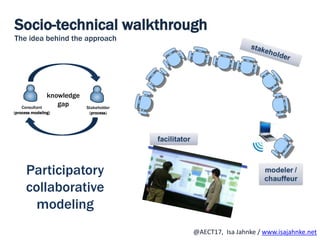
Socio-technical walkthrough
The idea behind the approach
knowledge
gap Stakeholder
(process)
Consultant
(process modeling)
Participatory
collaborative
modeling
R
@AECT17, Isa Jahnke / www.isajahnke.net
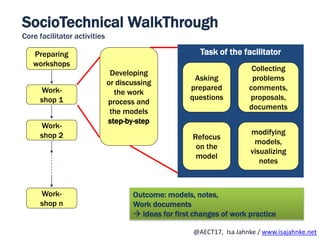
Task of the facilitatorPreparing
workshops
Work-
shop 1
Work-
shop 2
Work-
shop n
Developing
or discussing
the work
process and
the models
step-by-step
Asking
prepared
questions
Collecting
problems
comments,
proposals,
documents
Refocus
on the
model
modifying
models,
visualizing
notes
Outcome: models, notes,
Work documents
 Ideas for first changes of work practice
SocioTechnical WalkThrough
Core facilitator activities
R
@AECT17, Isa Jahnke / www.isajahnke.net
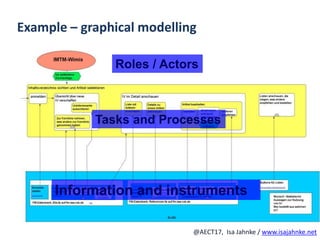
Example – graphical modelling
Roles / Actors
Information and instruments
Tasks and Processes
R
@AECT17, Isa Jahnke / www.isajahnke.net
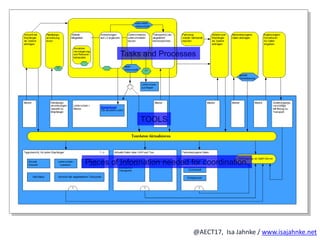
An example… (result of phase 2)
TOOLS
Pieces of Information needed for coordination.
Tasks and Processes
R
@AECT17, Isa Jahnke / www.isajahnke.net
The example of ElevatED - A tool for strategic
improvement planning (SIP) in schools
• Goal: schools improve their strategic improvement planning
• New technology called ElevatEd shall help
• With our IE Lab, we did a traditional usability study
• …and sociotechnical design (technology development and
preparation for implementation) with 3 teachers and 3 principals
We wanted to know:
1. What kind of activities exist in current SIPs, in what ways
are users (principals, teachers, and others) involved, and
what kind of digital systems are connected to the SIPs
workflows?
2. What challenges do principals and teachers face while
carrying out the SIP in schools?
R
@AECT17, Isa Jahnke / www.isajahnke.net
Let’s model together
R
@AECT17, Isa Jahnke / www.isajahnke.net
Role – carried out by single persons or
groups like departments. They usually
come with a set of rights and
responsibilities.
Activity – tasks which are carried out by
roles. They usually use entities or modify
them.
Entity – static aspects of processes (e.g.
objects, data, systems)
activity [1]
role
document
technical
system
activity [2]
SeeMe Basics
Basic elements
R
@AECT17, Isa Jahnke / www.isajahnke.net
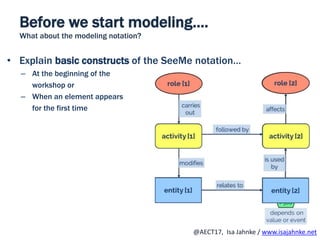
Before we start modeling….
What about the modeling notation?
• Explain basic constructs of the SeeMe notation…
– At the beginning of the
workshop or
– When an element appears
for the first time
R
@AECT17, Isa Jahnke / www.isajahnke.net
expects
something from
role [1]
activity [1]
role [2]
activity [2]
entity [1] entity [2]
These standard definitions can be altered by attaching
alternate labels to the respective relations.
carries
out
belongs
to
leads to
affects
can be
described by
modifies
is used
by
relates to
SeeMe Basics
Relations
R
@AECT17, Isa Jahnke / www.isajahnke.net
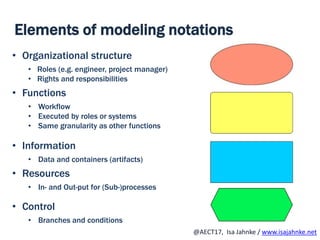
Elements of modeling notations
• Organizational structure
• Roles (e.g. engineer, project manager)
• Rights and responsibilities
• Functions
• Workflow
• Executed by roles or systems
• Same granularity as other functions
• Information
• Data and containers (artifacts)
• Resources
• In- and Out-put for (Sub-)processes
• Control
• Branches and conditions
R
@AECT17, Isa Jahnke / www.isajahnke.net
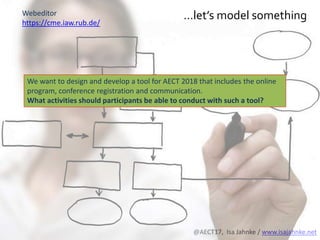
…let’s model somethingWebeditor
https://cme.iaw.rub.de/
We want to design and develop a tool for AECT 2018 that includes the online
program, conference registration and communication.
What activities should participants be able to conduct with such a tool?
R
@AECT17, Isa Jahnke / www.isajahnke.net
Let’s reflect together
R
@AECT17, Isa Jahnke / www.isajahnke.net
…let’s have a break
R
@AECT17, Isa Jahnke / www.isajahnke.net
STWT preparation
• Get an idea about the context of a process beforehand (e.g.
through interviews or document analysis)
– Start and end of the process
– Circumstances under which process takes place
• Break down overall goal to smaller goals for each workshop
• Set number of workshops and time for each workshop
• Assemble a suitable group
– All stakeholders should be present (including decision makers)
– Potentially invite domain experts or future customers
– It may become necessary to alter group during a modeling project
• Prepare guiding questions for workshop
R
@AECT17, Isa Jahnke / www.isajahnke.net
What makes a “good” question?
• A good guiding question:
– Is open: How, what, why, …
– Makes participants think about their concrete work environment
– Fosters creativity
– Relates a new solution to current practice
– Connects both old and new work process
• Examples:
– Think about a concrete case that you are currently working on. Does this case fit to
the process that is being modeled?
– How could the new software improve your current work process?
– What would help you to work more effectively or efficiently?
– What would help you to improve collaboration with your colleagues?
R
@AECT17, Isa Jahnke / www.isajahnke.net
Tips -- During STWTs sessions
General facilitator tasks
• Open and guide discourse
(Overview / background / goals)
• Try to integrate all participants into the discussion:
– All participants are experts, at least for their own practice / perspective
• Encourage critical questioning
• Keep track of the workshop goals
• Stay neutral, do not take a certain position / perspective.
• Ask for specific example
R
@AECT17, Isa Jahnke / www.isajahnke.net
Tips -- During STWTs sessions
Concrete guidelines
• Go through the process step-by-step
• Start with activities, then roles, then entities
• Each contribution should leave a trace in the model
• Use generally accepted terms
• Walk through process parts multiple times (if necessary)
• Show conflicts or diverging perspectives in the model
• Make use of comments and additional flipcharts
• Re-focus participants on the model
R
@AECT17, Isa Jahnke / www.isajahnke.net
Tips -- During STWTs sessions
General questions
• What happens next?
• What happens before?
• Under which conditions do you do this?
• When do you do something else?
• Who does that?
• Who is involved?
• Which resources do you need to do that?
• What is the result of this?
Questions are generally related to the characteristics of
processes.
R
@AECT17, Isa Jahnke / www.isajahnke.net
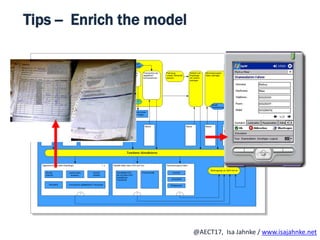
Tips -- Enrich the model
R
@AECT17, Isa Jahnke / www.isajahnke.net
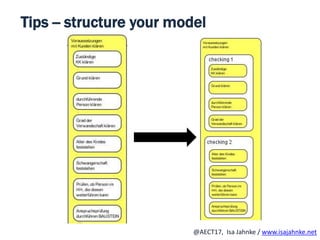
Tips -- structure your model
R
@AECT17, Isa Jahnke / www.isajahnke.net
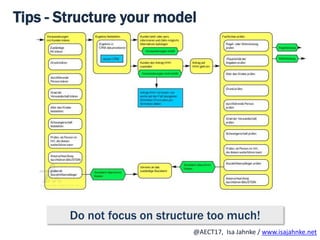
Tips - Structure your model
Do not focus on structure too much!
R
@AECT17, Isa Jahnke / www.isajahnke.net
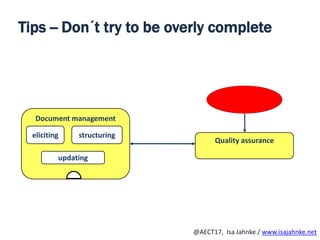
Document management
structuringeliciting
updating
Quality assurance
Tips -- Don´t try to be overly complete
R
@AECT17, Isa Jahnke / www.isajahnke.net
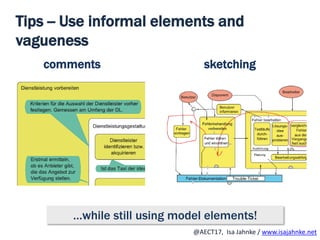
comments sketching
Tips -- Use informal elements and
vagueness
…while still using model elements!
R
@AECT17, Isa Jahnke / www.isajahnke.net
Tips -- Interplay between facilitator and
modeler
• Having a modeler is crucial!
• Facilitator and modeler have to work as a team:
– Get to know each other beforehand
– Set rules for collaboration
– The modeler has to pay as much attention about what is going on as the facilitator
– The modeler can alter the model by himself (if this is ok with the facilitator)
• The modeler should collect open questions
• The modeler may ask questions
• Use breaks in workshops to exchange views
R
@AECT17, Isa Jahnke / www.isajahnke.net
• Prepare dummy elements before a workshop
• Copy and paste elements by using…
– The context menu
– The “edit”-menu
– Shortcuts (CTRL + C, etc.)
– Duplicate elements through CTRL + D
• Elements will be created at the cursor position when
pasting
Tips and tricks for the modeler
Advanced functions of the SeeMe editor
R
@AECT17, Isa Jahnke / www.isajahnke.net
Using the SeeMe Editor
Presenting models
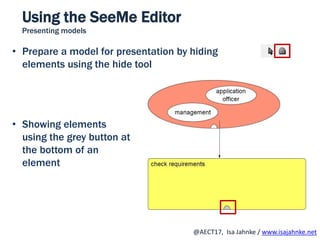
• Prepare a model for presentation by hiding
elements using the hide tool
• Showing elements
using the grey button at
the bottom of an
element
R
@AECT17, Isa Jahnke / www.isajahnke.net
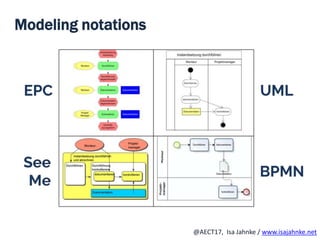
Modeling notations
R
@AECT17, Isa Jahnke / www.isajahnke.net
Specifics of visual modeling notations
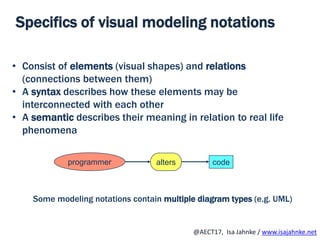
• Consist of elements (visual shapes) and relations
(connections between them)
• A syntax describes how these elements may be
interconnected with each other
• A semantic describes their meaning in relation to real life
phenomena
Some modeling notations contain multiple diagram types (e.g. UML)
altersprogrammer code
R
@AECT17, Isa Jahnke / www.isajahnke.net
…let’s model something
Model something related to your work in SeeMe
in 30 minutes in small groups of 3-5
Webeditor
https://cme.iaw.rub.de/
R
@AECT17, Isa Jahnke / www.isajahnke.net
Let’s reflect together
R
@AECT17, Isa Jahnke / www.isajahnke.net
Relation of STWT to other methods
JAD (Joint Application Design) (Crawford, 1994) Shares the relevance of
workshop/session series such as STWT but not the necessity of diagrammatic
representations of work processes
Scenario based techniques (Carroll, 1995) STWT: focus on diagrams which
cover a variety of possible scenarios, scenarios are an optional means for illustration
whereas STWT does not illustrate optimal but real current practices at first
Contextual Design (Holtzblatt, 2004) Validates models – also in workshops – which
are provided by an ethnographer, wheras STWT integrates the users as co-designers, model
development and validation together, and focusses on work processes
MUST (Method for Participatory Design) (Kensing et al., 1996)
intervention is seen as a communication process similar to STWT, different kind of modelling
Analysis of task analysis procedures (Jonassen, 1986) task analysis process:
inventorying, describing, selecting, sequencing, and analyzing tasks, differentiated analysis
procedures
Herrmann, Kunau, Loser, Menold, in: PD 2004
R
@AECT17, Isa Jahnke / www.isajahnke.net
Publications
• Herrmann et al., 2004, STWT in the beginning
• Herrmann, 2006 SeeMe
• Kunau, 2005, STWT in a PhD thesis
• Herrmann, Carrell, Menold, CSCL, 2005, proof that with models it is better than without!
• Herrmann, Loser, Jahnke, 2007, STWT later
• Prilla & Jahnke, 2012, STWT in a service project
• Nolte & Herrmann, 2016, STWT from facilitation perspective
Want to use the SeeMe Editor?
• Email the SeeMe Team at Univ. of Bochum, IAW-IMTM, Germany:
seeme@iaw.ruhr-uni-bochum.de
• Webeditor online:
https://cme.iaw.ruhr-uni-bochum.de/
• Further information / Dr. Isa Jahnke:
jahnkei@missouri.edu

Sociotechnical Walkthrough Workshop@AECT17

  • 1.
    R @AECT17, Isa Jahnke/ www.isajahnke.net The SocioTechnical Walkthrough, STWT Isa Jahnke, Alexander Nolte, So Mi Kim, Joi Moore University of Pittsburgh University of Missouri University of Missouri University of Missouri
  • 2.
    R @AECT17, Isa Jahnke/ www.isajahnke.net Roadmap next 3 hours • What is Sociotechnical? • Understanding Sociotechnical Walkthrough as method • Small Group Work (applying STWT) Proofed concept! “Improving the Coordination of Collaborative Learning with Process Models” Carell, Herrmann, Menold, in: CSCL2005
  • 3.
    R @AECT17, Isa Jahnke/ www.isajahnke.net Problems? Have you ever faced challenges like this... • Your organization makes decision for new technology and you have to work with it • Technology does not do what you want to do • Technology does not match task • Technology does not work when you need it • You have better tools in mind but your organization don‘t want to hear • You built “work arounds“ to avoid the system • … Technology Tasks
  • 4.
    R @AECT17, Isa Jahnke/ www.isajahnke.net We can engineer/design and control technical systems (and technical system rules)… …but social practices evolves! We cannot control how people use technology “Social Systems”, Niklas Luhmann, 1998
  • 5.
    R @AECT17, Isa Jahnke/ www.isajahnke.net Technology for or of Teaching/Learning? “Technology should not be the driver for teaching-learning but pedagogy should come first and then you choose the right app” …what do you think is the problem with that?
  • 6.
    R @AECT17, Isa Jahnke/ www.isajahnke.net The wicked problem • To know the ’right’ technology, you have to test it and to use it • To use technology, you have to change your current social practice --> a new social practice Co-evolutionary growth of both the Technical and the Social together
  • 7.
    R @AECT17, Isa Jahnke/ www.isajahnke.net Technical or social or sociotechnical ? HCI Person-Tool-Relationship… …woohoo really?
  • 8.
    R @AECT17, Isa Jahnke/ www.isajahnke.net Social or technical or sociotechnical ? Organization Culture Situation/ Context
  • 9.
    R @AECT17, Isa Jahnke/ www.isajahnke.net Elements of processes / coordination – Actors – Activities – Interdependencies (between resources) Coordination Theory Malone and Crowston (1990)
  • 10.
    R @AECT17, Isa Jahnke/ www.isajahnke.net • Relating goals/activities, actors and technologies to each other AND • Managing interdependencies (e.g., shared objects, make visible relationships) Coordination Theory Malone and Crowston (1990) • The result of one activity can be the input for another activity
  • 11.
    R @AECT17, Isa Jahnke/ www.isajahnke.net Our approach: Shift from technical to sociotechnical design The positive impact of a technical system on the Social depends on its way of being integrated into organizational processes, competence structures, and so forth …
  • 12.
    R @AECT17, Isa Jahnke/ www.isajahnke.net Aspects of socio-technical Features of the technical component Communication and cooperation Work processes Training and competence Roles and actors Ressources Conditions, events, exceptions Interplay between technical components Needed: a type of documentation which take all these aspects systematically into account and provides enough flexibility (for multiple perspectives) as well as consistency (for the sustainability of decisions)
  • 13.
    R @AECT17, Isa Jahnke/ www.isajahnke.net Documentation for socio-technical Graphical diagrams as a documentation form • Integration of formal and informal structures • Integration of technical and social aspects • Integration of ethnographic material • Tools for editing and presentation Experience: The success of the documentation depends essentially on the communication processes . Research since 1997 . Many cases . Different fields . . Prof. Thomas Herrmann & IMTM-IAW team! www.imtm-iaw.rub.de
  • 14.
    R @AECT17, Isa Jahnke/ www.isajahnke.net The example of ElevatED - A tool for strategic improvement planning (SIP) in schools • Goal: schools apply strategic improvement planning / SIP • New technology called ElevatEd shall help • With our IE Lab, we did a traditional usability study • …and sociotechnical design (technology development and preparation for implementation) with 3 teachers and 3 principals We wanted to know: 1. What kind of activities exist in current SIPs, in what ways are users (principals, teachers, and others) involved, and what kind of digital systems are connected to the SIPs workflows? 2. What challenges do principals and teachers face while carrying out the SIP in schools? Any ideas how the models look?
  • 15.
    R @AECT17, Isa Jahnke/ www.isajahnke.net STWT Founder: Prof. Dr. Thomas Herrmann & team, Univ. of Bochum, IMTM-IAW Germany Sociotechnical Walkthrough is a method to design and develop technology use in groups (small-big) by identifying and documenting current social practices and then to identify and document how technologies can help toward new social practices (processes) in a participatory design setting.
  • 16.
    R @AECT17, Isa Jahnke/ www.isajahnke.net Communication-oriented intervention method (preparation for change management) • Structured • Focused • Facilitated • Continuous • Sustainable  Socio-technical Walkthrough (STWT) … communication and documentation (aims to integrate technical, social, organizational, cultural aspects
  • 17.
    R @AECT17, Isa Jahnke/ www.isajahnke.net Outcome of a STWT • Decisions about the features of the socio-technical system – and about the work processes of the future • Decisions about decisions which are postponed or left open • Start of a learning process • Sustainable description about the characteristics of the socio-technical system
  • 18.
    R @AECT17, Isa Jahnke/ www.isajahnke.net Background of STWT, combination of… • Observations… – Allow for an unobstructed view on a process and allow to easily identify deviations – Only works for processes that are visible and observed subjects are prone to behave differently than they would without observation • Interviews… – Allow for identifying aspects of processes that cannot be observed – Only one perspective on a process is considered at a time and ones perspective on a process might be obstructed or biased. • Workshops… – Allow for exchanging perspectives and building common ground – Scheduling could be hard and only a limited number of people can reasonably participate
  • 19.
    R @AECT17, Isa Jahnke/ www.isajahnke.net Socio-technical walkthrough The idea behind the approach knowledge gap Stakeholder (process) Consultant (process modeling) Participatory collaborative modeling
  • 20.
    R @AECT17, Isa Jahnke/ www.isajahnke.net Task of the facilitatorPreparing workshops Work- shop 1 Work- shop 2 Work- shop n Developing or discussing the work process and the models step-by-step Asking prepared questions Collecting problems comments, proposals, documents Refocus on the model modifying models, visualizing notes Outcome: models, notes, Work documents  Ideas for first changes of work practice SocioTechnical WalkThrough Core facilitator activities
  • 21.
    R @AECT17, Isa Jahnke/ www.isajahnke.net Example – graphical modelling Roles / Actors Information and instruments Tasks and Processes
  • 22.
    R @AECT17, Isa Jahnke/ www.isajahnke.net An example… (result of phase 2) TOOLS Pieces of Information needed for coordination. Tasks and Processes
  • 23.
    R @AECT17, Isa Jahnke/ www.isajahnke.net The example of ElevatED - A tool for strategic improvement planning (SIP) in schools • Goal: schools improve their strategic improvement planning • New technology called ElevatEd shall help • With our IE Lab, we did a traditional usability study • …and sociotechnical design (technology development and preparation for implementation) with 3 teachers and 3 principals We wanted to know: 1. What kind of activities exist in current SIPs, in what ways are users (principals, teachers, and others) involved, and what kind of digital systems are connected to the SIPs workflows? 2. What challenges do principals and teachers face while carrying out the SIP in schools?
  • 24.
    R @AECT17, Isa Jahnke/ www.isajahnke.net Let’s model together
  • 25.
    R @AECT17, Isa Jahnke/ www.isajahnke.net Role – carried out by single persons or groups like departments. They usually come with a set of rights and responsibilities. Activity – tasks which are carried out by roles. They usually use entities or modify them. Entity – static aspects of processes (e.g. objects, data, systems) activity [1] role document technical system activity [2] SeeMe Basics Basic elements
  • 26.
    R @AECT17, Isa Jahnke/ www.isajahnke.net Before we start modeling…. What about the modeling notation? • Explain basic constructs of the SeeMe notation… – At the beginning of the workshop or – When an element appears for the first time
  • 27.
    R @AECT17, Isa Jahnke/ www.isajahnke.net expects something from role [1] activity [1] role [2] activity [2] entity [1] entity [2] These standard definitions can be altered by attaching alternate labels to the respective relations. carries out belongs to leads to affects can be described by modifies is used by relates to SeeMe Basics Relations
  • 28.
    R @AECT17, Isa Jahnke/ www.isajahnke.net Elements of modeling notations • Organizational structure • Roles (e.g. engineer, project manager) • Rights and responsibilities • Functions • Workflow • Executed by roles or systems • Same granularity as other functions • Information • Data and containers (artifacts) • Resources • In- and Out-put for (Sub-)processes • Control • Branches and conditions
  • 29.
    R @AECT17, Isa Jahnke/ www.isajahnke.net …let’s model somethingWebeditor https://cme.iaw.rub.de/ We want to design and develop a tool for AECT 2018 that includes the online program, conference registration and communication. What activities should participants be able to conduct with such a tool?
  • 30.
    R @AECT17, Isa Jahnke/ www.isajahnke.net Let’s reflect together
  • 31.
    R @AECT17, Isa Jahnke/ www.isajahnke.net …let’s have a break
  • 32.
    R @AECT17, Isa Jahnke/ www.isajahnke.net STWT preparation • Get an idea about the context of a process beforehand (e.g. through interviews or document analysis) – Start and end of the process – Circumstances under which process takes place • Break down overall goal to smaller goals for each workshop • Set number of workshops and time for each workshop • Assemble a suitable group – All stakeholders should be present (including decision makers) – Potentially invite domain experts or future customers – It may become necessary to alter group during a modeling project • Prepare guiding questions for workshop
  • 33.
    R @AECT17, Isa Jahnke/ www.isajahnke.net What makes a “good” question? • A good guiding question: – Is open: How, what, why, … – Makes participants think about their concrete work environment – Fosters creativity – Relates a new solution to current practice – Connects both old and new work process • Examples: – Think about a concrete case that you are currently working on. Does this case fit to the process that is being modeled? – How could the new software improve your current work process? – What would help you to work more effectively or efficiently? – What would help you to improve collaboration with your colleagues?
  • 34.
    R @AECT17, Isa Jahnke/ www.isajahnke.net Tips -- During STWTs sessions General facilitator tasks • Open and guide discourse (Overview / background / goals) • Try to integrate all participants into the discussion: – All participants are experts, at least for their own practice / perspective • Encourage critical questioning • Keep track of the workshop goals • Stay neutral, do not take a certain position / perspective. • Ask for specific example
  • 35.
    R @AECT17, Isa Jahnke/ www.isajahnke.net Tips -- During STWTs sessions Concrete guidelines • Go through the process step-by-step • Start with activities, then roles, then entities • Each contribution should leave a trace in the model • Use generally accepted terms • Walk through process parts multiple times (if necessary) • Show conflicts or diverging perspectives in the model • Make use of comments and additional flipcharts • Re-focus participants on the model
  • 36.
    R @AECT17, Isa Jahnke/ www.isajahnke.net Tips -- During STWTs sessions General questions • What happens next? • What happens before? • Under which conditions do you do this? • When do you do something else? • Who does that? • Who is involved? • Which resources do you need to do that? • What is the result of this? Questions are generally related to the characteristics of processes.
  • 37.
    R @AECT17, Isa Jahnke/ www.isajahnke.net Tips -- Enrich the model
  • 38.
    R @AECT17, Isa Jahnke/ www.isajahnke.net Tips -- structure your model
  • 39.
    R @AECT17, Isa Jahnke/ www.isajahnke.net Tips - Structure your model Do not focus on structure too much!
  • 40.
    R @AECT17, Isa Jahnke/ www.isajahnke.net Document management structuringeliciting updating Quality assurance Tips -- Don´t try to be overly complete
  • 41.
    R @AECT17, Isa Jahnke/ www.isajahnke.net comments sketching Tips -- Use informal elements and vagueness …while still using model elements!
  • 42.
    R @AECT17, Isa Jahnke/ www.isajahnke.net Tips -- Interplay between facilitator and modeler • Having a modeler is crucial! • Facilitator and modeler have to work as a team: – Get to know each other beforehand – Set rules for collaboration – The modeler has to pay as much attention about what is going on as the facilitator – The modeler can alter the model by himself (if this is ok with the facilitator) • The modeler should collect open questions • The modeler may ask questions • Use breaks in workshops to exchange views
  • 43.
    R @AECT17, Isa Jahnke/ www.isajahnke.net • Prepare dummy elements before a workshop • Copy and paste elements by using… – The context menu – The “edit”-menu – Shortcuts (CTRL + C, etc.) – Duplicate elements through CTRL + D • Elements will be created at the cursor position when pasting Tips and tricks for the modeler Advanced functions of the SeeMe editor
  • 44.
    R @AECT17, Isa Jahnke/ www.isajahnke.net Using the SeeMe Editor Presenting models • Prepare a model for presentation by hiding elements using the hide tool • Showing elements using the grey button at the bottom of an element
  • 45.
    R @AECT17, Isa Jahnke/ www.isajahnke.net Modeling notations
  • 46.
    R @AECT17, Isa Jahnke/ www.isajahnke.net Specifics of visual modeling notations • Consist of elements (visual shapes) and relations (connections between them) • A syntax describes how these elements may be interconnected with each other • A semantic describes their meaning in relation to real life phenomena Some modeling notations contain multiple diagram types (e.g. UML) altersprogrammer code
  • 47.
    R @AECT17, Isa Jahnke/ www.isajahnke.net …let’s model something Model something related to your work in SeeMe in 30 minutes in small groups of 3-5 Webeditor https://cme.iaw.rub.de/
  • 48.
    R @AECT17, Isa Jahnke/ www.isajahnke.net Let’s reflect together
  • 49.
    R @AECT17, Isa Jahnke/ www.isajahnke.net Relation of STWT to other methods JAD (Joint Application Design) (Crawford, 1994) Shares the relevance of workshop/session series such as STWT but not the necessity of diagrammatic representations of work processes Scenario based techniques (Carroll, 1995) STWT: focus on diagrams which cover a variety of possible scenarios, scenarios are an optional means for illustration whereas STWT does not illustrate optimal but real current practices at first Contextual Design (Holtzblatt, 2004) Validates models – also in workshops – which are provided by an ethnographer, wheras STWT integrates the users as co-designers, model development and validation together, and focusses on work processes MUST (Method for Participatory Design) (Kensing et al., 1996) intervention is seen as a communication process similar to STWT, different kind of modelling Analysis of task analysis procedures (Jonassen, 1986) task analysis process: inventorying, describing, selecting, sequencing, and analyzing tasks, differentiated analysis procedures Herrmann, Kunau, Loser, Menold, in: PD 2004
  • 50.
    R @AECT17, Isa Jahnke/ www.isajahnke.net Publications • Herrmann et al., 2004, STWT in the beginning • Herrmann, 2006 SeeMe • Kunau, 2005, STWT in a PhD thesis • Herrmann, Carrell, Menold, CSCL, 2005, proof that with models it is better than without! • Herrmann, Loser, Jahnke, 2007, STWT later • Prilla & Jahnke, 2012, STWT in a service project • Nolte & Herrmann, 2016, STWT from facilitation perspective Want to use the SeeMe Editor? • Email the SeeMe Team at Univ. of Bochum, IAW-IMTM, Germany: seeme@iaw.ruhr-uni-bochum.de • Webeditor online: https://cme.iaw.ruhr-uni-bochum.de/ • Further information / Dr. Isa Jahnke: jahnkei@missouri.edu