Digital Didactics
 The theory of designing
teaching and learning in a
   Social Media world


       Isa Jahnke
      Umeå University

       Presentation at
 InterMedia, University of Oslo
         15 Jan 2013
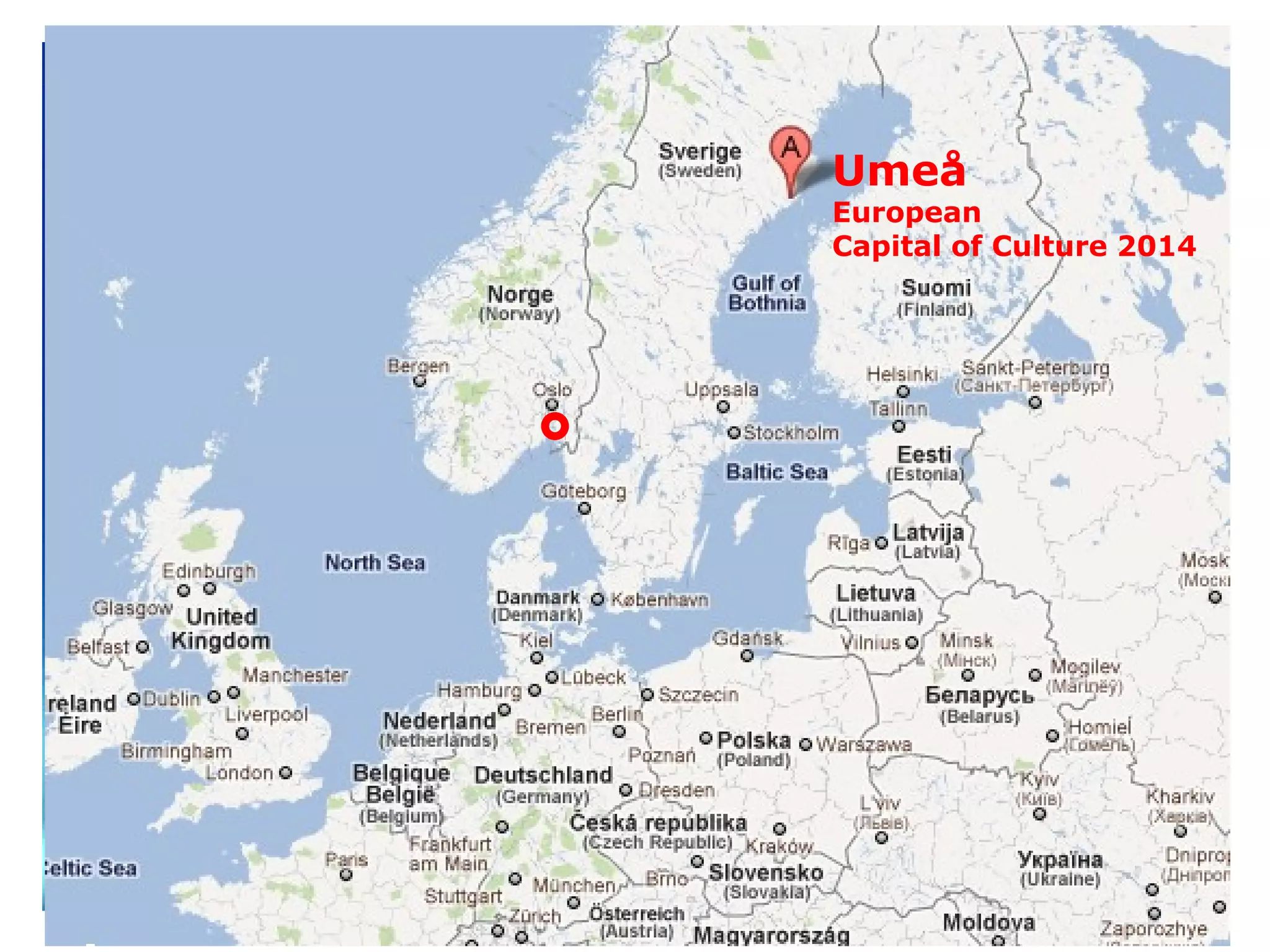
Umeå
                 European
                 Capital of Culture 2014


Datum   Sidfot                         2
Research group
“ICTML: Digital Didactics”

• Professor Dr. Isa Jahnke, Dep Applied Educational Science
  -- background: Social scientist in Computer Science (CSCL and CSCW)
  -- Dynamics of social roles in socio-technical systems
  -- Didactics (German Didaktik)


• 4 PhD students
   •   Andreas Olsson: Mobile Learning
   •   Lars Norqvist: Creative Learning
   •   Leif Marklund: Game-based learning
   •   Anders Norberg: Blended learning


• 1 Post-Doc (Visby Program): Nataliia Sharkova (Ukraine)
• 2 Post-Docs (50%) to be announced

• Our Website:
  https://iml.edusci.umu.se/ictml/


                                                      isa.jahnke@edusci.umu.se   3
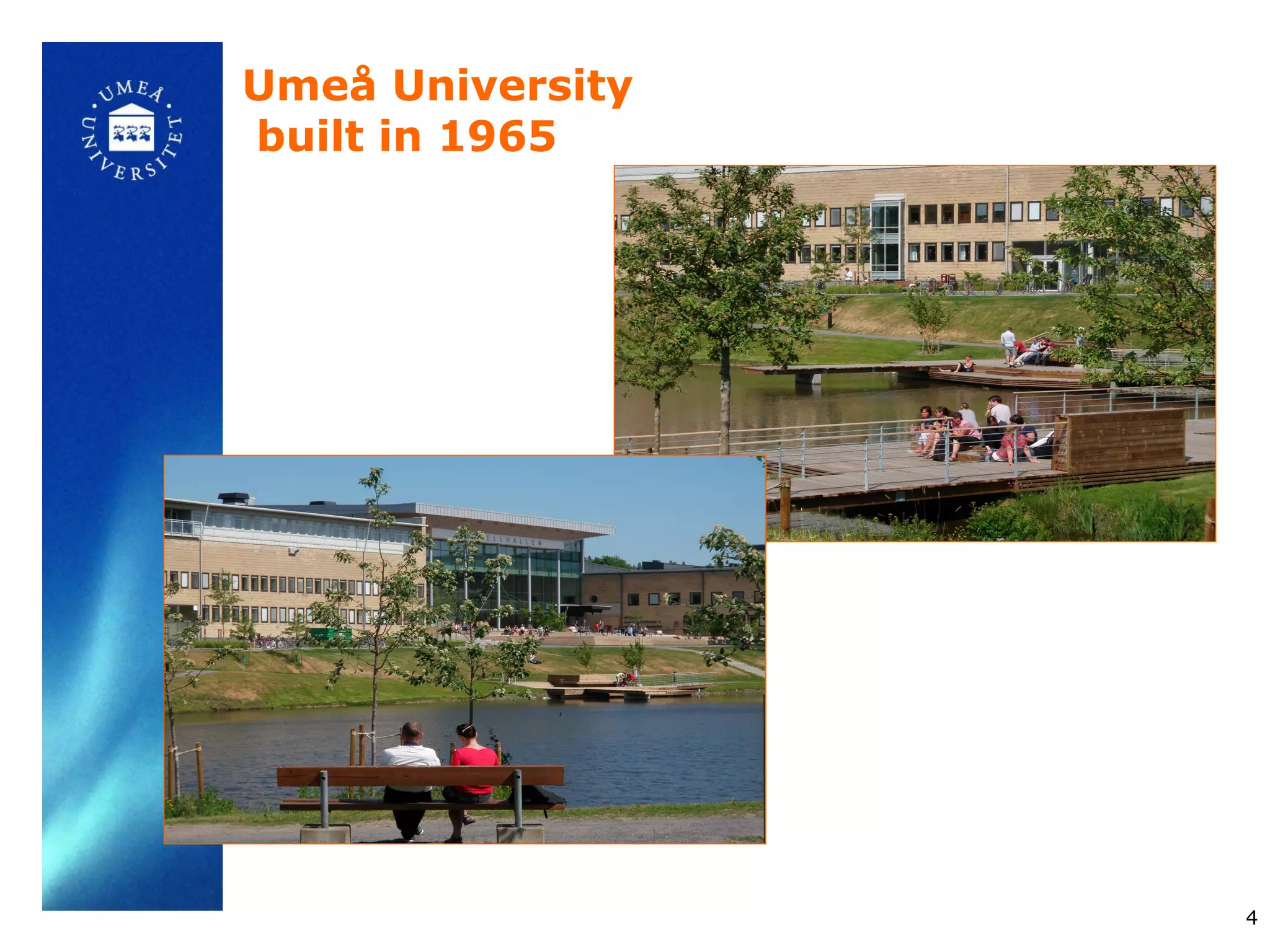
Umeå University
built in 1965


                  4
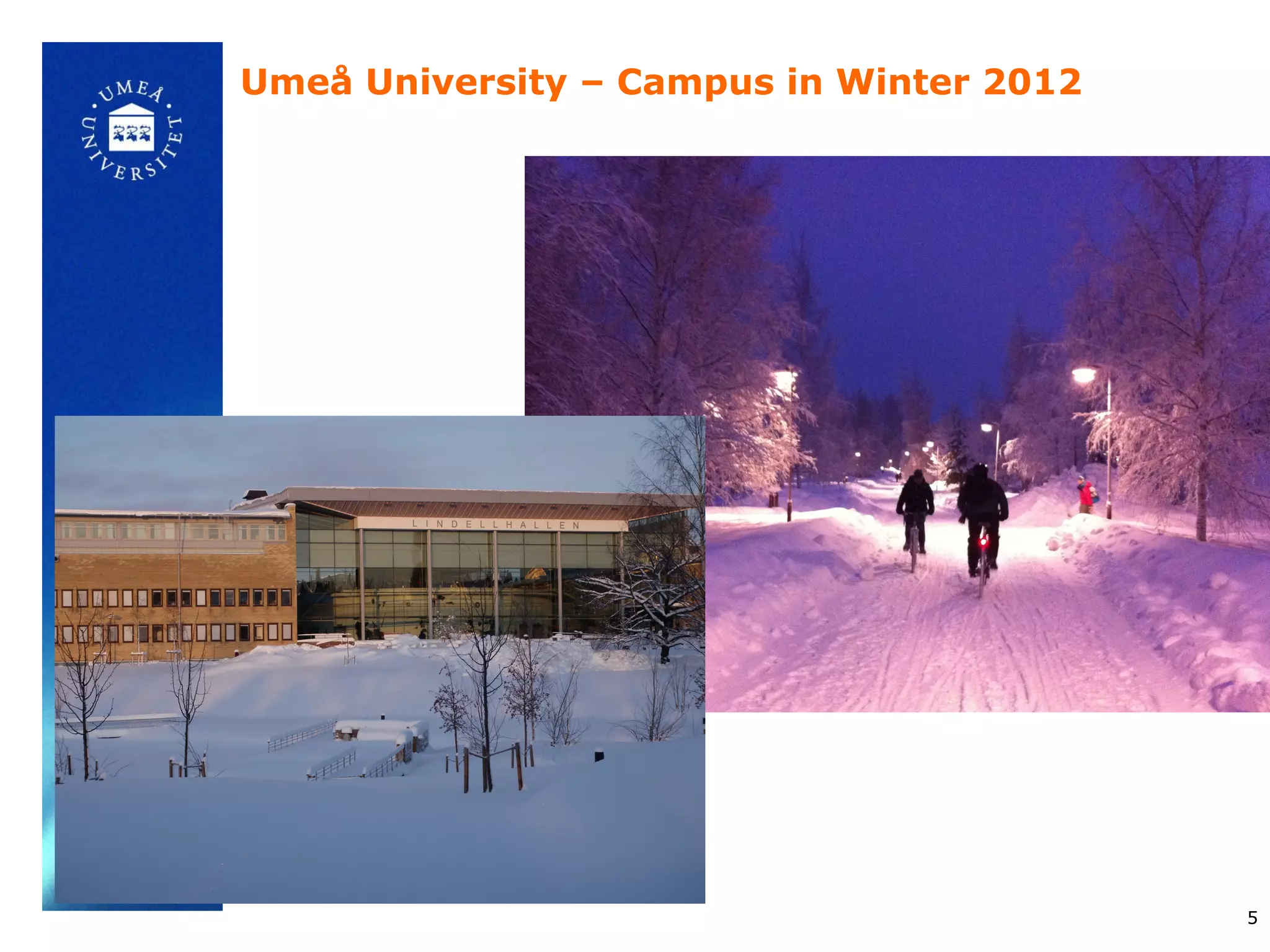
Umeå University – Campus in Winter 2012


                                          5
Umeå University
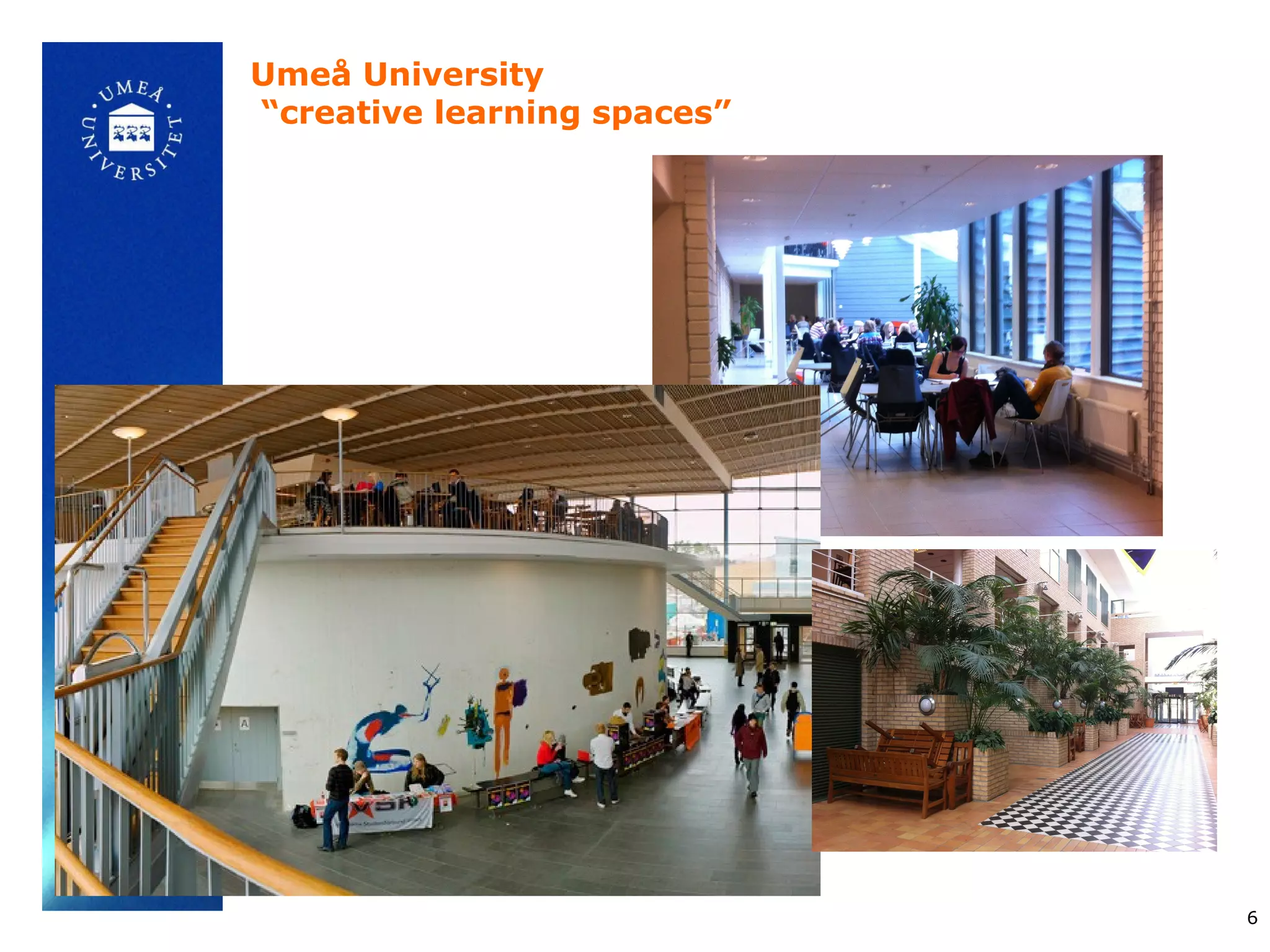
“creative learning spaces”


                             6
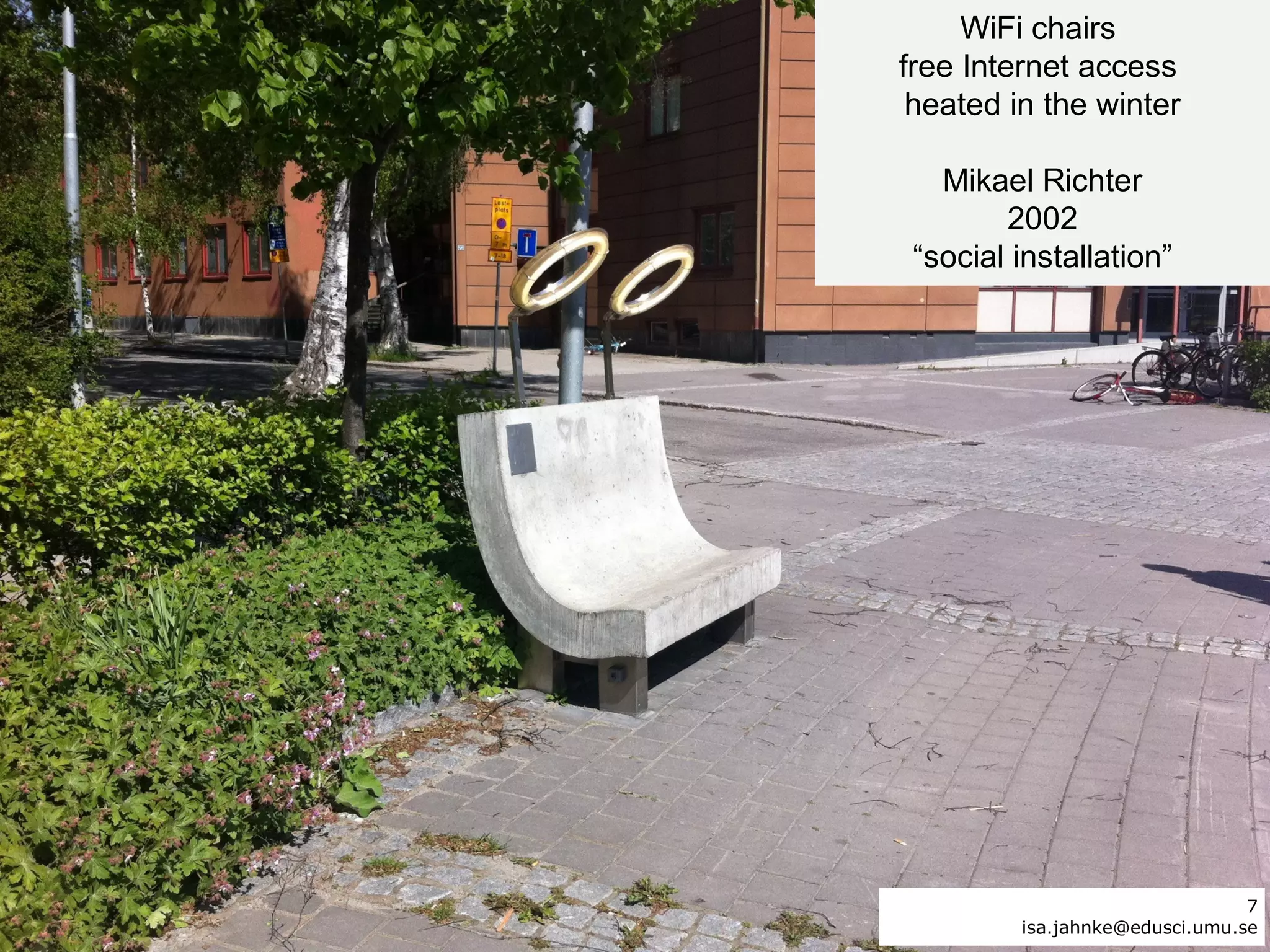
WiFi chairs
free Internet access
 heated in the winter

   Mikael Richter
        2002
 “social installation”


                          7     7
         isa.jahnke@edusci.umu.se
8
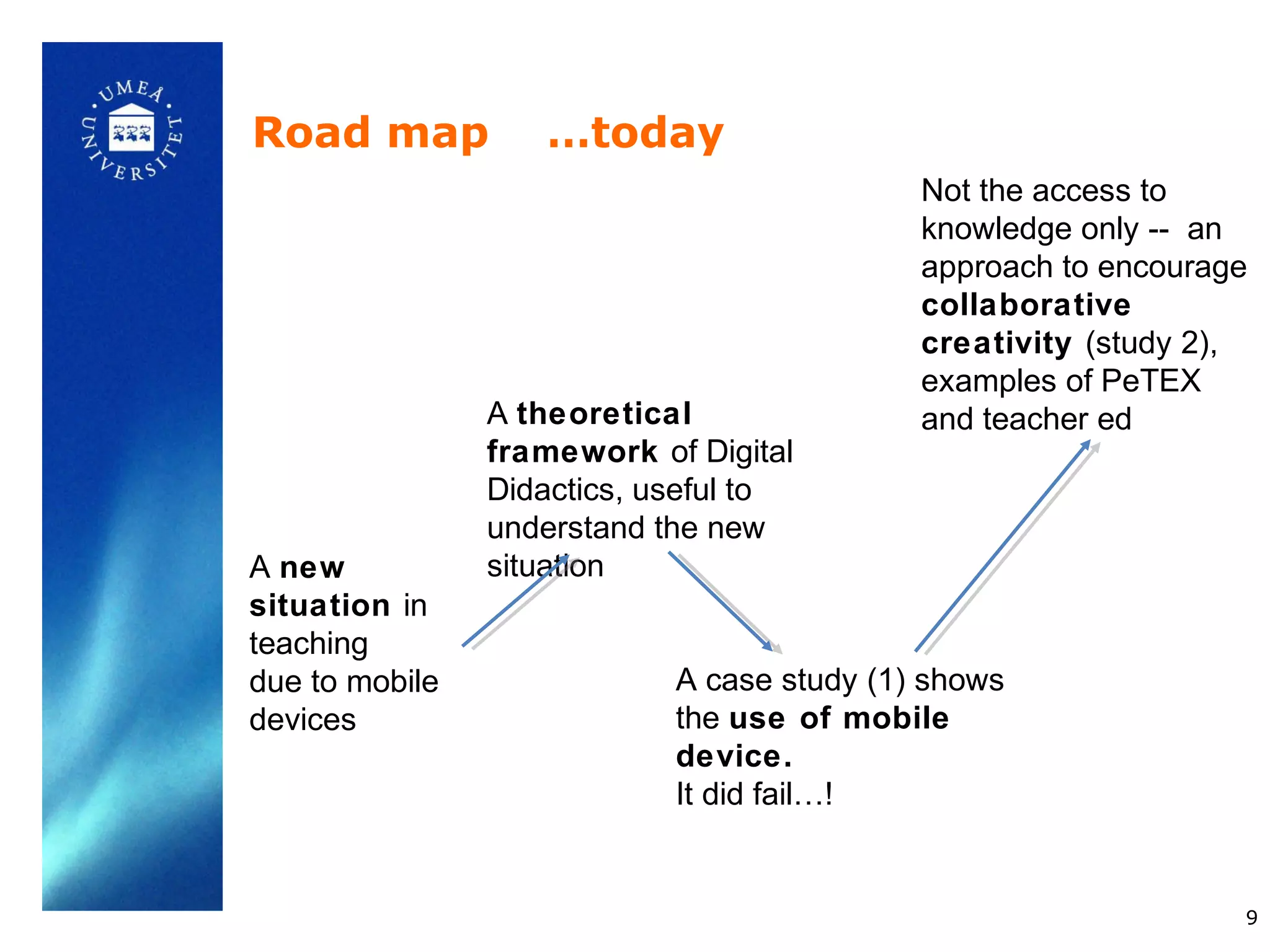
Road map           …today
                                            Not the access to
                                            knowledge only -- an
                                            approach to encourage
                                            collaborative
                                            creativity (study 2),
                                            examples of PeTEX
                A theoretical               and teacher ed
                framework of Digital
                Didactics, useful to
                understand the new
A new           situation
situation in
teaching
due to mobile               A case study (1) shows
devices                     the use of mobile
                            device.
                            It did fail…!


                                                                9
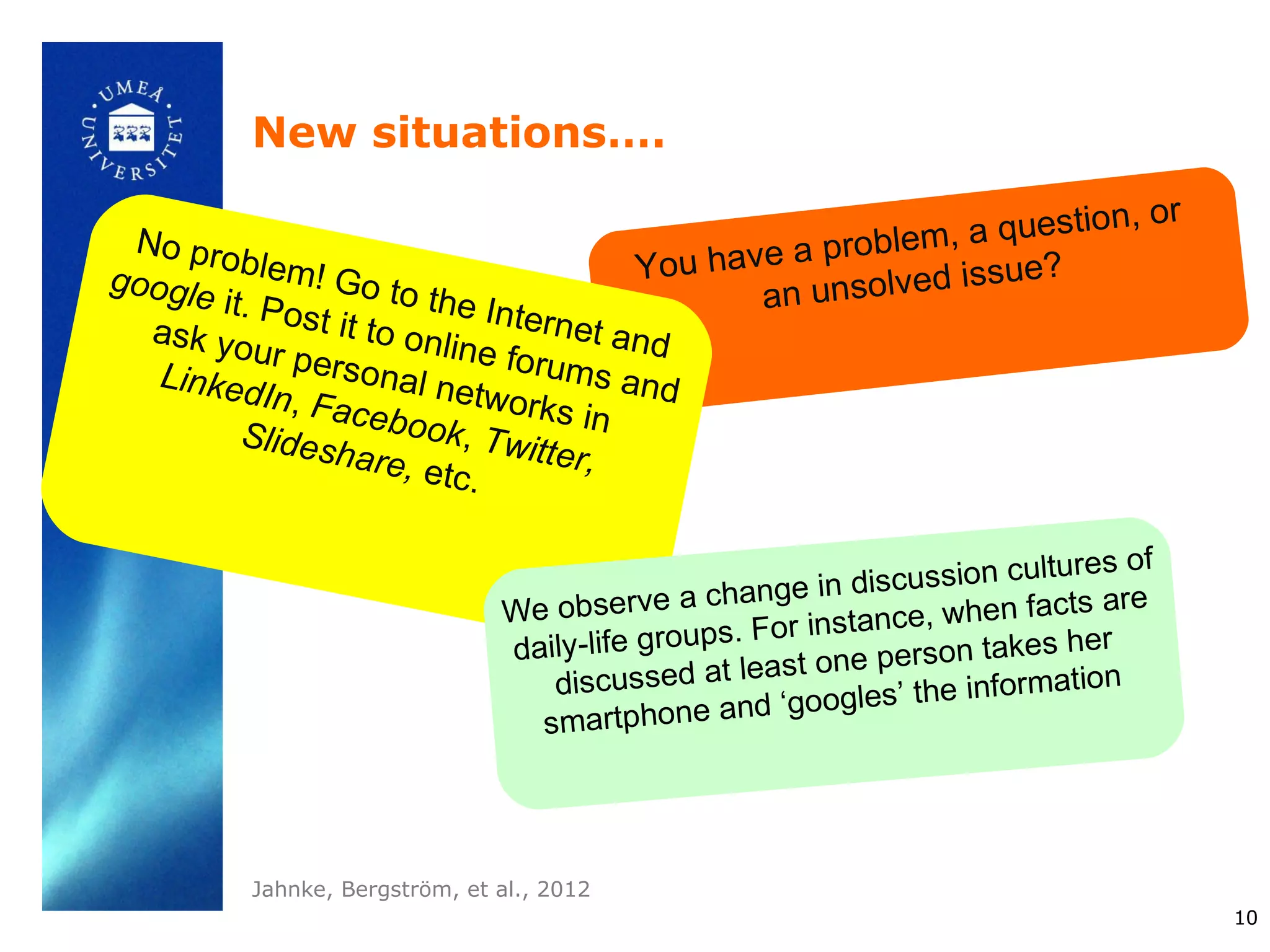
New situations….
                                                                         , or
 No pro                                                 blem, a question
         blem!                           You have a pro         ue?
google
       it. Pos
                Go to
                         the Int                an unsolved iss
  ask yo       t it to o         ernet
                         nline f        an
   Linked
          ur per
                 sonal          orums d
           In, Fa         netwo         and
                  ceboo          rks
         Slides            k, Twi in
                 hare,            tter,
                         etc.

                                                                                 s of
                                                    nge in dis cussion culture
                                We observe a cha           stance, when
                                                                           facts are
                                                 s. For in
                                daily-life group                       takes her
                                                     a st one person
                                   discussed at le                        rmation
                                                  nd ‘go  ogles’ the info
                                  smartphone a


          Jahnke, Bergström, et al., 2012
                                                                                        10
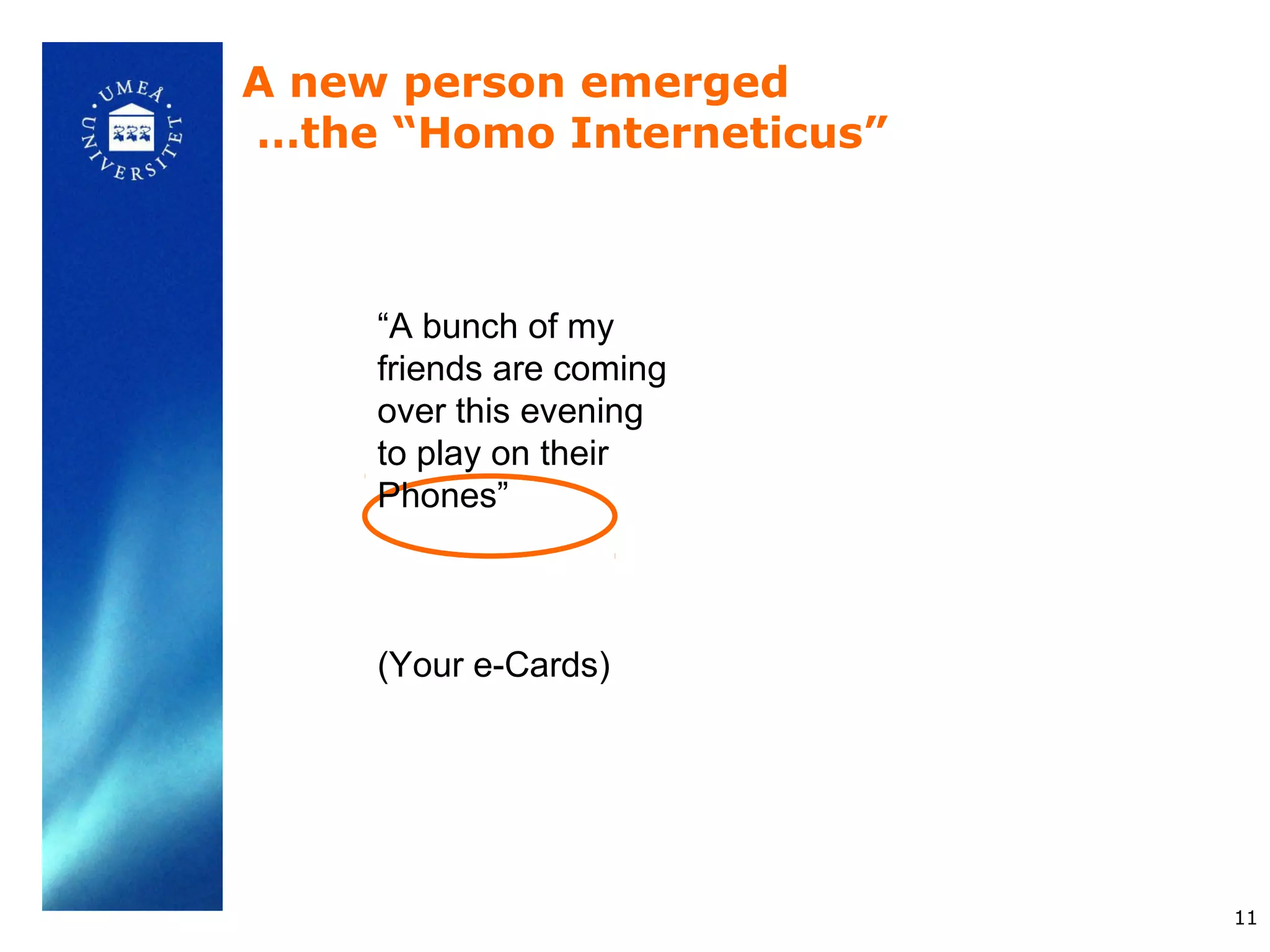
A new person emerged
…the “Homo Interneticus”


     “A bunch of my
     friends are coming
     over this evening
     to play on their
     Phones”


     (Your e-Cards)


                           11
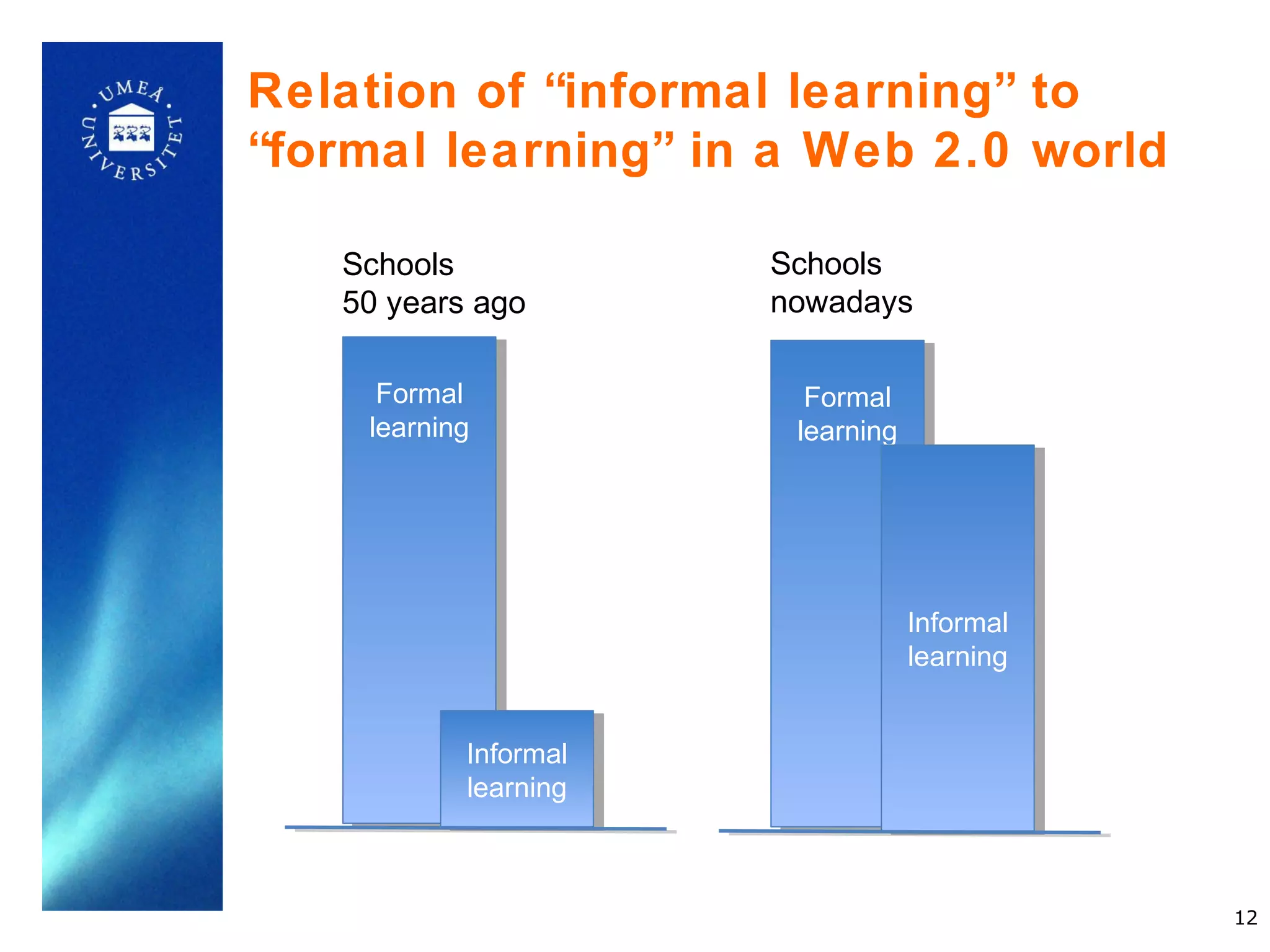
Relation of “informal learning” to
“formal learning” in a Web 2.0 world

   Schools            Schools
   50 years ago       nowadays

     Formal             Formal
    learning           learning


                                  Informal
                                  learning


           Informal
           learning


                                             12
We don’t live any longer
in a social constructed reality Homo I
                                      nterne
             BUT                             ticus
                                        ?
         we live in a
                                         idakticus
      socio-technically          Homo D
     constructed society


  The social construction of reality
  Berger & Luckmann, 1967


  Homo Interneticus
  Aleks Krotoski, 2011                               13
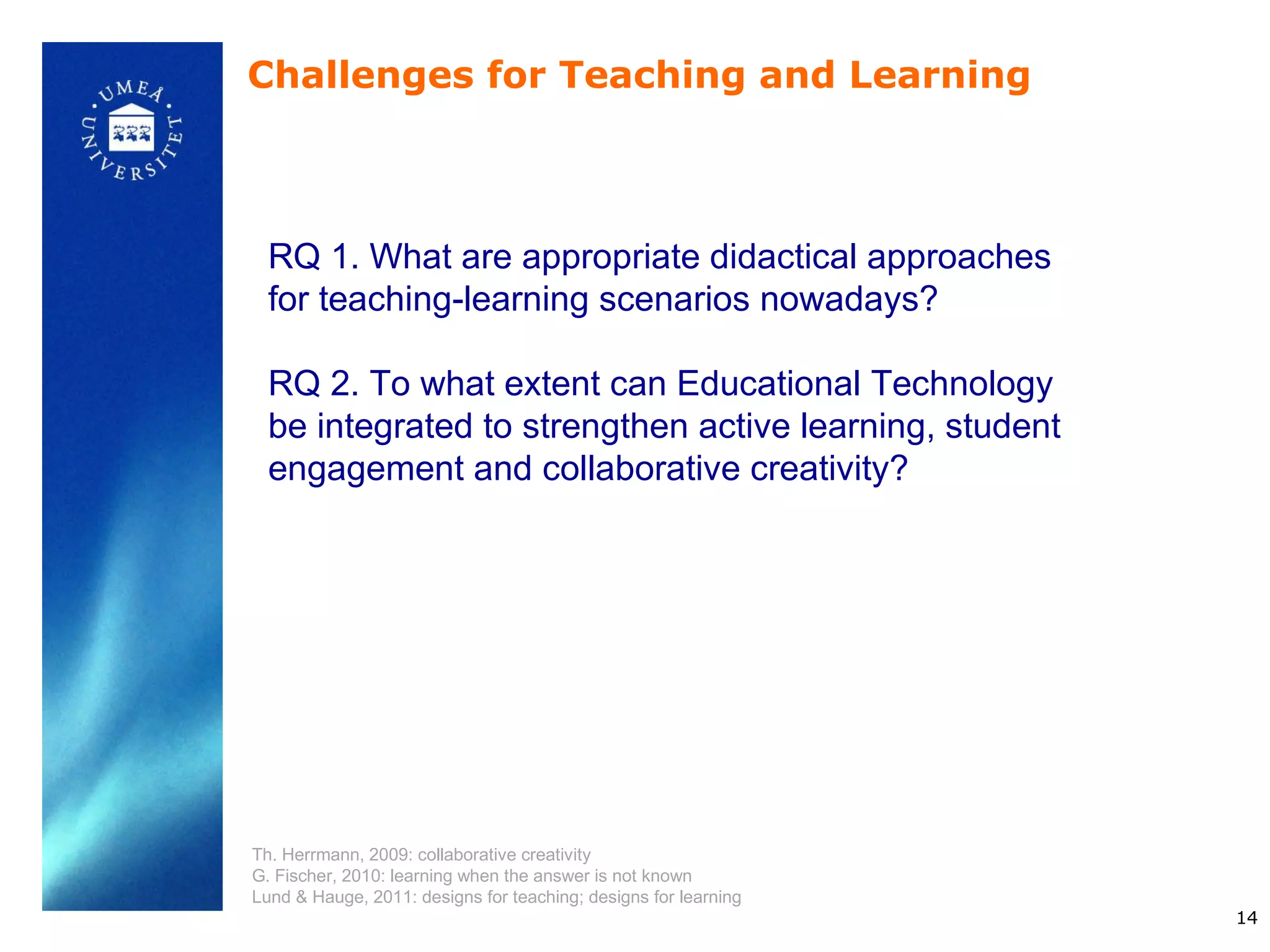
Challenges for Teaching and Learning


  RQ 1. What are appropriate didactical approaches
  for teaching-learning scenarios nowadays?

  RQ 2. To what extent can Educational Technology
  be integrated to strengthen active learning, student
  engagement and collaborative creativity?


Th. Herrmann, 2009: collaborative creativity
G. Fischer, 2010: learning when the answer is not known
Lund & Hauge, 2011: designs for teaching; designs for learning
                                                                 14
Theoretical framework


                        15
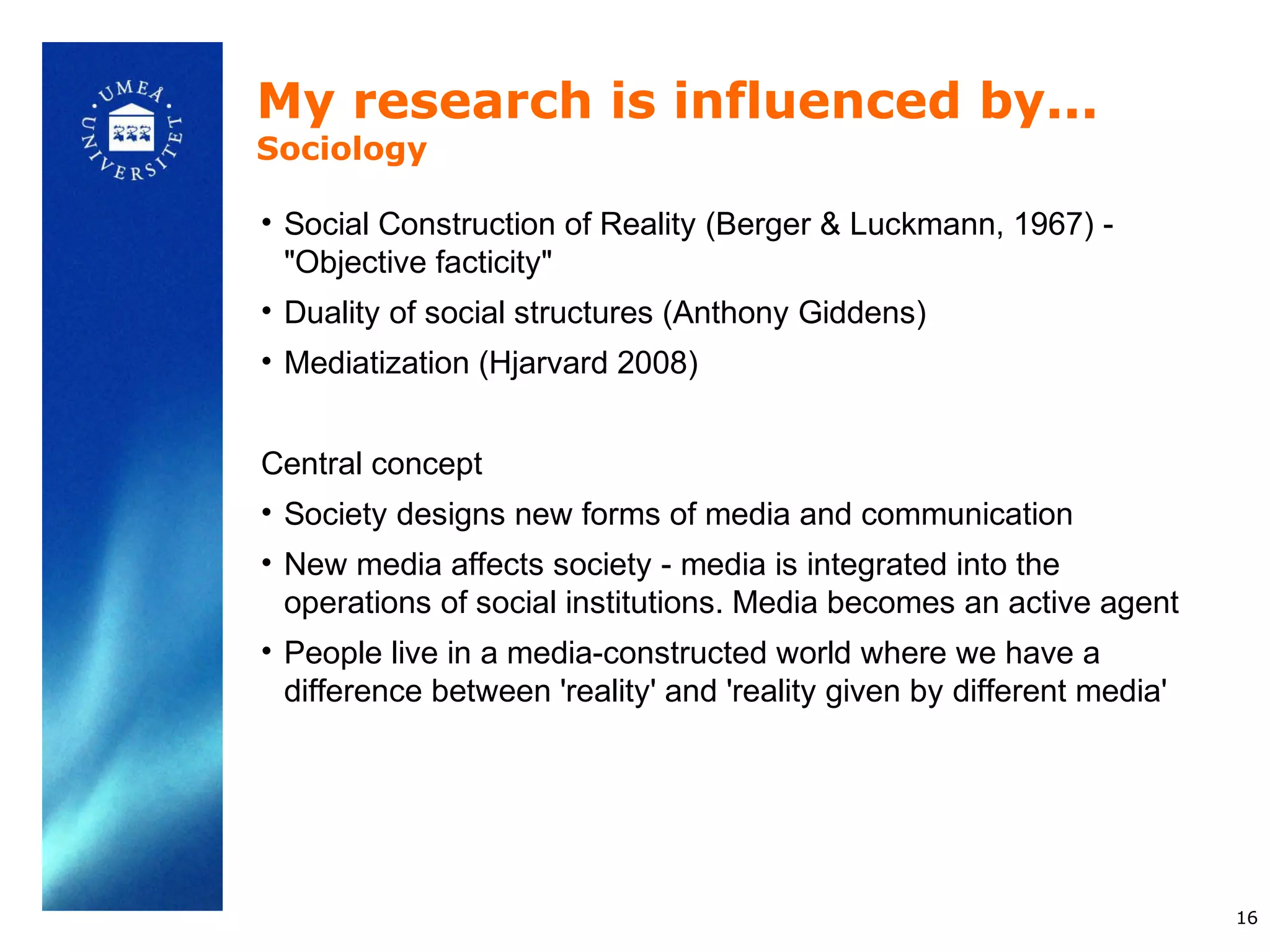
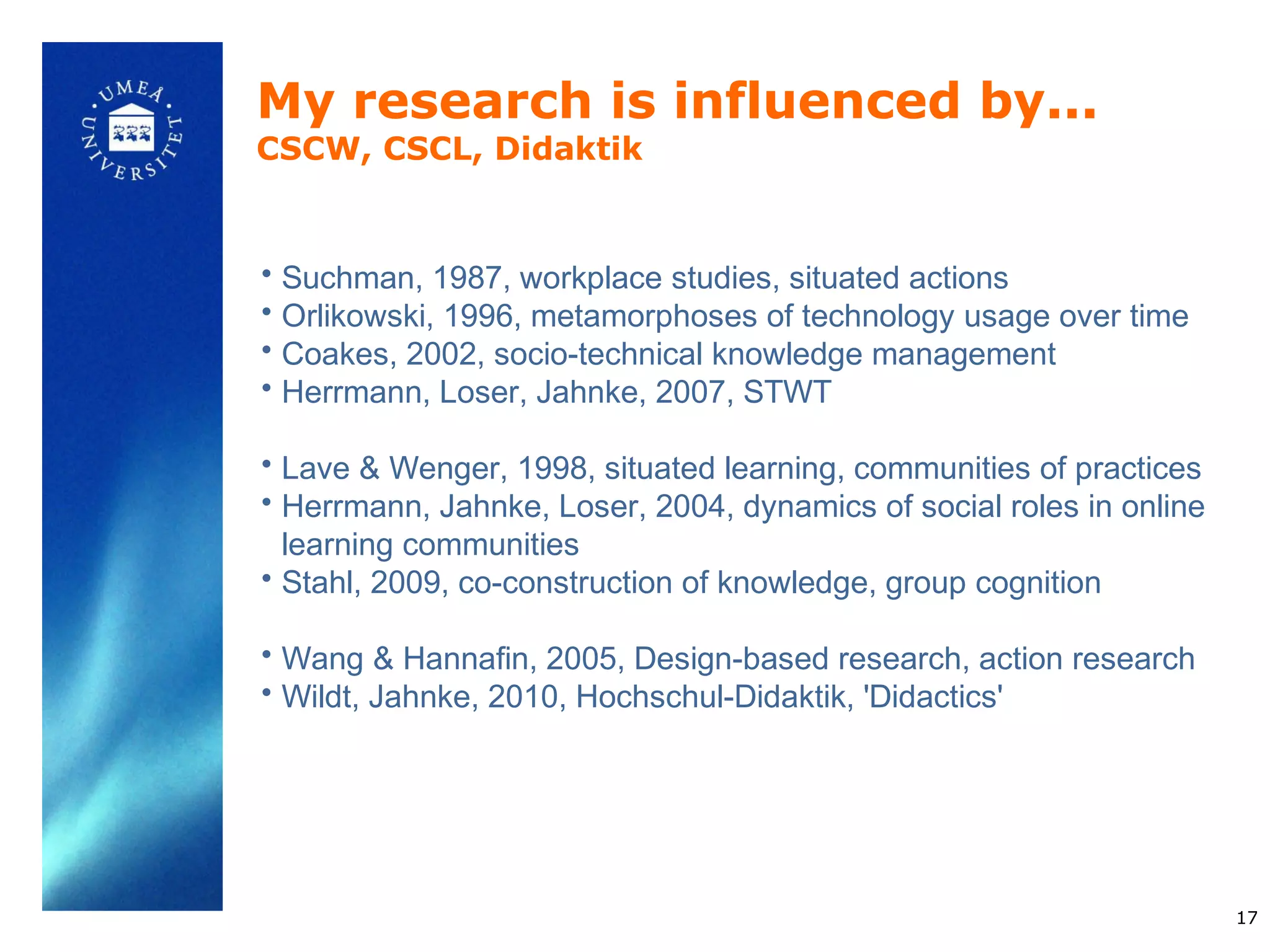
My research is influenced by...
Sociology

• Social Construction of Reality (Berger & Luckmann, 1967) -
  "Objective facticity"
• Duality of social structures (Anthony Giddens)
• Mediatization (Hjarvard 2008)


Central concept
• Society designs new forms of media and communication
• New media affects society - media is integrated into the
  operations of social institutions. Media becomes an active agent
• People live in a media-constructed world where we have a
  difference between 'reality' and 'reality given by different media'


                                                                        16
My research is influenced by...
CSCW, CSCL, Didaktik


• Suchman, 1987, workplace studies, situated actions
• Orlikowski, 1996, metamorphoses of technology usage over time
• Coakes, 2002, socio-technical knowledge management
• Herrmann, Loser, Jahnke, 2007, STWT

• Lave & Wenger, 1998, situated learning, communities of practices
• Herrmann, Jahnke, Loser, 2004, dynamics of social roles in online
  learning communities
• Stahl, 2009, co-construction of knowledge, group cognition

• Wang & Hannafin, 2005, Design-based research, action research
• Wildt, Jahnke, 2010, Hochschul-Didaktik, 'Didactics'


                                                                      17
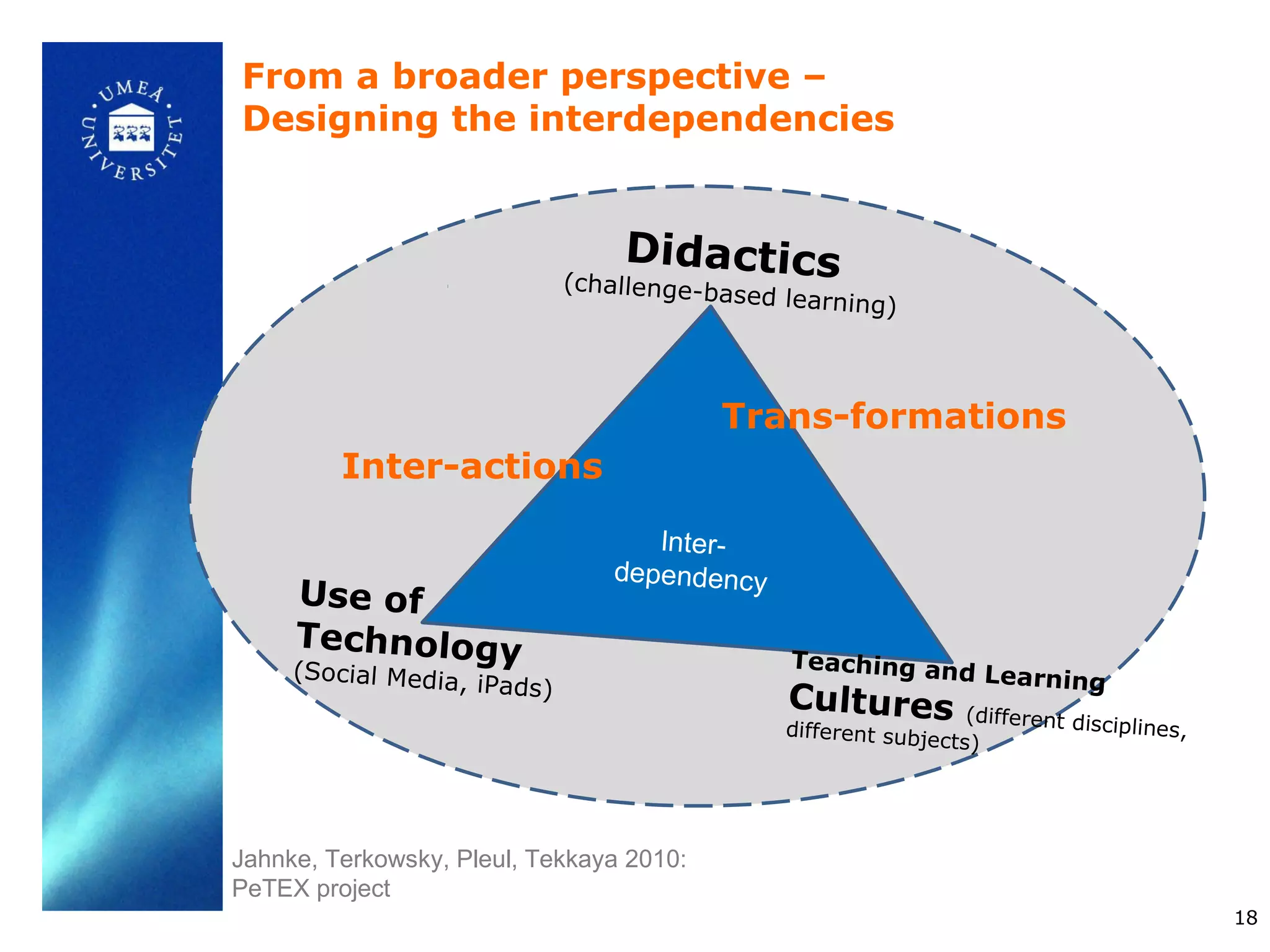
From a broader perspective –
Designing the interdependencies


                                  Didactics
                              (challenge-ba
                                              sed learning)


                                          Trans-formations
         Inter-actions

                                    Inter-
                                 dependency
     Us e o f
     Technology
     (Social Media                                Teaching an
                   , iPads)                                   d Learning
                                                  Cultures           (different disc
                                                  different subje                   iplines,
                                                                  cts)


Jahnke, Terkowsky, Pleul, Tekkaya 2010:
PeTEX project
                                                                                               18
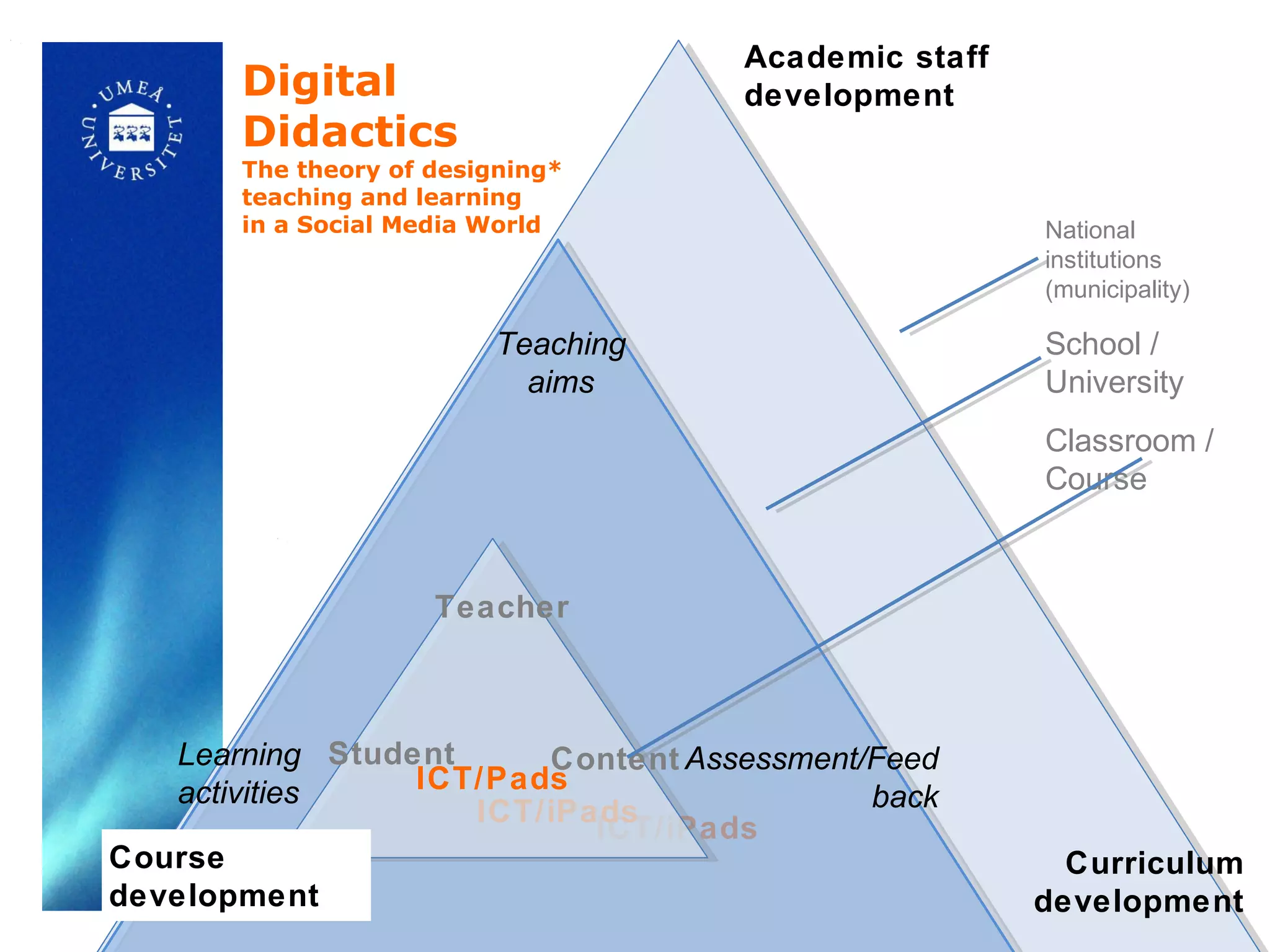
Academic staff
       Digital                      development
       Didactics
       The theory of designing*
       teaching and learning
       in a Social Media World                       National
                                                     institutions
                                                     (municipality)

                         Teaching                    School /
                           aims                      University
                                                     Classroom /
                                                     Course


                     Teacher


   Learning Student     Content Assessment/Feed
   activities    ICT/Pads
                    ICT/iPads              back
                           ICT/iPads
Course                                                 Curriculum
development                                          development
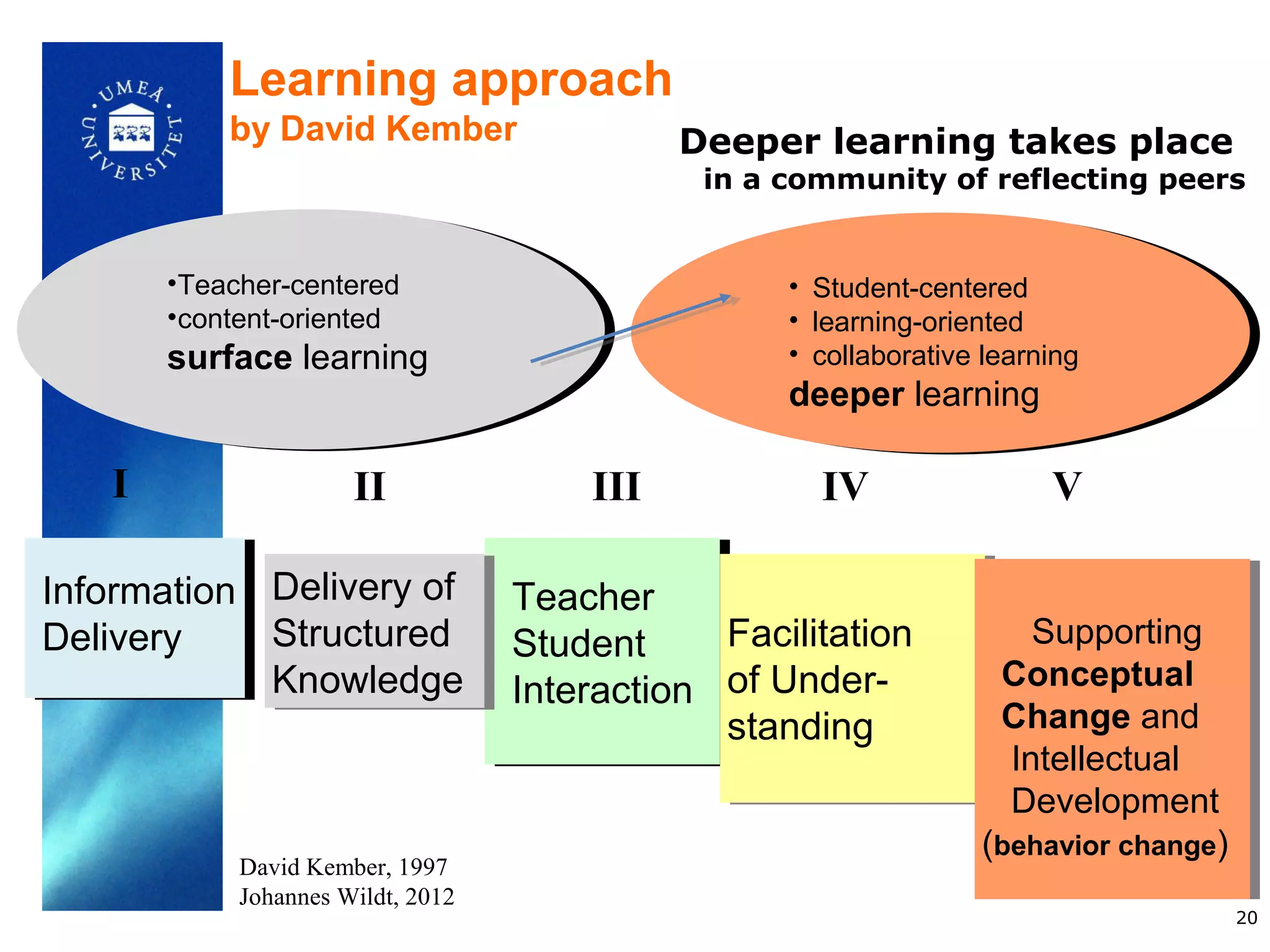
Learning approach
           by David Kember               Deeper learning takes place
                                          in a community of reflecting peers


       •Teacher-centered                       • Student-centered
       •content-oriented                       • learning-oriented
       surface learning                        • collaborative learning
                                               deeper learning

   I                  II           III           IV                 V

Information Delivery of Teacher
            Delivery of
Delivery    Structured
            Structured Student    Facilitation
                                   Facilitation                   Supporting
                                                                   Supporting
            Knowledge Interaction of Under-
            Knowledge              of Under-                    Conceptual
                                                                Conceptual
                                  standing
                                   standing                     Change and
                                                                Change and
                                                                Intellectual
                                                                 Intellectual
                                                                Development
                                                                 Development
                                                              ((behaviorchange))
                                                               behavior change
            David Kember, 1997
            Johannes Wildt, 2012
                                                                               20
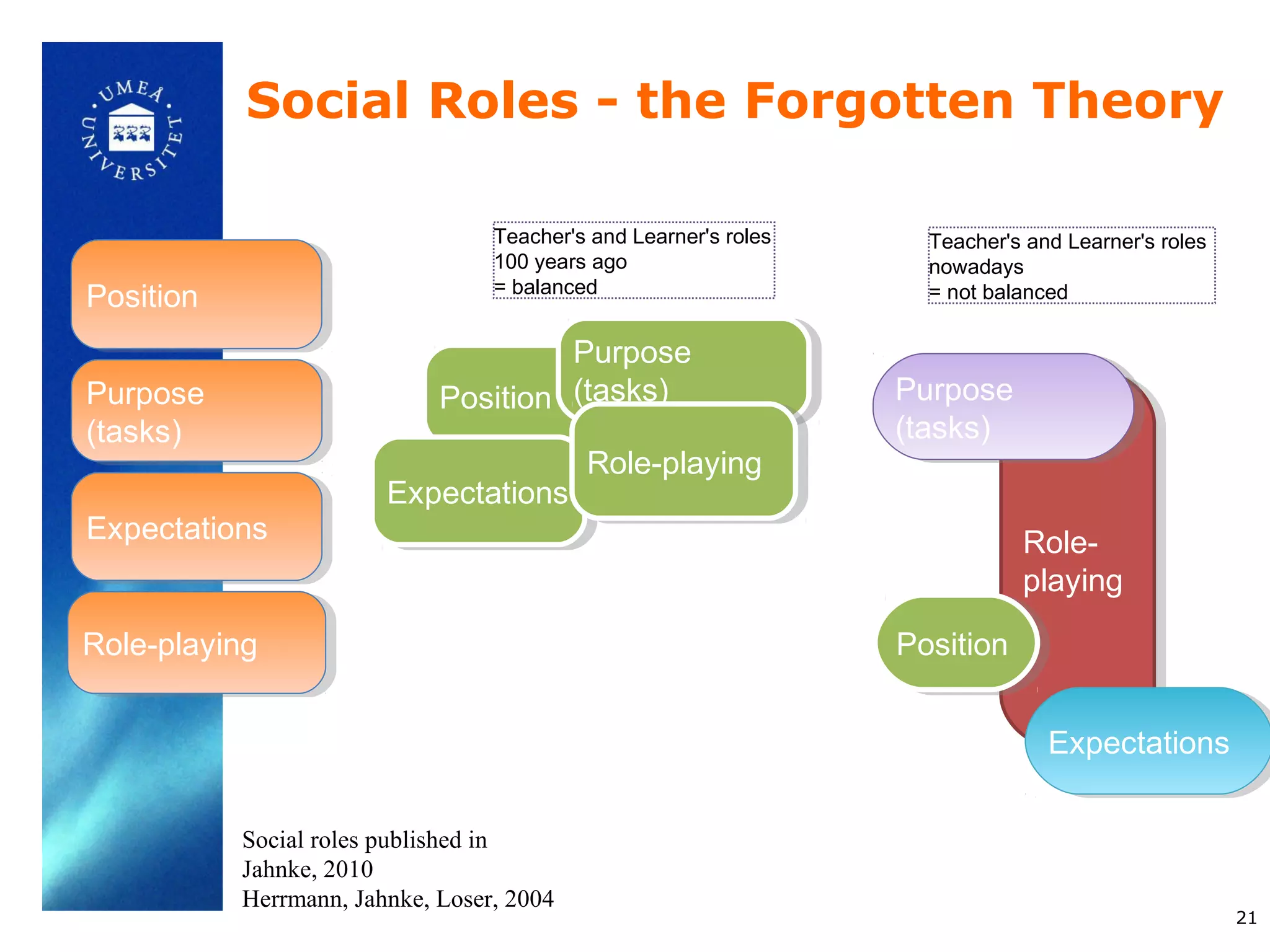
Social Roles - the Forgotten Theory

                                  Teacher's and Learner's roles     Teacher's and Learner's roles
                                  100 years ago                     nowadays
                                  = balanced                        = not balanced
Position
Position
                                      Purpose
                                       Purpose
Purpose
 Purpose                     Position (tasks)
                             Position (tasks)                     Purpose
                                                                   Purpose
(tasks)
 (tasks)                                                          (tasks)
                                                                   (tasks)
                                           Role-playing
                                           Role-playing
                        Expectations
                        Expectations
Expectations
Expectations                                                                 Role-
                                                                              Role-
                                                                             playing
                                                                              playing
Role-playing
Role-playing                                                      Position
                                                                  Position


                                                                                Expectations
                                                                                Expectations

           Social roles published in
           Jahnke, 2010
           Herrmann, Jahnke, Loser, 2004
                                                                                                    21
Method


         22
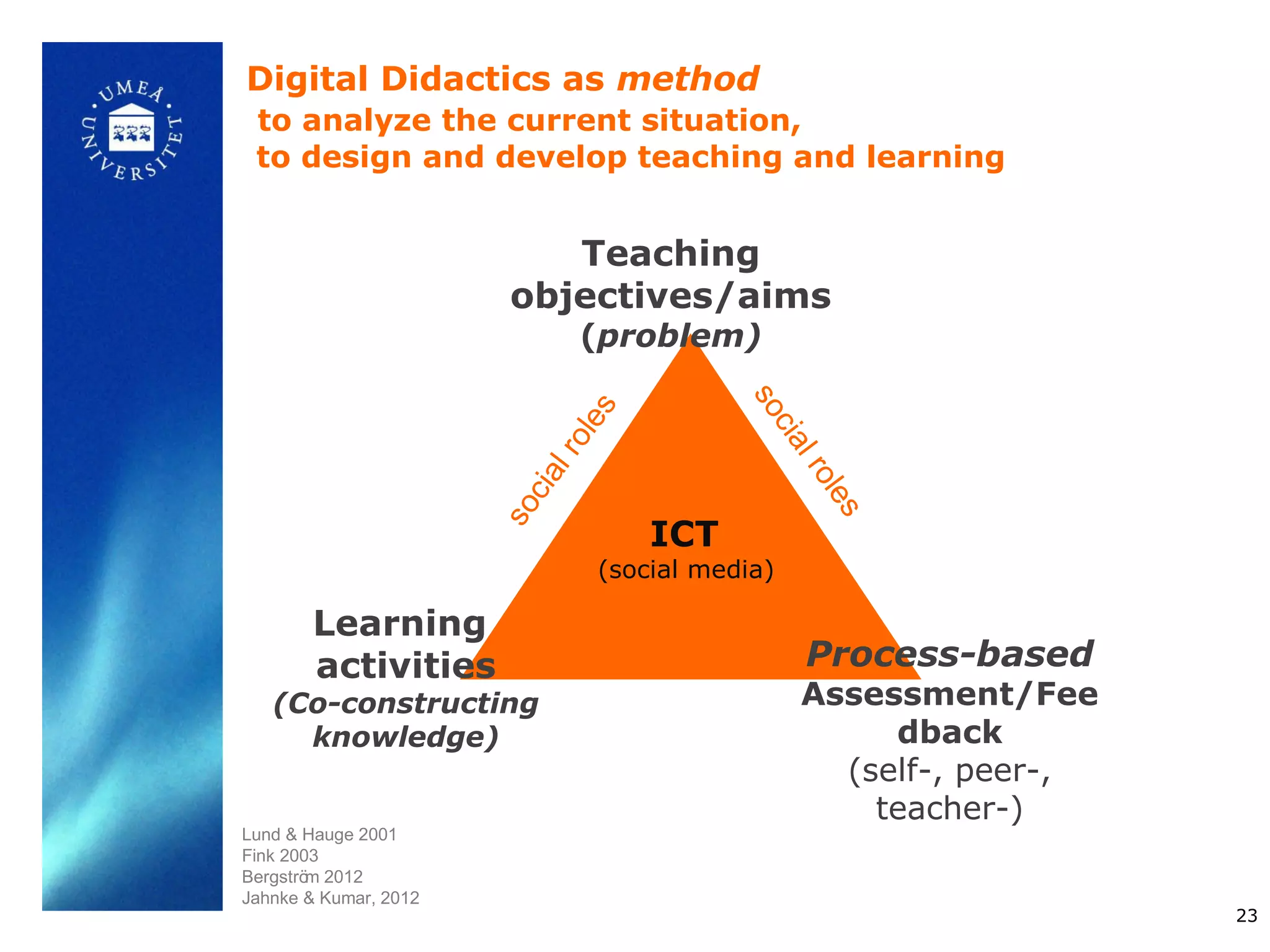
Digital Didactics as method
 to analyze the current situation,
 to design and develop teaching and learning


                          Teaching
                       objectives/aims
                             (problem)


                                            so
                               s
                            ole


                                              cia
                            lr


                                                 l ro
                         cia


                                                     les
                       so
                                     ICT
                                 (social media)

       Learning                  social roles
       activities                                 Process-based
   (Co-constructing                               Assessment/Fee
     knowledge)                                        dback
                                                    (self-, peer-,
                                                      teacher-)
Lund & Hauge 2001
Fink 2003
Bergströ 2012
        m
Jahnke & Kumar, 2012
                                                                     23
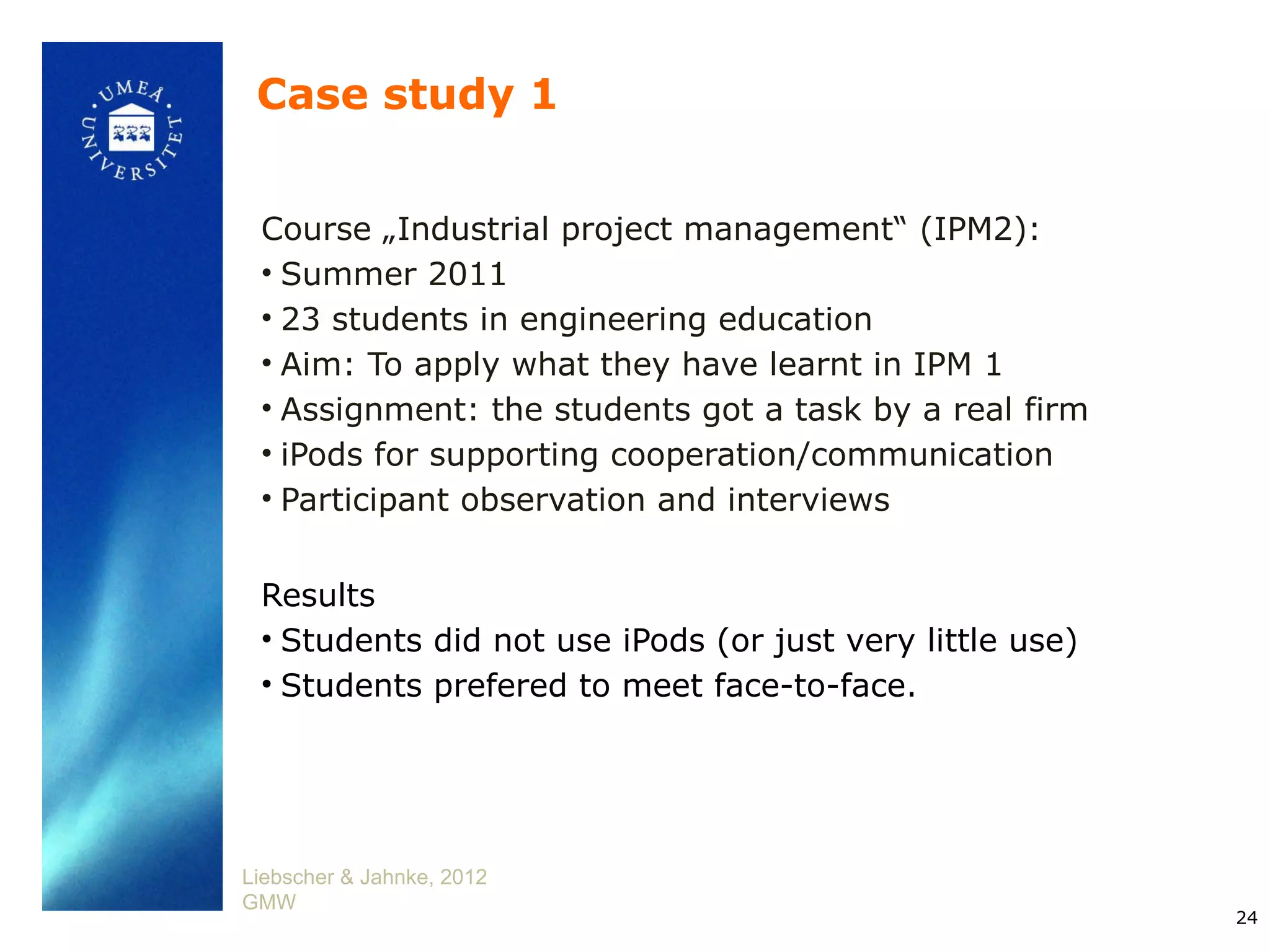
Case study 1


 Course „Industrial project management“ (IPM2):
 • Summer 2011
 • 23 students in engineering education
 • Aim: To apply what they have learnt in IPM 1
 • Assignment: the students got a task by a real firm
 • iPods for supporting cooperation/communication
 • Participant observation and interviews


 Results
 • Students did not use iPods (or just very little use)
 • Students prefered to meet face-to-face.


Liebscher & Jahnke, 2012
GMW
                                                          24
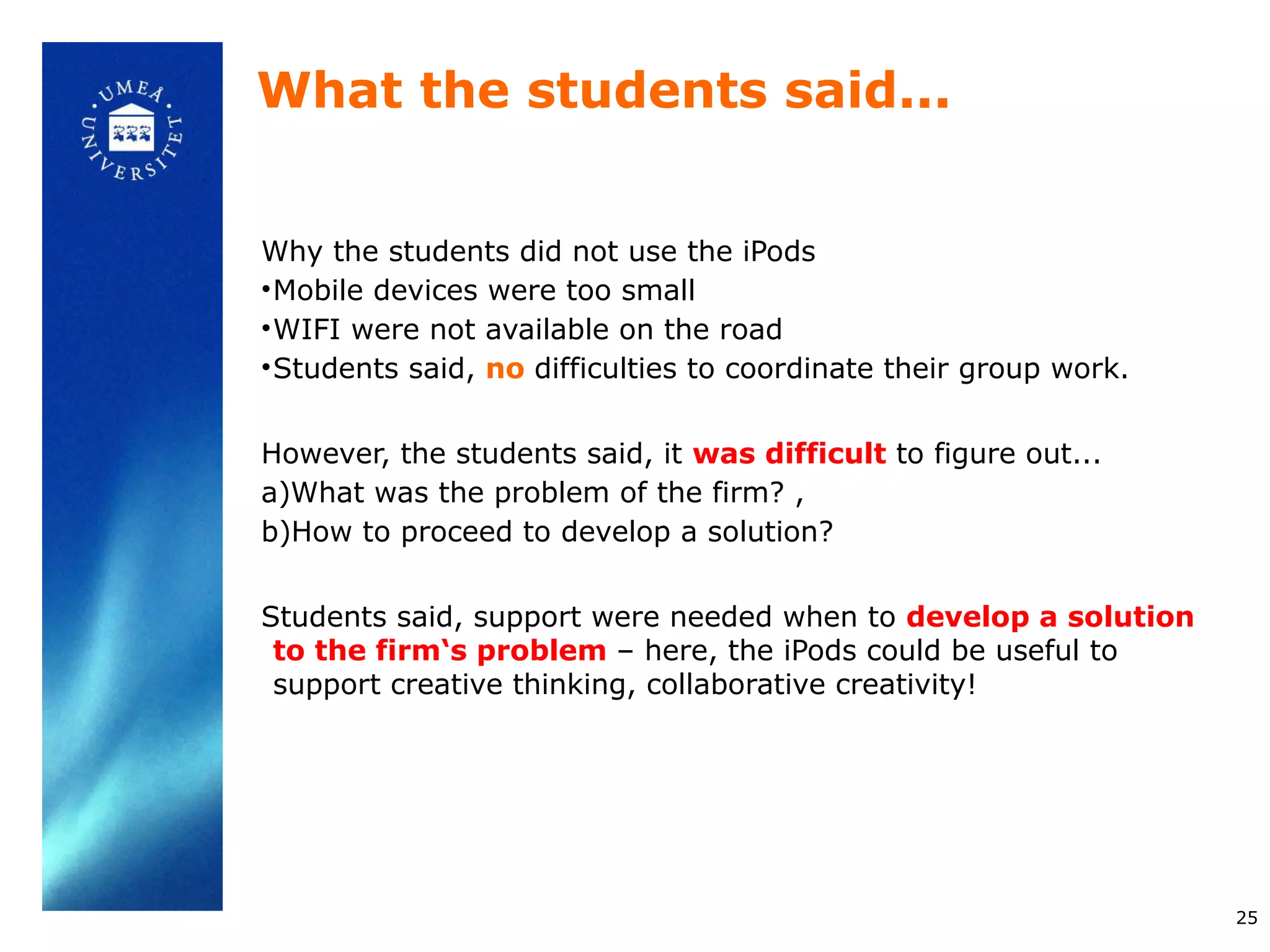
What the students said...


Why the students did not use the iPods
• Mobile devices were too small
• WIFI were not available on the road
• Students said, no difficulties to coordinate their group work.


However, the students said, it was difficult to figure out...
a)What was the problem of the firm? ,
b)How to proceed to develop a solution?


Students said, support were needed when to develop a solution
 to the firm‘s problem – here, the iPods could be useful to
 support creative thinking, collaborative creativity!


                                                                   25
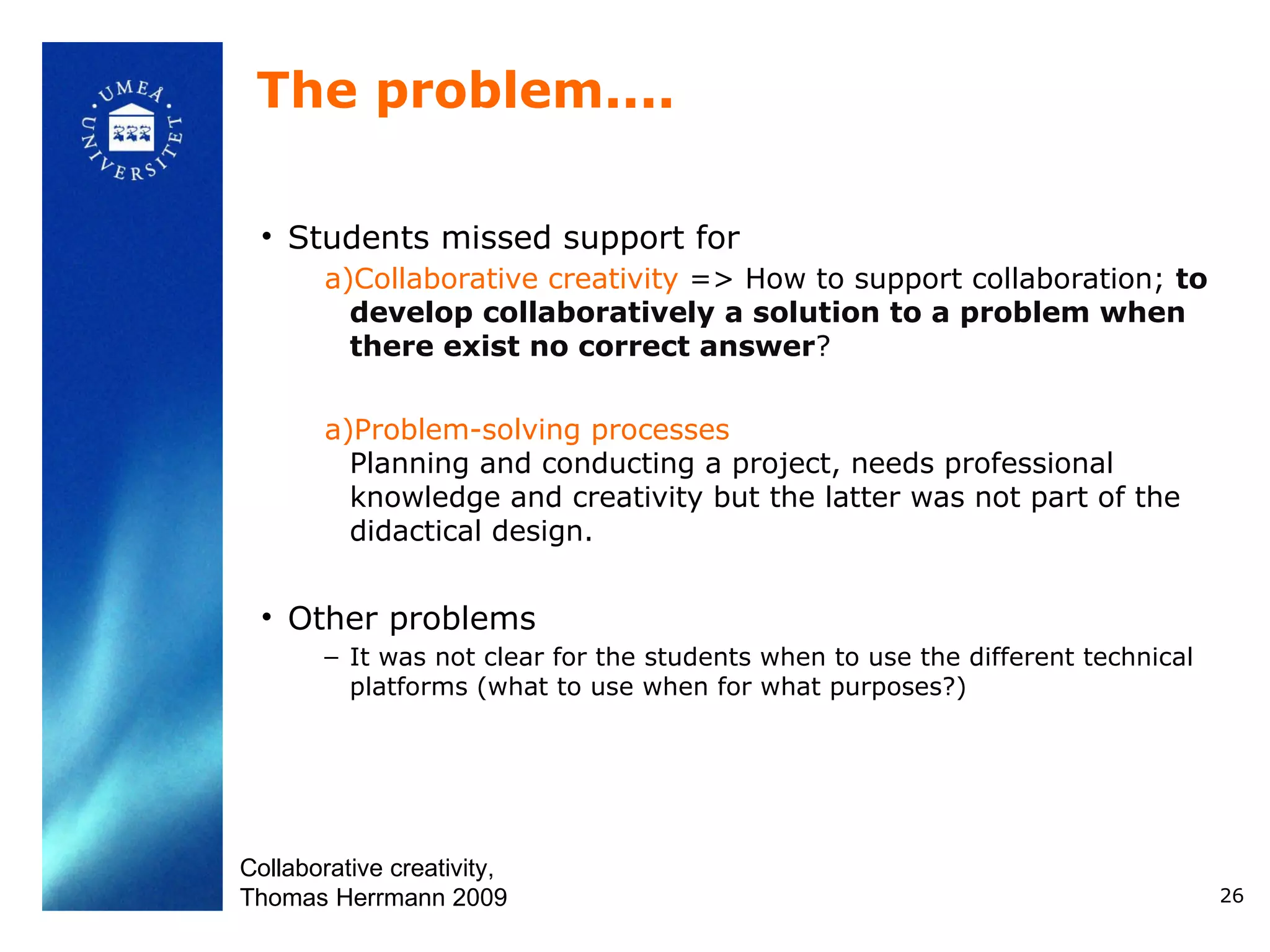
The problem....

 • Students missed support for
       a)Collaborative creativity => How to support collaboration; to
         develop collaboratively a solution to a problem when
         there exist no correct answer?

       a)Problem-solving processes
         Planning and conducting a project, needs professional
         knowledge and creativity but the latter was not part of the
         didactical design.


 • Other problems
       – It was not clear for the students when to use the different technical
         platforms (what to use when for what purposes?)


Collaborative creativity,
Thomas Herrmann 2009                                                             26
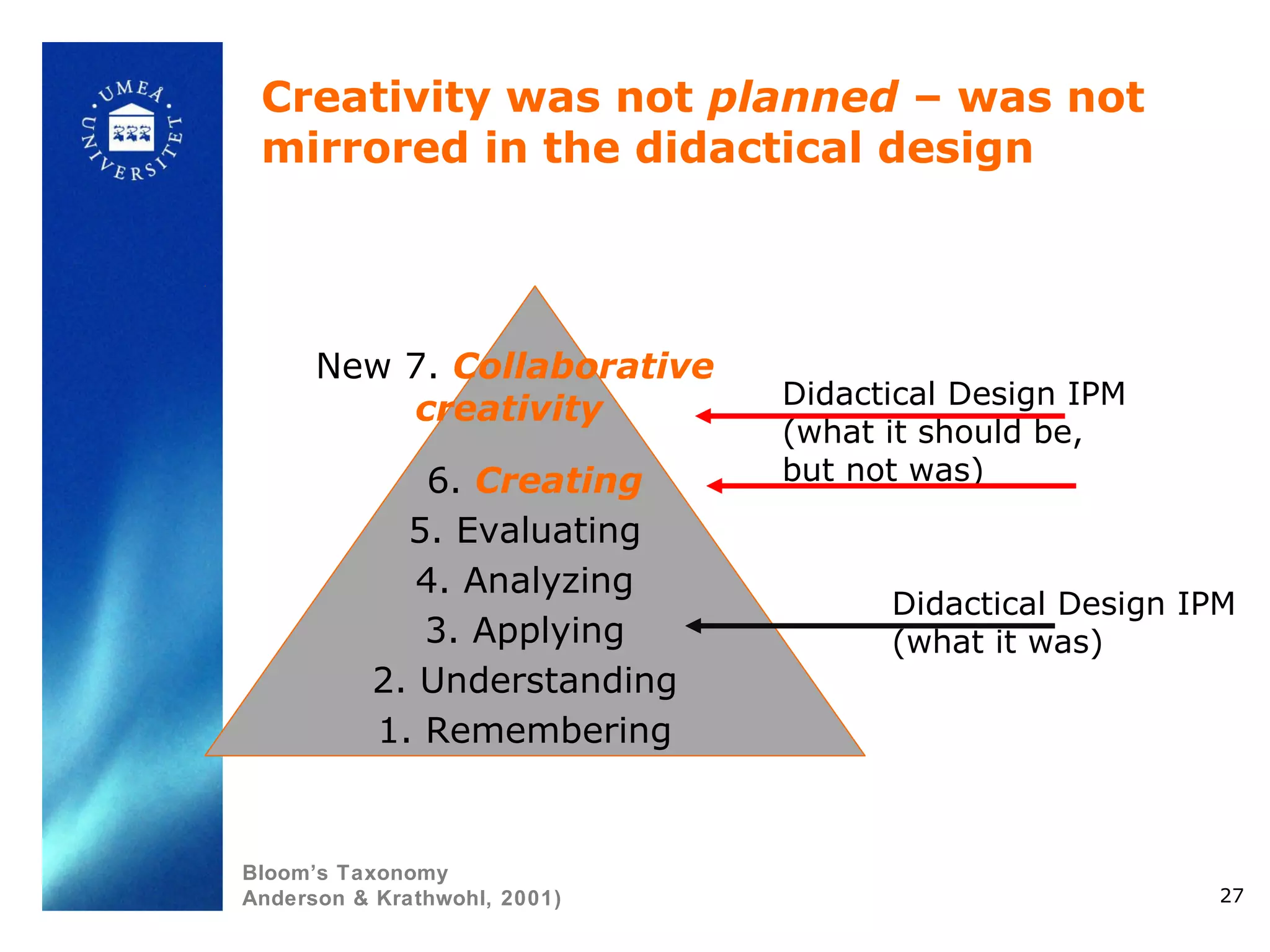
Creativity was not planned – was not
 mirrored in the didactical design


      New 7. Collaborative
                              Didactical Design IPM
          creativity
                              (what it should be,
              6. Creating     but not was)
            5. Evaluating
             4. Analyzing
                                    Didactical Design IPM
             3. Applying            (what it was)
          2. Understanding
          1. Remembering


Bloom’s Taxonomy
Anderson & Krathwohl, 2001)                            27
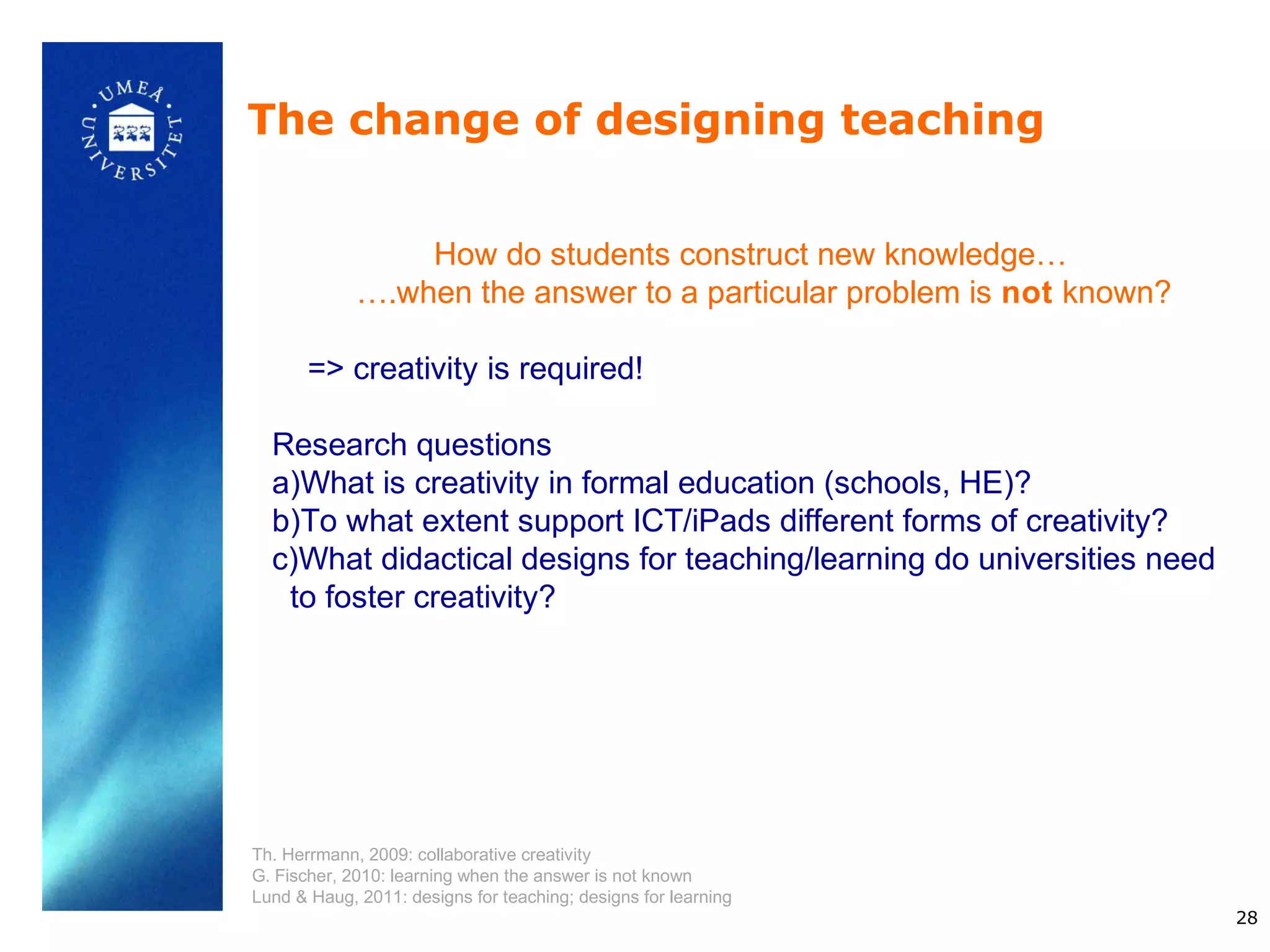
The change of designing teaching


                 How do students construct new knowledge…
             ….when the answer to a particular problem is not known?

       => creativity is required!

  Research questions
  a)What is creativity in formal education (schools, HE)?
  b)To what extent support ICT/iPads different forms of creativity?
  c)What didactical designs for teaching/learning do universities need
   to foster creativity?


Th. Herrmann, 2009: collaborative creativity
G. Fischer, 2010: learning when the answer is not known
Lund & Haug, 2011: designs for teaching; designs for learning
                                                                         28
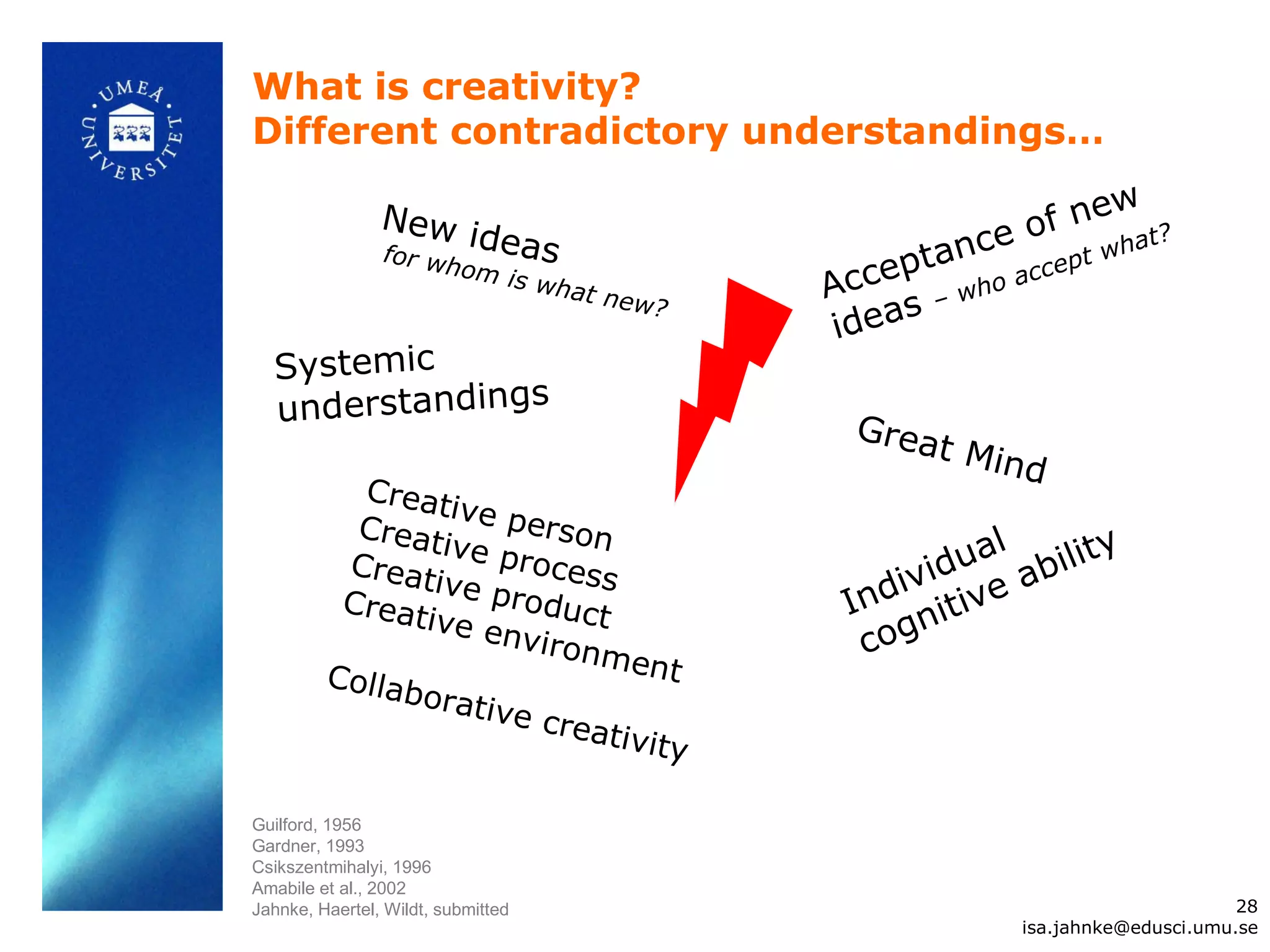
What is creativity?
Different contradictory understandings…

                                                                    ew
                New i
                      deas                                   e o f n h a t?
                for w
                                                       p tanc accept w
                                                  Acce – who
                        hom
                                is w h
                                       at ne
                                             w?        s
                                                   idea
  Systemic
  understandings                                    Grea
                                                         t   Mind
           Creat
                   iv
           Creat e person                                    l
                  iv                                                 y
          Creat e process                                idua abilit
                 iv
          Creat e product                            div tive
                                                   In ni
                ive e
                       nviro
                             nmen                   co g
         Colla                     t
               borat
                      ive cr
                            eativ
                                 ity

Guilford, 1956
Gardner, 1993
Csikszentmihalyi, 1996
Amabile et al., 2002
Jahnke, Haertel, Wildt, submitted                                                     28
                                                                isa.jahnke@edusci.umu.se
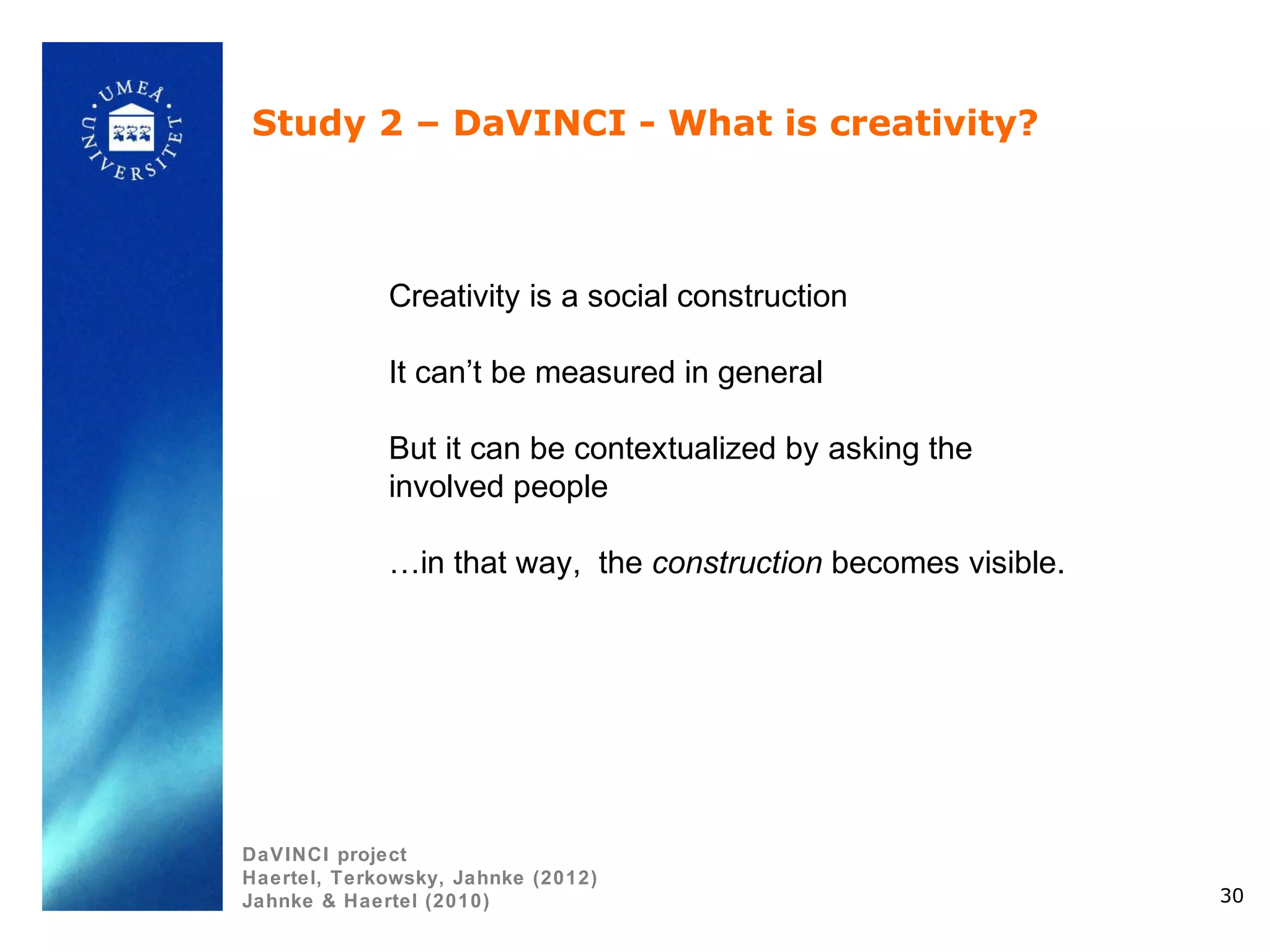
Study 2 – DaVINCI - What is creativity?


             Creativity is a social construction

             It can’t be measured in general

             But it can be contextualized by asking the
             involved people

             …in that way, the construction becomes visible.


DaVINCI project
Haertel, Terkowsky, Jahnke (2012)
Jahnke & Haertel (2010)                                        30
DaVINCI method
creativity in higher education

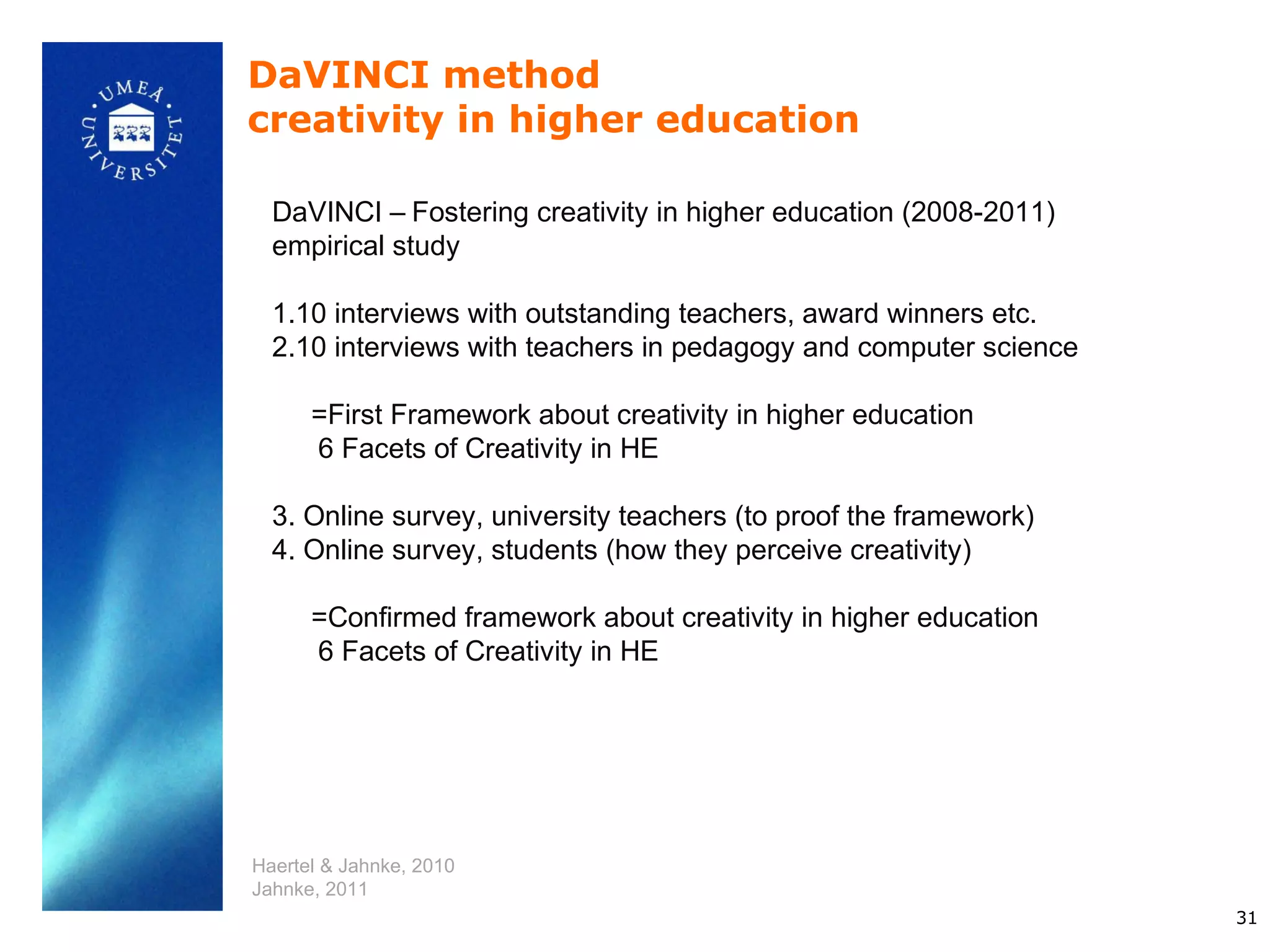
  DaVINCI – Fostering creativity in higher education (2008-2011)
  empirical study

  1.10 interviews with outstanding teachers, award winners etc.
  2.10 interviews with teachers in pedagogy and computer science

      =First Framework about creativity in higher education
      6 Facets of Creativity in HE

  3. Online survey, university teachers (to proof the framework)
  4. Online survey, students (how they perceive creativity)

      =Confirmed framework about creativity in higher education
      6 Facets of Creativity in HE


Haertel & Jahnke, 2010
Jahnke, 2011
                                                                   31
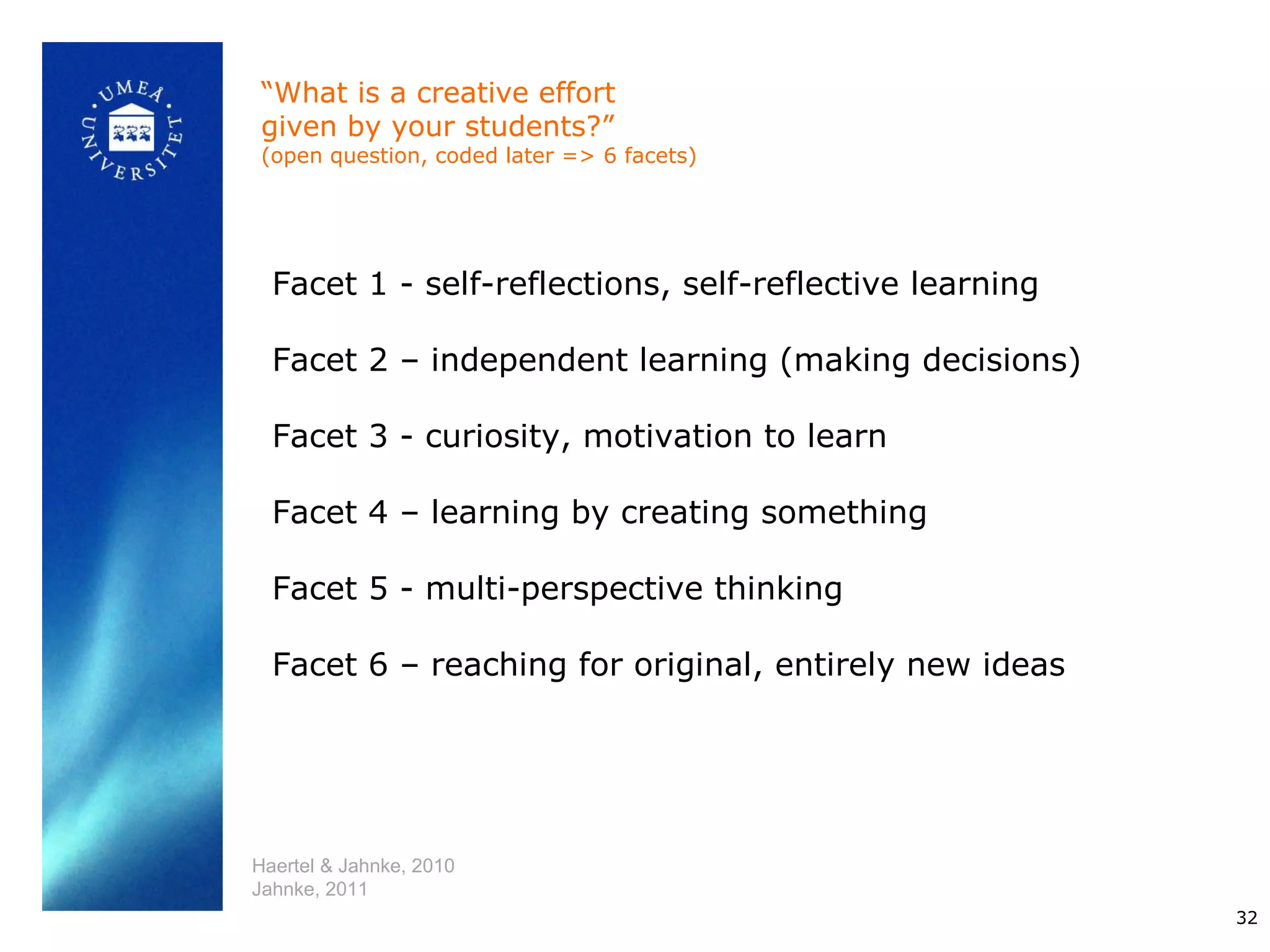
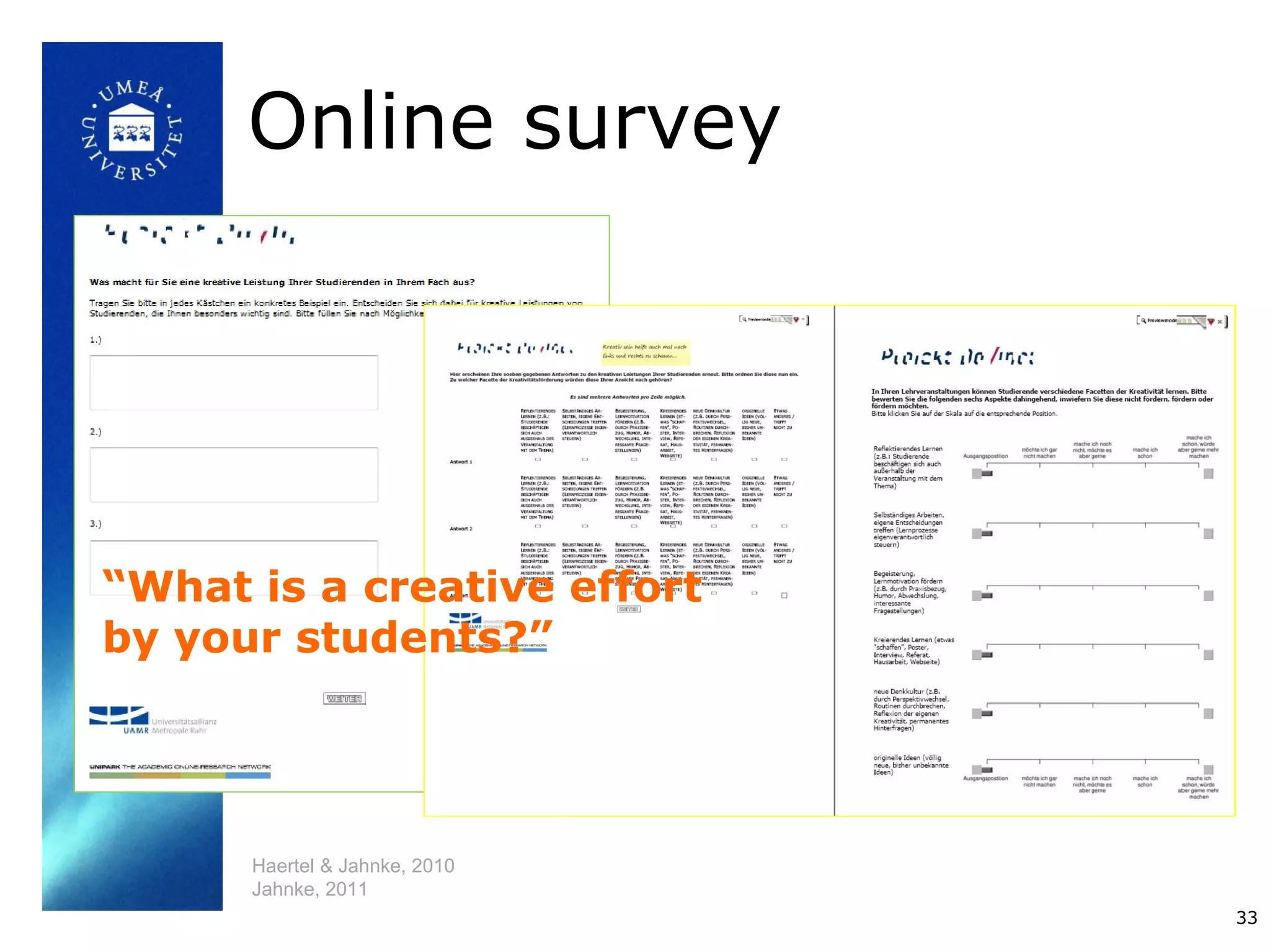
“What is a creative effort
given by your students?”
(open question, coded later => 6 facets)


  Facet 1 - self-reflections, self-reflective learning

  Facet 2 – independent learning (making decisions)

  Facet 3 - curiosity, motivation to learn

  Facet 4 – learning by creating something

  Facet 5 - multi-perspective thinking

  Facet 6 – reaching for original, entirely new ideas


Haertel & Jahnke, 2010
Jahnke, 2011
                                                         32
Online survey


“What is a creative effort
by your students?”


      Haertel & Jahnke, 2010
      Jahnke, 2011
                               33
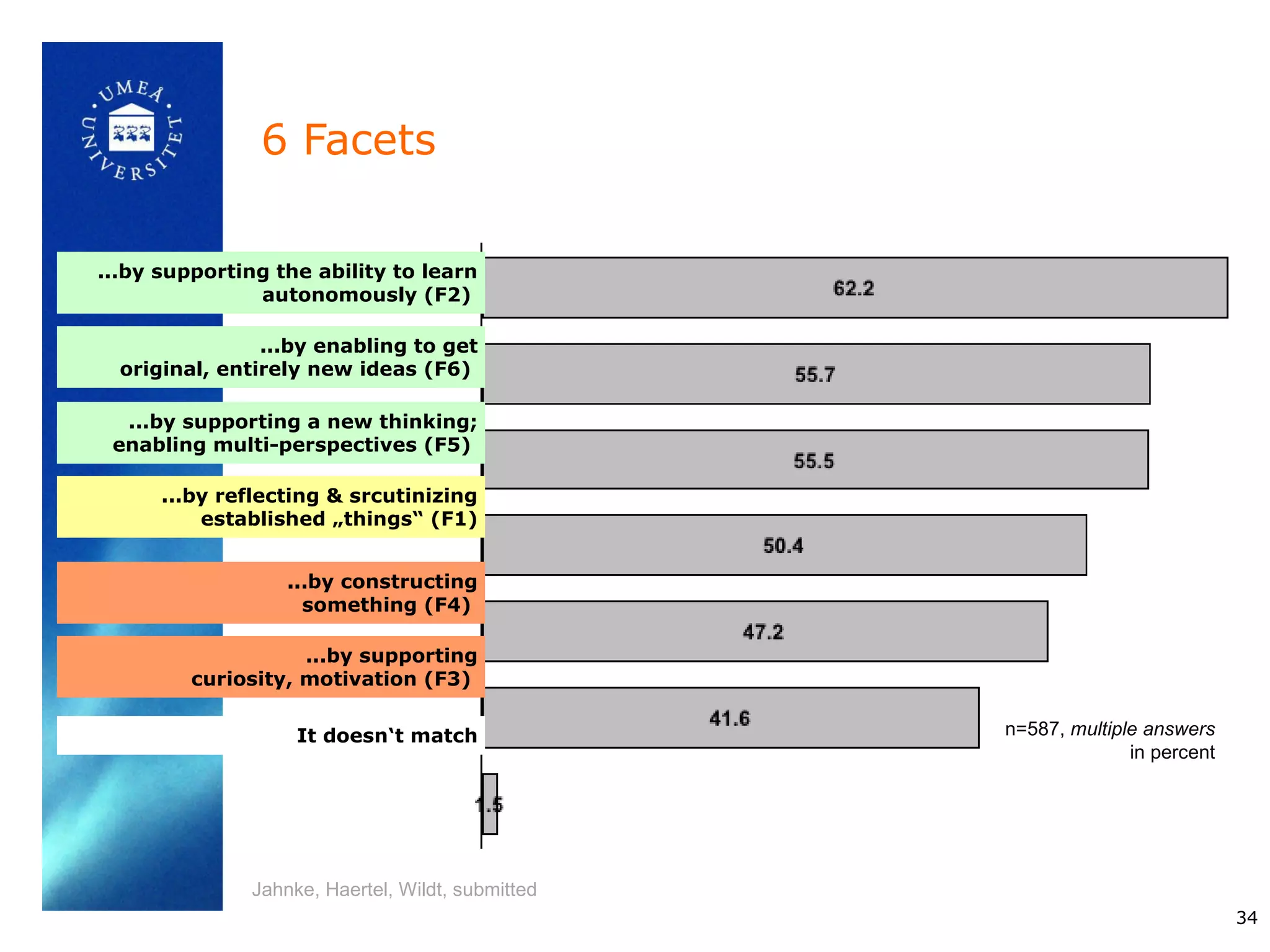
6 Facets

...by supporting the ability to learn
               autonomously (F2)

                ...by enabling to get
  original, entirely new ideas (F6)

  ...by supporting a new thinking;
 enabling multi-perspectives (F5)

      ...by reflecting & srcutinizing
          established „things“ (F1)


                   ...by constructing
                     something (F4)

                    ...by supporting
         curiosity, motivation (F3)

                    It doesn‘t match               n=587, multiple answers
                                                                 in percent


               Jahnke, Haertel, Wildt, submitted
                                                                              34
Next steps

 We did design methods how to evaluate the 6 facets:
 A questionnaire, informal feedback, and product analysis

 We created different courses
 for the different creativity facets
Examples
Supporting collaborative creativity
together with experts we designed learning


     • The case of PETEX in engineering education and
       learning at work – remote labs (Stockholm, Dortmund,
       Palermo)

     • The case of teacher education – blended learning
       supported by Wikis

     • The case of computer science in higher education, the
       course called “Informatics and Society”


                                                                           36
                                                     isa.jahnke@edusci.umu.se
example 1
PeTEX - platform for elearning and telemetric
experiments


                                                37
PeTEX


PeTEX
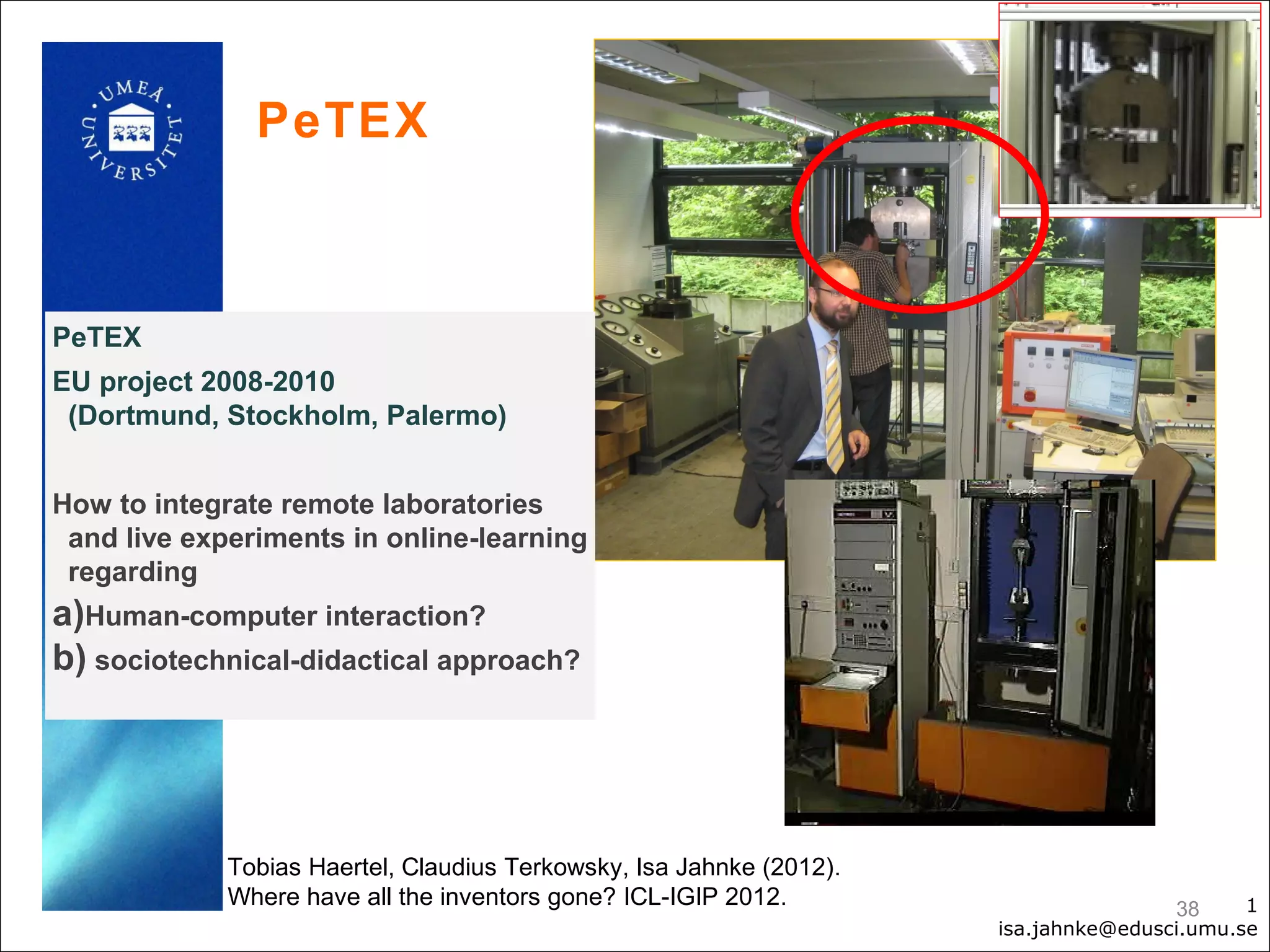
EU project 2008-2010
 (Dortmund, Stockholm, Palermo)


How to integrate remote laboratories
 and live experiments in online-learning
 regarding
a)Human-computer interaction?
b) sociotechnical-didactical approach?


             Tobias Haertel, Claudius Terkowsky, Isa Jahnke (2012).
             Where have all the inventors gone? ICL-IGIP 2012.                        38     1
                                                                      isa.jahnke@edusci.umu.se
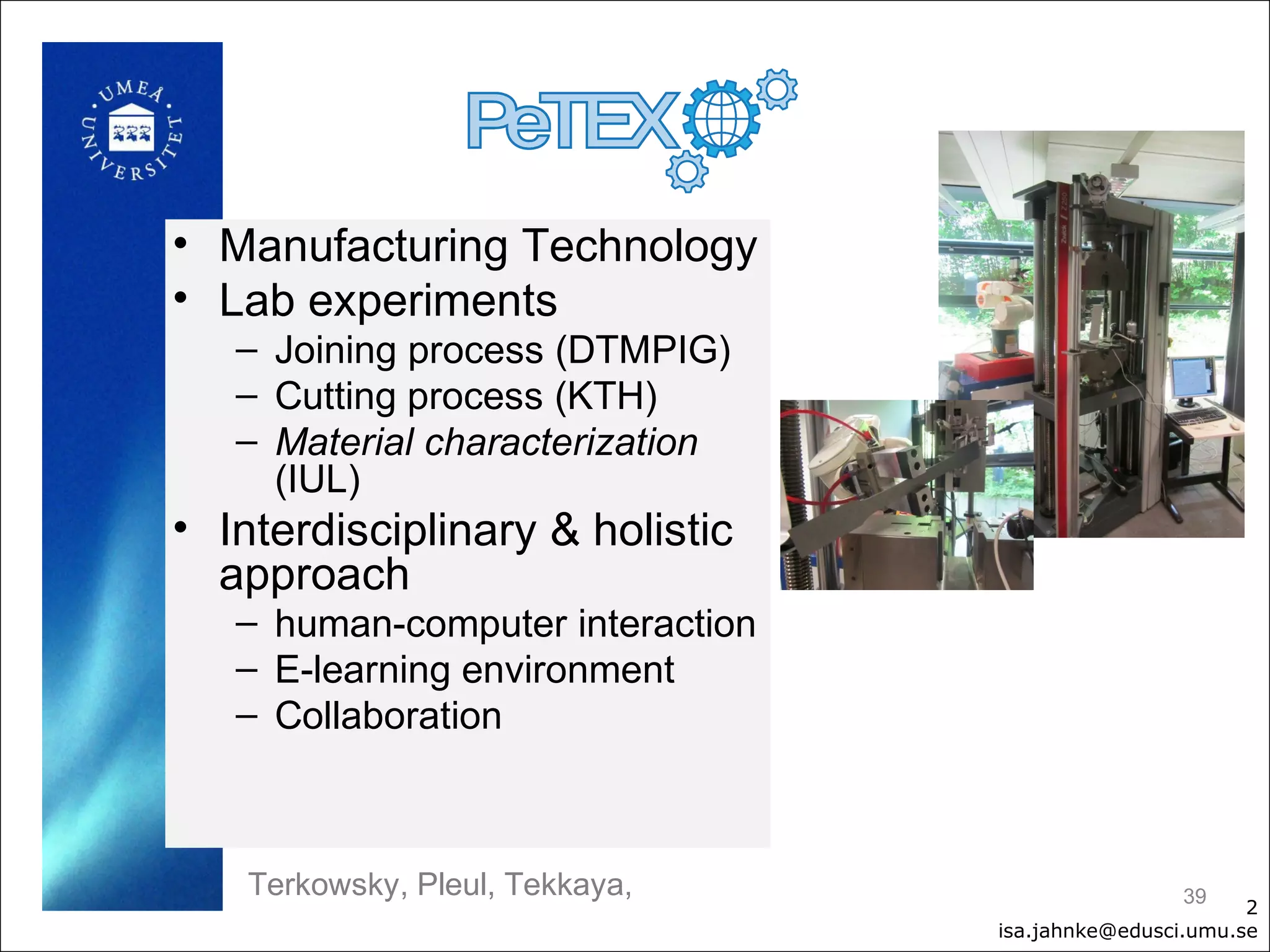
• Manufacturing Technology
• Lab experiments
   – Joining process (DTMPIG)
   – Cutting process (KTH)
   – Material characterization
     (IUL)
• Interdisciplinary & holistic
  approach
   – human-computer interaction
   – E-learning environment
   – Collaboration


    Terkowsky, Pleul, Tekkaya,                     39
                                                         2
                                  isa.jahnke@edusci.umu.se
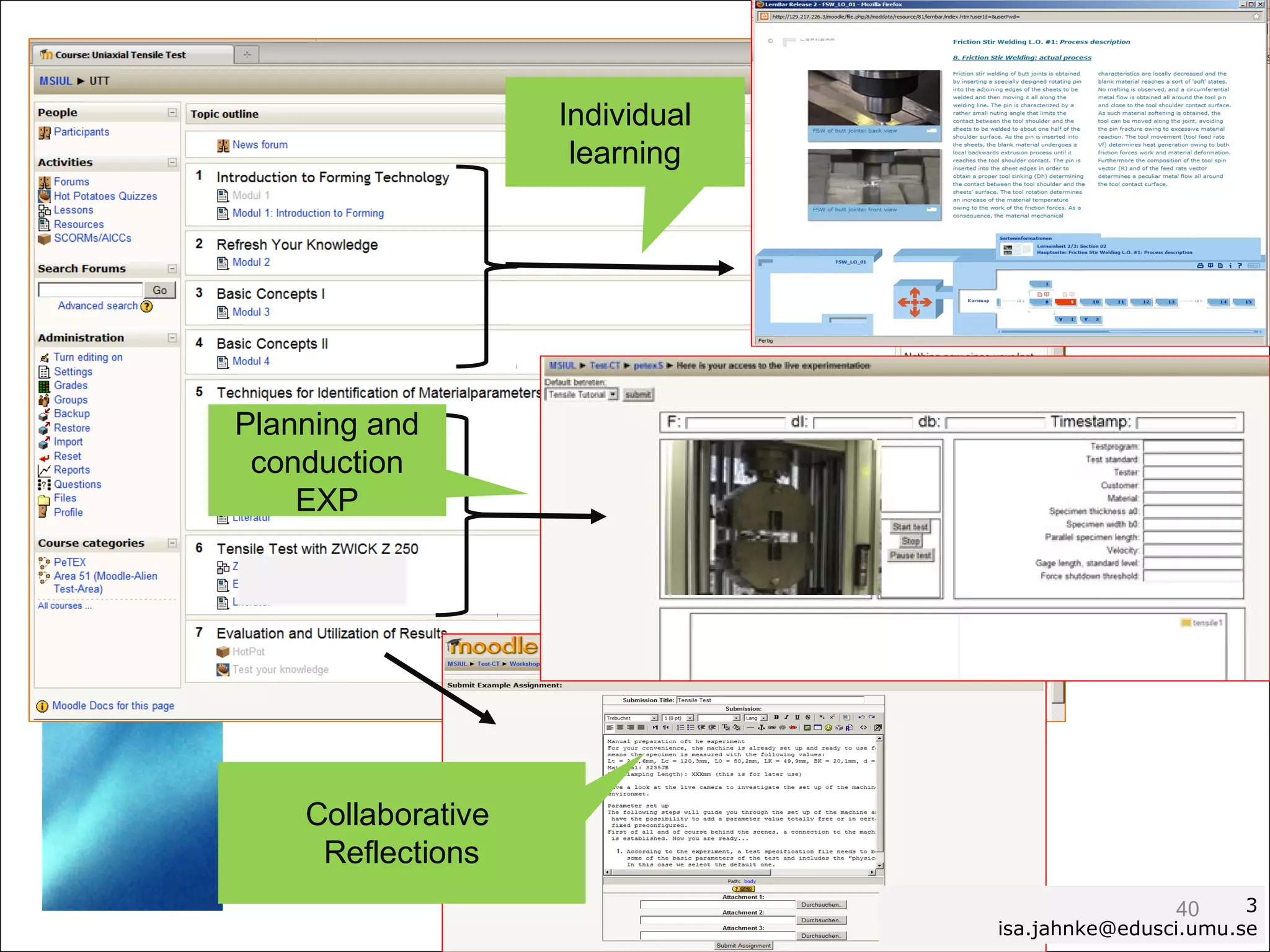
Individual
                     learning


Planning and
 conduction
    EXP


    Collaborative
     Reflections
                                                  40    3
                                 isa.jahnke@edusci.umu.se
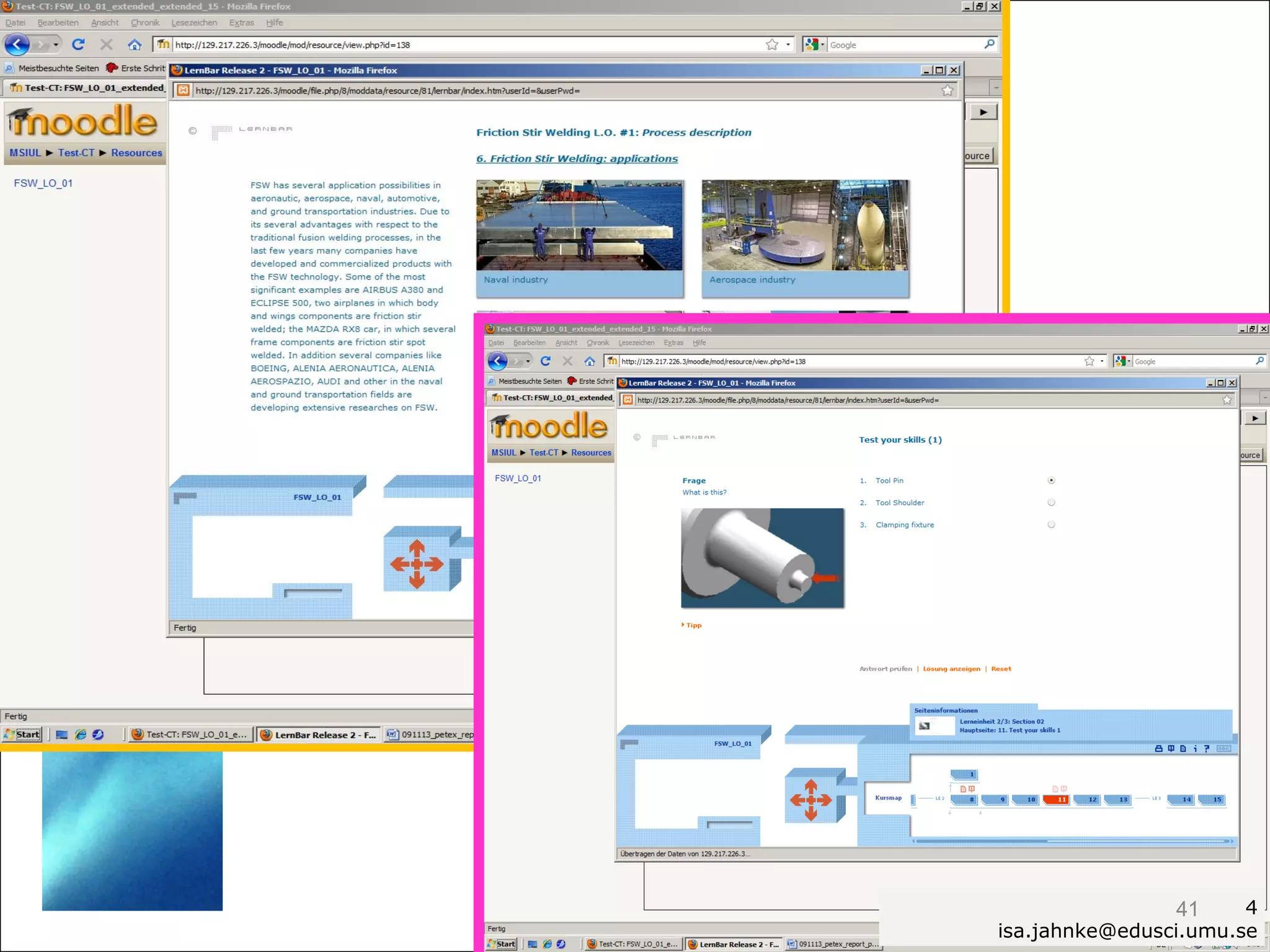
41    4
isa.jahnke@edusci.umu.se
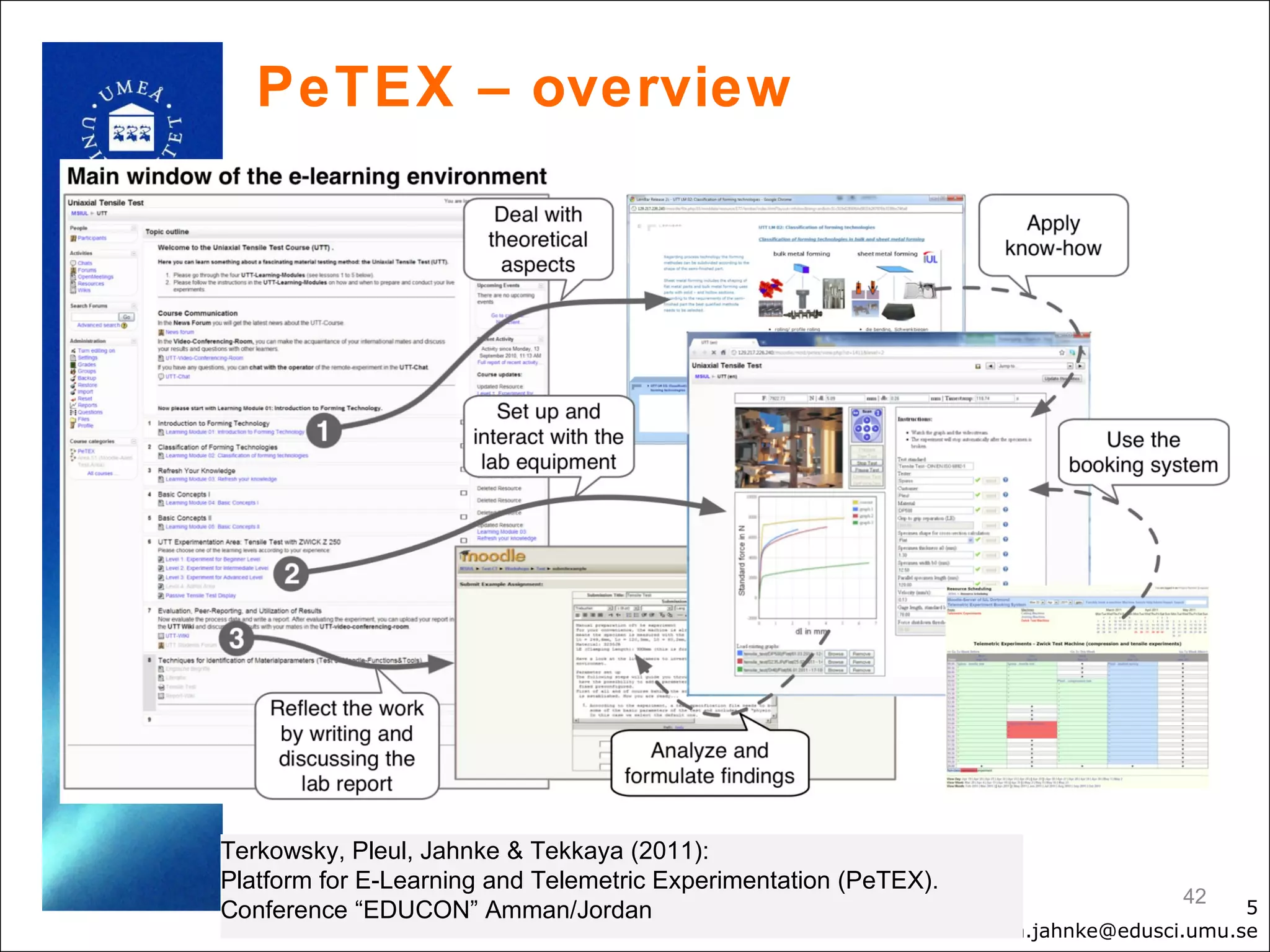
PeTEX – overview


Terkowsky, Pleul, Jahnke & Tekkaya (2011):
Platform for E-Learning and Telemetric Experimentation (PeTEX).
                                                                                   42
Conference “EDUCON” Amman/Jordan                                                         5
                                                                  isa.jahnke@edusci.umu.se
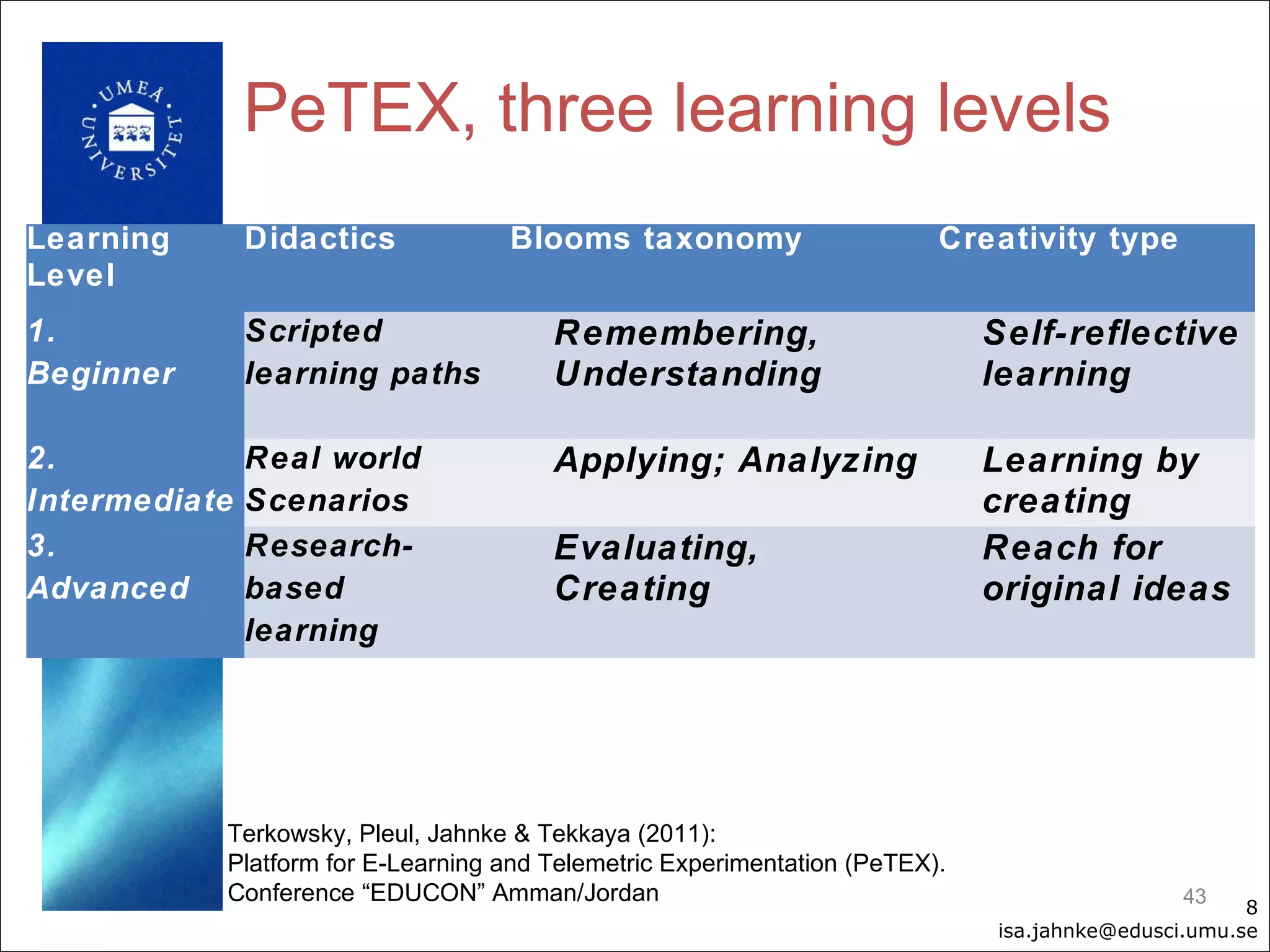
PeTEX, three learning levels
Learning       Didactics           Blooms taxonomy                       Creativity type
Level
1.             Scripted                Remembering,                          Self-reflective
Beginner       learning paths          Understanding                         learning

2.             Real world              Applying; Analyzing                   Learning by
Intermediate   Scenarios                                                     creating
3.             Research-               Evaluating,                           Reach for
Advanced       based                   Creating                              original ideas
               learning


           Terkowsky, Pleul, Jahnke & Tekkaya (2011):
           Platform for E-Learning and Telemetric Experimentation (PeTEX).
           Conference “EDUCON” Amman/Jordan                                                   43
                                                                                                    8
                                                                             isa.jahnke@edusci.umu.se
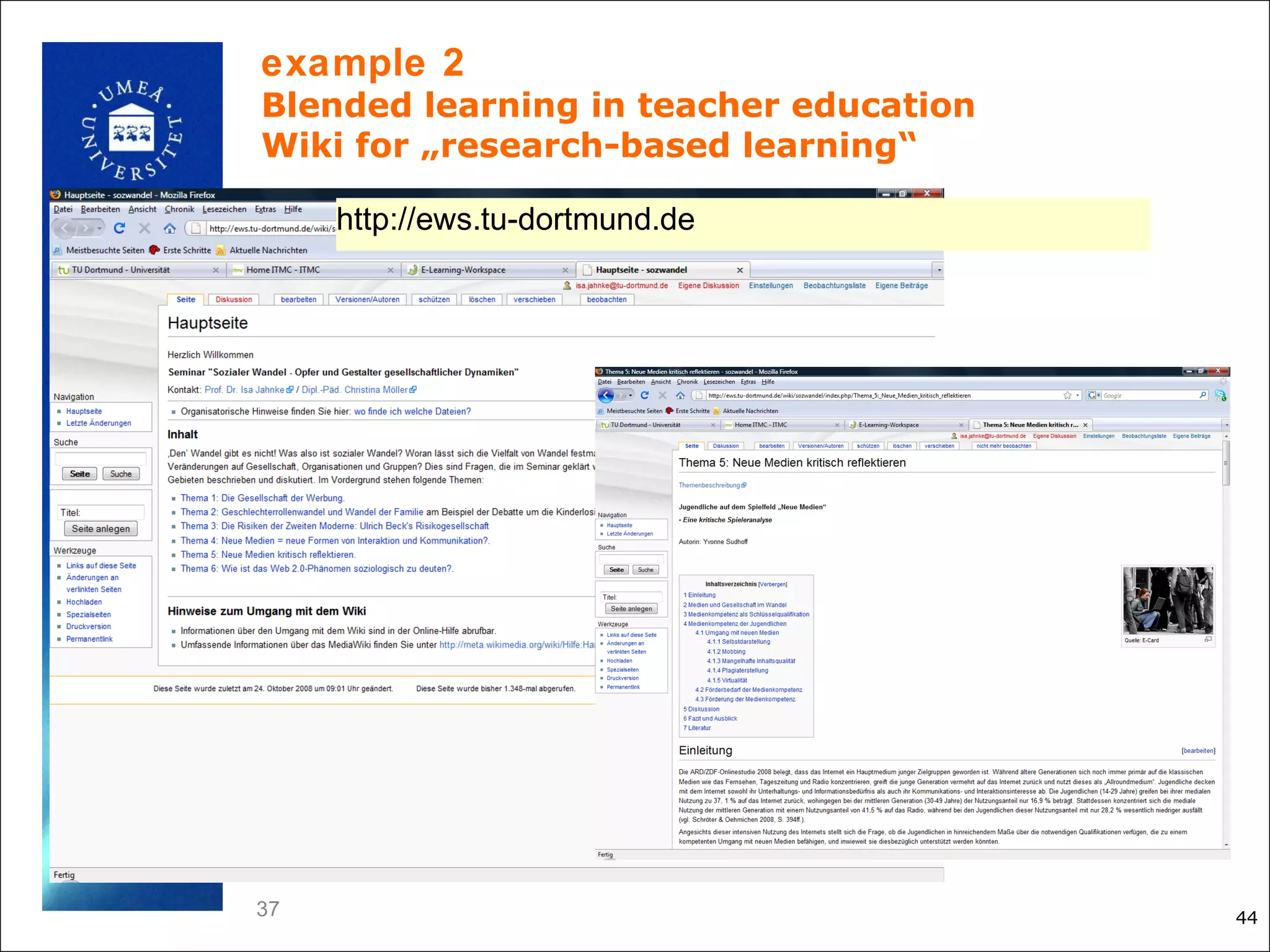
example 2
Blended learning in teacher education
Wiki for „research-based learning“

     http://ews.tu-dortmund.de


37                                      44
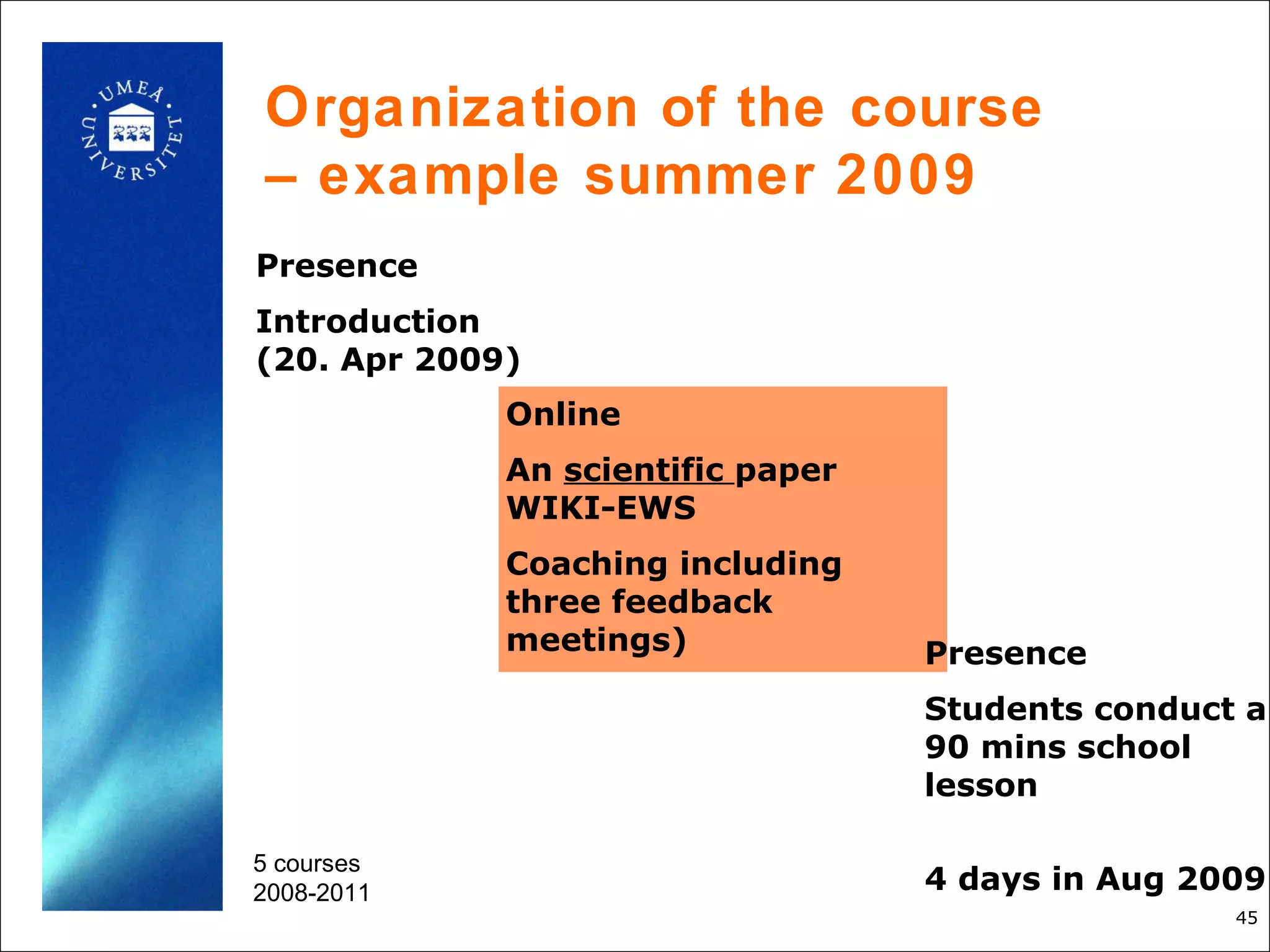
Organization of the course
– example summer 2009
Presence
Introduction
(20. Apr 2009)
             Online
             An scientific paper
             WIKI-EWS
             Coaching including
             three feedback
             meetings)             Presence
                                   Students conduct a
                                   90 mins school
                                   lesson

5 courses
2008-2011                          4 days in Aug 2009
                                                   45
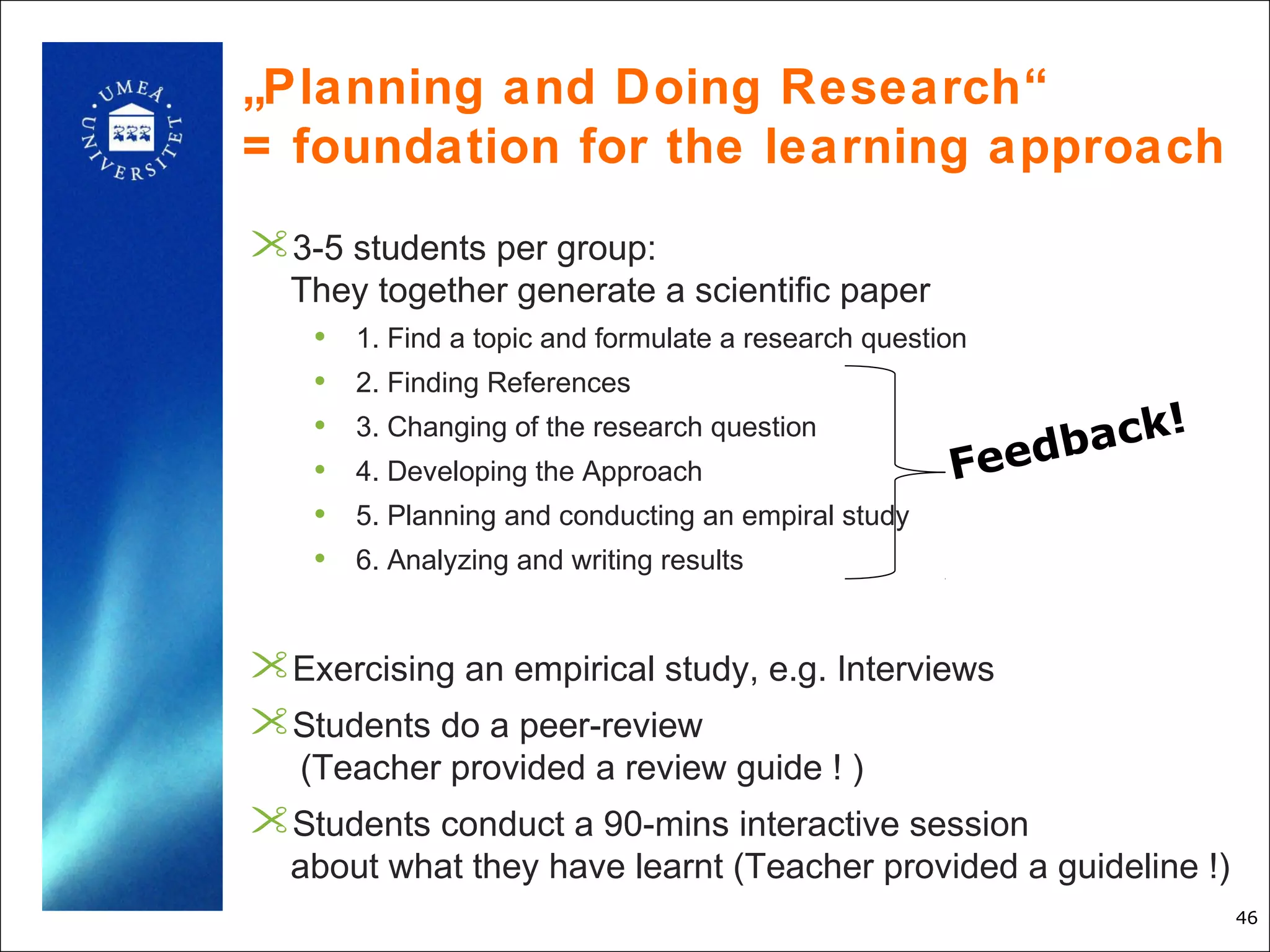
„Planning and Doing Research“
= foundation for the learning approach
3-5 students per group:
  They together generate a scientific paper
   • 1. Find a topic and formulate a research question
   • 2. Finding References
                                                               !
   • 3. Changing of the research question
                                                          back
   • 4. Developing the Approach                      Feed
   • 5. Planning and conducting an empiral study
   • 6. Analyzing and writing results


Exercising an empirical study, e.g. Interviews
Students do a peer-review
   (Teacher provided a review guide ! )
Students conduct a 90-mins interactive session
  about what they have learnt (Teacher provided a guideline !)
                                                                   46
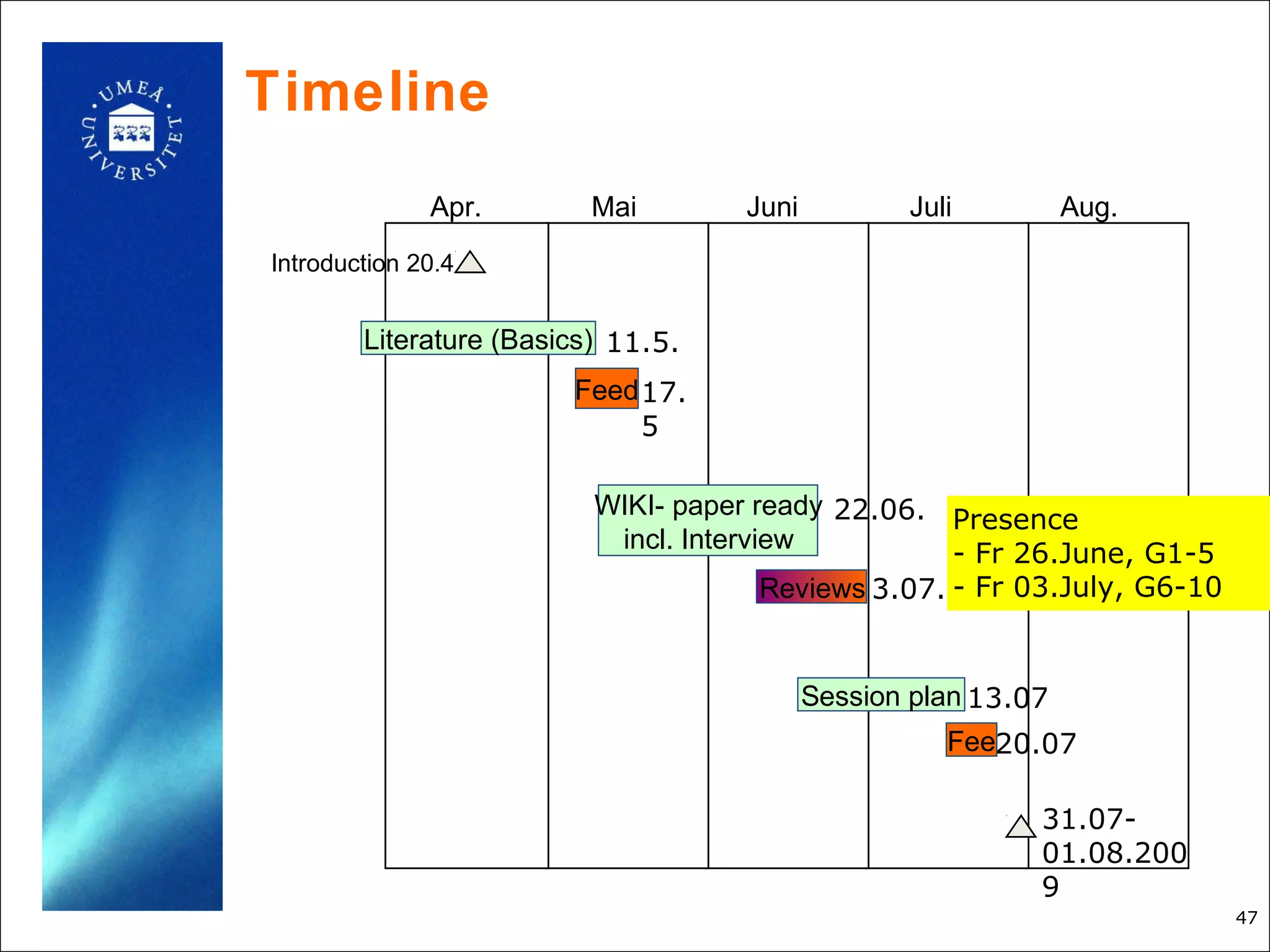
Timeline
               Apr.       Mai        Juni          Juli          Aug.
Introduction 20.4.


        Literature (Basics) 11.5.
                        Feed 17.
                             5

                          WIKI- paper ready 22.06.
                                                      Presence
                           incl. Interview
                                                      - Fr 26.June, G1-5
                                        Reviews 3.07. - Fr 03.July, G6-10


                                            Session plan 13.07
                                                      Fee20.07

                                                             31.07-
                                                             01.08.200
                                                             9
                                                                            47
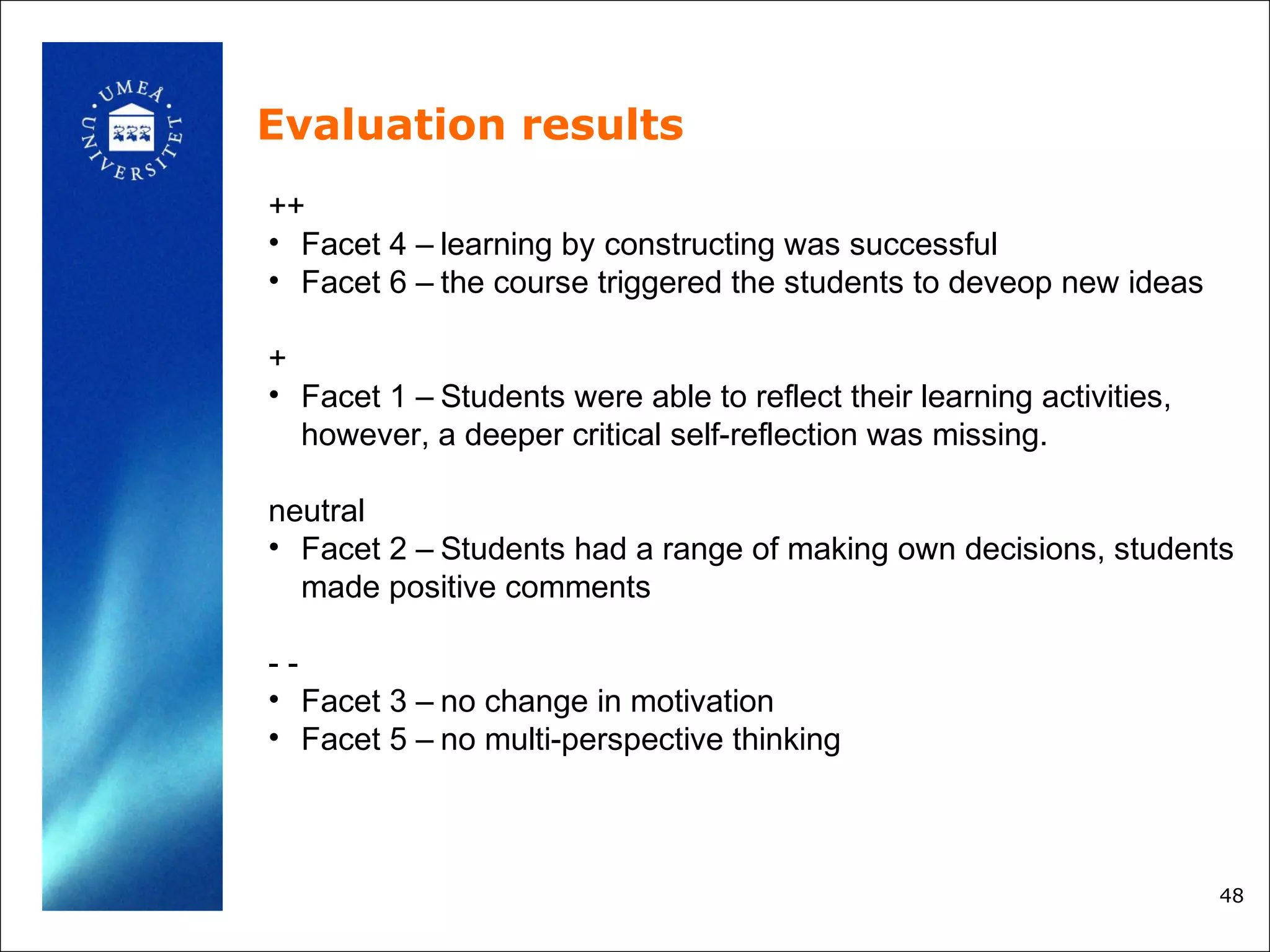
Evaluation results
++
• Facet 4 – learning by constructing was successful
• Facet 6 – the course triggered the students to deveop new ideas

+
• Facet 1 – Students were able to reflect their learning activities,
  however, a deeper critical self-reflection was missing.

neutral
• Facet 2 – Students had a range of making own decisions, students
  made positive comments

--
• Facet 3 – no change in motivation
• Facet 5 – no multi-perspective thinking


                                                                       48
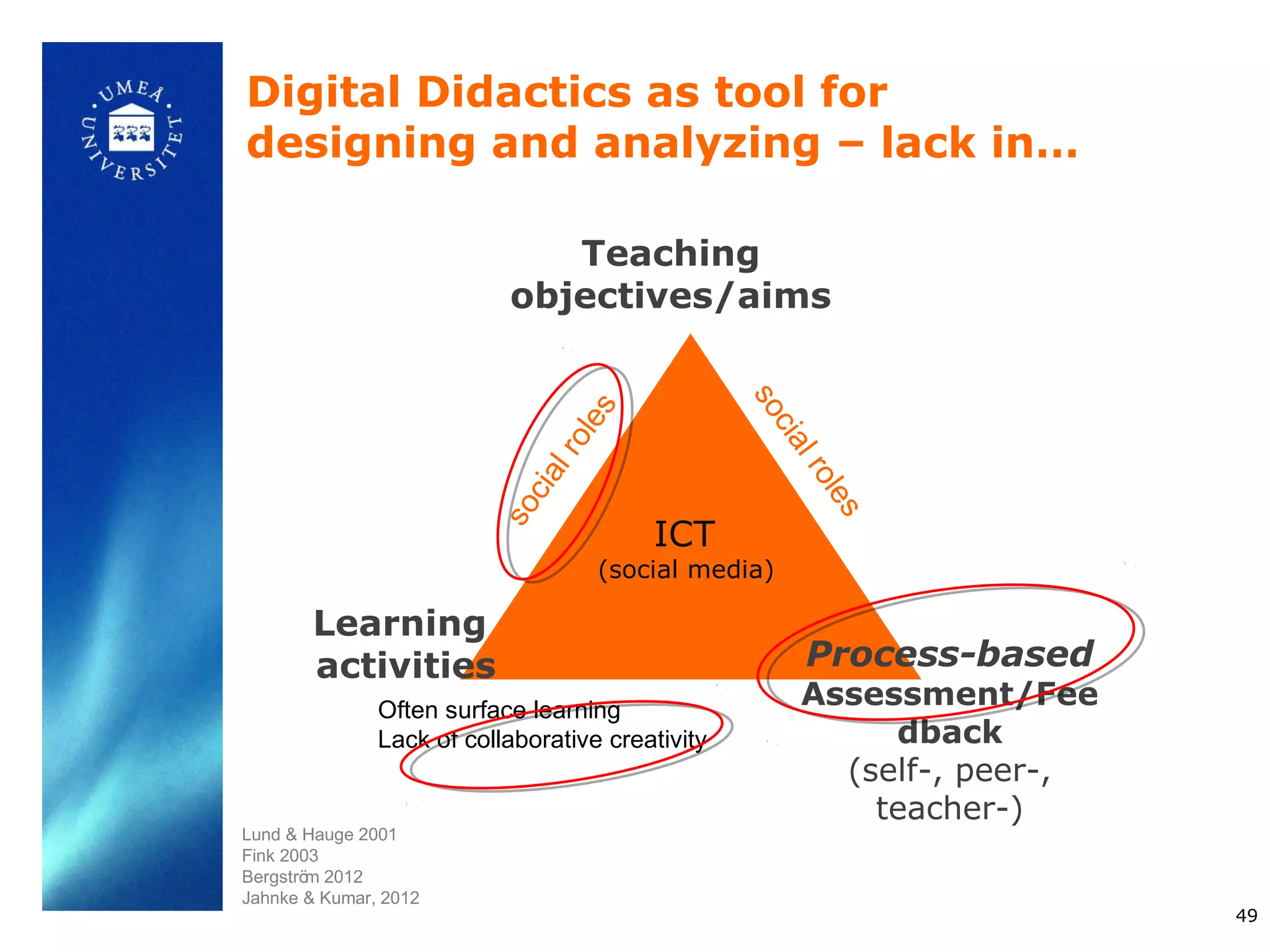
Digital Didactics as tool for
designing and analyzing – lack in…

                              Teaching
                           objectives/aims


                                                  so
                                   s
                                ole


                                                    cia
                               lr


                                                       l ro
                            cia


                                                           les
                          so
                                         ICT
                                    (social media)

       Learning                     social roles
       activities                                       Process-based
               Often surface learning
                                                       Assessment/Fee
               Lack of collaborative creativity             dback
                                                         (self-, peer-,
                                                           teacher-)
Lund & Hauge 2001
Fink 2003
Bergströ 2012
        m
Jahnke & Kumar, 2012
                                                                          49
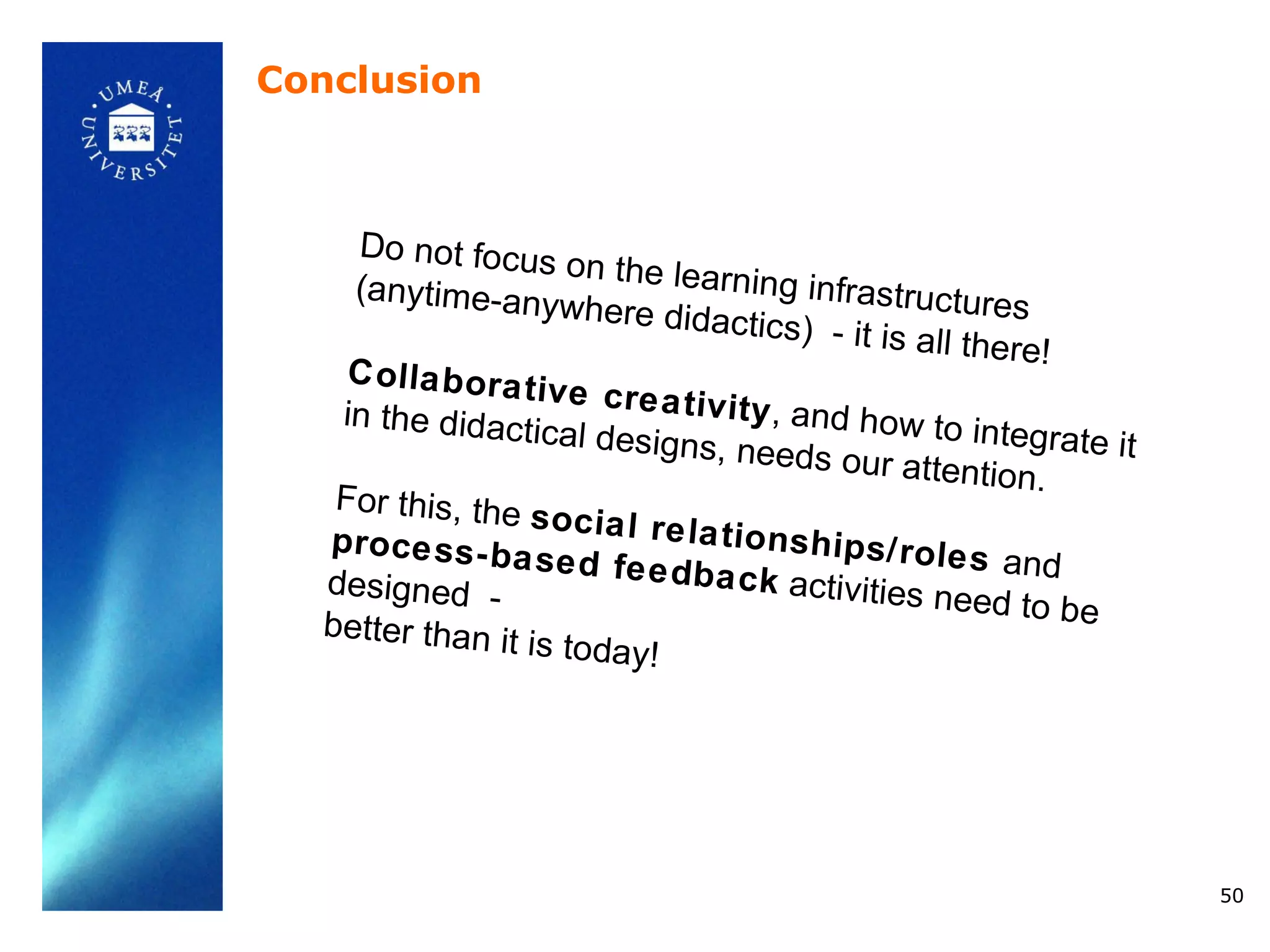
Conclusion


    Do not focus
                      on the learnin
    (anytime-any                          g infrastructu
                     where didac                           res
                                      tics) - it is a
                                                      ll there!
    C olla b ora t
                   iv e c re a tiv
   in the didacti                  i t y , a nd h ow
                   cal designs,                      to integrate it
                                    needs our att
                                                       ention.
   For this, the
                  s oc ia l re la
  p ro ce ss - b a                tio ns h ip s/ r
                   s e d fe e db a                  o l e s and
  designed -                         c k activities
                                                     need to be
  better than it
                  is today!


                                                                       50
Thanks a lot!

Professor Dr. Isa Jahnke
ICT, media and learning
Umeå University
Dep of Applied Educational Science


isa.jahnke@edusci.umu.se


http://www.isa-jahnke.com
http://www.facebook.com/isajahnke


http://iml.edusci.umu.se/ictml


                                         isa.jahnke@edusci.umu.se   44

Pres oslo2013-digital-didactics-isajahnke-v4

  • 1.
    Digital Didactics Thetheory of designing teaching and learning in a Social Media world Isa Jahnke Umeå University Presentation at InterMedia, University of Oslo 15 Jan 2013
  • 2.
    Umeå European Capital of Culture 2014 Datum Sidfot 2
  • 3.
    Research group “ICTML: DigitalDidactics” • Professor Dr. Isa Jahnke, Dep Applied Educational Science -- background: Social scientist in Computer Science (CSCL and CSCW) -- Dynamics of social roles in socio-technical systems -- Didactics (German Didaktik) • 4 PhD students • Andreas Olsson: Mobile Learning • Lars Norqvist: Creative Learning • Leif Marklund: Game-based learning • Anders Norberg: Blended learning • 1 Post-Doc (Visby Program): Nataliia Sharkova (Ukraine) • 2 Post-Docs (50%) to be announced • Our Website: https://iml.edusci.umu.se/ictml/ isa.jahnke@edusci.umu.se 3
  • 4.
  • 5.
    Umeå University –Campus in Winter 2012 5
  • 6.
  • 7.
    WiFi chairs free Internetaccess heated in the winter Mikael Richter 2002 “social installation” 7 7 isa.jahnke@edusci.umu.se
  • 8.
  • 9.
    Road map …today Not the access to knowledge only -- an approach to encourage collaborative creativity (study 2), examples of PeTEX A theoretical and teacher ed framework of Digital Didactics, useful to understand the new A new situation situation in teaching due to mobile A case study (1) shows devices the use of mobile device. It did fail…! 9
  • 10.
    New situations…. , or No pro blem, a question blem! You have a pro ue? google it. Pos Go to the Int an unsolved iss ask yo t it to o ernet nline f an Linked ur per sonal orums d In, Fa netwo and ceboo rks Slides k, Twi in hare, tter, etc. s of nge in dis cussion culture We observe a cha stance, when facts are s. For in daily-life group takes her a st one person discussed at le rmation nd ‘go ogles’ the info smartphone a Jahnke, Bergström, et al., 2012 10
  • 11.
    A new personemerged …the “Homo Interneticus” “A bunch of my friends are coming over this evening to play on their Phones” (Your e-Cards) 11
  • 12.
    Relation of “informallearning” to “formal learning” in a Web 2.0 world Schools Schools 50 years ago nowadays Formal Formal learning learning Informal learning Informal learning 12
  • 13.
    We don’t liveany longer in a social constructed reality Homo I nterne BUT ticus ? we live in a idakticus socio-technically Homo D constructed society The social construction of reality Berger & Luckmann, 1967 Homo Interneticus Aleks Krotoski, 2011 13
  • 14.
    Challenges for Teachingand Learning RQ 1. What are appropriate didactical approaches for teaching-learning scenarios nowadays? RQ 2. To what extent can Educational Technology be integrated to strengthen active learning, student engagement and collaborative creativity? Th. Herrmann, 2009: collaborative creativity G. Fischer, 2010: learning when the answer is not known Lund & Hauge, 2011: designs for teaching; designs for learning 14
  • 15.
  • 16.
    My research isinfluenced by... Sociology • Social Construction of Reality (Berger & Luckmann, 1967) - "Objective facticity" • Duality of social structures (Anthony Giddens) • Mediatization (Hjarvard 2008) Central concept • Society designs new forms of media and communication • New media affects society - media is integrated into the operations of social institutions. Media becomes an active agent • People live in a media-constructed world where we have a difference between 'reality' and 'reality given by different media' 16
  • 17.
    My research isinfluenced by... CSCW, CSCL, Didaktik • Suchman, 1987, workplace studies, situated actions • Orlikowski, 1996, metamorphoses of technology usage over time • Coakes, 2002, socio-technical knowledge management • Herrmann, Loser, Jahnke, 2007, STWT • Lave & Wenger, 1998, situated learning, communities of practices • Herrmann, Jahnke, Loser, 2004, dynamics of social roles in online learning communities • Stahl, 2009, co-construction of knowledge, group cognition • Wang & Hannafin, 2005, Design-based research, action research • Wildt, Jahnke, 2010, Hochschul-Didaktik, 'Didactics' 17
  • 18.
    From a broaderperspective – Designing the interdependencies Didactics (challenge-ba sed learning) Trans-formations Inter-actions Inter- dependency Us e o f Technology (Social Media Teaching an , iPads) d Learning Cultures (different disc different subje iplines, cts) Jahnke, Terkowsky, Pleul, Tekkaya 2010: PeTEX project 18
  • 19.
    Academic staff Digital development Didactics The theory of designing* teaching and learning in a Social Media World National institutions (municipality) Teaching School / aims University Classroom / Course Teacher Learning Student Content Assessment/Feed activities ICT/Pads ICT/iPads back ICT/iPads Course Curriculum development development
  • 20.
    Learning approach by David Kember Deeper learning takes place in a community of reflecting peers •Teacher-centered • Student-centered •content-oriented • learning-oriented surface learning • collaborative learning deeper learning I II III IV V Information Delivery of Teacher Delivery of Delivery Structured Structured Student Facilitation Facilitation Supporting Supporting Knowledge Interaction of Under- Knowledge of Under- Conceptual Conceptual standing standing Change and Change and Intellectual Intellectual Development Development ((behaviorchange)) behavior change David Kember, 1997 Johannes Wildt, 2012 20
  • 21.
    Social Roles -the Forgotten Theory Teacher's and Learner's roles Teacher's and Learner's roles 100 years ago nowadays = balanced = not balanced Position Position Purpose Purpose Purpose Purpose Position (tasks) Position (tasks) Purpose Purpose (tasks) (tasks) (tasks) (tasks) Role-playing Role-playing Expectations Expectations Expectations Expectations Role- Role- playing playing Role-playing Role-playing Position Position Expectations Expectations Social roles published in Jahnke, 2010 Herrmann, Jahnke, Loser, 2004 21
  • 22.
  • 23.
    Digital Didactics asmethod to analyze the current situation, to design and develop teaching and learning Teaching objectives/aims (problem) so s ole cia lr l ro cia les so ICT (social media) Learning social roles activities Process-based (Co-constructing Assessment/Fee knowledge) dback (self-, peer-, teacher-) Lund & Hauge 2001 Fink 2003 Bergströ 2012 m Jahnke & Kumar, 2012 23
  • 24.
    Case study 1 Course „Industrial project management“ (IPM2): • Summer 2011 • 23 students in engineering education • Aim: To apply what they have learnt in IPM 1 • Assignment: the students got a task by a real firm • iPods for supporting cooperation/communication • Participant observation and interviews Results • Students did not use iPods (or just very little use) • Students prefered to meet face-to-face. Liebscher & Jahnke, 2012 GMW 24
  • 25.
    What the studentssaid... Why the students did not use the iPods • Mobile devices were too small • WIFI were not available on the road • Students said, no difficulties to coordinate their group work. However, the students said, it was difficult to figure out... a)What was the problem of the firm? , b)How to proceed to develop a solution? Students said, support were needed when to develop a solution to the firm‘s problem – here, the iPods could be useful to support creative thinking, collaborative creativity! 25
  • 26.
    The problem.... •Students missed support for a)Collaborative creativity => How to support collaboration; to develop collaboratively a solution to a problem when there exist no correct answer? a)Problem-solving processes Planning and conducting a project, needs professional knowledge and creativity but the latter was not part of the didactical design. • Other problems – It was not clear for the students when to use the different technical platforms (what to use when for what purposes?) Collaborative creativity, Thomas Herrmann 2009 26
  • 27.
    Creativity was notplanned – was not mirrored in the didactical design New 7. Collaborative Didactical Design IPM creativity (what it should be, 6. Creating but not was) 5. Evaluating 4. Analyzing Didactical Design IPM 3. Applying (what it was) 2. Understanding 1. Remembering Bloom’s Taxonomy Anderson & Krathwohl, 2001) 27
  • 28.
    The change ofdesigning teaching How do students construct new knowledge… ….when the answer to a particular problem is not known? => creativity is required! Research questions a)What is creativity in formal education (schools, HE)? b)To what extent support ICT/iPads different forms of creativity? c)What didactical designs for teaching/learning do universities need to foster creativity? Th. Herrmann, 2009: collaborative creativity G. Fischer, 2010: learning when the answer is not known Lund & Haug, 2011: designs for teaching; designs for learning 28
  • 29.
    What is creativity? Differentcontradictory understandings… ew New i deas e o f n h a t? for w p tanc accept w Acce – who hom is w h at ne w? s idea Systemic understandings Grea t Mind Creat iv Creat e person l iv y Creat e process idua abilit iv Creat e product div tive In ni ive e nviro nmen co g Colla t borat ive cr eativ ity Guilford, 1956 Gardner, 1993 Csikszentmihalyi, 1996 Amabile et al., 2002 Jahnke, Haertel, Wildt, submitted 28 isa.jahnke@edusci.umu.se
  • 30.
    Study 2 –DaVINCI - What is creativity? Creativity is a social construction It can’t be measured in general But it can be contextualized by asking the involved people …in that way, the construction becomes visible. DaVINCI project Haertel, Terkowsky, Jahnke (2012) Jahnke & Haertel (2010) 30
  • 31.
    DaVINCI method creativity inhigher education DaVINCI – Fostering creativity in higher education (2008-2011) empirical study 1.10 interviews with outstanding teachers, award winners etc. 2.10 interviews with teachers in pedagogy and computer science =First Framework about creativity in higher education 6 Facets of Creativity in HE 3. Online survey, university teachers (to proof the framework) 4. Online survey, students (how they perceive creativity) =Confirmed framework about creativity in higher education 6 Facets of Creativity in HE Haertel & Jahnke, 2010 Jahnke, 2011 31
  • 32.
    “What is acreative effort given by your students?” (open question, coded later => 6 facets) Facet 1 - self-reflections, self-reflective learning Facet 2 – independent learning (making decisions) Facet 3 - curiosity, motivation to learn Facet 4 – learning by creating something Facet 5 - multi-perspective thinking Facet 6 – reaching for original, entirely new ideas Haertel & Jahnke, 2010 Jahnke, 2011 32
  • 33.
    Online survey “What isa creative effort by your students?” Haertel & Jahnke, 2010 Jahnke, 2011 33
  • 34.
    6 Facets ...by supportingthe ability to learn autonomously (F2) ...by enabling to get original, entirely new ideas (F6) ...by supporting a new thinking; enabling multi-perspectives (F5) ...by reflecting & srcutinizing established „things“ (F1) ...by constructing something (F4) ...by supporting curiosity, motivation (F3) It doesn‘t match n=587, multiple answers in percent Jahnke, Haertel, Wildt, submitted 34
  • 35.
    Next steps Wedid design methods how to evaluate the 6 facets: A questionnaire, informal feedback, and product analysis We created different courses for the different creativity facets
  • 36.
    Examples Supporting collaborative creativity togetherwith experts we designed learning • The case of PETEX in engineering education and learning at work – remote labs (Stockholm, Dortmund, Palermo) • The case of teacher education – blended learning supported by Wikis • The case of computer science in higher education, the course called “Informatics and Society” 36 isa.jahnke@edusci.umu.se
  • 37.
    example 1 PeTEX -platform for elearning and telemetric experiments 37
  • 38.
    PeTEX PeTEX EU project 2008-2010 (Dortmund, Stockholm, Palermo) How to integrate remote laboratories and live experiments in online-learning regarding a)Human-computer interaction? b) sociotechnical-didactical approach? Tobias Haertel, Claudius Terkowsky, Isa Jahnke (2012). Where have all the inventors gone? ICL-IGIP 2012. 38 1 isa.jahnke@edusci.umu.se
  • 39.
    • Manufacturing Technology •Lab experiments – Joining process (DTMPIG) – Cutting process (KTH) – Material characterization (IUL) • Interdisciplinary & holistic approach – human-computer interaction – E-learning environment – Collaboration Terkowsky, Pleul, Tekkaya, 39 2 isa.jahnke@edusci.umu.se
  • 40.
    Individual learning Planning and conduction EXP Collaborative Reflections 40 3 isa.jahnke@edusci.umu.se
  • 41.
    41 4 isa.jahnke@edusci.umu.se
  • 42.
    PeTEX – overview Terkowsky,Pleul, Jahnke & Tekkaya (2011): Platform for E-Learning and Telemetric Experimentation (PeTEX). 42 Conference “EDUCON” Amman/Jordan 5 isa.jahnke@edusci.umu.se
  • 43.
    PeTEX, three learninglevels Learning Didactics Blooms taxonomy Creativity type Level 1. Scripted Remembering, Self-reflective Beginner learning paths Understanding learning 2. Real world Applying; Analyzing Learning by Intermediate Scenarios creating 3. Research- Evaluating, Reach for Advanced based Creating original ideas learning Terkowsky, Pleul, Jahnke & Tekkaya (2011): Platform for E-Learning and Telemetric Experimentation (PeTEX). Conference “EDUCON” Amman/Jordan 43 8 isa.jahnke@edusci.umu.se
  • 44.
    example 2 Blended learningin teacher education Wiki for „research-based learning“ http://ews.tu-dortmund.de 37 44
  • 45.
    Organization of thecourse – example summer 2009 Presence Introduction (20. Apr 2009) Online An scientific paper WIKI-EWS Coaching including three feedback meetings) Presence Students conduct a 90 mins school lesson 5 courses 2008-2011 4 days in Aug 2009 45
  • 46.
    „Planning and DoingResearch“ = foundation for the learning approach 3-5 students per group: They together generate a scientific paper • 1. Find a topic and formulate a research question • 2. Finding References ! • 3. Changing of the research question back • 4. Developing the Approach Feed • 5. Planning and conducting an empiral study • 6. Analyzing and writing results Exercising an empirical study, e.g. Interviews Students do a peer-review (Teacher provided a review guide ! ) Students conduct a 90-mins interactive session about what they have learnt (Teacher provided a guideline !) 46
  • 47.
    Timeline Apr. Mai Juni Juli Aug. Introduction 20.4. Literature (Basics) 11.5. Feed 17. 5 WIKI- paper ready 22.06. Presence incl. Interview - Fr 26.June, G1-5 Reviews 3.07. - Fr 03.July, G6-10 Session plan 13.07 Fee20.07 31.07- 01.08.200 9 47
  • 48.
    Evaluation results ++ • Facet4 – learning by constructing was successful • Facet 6 – the course triggered the students to deveop new ideas + • Facet 1 – Students were able to reflect their learning activities, however, a deeper critical self-reflection was missing. neutral • Facet 2 – Students had a range of making own decisions, students made positive comments -- • Facet 3 – no change in motivation • Facet 5 – no multi-perspective thinking 48
  • 49.
    Digital Didactics astool for designing and analyzing – lack in… Teaching objectives/aims so s ole cia lr l ro cia les so ICT (social media) Learning social roles activities Process-based Often surface learning Assessment/Fee Lack of collaborative creativity dback (self-, peer-, teacher-) Lund & Hauge 2001 Fink 2003 Bergströ 2012 m Jahnke & Kumar, 2012 49
  • 50.
    Conclusion Do not focus on the learnin (anytime-any g infrastructu where didac res tics) - it is a ll there! C olla b ora t iv e c re a tiv in the didacti i t y , a nd h ow cal designs, to integrate it needs our att ention. For this, the s oc ia l re la p ro ce ss - b a tio ns h ip s/ r s e d fe e db a o l e s and designed - c k activities need to be better than it is today! 50
  • 51.
    Thanks a lot! ProfessorDr. Isa Jahnke ICT, media and learning Umeå University Dep of Applied Educational Science isa.jahnke@edusci.umu.se http://www.isa-jahnke.com http://www.facebook.com/isajahnke http://iml.edusci.umu.se/ictml isa.jahnke@edusci.umu.se 44

Editor's Notes

  • #2 In the age of Web 2.0 and social media, a constantly ubiquitous online presence is available - the ubiquitous access to information is quickly and easily. The teachers present theories, models and results, and some students "google" at the same time whether that is true what is being said. For the"Homo Interneticus" it is normal to search for facts. Discussions and learning cultures are changing.   What are appropriate didactical teaching-learning scenarios nowadays? To what extent can Educational Apps/Technology be integrated to strengthen active learning (student engagement) and collaborative learning? ((What are the right conditions?)) The talk gives answers in form of case studies and theses which illustrate changes towards digital didactical designs in universities and schools. Digital media enable learning in unexpected places online through established boundaries. If this is the case, then we face the challenge to understand teaching, learning and didactics in a new way – instead of a ‘text book learning’ only, that represents receptive, consumer-oriented teaching, we need creativity-focused didactical designs to enhance a meaningful learning experience.
  • #3 Umeå – Oslo = ca. 900 km
  • #5 Here you see 2 photos from Umeå University build in 1965 according to an American university Campus role model. It is a relax atmosphere , nice location outside, in the summer .
  • #6 Umeå is also known as the city of the birches Because of a big fire Downtown in the 19 century where a lot of houses burnt down, birches are trees which have a lot of waTER inside And so, to prevent a big fire storm again, you can see birches everywhere
  • #8 When I moved in 2011 to Umeå , one year ago, I started with a project called “taking a photo whenever I see something special what is different from “my” old cultures in Germany” Here I give you 2 examples This photo shows a chair in Umeå Downtown near by the opera house where 2 people have a seat. The special thing is that FIRST it is heated in the winter, so you also can sit there when there is snow around you. SECOND, you have free wireless access to the internet. This kind of “social installation” has been made in 2002 by Mikael Richter, 10 years ago!
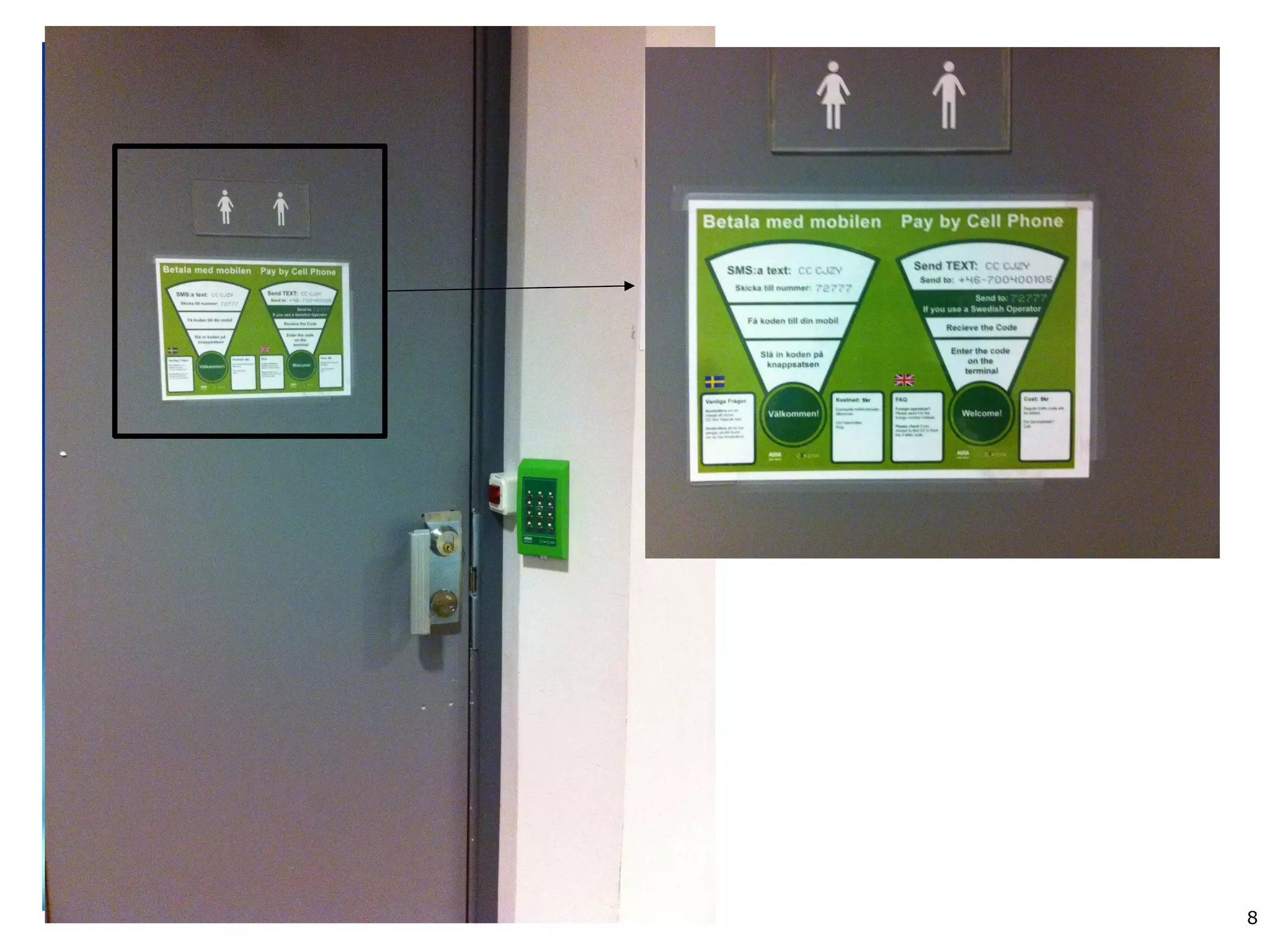
  • #9 This is my favorite photo. My best argument for eLearning ? Without using any new technologies you don ’t have access to public toilettes or restrooms. On this picutre, you see how to use your cell phone, You call an operator, s/he sends an SMS with a code to your cellphone and with that code you enter the door. This service costs 5 swedish krones
  • #11 --USA: viele iPads in CA --Studie KNO 90% zufriedenheit mit APP gegenueber 70% Zufriedenheit der Studierenden ohne APP --TAZ: LehrerInnen sehr optimisch, offen gegenueber solchen iPads / Touchpads Implementationen --
  • #14 … .and the question is: To what extent can we connect the Homo Interneticus and the Homo Didacticus ?
  • #19 Coming back to the questions: “how to design a combination of formal teaching and informal learning”
  • #30 These concepts might be true for their specific contexts! However, what is creativity in higher education from the university teachers points of view?
  • #39 Design-based Research (DBR)
  • #41 4 Bereiche Items mit Bezug Experiment (s. nächste Folie) technisches Design (???) Didaktisches, pädagogisches Konzept (???) Soziales Konzept (Community, Kommunikation)