Developments in educational resources Wim de Boer ECER - Annual Conference   september 2008, Gotenborg
educational resources developments & curriculum in the Netherlands research model & methodology results conclusions, interpretation and future research questions
Learning materials “on the move” School make use of curricular space: more emphasis on independent learning, competences, authentic learning, new environments, school profiles/themes New providers of learning materials: new publishers, new roles publishers, new partnerships between school, teachers publishing The role of ICT: digital learning resources, VLEs, repositories Shortage of teachers New ways of funding the learning resources Experiments: the teacher as a arranger and designer of learning materials new demands new offer, new possibilities new political situation
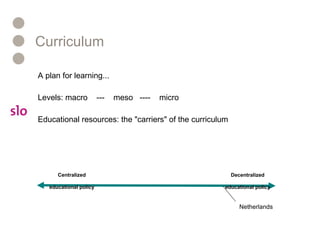
Curriculum A plan for learning... Levels: macro  ---  meso  ----  micro Educational resources: the "carriers" of the curriculum Decentralized educational policy Centralized educational policy Netherlands
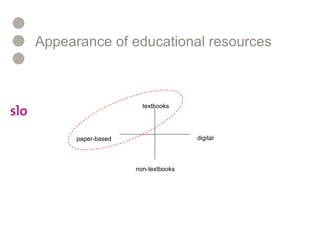
Appearance of educational resources digital paper-based textbooks non-textbooks
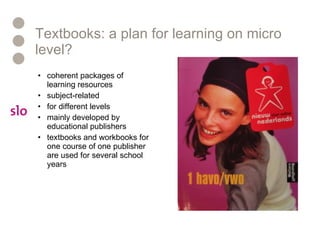
Textbooks: a plan for learning on micro level? coherent packages of learning resources  subject-related for different levels mainly developed by educational publishers textbooks and workbooks for one course of one publisher are used for several school years
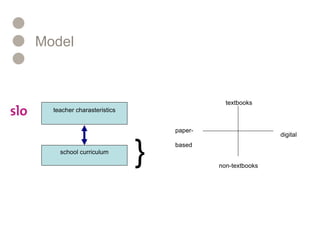
Model teacher charasteristics school curriculum } digital paper- based textbooks non-textbooks
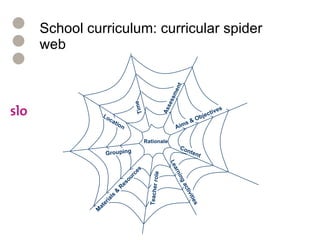
School curriculum: curricular spider web Rationale Content Teacher role Materials & Resources Grouping Location Time Assessment Aims & Objectives Learning activities
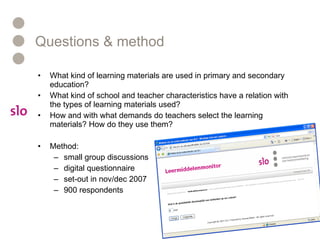
Questions & method What kind of learning materials are used in primary and secondary education? What kind of school and teacher characteristics have a relation with the types of learning materials used? How and with what demands do teachers select the learning materials? How do they use them? Method: small group discussions digital questionnaire set-out in nov/dec 2007 900 respondents
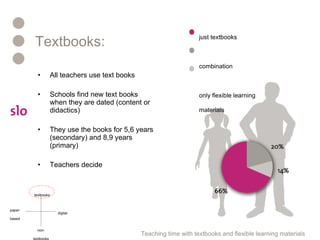
Textbooks: All teachers use text books Schools find new text books when they are dated (content or didactics) They use the books for 5,6 years (secondary) and 8,9 years (primary) Teachers decide just textbooks combination only flexible learning materials Teaching time with textbooks and flexible learning materials digital paper- based textbooks non- textbooks
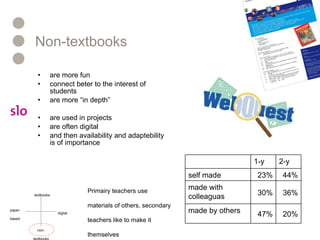
Non-textbooks are more fun connect beter to the interest of students are more “in depth”  are used in projects are often digital and then availability and adaptebility is of importance Primairy teachers use materials of others, secondary teachers like to make it themselves 20% 47% made by others 36% 30% made with colleaguas 44% 23% self made  2-y 1-y digital paper- based textbooks non- textbooks
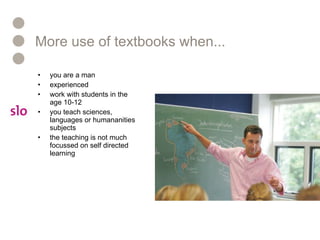
More use of textbooks when... you are a man  experienced work with students in the age 10-12 you teach sciences, languages or humananities subjects the teaching is not much focussed on self directed learning
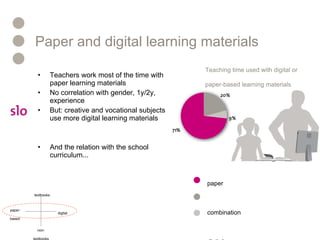
Paper and digital learning materials Teachers work most of the time with paper learning materials No correlation with gender, 1y/2y, experience But: creative and vocational subjects use more digital learning materials And the relation with the school curriculum... paper combination digital Teaching time used with digital or  paper-based learning materials digital paper- based textbooks non- textbooks
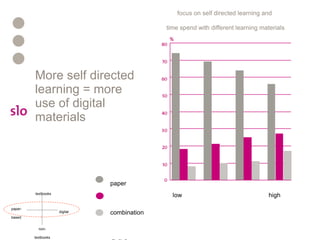
More self directed learning = more use of digital materials   low   high focus on self directed learning and  time spend with different learning materials paper combination digital digital paper- based textbooks non- textbooks
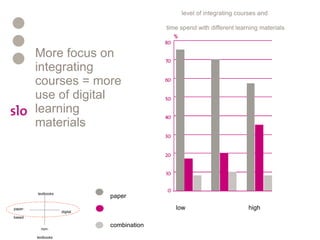
More focus on integrating courses = more use of digital learning materials level of integrating courses and  time spend with different learning materials   low   high paper combination digital digital paper- based textbooks non- textbooks
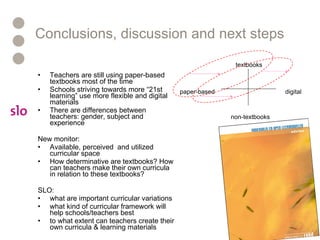
Conclusions, discussion and next steps Teachers are still using paper-based textbooks most of the time Schools striving towards more “21st learning” use more flexible and digital materials There are differences between teachers: gender, subject and experience  New monitor: Available, perceived  and utilized curricular space How determinative are textbooks? How can teachers make their own curricula in relation to these textbooks? SLO: what are important curricular variations what kind of curricular framework will help schools/teachers best to what extent can teachers create their own curricula & learning materials digital paper-based textbooks non-textbooks
Questions? More information: www.slo.nl/Leermiddelenmonitor   [email_address] http://translate.google.com/translate?u=http%3A%2F%2Fviewer.zoho.com%2Fdocs%2FllLcD&hl=nl&ie=UTF-8&sl=nl&tl=en
 
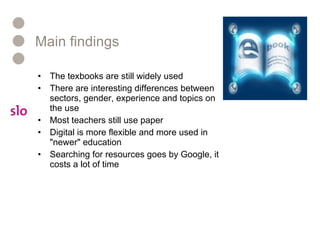
Main findings  The texbooks are still widely used  There are interesting differences between sectors, gender, experience and topics on the use  Most teachers still use paper Digital is more flexible and more used in "newer" education Searching for resources goes by Google, it costs a lot of time
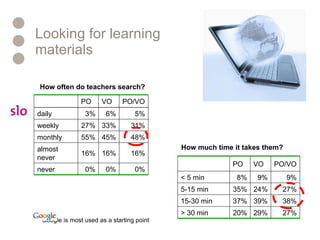
Looking for learning  materials How  often do teachers search? How much time it takes them? Google is most used as a starting point 0% 0% 0% never 16% 16% 16% almost never 48% 45% 55% monthly 31% 33% 27% weekly 5% 6% 3% daily PO/VO VO PO 27% 29% 20% > 30 min 38% 39% 37% 15-30 min 27% 24% 35% 5-15 min 9% 9% 8% < 5 min PO/VO VO PO
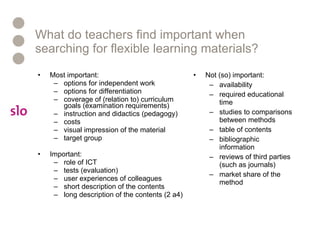
What do teachers find important when searching for flexible learning materials? Most important: options for independent work options for differentiation coverage of (relation to) curriculum goals (examination requirements) instruction and didactics (pedagogy)  costs visual impression of the material   target group Important: role of ICT  tests (evaluation)  user experiences of colleagues short description of the contents  long description of the contents (2 a4) Not (so) important: availability required educational time studies to comparisons between methods table of contents bibliographic information  reviews of third parties (such as journals) market share of the method
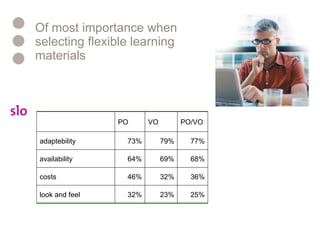
Of most importance when  selecting flexible learning  materials 25% 23% 32% look and feel 36% 32% 46% costs 68% 69% 64% availability 77% 79% 73% adaptebility PO/VO VO PO

Developments in educational resources

  • 1.
    Developments in educationalresources Wim de Boer ECER - Annual Conference september 2008, Gotenborg
  • 2.
    educational resources developments& curriculum in the Netherlands research model & methodology results conclusions, interpretation and future research questions
  • 3.
    Learning materials “onthe move” School make use of curricular space: more emphasis on independent learning, competences, authentic learning, new environments, school profiles/themes New providers of learning materials: new publishers, new roles publishers, new partnerships between school, teachers publishing The role of ICT: digital learning resources, VLEs, repositories Shortage of teachers New ways of funding the learning resources Experiments: the teacher as a arranger and designer of learning materials new demands new offer, new possibilities new political situation
  • 4.
    Curriculum A planfor learning... Levels: macro --- meso ---- micro Educational resources: the &quot;carriers&quot; of the curriculum Decentralized educational policy Centralized educational policy Netherlands
  • 5.
    Appearance of educationalresources digital paper-based textbooks non-textbooks
  • 6.
    Textbooks: a planfor learning on micro level? coherent packages of learning resources subject-related for different levels mainly developed by educational publishers textbooks and workbooks for one course of one publisher are used for several school years
  • 7.
    Model teacher charasteristicsschool curriculum } digital paper- based textbooks non-textbooks
  • 8.
    School curriculum: curricularspider web Rationale Content Teacher role Materials & Resources Grouping Location Time Assessment Aims & Objectives Learning activities
  • 9.
    Questions & methodWhat kind of learning materials are used in primary and secondary education? What kind of school and teacher characteristics have a relation with the types of learning materials used? How and with what demands do teachers select the learning materials? How do they use them? Method: small group discussions digital questionnaire set-out in nov/dec 2007 900 respondents
  • 10.
    Textbooks: All teachersuse text books Schools find new text books when they are dated (content or didactics) They use the books for 5,6 years (secondary) and 8,9 years (primary) Teachers decide just textbooks combination only flexible learning materials Teaching time with textbooks and flexible learning materials digital paper- based textbooks non- textbooks
  • 11.
    Non-textbooks are morefun connect beter to the interest of students are more “in depth” are used in projects are often digital and then availability and adaptebility is of importance Primairy teachers use materials of others, secondary teachers like to make it themselves 20% 47% made by others 36% 30% made with colleaguas 44% 23% self made 2-y 1-y digital paper- based textbooks non- textbooks
  • 12.
    More use oftextbooks when... you are a man experienced work with students in the age 10-12 you teach sciences, languages or humananities subjects the teaching is not much focussed on self directed learning
  • 13.
    Paper and digitallearning materials Teachers work most of the time with paper learning materials No correlation with gender, 1y/2y, experience But: creative and vocational subjects use more digital learning materials And the relation with the school curriculum... paper combination digital Teaching time used with digital or paper-based learning materials digital paper- based textbooks non- textbooks
  • 14.
    More self directedlearning = more use of digital materials low high focus on self directed learning and time spend with different learning materials paper combination digital digital paper- based textbooks non- textbooks
  • 15.
    More focus onintegrating courses = more use of digital learning materials level of integrating courses and time spend with different learning materials low high paper combination digital digital paper- based textbooks non- textbooks
  • 16.
    Conclusions, discussion andnext steps Teachers are still using paper-based textbooks most of the time Schools striving towards more “21st learning” use more flexible and digital materials There are differences between teachers: gender, subject and experience New monitor: Available, perceived and utilized curricular space How determinative are textbooks? How can teachers make their own curricula in relation to these textbooks? SLO: what are important curricular variations what kind of curricular framework will help schools/teachers best to what extent can teachers create their own curricula & learning materials digital paper-based textbooks non-textbooks
  • 17.
    Questions? More information:www.slo.nl/Leermiddelenmonitor [email_address] http://translate.google.com/translate?u=http%3A%2F%2Fviewer.zoho.com%2Fdocs%2FllLcD&hl=nl&ie=UTF-8&sl=nl&tl=en
  • 18.
  • 19.
    Main findings The texbooks are still widely used There are interesting differences between sectors, gender, experience and topics on the use Most teachers still use paper Digital is more flexible and more used in &quot;newer&quot; education Searching for resources goes by Google, it costs a lot of time
  • 20.
    Looking for learning materials How often do teachers search? How much time it takes them? Google is most used as a starting point 0% 0% 0% never 16% 16% 16% almost never 48% 45% 55% monthly 31% 33% 27% weekly 5% 6% 3% daily PO/VO VO PO 27% 29% 20% > 30 min 38% 39% 37% 15-30 min 27% 24% 35% 5-15 min 9% 9% 8% < 5 min PO/VO VO PO
  • 21.
    What do teachersfind important when searching for flexible learning materials? Most important: options for independent work options for differentiation coverage of (relation to) curriculum goals (examination requirements) instruction and didactics (pedagogy) costs visual impression of the material target group Important: role of ICT tests (evaluation) user experiences of colleagues short description of the contents long description of the contents (2 a4) Not (so) important: availability required educational time studies to comparisons between methods table of contents bibliographic information reviews of third parties (such as journals) market share of the method
  • 22.
    Of most importancewhen selecting flexible learning materials 25% 23% 32% look and feel 36% 32% 46% costs 68% 69% 64% availability 77% 79% 73% adaptebility PO/VO VO PO

Editor's Notes

  • #9 Subject matter and target group analysis: see Smith &amp; Ragan