Developing a Technology
Rich Teacher Education
Program: Use of Data to
Inform Instruction
Dr. Donna Redman
Nori Barajas-Murphy, M.Ed.
University of La Verne
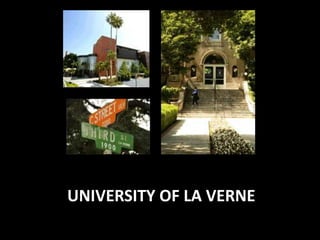
UNIVERSITY OF LA VERNE
Demographics
The University of La Verne is a Carnegie
doctoral/Research University in Southern
California enrolling over 8,000 students in four
colleges over 11 campuses.
The College of Education & Organizational
Leadership (CEOL) A leader in preparation of
professional educators and administrators.
Community
College Grant
Partner
Citrus Community
College total
enrollment of
13,184
Citrus Community
College serves five
unified school
districts
Title V Grant: Preparing Tomorrow’s
Teachers Today Through Technology
1. To improve the technology literacy of future
educatory by modeling exemplary use of
learning technologies in their teacher
preparation program
2. Improve program completion and graduation
rates of future teachers from community
college to 4-year college
DATA USED TO INFORM REDESIGN
& FACULTY DEVELOPMENT
• ECAR Study of Students and Technology
• Project Tomorrow: Speak Up Aspiring
Educators
• Course Evaluations
• Learning Outcome Surveys
• Liberal Studies Faculty Use of Data
Instrument
• Liberal Studies Lead Faculty Focus Group
• ECAR Study of Students and Technology
• Project Tomorrow: Speak Up Aspiring
Educators
• Course Evaluations
• Learning Outcome Surveys
• Liberal Studies Faculty Use of Data
Instrument
• Liberal Studies Lead Faculty Focus Group
ECAR data informed the
initial redesign process
Initial Conclusions - 2012
We believe mobile
devices and tablets will
increase in the near
future and want to
leverage that medium in
course redesign (Horizon
Report 2012)
Our students believe the
goals of the grant to be valid
– technology helps students
achieve course learning
outcomes
Our students own the equipment
needed to access online resources
– and want these resources
available in the LMS
ECAR data informed the
ongoing redesign process
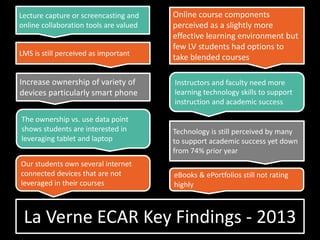
La Verne ECAR Key Findings - 2013
Online course components
perceived as a slightly more
effective learning environment but
few LV students had options to
take blended courses
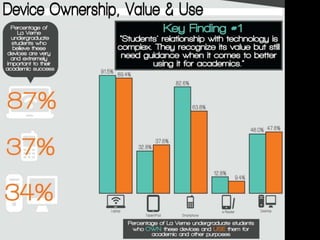
Increase ownership of variety of
devices particularly smart phone

The ownership vs. use data point
shows students are interested in
leveraging tablet and laptop
Instructors and faculty need more
learning technology skills to support
instruction and academic success
LMS is still perceived as important
Our students own several internet
connected devices that are not
leveraged in their courses
Technology is still perceived by many
to support academic success yet down
from 74% prior year
eBooks & ePortfolios still not rating
highly
Lecture capture or screencasting and
online collaboration tools are valued
• ECAR Study of Students and Technology
• Project Tomorrow: Speak Up Aspiring
Educators
• Course Evaluations
• Learning Outcome Surveys
• Liberal Studies Faculty Use of Data
Instrument
• Liberal Studies Lead Faculty Focus Group
Project Tomorrow: Speak Up
The New Digital Learning Playbook
– June 2014
• 325,279 K‐12 students
• 32,151 parents
• 37,756 teachers
• 2,230 librarians
• 933 district administrators
• 3,020 school administrators
• 577 technology leaders
• 1,346 members of the
community
• 9,005 public and private schools
from
• 2,710 districts
Project Tomorrow: Speak Up
Learning in the 21st Century: Digital
Experiences and Expectations of
Tomorrow’s Teachers
– February 7, 2013
1,351 college students completed the online Speak Up survey.
Key characteristics of this convenience sampling include:
• 75 % were enrolled in undergraduate teacher preparation
programs
• 25 % in post undergraduate programs either leading to a
graduate level degree or to a teacher certificate or
credential
• 41 % were aspiring for a multi-subject teacher credential
• 46 % for a single subject teacher credential
Speak Up 2013 Key Findings
Aspiring teachers place a
high value on the role of
technology to both impact
student academic success
and their own
effectiveness as a teacher.
In spite of their comfort
with using technology
tools, the aspiring teachers
say that their field
experiences as student
teachers and observing
their professors are the
best way for them to learn
about how to integrate
technology within
instruction.
La Verne Liberal Studies
students participated this
year in the 2014 Aspiring
Teacher Survey
Principal’s Expectations
vs. Aspiring Teacher
Experience
Disparity
• ECAR Study of Students and Technology
• Project Tomorrow: Speak Up Aspiring
Educators
• Course Evaluations
• Learning Outcome Surveys
• Liberal Studies Faculty Use of Data
Instrument
• Liberal Studies Lead Faculty Focus Group
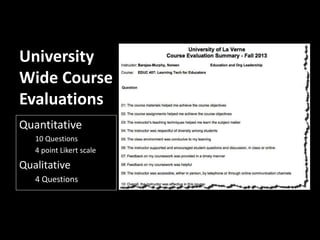
University
Wide Course
Evaluations
Quantitative
10 Questions
4 point Likert scale
Qualitative
4 Questions
Quantitative Evaluation Questions
• The course materials helped me achieve the course objectives
• The course assignments helped me achieve the course objectives
• The instructor’s teaching techniques helped my learn the subject matter
• The instructor was respectful of diversity among students
• The class environment was conducive to my learning
• The instructor supported and encouraged student questions and
discussion, in class or online
• Feedback on my coursework was provided in a timely manner
• Feedback on my coursework was helpful
• The instructor was accessible, either in person, by telephone or through
online communication channels.
• Overall the instructor was effective in the course
Qualitative Data Questions:
1. What were the instructor’s most satisfactory
teaching attributes?
2. What could the instructor do to improve
his/her teaching effectiveness?
3. What were the most satisfactory aspects of
this course?
4. How could this course be improved?
• ECAR Study of Students and Technology
• Project Tomorrow: Speak Up Aspiring
Educators
• Course Evaluations
• Learning Outcome Surveys
• Liberal Studies Faculty Use of Data
Instrument
• Liberal Studies Lead Faculty Focus Group
PT5 Course Outcome Surveys
The degree to which I could have competently
met this learning outcome BEFORE taking this
course.
The degree to which the course materials and
activities in (course) helped me meet the
following learning outcome
Strongly
Disagree
Somewhat
Disagree
Somewhat
Agree
Strongly
Agree
1 2 3 4
Impact of Course Redesign
Writing for Educators
Foundation Course
Art for Elementary
Educators
Liberal Studies Lesson
Plan Resource
Liberal Studies
ePortfolio Resource
Physical Education for
Elementary Educators
Early Childhood
Development
• ECAR Study of Students and Technology
• Project Tomorrow: Speak Up Aspiring
Educators
• Course Evaluations
• Learning Outcome Surveys
• Liberal Studies Faculty Use of Data
Instrument
• Liberal Studies Lead Faculty Focus Group
Liberal Studies Faculty Use of Data
• To what degree did the course learning
outcome data influence your teaching
practices?
• To what degree did the ECAR data influence
your teaching practices?
• To what degree did the faculty development
events influence your teaching practices?
ECAR Data + Course LO Data
To what degree did the course learning
outcome data influence your teaching
practices?
3.60
I have modified my instructional
approach(es) based on the 2012 data set.
3.14
I have modified my instructional
approach(es) based on the 2013 data set.
3.05
• ECAR Study of Students and Technology
• Project Tomorrow: Speak Up Aspiring
Educators
• Course Evaluations
• Learning Outcome Surveys
• Liberal Studies Faculty Use of Data
Instrument
• Liberal Studies Lead Faculty Focus Group
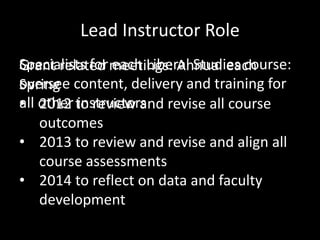
Lead Instructor Role
Specialists for each Liberal Studies course:
oversee content, delivery and training for
all other instructors
Grant related meetings: Annual each
Spring
• 2012 to review and revise all course
outcomes
• 2013 to review and revise and align all
course assessments
• 2014 to reflect on data and faculty
development
Liberal Studies Lead Focus Group
1. In what ways do you use data to inform
course content and instructional design
2. In what ways do you use faculty development
to inform course content and instructional
design
• ECAR Study of Students and Technology
• Project Tomorrow: Speak Up Aspiring
Educators
• Course Evaluations
• Learning Outcome Surveys
• Liberal Studies Faculty Use of Data
Instrument
• Liberal Studies Lead Faculty Focus Group
• ECAR Study of Students and Technology
• Project Tomorrow: Speak Up Aspiring
Educators
• Course Evaluations
• Learning Outcome Surveys
• Liberal Studies Faculty Use of Data
Instrument
• Liberal Studies Lead Faculty Focus Group
COURSE DESIGN
Year One Redesign
• Redesigned all presentations
• Lecture captured all course topics
and located on a streaming server
• Created SoftChalk SCORM
compliant lessons w/ embedded
lecture
• Created and embedded self
checking quizzes during each topic
• Assessments aligned more closely
with course learning outcomes
• Instructor feedback models online
“Office Hour” using screencast
grading
Writing for Educators
Foundation Course
Screencasting is used widely by
instructors and students in all courses
LMS is the central location for all
coursework in program
Device use is encouraged and course
content is increasingly mobile friendly
Liberal Studies courses are all
offered in the blended format; 7 of
the 11 required courses are offered
100% online
eBooks & ePortfolios are being consistently
and intentionally infused program wide
Year One Redesign Writing for Educators
Foundation Course
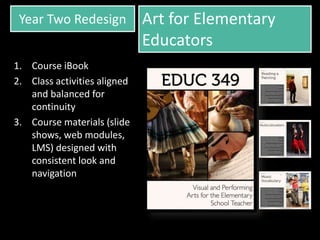
Year Two Redesign
1. Course iBook
2. Class activities aligned
and balanced for
continuity
3. Course materials (slide
shows, web modules,
LMS) designed with
consistent look and
navigation
Art for Elementary
Educators
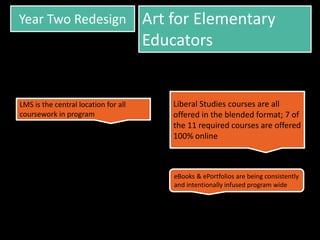
Year Two Redesign Art for Elementary
Educators
LMS is the central location for all
coursework in program
eBooks & ePortfolios are being consistently
and intentionally infused program wide
Liberal Studies courses are all
offered in the blended format; 7 of
the 11 required courses are offered
100% online
Year Three Redesign
1. Program alignment +
Capstone Rubric
2. Course level artifacts,
achievements, and
reflections
3. How-To manual
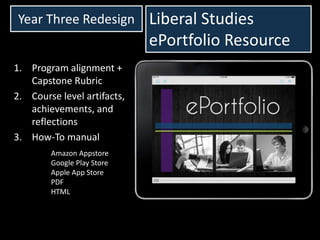
Liberal Studies
ePortfolio Resource
Amazon Appstore
Google Play Store
Apple App Store
PDF
HTML
Year Three Redesign Liberal Studies Lesson
Plan Resource
1. Program alignment
2. Examples of key
indicators
3. Guided practice using
assessment rubric
4. How-To manual
La Verne Redesign
Device use is encouraged and course
content is increasingly mobile friendly
Ongoing, sustained support of
consistent learning technology skills is
offered to all Liberal Studies faculty
and instructors
eBooks & ePortfolios are being consistently
and intentionally infused program wide
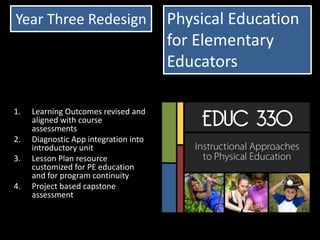
Year Three Redesign
1. Learning Outcomes revised and
aligned with course
assessments
2. Diagnostic App integration into
introductory unit
3. Lesson Plan resource
customized for PE education
and for program continuity
4. Project based capstone
assessment
Physical Education
for Elementary
Educators
La Verne Redesign
Problem based learning is the
course arc ~ students will create a
PE unit to solve a K-8 teaching
scenario
Diagnostic app integration and
modeling throughout course
Technology is still perceived by many
to support academic
Screencasting is used widely by
instructors and students in all courses
LMS is the central location for all
coursework in program
Device use is encouraged and course
content is increasingly mobile friendly
Ongoing, sustained support of
consistent learning technology skills is
offered to all Liberal Studies faculty
and instructors
eBooks & ePortfolios are being consistently
and intentionally infused program wide
Integration and modeling of device in
PE education and teaching
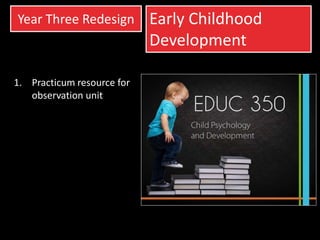
Year Three Redesign
1. Practicum resource for
observation unit
Early Childhood
Development
FACULTY DEVELOPMENT
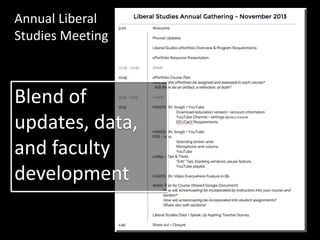
Annual Liberal
Studies Meeting
Blend of
updates, data,
and faculty
development
Liberal Studies Annual Meetings
Goals:
• ECAR Data + Course learning
outcomes data + Aspiring data
• Screencasting
• ePortfolio
To what degree have your incorporated
screencasting as an instructor?
3.6868%
Significantly
Faculty Development
To what degree have you assigned and
assessed an item for the Liberal Studies
ePortfolio?
To what degree have you integrated
screencasting into student assignments?
2.72
3.00
LEARNING TECHNOLOGY COURSE
SUPPORT OF STUDENT PROFICIENCY
EDUC407 Requirements
• Screencasting – Teaching concepts, rich media
development, reflection
• Video Channel – Student produced playlists
and streaming content
• Site development – digital presence,
ePortfolio, lesson planning content
• ECAR Study of Students and Technology
• Project Tomorrow: Speak Up Aspiring
Educators
• University of La Verne Course Evaluations
• Liberal Studies Learning Outcome Surveys
• Liberal Studies Faculty Use of Data
Instrument
• Liberal Studies Lead Faculty Focus Group
61
Questions?
Developing a Technology
Rich Teacher Education
Program: Use of Data to
Inform Instruction
dredman@laverne.edu
nbarajas-murphy@laverne.edu

Developing a Technology Rich Teacher Education Program

  • 1.
    Developing a Technology RichTeacher Education Program: Use of Data to Inform Instruction Dr. Donna Redman Nori Barajas-Murphy, M.Ed. University of La Verne
  • 2.
  • 3.
    Demographics The University ofLa Verne is a Carnegie doctoral/Research University in Southern California enrolling over 8,000 students in four colleges over 11 campuses. The College of Education & Organizational Leadership (CEOL) A leader in preparation of professional educators and administrators.
  • 4.
    Community College Grant Partner Citrus Community Collegetotal enrollment of 13,184 Citrus Community College serves five unified school districts
  • 6.
    Title V Grant:Preparing Tomorrow’s Teachers Today Through Technology 1. To improve the technology literacy of future educatory by modeling exemplary use of learning technologies in their teacher preparation program 2. Improve program completion and graduation rates of future teachers from community college to 4-year college
  • 7.
    DATA USED TOINFORM REDESIGN & FACULTY DEVELOPMENT
  • 8.
    • ECAR Studyof Students and Technology • Project Tomorrow: Speak Up Aspiring Educators • Course Evaluations • Learning Outcome Surveys • Liberal Studies Faculty Use of Data Instrument • Liberal Studies Lead Faculty Focus Group
  • 9.
    • ECAR Studyof Students and Technology • Project Tomorrow: Speak Up Aspiring Educators • Course Evaluations • Learning Outcome Surveys • Liberal Studies Faculty Use of Data Instrument • Liberal Studies Lead Faculty Focus Group
  • 10.
    ECAR data informedthe initial redesign process
  • 15.
    Initial Conclusions -2012 We believe mobile devices and tablets will increase in the near future and want to leverage that medium in course redesign (Horizon Report 2012) Our students believe the goals of the grant to be valid – technology helps students achieve course learning outcomes Our students own the equipment needed to access online resources – and want these resources available in the LMS
  • 16.
    ECAR data informedthe ongoing redesign process
  • 22.
    La Verne ECARKey Findings - 2013 Online course components perceived as a slightly more effective learning environment but few LV students had options to take blended courses Increase ownership of variety of devices particularly smart phone The ownership vs. use data point shows students are interested in leveraging tablet and laptop Instructors and faculty need more learning technology skills to support instruction and academic success LMS is still perceived as important Our students own several internet connected devices that are not leveraged in their courses Technology is still perceived by many to support academic success yet down from 74% prior year eBooks & ePortfolios still not rating highly Lecture capture or screencasting and online collaboration tools are valued
  • 23.
    • ECAR Studyof Students and Technology • Project Tomorrow: Speak Up Aspiring Educators • Course Evaluations • Learning Outcome Surveys • Liberal Studies Faculty Use of Data Instrument • Liberal Studies Lead Faculty Focus Group
  • 24.
    Project Tomorrow: SpeakUp The New Digital Learning Playbook – June 2014 • 325,279 K‐12 students • 32,151 parents • 37,756 teachers • 2,230 librarians • 933 district administrators • 3,020 school administrators • 577 technology leaders • 1,346 members of the community • 9,005 public and private schools from • 2,710 districts
  • 25.
    Project Tomorrow: SpeakUp Learning in the 21st Century: Digital Experiences and Expectations of Tomorrow’s Teachers – February 7, 2013 1,351 college students completed the online Speak Up survey. Key characteristics of this convenience sampling include: • 75 % were enrolled in undergraduate teacher preparation programs • 25 % in post undergraduate programs either leading to a graduate level degree or to a teacher certificate or credential • 41 % were aspiring for a multi-subject teacher credential • 46 % for a single subject teacher credential
  • 26.
    Speak Up 2013Key Findings Aspiring teachers place a high value on the role of technology to both impact student academic success and their own effectiveness as a teacher. In spite of their comfort with using technology tools, the aspiring teachers say that their field experiences as student teachers and observing their professors are the best way for them to learn about how to integrate technology within instruction. La Verne Liberal Studies students participated this year in the 2014 Aspiring Teacher Survey
  • 27.
    Principal’s Expectations vs. AspiringTeacher Experience Disparity
  • 28.
    • ECAR Studyof Students and Technology • Project Tomorrow: Speak Up Aspiring Educators • Course Evaluations • Learning Outcome Surveys • Liberal Studies Faculty Use of Data Instrument • Liberal Studies Lead Faculty Focus Group
  • 29.
    University Wide Course Evaluations Quantitative 10 Questions 4point Likert scale Qualitative 4 Questions
  • 30.
    Quantitative Evaluation Questions •The course materials helped me achieve the course objectives • The course assignments helped me achieve the course objectives • The instructor’s teaching techniques helped my learn the subject matter • The instructor was respectful of diversity among students • The class environment was conducive to my learning • The instructor supported and encouraged student questions and discussion, in class or online • Feedback on my coursework was provided in a timely manner • Feedback on my coursework was helpful • The instructor was accessible, either in person, by telephone or through online communication channels. • Overall the instructor was effective in the course
  • 31.
    Qualitative Data Questions: 1.What were the instructor’s most satisfactory teaching attributes? 2. What could the instructor do to improve his/her teaching effectiveness? 3. What were the most satisfactory aspects of this course? 4. How could this course be improved?
  • 32.
    • ECAR Studyof Students and Technology • Project Tomorrow: Speak Up Aspiring Educators • Course Evaluations • Learning Outcome Surveys • Liberal Studies Faculty Use of Data Instrument • Liberal Studies Lead Faculty Focus Group
  • 33.
    PT5 Course OutcomeSurveys The degree to which I could have competently met this learning outcome BEFORE taking this course. The degree to which the course materials and activities in (course) helped me meet the following learning outcome Strongly Disagree Somewhat Disagree Somewhat Agree Strongly Agree 1 2 3 4
  • 34.
    Impact of CourseRedesign Writing for Educators Foundation Course Art for Elementary Educators Liberal Studies Lesson Plan Resource Liberal Studies ePortfolio Resource Physical Education for Elementary Educators Early Childhood Development
  • 35.
    • ECAR Studyof Students and Technology • Project Tomorrow: Speak Up Aspiring Educators • Course Evaluations • Learning Outcome Surveys • Liberal Studies Faculty Use of Data Instrument • Liberal Studies Lead Faculty Focus Group
  • 36.
    Liberal Studies FacultyUse of Data • To what degree did the course learning outcome data influence your teaching practices? • To what degree did the ECAR data influence your teaching practices? • To what degree did the faculty development events influence your teaching practices?
  • 37.
    ECAR Data +Course LO Data To what degree did the course learning outcome data influence your teaching practices? 3.60 I have modified my instructional approach(es) based on the 2012 data set. 3.14 I have modified my instructional approach(es) based on the 2013 data set. 3.05
  • 38.
    • ECAR Studyof Students and Technology • Project Tomorrow: Speak Up Aspiring Educators • Course Evaluations • Learning Outcome Surveys • Liberal Studies Faculty Use of Data Instrument • Liberal Studies Lead Faculty Focus Group
  • 39.
    Lead Instructor Role Specialistsfor each Liberal Studies course: oversee content, delivery and training for all other instructors Grant related meetings: Annual each Spring • 2012 to review and revise all course outcomes • 2013 to review and revise and align all course assessments • 2014 to reflect on data and faculty development
  • 40.
    Liberal Studies LeadFocus Group 1. In what ways do you use data to inform course content and instructional design 2. In what ways do you use faculty development to inform course content and instructional design
  • 41.
    • ECAR Studyof Students and Technology • Project Tomorrow: Speak Up Aspiring Educators • Course Evaluations • Learning Outcome Surveys • Liberal Studies Faculty Use of Data Instrument • Liberal Studies Lead Faculty Focus Group • ECAR Study of Students and Technology • Project Tomorrow: Speak Up Aspiring Educators • Course Evaluations • Learning Outcome Surveys • Liberal Studies Faculty Use of Data Instrument • Liberal Studies Lead Faculty Focus Group
  • 42.
  • 43.
    Year One Redesign •Redesigned all presentations • Lecture captured all course topics and located on a streaming server • Created SoftChalk SCORM compliant lessons w/ embedded lecture • Created and embedded self checking quizzes during each topic • Assessments aligned more closely with course learning outcomes • Instructor feedback models online “Office Hour” using screencast grading Writing for Educators Foundation Course
  • 44.
    Screencasting is usedwidely by instructors and students in all courses LMS is the central location for all coursework in program Device use is encouraged and course content is increasingly mobile friendly Liberal Studies courses are all offered in the blended format; 7 of the 11 required courses are offered 100% online eBooks & ePortfolios are being consistently and intentionally infused program wide Year One Redesign Writing for Educators Foundation Course
  • 45.
    Year Two Redesign 1.Course iBook 2. Class activities aligned and balanced for continuity 3. Course materials (slide shows, web modules, LMS) designed with consistent look and navigation Art for Elementary Educators
  • 46.
    Year Two RedesignArt for Elementary Educators LMS is the central location for all coursework in program eBooks & ePortfolios are being consistently and intentionally infused program wide Liberal Studies courses are all offered in the blended format; 7 of the 11 required courses are offered 100% online
  • 47.
    Year Three Redesign 1.Program alignment + Capstone Rubric 2. Course level artifacts, achievements, and reflections 3. How-To manual Liberal Studies ePortfolio Resource Amazon Appstore Google Play Store Apple App Store PDF HTML
  • 48.
    Year Three RedesignLiberal Studies Lesson Plan Resource 1. Program alignment 2. Examples of key indicators 3. Guided practice using assessment rubric 4. How-To manual
  • 49.
    La Verne Redesign Deviceuse is encouraged and course content is increasingly mobile friendly Ongoing, sustained support of consistent learning technology skills is offered to all Liberal Studies faculty and instructors eBooks & ePortfolios are being consistently and intentionally infused program wide
  • 50.
    Year Three Redesign 1.Learning Outcomes revised and aligned with course assessments 2. Diagnostic App integration into introductory unit 3. Lesson Plan resource customized for PE education and for program continuity 4. Project based capstone assessment Physical Education for Elementary Educators
  • 51.
    La Verne Redesign Problembased learning is the course arc ~ students will create a PE unit to solve a K-8 teaching scenario Diagnostic app integration and modeling throughout course Technology is still perceived by many to support academic Screencasting is used widely by instructors and students in all courses LMS is the central location for all coursework in program Device use is encouraged and course content is increasingly mobile friendly Ongoing, sustained support of consistent learning technology skills is offered to all Liberal Studies faculty and instructors eBooks & ePortfolios are being consistently and intentionally infused program wide Integration and modeling of device in PE education and teaching
  • 52.
    Year Three Redesign 1.Practicum resource for observation unit Early Childhood Development
  • 53.
  • 54.
    Annual Liberal Studies Meeting Blendof updates, data, and faculty development
  • 55.
    Liberal Studies AnnualMeetings Goals: • ECAR Data + Course learning outcomes data + Aspiring data • Screencasting • ePortfolio
  • 56.
    To what degreehave your incorporated screencasting as an instructor? 3.6868% Significantly Faculty Development To what degree have you assigned and assessed an item for the Liberal Studies ePortfolio? To what degree have you integrated screencasting into student assignments? 2.72 3.00
  • 57.
    LEARNING TECHNOLOGY COURSE SUPPORTOF STUDENT PROFICIENCY
  • 58.
    EDUC407 Requirements • Screencasting– Teaching concepts, rich media development, reflection • Video Channel – Student produced playlists and streaming content • Site development – digital presence, ePortfolio, lesson planning content
  • 60.
    • ECAR Studyof Students and Technology • Project Tomorrow: Speak Up Aspiring Educators • University of La Verne Course Evaluations • Liberal Studies Learning Outcome Surveys • Liberal Studies Faculty Use of Data Instrument • Liberal Studies Lead Faculty Focus Group
  • 61.
  • 62.
    Developing a Technology RichTeacher Education Program: Use of Data to Inform Instruction dredman@laverne.edu nbarajas-murphy@laverne.edu

Editor's Notes

  • #4  ULV: The University of La Verne is a Carnegie doctoral/Research University in Southern California enrolling over 8,000 students in four colleges: the College of Arts and Science, the College of Business & Public Management, the College of Education & Organizational Leadership, & the college of Law. The University has nine regional campuses in central and southern California. The university is accredited by Accrediting Commission for Senior Colleges and Universities of the Western Association of Schools and Colleges. CEOL: provides a broad range of programs to prepare professional educators in a number of specialties including child development, elementary and secondary teaching, special education, pupil personnel services, school psychology, reading, child life, and educational and organizational leadership. Because of its long and rich tradition of excellence, the University of La Verne is recognized as one of the leading institutions engaged in the preparation of professional educators and leaders in Southern California. Accredited by NCATE and CCTC.
  • #5 Title V HSI Co-Op Grant - partner with University of La Verne - prepare underrepresented students to enter the teaching profession. With Citrus as the lead institution, the two colleges share the grant and have formed a program designed to prepare the next generation of K-12 teachers. The partnership builds on the shared strengths and values of the two colleges, which are Hispanic Serving Institutions. The collaboration between Citrus College and the University of La Verne has provided a critically needed and highly effective academic pathway that will prepare many Hispanic and other underrepresented students to become teachers. As such, the program is a high priority for both institutions.  Visit the Center for Teacher Excellence website. Celebrating over 90 years of service, Citrus College is located in Glendora in the foothills of the San Gabriel Mountains, approximately twenty-five miles northeast of metropolitan Los Angeles. The college has the distinction of being the oldest community college in Los Angeles County and the fifth oldest In the state Crrently serves 11,000 students
  • #6 Courses in the program are designed to enhance student competencies in the following areas: designing multiple subject curriculum and delivery at the P-6 level; demonstrating a comprehensive understanding of social issues and capability to teach culturally and linguistically diverse learners; understanding technology for use as a future teacher; and, preparing multiple subject teacher candidates for the state exam, the California Subject Exam for Teachers (CSET). The program serves to bridge the sequential process of becoming a teacher for Liberal Studies students through continuous communication and cooperation with the Teacher Credential Program.
  • #7 “(Solve)…the issue of poor student success [as evidenced] in teacher education completion rates and inadequate technology integration by faculty, and inadequate student technology literacy, emerged as one of the top priorities.” Grant Proposal An instructional design team has worked in partnership with Faculty Content Experts to redesign courses to include interactive mobile content, and technology and media rich
  • #11 Initial data used to inform redesign
  • #12 Initially, this data showed: Our students own laptops Most believe using learning tech will benefit their education Printers?
  • #13 Many believe their instructors have adequate skills, and use learning tech effectively Only 42% believe instructors provide enough modeling or training within a course More use of LMS
  • #14 ePortfolios + eBooks are not yet a priority Previous slide shows LMS and availability of course materials is a priority
  • #15 An interesting result~ Social media has continued to be of little interest to our students Again, LMS is important to many students
  • #16 Our student DO own equipment Students want resources available in the LMS Technology facilitates learning Horizon report – significant finding in 2012 that we included as we began redesign
  • #18 Increase ownership of variety of devices particularly smart phone The ownership vs use data point shows students are interested in leveraging tablet and laptop ECAR varied question to expand beyond ownership to the USE of the device for academic purposes
  • #19 Technology is still perceived by many as to support academic success yet down from 74% prior year ONLINE course components perceived as a slightly more effective learning environment but few had options to take blended courses Instructors and faculty need more learning technology to support instruction and academic success
  • #20 LMS is still perceived as important Lecture capture or screencasting and online collaboration tools are valued eBooks & ePortfolios still not rating highly
  • #22 Our students own several internet connected devices that are not leveraged in their courses
  • #25 2012 data New 2013 data Aspring questions
  • #26 2012 data New 2013 data Aspring questions
  • #28 Return to this when discussing 407
  • #29 Our focus group determined that course evaluations were the least valuable source of data. These evaluations do not address course content and students opinion of how much they learned. There is limited focus on learning outcomes. More focus on teaching strategies and environment Used heavily for tenure and promotion
  • #30 Quantitative Date Questions: Likert Ratings: 1-4 The course materials helped me achieve the course objectives The course assignments helped me achieve the course objectives The instructor’s teaching techniques helped my learn the subject matter The instructor was respectful of diversity among students The class environment was conducive to my learning The instructor supported and encouraged student questions and discussion, in class or online Feedback on my coursework was provided in a timely manner Feedback on my coursework was helpful The instructor was accessible, either in person, by telephone or through online communication channels. Overall the instructor was effective in the course Qualitative Date Questions: What were the instructor’s most satisfactory teaching attributes? What could the instructor do to improve his/her teaching effectiveness? What were the most satisfactory aspects of this course? How could this course be improved/
  • #33 Nori
  • #40 Lead faculty are specialists in each course. They oversee content, delivery and training to teach the course. Lead faculty meetings are held two times a year.
  • #41  All lead faculty expressed a need to incorporate more technology into their courses, based on the Ear and Learning outcomes data. More use of screencasting, software such as Skagit and Camtasia, video everywhere, and YouTube were incorporated into the courses, by both then instructors and student use. Faculty development also played a large part in it. As lead
  • #44 Full redesign – course was a patch work of borrowed materials Redesigned all presentations Lecture captured (Produced Camtasia) all course topics and located on a streaming server Created SoftChalk SCORM compliant lessons w/ embedded lecture Created and embedded self checking quizzes during each topic Assessments aligned more closely with course learning outcomes
  • #45 Screencasting and lecture capture LMS Streamed lectures on mobile device iBook authored as a companion course text
  • #46 Flipped class – defined by instructor, readings prior, activities during Resources more consistently organized in LMS
  • #47 Flipped class – defined by instructor, readings prior, activities during Resources more consistently organized in LMS iBook available with questions from course text
  • #48 Conversations about courses resulted in a deficit program wide on two items: ePortfolio + Lesson Planning We shifted to a platform agnostic outcome using Adobe Design + eLearning Suite How-To resources for program consistency and better faculty support
  • #49 How to guide with exemplars given in relation to rubric
  • #50 Resources are available for mobile devices, in the LMS and onlline as an html file or a PDF
  • #60 To support student use and creation of rich media – EDUC407 is a required course