Technology in languages education 
Kristyn Paul 
Project Manager 
Languages R-12 
Teaching & Learning Services 
5th Floor 
Education Centre 
31 Flinders Street 
Adelaide SA 5000 
http://www.slideshare.net/kristynpaul/technology-in-languages- 
education
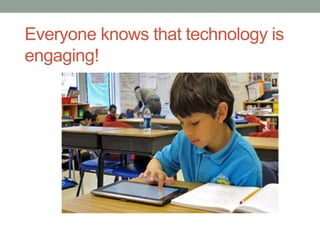
Everyone knows that technology is 
engaging!
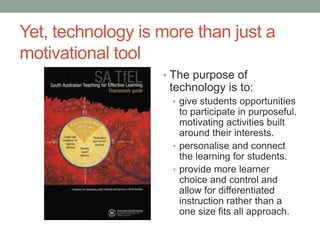
Yet, technology is more than just a 
motivational tool 
The purpose of technology is to: 
• give students opportunities 
to participate in purposeful, 
motivating activities built 
around their interests. 
• personalise and connect the 
learning for students. 
• provide more learner choice 
and control and allow for 
differentiated instruction 
rather than a one size fits all 
approach.
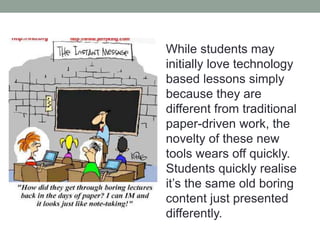
While students may 
initially love technology 
based lessons simply 
because they are different 
from traditional paper-driven 
work, the novelty of 
these new tools wears off 
quickly. Students quickly 
realise it’s the same old 
boring content just 
presented differently.
It’s what you do with the tools and not 
the tools themselves that is important!
Technology should not be used for its 
own sake. 
• Students should be given opportunities to use technology to 
demonstrate their learning and to share that learning with 
others. 
• Teachers should use technologies that facilitate the learning 
process. 
• Such technology should be more than simply using apps to 
play games, replace worksheets and kill & drill activities - 
Teachers must think about what they want to achieve through 
the use of technology. 
• Teachers must focus on the transformative and pedagogical 
use of technology.
Pedagogical approaches to technology 
integration 
• Technology integration in teaching and learning 
programs requires much more than just digital literacy 
and technical knowledge, it requires foresight, clear 
intentions, and well planned goals. Its purpose is to 
meet students learning needs and as such, technology 
is only a means to an end and not the end itself.
Australian Curriculum: General Capabilities 
Currently ICT is one seven general capabilities that 
support and enhance student learning across all areas of 
the curriculum. Learning areas provide the content and 
contexts within which students develop and apply the 
knowledge, skills, behaviours and dispositions that 
comprise the ICT capability. 
Check out this capability online and think about its scope 
in relation to the Languages learning area: 
http://www.australiancurriculum.edu.au/generalcapabilit 
ies/information-and-communication-technology-capability/ 
introduction/introduction
Pedagogical models 
• There are a number of models that teachers can use to 
assess and evaluate the technology they use in their 
classroom. 
• The most well known of these models are TPACK and 
SAMR.
TPACK (Technological, Pedagogical and 
Content Knowledge) model 
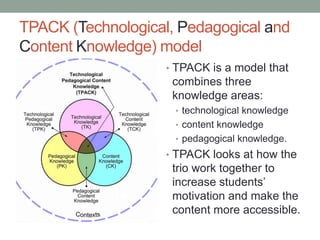
• TPACK is a model that combines 
three knowledge areas: 
– technological knowledge 
– content knowledge 
– pedagogical knowledge. 
• TPACK looks at how the trio 
work together to increase 
students’ motivation and make 
the content more accessible.
TPACK in 2 minutes 
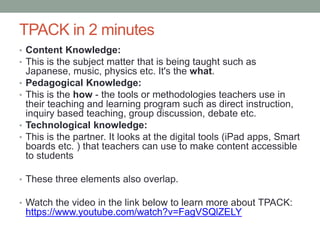
Content Knowledge: 
This is the subject matter that is being taught such as Japanese, music, 
physics etc. It's the what. 
Pedagogical Knowledge: 
This is the how - the tools or methodologies teachers use in their 
teaching and learning program such as direct instruction, inquiry based 
teaching, group discussion, debate etc. 
Technological knowledge: 
This is the partner. It looks at the digital tools (iPad apps, Smart boards 
etc. ) that teachers can use to make content accessible to students 
These three elements also overlap.
For more information … 
Watch the video in the link below to learn more about 
TPACK: https://www.youtube.com/watch?v=FagVSQlZELY 
Check out also the Teaching Teachers for the Future project: 
http://www.ttf.edu.au/
SAMR model 
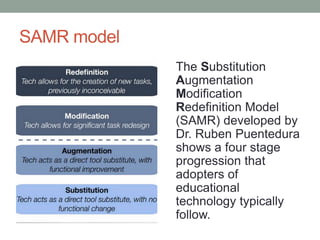
The Substitution 
Augmentation Modification 
Redefinition Model (SAMR) 
developed by Dr. Ruben 
Puentedura shows a four 
stage progression that 
adopters of educational 
technology typically follow.
Steps of the SAMR model 
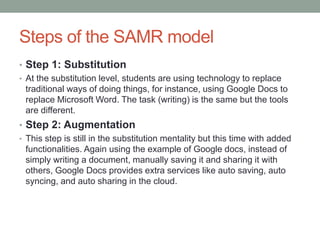
Step 1: Substitution 
At the substitution level, students are using technology to replace 
traditional ways of doing things, for instance, using Google Docs to 
replace Microsoft Word. The task (writing) is the same but the tools 
are different. 
Step 2: Augmentation 
This step is still in the substitution mentality but this time with added 
functionalities. Again using the example of Google docs, instead of 
simply writing a document, manually saving it and sharing it with 
others, Google Docs provides extra services like auto saving, auto 
syncing, and auto sharing in the cloud.
The SAMR model cont. 
Step 3: Modification 
In this step technology is used more effectively not just as a substitution 
for other tools but to redesign parts of the task, transforming student 
learning in the process. An example of this is using the commenting 
service in Google Docs, for instance, to collaborate and share feedback 
on a given task. 
Step 4: Redefinition 
In this step students are using technology in completely new ways. An 
example of redefinition is when students connect with their sister school 
and use Google docs to each write about a shared cultural event (such as 
Christmas) They then use the chat and comment section to discuss the 
differences in cultural practices. Later they might record voice comments 
about these differences and embed them in the class website.
Transformative use of technology 
Check out the Padagogy wheel by Allan Carrington, Learning Designer 
at the University of Adelaide in which he looks at Learning Design and 
its connections with attributes, capabilities and motivation through 
the SAMR model. 
This taxonomy is targeted at university teaching but is equally relevant 
to K-12 classrooms – Allan’s message for educators is don't jump into 
learning outcomes, activity design and selecting technology without 
first reflecting on student attributes and capabilities, then on how to 
improve motivation and engagement. 
Check out this pinterest board for links to other sites that focus on the 
transformative use of technology: 
http://www.pinterest.com/kristynpaul/samrtransformative-use-of-technology/
Connecting digital technologies with Bloom's 
Taxonomy & Gardner's Multiple Intelligences 
A number of educators have developed check lists of iPad apps that 
correspond with each level of Bloom’s Taxonomy. Kathy Schrock for 
example has developed a number of visuals with clickable hotspots: 
http://www.schrockguide.net/bloomin-apps.html 
Similarly, educators have developed interactive visuals that contain a 
wide range of iPad apps aligned with the different intelligences 
theorised by Howard Gardner. The following link is an example of one 
such visual: http://ipadders.eu/apps-for-multiple-intelligences/ 
Check out this pinterest board for links to other sites that focus on 
Bloom’s and Gardner’s: 
http://www.pinterest.com/kristynpaul/bloomgardner-and-languages-education/
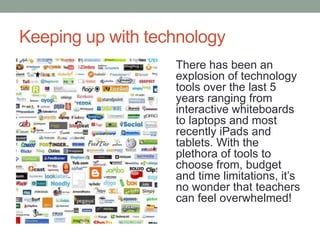
Keeping up with technology 
There has been an explosion 
of technology tools over the 
last 5 years ranging from 
interactive whiteboards to 
laptops and most recently 
iPads and tablets. With the 
plethora of tools to choose 
from, budget and time 
limitations, it’s no wonder 
that teachers can feel 
overwhelmed!
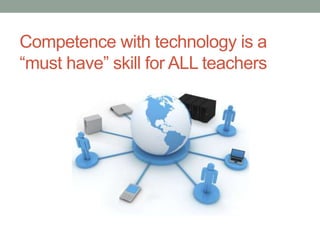
Competence with technology is a “must 
have” skill for ALL teachers
Students need the knowledge and skills to 
compete in the 21st century 
Students today have greater access to technology and 
information than any previous generation. 
Until more recently this access was terminated when they 
entered the four walls of the classroom. 
These ‘switched-on’ students learn more effectively when their 
teacher presents information in an interesting and interactive 
manner that keeps them involved, challenged and motivated. 
The challenge for teachers is how to develop competency that 
goes beyond the mere consumption of technology.
How can teachers develop “competency”? 
Establish professional learning networks: 
• Sign up with Twitter (follow me @kristynpaul) 
• Follow some educational hashtags such as #mfltwitterati 
• Check out other hashtags/uses of Twitter at my pinterest board 
Get ideas and resources from other teachers through Scootle Community: 
https://community.scootle.edu.au and the DECD Languages Facebook 
page: https://www.facebook.com/LanguagesDECDTLS?ref=bookmarks 
Subscribe to blogs written by technology leaders such as Richard Byrne: 
http://www.freetech4teachers.com / http://ipadapps4school.com 
Subscribe to YouTube feeds from educators such as iPadagogy: 
https://www.youtube.com/channel/UCRBmjKsbYGEcbYZz49hKTUA
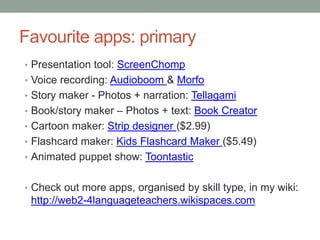
Favourite apps: primary 
Presentation tool: ScreenChomp 
Voice recording: Audioboom & Morfo 
Story maker - Photos + narration: Tellagami 
Book/story maker – Photos + text: Book Creator 
Cartoon maker: Strip designer ($2.99) 
Flashcard maker: Kids Flashcard Maker ($5.49) 
Animated puppet show: Toontastic 
Check out more apps, organised by skill type, in this wiki: 
http://web2-4languageteachers.wikispaces.com
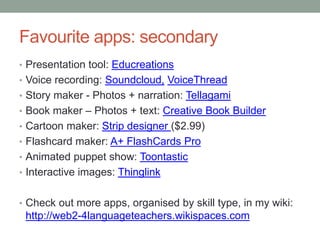
Favourite apps: secondary 
Presentation tool: Educreations 
Voice recording: Soundcloud, VoiceThread 
Story maker - Photos + narration: Tellagami 
Book maker – Photos + text: Creative Book Builder 
Cartoon maker: Strip designer ($2.99) 
Flashcard maker: A+ FlashCards Pro 
Animated puppet show: Toontastic 
Interactive images: Thinglink 
Check out more apps, organised by skill type, in this wiki: 
http://web2-4languageteachers.wikispaces.com
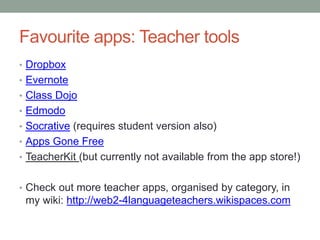
Favourite apps: Teacher tools 
Dropbox 
Evernote 
Class Dojo 
Edmodo 
Socrative (requires student version also) 
Apps Gone Free 
TeacherKit (but currently not available from the app store!) 
Check out more teacher apps, organised by category, in this wiki: 
http://web2-4languageteachers.wikispaces.com
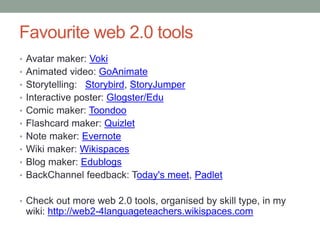
Favourite web 2.0 tools 
Avatar maker: Voki 
Animated video: GoAnimate 
Storytelling: Storybird, StoryJumper 
Interactive poster: Glogster/Edu 
Comic maker: Toondoo 
Flashcard maker: Quizlet 
Note maker: Evernote 
Wiki maker: Wikispaces 
Blog maker: Edublogs 
BackChannel feedback: Today's meet, Padlet 
Check out more web 2.0 tools, organised by skill type, in this wiki: 
http://web2-4languageteachers.wikispaces.com

Technology in languages education

  • 1.
    Technology in languageseducation Kristyn Paul Project Manager Languages R-12 Teaching & Learning Services 5th Floor Education Centre 31 Flinders Street Adelaide SA 5000 http://www.slideshare.net/kristynpaul/technology-in-languages- education
  • 2.
    Everyone knows thattechnology is engaging!
  • 3.
    Yet, technology ismore than just a motivational tool The purpose of technology is to: • give students opportunities to participate in purposeful, motivating activities built around their interests. • personalise and connect the learning for students. • provide more learner choice and control and allow for differentiated instruction rather than a one size fits all approach.
  • 4.
    While students may initially love technology based lessons simply because they are different from traditional paper-driven work, the novelty of these new tools wears off quickly. Students quickly realise it’s the same old boring content just presented differently.
  • 5.
    It’s what youdo with the tools and not the tools themselves that is important!
  • 6.
    Technology should notbe used for its own sake. • Students should be given opportunities to use technology to demonstrate their learning and to share that learning with others. • Teachers should use technologies that facilitate the learning process. • Such technology should be more than simply using apps to play games, replace worksheets and kill & drill activities - Teachers must think about what they want to achieve through the use of technology. • Teachers must focus on the transformative and pedagogical use of technology.
  • 7.
    Pedagogical approaches totechnology integration • Technology integration in teaching and learning programs requires much more than just digital literacy and technical knowledge, it requires foresight, clear intentions, and well planned goals. Its purpose is to meet students learning needs and as such, technology is only a means to an end and not the end itself.
  • 8.
    Australian Curriculum: GeneralCapabilities Currently ICT is one seven general capabilities that support and enhance student learning across all areas of the curriculum. Learning areas provide the content and contexts within which students develop and apply the knowledge, skills, behaviours and dispositions that comprise the ICT capability. Check out this capability online and think about its scope in relation to the Languages learning area: http://www.australiancurriculum.edu.au/generalcapabilit ies/information-and-communication-technology-capability/ introduction/introduction
  • 9.
    Pedagogical models •There are a number of models that teachers can use to assess and evaluate the technology they use in their classroom. • The most well known of these models are TPACK and SAMR.
  • 10.
    TPACK (Technological, Pedagogicaland Content Knowledge) model • TPACK is a model that combines three knowledge areas: – technological knowledge – content knowledge – pedagogical knowledge. • TPACK looks at how the trio work together to increase students’ motivation and make the content more accessible.
  • 11.
    TPACK in 2minutes Content Knowledge: This is the subject matter that is being taught such as Japanese, music, physics etc. It's the what. Pedagogical Knowledge: This is the how - the tools or methodologies teachers use in their teaching and learning program such as direct instruction, inquiry based teaching, group discussion, debate etc. Technological knowledge: This is the partner. It looks at the digital tools (iPad apps, Smart boards etc. ) that teachers can use to make content accessible to students These three elements also overlap.
  • 12.
    For more information… Watch the video in the link below to learn more about TPACK: https://www.youtube.com/watch?v=FagVSQlZELY Check out also the Teaching Teachers for the Future project: http://www.ttf.edu.au/
  • 13.
    SAMR model TheSubstitution Augmentation Modification Redefinition Model (SAMR) developed by Dr. Ruben Puentedura shows a four stage progression that adopters of educational technology typically follow.
  • 14.
    Steps of theSAMR model Step 1: Substitution At the substitution level, students are using technology to replace traditional ways of doing things, for instance, using Google Docs to replace Microsoft Word. The task (writing) is the same but the tools are different. Step 2: Augmentation This step is still in the substitution mentality but this time with added functionalities. Again using the example of Google docs, instead of simply writing a document, manually saving it and sharing it with others, Google Docs provides extra services like auto saving, auto syncing, and auto sharing in the cloud.
  • 15.
    The SAMR modelcont. Step 3: Modification In this step technology is used more effectively not just as a substitution for other tools but to redesign parts of the task, transforming student learning in the process. An example of this is using the commenting service in Google Docs, for instance, to collaborate and share feedback on a given task. Step 4: Redefinition In this step students are using technology in completely new ways. An example of redefinition is when students connect with their sister school and use Google docs to each write about a shared cultural event (such as Christmas) They then use the chat and comment section to discuss the differences in cultural practices. Later they might record voice comments about these differences and embed them in the class website.
  • 16.
    Transformative use oftechnology Check out the Padagogy wheel by Allan Carrington, Learning Designer at the University of Adelaide in which he looks at Learning Design and its connections with attributes, capabilities and motivation through the SAMR model. This taxonomy is targeted at university teaching but is equally relevant to K-12 classrooms – Allan’s message for educators is don't jump into learning outcomes, activity design and selecting technology without first reflecting on student attributes and capabilities, then on how to improve motivation and engagement. Check out this pinterest board for links to other sites that focus on the transformative use of technology: http://www.pinterest.com/kristynpaul/samrtransformative-use-of-technology/
  • 17.
    Connecting digital technologieswith Bloom's Taxonomy & Gardner's Multiple Intelligences A number of educators have developed check lists of iPad apps that correspond with each level of Bloom’s Taxonomy. Kathy Schrock for example has developed a number of visuals with clickable hotspots: http://www.schrockguide.net/bloomin-apps.html Similarly, educators have developed interactive visuals that contain a wide range of iPad apps aligned with the different intelligences theorised by Howard Gardner. The following link is an example of one such visual: http://ipadders.eu/apps-for-multiple-intelligences/ Check out this pinterest board for links to other sites that focus on Bloom’s and Gardner’s: http://www.pinterest.com/kristynpaul/bloomgardner-and-languages-education/
  • 18.
    Keeping up withtechnology There has been an explosion of technology tools over the last 5 years ranging from interactive whiteboards to laptops and most recently iPads and tablets. With the plethora of tools to choose from, budget and time limitations, it’s no wonder that teachers can feel overwhelmed!
  • 20.
    Competence with technologyis a “must have” skill for ALL teachers
  • 21.
    Students need theknowledge and skills to compete in the 21st century Students today have greater access to technology and information than any previous generation. Until more recently this access was terminated when they entered the four walls of the classroom. These ‘switched-on’ students learn more effectively when their teacher presents information in an interesting and interactive manner that keeps them involved, challenged and motivated. The challenge for teachers is how to develop competency that goes beyond the mere consumption of technology.
  • 22.
    How can teachersdevelop “competency”? Establish professional learning networks: • Sign up with Twitter (follow me @kristynpaul) • Follow some educational hashtags such as #mfltwitterati • Check out other hashtags/uses of Twitter at my pinterest board Get ideas and resources from other teachers through Scootle Community: https://community.scootle.edu.au and the DECD Languages Facebook page: https://www.facebook.com/LanguagesDECDTLS?ref=bookmarks Subscribe to blogs written by technology leaders such as Richard Byrne: http://www.freetech4teachers.com / http://ipadapps4school.com Subscribe to YouTube feeds from educators such as iPadagogy: https://www.youtube.com/channel/UCRBmjKsbYGEcbYZz49hKTUA
  • 23.
    Favourite apps: primary Presentation tool: ScreenChomp Voice recording: Audioboom & Morfo Story maker - Photos + narration: Tellagami Book/story maker – Photos + text: Book Creator Cartoon maker: Strip designer ($2.99) Flashcard maker: Kids Flashcard Maker ($5.49) Animated puppet show: Toontastic Check out more apps, organised by skill type, in this wiki: http://web2-4languageteachers.wikispaces.com
  • 24.
    Favourite apps: secondary Presentation tool: Educreations Voice recording: Soundcloud, VoiceThread Story maker - Photos + narration: Tellagami Book maker – Photos + text: Creative Book Builder Cartoon maker: Strip designer ($2.99) Flashcard maker: A+ FlashCards Pro Animated puppet show: Toontastic Interactive images: Thinglink Check out more apps, organised by skill type, in this wiki: http://web2-4languageteachers.wikispaces.com
  • 25.
    Favourite apps: Teachertools Dropbox Evernote Class Dojo Edmodo Socrative (requires student version also) Apps Gone Free TeacherKit (but currently not available from the app store!) Check out more teacher apps, organised by category, in this wiki: http://web2-4languageteachers.wikispaces.com
  • 26.
    Favourite web 2.0tools Avatar maker: Voki Animated video: GoAnimate Storytelling: Storybird, StoryJumper Interactive poster: Glogster/Edu Comic maker: Toondoo Flashcard maker: Quizlet Note maker: Evernote Wiki maker: Wikispaces Blog maker: Edublogs BackChannel feedback: Today's meet, Padlet Check out more web 2.0 tools, organised by skill type, in this wiki: http://web2-4languageteachers.wikispaces.com