BeyondTextbooks:
Inquiry-based Teaching
for Meaningful Learning
M. Ekdahl, TL Mentor
Vancouver School Board
UBC LLED 469
July 2014
Textbooks are not enough …
Textbooks, although they certainly have an important role in
content area learning, have been scrutinized by educational
critics who express concerns about their quality in terms of
accuracy, readability, and appeal. These criticisms remind us
that some textbooks may as well be made for furniture rather
than learning ….
Vacca and Vacca (2005)
Content Area Reading: Literacy and Learning Across the Curriculum.
NY: Pearson Education, 154.
Do we start with questions like these?
– How long before the system loses interest in the iPad?
– Will everyone have one for home and school?
– How will this tool still be used by teachers and students in
years to come?
– Is there an App for that?
Or are there more fundamental questions of educational
philosophy?
Is Technology the Answer?
What knowledge has the most worth? Why?
What are the best ways of teaching and learning?
Or broader moral and political questions:
What is the ‘good’ life?
How does one live a useful and worthy life?
When these questions are asked and answered, then and only
then can new technologies play their role in schools and
classrooms.
More Fundamental Questions Like:
TC4C
Where are you and other teachers on The Continuum for Change in teaching and
learning?
Just fine where I am, thanks.
No time to think about it. Just surviving here.
What was good enough for me is good enough for them.
Convince me.
I get bored doing the same old thing over and over.
I’m aware that students get bored with “read the chapter, do the
questions.”
I’m always looking to try new ways to engage kids with learning.
I love to work with technology. Let’s go …
Want to work on a new unit together? Let’s try Blogging Mathematicians!
Points of Inquiry:
No longer can it be assumed that the teacher is the
expert as students actively construct their own
personal understandings of information. This kind of
learning is best accomplished within a model of
inquiry .…
Points of Inquiry, A Framework for C21L
Developed by BCTLA using BC curriculum documents
Many Models, Same Skills …
Glogster: Inquiry Models
“Although the models may look different and use different
vocabulary they all include the same basic processes and
skills.”
From Nell Ududec - Educational Resources/Library Consultant,
Pembina Trails, Manitoba
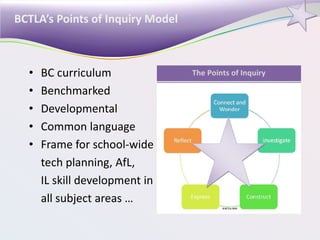
BCTLA’s Points of Inquiry Model
• BC curriculum
• Benchmarked
• Developmental
• Common language
• Frame for school-wide
tech planning, AfL,
IL skill development in
all subject areas …
Inquiring Learners:
• Are actively involved in the learning process
• Make connections and use prior knowledge
• Ask good questions, investigate
• Construct new understandings and
communicate these
• Think and reflect critically as they become
independent as learners
C21 Teachers
• Move to the side, guide, scaffold learning
• Provide feedback, empower deep learning
• Encourage students to have more authority over
their own knowledge and inquiry
• Are actively engaged in learning, assessing, and
teaching
• Ensure new learning happens in active, collaborative,
social contexts (real or virtual)
Good questions are the key to inquiry:
Langley Teacher Librarians’ Wiki:
Inquiry Questions
For Use with the Points of Inquiry Model
Top Ten Alternatives to Traditional Textbooks:
#1: Other Educators
What are other teachers or educators doing?
Check out –
Springfield Township High School Virtual Library (Joyce Valenza)
Eduscapes.com
Kathy Schrock`s Guide for Educators
PSAs, like Math Teachers
Twitter eg: YA Audiobooks, free for summer reading
Your recommendations?
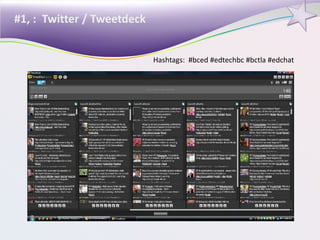
#1, : Twitter / Tweetdeck
Hashtags: #bced #edtechbc #bctla #edchat
#2 = Databases
Try ones like these from VSB’s Digital Library:
Global Issues in Context (SS and Science)
Biography in Context
Bookflix (ESL, SPED)
Newspapers (All)
Culturegrams (Home Ec, SPED, ESL)
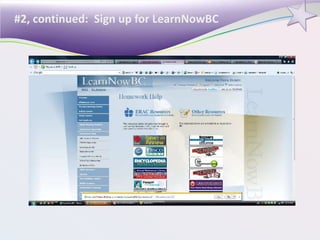
#2, continued: Sign up for LearnNowBC
#3 = eBooks
Go to VSB Webcat, click onto Video and More:
Check out such online book sources as:
Books should be free
Librivox Audio Books
Open Library Accessible Books Online
Project Gutenberg
World Book EBook centre
Smart History Art web-text
Merlot eText Content Online
#4 = Students Need “InfoSmarts” --
Teach search, retrieval, and CT strategies
Keywords
Google / Beyond Google = Chrome, Scholar, Ninja
Wikipedia – “begin here but never end here”
CCRAP – #9: evaluate sources for currency, coverage, relevance,
authority, perspective
Schrock’s Evaluating Websites page
BOOLEAN Machine
Advanced Search features
Wolfram Alpha (For Math and stats and other data, see By Topic)
Corroboration – hoax sites
ME’s Plagiarism Website
#5 = Authentic Sources
Authors
Creators
Scientists
National Geographic
NASA
TED Talks
Your recommendations?
#6 = Product Launches and Trials
What do you want to see?
Ask District Resource Centre for product trials
Ask Teacher-librarians for product updates
#7 = Digitization Initiatives
Canada in the Making - Constitutional History
Canada in the Making - Aboriginals: Treaties & Relations
Canada in the Making – Pioneers and Immigrants
Where are the Children? Healing the legacy of the residential schools
Moving Here, Staying Here. The Canadian Immigrant Experience - LAC
Multicultural Canada
Historica
History by the Minute
Canadian Encyclopedia, The
Black History Canada from Historica
… and lots more
#8 = youtube, NFB, TED, etc.
In Vancouver, Webcat links to Video and More by tab
Find a good short youtube clip, like -
Hans Rosling's 200 Countries, 200 Years,
4 Minutes - The Joy of Stats - BBC Four
#9 = Trade Books (and TLs)
Trade books are:
– For use by general public
– Informative, entertaining, appealing to range of readers
– Picture books, fiction, non-fiction, poetry
– Focused on a subject
– Develop in-depth understanding
– Opportunities for reading to learn and learning to read
– Best when used in multimedia environment with curriculum
integration in mind
– An optimal way to extend and enrich learning
See more in Vacca and Vacca, Chapter 5 (circulating)
#10 – Self-created Resources
Create your own resources with tools like:
• Animoto, blogger, Prezi, etc.
Find out more about:
• Merlot
• Lulu
It’s Just The Beginning…

Mod 1 beyond textbooks 4 ubc

  • 1.
    BeyondTextbooks: Inquiry-based Teaching for MeaningfulLearning M. Ekdahl, TL Mentor Vancouver School Board UBC LLED 469 July 2014
  • 3.
    Textbooks are notenough … Textbooks, although they certainly have an important role in content area learning, have been scrutinized by educational critics who express concerns about their quality in terms of accuracy, readability, and appeal. These criticisms remind us that some textbooks may as well be made for furniture rather than learning …. Vacca and Vacca (2005) Content Area Reading: Literacy and Learning Across the Curriculum. NY: Pearson Education, 154.
  • 4.
    Do we startwith questions like these? – How long before the system loses interest in the iPad? – Will everyone have one for home and school? – How will this tool still be used by teachers and students in years to come? – Is there an App for that? Or are there more fundamental questions of educational philosophy? Is Technology the Answer?
  • 5.
    What knowledge hasthe most worth? Why? What are the best ways of teaching and learning? Or broader moral and political questions: What is the ‘good’ life? How does one live a useful and worthy life? When these questions are asked and answered, then and only then can new technologies play their role in schools and classrooms. More Fundamental Questions Like:
  • 6.
    TC4C Where are youand other teachers on The Continuum for Change in teaching and learning? Just fine where I am, thanks. No time to think about it. Just surviving here. What was good enough for me is good enough for them. Convince me. I get bored doing the same old thing over and over. I’m aware that students get bored with “read the chapter, do the questions.” I’m always looking to try new ways to engage kids with learning. I love to work with technology. Let’s go … Want to work on a new unit together? Let’s try Blogging Mathematicians!
  • 7.
    Points of Inquiry: Nolonger can it be assumed that the teacher is the expert as students actively construct their own personal understandings of information. This kind of learning is best accomplished within a model of inquiry .… Points of Inquiry, A Framework for C21L Developed by BCTLA using BC curriculum documents
  • 8.
    Many Models, SameSkills … Glogster: Inquiry Models “Although the models may look different and use different vocabulary they all include the same basic processes and skills.” From Nell Ududec - Educational Resources/Library Consultant, Pembina Trails, Manitoba
  • 9.
    BCTLA’s Points ofInquiry Model • BC curriculum • Benchmarked • Developmental • Common language • Frame for school-wide tech planning, AfL, IL skill development in all subject areas …
  • 10.
    Inquiring Learners: • Areactively involved in the learning process • Make connections and use prior knowledge • Ask good questions, investigate • Construct new understandings and communicate these • Think and reflect critically as they become independent as learners
  • 11.
    C21 Teachers • Moveto the side, guide, scaffold learning • Provide feedback, empower deep learning • Encourage students to have more authority over their own knowledge and inquiry • Are actively engaged in learning, assessing, and teaching • Ensure new learning happens in active, collaborative, social contexts (real or virtual)
  • 12.
    Good questions arethe key to inquiry: Langley Teacher Librarians’ Wiki: Inquiry Questions For Use with the Points of Inquiry Model
  • 13.
    Top Ten Alternativesto Traditional Textbooks: #1: Other Educators What are other teachers or educators doing? Check out – Springfield Township High School Virtual Library (Joyce Valenza) Eduscapes.com Kathy Schrock`s Guide for Educators PSAs, like Math Teachers Twitter eg: YA Audiobooks, free for summer reading Your recommendations?
  • 14.
    #1, : Twitter/ Tweetdeck Hashtags: #bced #edtechbc #bctla #edchat
  • 15.
    #2 = Databases Tryones like these from VSB’s Digital Library: Global Issues in Context (SS and Science) Biography in Context Bookflix (ESL, SPED) Newspapers (All) Culturegrams (Home Ec, SPED, ESL)
  • 16.
    #2, continued: Signup for LearnNowBC
  • 17.
    #3 = eBooks Goto VSB Webcat, click onto Video and More: Check out such online book sources as: Books should be free Librivox Audio Books Open Library Accessible Books Online Project Gutenberg World Book EBook centre Smart History Art web-text Merlot eText Content Online
  • 18.
    #4 = StudentsNeed “InfoSmarts” -- Teach search, retrieval, and CT strategies Keywords Google / Beyond Google = Chrome, Scholar, Ninja Wikipedia – “begin here but never end here” CCRAP – #9: evaluate sources for currency, coverage, relevance, authority, perspective Schrock’s Evaluating Websites page BOOLEAN Machine Advanced Search features Wolfram Alpha (For Math and stats and other data, see By Topic) Corroboration – hoax sites ME’s Plagiarism Website
  • 19.
    #5 = AuthenticSources Authors Creators Scientists National Geographic NASA TED Talks Your recommendations?
  • 20.
    #6 = ProductLaunches and Trials What do you want to see? Ask District Resource Centre for product trials Ask Teacher-librarians for product updates
  • 21.
    #7 = DigitizationInitiatives Canada in the Making - Constitutional History Canada in the Making - Aboriginals: Treaties & Relations Canada in the Making – Pioneers and Immigrants Where are the Children? Healing the legacy of the residential schools Moving Here, Staying Here. The Canadian Immigrant Experience - LAC Multicultural Canada Historica History by the Minute Canadian Encyclopedia, The Black History Canada from Historica … and lots more
  • 22.
    #8 = youtube,NFB, TED, etc. In Vancouver, Webcat links to Video and More by tab Find a good short youtube clip, like - Hans Rosling's 200 Countries, 200 Years, 4 Minutes - The Joy of Stats - BBC Four
  • 23.
    #9 = TradeBooks (and TLs) Trade books are: – For use by general public – Informative, entertaining, appealing to range of readers – Picture books, fiction, non-fiction, poetry – Focused on a subject – Develop in-depth understanding – Opportunities for reading to learn and learning to read – Best when used in multimedia environment with curriculum integration in mind – An optimal way to extend and enrich learning See more in Vacca and Vacca, Chapter 5 (circulating)
  • 24.
    #10 – Self-createdResources Create your own resources with tools like: • Animoto, blogger, Prezi, etc. Find out more about: • Merlot • Lulu
  • 25.
    It’s Just TheBeginning…

Editor's Notes

  • #5 “Whatever your guesses are the next year or for 2020, the questions that need answers are not about the rapid expiration dates of the newest device – including the ‘revolutionary’ iPad – nor to what degree technology will be ubiquitous in home and school nor even how new technologies will be used by the next generation of teachers and students. No, those are not the questions that need to be asked. Instead, fundamental questions have to deal with matters of educational philosophy.