Made by:
Mukta khatavkar
Semester III
D.Y.Patil School of education
Navi Mumbai
What Are Learning Resources?
 For many people, the words educational materials
invoke images of large, print, classroom textbooks with
small type, outdated information, and content that
covers the breadth but not depth of a subject. But
learning resources are more than that. They are any
tool that helps teachers teach and students learn
 Learning resources include:
 Textbooks (print and digital)
Workbooks
Worksheets
Manipulatives (blocks, beads, etc.)
Flashcards
Educator workshops
Non-fiction books
Posters
Educational games
Contd….
 Websites
Software
Online courses
Activity books
Graphic novels
Reference books
DVDs
CDs
Contd….
 Study guides
Teacher guides
Labs
Models
Movies
Televisions shows
Webcasts
Podcasts
Maps & atlases
Text book
 A textbook is a collection of the knowledge, concepts,
and principles of a selected topic or course. It's usually
written by one or more teachers, college professors, or
education experts who are authorities in a specific
field. Most textbooks are accompanied by teacher
guides, which provide you with supplemental teaching
materials, ideas, and activities to use throughout the
academic year
Advantages of text book
Textbooks are usually used in schools when learning
They are books that have been published to cover the
syllabus that a student is supposed to learn in one
grade. Each grade will use different text books.
The one benefit of using textbooks is that they provide
information. The teacher is a reliable source of
information, but textbooks can be used to provide
more. This is because teachers do not always mention
everything, maybe due to the limitation in duration of
the lessons
Contd…
 Textbooks will also help students in noting and
highlighting the key points. They can also add guides for
easy understanding of sentences. If they note the key
words, it makes it easier to remember even during
examinations.
 Textbooks are also used for future reference. Students will
always forget what they have been taught by the teacher.
They therefore need such books to keep referring to, in
order to refresh their memory. Textbooks are also a reliable
source of information because they may contain term
papers and thesis. They may come with instruction and
guide the student on the kind of question that they are
likely to encounter during examinations
Contd….
 Textbooks are a detailed sequence of teaching
proceduresthat tell you what to do and when to do it.
There are no surprises—everything is carefully spelled
out.
 Textbooks provide administrators and teachers with a
complete program. The series is typically based on the
latest research and teaching strategies.
 Good textbooks are excellent teaching aids. They're a
resource for both teachers and students.
Contd..
 Textbooks are especially helpful for beginning
teachers. The material to be covered and the design of
each lesson are carefully spelled out in detail.
 Textbooks provide organized units of work. A textbook
gives you all the plans and lessons you need to cover a
topic in some detail.
 A textbook series provides you with a balanced,
chronological presentation of information
Workbooks
Workbooks are often used in schools for younger
students, either in middle school or elementary
school. They are favored because students can work
directly in their books, eliminating the need
for looseleaf and copying questions from a textbook.
ADVANTAGES OF WORKBOOK
 Workbooks also hold an advantage because they are
usually smaller and lighter than textbooks, which equates
to less trouble when the student brings the book home to
complete their homework.
 The term workbook is also used to describe other
compilations of questions that require the reader to
complete scratch-work when dealing with higher-level
mathematics.
 More recently, electronic workbooks have permitted
interactive and customized learning. Such workbooks may
be used on computers, laptops, and may be web-based.
Disadvantages
 Some textbooks may fail to arouse student interest. It
is not unusual for students to reject textbooks simply
because of what they are—compendiums of large
masses of data for large masses of students. Students
may find it difficult to understand the relevance of so
much data to their personal lives
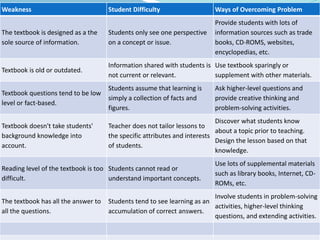
Weakness Student Difficulty Ways of Overcoming Problem
The textbook is designed as a the
sole source of information.
Students only see one perspective
on a concept or issue.
Provide students with lots of
information sources such as trade
books, CD-ROMS, websites,
encyclopedias, etc.
Textbook is old or outdated.
Information shared with students is
not current or relevant.
Use textbook sparingly or
supplement with other materials.
Textbook questions tend to be low
level or fact-based.
Students assume that learning is
simply a collection of facts and
figures.
Ask higher-level questions and
provide creative thinking and
problem-solving activities.
Textbook doesn't take students'
background knowledge into
account.
Teacher does not tailor lessons to
the specific attributes and interests
of students.
Discover what students know
about a topic prior to teaching.
Design the lesson based on that
knowledge.
Reading level of the textbook is too
difficult.
Students cannot read or
understand important concepts.
Use lots of supplemental materials
such as library books, Internet, CD-
ROMs, etc.
The textbook has all the answer to
all the questions.
Students tend to see learning as an
accumulation of correct answers.
Involve students in problem-solving
activities, higher-level thinking
questions, and extending activities.
Advantages and disadvantages
 References:
 Internet
 Books of education

DY PATIL SCHOOL OF EDUCATION Print learning resources (3)

  • 1.
    Made by: Mukta khatavkar SemesterIII D.Y.Patil School of education Navi Mumbai
  • 2.
    What Are LearningResources?  For many people, the words educational materials invoke images of large, print, classroom textbooks with small type, outdated information, and content that covers the breadth but not depth of a subject. But learning resources are more than that. They are any tool that helps teachers teach and students learn
  • 3.
     Learning resourcesinclude:  Textbooks (print and digital) Workbooks Worksheets Manipulatives (blocks, beads, etc.) Flashcards Educator workshops Non-fiction books Posters Educational games
  • 4.
    Contd….  Websites Software Online courses Activitybooks Graphic novels Reference books DVDs CDs
  • 5.
    Contd….  Study guides Teacherguides Labs Models Movies Televisions shows Webcasts Podcasts Maps & atlases
  • 6.
    Text book  Atextbook is a collection of the knowledge, concepts, and principles of a selected topic or course. It's usually written by one or more teachers, college professors, or education experts who are authorities in a specific field. Most textbooks are accompanied by teacher guides, which provide you with supplemental teaching materials, ideas, and activities to use throughout the academic year
  • 7.
    Advantages of textbook Textbooks are usually used in schools when learning They are books that have been published to cover the syllabus that a student is supposed to learn in one grade. Each grade will use different text books. The one benefit of using textbooks is that they provide information. The teacher is a reliable source of information, but textbooks can be used to provide more. This is because teachers do not always mention everything, maybe due to the limitation in duration of the lessons
  • 8.
    Contd…  Textbooks willalso help students in noting and highlighting the key points. They can also add guides for easy understanding of sentences. If they note the key words, it makes it easier to remember even during examinations.  Textbooks are also used for future reference. Students will always forget what they have been taught by the teacher. They therefore need such books to keep referring to, in order to refresh their memory. Textbooks are also a reliable source of information because they may contain term papers and thesis. They may come with instruction and guide the student on the kind of question that they are likely to encounter during examinations
  • 9.
    Contd….  Textbooks area detailed sequence of teaching proceduresthat tell you what to do and when to do it. There are no surprises—everything is carefully spelled out.  Textbooks provide administrators and teachers with a complete program. The series is typically based on the latest research and teaching strategies.  Good textbooks are excellent teaching aids. They're a resource for both teachers and students.
  • 10.
    Contd..  Textbooks areespecially helpful for beginning teachers. The material to be covered and the design of each lesson are carefully spelled out in detail.  Textbooks provide organized units of work. A textbook gives you all the plans and lessons you need to cover a topic in some detail.  A textbook series provides you with a balanced, chronological presentation of information
  • 11.
    Workbooks Workbooks are oftenused in schools for younger students, either in middle school or elementary school. They are favored because students can work directly in their books, eliminating the need for looseleaf and copying questions from a textbook.
  • 12.
    ADVANTAGES OF WORKBOOK Workbooks also hold an advantage because they are usually smaller and lighter than textbooks, which equates to less trouble when the student brings the book home to complete their homework.  The term workbook is also used to describe other compilations of questions that require the reader to complete scratch-work when dealing with higher-level mathematics.  More recently, electronic workbooks have permitted interactive and customized learning. Such workbooks may be used on computers, laptops, and may be web-based.
  • 13.
    Disadvantages  Some textbooksmay fail to arouse student interest. It is not unusual for students to reject textbooks simply because of what they are—compendiums of large masses of data for large masses of students. Students may find it difficult to understand the relevance of so much data to their personal lives
  • 14.
    Weakness Student DifficultyWays of Overcoming Problem The textbook is designed as a the sole source of information. Students only see one perspective on a concept or issue. Provide students with lots of information sources such as trade books, CD-ROMS, websites, encyclopedias, etc. Textbook is old or outdated. Information shared with students is not current or relevant. Use textbook sparingly or supplement with other materials. Textbook questions tend to be low level or fact-based. Students assume that learning is simply a collection of facts and figures. Ask higher-level questions and provide creative thinking and problem-solving activities. Textbook doesn't take students' background knowledge into account. Teacher does not tailor lessons to the specific attributes and interests of students. Discover what students know about a topic prior to teaching. Design the lesson based on that knowledge. Reading level of the textbook is too difficult. Students cannot read or understand important concepts. Use lots of supplemental materials such as library books, Internet, CD- ROMs, etc. The textbook has all the answer to all the questions. Students tend to see learning as an accumulation of correct answers. Involve students in problem-solving activities, higher-level thinking questions, and extending activities.
  • 15.
  • 16.