What is an Information System:
•Information System
•Interrelated components working together to
collect, process, store and distribute
information to support decision making,
coordination, control, analysis and
visualization in an organization.
What is an Information System:
•Information
Data that have been shaped into a form that is
meaningful and useful to human beings.
•Data:
Streams of raw facts representing events
occurring in organizations or the physical
environment before they have been organized
and arranged into a form that people can
understand and use.
What is an Information System:
•Information System Literacy
•It includes behavioral knowledge about
organizations and individuals using
information systems as well technical
knowledge about computers.
•Computer Literacy
•Knowledge about information technology,
focusing on understanding how computer-
based technologies work.
What is an Information System:
•Computer-based Information System
(CBIS(
IS that rely on computer hardware and software
for processing and disseminating information.
•Formal System
•System resting on accepted and fixed
definitions of data and procedures, operating
with predefined rules.
Why Information System:
•Globalization
–Management and control in a global marketplace
–Competition in world market
–Global Work groups
–Global delivery systems
Why Information System:
•Transformation of Industrial Economics
–Knowledge and information based economics
–New products and services
–Knowledge: a central productive and strategic assets
–Time based competition
–Shorter product life
–Turbulent or disordered environment
–Limited employment knowledge base
Why Information System:
•Transformation of the Enterprise
–Flattening
–Decentralization
–Flexibility
–Location independence
–Low transaction and coordination costs
–Empowerment
–Collaborative work teamwork
Why Information System:
•Emergence of the Digital Firm
–Digitally enabled relationship with customers,
suppliers and employment
–Core business processes accomplished via digital
networks
–Digital management
–Rapid sensing and responding to environment
changes
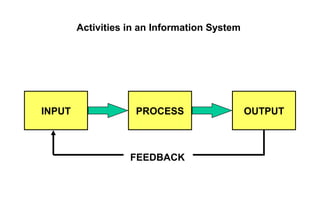
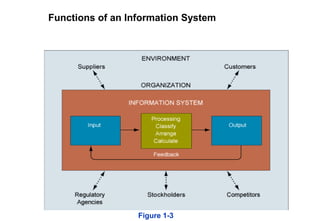
INPUT OUTPUTPROCESS
FEEDBACK
Activities in an Information System
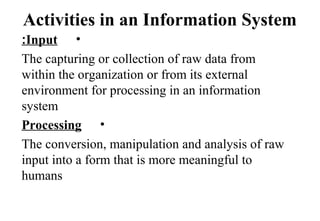
•Input:
The capturing or collection of raw data from
within the organization or from its external
environment for processing in an information
system
•Processing
The conversion, manipulation and analysis of raw
input into a form that is more meaningful to
humans
Activities in an Information System
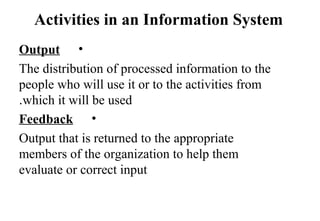
•Output
The distribution of processed information to the
people who will use it or to the activities from
which it will be used.
•Feedback
Output that is returned to the appropriate
members of the organization to help them
evaluate or correct input
Functions of an Information System
Figure 1-3
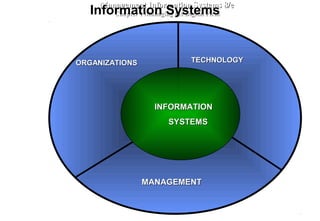
Management Information Systems 8/eManagement Information Systems 8/e
Chapter 1 Managing the Digital FirmChapter 1 Managing the Digital FirmInformation Systems
ORGANIZATIONSORGANIZATIONS TECHNOLOGYTECHNOLOGY
MANAGEMENTMANAGEMENT
INFORMATIONINFORMATION
SYSTEMSSYSTEMS
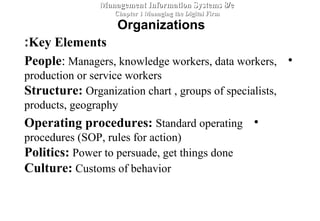
Key Elements:
•People: Managers, knowledge workers, data workers,
production or service workers
Structure: Organization chart , groups of specialists,
products, geography
•Operating procedures: Standard operating
procedures (SOP, rules for action)
Politics: Power to persuade, get things done
Culture: Customs of behavior
Management Information Systems 8/eManagement Information Systems 8/e
Chapter 1 Managing the Digital FirmChapter 1 Managing the Digital Firm
Organizations
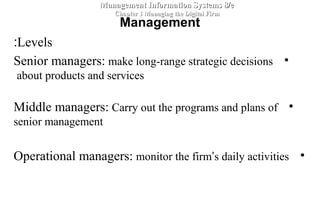
Levels:
•Senior managers: make long-range strategic decisions
about products and services
•Middle managers: Carry out the programs and plans of
senior management
•Operational managers: monitor the firm’s daily activities
Management Information Systems 8/eManagement Information Systems 8/e
Chapter 1 Managing the Digital FirmChapter 1 Managing the Digital Firm
Management
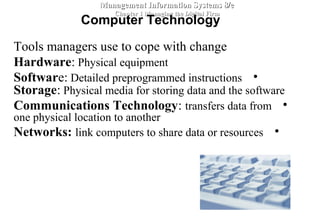
Tools managers use to cope with change
Hardware: Physical equipment
•Software: Detailed preprogrammed instructions
Storage: Physical media for storing data and the software
•Communications Technology: transfers data from
one physical location to another
•Networks: link computers to share data or resources
Management Information Systems 8/eManagement Information Systems 8/e
Chapter 1 Managing the Digital FirmChapter 1 Managing the Digital Firm
Computer Technology
Definition MIS
•MIS refers broadly to a computer-based system that
provides managers with the tools for organizing,
evaluating and efficiently running their departments.
•An MIS can include software that helps in decision
making, data resources such as databases, the hardware
resources of a system, decision support systems, people
management and project management applications, and
any computerized processes that enable the department to
run efficiently.
Management Information Systems 8/eManagement Information Systems 8/e
Chapter 1 Managing the Digital FirmChapter 1 Managing the Digital Firm
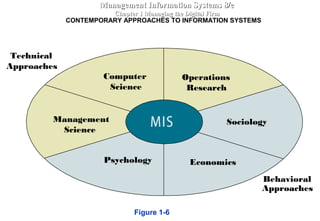
CONTEMPORARY APPROACHES TO INFORMATION SYSTEMS
Figure 1-6
Technical
Approaches
Behavioral
Approaches
Management
Science
Operations
Research
Sociology
Economics
Computer
Science
Psychology

2 information system

  • 1.
    What is anInformation System: •Information System •Interrelated components working together to collect, process, store and distribute information to support decision making, coordination, control, analysis and visualization in an organization.
  • 2.
    What is anInformation System: •Information Data that have been shaped into a form that is meaningful and useful to human beings. •Data: Streams of raw facts representing events occurring in organizations or the physical environment before they have been organized and arranged into a form that people can understand and use.
  • 3.
    What is anInformation System: •Information System Literacy •It includes behavioral knowledge about organizations and individuals using information systems as well technical knowledge about computers. •Computer Literacy •Knowledge about information technology, focusing on understanding how computer- based technologies work.
  • 4.
    What is anInformation System: •Computer-based Information System (CBIS( IS that rely on computer hardware and software for processing and disseminating information. •Formal System •System resting on accepted and fixed definitions of data and procedures, operating with predefined rules.
  • 5.
    Why Information System: •Globalization –Managementand control in a global marketplace –Competition in world market –Global Work groups –Global delivery systems
  • 6.
    Why Information System: •Transformationof Industrial Economics –Knowledge and information based economics –New products and services –Knowledge: a central productive and strategic assets –Time based competition –Shorter product life –Turbulent or disordered environment –Limited employment knowledge base
  • 7.
    Why Information System: •Transformationof the Enterprise –Flattening –Decentralization –Flexibility –Location independence –Low transaction and coordination costs –Empowerment –Collaborative work teamwork
  • 8.
    Why Information System: •Emergenceof the Digital Firm –Digitally enabled relationship with customers, suppliers and employment –Core business processes accomplished via digital networks –Digital management –Rapid sensing and responding to environment changes
  • 9.
  • 10.
    Activities in anInformation System •Input: The capturing or collection of raw data from within the organization or from its external environment for processing in an information system •Processing The conversion, manipulation and analysis of raw input into a form that is more meaningful to humans
  • 11.
    Activities in anInformation System •Output The distribution of processed information to the people who will use it or to the activities from which it will be used. •Feedback Output that is returned to the appropriate members of the organization to help them evaluate or correct input
  • 12.
    Functions of anInformation System Figure 1-3
  • 13.
    Management Information Systems8/eManagement Information Systems 8/e Chapter 1 Managing the Digital FirmChapter 1 Managing the Digital FirmInformation Systems ORGANIZATIONSORGANIZATIONS TECHNOLOGYTECHNOLOGY MANAGEMENTMANAGEMENT INFORMATIONINFORMATION SYSTEMSSYSTEMS
  • 14.
    Key Elements: •People: Managers,knowledge workers, data workers, production or service workers Structure: Organization chart , groups of specialists, products, geography •Operating procedures: Standard operating procedures (SOP, rules for action) Politics: Power to persuade, get things done Culture: Customs of behavior Management Information Systems 8/eManagement Information Systems 8/e Chapter 1 Managing the Digital FirmChapter 1 Managing the Digital Firm Organizations
  • 15.
    Levels: •Senior managers: makelong-range strategic decisions about products and services •Middle managers: Carry out the programs and plans of senior management •Operational managers: monitor the firm’s daily activities Management Information Systems 8/eManagement Information Systems 8/e Chapter 1 Managing the Digital FirmChapter 1 Managing the Digital Firm Management
  • 16.
    Tools managers useto cope with change Hardware: Physical equipment •Software: Detailed preprogrammed instructions Storage: Physical media for storing data and the software •Communications Technology: transfers data from one physical location to another •Networks: link computers to share data or resources Management Information Systems 8/eManagement Information Systems 8/e Chapter 1 Managing the Digital FirmChapter 1 Managing the Digital Firm Computer Technology
  • 17.
    Definition MIS •MIS refersbroadly to a computer-based system that provides managers with the tools for organizing, evaluating and efficiently running their departments. •An MIS can include software that helps in decision making, data resources such as databases, the hardware resources of a system, decision support systems, people management and project management applications, and any computerized processes that enable the department to run efficiently.
  • 18.
    Management Information Systems8/eManagement Information Systems 8/e Chapter 1 Managing the Digital FirmChapter 1 Managing the Digital Firm CONTEMPORARY APPROACHES TO INFORMATION SYSTEMS Figure 1-6 Technical Approaches Behavioral Approaches Management Science Operations Research Sociology Economics Computer Science Psychology