1
Principle of Management
Course:
Course instructor:
MAM SADIA
MBA 1st Semester
Class:
2
Presentation:-:
Strategic Management (Chapter # 09)
3
Presented By:-
1. Mirza Sajid Mahmood
2. Waheed Iqbal
3. Rao Salman
•Define Strategic Management
/ Importance
•Strategic Management Process
•Corporate Level Strategy
•Business Level Strategy
•Functional Level Strategy
•Current Strategic Mgt Issues
•E-Business Strategies
•Customer Service Strategies
•Innovation Strategies
4
5
Strategy
• The ongoing process of formultaing,implementing and
controlling broad plans to guide the organization in
achieving its strategic goals, given its internal &
external environment
• A comprehensive Plan aimed at helping the
organization achieve its goals
Strategic Management
• What managers do to develop the organization’s
strategies
OR
6
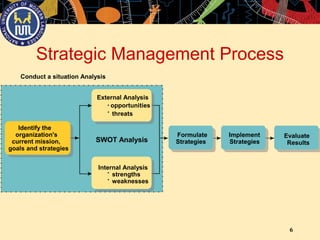
Strategic Management Process
Formulate
Strategies
Implement
Strategies
Evaluate
ResultsSWOT Analysis
Identify the
organization's
current mission,
goals and strategies
Internal Analysis
•
strengths
•
weaknesses
External Analysis
• opportunities
•
threats
Conduct a situation Analysis
7
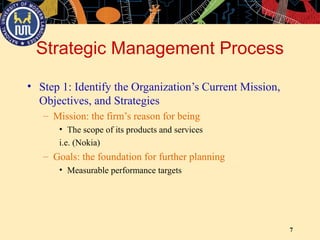
Strategic Management Process
• Step 1: Identify the Organization’s Current Mission,
Objectives, and Strategies
– Mission: the firm’s reason for being
• The scope of its products and services
i.e. (Nokia)
– Goals: the foundation for further planning
• Measurable performance targets
8
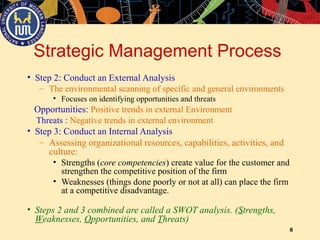
Strategic Management Process
• Step 2: Conduct an External Analysis
– The environmental scanning of specific and general environments
• Focuses on identifying opportunities and threats
Opportunities: Positive trends in external Environment
Threats : Negative trends in external environment
• Step 3: Conduct an Internal Analysis
– Assessing organizational resources, capabilities, activities, and
culture:
• Strengths (core competencies) create value for the customer and
strengthen the competitive position of the firm
• Weaknesses (things done poorly or not at all) can place the firm
at a competitive disadvantage.
• Steps 2 and 3 combined are called a SWOT analysis. (Strengths,
Weaknesses, Opportunities, and Threats)
9
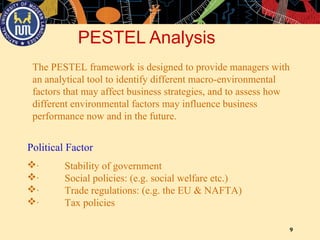
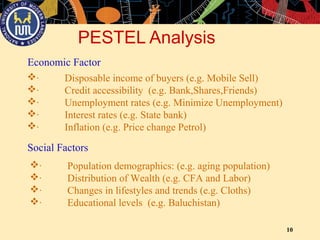
PESTEL Analysis
Political Factor
· Stability of government
· Social policies: (e.g. social welfare etc.)
· Trade regulations: (e.g. the EU & NAFTA)
· Tax policies
The PESTEL framework is designed to provide managers with
an analytical tool to identify different macro-environmental
factors that may affect business strategies, and to assess how
different environmental factors may influence business
performance now and in the future.
10
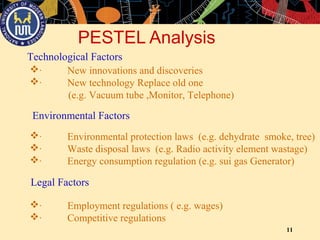
Social Factors
PESTEL Analysis
· Population demographics: (e.g. aging population)
· Distribution of Wealth (e.g. CFA and Labor)
· Changes in lifestyles and trends (e.g. Cloths)
· Educational levels (e.g. Baluchistan)
Economic Factor
· Disposable income of buyers (e.g. Mobile Sell)
· Credit accessibility (e.g. Bank,Shares,Friends)
· Unemployment rates (e.g. Minimize Unemployment)
· Interest rates (e.g. State bank)
· Inflation (e.g. Price change Petrol)
11
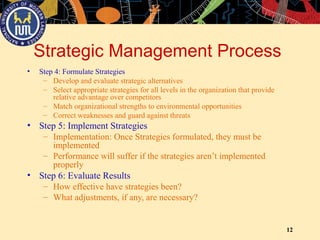
PESTEL Analysis
Environmental Factors
· Environmental protection laws (e.g. dehydrate smoke, tree)
· Waste disposal laws (e.g. Radio activity element wastage)
· Energy consumption regulation (e.g. sui gas Generator)
· Employment regulations ( e.g. wages)
· Competitive regulations
Legal Factors
Technological Factors
· New innovations and discoveries
· New technology Replace old one
(e.g. Vacuum tube ,Monitor, Telephone)
12
Strategic Management Process
• Step 4: Formulate Strategies
– Develop and evaluate strategic alternatives
– Select appropriate strategies for all levels in the organization that provide
relative advantage over competitors
– Match organizational strengths to environmental opportunities
– Correct weaknesses and guard against threats
• Step 5: Implement Strategies
– Implementation: Once Strategies formulated, they must be
implemented
– Performance will suffer if the strategies aren’t implemented
properly
• Step 6: Evaluate Results
– How effective have strategies been?
– What adjustments, if any, are necessary?
13
Why Strategic Management Is
Important
• higher organizational performance
• requires that managers examine and adapt to
business environment changes
• coordinates different organizational units to
focus on organizational goals
• Key to the managerial decision-making
process
14
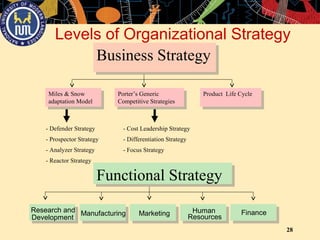
Types of Organizational Strategies
There are three basic types of organizational strategies
1. Corporate Level Strategy
2. Business Level or Competitive Strategy
3. Functional Level Strategy
15
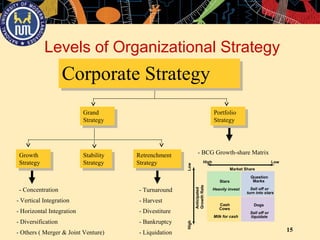
Corporate StrategyCorporate Strategy
Grand
Strategy
Grand
Strategy
Portfolio
Strategy
Portfolio
Strategy
Growth
Strategy
Growth
Strategy
Stability
Strategy
Stability
Strategy
Retrenchment
Strategy
Retrenchment
Strategy
- Concentration
- Vertical Integration
- Horizontal Integration
- Diversification
- Turnaround
- Harvest
- Others ( Merger & Joint Venture)
- Divestiture
- Bankruptcy
- Liquidation
- BCG Growth-share Matrix
Levels of Organizational Strategy
Stars
Heavily invest
Question
Marks
Sell off or
turn into stars
Cash
Cows
Milk for cash
Dogs
Sell off or
liquidate
High Low
Market Share
HighLow
Anticipated
GrowthRate
16
Corporate Level Strategy
1. Grand Strategy
Grand strategy is a comprehensive general strategy
designed to guide the major actions that will accomplish
the organization’s long-term goals
• Improve the organization’s performance ,maximize
opportunities and internal strength
• Minimize external threats and internal weakness
There are two types of corporate level strategies
1. Grand Strategy
2. Portfolio Strategy
17
There are three types of Grand strategy
Corporate Level Strategy
A. Growth Strategy
B. Stability Strategy
C. Retrenchment Strategy
A. Growth Strategy
 Seeking to increase the organization’s business by
expansion into new products and markets
Possible growth strategies are
1.Concentration
2.Vertical Integration
3.Horizontal integration
4.Diversification
5. others (Merger & Joint Venture
18
Corporate Level Strategy
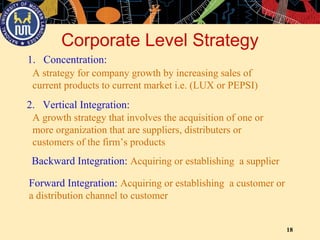
1. Concentration:
A strategy for company growth by increasing sales of
current products to current market i.e. (LUX or PEPSI)
2. Vertical Integration:
A growth strategy that involves the acquisition of one or
more organization that are suppliers, distributers or
customers of the firm’s products
Backward Integration: Acquiring or establishing a supplier
Forward Integration: Acquiring or establishing a customer or
a distribution channel to customer
19
Corporate Level Strategy
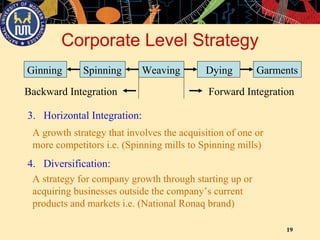
3. Horizontal Integration:
A growth strategy that involves the acquisition of one or
more competitors i.e. (Spinning mills to Spinning mills)
Ginning Spinning Weaving Dying Garments
Forward IntegrationBackward Integration
4. Diversification:
A strategy for company growth through starting up or
acquiring businesses outside the company’s current
products and markets i.e. (National Ronaq brand)
20
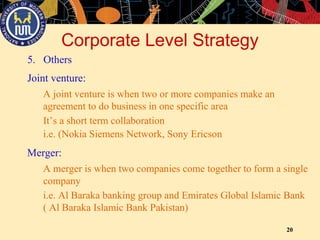
A joint venture is when two or more companies make an
agreement to do business in one specific area
Joint venture:
It’s a short term collaboration
i.e. (Nokia Siemens Network, Sony Ericson
Merger:
A merger is when two companies come together to form a single
company
i.e. Al Baraka banking group and Emirates Global Islamic Bank
( Al Baraka Islamic Bank Pakistan)
Corporate Level Strategy
5. Others
21
Corporate Level Strategy
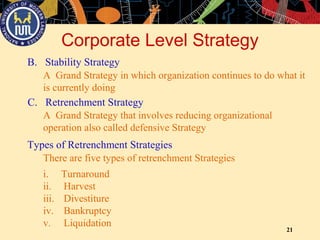
B. Stability Strategy
A Grand Strategy in which organization continues to do what it
is currently doing
C. Retrenchment Strategy
A Grand Strategy that involves reducing organizational
operation also called defensive Strategy
Types of Retrenchment Strategies
There are five types of retrenchment Strategies
i. Turnaround
ii. Harvest
iii. Divestiture
iv. Bankruptcy
v. Liquidation
22
Corporate Level Strategy
i. Turnaround
A retrenchment strategy intended to reverse a negative trend and
regain profitability
 Reducing Salaries and bonuses employees and downsizing to
get profit
 Increase Customer satisfaction and adjust pricing for better
profitability
ii. Harvest
A retrenchment strategy that involves minimizing investment
and maximizing short-term profit
 Increase prices to get maximum profits
 Reduce or eliminate advertising or marketing effort to save
cost
23
iii. Divestiture
Corporate Level Strategy
A retrenchment strategy that involves selling all or part of an
organization
 Poor working organization unit does nothing to achieve
organization long term goals selling is one solution
iv. Bankruptcy
A retrenchment strategy in which an organization unable to meet
its obligations seeks court protection to gain time and
opportunity to attempt a turnaround
 Managers choose bankruptcy only after they have failed to
reverse a long period of decline
Organization responsible to give all parties payment honestly
24
v. Liquidation
Corporate Level Strategy
A retrenchment strategy that involves dissolving or selling an
entire organization
 when small business owners choose liquidation when they
believe that their organization’s future is bleak
e.g. (Partners Death, Illegal work)
25
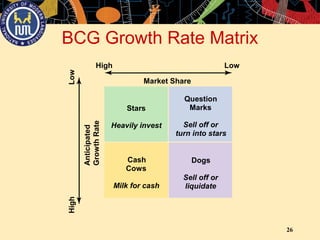
• Corporate Portfolio Analysis
– BCG Matrix
• Developed by the Boston Consulting Group
• Considers market share and industry growth rate
• Classifies firms as:
– Cash cows: low growth rate, high market share
– Stars: high growth rate, high market share
– Question marks: high growth rate, low market share
– Dogs: low growth rate, low market share
Corporate Level Strategy
26
BCG Growth Rate Matrix
Stars
Heavily invest
Question
Marks
Sell off or
turn into stars
Cash
Cows
Milk for cash
Dogs
Sell off or
liquidate
High Low
Market Share
HighLow
Anticipated
GrowthRate
27
28
Business StrategyBusiness Strategy
Miles & Snow
adaptation Model
Miles & Snow
adaptation Model
Porter’s Generic
Competitive Strategies
Porter’s Generic
Competitive Strategies
Product Life CycleProduct Life Cycle
- Defender Strategy
- Prospector Strategy
- Analyzer Strategy
- Reactor Strategy
- Cost Leadership Strategy
- Differentiation Strategy
- Focus Strategy
Research and
Development
Manufacturing Marketing Human
Resources
Finance
Functional StrategyFunctional Strategy
Levels of Organizational Strategy
29
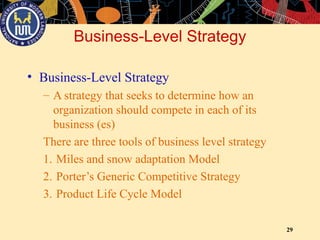
Business-Level Strategy
• Business-Level Strategy
– A strategy that seeks to determine how an
organization should compete in each of its
business (es)
There are three tools of business level strategy
1. Miles and snow adaptation Model
2. Porter’s Generic Competitive Strategy
3. Product Life Cycle Model
30
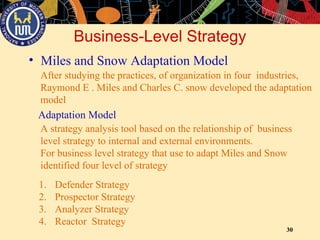
Business-Level Strategy
• Miles and Snow Adaptation Model
After studying the practices, of organization in four industries,
Raymond E . Miles and Charles C. snow developed the adaptation
model
Adaptation Model
A strategy analysis tool based on the relationship of business
level strategy to internal and external environments.
For business level strategy that use to adapt Miles and Snow
identified four level of strategy
1. Defender Strategy
2. Prospector Strategy
3. Analyzer Strategy
4. Reactor Strategy
31
Business-Level Strategy
1. Defender Strategy
The defender strategy involves defining a narrow market that the
organization can thoroughly penetrate with a limited number of
goods or services
 Effective in stable environment
 Focus on internal efficiencies rather than worrying about
external environment
 It may leave organization weak in the case of major
environmental shift
32
2. Prospector Strategy
Business-Level Strategy
The prospector strategy is opposite of the defender strategy, being
concerned with identifying and developing new product and
market opportunities
 Effective in dynamic environment
 It can be costly strategy to follow (pursue)
 Remaining flexible and responsive (scan) to environmental
changes
i.e. importer exporter
33
Business-Level Strategy
3. Analyzer Strategy
The analyzer strategy combines elements of the defender and
prospector strategies
 Organization maintain traditional products & customers
 Watching competitors activity
 Searching for new products and market, that appear to be
possible
 Flexibility to respond to environmental changes
 Stability to profit from a stable environment
 Keep flexibility and stability in balance, if not balance then
result can be inefficient (Daewoo express)
34
Business-Level Strategy
4. Reactor Strategy
 In any type of environment reactor acts without a consistent
strategy
 Reactor responds in appropriately and ad hoc fashion
 Reactor risks poor performance because of inability to react
appropriately or consistently to any environmental situation
35
Business-Level Strategy
• Porter’s Generic Competitive Strategies
An organization becomes stuck in middle when its costs are too
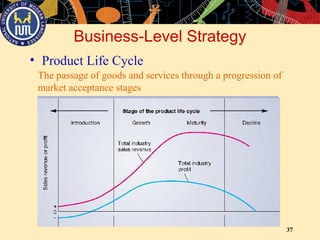
high to compete with the low cost leader or when its products are
not differentiator's products or compete the differentiator
1. Cost Leadership Strategy
2. Differentiation Strategy
3. Focus Strategy
1. Cost Leadership Strategy
A low cost leader is highly efficient overhead is kept to minimum
and the firm does everything it can to cut costs (e.g. Wal-Mart)
36
Business-Level Strategy
2. Differentiation Strategy
Products might come from exceptionally high quality,
extraordinary service, innovative design or an unusually positive
brand image
3. Focus Strategy
The generic competitive strategy in which an organization
concentrates on a limited part of the market, a limited product line,
or a confined geographic area
 Cost focus
Involve a cost advantage
 Differentiation Focus
Narrow segment or niche
37
Business-Level Strategy
• Product Life Cycle
The passage of goods and services through a progression of
market acceptance stages
38
Five Competitive Forces
1. Threat of New Entrants
– The ease or difficulty with which new competitors can enter
an industry
1. Threat of Substitutes
– The extent to which switching costs and brand loyalty affect
the likelihood of customers adopting substitute products and
services
1. Bargaining Power of Buyers
– The degree to which buyers have the market strength to hold
sway over and influence competitors in an industry
4. Bargaining Power of Suppliers
– The relative number of buyers to suppliers and threats from
substitutes and new entrants affect the buyer-supplier
relationship
4. Current Rivalry
– Intensity among rivals increases when industry growth rates
slow, demand falls, and product prices descend
39
Functional-Level Strategy
The strategies used by an organization’s various functional
departments to support the competitive strategy
1. Research and development
2. Manufacturing
3. Marketing
4. Human Resource
5. Finance
1. Research and Development
Research and Development comprise creative work
undertaken on a systematic basis in order to increase the stock
of knowledge, including knowledge of man, culture and
society, and the use of this stock of knowledge to devise new
applications
40
Functional-Level Strategy
To make or process a raw material into a finished product
2. Manufacturing
3. Marketing
The act or process of buying and selling in a market
4. Human Resource
Human resources is the set of individuals who make up the
workforce of an organization and business sector
5. Finance
Finance refers to the management, creation and study of
money, banking, credit, investments, assets, and liabilities
41
Current Strategic Management Issues
1. The need for Strategic Leadership
2. The need for Strategic Flexibility
1. The need for Strategic Leadership
The ability to anticipate, envision, maintain flexibility, think
strategically and work with others in the organization to
initiate changes that will create a viable (possible) and
valuable future for the organization
2. The need for Strategic Flexibility
The ability to recognize major external changes to quickly
commit resources, and to recognize when a strategic decision
was a mistake
42
43
Important Organizational Strategies
for today’s Environment
1. e. Business Strategy (Online)
2. Customer service strategy
3. Innovation strategy
1. e. Business Strategy (Online)
 Specific chat room
 Niche web sites for selling products
 Selling calls (credit card company)
44
Important Organizational Strategies
for today’s Environment
2. Customer service strategy
 An efficient customer communication system is an important
customer service strategy
 An organizational culture is important to providing excellent
customers services
 Employees should be trained to provide exceptional customer
service
45
Important Organizational Strategies
for today’s Environment
3. Innovation Strategy
• Strategic Decisions about Innovation
– Basic research
– Product development
– Process innovation
• First Mover
– An organization that brings a product innovation to market or
uses a new process innovation
46
Thanks

Strategic management

  • 1.
    1 Principle of Management Course: Courseinstructor: MAM SADIA MBA 1st Semester Class:
  • 2.
  • 3.
    3 Presented By:- 1. MirzaSajid Mahmood 2. Waheed Iqbal 3. Rao Salman •Define Strategic Management / Importance •Strategic Management Process •Corporate Level Strategy •Business Level Strategy •Functional Level Strategy •Current Strategic Mgt Issues •E-Business Strategies •Customer Service Strategies •Innovation Strategies
  • 4.
  • 5.
    5 Strategy • The ongoingprocess of formultaing,implementing and controlling broad plans to guide the organization in achieving its strategic goals, given its internal & external environment • A comprehensive Plan aimed at helping the organization achieve its goals Strategic Management • What managers do to develop the organization’s strategies OR
  • 6.
    6 Strategic Management Process Formulate Strategies Implement Strategies Evaluate ResultsSWOTAnalysis Identify the organization's current mission, goals and strategies Internal Analysis • strengths • weaknesses External Analysis • opportunities • threats Conduct a situation Analysis
  • 7.
    7 Strategic Management Process •Step 1: Identify the Organization’s Current Mission, Objectives, and Strategies – Mission: the firm’s reason for being • The scope of its products and services i.e. (Nokia) – Goals: the foundation for further planning • Measurable performance targets
  • 8.
    8 Strategic Management Process •Step 2: Conduct an External Analysis – The environmental scanning of specific and general environments • Focuses on identifying opportunities and threats Opportunities: Positive trends in external Environment Threats : Negative trends in external environment • Step 3: Conduct an Internal Analysis – Assessing organizational resources, capabilities, activities, and culture: • Strengths (core competencies) create value for the customer and strengthen the competitive position of the firm • Weaknesses (things done poorly or not at all) can place the firm at a competitive disadvantage. • Steps 2 and 3 combined are called a SWOT analysis. (Strengths, Weaknesses, Opportunities, and Threats)
  • 9.
    9 PESTEL Analysis Political Factor ·Stability of government · Social policies: (e.g. social welfare etc.) · Trade regulations: (e.g. the EU & NAFTA) · Tax policies The PESTEL framework is designed to provide managers with an analytical tool to identify different macro-environmental factors that may affect business strategies, and to assess how different environmental factors may influence business performance now and in the future.
  • 10.
    10 Social Factors PESTEL Analysis ·Population demographics: (e.g. aging population) · Distribution of Wealth (e.g. CFA and Labor) · Changes in lifestyles and trends (e.g. Cloths) · Educational levels (e.g. Baluchistan) Economic Factor · Disposable income of buyers (e.g. Mobile Sell) · Credit accessibility (e.g. Bank,Shares,Friends) · Unemployment rates (e.g. Minimize Unemployment) · Interest rates (e.g. State bank) · Inflation (e.g. Price change Petrol)
  • 11.
    11 PESTEL Analysis Environmental Factors ·Environmental protection laws (e.g. dehydrate smoke, tree) · Waste disposal laws (e.g. Radio activity element wastage) · Energy consumption regulation (e.g. sui gas Generator) · Employment regulations ( e.g. wages) · Competitive regulations Legal Factors Technological Factors · New innovations and discoveries · New technology Replace old one (e.g. Vacuum tube ,Monitor, Telephone)
  • 12.
    12 Strategic Management Process •Step 4: Formulate Strategies – Develop and evaluate strategic alternatives – Select appropriate strategies for all levels in the organization that provide relative advantage over competitors – Match organizational strengths to environmental opportunities – Correct weaknesses and guard against threats • Step 5: Implement Strategies – Implementation: Once Strategies formulated, they must be implemented – Performance will suffer if the strategies aren’t implemented properly • Step 6: Evaluate Results – How effective have strategies been? – What adjustments, if any, are necessary?
  • 13.
    13 Why Strategic ManagementIs Important • higher organizational performance • requires that managers examine and adapt to business environment changes • coordinates different organizational units to focus on organizational goals • Key to the managerial decision-making process
  • 14.
    14 Types of OrganizationalStrategies There are three basic types of organizational strategies 1. Corporate Level Strategy 2. Business Level or Competitive Strategy 3. Functional Level Strategy
  • 15.
    15 Corporate StrategyCorporate Strategy Grand Strategy Grand Strategy Portfolio Strategy Portfolio Strategy Growth Strategy Growth Strategy Stability Strategy Stability Strategy Retrenchment Strategy Retrenchment Strategy -Concentration - Vertical Integration - Horizontal Integration - Diversification - Turnaround - Harvest - Others ( Merger & Joint Venture) - Divestiture - Bankruptcy - Liquidation - BCG Growth-share Matrix Levels of Organizational Strategy Stars Heavily invest Question Marks Sell off or turn into stars Cash Cows Milk for cash Dogs Sell off or liquidate High Low Market Share HighLow Anticipated GrowthRate
  • 16.
    16 Corporate Level Strategy 1.Grand Strategy Grand strategy is a comprehensive general strategy designed to guide the major actions that will accomplish the organization’s long-term goals • Improve the organization’s performance ,maximize opportunities and internal strength • Minimize external threats and internal weakness There are two types of corporate level strategies 1. Grand Strategy 2. Portfolio Strategy
  • 17.
    17 There are threetypes of Grand strategy Corporate Level Strategy A. Growth Strategy B. Stability Strategy C. Retrenchment Strategy A. Growth Strategy  Seeking to increase the organization’s business by expansion into new products and markets Possible growth strategies are 1.Concentration 2.Vertical Integration 3.Horizontal integration 4.Diversification 5. others (Merger & Joint Venture
  • 18.
    18 Corporate Level Strategy 1.Concentration: A strategy for company growth by increasing sales of current products to current market i.e. (LUX or PEPSI) 2. Vertical Integration: A growth strategy that involves the acquisition of one or more organization that are suppliers, distributers or customers of the firm’s products Backward Integration: Acquiring or establishing a supplier Forward Integration: Acquiring or establishing a customer or a distribution channel to customer
  • 19.
    19 Corporate Level Strategy 3.Horizontal Integration: A growth strategy that involves the acquisition of one or more competitors i.e. (Spinning mills to Spinning mills) Ginning Spinning Weaving Dying Garments Forward IntegrationBackward Integration 4. Diversification: A strategy for company growth through starting up or acquiring businesses outside the company’s current products and markets i.e. (National Ronaq brand)
  • 20.
    20 A joint ventureis when two or more companies make an agreement to do business in one specific area Joint venture: It’s a short term collaboration i.e. (Nokia Siemens Network, Sony Ericson Merger: A merger is when two companies come together to form a single company i.e. Al Baraka banking group and Emirates Global Islamic Bank ( Al Baraka Islamic Bank Pakistan) Corporate Level Strategy 5. Others
  • 21.
    21 Corporate Level Strategy B.Stability Strategy A Grand Strategy in which organization continues to do what it is currently doing C. Retrenchment Strategy A Grand Strategy that involves reducing organizational operation also called defensive Strategy Types of Retrenchment Strategies There are five types of retrenchment Strategies i. Turnaround ii. Harvest iii. Divestiture iv. Bankruptcy v. Liquidation
  • 22.
    22 Corporate Level Strategy i.Turnaround A retrenchment strategy intended to reverse a negative trend and regain profitability  Reducing Salaries and bonuses employees and downsizing to get profit  Increase Customer satisfaction and adjust pricing for better profitability ii. Harvest A retrenchment strategy that involves minimizing investment and maximizing short-term profit  Increase prices to get maximum profits  Reduce or eliminate advertising or marketing effort to save cost
  • 23.
    23 iii. Divestiture Corporate LevelStrategy A retrenchment strategy that involves selling all or part of an organization  Poor working organization unit does nothing to achieve organization long term goals selling is one solution iv. Bankruptcy A retrenchment strategy in which an organization unable to meet its obligations seeks court protection to gain time and opportunity to attempt a turnaround  Managers choose bankruptcy only after they have failed to reverse a long period of decline Organization responsible to give all parties payment honestly
  • 24.
    24 v. Liquidation Corporate LevelStrategy A retrenchment strategy that involves dissolving or selling an entire organization  when small business owners choose liquidation when they believe that their organization’s future is bleak e.g. (Partners Death, Illegal work)
  • 25.
    25 • Corporate PortfolioAnalysis – BCG Matrix • Developed by the Boston Consulting Group • Considers market share and industry growth rate • Classifies firms as: – Cash cows: low growth rate, high market share – Stars: high growth rate, high market share – Question marks: high growth rate, low market share – Dogs: low growth rate, low market share Corporate Level Strategy
  • 26.
    26 BCG Growth RateMatrix Stars Heavily invest Question Marks Sell off or turn into stars Cash Cows Milk for cash Dogs Sell off or liquidate High Low Market Share HighLow Anticipated GrowthRate
  • 27.
  • 28.
    28 Business StrategyBusiness Strategy Miles& Snow adaptation Model Miles & Snow adaptation Model Porter’s Generic Competitive Strategies Porter’s Generic Competitive Strategies Product Life CycleProduct Life Cycle - Defender Strategy - Prospector Strategy - Analyzer Strategy - Reactor Strategy - Cost Leadership Strategy - Differentiation Strategy - Focus Strategy Research and Development Manufacturing Marketing Human Resources Finance Functional StrategyFunctional Strategy Levels of Organizational Strategy
  • 29.
    29 Business-Level Strategy • Business-LevelStrategy – A strategy that seeks to determine how an organization should compete in each of its business (es) There are three tools of business level strategy 1. Miles and snow adaptation Model 2. Porter’s Generic Competitive Strategy 3. Product Life Cycle Model
  • 30.
    30 Business-Level Strategy • Milesand Snow Adaptation Model After studying the practices, of organization in four industries, Raymond E . Miles and Charles C. snow developed the adaptation model Adaptation Model A strategy analysis tool based on the relationship of business level strategy to internal and external environments. For business level strategy that use to adapt Miles and Snow identified four level of strategy 1. Defender Strategy 2. Prospector Strategy 3. Analyzer Strategy 4. Reactor Strategy
  • 31.
    31 Business-Level Strategy 1. DefenderStrategy The defender strategy involves defining a narrow market that the organization can thoroughly penetrate with a limited number of goods or services  Effective in stable environment  Focus on internal efficiencies rather than worrying about external environment  It may leave organization weak in the case of major environmental shift
  • 32.
    32 2. Prospector Strategy Business-LevelStrategy The prospector strategy is opposite of the defender strategy, being concerned with identifying and developing new product and market opportunities  Effective in dynamic environment  It can be costly strategy to follow (pursue)  Remaining flexible and responsive (scan) to environmental changes i.e. importer exporter
  • 33.
    33 Business-Level Strategy 3. AnalyzerStrategy The analyzer strategy combines elements of the defender and prospector strategies  Organization maintain traditional products & customers  Watching competitors activity  Searching for new products and market, that appear to be possible  Flexibility to respond to environmental changes  Stability to profit from a stable environment  Keep flexibility and stability in balance, if not balance then result can be inefficient (Daewoo express)
  • 34.
    34 Business-Level Strategy 4. ReactorStrategy  In any type of environment reactor acts without a consistent strategy  Reactor responds in appropriately and ad hoc fashion  Reactor risks poor performance because of inability to react appropriately or consistently to any environmental situation
  • 35.
    35 Business-Level Strategy • Porter’sGeneric Competitive Strategies An organization becomes stuck in middle when its costs are too high to compete with the low cost leader or when its products are not differentiator's products or compete the differentiator 1. Cost Leadership Strategy 2. Differentiation Strategy 3. Focus Strategy 1. Cost Leadership Strategy A low cost leader is highly efficient overhead is kept to minimum and the firm does everything it can to cut costs (e.g. Wal-Mart)
  • 36.
    36 Business-Level Strategy 2. DifferentiationStrategy Products might come from exceptionally high quality, extraordinary service, innovative design or an unusually positive brand image 3. Focus Strategy The generic competitive strategy in which an organization concentrates on a limited part of the market, a limited product line, or a confined geographic area  Cost focus Involve a cost advantage  Differentiation Focus Narrow segment or niche
  • 37.
    37 Business-Level Strategy • ProductLife Cycle The passage of goods and services through a progression of market acceptance stages
  • 38.
    38 Five Competitive Forces 1.Threat of New Entrants – The ease or difficulty with which new competitors can enter an industry 1. Threat of Substitutes – The extent to which switching costs and brand loyalty affect the likelihood of customers adopting substitute products and services 1. Bargaining Power of Buyers – The degree to which buyers have the market strength to hold sway over and influence competitors in an industry 4. Bargaining Power of Suppliers – The relative number of buyers to suppliers and threats from substitutes and new entrants affect the buyer-supplier relationship 4. Current Rivalry – Intensity among rivals increases when industry growth rates slow, demand falls, and product prices descend
  • 39.
    39 Functional-Level Strategy The strategiesused by an organization’s various functional departments to support the competitive strategy 1. Research and development 2. Manufacturing 3. Marketing 4. Human Resource 5. Finance 1. Research and Development Research and Development comprise creative work undertaken on a systematic basis in order to increase the stock of knowledge, including knowledge of man, culture and society, and the use of this stock of knowledge to devise new applications
  • 40.
    40 Functional-Level Strategy To makeor process a raw material into a finished product 2. Manufacturing 3. Marketing The act or process of buying and selling in a market 4. Human Resource Human resources is the set of individuals who make up the workforce of an organization and business sector 5. Finance Finance refers to the management, creation and study of money, banking, credit, investments, assets, and liabilities
  • 41.
    41 Current Strategic ManagementIssues 1. The need for Strategic Leadership 2. The need for Strategic Flexibility 1. The need for Strategic Leadership The ability to anticipate, envision, maintain flexibility, think strategically and work with others in the organization to initiate changes that will create a viable (possible) and valuable future for the organization 2. The need for Strategic Flexibility The ability to recognize major external changes to quickly commit resources, and to recognize when a strategic decision was a mistake
  • 42.
  • 43.
    43 Important Organizational Strategies fortoday’s Environment 1. e. Business Strategy (Online) 2. Customer service strategy 3. Innovation strategy 1. e. Business Strategy (Online)  Specific chat room  Niche web sites for selling products  Selling calls (credit card company)
  • 44.
    44 Important Organizational Strategies fortoday’s Environment 2. Customer service strategy  An efficient customer communication system is an important customer service strategy  An organizational culture is important to providing excellent customers services  Employees should be trained to provide exceptional customer service
  • 45.
    45 Important Organizational Strategies fortoday’s Environment 3. Innovation Strategy • Strategic Decisions about Innovation – Basic research – Product development – Process innovation • First Mover – An organization that brings a product innovation to market or uses a new process innovation
  • 46.

Editor's Notes

  • #6 The role that the environment plays has influenced managers in developing a systematic means of analyzing the environment, assessing their organization’s strengths and weaknesses, identifying opportunities that would give the organization a competitive advantage, and incorporating these findings into their planning. The value of thinking strategically has an important impact on organization performance. 1. Strategic management is that set of managerial decisions and actions that determines the long-run performance of an organization. 2. It entails all of the basic management functions—planning, organizing, leading, and controlling.
  • #7 The strategic management process is a six-step process that encompasses strategic planning, implementation, and evaluation (see Exhibit 7.1).
  • #8 Step 1: Identifying the Organization’s Current Mission, Objectives, and Strategies. 1. Every organization needs a mission, which defines the purpose of the organization. What is the organization’s reason for being in business? Exhibit 7.2 describes some common components found in organizational mission statements. 2.It’s also important to identify the organization’s current objectives and strategies. Step 2: External Analysis. 1.Managers in every organization need to do an external analysis. Factors such as competition, pending legislation, and labour supply could have an impact. 2.After analyzing the environment, managers need to assess what they have learned in terms of opportunities and threats. Opportunities are positive trends in external environmental factors; threats are negative trends. 3.The same environment can present opportunities to one organization and pose threats to another in the same industry because of different resources and capabilities.
  • #9 Step 3: Internal Analysis. 1.Should lead to a clear assessment of the organization’s resources and capabilities. 2.Any activities the organization does well or any unique resources that it has are called strengths. 3.Weaknesses are activities the organization does not do well or resources it needs but does not possess. If any of the organizational capabilities or resources are exceptional or unique, they’re called the organization’s core competencies. 4. Organizational culture is important in internal analysis. It can promote or hinder an organization’s strategic actions. 5. Combined external and internal analyses are called SWOT analysis because it’s an analysis of the organizations’ strengths, weaknesses, opportunities, and threats.
  • #13 Step 4: Formulating Strategies. 1. After the SWOT, managers develop and evaluate strategic alternatives and select strategies that are appropriate. 2. Strategies need to be established for corporate, business, and functional levels.
  • #14 1. One reason strategic management is important is because it can make a difference in how well an organization performs. 2. Another reason has to do with the fact that organizations of all types and sizes face continually changing situations. 3. Strategic management is also important because of the nature of organizations. They are composed of diverse divisions, units, functions, and work activities that need to be coordinated. 4. Strategic management is also important because it’s involved in many of the decisions that managers make.
  • #21 A stability strategy is characterized by an absence of significant change.
  • #26 Corporate Portfolio Analysis. Used when an organization’s corporate strategy involves a number of businesses. BCG Matrix helps to identify which businesses offer high potential and which are a drain on organizational resources.
  • #27 The first portfolio matrix—the BCG matrix—developed by the Boston Consulting Group, introduced the idea that an organization’s businesses could be evaluated and plotted using a 2 x 2 matrix (see Exhibit 7.5) to identify which ones offered high potential and which were a drain on organizational resources. The horizontal axis represents market share, which was evaluated as either low or high; and the vertical axis indicates anticipated market growth, which also was evaluated as either low or high. Based on its evaluation, businesses can be placed in one of four categories.
  • #30 A business-level strategy seeks to determine how an organization should compete in each of its businesses. For organizations in multiple businesses, each division will have its own strategy that defines the products or services it will offer, the customers it wants to reach, and the like. When an organization is in several different businesses, these single businesses that are independent and formulate their own strategies are often called strategic business units (SBUs).
  • #39 Competitive strategies developed out of the work of Michael Porter. His framework suggests that managers can choose from among three generic strategies. Porter’s major contribution has been to carefully outline how managers can create and sustain a competitive strategy in order to earn above-average profitability. a.Industry analysis is an important step in Porter’s framework. He says there are five competitive forces at work in an industry (see Exhibit 7.6). 1) Threat of new entrants is determined by barriers to entry, which are factors that determine how easy or hard it is for new competitors to enter an industry. 2) Threat of substitutes is a factor that determines whether or not customers will switch their business to a competitor. 3) Bargaining power of buyers is a factor that determines the amount of influence that buyers have in an industry.