MANAGEMENT INFORMATION SYSTEM
BY-
Er. Vaibhav Agarwal
Asst. Prof.
School of Management
BBD University, Lucknow
Meaning Of Information Systems
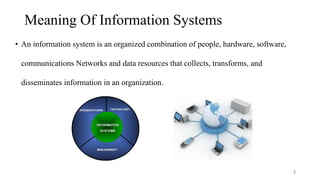
• An information system is an organized combination of people, hardware, software,
communications Networks and data resources that collects, transforms, and
disseminates information in an organization.
2
MIS stand for Management Information System
“Management is function to do the work at the Right time, by the right Person, For the Right Job.”
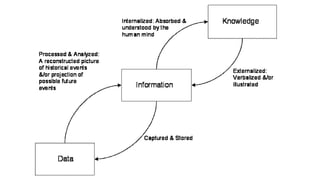
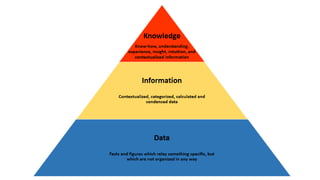
Information: - “Information is the Collection of Organized data which plays a Vital Role for
decision making.”
System:-“System Consist for a set of elements which Provides a Framework to convert Unorganized
(Data) into Organized Information.”
Role of Management Information System
Meaning of Management Information System
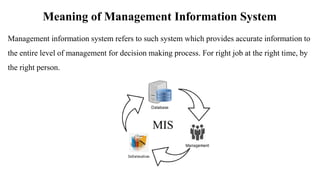
Management information system refers to such system which provides accurate information to
the entire level of management for decision making process. For right job at the right time, by
the right person.
Role of Management Information System
Management information system (MIS) has become very necessary due to emergence of high complexity in
Business Organization. It is all to know that without information no Organization can take even one step
properly regarding the decision making process. Because it is matter of fact that in an organization decision
plays an essential role for the achievement of its objectives and we know that every decision is based upon
information. If gathered information are irrelevant than decision will also incorrect and Organization may face
big loss & lots of Difficulties in Surviving as well.
1. Helps In Decision Making: - Management Information System (MIS) plays a significant Role in Decision making
Process of any Organization. Because in Any organization decision is made on the basis of relevant Information and
relevant information can only be Retrieving from the MSI.
2. Helps in Coordination Among the Department: - Management information System is also help in establishing a sound
Relationship among the every persons of department to department through proper exchanging of Information’s.
3. Helps In Finding Out Problems: - As we know that MIS provides relevant information about the every aspect of
activities. Hence, If any mistake is made by the management then Management Information Systems (MIS) Information
helps in Finding out the Solution of that Problem.
4. Helps In Comparison Of Business Performance: - MIS store all Past Data and information in its Database. That why
management information system is very useful to compare Business organization Performance. With the help of
Management information system (MIS) Organization can analyze his Performance means whatever they do last year or
Previous Years and whatever business performance in this year and also measures organization Development and Growth.
Organizations and Information Systems
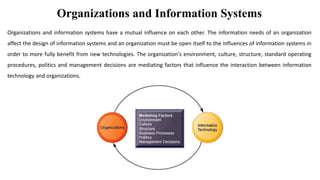
Organizations and information systems have a mutual influence on each other. The information needs of an organization
affect the design of information systems and an organization must be open itself to the influences of information systems in
order to more fully benefit from new technologies. The organization's environment, culture, structure, standard operating
procedures, politics and management decisions are mediating factors that influence the interaction between information
technology and organizations.
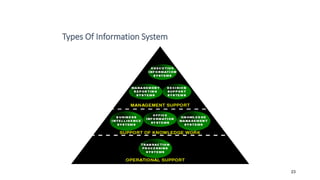
Types Of Information System
23
• The MIS is defined as a system based on the database of
the evolved for the purpose of providing information to the
people in the organization.
MANAGEMENT INFORMATION SYSTEM(MIS)
24
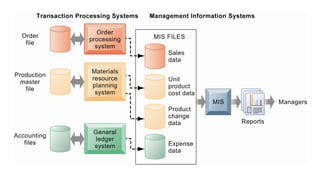
• Management information systems are distinct from regular
information systems in that they are used to analyze other
information systems applied in operational activities in the
organization. MIS involve three primary resources:
technology, information, and people.
• Management information systems are regarded to be a
subset of the overall internal controls procedures in a
business, which cover the application of people,
documents, technologies, and procedures used by
management accountants to solve business problems such
as costing a product, service or a business-wide strategy.
25
Role Of MIS
• The role of MIS in an organization can be compared to the
role of heart in the body.
• The information is the blood and MIS is the heart. In the
body the heart plays the role of supplying pure blood to all
the elements of the body including the brain.
• The MIS plays exactly the same role in the organization.
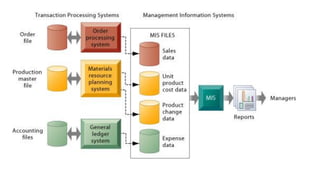
• The system ensures that an appropriate data is collected
from the various sources, processed, and sent further to all
the needy destinations.
26
• The system is expected to fulfill the information needs of
an individual, a group of individuals, the management
functionaries: the managers and the top management.
• The MIS satisfies the diverse needs through a variety of
systems such as Query Systems, Analysis Systems,
Modeling Systems and Decision Support Systems.
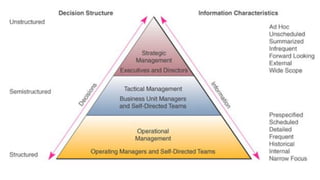
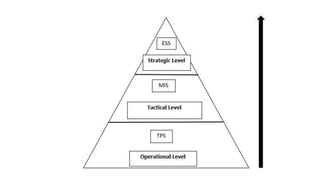
• The MIS helps in Strategic Planning, Management Control,
Operational Control and Transaction Processing.
27
Aim of Management Information System
• The main aim of MIS is to inform management and help
them make informed decisions about management and the
way the business is run.
28
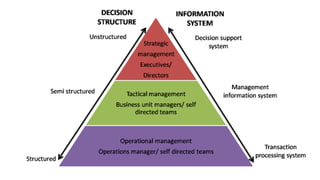
Types Of MIS
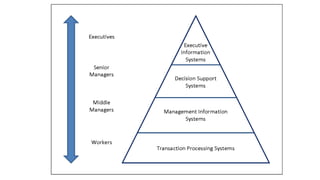
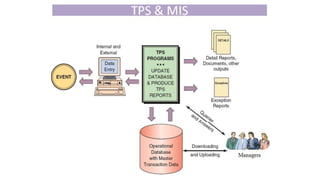
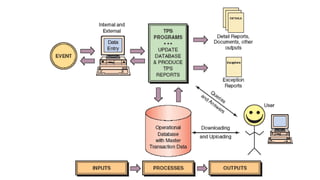
• Transaction processing systems: These systems process a large volume of
routine, recurring transactions.
• Operations information systems: These systems gather comprehensive data,
organize it and summarize it in a form that is useful for managers.
• Decision support systems: These systems help mangers with the necessary
information to make intelligent decisions.
• Expert systems: They are meant to mimic humans in making decisions in a
specific field.
29
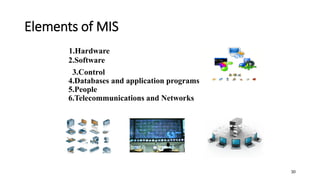
Elements of MIS
1.Hardware
2.Software
3.Control
4.Databases and application programs
5.People
6.Telecommunications and Networks
30
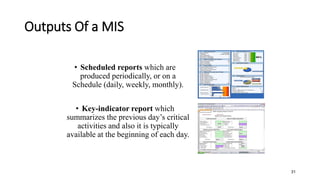
Outputs Of a MIS
• Scheduled reports which are
produced periodically, or on a
Schedule (daily, weekly, monthly).
• Key-indicator report which
summarizes the previous day’s critical
activities and also it is typically
available at the beginning of each day.
31
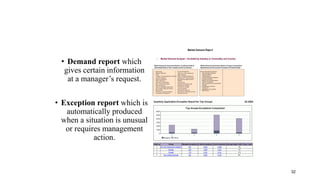
• Demand report which
gives certain information
at a manager’s request.
• Exception report which is
automatically produced
when a situation is unusual
or requires management
action.
32
Benefits of MIS
• It improves personal efficiency.
• It expedites problem solving(speed up
the progress of problems solving in an
organization).
• It facilitates interpersonal
communication
• It promotes learning or training.
• It increases organizational control.
33
• It generates new evidence in support
of a decision.
• It creates a competitive advantage
over competition.
• It encourages exploration and
discovery on the part of the decision
maker.
• It reveals new approaches to thinking
about the problem space.
• It helps automate the Managerial
processes.
34

ManagemSystement Information

  • 1.
    MANAGEMENT INFORMATION SYSTEM BY- Er.Vaibhav Agarwal Asst. Prof. School of Management BBD University, Lucknow
  • 2.
    Meaning Of InformationSystems • An information system is an organized combination of people, hardware, software, communications Networks and data resources that collects, transforms, and disseminates information in an organization. 2
  • 3.
    MIS stand forManagement Information System “Management is function to do the work at the Right time, by the right Person, For the Right Job.” Information: - “Information is the Collection of Organized data which plays a Vital Role for decision making.” System:-“System Consist for a set of elements which Provides a Framework to convert Unorganized (Data) into Organized Information.” Role of Management Information System
  • 4.
    Meaning of ManagementInformation System Management information system refers to such system which provides accurate information to the entire level of management for decision making process. For right job at the right time, by the right person.
  • 5.
    Role of ManagementInformation System Management information system (MIS) has become very necessary due to emergence of high complexity in Business Organization. It is all to know that without information no Organization can take even one step properly regarding the decision making process. Because it is matter of fact that in an organization decision plays an essential role for the achievement of its objectives and we know that every decision is based upon information. If gathered information are irrelevant than decision will also incorrect and Organization may face big loss & lots of Difficulties in Surviving as well.
  • 6.
    1. Helps InDecision Making: - Management Information System (MIS) plays a significant Role in Decision making Process of any Organization. Because in Any organization decision is made on the basis of relevant Information and relevant information can only be Retrieving from the MSI. 2. Helps in Coordination Among the Department: - Management information System is also help in establishing a sound Relationship among the every persons of department to department through proper exchanging of Information’s. 3. Helps In Finding Out Problems: - As we know that MIS provides relevant information about the every aspect of activities. Hence, If any mistake is made by the management then Management Information Systems (MIS) Information helps in Finding out the Solution of that Problem. 4. Helps In Comparison Of Business Performance: - MIS store all Past Data and information in its Database. That why management information system is very useful to compare Business organization Performance. With the help of Management information system (MIS) Organization can analyze his Performance means whatever they do last year or Previous Years and whatever business performance in this year and also measures organization Development and Growth.
  • 7.
    Organizations and InformationSystems Organizations and information systems have a mutual influence on each other. The information needs of an organization affect the design of information systems and an organization must be open itself to the influences of information systems in order to more fully benefit from new technologies. The organization's environment, culture, structure, standard operating procedures, politics and management decisions are mediating factors that influence the interaction between information technology and organizations.
  • 23.
  • 24.
    • The MISis defined as a system based on the database of the evolved for the purpose of providing information to the people in the organization. MANAGEMENT INFORMATION SYSTEM(MIS) 24
  • 25.
    • Management informationsystems are distinct from regular information systems in that they are used to analyze other information systems applied in operational activities in the organization. MIS involve three primary resources: technology, information, and people. • Management information systems are regarded to be a subset of the overall internal controls procedures in a business, which cover the application of people, documents, technologies, and procedures used by management accountants to solve business problems such as costing a product, service or a business-wide strategy. 25
  • 26.
    Role Of MIS •The role of MIS in an organization can be compared to the role of heart in the body. • The information is the blood and MIS is the heart. In the body the heart plays the role of supplying pure blood to all the elements of the body including the brain. • The MIS plays exactly the same role in the organization. • The system ensures that an appropriate data is collected from the various sources, processed, and sent further to all the needy destinations. 26
  • 27.
    • The systemis expected to fulfill the information needs of an individual, a group of individuals, the management functionaries: the managers and the top management. • The MIS satisfies the diverse needs through a variety of systems such as Query Systems, Analysis Systems, Modeling Systems and Decision Support Systems. • The MIS helps in Strategic Planning, Management Control, Operational Control and Transaction Processing. 27
  • 28.
    Aim of ManagementInformation System • The main aim of MIS is to inform management and help them make informed decisions about management and the way the business is run. 28
  • 29.
    Types Of MIS •Transaction processing systems: These systems process a large volume of routine, recurring transactions. • Operations information systems: These systems gather comprehensive data, organize it and summarize it in a form that is useful for managers. • Decision support systems: These systems help mangers with the necessary information to make intelligent decisions. • Expert systems: They are meant to mimic humans in making decisions in a specific field. 29
  • 30.
    Elements of MIS 1.Hardware 2.Software 3.Control 4.Databasesand application programs 5.People 6.Telecommunications and Networks 30
  • 31.
    Outputs Of aMIS • Scheduled reports which are produced periodically, or on a Schedule (daily, weekly, monthly). • Key-indicator report which summarizes the previous day’s critical activities and also it is typically available at the beginning of each day. 31
  • 32.
    • Demand reportwhich gives certain information at a manager’s request. • Exception report which is automatically produced when a situation is unusual or requires management action. 32
  • 33.
    Benefits of MIS •It improves personal efficiency. • It expedites problem solving(speed up the progress of problems solving in an organization). • It facilitates interpersonal communication • It promotes learning or training. • It increases organizational control. 33
  • 34.
    • It generatesnew evidence in support of a decision. • It creates a competitive advantage over competition. • It encourages exploration and discovery on the part of the decision maker. • It reveals new approaches to thinking about the problem space. • It helps automate the Managerial processes. 34