
In the Name of ALLAH ,The most Beneficent and most merciful
Business Communication
Course:
Course instructor:
MAM MALKA
MBA 1st
Semester
Class:
Presentation:
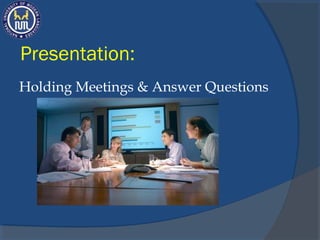
Holding Meetings & Answer Questions
Presented By:
1. Mirza Sajid Mahmood
2. Haris Javed
3. Zahra Naeem
4. Rabbia Jillani
Holding
Meeting
Answering
Questions
Media
Interviews
As Participant
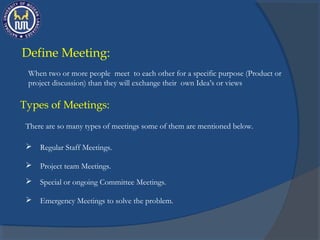
When two or more people meet to each other for a specific purpose (Product or
project discussion) than they will exchange their own Idea’s or views
Types of Meetings:
There are so many types of meetings some of them are mentioned below.
Define Meeting:
 Regular Staff Meetings.
 Project team Meetings.
 Special or ongoing Committee Meetings.
 Emergency Meetings to solve the problem.
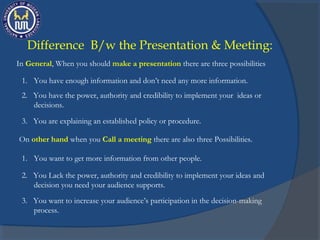
In General, When you should make a presentation there are three possibilities
3. You are explaining an established policy or procedure.
On other hand when you Call a meeting there are also three Possibilities.
3. You want to increase your audience’s participation in the decision-making
process.
1. You have enough information and don’t need any more information.
2. You have the power, authority and credibility to implement your ideas or
decisions.
1. You want to get more information from other people.
2. You Lack the power, authority and credibility to implement your ideas and
decision you need your audience supports.
Difference B/w the Presentation & Meeting:
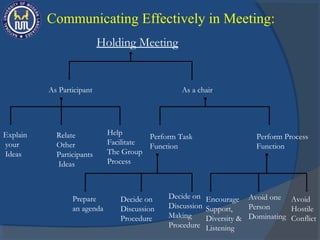
Communicating Effectively in Meeting:
Holding Meeting
As Participant As a chair
Explain
your
Ideas
Relate
Other
Participants
Ideas
Help
Facilitate
The Group
Process
Perform Task
Function
Perform Process
Function
Prepare
an agenda
Decide on
Discussion
Procedure
Decide on
Discussion
Making
Procedure
Encourage
Support,
Diversity &
Listening
Avoid one
Person
Dominating
Avoid
Hostile
Conflict
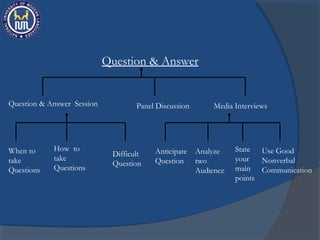
Question & Answer
Panel Discussion
When to
take
Questions
Difficult
Question
Question & Answer Session
How to
take
Questions
Media Interviews
Anticipate
Question
Analyze
two
Audience
State
your
main
points
Use Good
Nonverbal
Communication
Participating in Meetings:
As a Participant in a meeting, remember that you are just that “a Participant". The
As a Participant in a meeting, you have three job
3. Help facilitate the group process.
Ideas on everyone else there.
purpose of a meeting is to work as a group. You are not force your predetermined
1. Explain your ideas.
2. Relate other Participant ideas.
As Participant
below mentioned statement.
 Stick to the agenda and don’t bring up irrelevant ideas.
1. Explain your ideas:
When you explain your own ideas in meeting, you usually do so in a quicker and
less formal manner..your Structure is different in a meeting. You don’t need a
 Don’t need a “Grabber” Statement because people know the importance of
meeting.
 Don’t need a “formal closing”
 You Won’t talk for more than about five minutes at a time.
As Participant
2. Other Participating ideas:
 As a participant you should not only explain your own ideas .You should also
speak
about the other participants ideas.
 Your most of time at a meeting should be devoted to interacting with others, not
to presenting your own views.
 If you agree with other participant views than you should appreciate them.
 If you disagree with other participant views than you can avoid humiliating them.
e.g. That project may be very time consuming instead of “Noman's project will
take too long
e.g. When you disagree than say “ I am worried about” instead of “ I disagree with”
As Participant
3. Help to Facilitate the Group Process:
• A participant should help the chairperson to facilitate the group’s process
• That doesn’t mean you should start running the meeting instead you
might help the chairperson stay on the agenda
• You Could say, for example,” It seems to me we have covered this topic fairly
well now
• If the rest of you agree, perhaps we can cover this item up with decision now
As Participant
Chairing Meeting
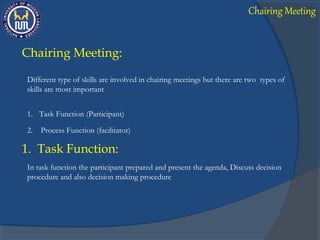
Chairing Meeting:
Different type of skills are involved in chairing meetings but there are two types of
skills are most important
1. Task Function (Participant)
2. Process Function (facilitator)
1. Task Function:
In task function the participant prepared and present the agenda, Discuss decision
procedure and also decision making procedure
Chairing Meeting
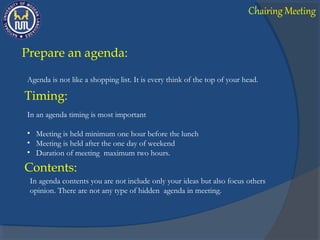
Prepare an agenda:
Agenda is not like a shopping list. It is every think of the top of your head.
In an agenda timing is most important
• Meeting is held minimum one hour before the lunch
• Meeting is held after the one day of weekend
• Duration of meeting maximum two hours.
Timing:
Contents:
In agenda contents you are not include only your ideas but also focus others
opinion. There are not any type of hidden agenda in meeting.
Chairing Meeting
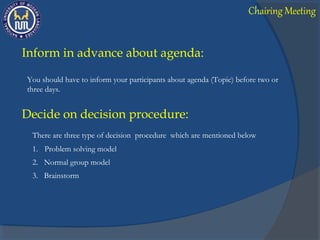
Inform in advance about agenda:
You should have to inform your participants about agenda (Topic) before two or
three days.
Decide on decision procedure:
There are three type of decision procedure which are mentioned below
1. Problem solving model
2. Normal group model
3. Brainstorm
Chairing Meeting
1. Problem solving model:
First of all define the problem, analyze it and give a number of solution. select the best
and decided how to implement the solution.
2. Nominal group model :
It is unusual but popular decision making process, every one explain their ideas
individually ,no one talking with other group members, and make a list of ideas &
cancel the same type of ideas make an review after that the group make decision.
3. Brainstorming:
In this process there are two stages
 The 1st
is simply record ideas, there is no reacting or criticize. every participant can
give ideas. Usually this process is perform on blackboard or flip chart
 The 2nd
stage is select relevant ideas of group and make decision on behalf of those
ideas or data.
Chairing Meeting
Decide on decision making procedures:
There are five type of decision making procedures
1. One man show
2. Majority rule
3. Both one man & majority
4. Consensus
5. Unanimity
1. One man show:
In this stage one man who will be a chairperson of a company made a decision and
participant just informed.
Chairing Meeting
2. Majority rule:
According to parliamentarian procedure, one person say some thing & if any
other person agreed, then it is a MOTION. then members discus or debate on
motion, vote it and voting make decision on 2/3rd majority
3. Decision by consensus:
When group make a decision and some of one not agree may be he or she has a
batter idea but admit the group decision
4. Decision by unanimity:
In this case the company make decision and every one agreed 100% .
Chairing Meeting
Progress report:
After the decision the implementation is compulsory so group leader must be check
the progress and make a report.
Process function:
Make sure everyone participates.
There are three process functions who help in meet the goal.
(1) Encourage support, diversity and listening.
(2) Avoid one person dominating.
(3) Avoid hostile conflict.
Chairing Meeting
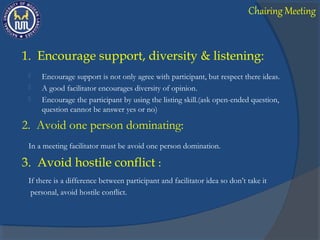
1. Encourage support, diversity & listening:
 Encourage support is not only agree with participant, but respect there ideas.
 A good facilitator encourages diversity of opinion.
 Encourage the participant by using the listing skill.(ask open-ended question,
question cannot be answer yes or no)
2. Avoid one person dominating:
In a meeting facilitator must be avoid one person domination.
3. Avoid hostile conflict :
If there is a difference between participant and facilitator idea so don’t take it
personal, avoid hostile conflict.
Chairing Meeting
Answering Question Session
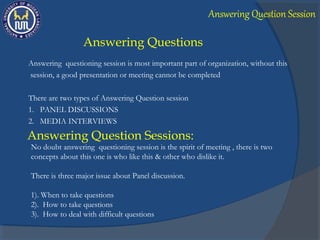
Answering Questions
Answering questioning session is most important part of organization, without this
session, a good presentation or meeting cannot be completed
There are two types of Answering Question session
1. PANEL DISCUSSIONS
2. MEDIA INTERVIEWS
Answering Question Sessions:
No doubt answering questioning session is the spirit of meeting , there is two
concepts about this one is who like this & other who dislike it.
There is three major issue about Panel discussion.
1). When to take questions
2). How to take questions
3). How to deal with difficult questions
Answering Question Session
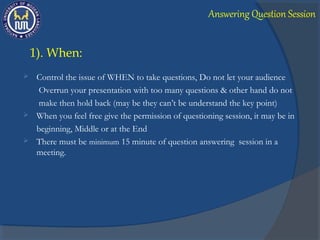
 Control the issue of WHEN to take questions, Do not let your audience
Overrun your presentation with too many questions & other hand do not
make then hold back (may be they can’t be understand the key point)
 When you feel free give the permission of questioning session, it may be in
beginning, Middle or at the End
 There must be minimum 15 minute of question answering session in a
meeting.
1). When:
Answering Question Session
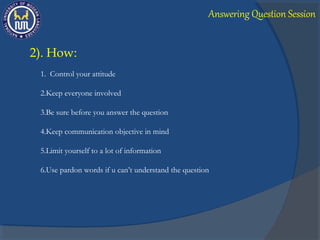
2). How:
1. Control your attitude
2.Keep everyone involved
3.Be sure before you answer the question
4.Keep communication objective in mind
5.Limit yourself to a lot of information
6.Use pardon words if u can’t understand the question
Answering Question Session
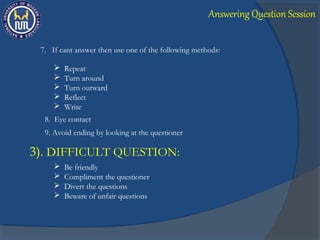
 Repeat
 Turn around
 Turn outward
 Reflect
 Write
7. If cant answer then use one of the following methods:
8. Eye contact
9. Avoid ending by looking at the questioner
3). DIFFICULT QUESTION:
 Be friendly
 Compliment the questioner
 Divert the questions
 Beware of unfair questions
Answering Question Session
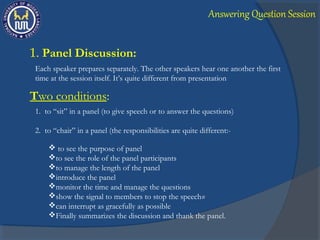
1. Panel Discussion:
Each speaker prepares separately. The other speakers hear one another the first
time at the session itself. It’s quite different from presentation
Two conditions:
1. to “sit” in a panel (to give speech or to answer the questions)
2. to “chair” in a panel (the responsibilities are quite different:-
 to see the purpose of panel
to see the role of the panel participants
to manage the length of the panel
introduce the panel
monitor the time and manage the questions
show the signal to members to stop the speech#
can interrupt as gracefully as possible
Finally summarizes the discussion and thank the panel.
Answering Question Session
Media Interview
Media interview:
A final step of the business situation where you answer question dealing with "press”
is the media interview.
Business person said, “Dealing with the press is communication skill.
Media interview skill consist of below mentioned five steps.
Media interview skill:
1. Anticipate question
2. Plan your response
3. Analyze two audiences
4. State your main point
5. Use good nonverbal communication
Media Interview
1. Anticipate question:
The first step is preparing for a media interview is to anticipate question.
To ask about the topic which is under discussion?
If you are reporter,
 What would you asked?
 What would you be interest in hearing about?
2. Plan your response:
You should have to analyze the interview from the opposite point of view and plan
your responses according to them.
Think about the ideas that will interest, benefit or appeal to your audience. Plan what
you want to say
Media Interview
 Structure the main idea into effective answers
 Give the answer in the short statements
If the reporter asked some question to you then speaker will know about your
response.
And for this it is necessary that the speaker will,
3. Analyze two audiences:
Speaker have to face the two types of audiences.
i. Reporters
ii. Listeners or readers
i. Reporters :
Reports job is to find interesting stories that will interest their audience
Reporters Work under the situation
 Time pressure (meeting deadlines)
 Commercial pressure (increasing advertising revenue)
 Competitor pressure (scoop their rivals)
Media Interview
ii. Listeners or Readers :
Listeners are those people who are other than reporters, they are just listening the
media interviews.
Readers are those people who are getting the information when they read the
newspaper.
4. State your main point:
Speaker will write all the main point before starting the media interview in this way
he can give effective answers to reporter
When the media interview started then the reporter will write all the main points
because after the completion of interview they want to ask the questions to the Speaker
5. Use good Nonverbal Communication:
Nonverbal communication is so important for the speaker when he is facing the
audience.
Media Interview
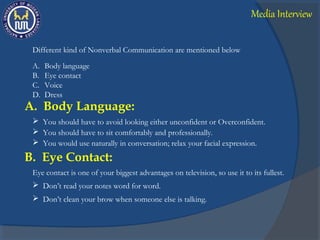
Different kind of Nonverbal Communication are mentioned below
A. Body language
B. Eye contact
C. Voice
D. Dress
A. Body Language:
 You should have to avoid looking either unconfident or Overconfident.
 You should have to sit comfortably and professionally.
 You would use naturally in conversation; relax your facial expression.
Eye contact is one of your biggest advantages on television, so use it to its fullest.
B. Eye Contact:
 Don’t read your notes word for word.
 Don’t clean your brow when someone else is talking.
Media Interview
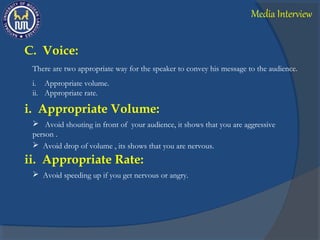
C. Voice:
There are two appropriate way for the speaker to convey his message to the audience.
i. Appropriate volume.
ii. Appropriate rate.
i. Appropriate Volume:
 Avoid shouting in front of your audience, it shows that you are aggressive
person .
 Avoid drop of volume , its shows that you are nervous.
ii. Appropriate Rate:
 Avoid speeding up if you get nervous or angry.
Media Interview
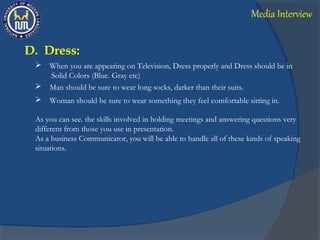
D. Dress:
 When you are appearing on Television, Dress properly and Dress should be in
Solid Colors (Blue. Gray etc)
 Man should be sure to wear long socks, darker than their suits.
 Woman should be sure to wear something they feel comfortable sitting in.
As you can see. the skills involved in holding meetings and answering questions very
different from those you use in presentation.
As a business Communicator, you will be able to handle all of these kinds of speaking
situations.
Media Interview
Holding meeting & answering question

Holding meeting & answering question

  • 1.
    In the Nameof ALLAH ,The most Beneficent and most merciful
  • 2.
  • 3.
  • 4.
    Presented By: 1. MirzaSajid Mahmood 2. Haris Javed 3. Zahra Naeem 4. Rabbia Jillani Holding Meeting Answering Questions Media Interviews
  • 5.
  • 6.
    When two ormore people meet to each other for a specific purpose (Product or project discussion) than they will exchange their own Idea’s or views Types of Meetings: There are so many types of meetings some of them are mentioned below. Define Meeting:  Regular Staff Meetings.  Project team Meetings.  Special or ongoing Committee Meetings.  Emergency Meetings to solve the problem.
  • 7.
    In General, Whenyou should make a presentation there are three possibilities 3. You are explaining an established policy or procedure. On other hand when you Call a meeting there are also three Possibilities. 3. You want to increase your audience’s participation in the decision-making process. 1. You have enough information and don’t need any more information. 2. You have the power, authority and credibility to implement your ideas or decisions. 1. You want to get more information from other people. 2. You Lack the power, authority and credibility to implement your ideas and decision you need your audience supports. Difference B/w the Presentation & Meeting:
  • 8.
    Communicating Effectively inMeeting: Holding Meeting As Participant As a chair Explain your Ideas Relate Other Participants Ideas Help Facilitate The Group Process Perform Task Function Perform Process Function Prepare an agenda Decide on Discussion Procedure Decide on Discussion Making Procedure Encourage Support, Diversity & Listening Avoid one Person Dominating Avoid Hostile Conflict
  • 9.
    Question & Answer PanelDiscussion When to take Questions Difficult Question Question & Answer Session How to take Questions Media Interviews Anticipate Question Analyze two Audience State your main points Use Good Nonverbal Communication
  • 10.
    Participating in Meetings: Asa Participant in a meeting, remember that you are just that “a Participant". The As a Participant in a meeting, you have three job 3. Help facilitate the group process. Ideas on everyone else there. purpose of a meeting is to work as a group. You are not force your predetermined 1. Explain your ideas. 2. Relate other Participant ideas. As Participant
  • 11.
    below mentioned statement. Stick to the agenda and don’t bring up irrelevant ideas. 1. Explain your ideas: When you explain your own ideas in meeting, you usually do so in a quicker and less formal manner..your Structure is different in a meeting. You don’t need a  Don’t need a “Grabber” Statement because people know the importance of meeting.  Don’t need a “formal closing”  You Won’t talk for more than about five minutes at a time. As Participant
  • 12.
    2. Other Participatingideas:  As a participant you should not only explain your own ideas .You should also speak about the other participants ideas.  Your most of time at a meeting should be devoted to interacting with others, not to presenting your own views.  If you agree with other participant views than you should appreciate them.  If you disagree with other participant views than you can avoid humiliating them. e.g. That project may be very time consuming instead of “Noman's project will take too long e.g. When you disagree than say “ I am worried about” instead of “ I disagree with” As Participant
  • 13.
    3. Help toFacilitate the Group Process: • A participant should help the chairperson to facilitate the group’s process • That doesn’t mean you should start running the meeting instead you might help the chairperson stay on the agenda • You Could say, for example,” It seems to me we have covered this topic fairly well now • If the rest of you agree, perhaps we can cover this item up with decision now As Participant
  • 14.
  • 15.
    Chairing Meeting: Different typeof skills are involved in chairing meetings but there are two types of skills are most important 1. Task Function (Participant) 2. Process Function (facilitator) 1. Task Function: In task function the participant prepared and present the agenda, Discuss decision procedure and also decision making procedure Chairing Meeting
  • 16.
    Prepare an agenda: Agendais not like a shopping list. It is every think of the top of your head. In an agenda timing is most important • Meeting is held minimum one hour before the lunch • Meeting is held after the one day of weekend • Duration of meeting maximum two hours. Timing: Contents: In agenda contents you are not include only your ideas but also focus others opinion. There are not any type of hidden agenda in meeting. Chairing Meeting
  • 17.
    Inform in advanceabout agenda: You should have to inform your participants about agenda (Topic) before two or three days. Decide on decision procedure: There are three type of decision procedure which are mentioned below 1. Problem solving model 2. Normal group model 3. Brainstorm Chairing Meeting
  • 18.
    1. Problem solvingmodel: First of all define the problem, analyze it and give a number of solution. select the best and decided how to implement the solution. 2. Nominal group model : It is unusual but popular decision making process, every one explain their ideas individually ,no one talking with other group members, and make a list of ideas & cancel the same type of ideas make an review after that the group make decision. 3. Brainstorming: In this process there are two stages  The 1st is simply record ideas, there is no reacting or criticize. every participant can give ideas. Usually this process is perform on blackboard or flip chart  The 2nd stage is select relevant ideas of group and make decision on behalf of those ideas or data. Chairing Meeting
  • 19.
    Decide on decisionmaking procedures: There are five type of decision making procedures 1. One man show 2. Majority rule 3. Both one man & majority 4. Consensus 5. Unanimity 1. One man show: In this stage one man who will be a chairperson of a company made a decision and participant just informed. Chairing Meeting
  • 20.
    2. Majority rule: Accordingto parliamentarian procedure, one person say some thing & if any other person agreed, then it is a MOTION. then members discus or debate on motion, vote it and voting make decision on 2/3rd majority 3. Decision by consensus: When group make a decision and some of one not agree may be he or she has a batter idea but admit the group decision 4. Decision by unanimity: In this case the company make decision and every one agreed 100% . Chairing Meeting
  • 21.
    Progress report: After thedecision the implementation is compulsory so group leader must be check the progress and make a report. Process function: Make sure everyone participates. There are three process functions who help in meet the goal. (1) Encourage support, diversity and listening. (2) Avoid one person dominating. (3) Avoid hostile conflict. Chairing Meeting
  • 22.
    1. Encourage support,diversity & listening:  Encourage support is not only agree with participant, but respect there ideas.  A good facilitator encourages diversity of opinion.  Encourage the participant by using the listing skill.(ask open-ended question, question cannot be answer yes or no) 2. Avoid one person dominating: In a meeting facilitator must be avoid one person domination. 3. Avoid hostile conflict : If there is a difference between participant and facilitator idea so don’t take it personal, avoid hostile conflict. Chairing Meeting
  • 23.
  • 24.
    Answering Questions Answering questioningsession is most important part of organization, without this session, a good presentation or meeting cannot be completed There are two types of Answering Question session 1. PANEL DISCUSSIONS 2. MEDIA INTERVIEWS Answering Question Sessions: No doubt answering questioning session is the spirit of meeting , there is two concepts about this one is who like this & other who dislike it. There is three major issue about Panel discussion. 1). When to take questions 2). How to take questions 3). How to deal with difficult questions Answering Question Session
  • 25.
     Control theissue of WHEN to take questions, Do not let your audience Overrun your presentation with too many questions & other hand do not make then hold back (may be they can’t be understand the key point)  When you feel free give the permission of questioning session, it may be in beginning, Middle or at the End  There must be minimum 15 minute of question answering session in a meeting. 1). When: Answering Question Session
  • 26.
    2). How: 1. Controlyour attitude 2.Keep everyone involved 3.Be sure before you answer the question 4.Keep communication objective in mind 5.Limit yourself to a lot of information 6.Use pardon words if u can’t understand the question Answering Question Session
  • 27.
     Repeat  Turnaround  Turn outward  Reflect  Write 7. If cant answer then use one of the following methods: 8. Eye contact 9. Avoid ending by looking at the questioner 3). DIFFICULT QUESTION:  Be friendly  Compliment the questioner  Divert the questions  Beware of unfair questions Answering Question Session
  • 28.
    1. Panel Discussion: Eachspeaker prepares separately. The other speakers hear one another the first time at the session itself. It’s quite different from presentation Two conditions: 1. to “sit” in a panel (to give speech or to answer the questions) 2. to “chair” in a panel (the responsibilities are quite different:-  to see the purpose of panel to see the role of the panel participants to manage the length of the panel introduce the panel monitor the time and manage the questions show the signal to members to stop the speech# can interrupt as gracefully as possible Finally summarizes the discussion and thank the panel. Answering Question Session
  • 29.
  • 30.
    Media interview: A finalstep of the business situation where you answer question dealing with "press” is the media interview. Business person said, “Dealing with the press is communication skill. Media interview skill consist of below mentioned five steps. Media interview skill: 1. Anticipate question 2. Plan your response 3. Analyze two audiences 4. State your main point 5. Use good nonverbal communication Media Interview
  • 31.
    1. Anticipate question: Thefirst step is preparing for a media interview is to anticipate question. To ask about the topic which is under discussion? If you are reporter,  What would you asked?  What would you be interest in hearing about? 2. Plan your response: You should have to analyze the interview from the opposite point of view and plan your responses according to them. Think about the ideas that will interest, benefit or appeal to your audience. Plan what you want to say Media Interview
  • 32.
     Structure themain idea into effective answers  Give the answer in the short statements If the reporter asked some question to you then speaker will know about your response. And for this it is necessary that the speaker will, 3. Analyze two audiences: Speaker have to face the two types of audiences. i. Reporters ii. Listeners or readers i. Reporters : Reports job is to find interesting stories that will interest their audience Reporters Work under the situation  Time pressure (meeting deadlines)  Commercial pressure (increasing advertising revenue)  Competitor pressure (scoop their rivals) Media Interview
  • 33.
    ii. Listeners orReaders : Listeners are those people who are other than reporters, they are just listening the media interviews. Readers are those people who are getting the information when they read the newspaper. 4. State your main point: Speaker will write all the main point before starting the media interview in this way he can give effective answers to reporter When the media interview started then the reporter will write all the main points because after the completion of interview they want to ask the questions to the Speaker 5. Use good Nonverbal Communication: Nonverbal communication is so important for the speaker when he is facing the audience. Media Interview
  • 34.
    Different kind ofNonverbal Communication are mentioned below A. Body language B. Eye contact C. Voice D. Dress A. Body Language:  You should have to avoid looking either unconfident or Overconfident.  You should have to sit comfortably and professionally.  You would use naturally in conversation; relax your facial expression. Eye contact is one of your biggest advantages on television, so use it to its fullest. B. Eye Contact:  Don’t read your notes word for word.  Don’t clean your brow when someone else is talking. Media Interview
  • 35.
    C. Voice: There aretwo appropriate way for the speaker to convey his message to the audience. i. Appropriate volume. ii. Appropriate rate. i. Appropriate Volume:  Avoid shouting in front of your audience, it shows that you are aggressive person .  Avoid drop of volume , its shows that you are nervous. ii. Appropriate Rate:  Avoid speeding up if you get nervous or angry. Media Interview
  • 36.
    D. Dress:  Whenyou are appearing on Television, Dress properly and Dress should be in Solid Colors (Blue. Gray etc)  Man should be sure to wear long socks, darker than their suits.  Woman should be sure to wear something they feel comfortable sitting in. As you can see. the skills involved in holding meetings and answering questions very different from those you use in presentation. As a business Communicator, you will be able to handle all of these kinds of speaking situations. Media Interview