TOPIC:
FIRST ORDER COMPLEX REACTION
Mehran University of engineering
and technology, jamshoro
Prepared by:
Abu Umeer (14CH42)
u.ahmed8@yahoo.com
Madni Alam (14CH38)
Chaman Lal (14CH39)
Assigned by:
Prof: Dr: Abdul Rehman Memon 1
Complex Reaction:
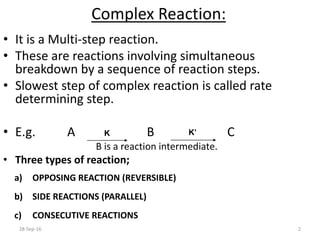
• It is a Multi-step reaction.
• These are reactions involving simultaneous
breakdown by a sequence of reaction steps.
• Slowest step of complex reaction is called rate
determining step.
• E.g. A B C
B is a reaction intermediate.
• Three types of reaction;
a) OPPOSING REACTION (REVERSIBLE)
b) SIDE REACTIONS (PARALLEL)
c) CONSECUTIVE REACTIONS
K K’
28-Sep-16 2
….cont:
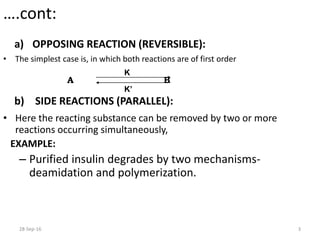
a) OPPOSING REACTION (REVERSIBLE):
• The simplest case is, in which both reactions are of first order
A B
b) SIDE REACTIONS (PARALLEL):
• Here the reacting substance can be removed by two or more
reactions occurring simultaneously,
EXAMPLE:
– Purified insulin degrades by two mechanisms-
deamidation and polymerization.
K
K’
28-Sep-16 3
….cont:
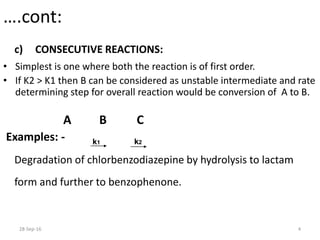
c) CONSECUTIVE REACTIONS:
• Simplest is one where both the reaction is of first order.
• If K2 > K1 then B can be considered as unstable intermediate and rate
determining step for overall reaction would be conversion of A to B.
A B C
Examples: -
Degradation of chlorbenzodiazepine by hydrolysis to lactam
form and further to benzophenone.
k1 k2
28-Sep-16 4
Order of Reaction:
• This is the number of concentration terms that
determine the rate.
• Consider the reaction:
A + B C + D
• The overall equation is,
Rate = k [A]x [B]y
• The overall order of reaction is x+y
28-Sep-16 5
…..cont:
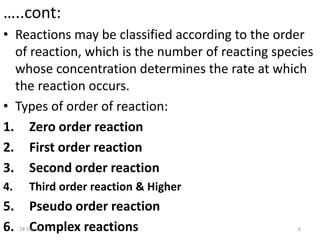
• Reactions may be classified according to the order
of reaction, which is the number of reacting species
whose concentration determines the rate at which
the reaction occurs.
• Types of order of reaction:
1. Zero order reaction
2. First order reaction
3. Second order reaction
4. Third order reaction & Higher
5. Pseudo order reaction
6. Complex reactions28-Sep-16 6
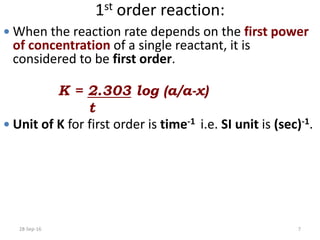
1st order reaction:
 When the reaction rate depends on the first power
of concentration of a single reactant, it is
considered to be first order.
K = 2.303 log (a/a-x)
t
 Unit of K for first order is time-1 i.e. SI unit is (sec)-1.
28-Sep-16 7
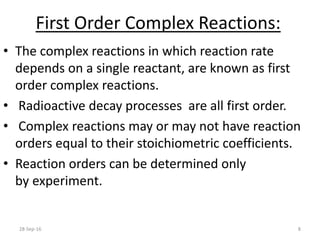
First Order Complex Reactions:
• The complex reactions in which reaction rate
depends on a single reactant, are known as first
order complex reactions.
• Radioactive decay processes are all first order.
• Complex reactions may or may not have reaction
orders equal to their stoichiometric coefficients.
• Reaction orders can be determined only
by experiment.
28-Sep-16 8
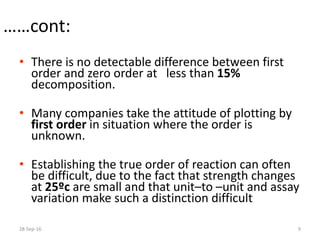
……cont:
• There is no detectable difference between first
order and zero order at less than 15%
decomposition.
• Many companies take the attitude of plotting by
first order in situation where the order is
unknown.
• Establishing the true order of reaction can often
be difficult, due to the fact that strength changes
at 25ºc are small and that unit–to –unit and assay
variation make such a distinction difficult
28-Sep-16 9
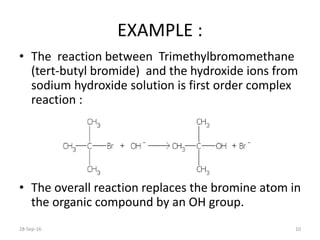
EXAMPLE :
• The reaction between Trimethylbromomethane
(tert-butyl bromide) and the hydroxide ions from
sodium hydroxide solution is first order complex
reaction :
• The overall reaction replaces the bromine atom in
the organic compound by an OH group.
28-Sep-16 10
…..cont:
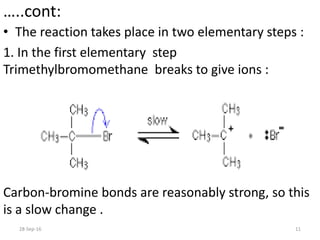
• The reaction takes place in two elementary steps :
1. In the first elementary step
Trimethylbromomethane breaks to give ions :
Carbon-bromine bonds are reasonably strong, so this
is a slow change .
28-Sep-16 11
…..cont:
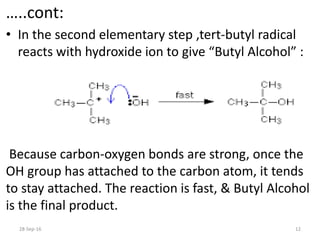
• In the second elementary step ,tert-butyl radical
reacts with hydroxide ion to give “Butyl Alcohol” :
Because carbon-oxygen bonds are strong, once the
OH group has attached to the carbon atom, it tends
to stay attached. The reaction is fast, & Butyl Alcohol
is the final product.
28-Sep-16 12
…..cont:
• The tert-butyl radical is the reaction
intermediate.
• The slow step of a reaction is known as
the rate determining step. SO,
rate = k [C4H9Br]
• The reaction is first order with respect to the
organic compound.
28-Sep-16 13
Summary:
• Complex reaction is a Multi-step reaction.
• Order of reaction is the number of concentration
terms that determine the rate.
• first order complex reactions are those in which
reaction rate depends on a single reactant.
• Reaction orders can be determined only
by experiment.
• There is no detectable difference between first
order and zero order at less than 15%
decomposition.
28-Sep-16 14
1528-Sep-16

1st order complex reaction

  • 1.
    TOPIC: FIRST ORDER COMPLEXREACTION Mehran University of engineering and technology, jamshoro Prepared by: Abu Umeer (14CH42) u.ahmed8@yahoo.com Madni Alam (14CH38) Chaman Lal (14CH39) Assigned by: Prof: Dr: Abdul Rehman Memon 1
  • 2.
    Complex Reaction: • Itis a Multi-step reaction. • These are reactions involving simultaneous breakdown by a sequence of reaction steps. • Slowest step of complex reaction is called rate determining step. • E.g. A B C B is a reaction intermediate. • Three types of reaction; a) OPPOSING REACTION (REVERSIBLE) b) SIDE REACTIONS (PARALLEL) c) CONSECUTIVE REACTIONS K K’ 28-Sep-16 2
  • 3.
    ….cont: a) OPPOSING REACTION(REVERSIBLE): • The simplest case is, in which both reactions are of first order A B b) SIDE REACTIONS (PARALLEL): • Here the reacting substance can be removed by two or more reactions occurring simultaneously, EXAMPLE: – Purified insulin degrades by two mechanisms- deamidation and polymerization. K K’ 28-Sep-16 3
  • 4.
    ….cont: c) CONSECUTIVE REACTIONS: •Simplest is one where both the reaction is of first order. • If K2 > K1 then B can be considered as unstable intermediate and rate determining step for overall reaction would be conversion of A to B. A B C Examples: - Degradation of chlorbenzodiazepine by hydrolysis to lactam form and further to benzophenone. k1 k2 28-Sep-16 4
  • 5.
    Order of Reaction: •This is the number of concentration terms that determine the rate. • Consider the reaction: A + B C + D • The overall equation is, Rate = k [A]x [B]y • The overall order of reaction is x+y 28-Sep-16 5
  • 6.
    …..cont: • Reactions maybe classified according to the order of reaction, which is the number of reacting species whose concentration determines the rate at which the reaction occurs. • Types of order of reaction: 1. Zero order reaction 2. First order reaction 3. Second order reaction 4. Third order reaction & Higher 5. Pseudo order reaction 6. Complex reactions28-Sep-16 6
  • 7.
    1st order reaction: When the reaction rate depends on the first power of concentration of a single reactant, it is considered to be first order. K = 2.303 log (a/a-x) t  Unit of K for first order is time-1 i.e. SI unit is (sec)-1. 28-Sep-16 7
  • 8.
    First Order ComplexReactions: • The complex reactions in which reaction rate depends on a single reactant, are known as first order complex reactions. • Radioactive decay processes are all first order. • Complex reactions may or may not have reaction orders equal to their stoichiometric coefficients. • Reaction orders can be determined only by experiment. 28-Sep-16 8
  • 9.
    ……cont: • There isno detectable difference between first order and zero order at less than 15% decomposition. • Many companies take the attitude of plotting by first order in situation where the order is unknown. • Establishing the true order of reaction can often be difficult, due to the fact that strength changes at 25ºc are small and that unit–to –unit and assay variation make such a distinction difficult 28-Sep-16 9
  • 10.
    EXAMPLE : • Thereaction between Trimethylbromomethane (tert-butyl bromide) and the hydroxide ions from sodium hydroxide solution is first order complex reaction : • The overall reaction replaces the bromine atom in the organic compound by an OH group. 28-Sep-16 10
  • 11.
    …..cont: • The reactiontakes place in two elementary steps : 1. In the first elementary step Trimethylbromomethane breaks to give ions : Carbon-bromine bonds are reasonably strong, so this is a slow change . 28-Sep-16 11
  • 12.
    …..cont: • In thesecond elementary step ,tert-butyl radical reacts with hydroxide ion to give “Butyl Alcohol” : Because carbon-oxygen bonds are strong, once the OH group has attached to the carbon atom, it tends to stay attached. The reaction is fast, & Butyl Alcohol is the final product. 28-Sep-16 12
  • 13.
    …..cont: • The tert-butylradical is the reaction intermediate. • The slow step of a reaction is known as the rate determining step. SO, rate = k [C4H9Br] • The reaction is first order with respect to the organic compound. 28-Sep-16 13
  • 14.
    Summary: • Complex reactionis a Multi-step reaction. • Order of reaction is the number of concentration terms that determine the rate. • first order complex reactions are those in which reaction rate depends on a single reactant. • Reaction orders can be determined only by experiment. • There is no detectable difference between first order and zero order at less than 15% decomposition. 28-Sep-16 14
  • 15.