Buchwald-Hartwig Coupling
&
Click reaction
U-5 New synthetic Organic Reactions
B.SATEESH KUMAR
L.IN CHEMISTRY,GDCM SKLM
III BSc Chemistry
Semester-VI
Paper- VIII C-2
Part-8
Outlines
• U-5 Total syllabus
• Short notes on coupling reactions
• About the Buchwald - hartwig Coupling Reaction
Statement with equation
Mechanism
• About Click Reaction
Statement with equation
Mechanism
• Conclusions
B SATEESH KUMAR , L IN CHEMISTRY , GDC M SKLM
Unit-5
[New synthetic reactions]
1. Baylis-Hillmann reaction
2. Grubbs catalysts
3. Grubbs RCM olefin metathesis reaction
4. Mukayama aldol reaction
5. Mcmurry reaction
6. Mitsnobu reaction
7. Julia-lythgoe olefination
8. Peterson olefination
9. Heck reaction
10. Suzuki coupling
11. Stille coupling
12. Sonogishira coupling
13. Buchwald - hartwig coupling
14. Click reaction
15. Ugi reaction
B SATEESH KUMAR , L IN CHEMISTRY , GDC M SKLM
Buchwald - Hartwig Coupling
Reaction
B SATEESH KUMAR , L IN CHEMISTRY , GDC M SKLM
Start
with
About the reaction
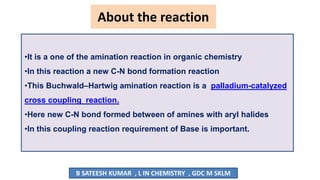
•It is a one of the amination reaction in organic chemistry
•In this reaction a new C-N bond formation reaction
•This Buchwald–Hartwig amination reaction is a palladium-catalyzed
cross coupling reaction.
•Here new C-N bond formed between of amines with aryl halides
•In this coupling reaction requirement of Base is important.
B SATEESH KUMAR , L IN CHEMISTRY , GDC M SKLM
Statement
B SATEESH KUMAR , L IN CHEMISTRY , GDC M SKLM
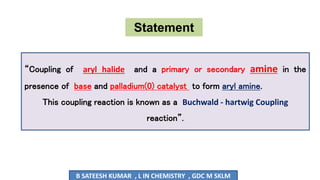
“Coupling of aryl halide and a primary or secondary amine in the
presence of base and palladium(0) catalyst to form aryl amine.
This coupling reaction is known as a Buchwald - hartwig Coupling
reaction”.
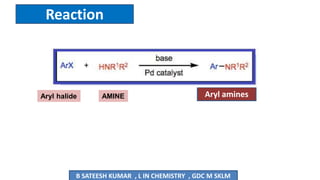
Aryl halide
Reaction
B SATEESH KUMAR , L IN CHEMISTRY , GDC M SKLM
AMINE Aryl amines
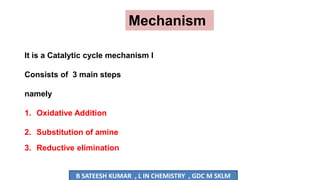
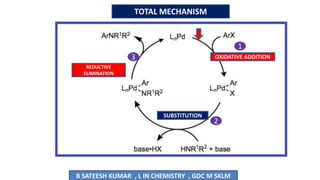
It is a Catalytic cycle mechanism I
Consists of 3 main steps
namely
1. Oxidative Addition
2. Substitution of amine
3. Reductive elimination
Mechanism
B SATEESH KUMAR , L IN CHEMISTRY , GDC M SKLM
TOTAL MECHANISM
OXIDATIVE ADDITION
SUBSTITUTION
REDUCTIVE
ELIMINATION
1
2
3
B SATEESH KUMAR , L IN CHEMISTRY , GDC M SKLM
Click reaction
2
B SATEESH KUMAR , L IN CHEMISTRY , GDC M SKLM
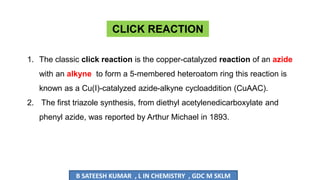
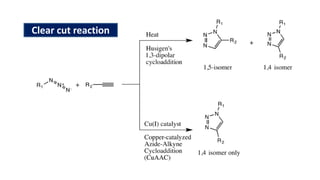
1. The classic click reaction is the copper-catalyzed reaction of an azide
with an alkyne to form a 5-membered heteroatom ring this reaction is
known as a Cu(I)-catalyzed azide-alkyne cycloaddition (CuAAC).
2. The first triazole synthesis, from diethyl acetylenedicarboxylate and
phenyl azide, was reported by Arthur Michael in 1893.
CLICK REACTION
B SATEESH KUMAR , L IN CHEMISTRY , GDC M SKLM
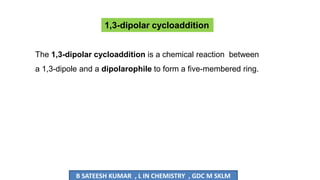
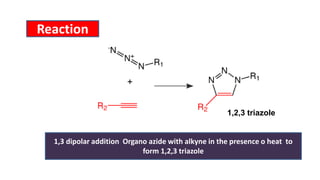
The 1,3-dipolar cycloaddition is a chemical reaction between
a 1,3-dipole and a dipolarophile to form a five-membered ring.
1,3-dipolar cycloaddition
B SATEESH KUMAR , L IN CHEMISTRY , GDC M SKLM
Reaction
1,3 dipolar addition Organo azide with alkyne in the presence o heat to
form 1,2,3 triazole
1,2,3 triazole
Clear cut reaction
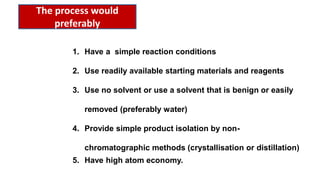
1. Have a simple reaction conditions
2. Use readily available starting materials and reagents
3. Use no solvent or use a solvent that is benign or easily
removed (preferably water)
4. Provide simple product isolation by non-
chromatographic methods (crystallisation or distillation)
5. Have high atom economy.
The process would
preferably
Thank You
STAY HOME & STAY SAFE
SEE YOU
More details visit my YOUTUBE channel
SATEESH KEYS
END

buchwald hartwig coupling.ppt

  • 1.
    Buchwald-Hartwig Coupling & Click reaction U-5New synthetic Organic Reactions B.SATEESH KUMAR L.IN CHEMISTRY,GDCM SKLM III BSc Chemistry Semester-VI Paper- VIII C-2 Part-8
  • 2.
    Outlines • U-5 Totalsyllabus • Short notes on coupling reactions • About the Buchwald - hartwig Coupling Reaction Statement with equation Mechanism • About Click Reaction Statement with equation Mechanism • Conclusions B SATEESH KUMAR , L IN CHEMISTRY , GDC M SKLM
  • 3.
    Unit-5 [New synthetic reactions] 1.Baylis-Hillmann reaction 2. Grubbs catalysts 3. Grubbs RCM olefin metathesis reaction 4. Mukayama aldol reaction 5. Mcmurry reaction 6. Mitsnobu reaction 7. Julia-lythgoe olefination 8. Peterson olefination 9. Heck reaction 10. Suzuki coupling 11. Stille coupling 12. Sonogishira coupling 13. Buchwald - hartwig coupling 14. Click reaction 15. Ugi reaction B SATEESH KUMAR , L IN CHEMISTRY , GDC M SKLM
  • 4.
    Buchwald - HartwigCoupling Reaction B SATEESH KUMAR , L IN CHEMISTRY , GDC M SKLM Start with
  • 5.
    About the reaction •Itis a one of the amination reaction in organic chemistry •In this reaction a new C-N bond formation reaction •This Buchwald–Hartwig amination reaction is a palladium-catalyzed cross coupling reaction. •Here new C-N bond formed between of amines with aryl halides •In this coupling reaction requirement of Base is important. B SATEESH KUMAR , L IN CHEMISTRY , GDC M SKLM
  • 6.
    Statement B SATEESH KUMAR, L IN CHEMISTRY , GDC M SKLM “Coupling of aryl halide and a primary or secondary amine in the presence of base and palladium(0) catalyst to form aryl amine. This coupling reaction is known as a Buchwald - hartwig Coupling reaction”.
  • 7.
    Aryl halide Reaction B SATEESHKUMAR , L IN CHEMISTRY , GDC M SKLM AMINE Aryl amines
  • 8.
    It is aCatalytic cycle mechanism I Consists of 3 main steps namely 1. Oxidative Addition 2. Substitution of amine 3. Reductive elimination Mechanism B SATEESH KUMAR , L IN CHEMISTRY , GDC M SKLM
  • 9.
  • 10.
    Click reaction 2 B SATEESHKUMAR , L IN CHEMISTRY , GDC M SKLM
  • 11.
    1. The classicclick reaction is the copper-catalyzed reaction of an azide with an alkyne to form a 5-membered heteroatom ring this reaction is known as a Cu(I)-catalyzed azide-alkyne cycloaddition (CuAAC). 2. The first triazole synthesis, from diethyl acetylenedicarboxylate and phenyl azide, was reported by Arthur Michael in 1893. CLICK REACTION B SATEESH KUMAR , L IN CHEMISTRY , GDC M SKLM
  • 12.
    The 1,3-dipolar cycloadditionis a chemical reaction between a 1,3-dipole and a dipolarophile to form a five-membered ring. 1,3-dipolar cycloaddition B SATEESH KUMAR , L IN CHEMISTRY , GDC M SKLM
  • 13.
    Reaction 1,3 dipolar additionOrgano azide with alkyne in the presence o heat to form 1,2,3 triazole 1,2,3 triazole
  • 14.
  • 15.
    1. Have asimple reaction conditions 2. Use readily available starting materials and reagents 3. Use no solvent or use a solvent that is benign or easily removed (preferably water) 4. Provide simple product isolation by non- chromatographic methods (crystallisation or distillation) 5. Have high atom economy. The process would preferably
  • 16.
    Thank You STAY HOME& STAY SAFE SEE YOU More details visit my YOUTUBE channel SATEESH KEYS END