CARDIOVASCULAR DRUG
From: Sanket Bhatshankar
M. Pharm ( 1-Semester)
Pharmaceutical Chemistry
Modern College of Pharmacy Nigdi, Pune
Content
 INTRODUCTION
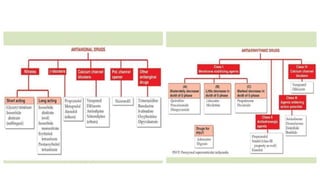
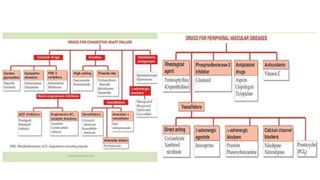
 CLASSIFICATION OF CARDIOVASCULAR DRUG
 CHEMISTRY OF LOVASTATIN
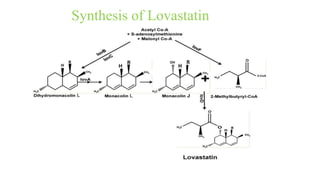
 SYNTHESIS OF LOVASTATIN
 MECHANISM ACTION OF LOVASTATIN
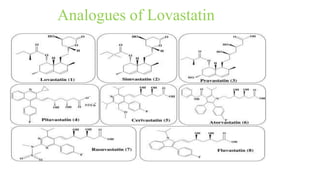
 ANALOGUES OF LOVASTATIN
 STRUCTURE ACTIVITY RELATIONSHIP OF LOVASTATIN
 THERAPEUTIC USE OF LOVASTATIN
 CHEMISTRY OF DICOUMAROL
 SYNTHESIS OF DICOUMAROL
 MECHANISM ACTION OF DICOUMAROL
 STRUCTURE ACTIVITY RELATIONSHIP OF DICOUMAROL
 ANALOGUES OF DICOUMAROL
 THERAPEUTIC USE OF DICOUMAROL
 CHEMISTRY OF TEPROTIDE
 ISOLATION AND DERIVED COMPOUND FROM TEPROTIDE
 MECHANISM ACTION OF TEPROTIDE
 THERAPEUTIC USE OF TEPROTIDE
Introduction
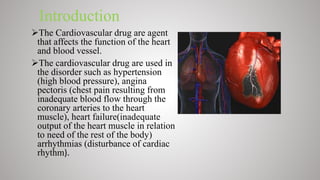
The Cardiovascular drug are agent
that affects the function of the heart
and blood vessel.
The cardiovascular drug are used in
the disorder such as hypertension
(high blood pressure), angina
pectoris (chest pain resulting from
inadequate blood flow through the
coronary arteries to the heart
muscle), heart failure(inadequate
output of the heart muscle in relation
to need of the rest of the body)
arrhythmias (disturbance of cardiac
rhythm).
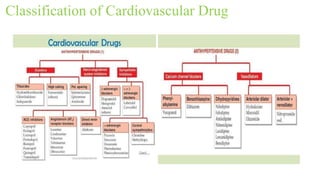
Classification of Cardiovascular Drug
Chemistry of Lovastatin
 Lovastatin, 2-methylbutanoic acid 1,2,3,7,8,8a-hexahydro-3,7-dimethyl-8-[2-(tetrahydro-
4-hydroxy 6-oxo-2H-pyran-2-yl)ethyl]-1-naphthalenyl ester, mevinolin,MK-803
(Mevacor) (formerly called mevinolin), is a potentinhibitor of HMG-CoA.
The drug was obtained originally from the fermentation product of the fungi Aspergillus
terreus and Monascus ruber.
Molecular formula: C24H36O5
Synthesis of Lovastatin
Mechanism action of Lovastatin
These kinds of drugs competitively inhibit the conversion of 3-
hyroxy-3-methyl glutaryl coenzyme(HMG CoA) to mevalonate,
which is the rate-limiting step in cholesterol synthesis.
It results in mediated uptake and catabolism of intermediate density
lipoprotein and very low-density lipoprotein
Mevalonate is a required building block for cholesterol
biosynthesis and lovastatin interferes with its production by acting
as a reversible competitive inhibitor for HMG-CoA, which binds to
the HMG-CoA reductase.
Lovastatin is a prodrug, an inactive lactone in its native form, the
gamma-lactone closed ring form in which it is administered, is
hydrolysed in vivo to the β-hydroxy acid open ring form; which is
the active form.
Analogues of Lovastatin
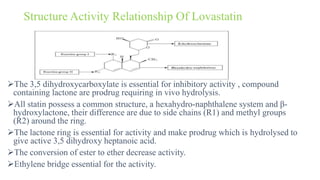
Structure Activity Relationship Of Lovastatin
The 3,5 dihydroxycarboxylate is essential for inhibitory activity , compound
containing lactone are prodrug requiring in vivo hydrolysis.
All statin possess a common structure, a hexahydro-naphthalene system and β-
hydroxylactone, their difference are due to side chains (R1) and methyl groups
(R2) around the ring.
The lactone ring is essential for activity and make prodrug which is hydrolysed to
give active 3,5 dihydroxy heptanoic acid.
The conversion of ester to ether decrease activity.
Ethylene bridge essential for the activity.
Therapeutic uses of Lovastatin
The primary uses of lovastatin is for the treatment of dyslipidemia and the
prevention of cardiovascular disease.
It is used as HMG CO-A reductase inhibitor and lipid regulating drug.
It is recommended to use only after other measures such as diet,
exercise ,weight reduction, and have not improved cholesterol level.
Diarrhea, constipation, headache, muscles pains, rash, and trouble
sleeping are common side effect.
Serious side effect include liver problems, muscle breakdown, and
kidney failure.
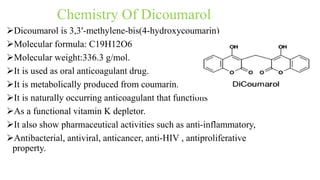
Chemistry Of Dicoumarol
Dicoumarol is 3,3′-methylene-bis(4-hydroxycoumarin)
Molecular formula: C19H12O6
Molecular weight:336.3 g/mol.
It is used as oral anticoagulant drug.
It is metabolically produced from coumarin.
It is naturally occurring anticoagulant that functions
As a functional vitamin K depletor.
It also show pharmaceutical activities such as anti-inflammatory,
Antibacterial, antiviral, anticancer, anti-HIV , antiproliferative
property.
Synthesis Of Dicoumarol
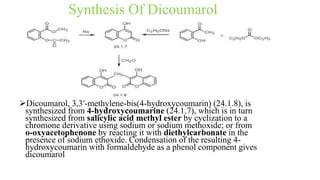
Dicoumarol, 3,3′-methylene-bis(4-hydroxycoumarin) (24.1.8), is
synthesized from 4-hydroxycoumarine (24.1.7), which is in turn
synthesized from salicylic acid methyl ester by cyclization to a
chromone derivative using sodium or sodium methoxide; or from
o-oxyacetophenone by reacting it with diethylcarbonate in the
presence of sodium ethoxide. Condensation of the resulting 4-
hydroxycoumarin with formaldehyde as a phenol component gives
dicoumarol
Mechanism Action of Dicoumarol
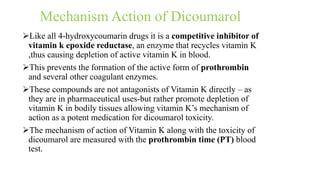
Like all 4-hydroxycoumarin drugs it is a competitive inhibitor of
vitamin k epoxide reductase, an enzyme that recycles vitamin K
,thus causing depletion of active vitamin K in blood.
This prevents the formation of the active form of prothrombin
and several other coagulant enzymes.
These compounds are not antagonists of Vitamin K directly – as
they are in pharmaceutical uses-but rather promote depletion of
vitamin K in bodily tissues allowing vitamin K’s mechanism of
action as a potent medication for dicoumarol toxicity.
The mechanism of action of Vitamin K along with the toxicity of
dicoumarol are measured with the prothrombin time (PT) blood
test.
Structure activity relationship of Dicoumarol
Coumarin and its derivatives are principal oral anticoagulants
Coumarin is water insoluble, however 4- hydroxy substitution
confers weakly acidic properties to the molecule that makes it
water soluble under slightly alkaline conditions.
Warfarin marketed as sodium salt as racemate , however ,The
S(-) isomer is more potent than the R (+) isomer.
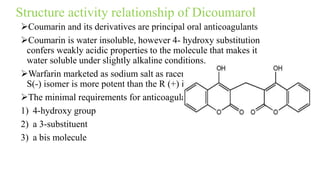
The minimal requirements for anticoagulant activity are:
1) 4-hydroxy group
2) a 3-substituent
3) a bis molecule
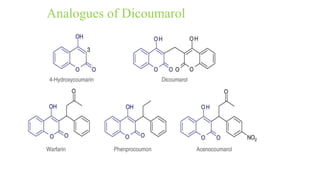
Analogues of Dicoumarol
Therapeutic use of Dicoumarol
Dicoumarol is an anticoagulant that acts as an vitamin K
antagonist.
The therapeutic dose of dicoumarol use in treatment for deep
vein thrombosis and other blood clotting disorders.
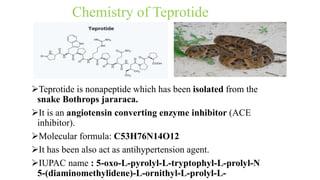
Chemistry of Teprotide
Teprotide is nonapeptide which has been isolated from the
snake Bothrops jararaca.
It is an angiotensin converting enzyme inhibitor (ACE
inhibitor).
Molecular formula: C53H76N14O12
It has been also act as antihypertension agent.
IUPAC name : 5-oxo-L-pyrolyl-L-tryptophyl-L-prolyl-N
5-(diaminomethylidene)-L-ornithyl-L-prolyl-L-
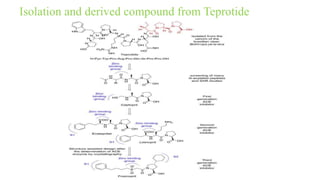
Isolation and derived compound from Teprotide
Mechanism action of Teprotide
Teprotide is an first ACE inhibitor derived feom the venom
Brazilian arrowhead viper (Bothrops jararaca).
It inhibit the conversion of angiotensin 1 to angiotensin 2
and may potentiate some of the pharmacological actions of
bradykinin and lowers the blood pressure.
The teprotide lower blood pressure only after sodium
depletion, an effect which is abolished by bilateral
nephrectomy.
It may also show antihypertensive drug activity.
Therapeutic use of Teprotide
Teprotide is first ACE inhibitor isolated from the venom of
the snake Bothrops jararaca.
It is used to derived ACE inhibitor drug such as
captopril,enalpril, lisinopril, fosinopril etc
It previously act as potent ACE inhibitor but nowadays it is
not use as a ACE inhibitor because it show less activity
than captopril.
Thank You !

Cardiovascular drug

  • 1.
    CARDIOVASCULAR DRUG From: SanketBhatshankar M. Pharm ( 1-Semester) Pharmaceutical Chemistry Modern College of Pharmacy Nigdi, Pune
  • 2.
    Content  INTRODUCTION  CLASSIFICATIONOF CARDIOVASCULAR DRUG  CHEMISTRY OF LOVASTATIN  SYNTHESIS OF LOVASTATIN  MECHANISM ACTION OF LOVASTATIN  ANALOGUES OF LOVASTATIN  STRUCTURE ACTIVITY RELATIONSHIP OF LOVASTATIN  THERAPEUTIC USE OF LOVASTATIN  CHEMISTRY OF DICOUMAROL  SYNTHESIS OF DICOUMAROL  MECHANISM ACTION OF DICOUMAROL  STRUCTURE ACTIVITY RELATIONSHIP OF DICOUMAROL  ANALOGUES OF DICOUMAROL  THERAPEUTIC USE OF DICOUMAROL  CHEMISTRY OF TEPROTIDE  ISOLATION AND DERIVED COMPOUND FROM TEPROTIDE  MECHANISM ACTION OF TEPROTIDE  THERAPEUTIC USE OF TEPROTIDE
  • 3.
    Introduction The Cardiovascular drugare agent that affects the function of the heart and blood vessel. The cardiovascular drug are used in the disorder such as hypertension (high blood pressure), angina pectoris (chest pain resulting from inadequate blood flow through the coronary arteries to the heart muscle), heart failure(inadequate output of the heart muscle in relation to need of the rest of the body) arrhythmias (disturbance of cardiac rhythm).
  • 4.
  • 7.
    Chemistry of Lovastatin Lovastatin, 2-methylbutanoic acid 1,2,3,7,8,8a-hexahydro-3,7-dimethyl-8-[2-(tetrahydro- 4-hydroxy 6-oxo-2H-pyran-2-yl)ethyl]-1-naphthalenyl ester, mevinolin,MK-803 (Mevacor) (formerly called mevinolin), is a potentinhibitor of HMG-CoA. The drug was obtained originally from the fermentation product of the fungi Aspergillus terreus and Monascus ruber. Molecular formula: C24H36O5
  • 8.
  • 9.
    Mechanism action ofLovastatin These kinds of drugs competitively inhibit the conversion of 3- hyroxy-3-methyl glutaryl coenzyme(HMG CoA) to mevalonate, which is the rate-limiting step in cholesterol synthesis. It results in mediated uptake and catabolism of intermediate density lipoprotein and very low-density lipoprotein Mevalonate is a required building block for cholesterol biosynthesis and lovastatin interferes with its production by acting as a reversible competitive inhibitor for HMG-CoA, which binds to the HMG-CoA reductase. Lovastatin is a prodrug, an inactive lactone in its native form, the gamma-lactone closed ring form in which it is administered, is hydrolysed in vivo to the β-hydroxy acid open ring form; which is the active form.
  • 10.
  • 11.
    Structure Activity RelationshipOf Lovastatin The 3,5 dihydroxycarboxylate is essential for inhibitory activity , compound containing lactone are prodrug requiring in vivo hydrolysis. All statin possess a common structure, a hexahydro-naphthalene system and β- hydroxylactone, their difference are due to side chains (R1) and methyl groups (R2) around the ring. The lactone ring is essential for activity and make prodrug which is hydrolysed to give active 3,5 dihydroxy heptanoic acid. The conversion of ester to ether decrease activity. Ethylene bridge essential for the activity.
  • 12.
    Therapeutic uses ofLovastatin The primary uses of lovastatin is for the treatment of dyslipidemia and the prevention of cardiovascular disease. It is used as HMG CO-A reductase inhibitor and lipid regulating drug. It is recommended to use only after other measures such as diet, exercise ,weight reduction, and have not improved cholesterol level. Diarrhea, constipation, headache, muscles pains, rash, and trouble sleeping are common side effect. Serious side effect include liver problems, muscle breakdown, and kidney failure.
  • 13.
    Chemistry Of Dicoumarol Dicoumarolis 3,3′-methylene-bis(4-hydroxycoumarin) Molecular formula: C19H12O6 Molecular weight:336.3 g/mol. It is used as oral anticoagulant drug. It is metabolically produced from coumarin. It is naturally occurring anticoagulant that functions As a functional vitamin K depletor. It also show pharmaceutical activities such as anti-inflammatory, Antibacterial, antiviral, anticancer, anti-HIV , antiproliferative property.
  • 14.
    Synthesis Of Dicoumarol Dicoumarol,3,3′-methylene-bis(4-hydroxycoumarin) (24.1.8), is synthesized from 4-hydroxycoumarine (24.1.7), which is in turn synthesized from salicylic acid methyl ester by cyclization to a chromone derivative using sodium or sodium methoxide; or from o-oxyacetophenone by reacting it with diethylcarbonate in the presence of sodium ethoxide. Condensation of the resulting 4- hydroxycoumarin with formaldehyde as a phenol component gives dicoumarol
  • 15.
    Mechanism Action ofDicoumarol Like all 4-hydroxycoumarin drugs it is a competitive inhibitor of vitamin k epoxide reductase, an enzyme that recycles vitamin K ,thus causing depletion of active vitamin K in blood. This prevents the formation of the active form of prothrombin and several other coagulant enzymes. These compounds are not antagonists of Vitamin K directly – as they are in pharmaceutical uses-but rather promote depletion of vitamin K in bodily tissues allowing vitamin K’s mechanism of action as a potent medication for dicoumarol toxicity. The mechanism of action of Vitamin K along with the toxicity of dicoumarol are measured with the prothrombin time (PT) blood test.
  • 16.
    Structure activity relationshipof Dicoumarol Coumarin and its derivatives are principal oral anticoagulants Coumarin is water insoluble, however 4- hydroxy substitution confers weakly acidic properties to the molecule that makes it water soluble under slightly alkaline conditions. Warfarin marketed as sodium salt as racemate , however ,The S(-) isomer is more potent than the R (+) isomer. The minimal requirements for anticoagulant activity are: 1) 4-hydroxy group 2) a 3-substituent 3) a bis molecule
  • 17.
  • 18.
    Therapeutic use ofDicoumarol Dicoumarol is an anticoagulant that acts as an vitamin K antagonist. The therapeutic dose of dicoumarol use in treatment for deep vein thrombosis and other blood clotting disorders.
  • 19.
    Chemistry of Teprotide Teprotideis nonapeptide which has been isolated from the snake Bothrops jararaca. It is an angiotensin converting enzyme inhibitor (ACE inhibitor). Molecular formula: C53H76N14O12 It has been also act as antihypertension agent. IUPAC name : 5-oxo-L-pyrolyl-L-tryptophyl-L-prolyl-N 5-(diaminomethylidene)-L-ornithyl-L-prolyl-L-
  • 20.
    Isolation and derivedcompound from Teprotide
  • 21.
    Mechanism action ofTeprotide Teprotide is an first ACE inhibitor derived feom the venom Brazilian arrowhead viper (Bothrops jararaca). It inhibit the conversion of angiotensin 1 to angiotensin 2 and may potentiate some of the pharmacological actions of bradykinin and lowers the blood pressure. The teprotide lower blood pressure only after sodium depletion, an effect which is abolished by bilateral nephrectomy. It may also show antihypertensive drug activity.
  • 22.
    Therapeutic use ofTeprotide Teprotide is first ACE inhibitor isolated from the venom of the snake Bothrops jararaca. It is used to derived ACE inhibitor drug such as captopril,enalpril, lisinopril, fosinopril etc It previously act as potent ACE inhibitor but nowadays it is not use as a ACE inhibitor because it show less activity than captopril.
  • 23.