Prepared by: Abu Umeer
Submitted to : Aisha Kauser Affendi
ENG: MATERIAL.
Roll no:
14ch 42
Mehran
university
Faculty of
science
Chemical
department
2Bio Material
Intro to biomaterials
Intro to nano materials
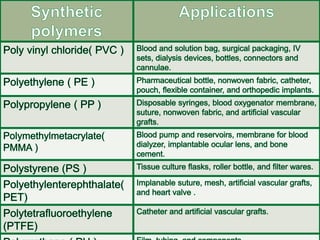
PVC
Material testing(destructive
nano materials)
International standards for
materials testing
Contents
A biomaterial can be defined as any material used
to make devices to replace a part or a function of
the body in a safe, reliable, economic, and
physiologically acceptable manner.
Bio Material 3
FUNCTIONS OF BIOMATERIALS
4
 The functions of implants fall in to one of the categories:
Load bearing or transmission
The control of fluid flow in order to stimulate normal
 physiological function or situation
Passive space filling either for cosmetic reasons or
 functional reasons.
Generation of electric stimuli and transmission of light
and
 sound.
5Bio Material
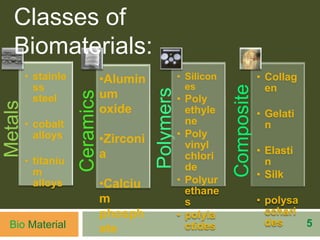
Metals
• stainle
ss
steel
• cobalt
alloys
• titaniu
m
alloys
Ceramics
Polymers
• Silicon
es
• Poly
ethyle
ne
• Poly
vinyl
chlori
de
• Polyur
ethane
s
• polyla
ctides
Composite
• Collag
en
• Gelati
n
• Elasti
n
• Silk
• polysa
cchari
des
Classes of
Biomaterials:
•Alumin
um
oxide
•Zirconi
a
•Calciu
m
phosph
ate
6Bio Material
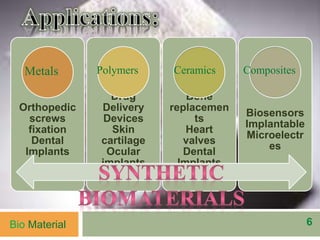
Orthopedic
screws
fixation
Dental
Implants
Drug
Delivery
Devices
Skin
cartilage
Ocular
implants
Bone
replacemen
ts
Heart
valves
Dental
Implants
Biosensors
Implantable
Microelectr
es
Metals Polymers Ceramics Composites
7Bio Material
An appropriate combination of engineers,
clinicians and basic science researches will
pave the way for the development of better
bio materials and hence (medical) devices
that will help improve the quality of life of
humans.
8Bio Material
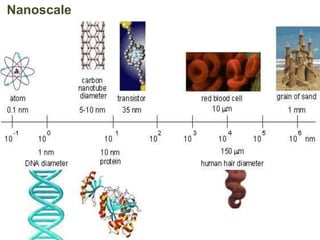
Nanoscale
 Nanomaterials are cornerstones of nanoscience and
nanotechnology.
 Is defined as any material that has unique or novel
properties, due to the nanoscale structuring.
 Nanomaterials are commonly defined as materials with an
average grain size less than 100 nanometers
 Nanomaterials have extremely small size which having at
least one dimension 100 nm
 They are subdivided into nanocrystals, nanopowders, and
nanotubes:
Intro to nano materials
 Nanotubes are extremely strong
mechanically and very pure conductors of
electric current.
 Applications of the nanotube
include resistors, capacitors, inductors, dio
des
and transistors. ),.
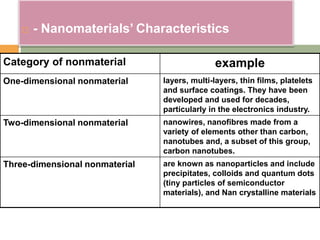
exampleCategory of nonmaterial
layers, multi-layers, thin films, platelets
and surface coatings. They have been
developed and used for decades,
particularly in the electronics industry.
One-dimensional nonmaterial
nanowires, nanofibres made from a
variety of elements other than carbon,
nanotubes and, a subset of this group,
carbon nanotubes.
Two-dimensional nonmaterial
are known as nanoparticles and include
precipitates, colloids and quantum dots
(tiny particles of semiconductor
materials), and Nan crystalline materials
Three-dimensional nonmaterial
 - Nanomaterials’ Characteristics
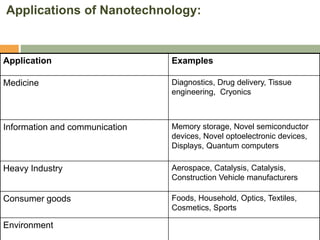
Applications of Nanotechnology:
ExamplesApplication
Diagnostics, Drug delivery, Tissue
engineering, Cryonics
Medicine
Memory storage, Novel semiconductor
devices, Novel optoelectronic devices,
Displays, Quantum computers
Information and communication
Aerospace, Catalysis, Catalysis,
Construction Vehicle manufacturers
Heavy Industry
Foods, Household, Optics, Textiles,
Cosmetics, Sports
Consumer goods
Environment
PVC14
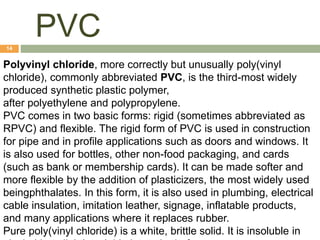
Polyvinyl chloride, more correctly but unusually poly(vinyl
chloride), commonly abbreviated PVC, is the third-most widely
produced synthetic plastic polymer,
after polyethylene and polypropylene.
PVC comes in two basic forms: rigid (sometimes abbreviated as
RPVC) and flexible. The rigid form of PVC is used in construction
for pipe and in profile applications such as doors and windows. It
is also used for bottles, other non-food packaging, and cards
(such as bank or membership cards). It can be made softer and
more flexible by the addition of plasticizers, the most widely used
beingphthalates. In this form, it is also used in plumbing, electrical
cable insulation, imitation leather, signage, inflatable products,
and many applications where it replaces rubber.
Pure poly(vinyl chloride) is a white, brittle solid. It is insoluble in
15
Mechanical properties
Elongation at break 20–40%
Notch test 2–5 kJ/m
2
Glass Transition Temperature 82 °C
[3]
Melting point 100–260 °C
Effective heat of combustion 17.95 MJ/kg
Specific heat (c) 0.9 kJ/(kg·K)
Water absorption (ASTM) 0.04–0.4
Dielectric Breakdown Voltage 40 MV/m
Chemical
formula
16
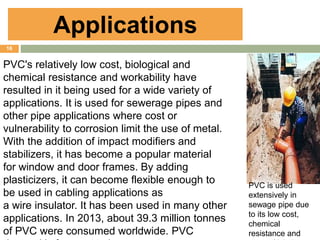
PVC is used
extensively in
sewage pipe due
to its low cost,
chemical
resistance and
Applications
PVC's relatively low cost, biological and
chemical resistance and workability have
resulted in it being used for a wide variety of
applications. It is used for sewerage pipes and
other pipe applications where cost or
vulnerability to corrosion limit the use of metal.
With the addition of impact modifiers and
stabilizers, it has become a popular material
for window and door frames. By adding
plasticizers, it can become flexible enough to
be used in cabling applications as
a wire insulator. It has been used in many other
applications. In 2013, about 39.3 million tonnes
of PVC were consumed worldwide. PVC
Material testing.(nano
destructive)17
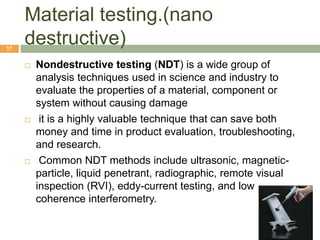
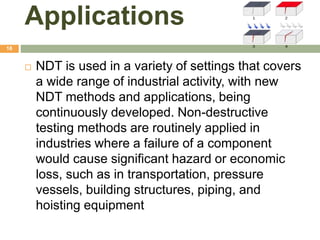
 Nondestructive testing (NDT) is a wide group of
analysis techniques used in science and industry to
evaluate the properties of a material, component or
system without causing damage
 it is a highly valuable technique that can save both
money and time in product evaluation, troubleshooting,
and research.
 Common NDT methods include ultrasonic, magnetic-
particle, liquid penetrant, radiographic, remote visual
inspection (RVI), eddy-current testing, and low
coherence interferometry.
Applications
18
 NDT is used in a variety of settings that covers
a wide range of industrial activity, with new
NDT methods and applications, being
continuously developed. Non-destructive
testing methods are routinely applied in
industries where a failure of a component
would cause significant hazard or economic
loss, such as in transportation, pressure
vessels, building structures, piping, and
hoisting equipment
International Standards
19
 iSO 6892-1 - for tensile testing on metals: metallic foils, metal
sheets, bars, tubes and threaded and/or shouldered
specimens according to DIN 50125 Standard at room
temperature;
 ASTM A370 – for tensile test;
 ISO 10113 – for anisotropy determination and ISO 10275 –
for work hardening determination;
 ISO 15630 – for tests on steel reinforcing bars for concrete
(Rebar);
 ISO 898 – for tests on screws;
 ASTM E21, ISO 6892-2 - for tensile testing at high
temperature for the determination of yield point, strength,
elongation and striction of metals;
 NADCAP – compliance with Standard ASTM E1012;
 ASTM E190 – for guided bend test for ductility of welds.
INTERNATIONAL STANDARDS – PLASTICS AND
NON-METALS
20
 ISO 527 - for tensile tests on plastics (specimens, micro
specimens 1BA);
 ASTM D638 - for tensile tests on plastics (bars, round
specimens, tubular specimens);
 ISO 178 – for flexure testing on rigid and semi-rigid
plastics;
 ASTM D882 – for tensile tests on thin plastic sheeting;
 ISO 2062 - for tests on textile yarns, wire and twine;
 EN 310 – for test on wood;
 ASTM D3039 – for tensile tests on carbon fiber strips with
polymer matrix;
 ISO 604 - for compression tests on plastics (rigid and semi-
rigid thermoplastic moulding and extrusion materials,
compounds, thermo tropic liquid-crystal polymers).

materials presentation............

  • 1.
    Prepared by: AbuUmeer Submitted to : Aisha Kauser Affendi ENG: MATERIAL. Roll no: 14ch 42 Mehran university Faculty of science Chemical department
  • 2.
    2Bio Material Intro tobiomaterials Intro to nano materials PVC Material testing(destructive nano materials) International standards for materials testing Contents
  • 3.
    A biomaterial canbe defined as any material used to make devices to replace a part or a function of the body in a safe, reliable, economic, and physiologically acceptable manner. Bio Material 3
  • 4.
    FUNCTIONS OF BIOMATERIALS 4 The functions of implants fall in to one of the categories: Load bearing or transmission The control of fluid flow in order to stimulate normal  physiological function or situation Passive space filling either for cosmetic reasons or  functional reasons. Generation of electric stimuli and transmission of light and  sound.
  • 5.
    5Bio Material Metals • stainle ss steel •cobalt alloys • titaniu m alloys Ceramics Polymers • Silicon es • Poly ethyle ne • Poly vinyl chlori de • Polyur ethane s • polyla ctides Composite • Collag en • Gelati n • Elasti n • Silk • polysa cchari des Classes of Biomaterials: •Alumin um oxide •Zirconi a •Calciu m phosph ate
  • 6.
  • 7.
  • 8.
    An appropriate combinationof engineers, clinicians and basic science researches will pave the way for the development of better bio materials and hence (medical) devices that will help improve the quality of life of humans. 8Bio Material
  • 9.
  • 10.
     Nanomaterials arecornerstones of nanoscience and nanotechnology.  Is defined as any material that has unique or novel properties, due to the nanoscale structuring.  Nanomaterials are commonly defined as materials with an average grain size less than 100 nanometers  Nanomaterials have extremely small size which having at least one dimension 100 nm  They are subdivided into nanocrystals, nanopowders, and nanotubes: Intro to nano materials
  • 11.
     Nanotubes areextremely strong mechanically and very pure conductors of electric current.  Applications of the nanotube include resistors, capacitors, inductors, dio des and transistors. ),.
  • 12.
    exampleCategory of nonmaterial layers,multi-layers, thin films, platelets and surface coatings. They have been developed and used for decades, particularly in the electronics industry. One-dimensional nonmaterial nanowires, nanofibres made from a variety of elements other than carbon, nanotubes and, a subset of this group, carbon nanotubes. Two-dimensional nonmaterial are known as nanoparticles and include precipitates, colloids and quantum dots (tiny particles of semiconductor materials), and Nan crystalline materials Three-dimensional nonmaterial  - Nanomaterials’ Characteristics
  • 13.
    Applications of Nanotechnology: ExamplesApplication Diagnostics,Drug delivery, Tissue engineering, Cryonics Medicine Memory storage, Novel semiconductor devices, Novel optoelectronic devices, Displays, Quantum computers Information and communication Aerospace, Catalysis, Catalysis, Construction Vehicle manufacturers Heavy Industry Foods, Household, Optics, Textiles, Cosmetics, Sports Consumer goods Environment
  • 14.
    PVC14 Polyvinyl chloride, morecorrectly but unusually poly(vinyl chloride), commonly abbreviated PVC, is the third-most widely produced synthetic plastic polymer, after polyethylene and polypropylene. PVC comes in two basic forms: rigid (sometimes abbreviated as RPVC) and flexible. The rigid form of PVC is used in construction for pipe and in profile applications such as doors and windows. It is also used for bottles, other non-food packaging, and cards (such as bank or membership cards). It can be made softer and more flexible by the addition of plasticizers, the most widely used beingphthalates. In this form, it is also used in plumbing, electrical cable insulation, imitation leather, signage, inflatable products, and many applications where it replaces rubber. Pure poly(vinyl chloride) is a white, brittle solid. It is insoluble in
  • 15.
    15 Mechanical properties Elongation atbreak 20–40% Notch test 2–5 kJ/m 2 Glass Transition Temperature 82 °C [3] Melting point 100–260 °C Effective heat of combustion 17.95 MJ/kg Specific heat (c) 0.9 kJ/(kg·K) Water absorption (ASTM) 0.04–0.4 Dielectric Breakdown Voltage 40 MV/m Chemical formula
  • 16.
    16 PVC is used extensivelyin sewage pipe due to its low cost, chemical resistance and Applications PVC's relatively low cost, biological and chemical resistance and workability have resulted in it being used for a wide variety of applications. It is used for sewerage pipes and other pipe applications where cost or vulnerability to corrosion limit the use of metal. With the addition of impact modifiers and stabilizers, it has become a popular material for window and door frames. By adding plasticizers, it can become flexible enough to be used in cabling applications as a wire insulator. It has been used in many other applications. In 2013, about 39.3 million tonnes of PVC were consumed worldwide. PVC
  • 17.
    Material testing.(nano destructive)17  Nondestructivetesting (NDT) is a wide group of analysis techniques used in science and industry to evaluate the properties of a material, component or system without causing damage  it is a highly valuable technique that can save both money and time in product evaluation, troubleshooting, and research.  Common NDT methods include ultrasonic, magnetic- particle, liquid penetrant, radiographic, remote visual inspection (RVI), eddy-current testing, and low coherence interferometry.
  • 18.
    Applications 18  NDT isused in a variety of settings that covers a wide range of industrial activity, with new NDT methods and applications, being continuously developed. Non-destructive testing methods are routinely applied in industries where a failure of a component would cause significant hazard or economic loss, such as in transportation, pressure vessels, building structures, piping, and hoisting equipment
  • 19.
    International Standards 19  iSO6892-1 - for tensile testing on metals: metallic foils, metal sheets, bars, tubes and threaded and/or shouldered specimens according to DIN 50125 Standard at room temperature;  ASTM A370 – for tensile test;  ISO 10113 – for anisotropy determination and ISO 10275 – for work hardening determination;  ISO 15630 – for tests on steel reinforcing bars for concrete (Rebar);  ISO 898 – for tests on screws;  ASTM E21, ISO 6892-2 - for tensile testing at high temperature for the determination of yield point, strength, elongation and striction of metals;  NADCAP – compliance with Standard ASTM E1012;  ASTM E190 – for guided bend test for ductility of welds.
  • 20.
    INTERNATIONAL STANDARDS –PLASTICS AND NON-METALS 20  ISO 527 - for tensile tests on plastics (specimens, micro specimens 1BA);  ASTM D638 - for tensile tests on plastics (bars, round specimens, tubular specimens);  ISO 178 – for flexure testing on rigid and semi-rigid plastics;  ASTM D882 – for tensile tests on thin plastic sheeting;  ISO 2062 - for tests on textile yarns, wire and twine;  EN 310 – for test on wood;  ASTM D3039 – for tensile tests on carbon fiber strips with polymer matrix;  ISO 604 - for compression tests on plastics (rigid and semi- rigid thermoplastic moulding and extrusion materials, compounds, thermo tropic liquid-crystal polymers).