DRUG STABILITY
By,
Dr. Vaibhav G. Bhamare
Ph. D, M. Pharm, MBA
2
INTRODUCTION Reaction Kinetics
 Drug stability is measured by the rate of changes that take place in the
pharmaceutical dosage forms.
 Reaction kinetics has been found useful to investigate and solve or explain the
mechanisms of reactions.
 The experimental study of reaction rates to infer about the kinetic mechanisms
for chemical conversion of reactants (R) into products (P) is referred to as
chemical kinetics.
 Reaction takes place by various mechanism and a various number of principles
and related rate processes are implicit in a chain of events like Stability and
incompatibility, Dissolution, Pharmacokinetics and Drug action.
3
Types of Reactions
 There are two types of reactions:
i)Equilibrium reaction: These are the reactions where the rate of
two opposing reactions are equal and the concentration of reactant or
product do not change with time.
ii)Spontaneous reaction: These are the reactions which occur
from left to right till all reactant is converted to products.
4
TERMINOLOGIES
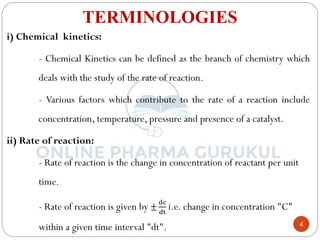
i) Chemical kinetics:
- Chemical Kinetics can be defined as the branch of chemistry which
deals with the study of the rate of reaction.
- Various factors which contribute to the rate of a reaction include
concentration, temperature, pressure and presence of a catalyst.
ii) Rate of reaction:
- Rate of reaction is the change in concentration of reactant per unit
time.
- Rate of reaction is given by ±
dc
dt
i.e. change in concentration "C"
within a given time interval "dt".
5
ii) Rate of reaction:
Law of Mass action states that the rate of a chemical reaction is
directly proportional to the active mass of reacting substances.
OR
The rate of a chemical reaction is proportional to the product of the
molar concentration of reactant each raised to a power equal to the
number of molecules of a substance undergoing reaction.
i.e. xA + yB  product
where, K is proportionality constant called as the rate constant and
equation is called as Rate law or Rate equation.
y
x
]
B
[
]
A
[
Rate 

y
x
]
B
[
]
A
[
K
Rate 

6
iii) Order of reaction:
- Order of reaction is defined as the sum of the exponents of the
concentration terms that afford a linear plot when the rate of reaction
is plotted as a function of the concentration of the reactant.
- Order of reaction is the sum of the power of concentration in the
rate law.
- Order of reaction = (x + y)
First-order i.e. x + y = 1
Second-order i.e. x + y = 2
Third-order i.e. x + y = 3
Zero-order i.e. reaction proceeds independent of
concentration terms.
y
x
]
B
[
]
A
[
K
Rate
When 
7
iv) Molecularity of reaction:
Molecularity of reaction is the number of atoms or molecules or ions
that take part in the reaction.
i) Unimolecular: Involve only one molecule trans.
ii) Bimolecular: Involve a reaction between two molecule.
iii) Termolecular: Involve more than two molecular reactions
appearing termolecular often consist of a sequence of bimolecular
steps.
8
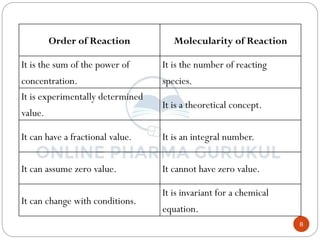
Order of Reaction Molecularity of Reaction
It is the sum of the power of
concentration.
It is the number of reacting
species.
It is experimentally determined
value.
It is a theoretical concept.
It can have a fractional value. It is an integral number.
It can assume zero value. It cannot have zero value.
It can change with conditions.
It is invariant for a chemical
equation.
9
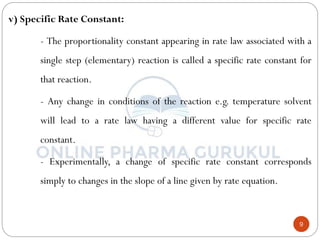
v) Specific Rate Constant:
- The proportionality constant appearing in rate law associated with a
single step (elementary) reaction is called a specific rate constant for
that reaction.
- Any change in conditions of the reaction e.g. temperature solvent
will lead to a rate law having a different value for specific rate
constant.
- Experimentally, a change of specific rate constant corresponds
simply to changes in the slope of a line given by rate equation.
10
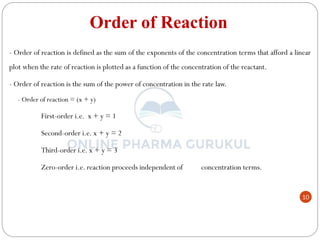
Order of Reaction
- Order of reaction is defined as the sum of the exponents of the concentration terms that afford a linear
plot when the rate of reaction is plotted as a function of the concentration of the reactant.
- Order of reaction is the sum of the power of concentration in the rate law.
- Order of reaction = (x + y)
First-order i.e. x + y = 1
Second-order i.e. x + y = 2
Third-order i.e. x + y = 3
Zero-order i.e. reaction proceeds independent of concentration terms.
11
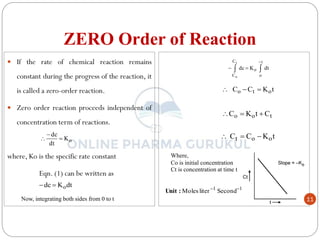
ZERO Order of Reaction
 If the rate of chemical reaction remains
constant during the progress of the reaction, it
is called a zero-order reaction.
 Zero order reaction proceeds independent of
concentration term of reactions.
where, Ko is the specific rate constant
Eqn. (1) can be written as
o
K
dt
dc



dt
K
dc o


Now, integrating both sides from 0 to t
dt
K
dc
t
o
o
C
C
t
o





t
K
C
C o
t
o 


t
o
o C
t
K
C 


t
K
C
C o
o
t 


Where,
Co is initial concentration
Ct is concentration at time t
1
1
Second
liter
Moles 

:
Unit
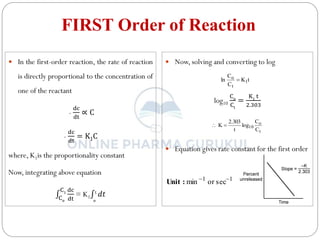
FIRST Order of Reaction
 Now, solving and converting to log
log10
Co
Ct
=
K1
t
2.303
 Equation gives rate constant for the first order
 In the first-order reaction, the rate of reaction
is directly proportional to the concentration of
one of the reactant
-
dc
dt
∝ C
-
dc
dt
= K1C
where, K1is the proportionality constant
Now, integrating above equation
Co
C1 dc
dt
= K1
o
t
𝑑𝑡
t
K
C
C
ln 1
t
o

t
o
10
C
C
log
t
303
.
2
K 

1
1
sec
or
min 

:
Unit
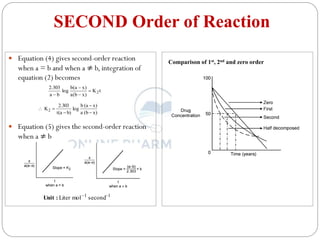
SECOND Order of Reaction
 In the simplest case when a = b, then equation
(2) can be written as
 Integrating the above equation,
 In the second-order reaction, the rate of
reaction depends on the concentration terms
of reactant raised to power one.
 Suppose in reaction A + B  Product
where K2 is Second-order rate constant
If 'a' and 'b' are the initial concentration of A and
B when t = 0 and if ‘x’ is the concentration of
each species when t = t then
]
B
[
]
A
[
dt
]
B
[
d
dt
]
A
[
d







]
B
[
]
A
[
K
dt
]
B
[
d
dt
]
A
[
d
2 






)
x
b
(
)
x
a
(
K
dt
dx
2 


2
2 )
x
a
(
K
dt
dx


dt
K
)
x
a
(
dx
2
2



dt
K
)
x
a
(
dx
t
0
2
2
x
0

 

t
K
0
a
1
x
a
1
2

















t
K
)
x
a
(
a
x
2












x
a
x
at
1
K2
SECOND Order of Reaction
 Equation (4) gives second-order reaction
when a = b and when a ≠ b, integration of
equation (2) becomes
 Equation (5) gives the second-order reaction
when a ≠ b
t
K
)
x
b
(
a
)
x
a
(
b
log
b
a
303
.
2
2




)
x
b
(
a
)
x
a
(
b
log
)
b
a
(
t
303
.
2
K2





1
1
second
mol
Liter 

:
Unit
Comparison of 1st, 2nd and zero order
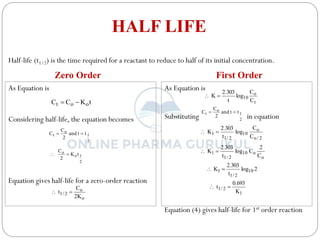
HALF LIFE
As Equation is
Considering half-life, the equation becomes
Equation gives half-life for a zero-order reaction
Zero Order First Order
Half-life (t1/2) is the time required for a reactant to reduce to half of its initial concentration.
t
K
C
C o
o
t 

2
1
o
t t
t
and
2
C
C 

2
1
o
o t
K
2
C


o
o
2
/
1
K
2
C
t 

As Equation is
Substituting in equation
Equation (4) gives half-life for 1st order reaction
t
o
10
C
C
log
t
303
.
2
K 

2
1
o
t t
t
and
2
C
C 

2
/
o
o
10
2
/
1
1
C
C
log
t
303
.
2
K 

o
o
10
2
/
1
1
C
2
C
log
t
303
.
2
K 

2
log
t
303
.
2
K 10
2
/
1
1 

1
2
/
1
K
693
.
0
t 

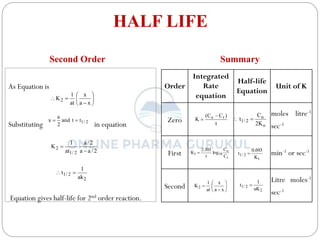
HALF LIFE
As Equation is
Substituting in equation
Equation gives half-life for 2nd order reaction.
Second Order









x
a
x
at
1
K2
2
/
1
t
t
and
2
a
x 

2
/
a
a
2
/
a
at
1
K
2
/
1
2


2
2
/
1
ak
1
t 

Order
Integrated
Rate
equation
Half-life
Equation
Unit of K
Zero
moles litre-1
sec-1
First min-1 or sec-1
Second
Litre moles-1
sec-1
t
)
C
C
(
K t
o 

t
o
10
1
C
C
log
t
303
.
2
K 
1
2
/
1
K
693
.
0
t 








x
a
x
at
1
K2
2
2
/
1
aK
1
t 
Summary
o
o
2
/
1
K
2
C
t 

DETERMINATION OF
ORDER OF REACTION
By,
Dr. Vaibhav G. Bhamare
Ph. D, M. Pharm, MBA
18
INTRODUCTION
 The order of reaction can be determined by several methods
i) Substitution method or integration
ii) Graphical method
iii) Half-life method
iv) Ostwald’s isolation method
v)Van’t Hoff Differential Method
19
SUBSTITUTION METHOD
 This is a trial and error method in which reaction is performed by taking a
different initial concentration of the reactant (a).
 The concentrations of the reactant (a-x) were noted at regular time interval
t.
 These values of a, (a-x) were substituted into the integrated rate equation
for first, second order.
 The equation that gives a constant value of K is considered to be the order
of the reaction.
20
GRAPHICAL METHOD
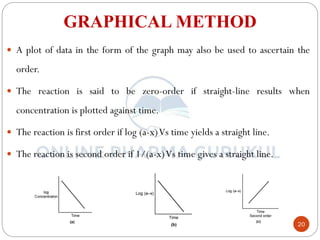
 A plot of data in the form of the graph may also be used to ascertain the
order.
 The reaction is said to be zero-order if straight-line results when
concentration is plotted against time.
 The reaction is first order if log (a-x)Vs time yields a straight line.
 The reaction is second order if 1/(a-x)Vs time gives a straight line.
21
HALF LIFE METHOD
 In this method half-life is determined as a function of concentration
 Half-life α initial concentration …………. Zero-order
 Half-life is independent on initial concentration …… First-order
 Half Life ∝
1
initial concentration
………… Second order
 Half Life ∝
1
initial concentrationn−1 ………… n order of the reaction.
 Thus,
If two reactions are run at different initial concentration, the half-
lives are related
22
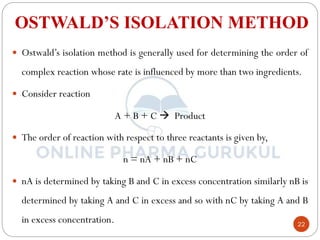
OSTWALD’S ISOLATION METHOD
 Ostwald’s isolation method is generally used for determining the order of
complex reaction whose rate is influenced by more than two ingredients.
 Consider reaction
A + B + C  Product
 The order of reaction with respect to three reactants is given by,
n = nA + nB + nC
 nA is determined by taking B and C in excess concentration similarly nB is
determined by taking A and C in excess and so with nC by taking A and B
in excess concentration.
23
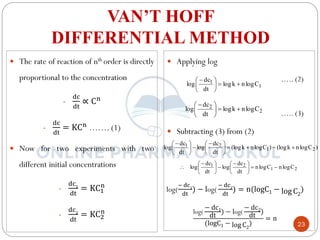
VAN’T HOFF
DIFFERENTIAL METHOD
 The rate of reaction of nth order is directly
proportional to the concentration
-
dc
dt
∝ Cn
-
dc
dt
= KCn
……. (1)
 Now for two experiments with two
different initial concentrations
-
dc1
dt
= KC1
n
-
dc2
dt
= KC2
n
 Applying log
….. (2)
….. (3)
 Subtracting (3) from (2)
1
1 C
log
n
k
log
dt
dc
log 






 
2
2 C
log
n
k
log
dt
dc
log 






 
)
C
log
n
k
(log
)
C
log
n
k
(log
dt
dc
log
dt
dc
log 2
1
2
1 








 






 
2
1
2
1 C
log
n
C
log
n
dt
dc
log
dt
dc
log 






 






 

log(
− dc1
dt
) − log(
− dc2
dt
) = n(logC1 − log C2
)
log(
− dc1
dt
) − log(
− dc2
dt
)
(logC1 − log C2
)
= n
DEGRADATION IN
PHARMACEUTICAL PRODUCT
By,
Dr. Vaibhav G. Bhamare
Ph. D, M. Pharm, MBA
25
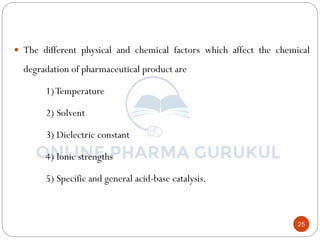
 The different physical and chemical factors which affect the chemical
degradation of pharmaceutical product are
1)Temperature
2) Solvent
3) Dielectric constant
4) Ionic strengths
5) Specific and general acid-base catalysis.
26
TEMPERATURE
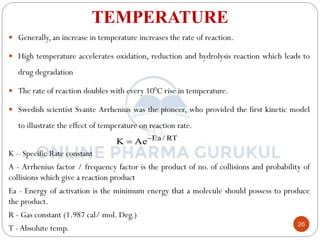
 Generally, an increase in temperature increases the rate of reaction.
 High temperature accelerates oxidation, reduction and hydrolysis reaction which leads to
drug degradation
 The rate of reaction doubles with every 100C rise in temperature.
 Swedish scientist Svante Arrhenius was the pioneer, who provided the first kinetic model
to illustrate the effect of temperature on reaction rate.
K – Specific Rate constant
A - Arrhenius factor / frequency factor is the product of no. of collisions and probability of
collisions which give a reaction product
Ea - Energy of activation is the minimum energy that a molecule should possess to produce
the product.
R - Gas constant (1.987 cal/ mol. Deg.)
T -Absolute temp.
RT
/
Ea
Ae
K 

27
SOLVENT
 Acidic and alkaline pH of solvent influence the rate of decomposition of
most drugs.
 Replacing an aqueous solvent in a formulation with a non-aqueous one is a
potential means of avoiding hydrolysis.
 Weekly acidic and basic drugs show good solubility when they are ionized
and they also decompose faster when they are ionized.
 Reactions catalyzed by pH are monitored by measuring degradation rates
against pH, keeping temperature, ionic strength and solvent concentration
constant.
28
DIELECTRIC CONSTANT
 The dielectric constant of a solvent is related to its polarity, more polar
solvents having higher values.
 The dielectric constant can influence the rate at which charged species
react. However, the practical considerations of choosing a solvent for a
formulation, such as its toxicity and compatibility with the drug, usually
outweigh consideration of any effect due to the solvent’s dielectric
constant.
29
IONIC STRENGTH
 The ionic strength of a medium is related to the concentration of ionic
species in it.
 Changing the ionic strength by adding electrolyte to a solution has some
influence on the rate of many degradation reactions.
 For drug degradation involving reaction with or between ionic species, the
rate is affected by the presence of other ionic species such as salts like
sodium chloride.
 Ionic strength affects the observed degradation rate constant K, by its effect
on the activity coefficient f.
30
ACID BASE CATALYSIS
 The term "general" refers to the fact that any acid or base we add to the
solution will affect the rate of the reaction and hence the catalysis is
quite general. The term" specific" refers to the fact that just
one acid or base, that from the solvent, affects the rate. The catalysis is
therefore very specific.
 Specific-acid catalysis refers to a process in which the reaction rate depends
upon the specific acid and not upon other acids present in the solution.
 If the acid catalyst is involved in equilibrium prior to the rate determining
step and it is not involved in the rate-determining step, then the kinetics of
the reaction will depend solely upon the concentration of the specific acid.
STABILIZATION OF
MEDICINAL AGENTS
By,
Dr. Vaibhav G. Bhamare
Ph. D, M. Pharm, MBA
32
HYDROLYSIS
 Hydrolysis is the most common form of drug degradation due to the
prevalence of water in isolation procedures, formulation strategies and a
large number of functional groups that can undergo hydrolysis.
 Hydrolysis generally occurs via an acid or base catalyzed mechanism but can
also occur under neutral conditions where water can act as a base.
 Molecular hydrolysis reactions proceed much slower than ionic type.
 The carbonyl function of esters, lactones, amides, lactams, carbamates
and imides are susceptible to hydrolysis, as are imines.
33
OXIDATION
 Oxidative degradation often presents unique patterns of drug degradation
(eg, rapid growth of impurities following an induction period and
sensitivity to trace amounts of free radicals).
 Oxidation-Reduction reactions are mediated by free radicals or by
molecular oxygen.
 Reaction of any material with molecular oxygen is known as auto-
oxidation.
 Oxidative reactions can be catalyzed by oxygen, heavy metal ins and light
leading to free radical formation.
34
ISOMERIZATION
 Isomerization involves the conversion of chemical into its optical or geometric
isomer.
 Many isomers are roughly equal in bond energy and so exist in roughly equal
amounts, provided that they can convert somewhat freely that is, the energy
barrier between the two isomers is not too high.
 Isomerization, the process by which a compound is transformed into any of its
isomeric forms, i.e. forms with the same chemical composition but with
different and hence, generally with different physical and chemical properties.
 Cis–trans isomerization is also called geometrical isomerization, which
describes the relative orientation of functional groups within a molecule that,
in general, contain double bonds.
35
PHOTOLYSIS
 Decomposition of drugs due to absorption of radiant energy in form of
light known as photolysis.
 Photodegradation is the alteration of materials by light. Typically, the term
refers to the combined action of sunlight and air. Photodegradation is
usually oxidation and hydrolysis.
 Energy absorption is greater at lower wavelength. Photo-chemical reactions
are initiated by the absorption of a photon, typically in the wavelength
range 290-700 nm (at the surface of the Earth). The energy of an absorbed
photon is transferred to electrons in the molecule and briefly changes their
configuration.
STABILITY TESTING
By,
Dr. Vaibhav G. Bhamare
Ph. D, M. Pharm, MBA
37
INTRODUCTION
 The purpose of stability testing is to provide evidence on how the quality of
active pharmaceutical ingredient or medicinal product varies with time
under the influence of a variety of environmental factors.
 Stability of pharmaceutical product may be defined as the capability of
particular formulation in a specific container closure system to remain
within its physical, chemical, therapeutic and toxicological specifications.
 Pharmaceutical products are expected to meet their specifications for
identifying purity, quality and strength throughout their defined storage
period at specific storage condition.
38
 Such guidelines were initially issued in 1980s. These were later harmonized
(made uniform) in the International Conference on Harmonization (ICH)
in order to overcome the bottleneck to market and register the products in
other countries.
 ICH has given a guideline on stability testing in 1993 as quality guidelines,
safety guidelines, efficacy guidelines and multidisciplinary guidelines.
 The World Health Organization (WHO), in 1996, modified the ICH
guidelines.
 WHO, in 2004, also released guidelines for stability studies in global
environment (WHO, 2004). ICH guidelines were also extended later for
veterinary products.
39
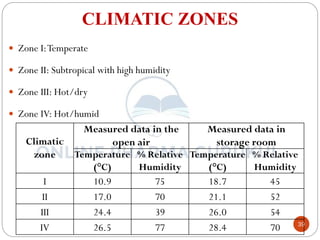
CLIMATIC ZONES
 Zone I:Temperate
 Zone II: Subtropical with high humidity
 Zone III: Hot/dry
 Zone IV: Hot/humid
Climatic
zone
Measured data in the
open air
Measured data in
storage room
Temperature
(°C)
% Relative
Humidity
Temperature
(°C)
% Relative
Humidity
I 10.9 75 18.7 45
II 17.0 70 21.1 52
III 24.4 39 26.0 54
IV 26.5 77 28.4 70
40
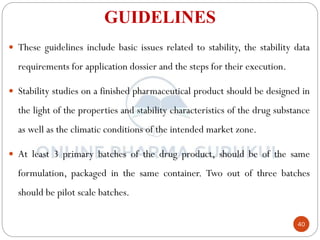
GUIDELINES
 These guidelines include basic issues related to stability, the stability data
requirements for application dossier and the steps for their execution.
 Stability studies on a finished pharmaceutical product should be designed in
the light of the properties and stability characteristics of the drug substance
as well as the climatic conditions of the intended market zone.
 At least 3 primary batches of the drug product, should be of the same
formulation, packaged in the same container. Two out of three batches
should be pilot scale batches.
41
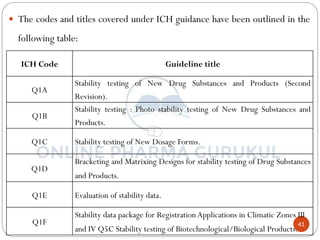
 The codes and titles covered under ICH guidance have been outlined in the
following table:
ICH Code Guideline title
Q1A
Stability testing of New Drug Substances and Products (Second
Revision).
Q1B
Stability testing : Photo stability testing of New Drug Substances and
Products.
Q1C Stability testing of New Dosage Forms.
Q1D
Bracketing and Matrixing Designs for stability testing of Drug Substances
and Products.
Q1E Evaluation of stability data.
Q1F
Stability data package for RegistrationApplications in Climatic Zones III
and IV Q5C Stability testing of Biotechnological/Biological Products.
42
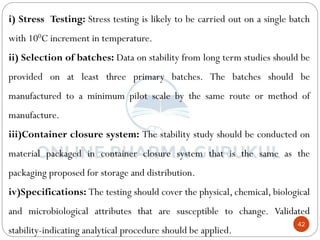
i) Stress Testing: Stress testing is likely to be carried out on a single batch
with 100C increment in temperature.
ii) Selection of batches: Data on stability from long term studies should be
provided on at least three primary batches. The batches should be
manufactured to a minimum pilot scale by the same route or method of
manufacture.
iii)Container closure system: The stability study should be conducted on
material packaged in container closure system that is the same as the
packaging proposed for storage and distribution.
iv)Specifications: The testing should cover the physical, chemical, biological
and microbiological attributes that are susceptible to change. Validated
stability-indicating analytical procedure should be applied.
43
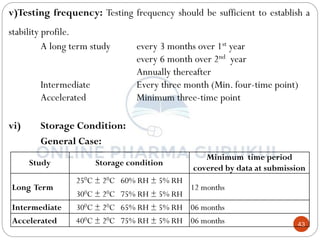
v)Testing frequency: Testing frequency should be sufficient to establish a
stability profile.
A long term study every 3 months over 1st year
every 6 month over 2nd year
Annually thereafter
Intermediate Every three month (Min. four-time point)
Accelerated Minimum three-time point
vi) Storage Condition:
General Case:
Study Storage condition
Minimum time period
covered by data at submission
Long Term
250C ± 20C 60% RH ± 5% RH
300C ± 20C 75% RH ± 5% RH
12 months
Intermediate 300C ± 20C 65% RH ± 5% RH 06 months
Accelerated 400C ± 20C 75% RH ± 5% RH 06 months
44
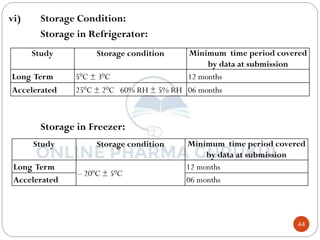
vi) Storage Condition:
Storage in Refrigerator:
Storage in Freezer:
Study Storage condition Minimum time period covered
by data at submission
Long Term 50C ± 30C 12 months
Accelerated 250C ± 20C 60% RH ± 5% RH 06 months
Study Storage condition Minimum time period covered
by data at submission
Long Term
– 200C ± 50C
12 months
Accelerated 06 months
45
ACCELERATED STABILITY
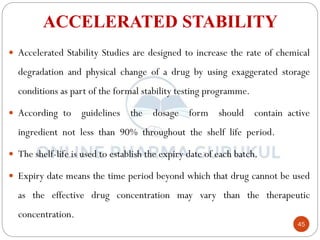
 Accelerated Stability Studies are designed to increase the rate of chemical
degradation and physical change of a drug by using exaggerated storage
conditions as part of the formal stability testing programme.
 According to guidelines the dosage form should contain active
ingredient not less than 90% throughout the shelf life period.
 The shelf-life is used to establish the expiry date of each batch.
 Expiry date means the time period beyond which that drug cannot be used
as the effective drug concentration may vary than the therapeutic
concentration.
46
Objective:
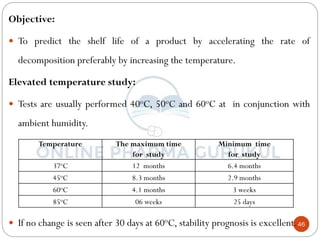
 To predict the shelf life of a product by accelerating the rate of
decomposition preferably by increasing the temperature.
Elevated temperature study:
 Tests are usually performed 40oC, 50oC and 60oC at in conjunction with
ambient humidity.
 If no change is seen after 30 days at 60oC, stability prognosis is excellent.
Temperature The maximum time
for study
Minimum time
for study
37oC 12 months 6.4 months
45oC 8.3 months 2.9 months
60oC 4.1 months 3 weeks
85oC 06 weeks 25 days
47
 A tentative shelf-life of 24 months may be established provided the
following conditions are satisfied:
i) The active ingredient is known to be stable (not easily degradable);
stability studies have been performed and no significant changes have
been observed.
ii) Supporting data indicate that similar formulations have been
assigned a shelf life of 24 months or more.
iii) The manufacturer will continue to conduct real-time studies until
the proposed shelf-life has been covered and the results obtained will
be submitted to the registration authority.
48
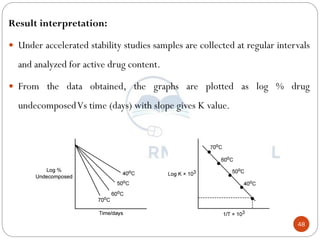
Result interpretation:
 Under accelerated stability studies samples are collected at regular intervals
and analyzed for active drug content.
 From the data obtained, the graphs are plotted as log % drug
undecomposedVs time (days) with slope gives K value.
49
Dr.VAIBHAV G. BHAMARE
(91)7588176846
vaibhav.bhamre@gmail.com
subscribe on you tube to

SY - PP II - Drug Stability.pdf

  • 1.
    DRUG STABILITY By, Dr. VaibhavG. Bhamare Ph. D, M. Pharm, MBA
  • 2.
    2 INTRODUCTION Reaction Kinetics Drug stability is measured by the rate of changes that take place in the pharmaceutical dosage forms.  Reaction kinetics has been found useful to investigate and solve or explain the mechanisms of reactions.  The experimental study of reaction rates to infer about the kinetic mechanisms for chemical conversion of reactants (R) into products (P) is referred to as chemical kinetics.  Reaction takes place by various mechanism and a various number of principles and related rate processes are implicit in a chain of events like Stability and incompatibility, Dissolution, Pharmacokinetics and Drug action.
  • 3.
    3 Types of Reactions There are two types of reactions: i)Equilibrium reaction: These are the reactions where the rate of two opposing reactions are equal and the concentration of reactant or product do not change with time. ii)Spontaneous reaction: These are the reactions which occur from left to right till all reactant is converted to products.
  • 4.
    4 TERMINOLOGIES i) Chemical kinetics: -Chemical Kinetics can be defined as the branch of chemistry which deals with the study of the rate of reaction. - Various factors which contribute to the rate of a reaction include concentration, temperature, pressure and presence of a catalyst. ii) Rate of reaction: - Rate of reaction is the change in concentration of reactant per unit time. - Rate of reaction is given by ± dc dt i.e. change in concentration "C" within a given time interval "dt".
  • 5.
    5 ii) Rate ofreaction: Law of Mass action states that the rate of a chemical reaction is directly proportional to the active mass of reacting substances. OR The rate of a chemical reaction is proportional to the product of the molar concentration of reactant each raised to a power equal to the number of molecules of a substance undergoing reaction. i.e. xA + yB  product where, K is proportionality constant called as the rate constant and equation is called as Rate law or Rate equation. y x ] B [ ] A [ Rate   y x ] B [ ] A [ K Rate  
  • 6.
    6 iii) Order ofreaction: - Order of reaction is defined as the sum of the exponents of the concentration terms that afford a linear plot when the rate of reaction is plotted as a function of the concentration of the reactant. - Order of reaction is the sum of the power of concentration in the rate law. - Order of reaction = (x + y) First-order i.e. x + y = 1 Second-order i.e. x + y = 2 Third-order i.e. x + y = 3 Zero-order i.e. reaction proceeds independent of concentration terms. y x ] B [ ] A [ K Rate When 
  • 7.
    7 iv) Molecularity ofreaction: Molecularity of reaction is the number of atoms or molecules or ions that take part in the reaction. i) Unimolecular: Involve only one molecule trans. ii) Bimolecular: Involve a reaction between two molecule. iii) Termolecular: Involve more than two molecular reactions appearing termolecular often consist of a sequence of bimolecular steps.
  • 8.
    8 Order of ReactionMolecularity of Reaction It is the sum of the power of concentration. It is the number of reacting species. It is experimentally determined value. It is a theoretical concept. It can have a fractional value. It is an integral number. It can assume zero value. It cannot have zero value. It can change with conditions. It is invariant for a chemical equation.
  • 9.
    9 v) Specific RateConstant: - The proportionality constant appearing in rate law associated with a single step (elementary) reaction is called a specific rate constant for that reaction. - Any change in conditions of the reaction e.g. temperature solvent will lead to a rate law having a different value for specific rate constant. - Experimentally, a change of specific rate constant corresponds simply to changes in the slope of a line given by rate equation.
  • 10.
    10 Order of Reaction -Order of reaction is defined as the sum of the exponents of the concentration terms that afford a linear plot when the rate of reaction is plotted as a function of the concentration of the reactant. - Order of reaction is the sum of the power of concentration in the rate law. - Order of reaction = (x + y) First-order i.e. x + y = 1 Second-order i.e. x + y = 2 Third-order i.e. x + y = 3 Zero-order i.e. reaction proceeds independent of concentration terms.
  • 11.
    11 ZERO Order ofReaction  If the rate of chemical reaction remains constant during the progress of the reaction, it is called a zero-order reaction.  Zero order reaction proceeds independent of concentration term of reactions. where, Ko is the specific rate constant Eqn. (1) can be written as o K dt dc    dt K dc o   Now, integrating both sides from 0 to t dt K dc t o o C C t o      t K C C o t o    t o o C t K C    t K C C o o t    Where, Co is initial concentration Ct is concentration at time t 1 1 Second liter Moles   : Unit
  • 12.
    FIRST Order ofReaction  Now, solving and converting to log log10 Co Ct = K1 t 2.303  Equation gives rate constant for the first order  In the first-order reaction, the rate of reaction is directly proportional to the concentration of one of the reactant - dc dt ∝ C - dc dt = K1C where, K1is the proportionality constant Now, integrating above equation Co C1 dc dt = K1 o t 𝑑𝑡 t K C C ln 1 t o  t o 10 C C log t 303 . 2 K   1 1 sec or min   : Unit
  • 13.
    SECOND Order ofReaction  In the simplest case when a = b, then equation (2) can be written as  Integrating the above equation,  In the second-order reaction, the rate of reaction depends on the concentration terms of reactant raised to power one.  Suppose in reaction A + B  Product where K2 is Second-order rate constant If 'a' and 'b' are the initial concentration of A and B when t = 0 and if ‘x’ is the concentration of each species when t = t then ] B [ ] A [ dt ] B [ d dt ] A [ d        ] B [ ] A [ K dt ] B [ d dt ] A [ d 2        ) x b ( ) x a ( K dt dx 2    2 2 ) x a ( K dt dx   dt K ) x a ( dx 2 2    dt K ) x a ( dx t 0 2 2 x 0     t K 0 a 1 x a 1 2                  t K ) x a ( a x 2             x a x at 1 K2
  • 14.
    SECOND Order ofReaction  Equation (4) gives second-order reaction when a = b and when a ≠ b, integration of equation (2) becomes  Equation (5) gives the second-order reaction when a ≠ b t K ) x b ( a ) x a ( b log b a 303 . 2 2     ) x b ( a ) x a ( b log ) b a ( t 303 . 2 K2      1 1 second mol Liter   : Unit Comparison of 1st, 2nd and zero order
  • 15.
    HALF LIFE As Equationis Considering half-life, the equation becomes Equation gives half-life for a zero-order reaction Zero Order First Order Half-life (t1/2) is the time required for a reactant to reduce to half of its initial concentration. t K C C o o t   2 1 o t t t and 2 C C   2 1 o o t K 2 C   o o 2 / 1 K 2 C t   As Equation is Substituting in equation Equation (4) gives half-life for 1st order reaction t o 10 C C log t 303 . 2 K   2 1 o t t t and 2 C C   2 / o o 10 2 / 1 1 C C log t 303 . 2 K   o o 10 2 / 1 1 C 2 C log t 303 . 2 K   2 log t 303 . 2 K 10 2 / 1 1   1 2 / 1 K 693 . 0 t  
  • 16.
    HALF LIFE As Equationis Substituting in equation Equation gives half-life for 2nd order reaction. Second Order          x a x at 1 K2 2 / 1 t t and 2 a x   2 / a a 2 / a at 1 K 2 / 1 2   2 2 / 1 ak 1 t   Order Integrated Rate equation Half-life Equation Unit of K Zero moles litre-1 sec-1 First min-1 or sec-1 Second Litre moles-1 sec-1 t ) C C ( K t o   t o 10 1 C C log t 303 . 2 K  1 2 / 1 K 693 . 0 t          x a x at 1 K2 2 2 / 1 aK 1 t  Summary o o 2 / 1 K 2 C t  
  • 17.
    DETERMINATION OF ORDER OFREACTION By, Dr. Vaibhav G. Bhamare Ph. D, M. Pharm, MBA
  • 18.
    18 INTRODUCTION  The orderof reaction can be determined by several methods i) Substitution method or integration ii) Graphical method iii) Half-life method iv) Ostwald’s isolation method v)Van’t Hoff Differential Method
  • 19.
    19 SUBSTITUTION METHOD  Thisis a trial and error method in which reaction is performed by taking a different initial concentration of the reactant (a).  The concentrations of the reactant (a-x) were noted at regular time interval t.  These values of a, (a-x) were substituted into the integrated rate equation for first, second order.  The equation that gives a constant value of K is considered to be the order of the reaction.
  • 20.
    20 GRAPHICAL METHOD  Aplot of data in the form of the graph may also be used to ascertain the order.  The reaction is said to be zero-order if straight-line results when concentration is plotted against time.  The reaction is first order if log (a-x)Vs time yields a straight line.  The reaction is second order if 1/(a-x)Vs time gives a straight line.
  • 21.
    21 HALF LIFE METHOD In this method half-life is determined as a function of concentration  Half-life α initial concentration …………. Zero-order  Half-life is independent on initial concentration …… First-order  Half Life ∝ 1 initial concentration ………… Second order  Half Life ∝ 1 initial concentrationn−1 ………… n order of the reaction.  Thus, If two reactions are run at different initial concentration, the half- lives are related
  • 22.
    22 OSTWALD’S ISOLATION METHOD Ostwald’s isolation method is generally used for determining the order of complex reaction whose rate is influenced by more than two ingredients.  Consider reaction A + B + C  Product  The order of reaction with respect to three reactants is given by, n = nA + nB + nC  nA is determined by taking B and C in excess concentration similarly nB is determined by taking A and C in excess and so with nC by taking A and B in excess concentration.
  • 23.
    23 VAN’T HOFF DIFFERENTIAL METHOD The rate of reaction of nth order is directly proportional to the concentration - dc dt ∝ Cn - dc dt = KCn ……. (1)  Now for two experiments with two different initial concentrations - dc1 dt = KC1 n - dc2 dt = KC2 n  Applying log ….. (2) ….. (3)  Subtracting (3) from (2) 1 1 C log n k log dt dc log          2 2 C log n k log dt dc log          ) C log n k (log ) C log n k (log dt dc log dt dc log 2 1 2 1                    2 1 2 1 C log n C log n dt dc log dt dc log                   log( − dc1 dt ) − log( − dc2 dt ) = n(logC1 − log C2 ) log( − dc1 dt ) − log( − dc2 dt ) (logC1 − log C2 ) = n
  • 24.
    DEGRADATION IN PHARMACEUTICAL PRODUCT By, Dr.Vaibhav G. Bhamare Ph. D, M. Pharm, MBA
  • 25.
    25  The differentphysical and chemical factors which affect the chemical degradation of pharmaceutical product are 1)Temperature 2) Solvent 3) Dielectric constant 4) Ionic strengths 5) Specific and general acid-base catalysis.
  • 26.
    26 TEMPERATURE  Generally, anincrease in temperature increases the rate of reaction.  High temperature accelerates oxidation, reduction and hydrolysis reaction which leads to drug degradation  The rate of reaction doubles with every 100C rise in temperature.  Swedish scientist Svante Arrhenius was the pioneer, who provided the first kinetic model to illustrate the effect of temperature on reaction rate. K – Specific Rate constant A - Arrhenius factor / frequency factor is the product of no. of collisions and probability of collisions which give a reaction product Ea - Energy of activation is the minimum energy that a molecule should possess to produce the product. R - Gas constant (1.987 cal/ mol. Deg.) T -Absolute temp. RT / Ea Ae K  
  • 27.
    27 SOLVENT  Acidic andalkaline pH of solvent influence the rate of decomposition of most drugs.  Replacing an aqueous solvent in a formulation with a non-aqueous one is a potential means of avoiding hydrolysis.  Weekly acidic and basic drugs show good solubility when they are ionized and they also decompose faster when they are ionized.  Reactions catalyzed by pH are monitored by measuring degradation rates against pH, keeping temperature, ionic strength and solvent concentration constant.
  • 28.
    28 DIELECTRIC CONSTANT  Thedielectric constant of a solvent is related to its polarity, more polar solvents having higher values.  The dielectric constant can influence the rate at which charged species react. However, the practical considerations of choosing a solvent for a formulation, such as its toxicity and compatibility with the drug, usually outweigh consideration of any effect due to the solvent’s dielectric constant.
  • 29.
    29 IONIC STRENGTH  Theionic strength of a medium is related to the concentration of ionic species in it.  Changing the ionic strength by adding electrolyte to a solution has some influence on the rate of many degradation reactions.  For drug degradation involving reaction with or between ionic species, the rate is affected by the presence of other ionic species such as salts like sodium chloride.  Ionic strength affects the observed degradation rate constant K, by its effect on the activity coefficient f.
  • 30.
    30 ACID BASE CATALYSIS The term "general" refers to the fact that any acid or base we add to the solution will affect the rate of the reaction and hence the catalysis is quite general. The term" specific" refers to the fact that just one acid or base, that from the solvent, affects the rate. The catalysis is therefore very specific.  Specific-acid catalysis refers to a process in which the reaction rate depends upon the specific acid and not upon other acids present in the solution.  If the acid catalyst is involved in equilibrium prior to the rate determining step and it is not involved in the rate-determining step, then the kinetics of the reaction will depend solely upon the concentration of the specific acid.
  • 31.
    STABILIZATION OF MEDICINAL AGENTS By, Dr.Vaibhav G. Bhamare Ph. D, M. Pharm, MBA
  • 32.
    32 HYDROLYSIS  Hydrolysis isthe most common form of drug degradation due to the prevalence of water in isolation procedures, formulation strategies and a large number of functional groups that can undergo hydrolysis.  Hydrolysis generally occurs via an acid or base catalyzed mechanism but can also occur under neutral conditions where water can act as a base.  Molecular hydrolysis reactions proceed much slower than ionic type.  The carbonyl function of esters, lactones, amides, lactams, carbamates and imides are susceptible to hydrolysis, as are imines.
  • 33.
    33 OXIDATION  Oxidative degradationoften presents unique patterns of drug degradation (eg, rapid growth of impurities following an induction period and sensitivity to trace amounts of free radicals).  Oxidation-Reduction reactions are mediated by free radicals or by molecular oxygen.  Reaction of any material with molecular oxygen is known as auto- oxidation.  Oxidative reactions can be catalyzed by oxygen, heavy metal ins and light leading to free radical formation.
  • 34.
    34 ISOMERIZATION  Isomerization involvesthe conversion of chemical into its optical or geometric isomer.  Many isomers are roughly equal in bond energy and so exist in roughly equal amounts, provided that they can convert somewhat freely that is, the energy barrier between the two isomers is not too high.  Isomerization, the process by which a compound is transformed into any of its isomeric forms, i.e. forms with the same chemical composition but with different and hence, generally with different physical and chemical properties.  Cis–trans isomerization is also called geometrical isomerization, which describes the relative orientation of functional groups within a molecule that, in general, contain double bonds.
  • 35.
    35 PHOTOLYSIS  Decomposition ofdrugs due to absorption of radiant energy in form of light known as photolysis.  Photodegradation is the alteration of materials by light. Typically, the term refers to the combined action of sunlight and air. Photodegradation is usually oxidation and hydrolysis.  Energy absorption is greater at lower wavelength. Photo-chemical reactions are initiated by the absorption of a photon, typically in the wavelength range 290-700 nm (at the surface of the Earth). The energy of an absorbed photon is transferred to electrons in the molecule and briefly changes their configuration.
  • 36.
    STABILITY TESTING By, Dr. VaibhavG. Bhamare Ph. D, M. Pharm, MBA
  • 37.
    37 INTRODUCTION  The purposeof stability testing is to provide evidence on how the quality of active pharmaceutical ingredient or medicinal product varies with time under the influence of a variety of environmental factors.  Stability of pharmaceutical product may be defined as the capability of particular formulation in a specific container closure system to remain within its physical, chemical, therapeutic and toxicological specifications.  Pharmaceutical products are expected to meet their specifications for identifying purity, quality and strength throughout their defined storage period at specific storage condition.
  • 38.
    38  Such guidelineswere initially issued in 1980s. These were later harmonized (made uniform) in the International Conference on Harmonization (ICH) in order to overcome the bottleneck to market and register the products in other countries.  ICH has given a guideline on stability testing in 1993 as quality guidelines, safety guidelines, efficacy guidelines and multidisciplinary guidelines.  The World Health Organization (WHO), in 1996, modified the ICH guidelines.  WHO, in 2004, also released guidelines for stability studies in global environment (WHO, 2004). ICH guidelines were also extended later for veterinary products.
  • 39.
    39 CLIMATIC ZONES  ZoneI:Temperate  Zone II: Subtropical with high humidity  Zone III: Hot/dry  Zone IV: Hot/humid Climatic zone Measured data in the open air Measured data in storage room Temperature (°C) % Relative Humidity Temperature (°C) % Relative Humidity I 10.9 75 18.7 45 II 17.0 70 21.1 52 III 24.4 39 26.0 54 IV 26.5 77 28.4 70
  • 40.
    40 GUIDELINES  These guidelinesinclude basic issues related to stability, the stability data requirements for application dossier and the steps for their execution.  Stability studies on a finished pharmaceutical product should be designed in the light of the properties and stability characteristics of the drug substance as well as the climatic conditions of the intended market zone.  At least 3 primary batches of the drug product, should be of the same formulation, packaged in the same container. Two out of three batches should be pilot scale batches.
  • 41.
    41  The codesand titles covered under ICH guidance have been outlined in the following table: ICH Code Guideline title Q1A Stability testing of New Drug Substances and Products (Second Revision). Q1B Stability testing : Photo stability testing of New Drug Substances and Products. Q1C Stability testing of New Dosage Forms. Q1D Bracketing and Matrixing Designs for stability testing of Drug Substances and Products. Q1E Evaluation of stability data. Q1F Stability data package for RegistrationApplications in Climatic Zones III and IV Q5C Stability testing of Biotechnological/Biological Products.
  • 42.
    42 i) Stress Testing:Stress testing is likely to be carried out on a single batch with 100C increment in temperature. ii) Selection of batches: Data on stability from long term studies should be provided on at least three primary batches. The batches should be manufactured to a minimum pilot scale by the same route or method of manufacture. iii)Container closure system: The stability study should be conducted on material packaged in container closure system that is the same as the packaging proposed for storage and distribution. iv)Specifications: The testing should cover the physical, chemical, biological and microbiological attributes that are susceptible to change. Validated stability-indicating analytical procedure should be applied.
  • 43.
    43 v)Testing frequency: Testingfrequency should be sufficient to establish a stability profile. A long term study every 3 months over 1st year every 6 month over 2nd year Annually thereafter Intermediate Every three month (Min. four-time point) Accelerated Minimum three-time point vi) Storage Condition: General Case: Study Storage condition Minimum time period covered by data at submission Long Term 250C ± 20C 60% RH ± 5% RH 300C ± 20C 75% RH ± 5% RH 12 months Intermediate 300C ± 20C 65% RH ± 5% RH 06 months Accelerated 400C ± 20C 75% RH ± 5% RH 06 months
  • 44.
    44 vi) Storage Condition: Storagein Refrigerator: Storage in Freezer: Study Storage condition Minimum time period covered by data at submission Long Term 50C ± 30C 12 months Accelerated 250C ± 20C 60% RH ± 5% RH 06 months Study Storage condition Minimum time period covered by data at submission Long Term – 200C ± 50C 12 months Accelerated 06 months
  • 45.
    45 ACCELERATED STABILITY  AcceleratedStability Studies are designed to increase the rate of chemical degradation and physical change of a drug by using exaggerated storage conditions as part of the formal stability testing programme.  According to guidelines the dosage form should contain active ingredient not less than 90% throughout the shelf life period.  The shelf-life is used to establish the expiry date of each batch.  Expiry date means the time period beyond which that drug cannot be used as the effective drug concentration may vary than the therapeutic concentration.
  • 46.
    46 Objective:  To predictthe shelf life of a product by accelerating the rate of decomposition preferably by increasing the temperature. Elevated temperature study:  Tests are usually performed 40oC, 50oC and 60oC at in conjunction with ambient humidity.  If no change is seen after 30 days at 60oC, stability prognosis is excellent. Temperature The maximum time for study Minimum time for study 37oC 12 months 6.4 months 45oC 8.3 months 2.9 months 60oC 4.1 months 3 weeks 85oC 06 weeks 25 days
  • 47.
    47  A tentativeshelf-life of 24 months may be established provided the following conditions are satisfied: i) The active ingredient is known to be stable (not easily degradable); stability studies have been performed and no significant changes have been observed. ii) Supporting data indicate that similar formulations have been assigned a shelf life of 24 months or more. iii) The manufacturer will continue to conduct real-time studies until the proposed shelf-life has been covered and the results obtained will be submitted to the registration authority.
  • 48.
    48 Result interpretation:  Underaccelerated stability studies samples are collected at regular intervals and analyzed for active drug content.  From the data obtained, the graphs are plotted as log % drug undecomposedVs time (days) with slope gives K value.
  • 49.