Order of a reaction
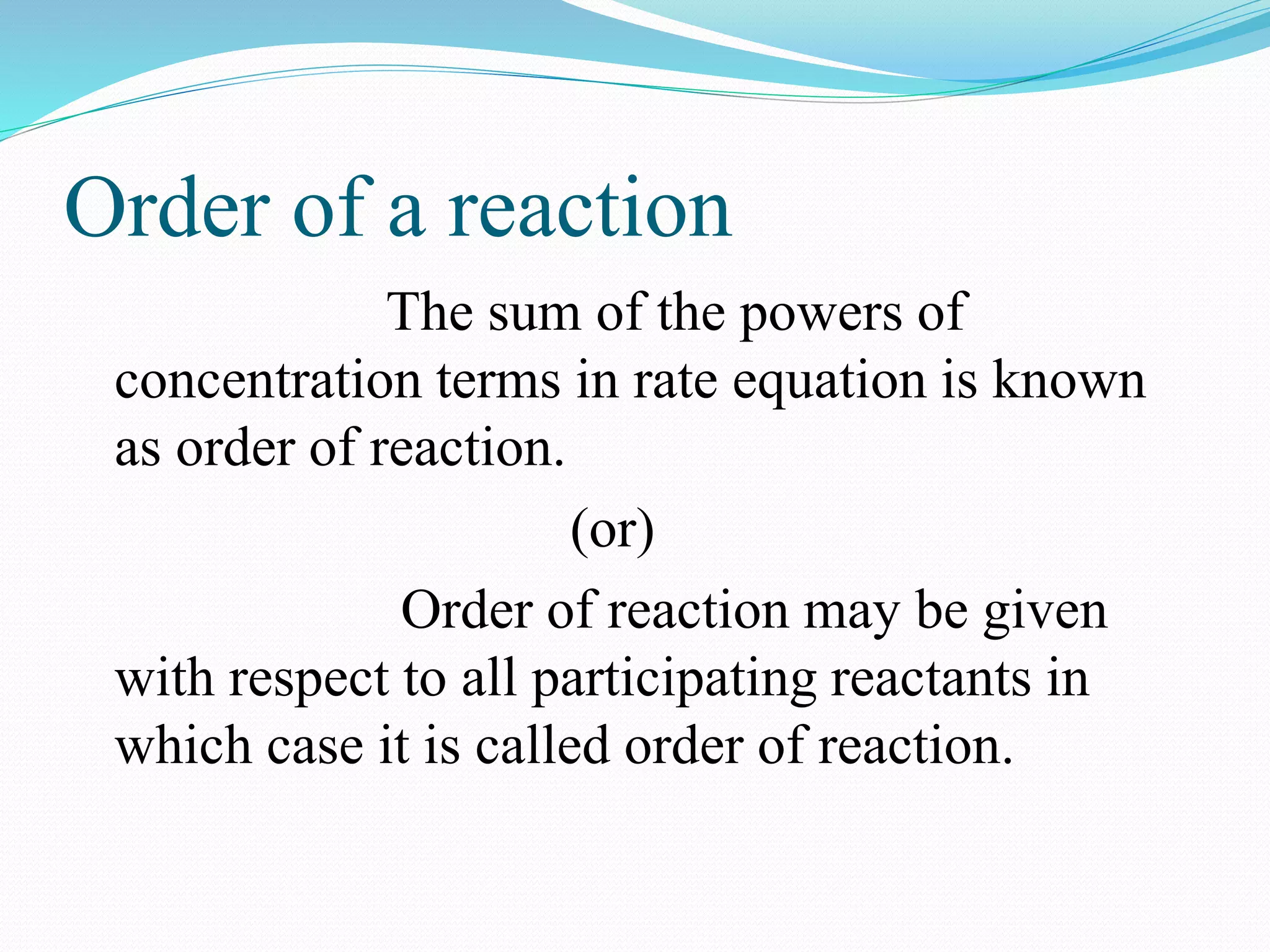
The sum of the powers of
concentration terms in rate equation is known
as order of reaction.
(or)
Order of reaction may be given
with respect to all participating reactants in
which case it is called order of reaction.
Consider a reaction mA + nB product
Rate eq (R)=k[A]m[B]n
Order = m + n
Zero Order Reaction
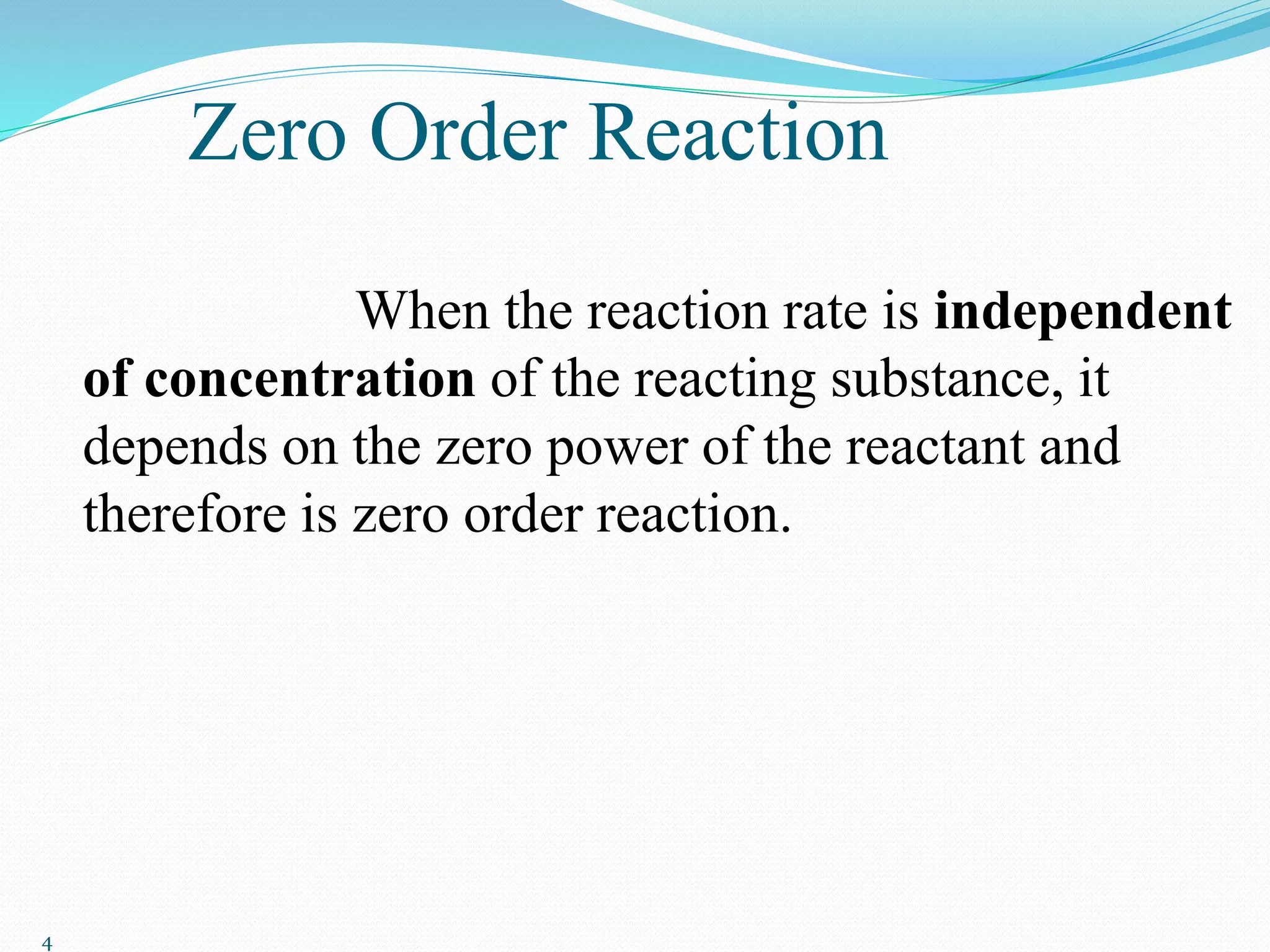
When the reaction rate is independent
of concentration of the reacting substance, it
depends on the zero power of the reactant and
therefore is zero order reaction.
4
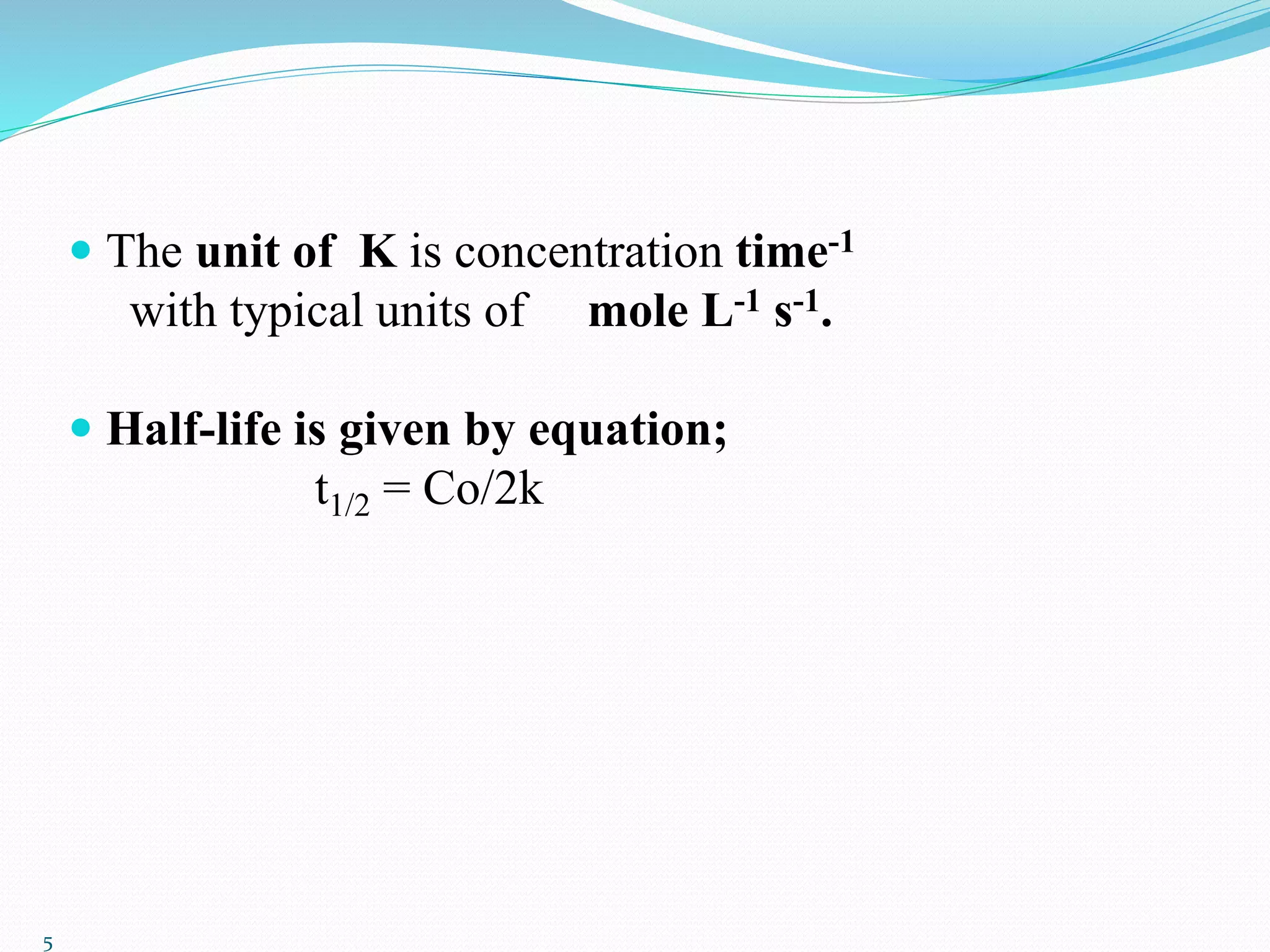
 The unit of K is concentration time-1
with typical units of mole L-1 s-1.
 Half-life is given by equation;
t1/2 = Co/2k
5
First order Reaction
First order reaction consists of one reactant.
A product
R = k[A]1
Rate constant for first order reaction:
k = 2.303 . log(a/a-x)
t
where, a=initial conc. of A in mol/lit
a-x=change in initial conc. of A in
mol/lit in time interval ’t’
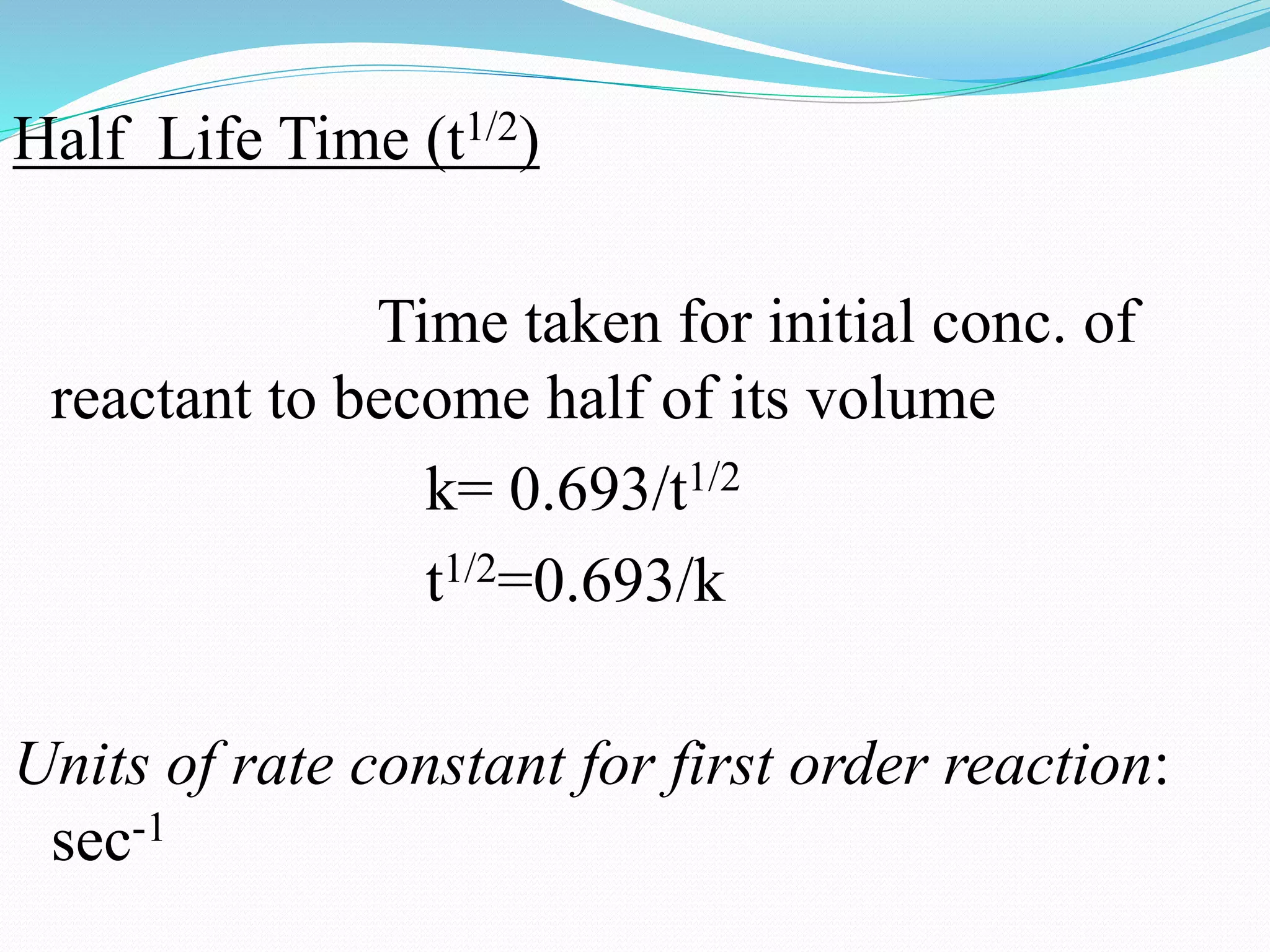
Half Life Time (t1/2)
Time taken for initial conc. of
reactant to become half of its volume
k= 0.693/t1/2
t1/2=0.693/k
Units of rate constant for first order reaction:
sec-1
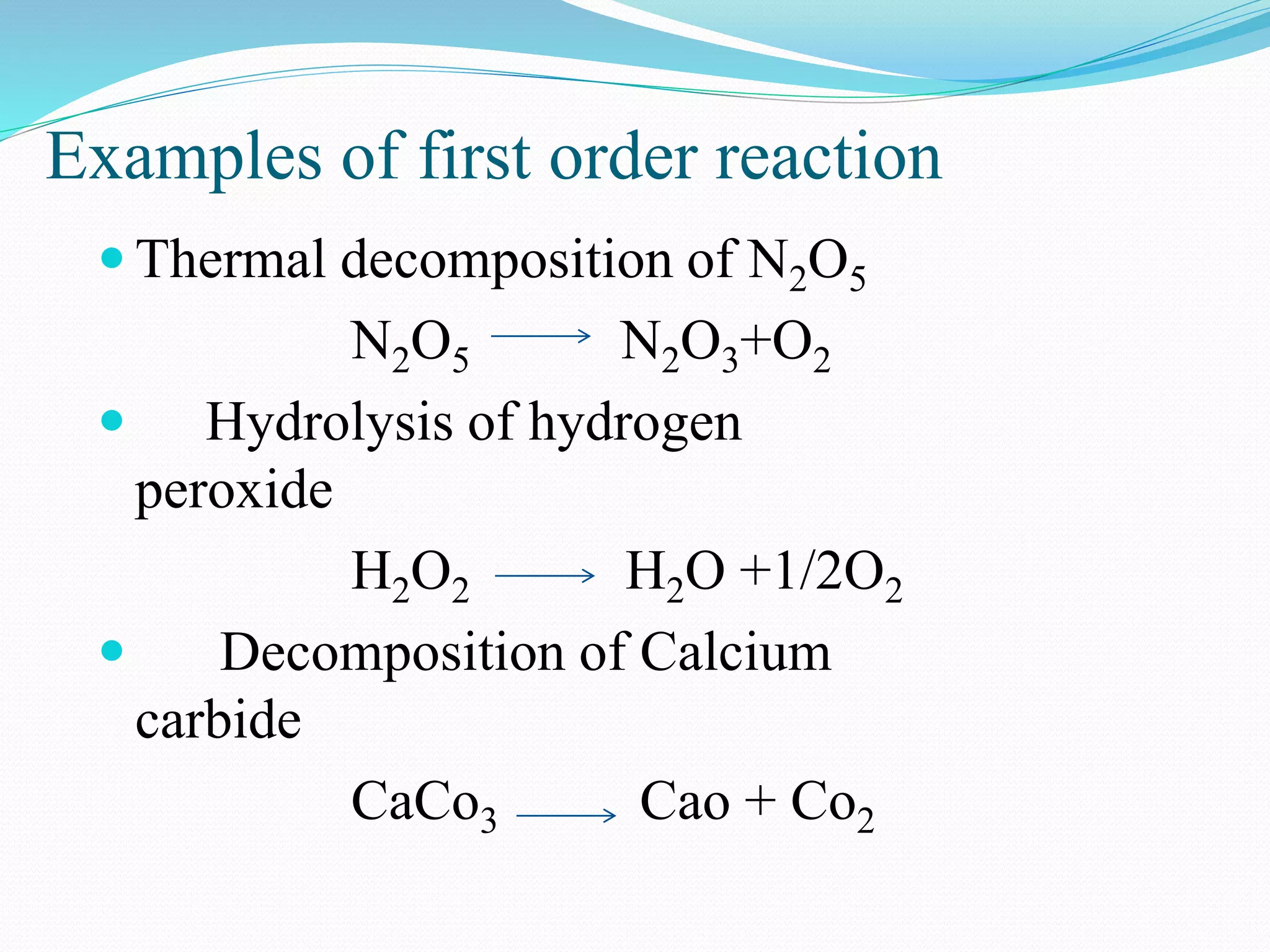
Examples of first order reaction
 Thermal decomposition of N2O5
N2O5 N2O3+O2
 Hydrolysis of hydrogen
peroxide
H2O2 H2O +1/2O2
 Decomposition of Calcium
carbide
CaCo3 Cao + Co2
Second Order Of Reaction
Second order reaction consists
of two reactants.
2A products
A+B products
Rate = k[A]2 ; n=2
Rate = k[A] [B] ; n=1+1=2
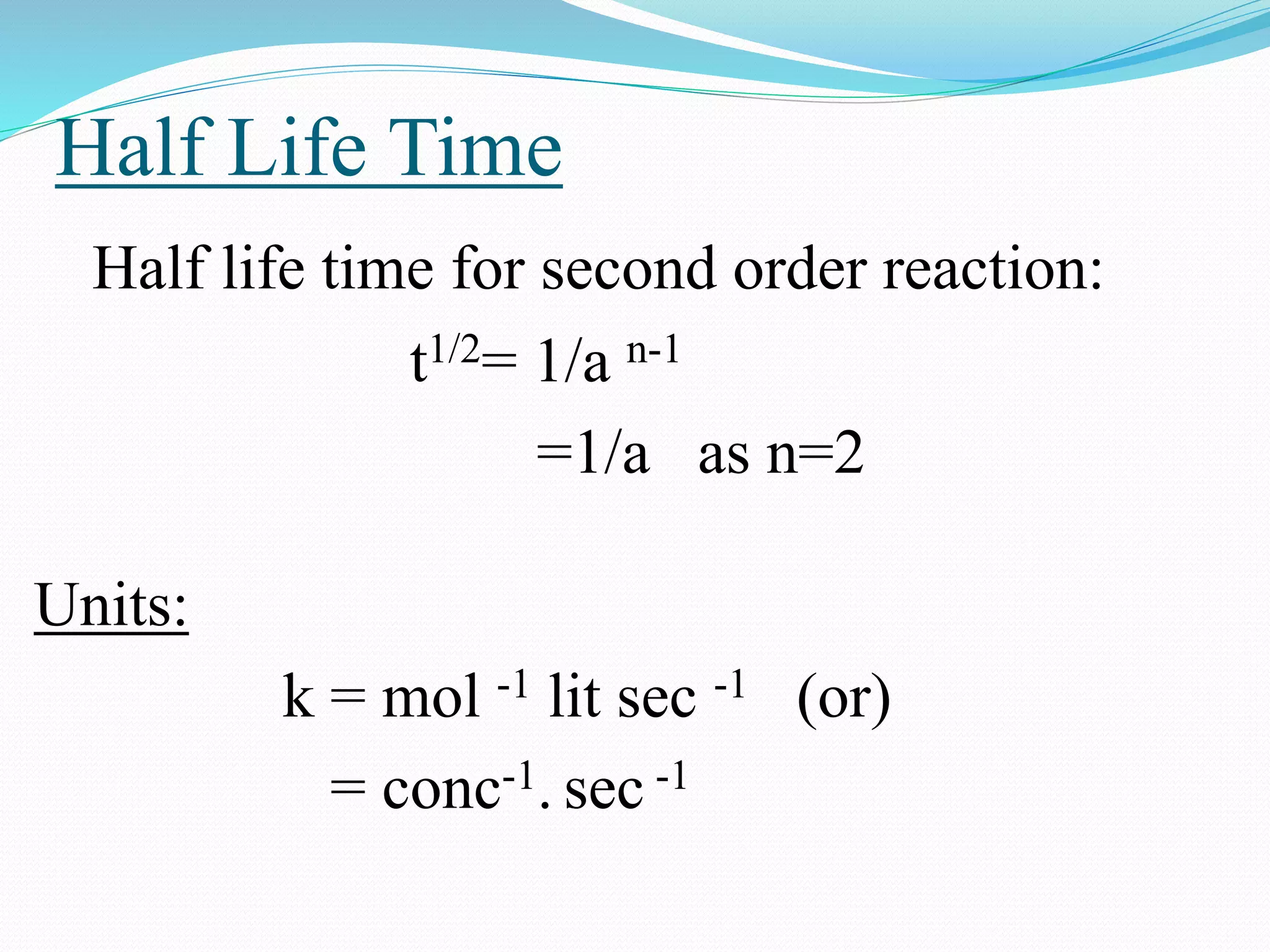
Half Life Time
Half life time for second order reaction:
t1/2= 1/a n-1
=1/a as n=2
Units:
k = mol -1 lit sec -1 (or)
= conc-1. sec -1
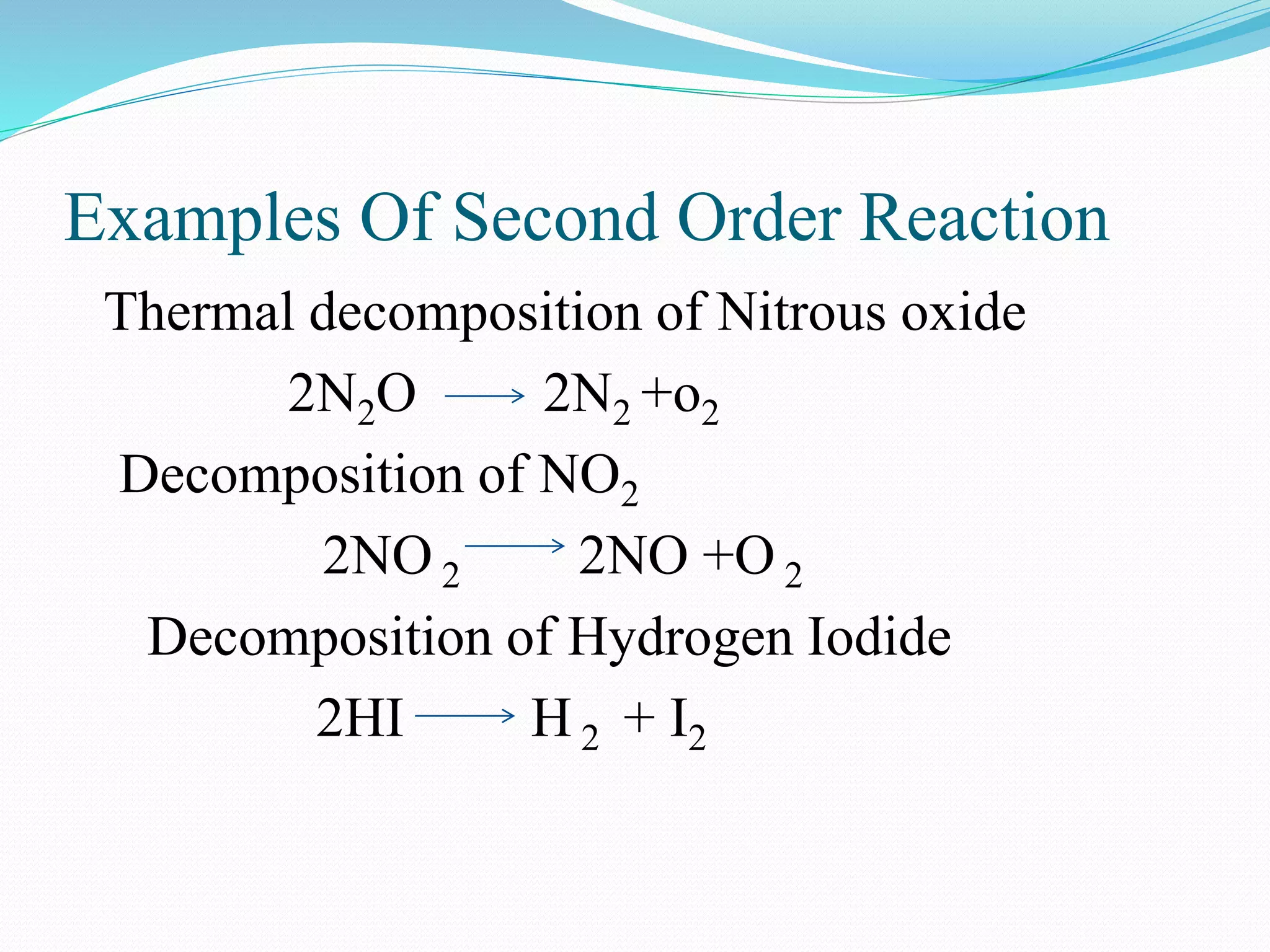
Examples Of Second Order Reaction
Thermal decomposition of Nitrous oxide
2N2O 2N2 +o2
Decomposition of NO2
2NO 2 2NO +O 2
Decomposition of Hydrogen Iodide
2HI H 2 + I2
Third Order Reaction
Third order reaction includes three
reactants
3A Products
r = k [A] 3
A+B+C Products
r = k [A] [B] [C]
2A+B Products
r = k [A]2 [B]
Half Life Time
Half life time for third order reaction
t ½ = 1/a n-1
= 1/a 3-1 = 1/ a2
[as n=3]
Units:
k = mol -2 lit 2 sec -1
= conc. -2 sec -1
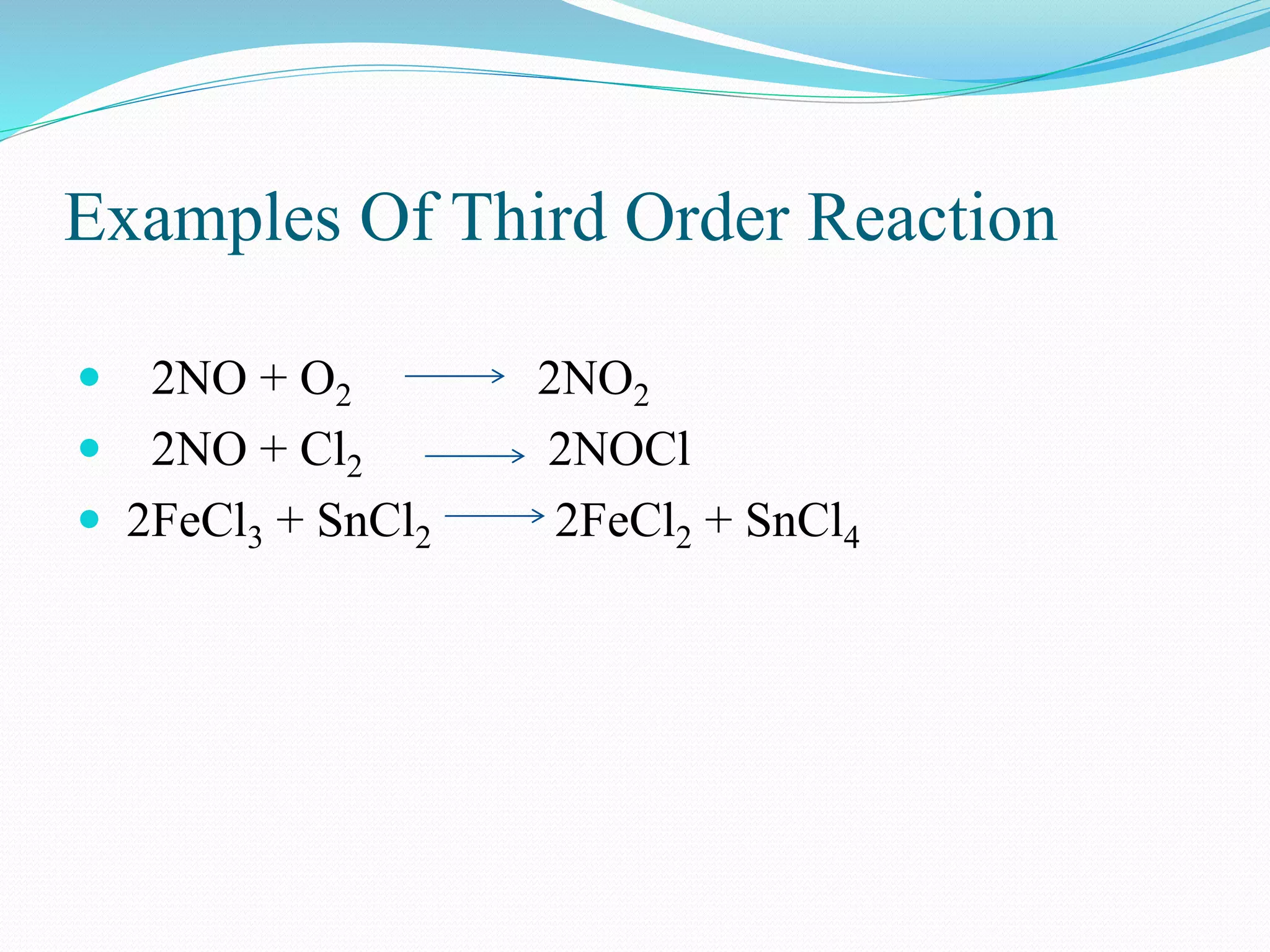
Examples Of Third Order Reaction
 2NO + O2 2NO2
 2NO + Cl2 2NOCl
 2FeCl3 + SnCl2 2FeCl2 + SnCl4
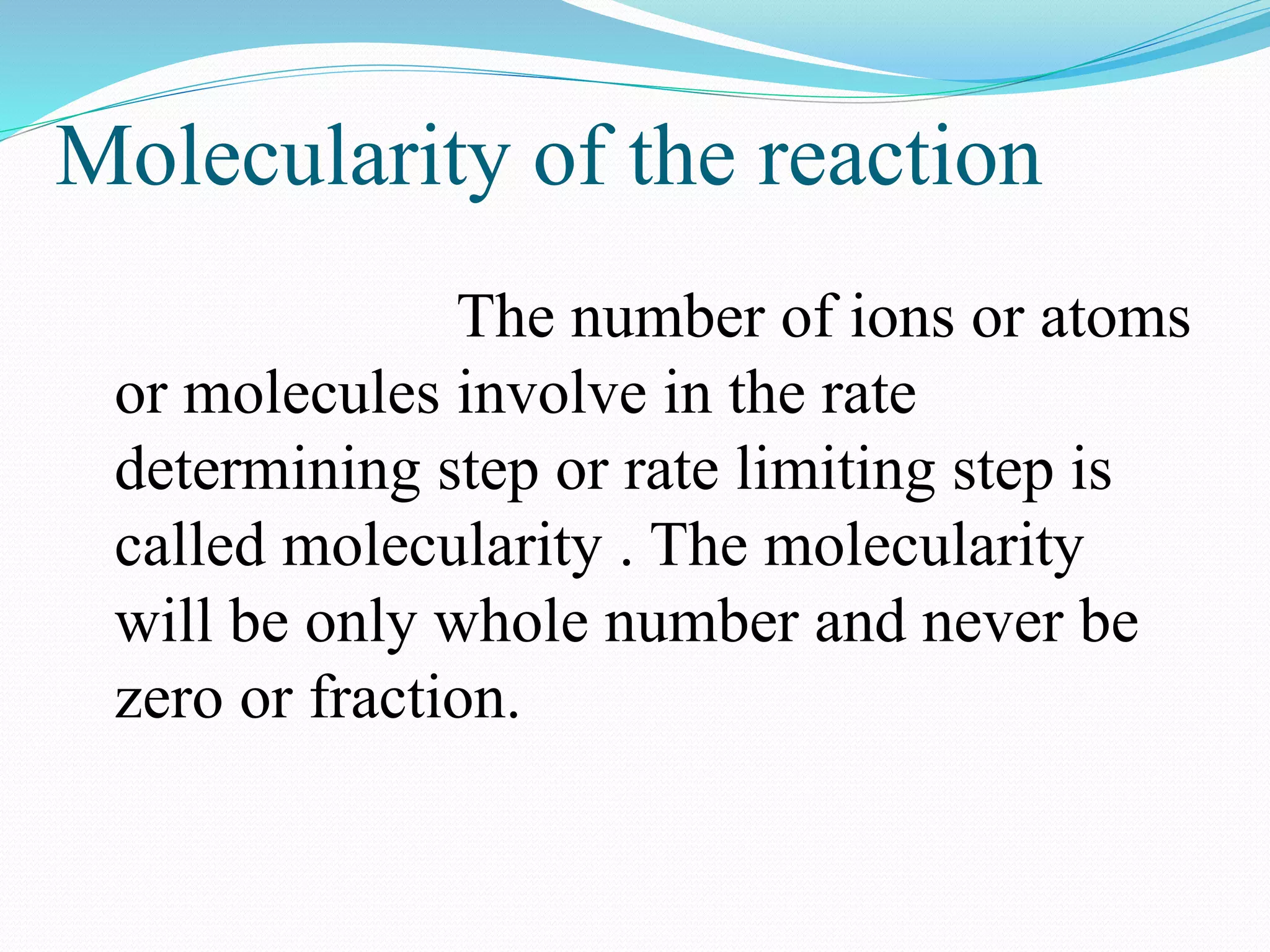
Molecularity of the reaction
The number of ions or atoms
or molecules involve in the rate
determining step or rate limiting step is
called molecularity . The molecularity
will be only whole number and never be
zero or fraction.
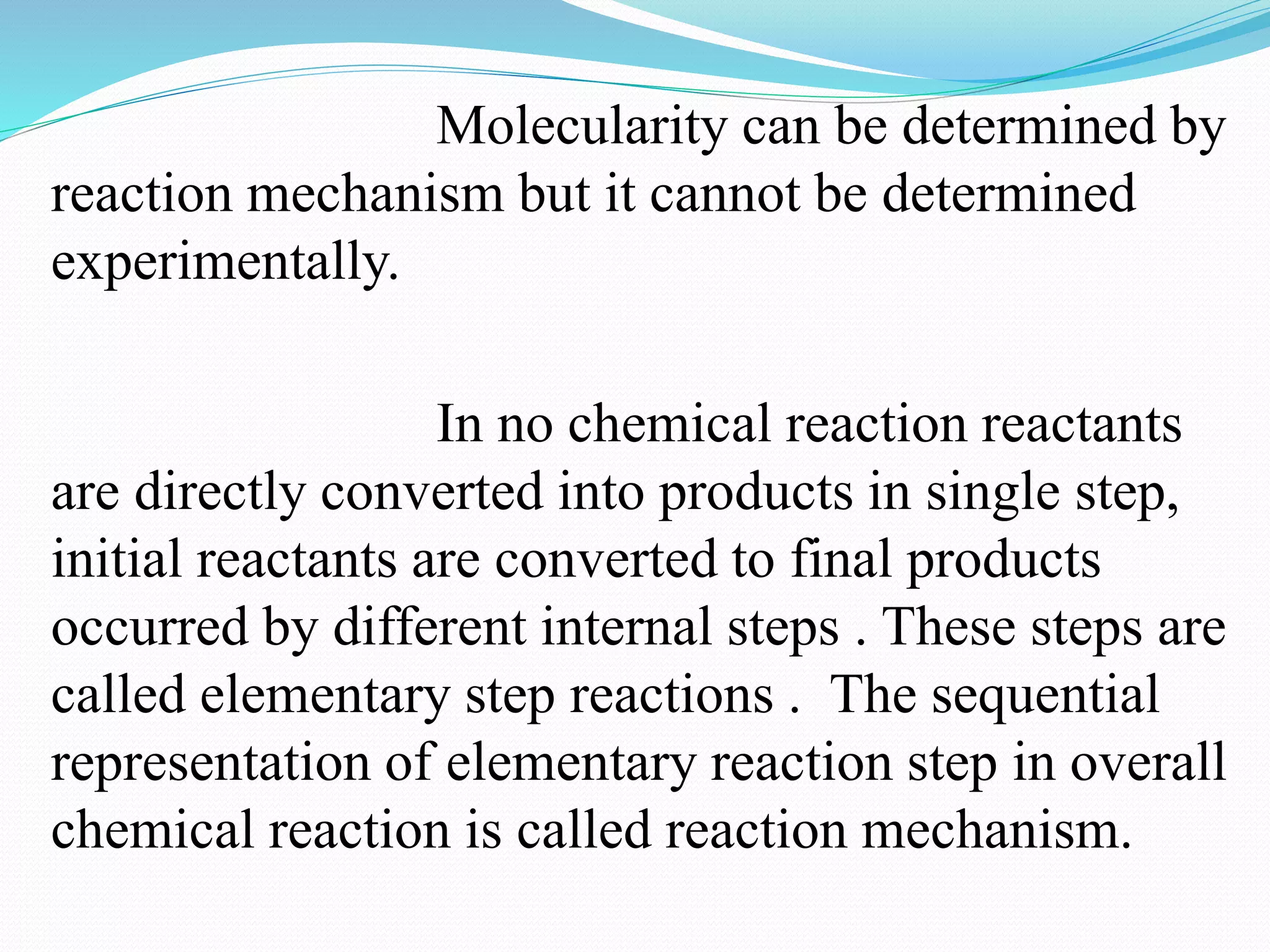
Molecularity can be determined by
reaction mechanism but it cannot be determined
experimentally.
In no chemical reaction reactants
are directly converted into products in single step,
initial reactants are converted to final products
occurred by different internal steps . These steps are
called elementary step reactions . The sequential
representation of elementary reaction step in overall
chemical reaction is called reaction mechanism.
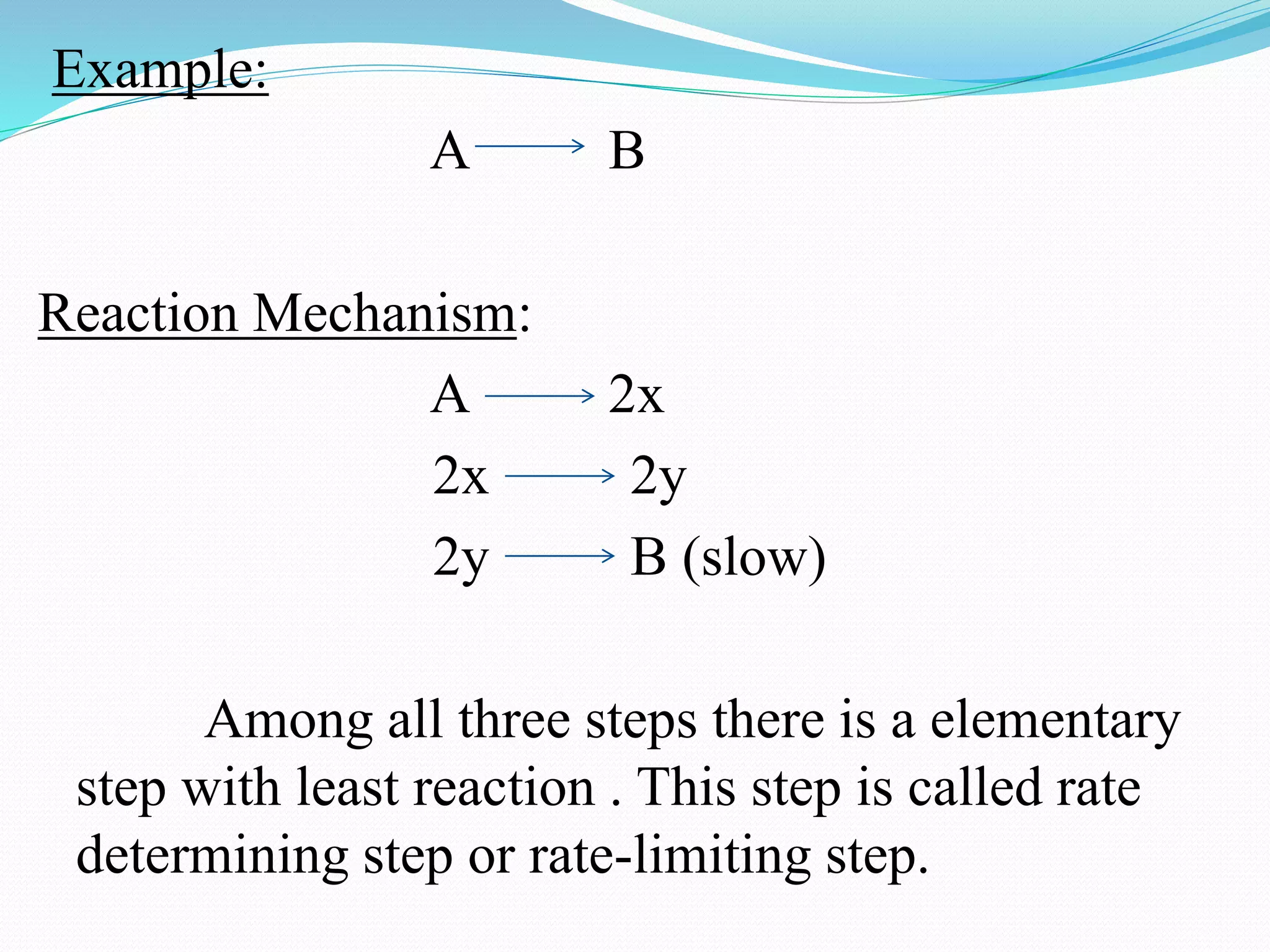
Example:
A B
Reaction Mechanism:
A 2x
2x 2y
2y B (slow)
Among all three steps there is a elementary
step with least reaction . This step is called rate
determining step or rate-limiting step.
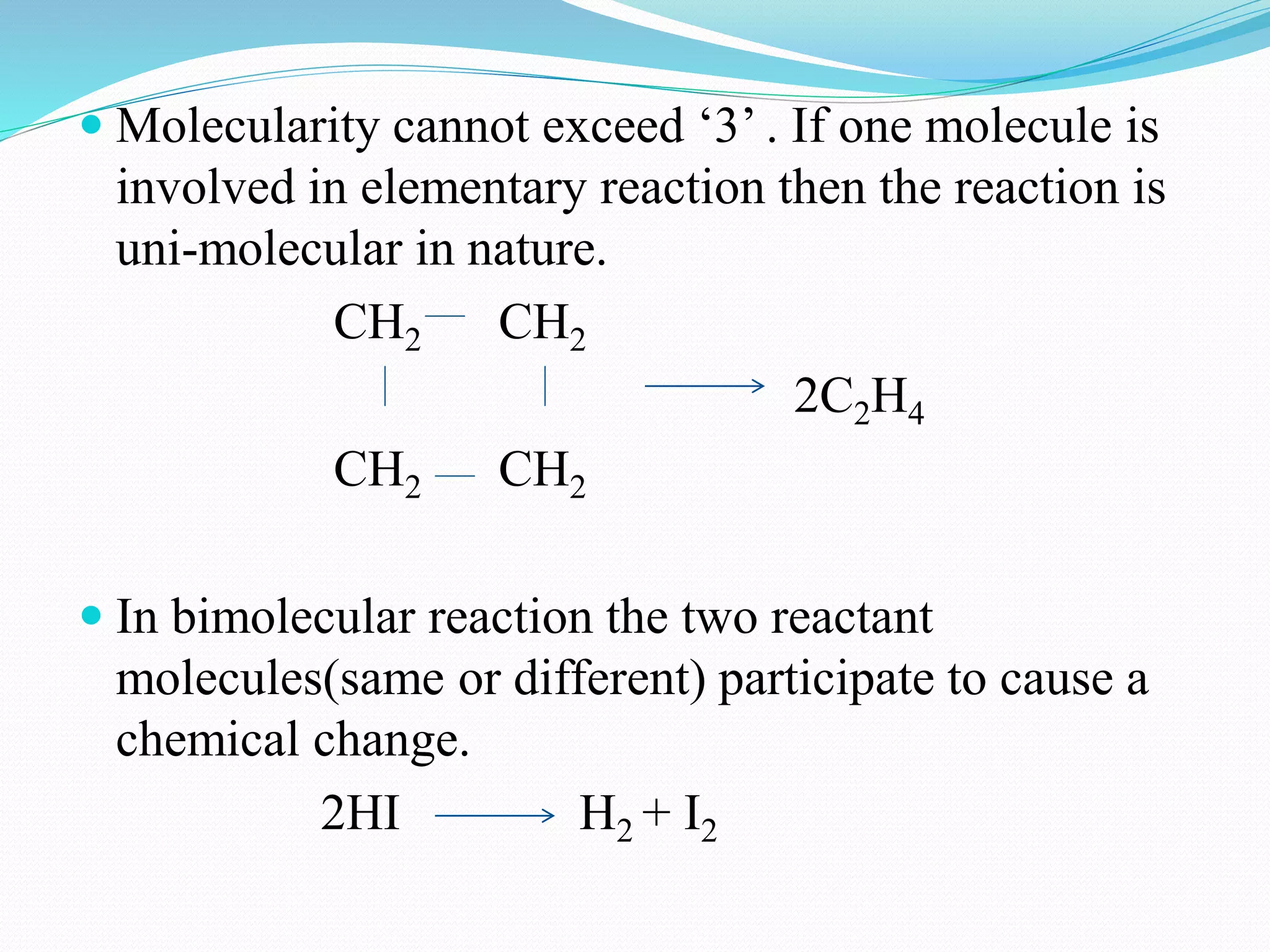
 Molecularity cannot exceed ‘3’ . If one molecule is
involved in elementary reaction then the reaction is
uni-molecular in nature.
CH2 CH2
2C2H4
CH2 CH2
 In bimolecular reaction the two reactant
molecules(same or different) participate to cause a
chemical change.
2HI H2 + I2
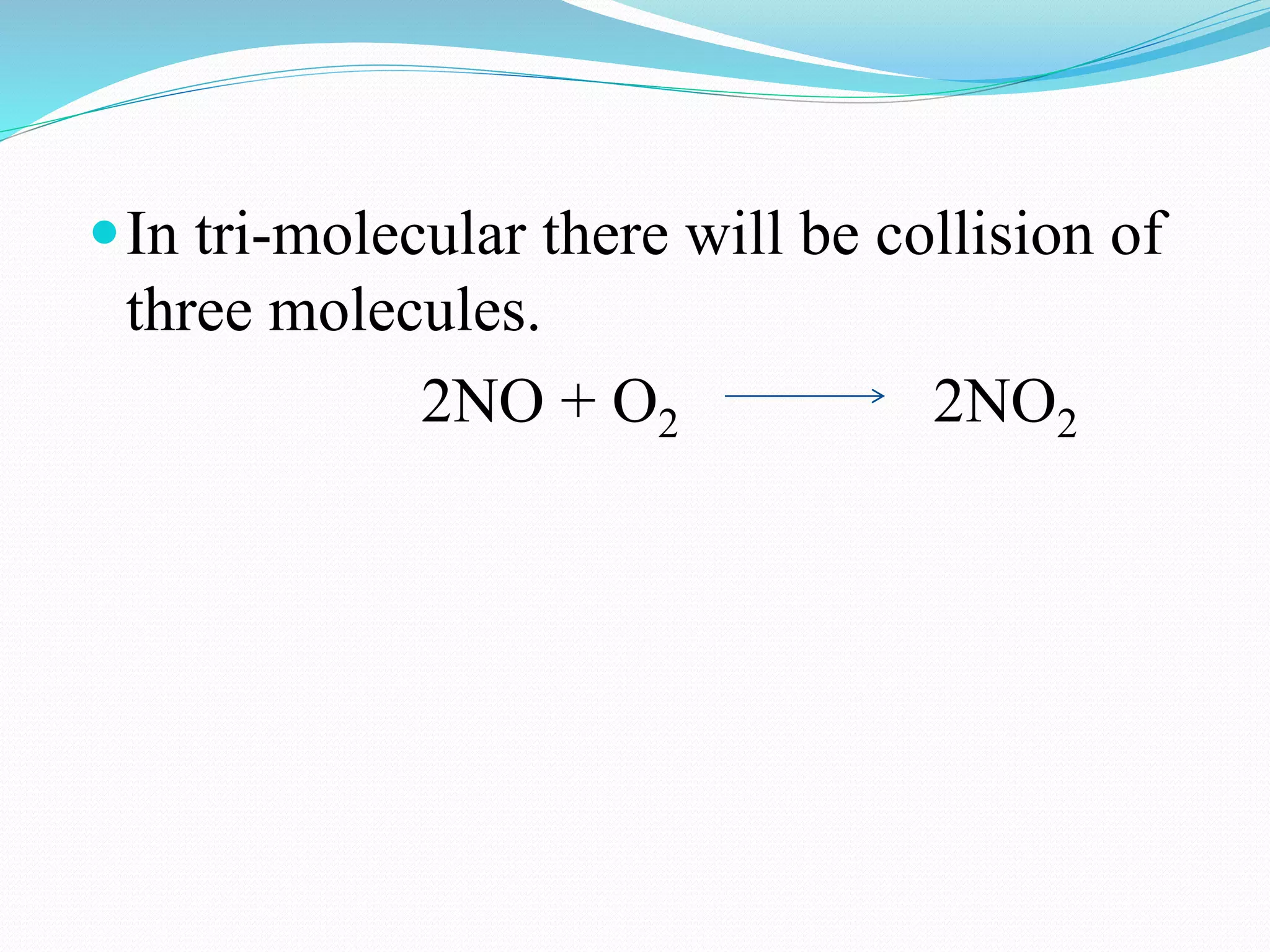
In tri-molecular there will be collision of
three molecules.
2NO + O2 2NO2
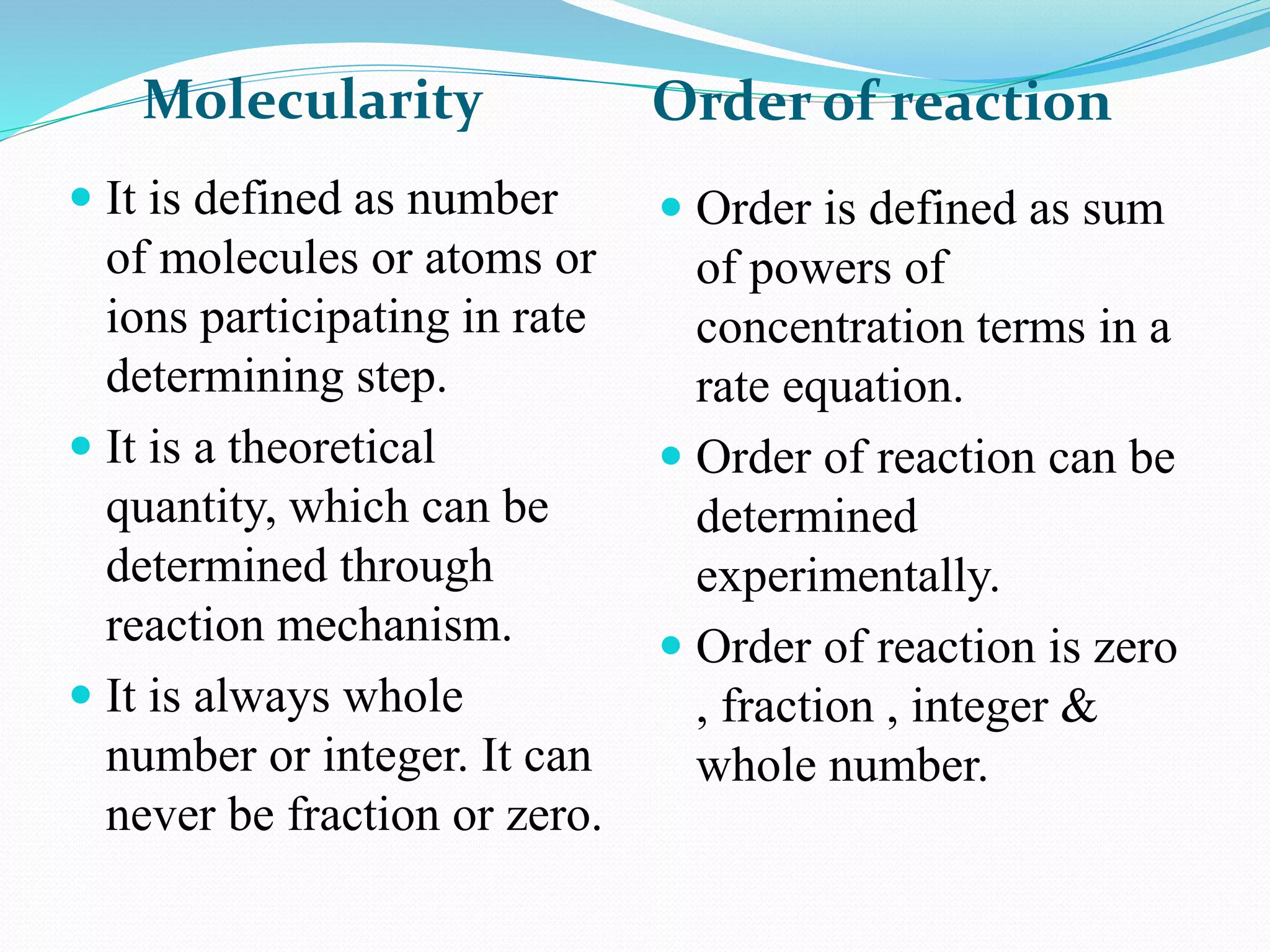
Molecularity Order of reaction
 It is defined as number
of molecules or atoms or
ions participating in rate
determining step.
 It is a theoretical
quantity, which can be
determined through
reaction mechanism.
 It is always whole
number or integer. It can
never be fraction or zero.
 Order is defined as sum
of powers of
concentration terms in a
rate equation.
 Order of reaction can be
determined
experimentally.
 Order of reaction is zero
, fraction , integer &
whole number.
Difference between order and molecularity of a reaction 2310

Difference between order and molecularity of a reaction 2310

  • 2.
    Order of areaction The sum of the powers of concentration terms in rate equation is known as order of reaction. (or) Order of reaction may be given with respect to all participating reactants in which case it is called order of reaction.
  • 3.
    Consider a reactionmA + nB product Rate eq (R)=k[A]m[B]n Order = m + n
  • 4.
    Zero Order Reaction Whenthe reaction rate is independent of concentration of the reacting substance, it depends on the zero power of the reactant and therefore is zero order reaction. 4
  • 5.
     The unitof K is concentration time-1 with typical units of mole L-1 s-1.  Half-life is given by equation; t1/2 = Co/2k 5
  • 6.
    First order Reaction Firstorder reaction consists of one reactant. A product R = k[A]1 Rate constant for first order reaction: k = 2.303 . log(a/a-x) t where, a=initial conc. of A in mol/lit a-x=change in initial conc. of A in mol/lit in time interval ’t’
  • 7.
    Half Life Time(t1/2) Time taken for initial conc. of reactant to become half of its volume k= 0.693/t1/2 t1/2=0.693/k Units of rate constant for first order reaction: sec-1
  • 8.
    Examples of firstorder reaction  Thermal decomposition of N2O5 N2O5 N2O3+O2  Hydrolysis of hydrogen peroxide H2O2 H2O +1/2O2  Decomposition of Calcium carbide CaCo3 Cao + Co2
  • 9.
    Second Order OfReaction Second order reaction consists of two reactants. 2A products A+B products Rate = k[A]2 ; n=2 Rate = k[A] [B] ; n=1+1=2
  • 10.
    Half Life Time Halflife time for second order reaction: t1/2= 1/a n-1 =1/a as n=2 Units: k = mol -1 lit sec -1 (or) = conc-1. sec -1
  • 11.
    Examples Of SecondOrder Reaction Thermal decomposition of Nitrous oxide 2N2O 2N2 +o2 Decomposition of NO2 2NO 2 2NO +O 2 Decomposition of Hydrogen Iodide 2HI H 2 + I2
  • 12.
    Third Order Reaction Thirdorder reaction includes three reactants 3A Products r = k [A] 3 A+B+C Products r = k [A] [B] [C] 2A+B Products r = k [A]2 [B]
  • 13.
    Half Life Time Halflife time for third order reaction t ½ = 1/a n-1 = 1/a 3-1 = 1/ a2 [as n=3] Units: k = mol -2 lit 2 sec -1 = conc. -2 sec -1
  • 14.
    Examples Of ThirdOrder Reaction  2NO + O2 2NO2  2NO + Cl2 2NOCl  2FeCl3 + SnCl2 2FeCl2 + SnCl4
  • 15.
    Molecularity of thereaction The number of ions or atoms or molecules involve in the rate determining step or rate limiting step is called molecularity . The molecularity will be only whole number and never be zero or fraction.
  • 16.
    Molecularity can bedetermined by reaction mechanism but it cannot be determined experimentally. In no chemical reaction reactants are directly converted into products in single step, initial reactants are converted to final products occurred by different internal steps . These steps are called elementary step reactions . The sequential representation of elementary reaction step in overall chemical reaction is called reaction mechanism.
  • 17.
    Example: A B Reaction Mechanism: A2x 2x 2y 2y B (slow) Among all three steps there is a elementary step with least reaction . This step is called rate determining step or rate-limiting step.
  • 18.
     Molecularity cannotexceed ‘3’ . If one molecule is involved in elementary reaction then the reaction is uni-molecular in nature. CH2 CH2 2C2H4 CH2 CH2  In bimolecular reaction the two reactant molecules(same or different) participate to cause a chemical change. 2HI H2 + I2
  • 19.
    In tri-molecular therewill be collision of three molecules. 2NO + O2 2NO2
  • 20.
    Molecularity Order ofreaction  It is defined as number of molecules or atoms or ions participating in rate determining step.  It is a theoretical quantity, which can be determined through reaction mechanism.  It is always whole number or integer. It can never be fraction or zero.  Order is defined as sum of powers of concentration terms in a rate equation.  Order of reaction can be determined experimentally.  Order of reaction is zero , fraction , integer & whole number.