Rate of reaction
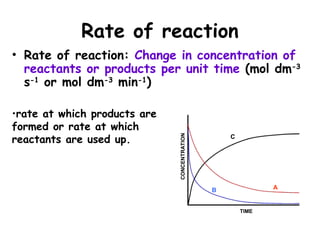
•Rate of reaction: Change in concentration of
reactants or products per unit time (mol dm-3
s-1
or mol dm-3
min-1
)
TIME
CONCENTRATION
B A
C
•rate at which products are
formed or rate at which
reactants are used up.
3.
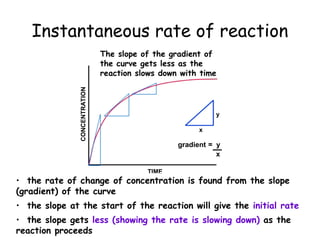
Instantaneous rate ofreaction
y
CONCENTRATION
gradient = y
x
x
TIME
• the rate of change of concentration is found from the slope
(gradient) of the curve
• the slope at the start of the reaction will give the initial rate
• the slope gets less (showing the rate is slowing down) as the
reaction proceeds
The slope of the gradient of
the curve gets less as the
reaction slows down with time
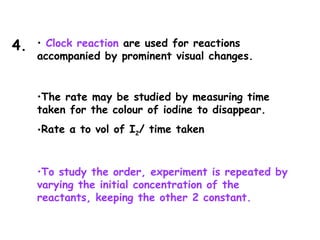
4.
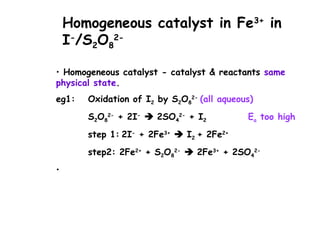
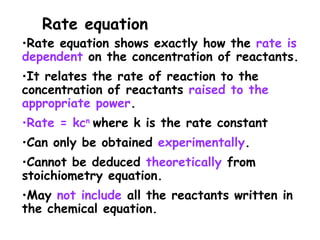
•Rate equation showsexactly how the rate is
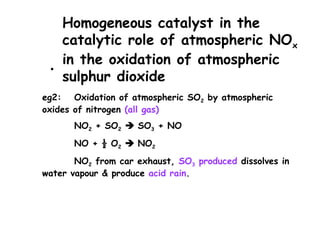
dependent on the concentration of reactants.
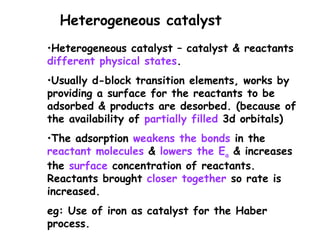
•It relates the rate of reaction to the
concentration of reactants raised to the
appropriate power.
•Rate = kcn
where k is the rate constant
•Can only be obtained experimentally.
•Cannot be deduced theoretically from
stoichiometry equation.
•May not include all the reactants written in
the chemical equation.
Rate equation
5.
• Order ofreaction shows the exact dependence of
rate of concentration & can only be found
experimentally.
•Defined as the power to which the concentration of
that reactant is raised to in the experimentally
determined rate equation.
•The overall order of reaction is the sum of the
powers of the concentration terms in the
experimentally determined rate equation.
eg: aA +bB products
Rate = k[A]m
[B]n
m= order with respect to A
n= order with respect to B
m+n = overall order of reaction
Order of reaction
6.
• Rate constantk is a constant of
proportionality in the rate equation. It
is constant for a given reaction at a
particular temperature.
•The unit is dependant on the order of
reaction.
Rate constant
7.
•The rate ofreaction is independent of
the concentration of the reactant, A.
rate [A]0
•The concentration-time graph is a
straight line showing that rate is
constant.
Zero order
8.
•The rate ofreaction is proportional to one
concentration term, rate [A]1
•The concentration-time graph is a curve with
a constant half-life. For other orders of
reaction, the half-life is not constant.
eg: decomposition of hydrogen peroxide:
2H2O2 O2 +2H2O
The rate equation: rate=k[H2O2]
The rate of reaction is directly proportional
to [H2O2].
First order
9.
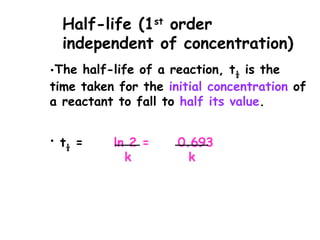
•The half-life ofa reaction, t½ is the
time taken for the initial concentration of
a reactant to fall to half its value.
• t½ = ln 2 = 0.693
k k
Half-life (1st
order
independent of concentration)
10.
•The rate ofreaction is proportional to two
concentration terms rate [A]
2
•t½ not constant t½ = 1/k[A]
•eg: decomposition of NO2:
2NO2(g) 2NO(g) + O2(g)
The rate equation: rate = k [NO2]2
Therefore doubling [NO2] will increase the
rate of reaction four folds.
Second order
11.
Given the variationof initial reaction with
[NO2] for the reaction NO2(g)
+CO(g)NO(g)+CO2(g)
Deduce order by initial rate
Experiment Rate/mol dm-3
s-1
[NO2]/mol dm-3
1 0.010 0.15
2 0.040 0.30
3 0.160 0.60
4 0.360 0.90
On doubling [NO2], the rate increases by
a factor of 4. Thus the rate to [NO2]2
& the reaction is second order with
respect to NO2.
•The rate ofdecomposition of a 3.0 mol dm-3
H2O2(aq)
was measured by withdrawing 10cm3
portions at various
times & titrating with acidified 0.1 mol dm-3
KMnO4(aq).
The results obtain are given.
Calculate rate constant using
initial rate
time/min vol of KMnO4/cm3
0 30.0
5 23.4
10 18.3
15 14.2
20 11.1
25 8.7
30 6.8
Order may be found by plotting the graph
of vol of KMnO4 against time.
Since half life is constant, reaction is 1st
order with respect to H2O2.
Rate equation is: rate=k[H2O2]
From graph, t½ = 14min
Rate constant, k = 0.693/14
= 0.0495min-1
14.
• The tablegiven shows the results obtained in a
study of the reaction: RBr+NaOHROH+Na+
Br-
Calculation of initial rates
from concentration-time graph
Time/min [RBr]/mol dm-3
[OH]=0.10 [OH]=0.15
0 0.0100 0.0100
40 0.0079 0.0070
80 0.0062 0.0049
120 0.0049 0.0034
160 0.0038 0.0024
200 0.0030 0.0017
240 0.0024 0.0012
The order may be deduced by
plotting graphs of [RBr]vs
time.
From the graph, t½ = 77min
Therefore, 1st
order with
respect to RBr
From graph1, initial rate
= gradient
= 0.005/90= 5.5x10⁻⁵
From graph2, initial rate
= 0.005/60=8.3x10-5
• Hence, when [OH-
] increases by factor of 1.5, initial rate increases
by a factor of 8.3x10⁻⁵
/5.5x10-5
=1.5
•Therefore the reaction if 1st
order with respect to NaOH
15.
•A reaction mechanismis a sequence of
simple steps proposed in theory to account
for the overall chemical reaction that
takes place& it must be consistent with
the observed kinetics. (satisfy the rate
equation & stoichiometry equation)
Reaction mechanism
16.
• The sloweststep in the reaction
mechanism is called the rate determining
step. It determines the rate of the
entire multi-step process.
•Therefore, the particles that collide
together in the rate-determining step are
the substance that appear in the rate
equation.
•The order of reaction could be predicted
from the rate-determining step of a given
reaction mechanism.
Rate determining step
17.
• CH3CH2CH2CH2Br +OH-
CH3CH2CH2CH2OH+Br-
•This reaction takes place in one step
•Both CH3CH2CH2CH2Br & OH-
are involved in the slow
step. Hence the rate equation is :
rate=k[CH3CH2CH2CH2Br][OH-
]
•Therefore this reaction is 1st
order with respect to
CH3CH2CH2CH2Br & 1st
order with respect to OH-
•Reaction is bimolecular since 2 reactants are involved
Single-step reaction
18.
• (CH3)3C-Br +OH-
(CH3)3
C-OH + Br-
•This reaction takes place in 2 steps
•1. (CH3)3C-Br (CH3)3C+
+ Br- slow
•2. (CH3)3C+
+OH-
(CH3)3C-OH fast
•Only (CH3)3C-Br is involved in the rate determining
step. Hence, rate equation is :
rate = k[(CH3)3C-Br]
•Therefore this reaction is 1st order with respect to
(CH3)3C-Br & zero order with respect to OH-
•Reaction is unimolecular since only one reactant is
involved in the rate-determining step.
Multi-step reaction
19.
In the decompositionof hydrogen peroxide,
2H2O2 2H2O + O2, the rate equation is
rate = k[H2O2]. What is the possible
mechanism?
It cannot be a simple 1 step bimolecular
reaction.
Step 1: H2O2 H2O + [O]……..slow
Step 2: [O] + [O] O2 …….fast
Suggest reaction mechanism from
rate equation
20.
(CH3)3C-Cl + OH-
(CH3)3C-OH +Cl-
Experiment shows that rate of reaction is
1st
order with respect to the organic
chloride & zero order with respect to OH-
.
Suggest a mechanism.
We can conclude that the reaction does not
happen at only 1 step which involves both
reactants.
The rate determining step (slow step)
should involve the organic chloride. The fast
step should involve the OH-
.
(CH3)3C-Cl (CH3)3C+
+Cl-
…….slow
(CH3)3C+
+OH-
(CH3)3C-OH ………..fast
21.
Predict order fromreaction mechanism
Decomposition of hydrogen iodide involves a few steps
HI + HI H-I ……..slow
H-I
H-I
H2 + 2I ……..fast
H-I
2I I2 ………….fast
What is the order?
It is 2nd
order with respect to HI & the stoichiometry
is 2HI H2 + I2
22.
When initial stepis not the slow step
Consider this equation & predict the orders:
5Br-
(aq) + BrO3
-
(aq) + 6H+
(aq) 3Br2(aq) + 3H2O(l)
H+
+ Br-
HBr fast
H+
+ BrO3
-
HBrO3 fast
HBr + HBrO3 HBrO + HBrO2 slow
HBrO2 + HBr 2HBrO fast
HBrO + HBr H2O + Br2 fast
Rate = k[Br-
][BrO3
-
][H+
]2
23.
• Titrimetric methodis useful for reaction
in solutions.
•The concentration of reactants/products
is determined at different times by
withdrawing known volumes of the reaction
mixture & titrating with a suitable
standard solution
Experimental techniques to
study rate of reaction
1.
24.
Acid catalysed reactionof propanone with iodine
•CH3COCH3(aq) + I2(aq) CH2ICOCH3(aq) + HI (aq)
•Unreacted iodine is determined at different times
•Portions of the reaction mixture are pipetted at regular
time intervals into NaHCO3(aq) which “quenches” the
reaction by neutralising the acid catalyst.
•The quenched mixture is then titrated against a
standard solution of Na2S2O3 to determine the amount
of unreacted iodine.
•2S2O3
2-
(aq) + I2 (aq) S4O6
2-
(aq) +2I-
(aq)
•Vol of S2O3
2-
against time is a straight line showing
rate is constant as [I ] varies. (zero order)
Example 1:
25.
Alkaline hydrolysis ofan ester
• CH3CO2C2H5(aq) + NaOH(aq) CH3CO2
-
Na+
(aq) +C2H5OH(aq)
• Unreacted NaOH in the reaction mixture is determined
at different times.
•At various times mixture is withdrawn & run into about
4x its vol of cold water to quench the mixture.
•The NaOH that remains is titrated against a standard
acid (phenolphthalein)
•H+
(aq) + NaOH(aq) H2O(l) + Na+
(aq)
•Vol of acid against time is a curve with constant half-
life. Rate is α to [OH-
].
Example 2:
26.
• Measurement ofvol of gaseous product
method is useful for reaction involving
formation of gaseous products.
•Measurement can be done on vol of gas
produced per unit time (with a syringe)
•OR loss of mass per unit time (where gas
is allowed to escape)
2.
27.
Reaction between diluteHCl & marble chips
•CaCO3(s) +2HCl(aq) CaCl2(aq) + CO2(g) + H2O(l)
•CO2(g) is collected in a syringe & its vol measured at
regular time interval
•(Vol of CO2 evolved at the end)- (Vol of CO2 after t) =
amount of unreacted at time t
•Vol of unreacted is plotted against time
•OR loss of mass of conical flask & its content per unit
time is determined.
•Rate of reaction may be found by plotting loss of mass
against time
Example:
28.
• Colorimetry methodis used when
the colour intensity of a compound is
proportional to its concentration.
3.
29.
Acid catalysed reactionof propanone with iodine
•CH3COCH3(aq) + I2(aq) CH2ICOCH3(aq) + HI (aq)
reddish brown
•The reduction in [I2] (decrease in colour intensity) is
measured in a colorimeter.
•The rate may be found by plotting [I2] against time.
•To study the order, experiment is repeated by varying
the initial concentration of each of the reactants
(propanone, iodine & acid), keeping the other 2 constant
& corresponding [I2] graph against time are plotted.
•Graphs
Example 1:
30.
• Clock reactionare used for reactions
accompanied by prominent visual changes.
•The rate may be studied by measuring time
taken for the colour of iodine to disappear.
•Rate α to vol of I2/ time taken
•To study the order, experiment is repeated by
varying the initial concentration of the
reactants, keeping the other 2 constant.
4.
31.
Homogeneous catalyst inFe3+
in
I-
/S2O8
2-
• Homogeneous catalyst - catalyst & reactants same
physical state.
eg1: Oxidation of I2 by S2O8
2-
(all aqueous)
S2O8
2-
+ 2I-
2SO4
2-
+ I2 Ea too high
step 1: 2I-
+ 2Fe3+
I2 + 2Fe2+
step2: 2Fe2+
+ S2O8
2-
2Fe3+
+ 2SO4
2-
•
32.
•
Homogeneous catalyst inthe
catalytic role of atmospheric NOx
in the oxidation of atmospheric
sulphur dioxide
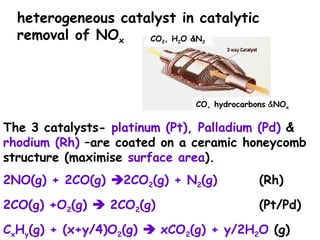
eg2: Oxidation of atmospheric SO2 by atmospheric
oxides of nitrogen (all gas)
NO2 + SO2 SO3 + NO
NO + ½ O2 NO2
NO2 from car exhaust, SO3 produced dissolves in
water vapour & produce acid rain.
33.
•Heterogeneous catalyst –catalyst & reactants
different physical states.
•Usually d-block transition elements, works by
providing a surface for the reactants to be
adsorbed & products are desorbed. (because of
the availability of partially filled 3d orbitals)
•The adsorption weakens the bonds in the
reactant molecules & lowers the Ea & increases
the surface concentration of reactants.
Reactants brought closer together so rate is
increased.
eg: Use of iron as catalyst for the Haber
process.
Heterogeneous catalyst
34.
•
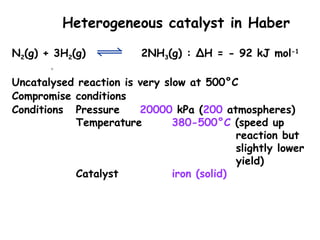
Heterogeneous catalyst inHaber
N2(g) + 3H2(g) 2NH3(g) : ∆H = - 92 kJ mol-1
Uncatalysed reaction is very slow at 500°C
Compromise conditions
Conditions Pressure 20000 kPa (200 atmospheres)
Temperature 380-500°C (speed up
reaction but
slightly lower
yield)
Catalyst iron (solid)

![• Order of reaction shows the exact dependence of
rate of concentration & can only be found
experimentally.
•Defined as the power to which the concentration of
that reactant is raised to in the experimentally
determined rate equation.
•The overall order of reaction is the sum of the
powers of the concentration terms in the
experimentally determined rate equation.
eg: aA +bB products
Rate = k[A]m
[B]n
m= order with respect to A
n= order with respect to B
m+n = overall order of reaction
Order of reaction](https://image.slidesharecdn.com/reactionkineticsdept-250219053657-146798ff/85/Reaction-kineticsA-level-Chemistry-power-point-5-320.jpg)
![•The rate of reaction is independent of
the concentration of the reactant, A.
rate [A]0
•The concentration-time graph is a
straight line showing that rate is
constant.
Zero order](https://image.slidesharecdn.com/reactionkineticsdept-250219053657-146798ff/85/Reaction-kineticsA-level-Chemistry-power-point-7-320.jpg)
![•The rate of reaction is proportional to one
concentration term, rate [A]1
•The concentration-time graph is a curve with
a constant half-life. For other orders of
reaction, the half-life is not constant.
eg: decomposition of hydrogen peroxide:
2H2O2 O2 +2H2O
The rate equation: rate=k[H2O2]
The rate of reaction is directly proportional
to [H2O2].
First order](https://image.slidesharecdn.com/reactionkineticsdept-250219053657-146798ff/85/Reaction-kineticsA-level-Chemistry-power-point-8-320.jpg)
![•The rate of reaction is proportional to two
concentration terms rate [A]
2
•t½ not constant t½ = 1/k[A]
•eg: decomposition of NO2:
2NO2(g) 2NO(g) + O2(g)
The rate equation: rate = k [NO2]2
Therefore doubling [NO2] will increase the
rate of reaction four folds.
Second order](https://image.slidesharecdn.com/reactionkineticsdept-250219053657-146798ff/85/Reaction-kineticsA-level-Chemistry-power-point-10-320.jpg)
![Given the variation of initial reaction with
[NO2] for the reaction NO2(g)
+CO(g)NO(g)+CO2(g)
Deduce order by initial rate
Experiment Rate/mol dm-3
s-1
[NO2]/mol dm-3
1 0.010 0.15
2 0.040 0.30
3 0.160 0.60
4 0.360 0.90
On doubling [NO2], the rate increases by
a factor of 4. Thus the rate to [NO2]2
& the reaction is second order with
respect to NO2.](https://image.slidesharecdn.com/reactionkineticsdept-250219053657-146798ff/85/Reaction-kineticsA-level-Chemistry-power-point-11-320.jpg)
![Given the reaction of H2O2 with acidified
I-
ions, liberating I2
Deduce order by initial rate
Exp Initial conc/mol dm-3
Initial rates/mol dm-3
s-1
[H2O2] [I-
] [H+
]
1 0.010 0.010 0.010 2.0x10⁻⁶
2 0.030 0.010 0.010 6.0x10⁻⁶
3 0.030 0.020 0.010 1.2x10⁻⁵
4 0.030 0.020 0.020 1.2x10⁻⁵
Comparing exp 1&2
Comparing exp2&3
Comparing exp 3&4](https://image.slidesharecdn.com/reactionkineticsdept-250219053657-146798ff/85/Reaction-kineticsA-level-Chemistry-power-point-12-320.jpg)
![•The rate of decomposition of a 3.0 mol dm-3
H2O2(aq)
was measured by withdrawing 10cm3
portions at various
times & titrating with acidified 0.1 mol dm-3
KMnO4(aq).
The results obtain are given.
Calculate rate constant using
initial rate
time/min vol of KMnO4/cm3
0 30.0
5 23.4
10 18.3
15 14.2
20 11.1
25 8.7
30 6.8
Order may be found by plotting the graph
of vol of KMnO4 against time.
Since half life is constant, reaction is 1st
order with respect to H2O2.
Rate equation is: rate=k[H2O2]
From graph, t½ = 14min
Rate constant, k = 0.693/14
= 0.0495min-1](https://image.slidesharecdn.com/reactionkineticsdept-250219053657-146798ff/85/Reaction-kineticsA-level-Chemistry-power-point-13-320.jpg)
![• The table given shows the results obtained in a
study of the reaction: RBr+NaOHROH+Na+
Br-
Calculation of initial rates
from concentration-time graph
Time/min [RBr]/mol dm-3
[OH]=0.10 [OH]=0.15
0 0.0100 0.0100
40 0.0079 0.0070
80 0.0062 0.0049
120 0.0049 0.0034
160 0.0038 0.0024
200 0.0030 0.0017
240 0.0024 0.0012
The order may be deduced by
plotting graphs of [RBr]vs
time.
From the graph, t½ = 77min
Therefore, 1st
order with
respect to RBr
From graph1, initial rate
= gradient
= 0.005/90= 5.5x10⁻⁵
From graph2, initial rate
= 0.005/60=8.3x10-5
• Hence, when [OH-
] increases by factor of 1.5, initial rate increases
by a factor of 8.3x10⁻⁵
/5.5x10-5
=1.5
•Therefore the reaction if 1st
order with respect to NaOH](https://image.slidesharecdn.com/reactionkineticsdept-250219053657-146798ff/85/Reaction-kineticsA-level-Chemistry-power-point-14-320.jpg)

![• CH3CH2CH2CH2Br + OH-
CH3CH2CH2CH2OH+Br-
•This reaction takes place in one step
•Both CH3CH2CH2CH2Br & OH-
are involved in the slow
step. Hence the rate equation is :
rate=k[CH3CH2CH2CH2Br][OH-
]
•Therefore this reaction is 1st
order with respect to
CH3CH2CH2CH2Br & 1st
order with respect to OH-
•Reaction is bimolecular since 2 reactants are involved
Single-step reaction](https://image.slidesharecdn.com/reactionkineticsdept-250219053657-146798ff/85/Reaction-kineticsA-level-Chemistry-power-point-17-320.jpg)
![• (CH3)3C-Br + OH-
(CH3)3
C-OH + Br-
•This reaction takes place in 2 steps
•1. (CH3)3C-Br (CH3)3C+
+ Br- slow
•2. (CH3)3C+
+OH-
(CH3)3C-OH fast
•Only (CH3)3C-Br is involved in the rate determining
step. Hence, rate equation is :
rate = k[(CH3)3C-Br]
•Therefore this reaction is 1st order with respect to
(CH3)3C-Br & zero order with respect to OH-
•Reaction is unimolecular since only one reactant is
involved in the rate-determining step.
Multi-step reaction](https://image.slidesharecdn.com/reactionkineticsdept-250219053657-146798ff/85/Reaction-kineticsA-level-Chemistry-power-point-18-320.jpg)
![In the decomposition of hydrogen peroxide,
2H2O2 2H2O + O2, the rate equation is
rate = k[H2O2]. What is the possible
mechanism?
It cannot be a simple 1 step bimolecular
reaction.
Step 1: H2O2 H2O + [O]……..slow
Step 2: [O] + [O] O2 …….fast
Suggest reaction mechanism from
rate equation](https://image.slidesharecdn.com/reactionkineticsdept-250219053657-146798ff/85/Reaction-kineticsA-level-Chemistry-power-point-19-320.jpg)

![When initial step is not the slow step
Consider this equation & predict the orders:
5Br-
(aq) + BrO3
-
(aq) + 6H+
(aq) 3Br2(aq) + 3H2O(l)
H+
+ Br-
HBr fast
H+
+ BrO3
-
HBrO3 fast
HBr + HBrO3 HBrO + HBrO2 slow
HBrO2 + HBr 2HBrO fast
HBrO + HBr H2O + Br2 fast
Rate = k[Br-
][BrO3
-
][H+
]2](https://image.slidesharecdn.com/reactionkineticsdept-250219053657-146798ff/85/Reaction-kineticsA-level-Chemistry-power-point-22-320.jpg)

![Acid catalysed reaction of propanone with iodine
•CH3COCH3(aq) + I2(aq) CH2ICOCH3(aq) + HI (aq)
•Unreacted iodine is determined at different times
•Portions of the reaction mixture are pipetted at regular
time intervals into NaHCO3(aq) which “quenches” the
reaction by neutralising the acid catalyst.
•The quenched mixture is then titrated against a
standard solution of Na2S2O3 to determine the amount
of unreacted iodine.
•2S2O3
2-
(aq) + I2 (aq) S4O6
2-
(aq) +2I-
(aq)
•Vol of S2O3
2-
against time is a straight line showing
rate is constant as [I ] varies. (zero order)
Example 1:](https://image.slidesharecdn.com/reactionkineticsdept-250219053657-146798ff/85/Reaction-kineticsA-level-Chemistry-power-point-24-320.jpg)
![Alkaline hydrolysis of an ester
• CH3CO2C2H5(aq) + NaOH(aq) CH3CO2
-
Na+
(aq) +C2H5OH(aq)
• Unreacted NaOH in the reaction mixture is determined
at different times.
•At various times mixture is withdrawn & run into about
4x its vol of cold water to quench the mixture.
•The NaOH that remains is titrated against a standard
acid (phenolphthalein)
•H+
(aq) + NaOH(aq) H2O(l) + Na+
(aq)
•Vol of acid against time is a curve with constant half-
life. Rate is α to [OH-
].
Example 2:](https://image.slidesharecdn.com/reactionkineticsdept-250219053657-146798ff/85/Reaction-kineticsA-level-Chemistry-power-point-25-320.jpg)

![Acid catalysed reaction of propanone with iodine
•CH3COCH3(aq) + I2(aq) CH2ICOCH3(aq) + HI (aq)
reddish brown
•The reduction in [I2] (decrease in colour intensity) is
measured in a colorimeter.
•The rate may be found by plotting [I2] against time.
•To study the order, experiment is repeated by varying
the initial concentration of each of the reactants
(propanone, iodine & acid), keeping the other 2 constant
& corresponding [I2] graph against time are plotted.
•Graphs
Example 1:](https://image.slidesharecdn.com/reactionkineticsdept-250219053657-146798ff/85/Reaction-kineticsA-level-Chemistry-power-point-29-320.jpg)