Software Development Life Cycle
(SDLC)
SDLC Model
A framework that describes the activities
performed at each stage of a software
development project.
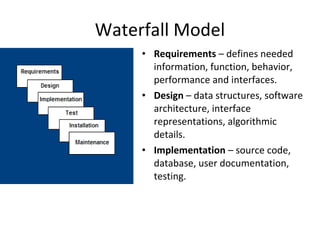
Waterfall Model
• Requirements – defines needed
information, function, behavior,
performance and interfaces.
• Design – data structures, software
architecture, interface
representations, algorithmic
details.
• Implementation – source code,
database, user documentation,
testing.
Waterfall Strengths
• Easy to understand, easy to use
• Provides structure to inexperienced staff
• Milestones are well understood
• Sets requirements stability
• Good for management control (plan, staff, track)
• Works well when quality is more important than cost
or schedule
Waterfall Deficiencies
• All requirements must be known upfront
• Deliverables created for each phase are considered
frozen – inhibits flexibility
• Can give a false impression of progress
• Does not reflect problem-solving nature of software
development – iterations of phases
• Integration is one big bang at the end
• Little opportunity for customer to preview the
system (until it may be too late)
Structured Evolutionary Prototyping Steps
• A preliminary project plan is developed
• An partial high-level paper model is created
• The model is source for a partial requirements specification
• A prototype is built with basic and critical attributes
• The designer builds
– the database
– user interface
– algorithmic functions
• The designer demonstrates the prototype, the user evaluates
for problems and suggests improvements.
• This loop continues until the user is satisfied
Structured Evolutionary Prototyping
Strengths
• Customers can “see” the system requirements as
they are being gathered
• Developers learn from customers
• A more accurate end product
• Unexpected requirements accommodated
• Allows for flexible design and development
• Steady, visible signs of progress produced
• Interaction with the prototype stimulates awareness
of additional needed functionality
Structured Evolutionary Prototyping
Weaknesses
• Tendency to abandon structured program
development for “code-and-fix” development
• Bad reputation for “quick-and-dirty” methods
• Overall maintainability may be overlooked
• The customer may want the prototype delivered.
• Process may continue forever (scope creep)
When to use the Incremental Model
• Risk, funding, schedule, program complexity, or need
for early realization of benefits.
• Most of the requirements are known up-front but
are expected to evolve over time
• A need to get basic functionality to the market early
• On projects which have lengthy development
schedules
• On a project with new technology
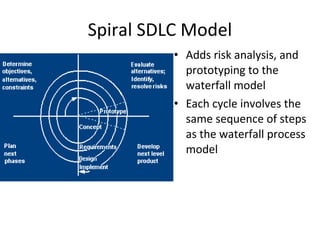
Spiral SDLC Model
• Adds risk analysis, and
prototyping to the
waterfall model
• Each cycle involves the
same sequence of steps
as the waterfall process
model
Spiral Quadrant
Determine objectives, alternatives and constraints
• Objectives: functionality, performance, hardware/software
interface, critical success factors, etc.
• Alternatives: build, reuse, buy, sub-contract, etc.
• Constraints: cost, schedule, interface, etc.
Spiral Quadrant
Evaluate alternatives, identify and resolve risks
• Study alternatives relative to objectives and constraints
• Identify risks (lack of experience, new technology, tight
schedules, poor process, etc.
• Resolve risks (evaluate if money could be lost by continuing
system development
Spiral Quadrant
Develop next-level product
• Typical activites:
– Create a design
– Review design
– Develop code
– Inspect code
– Test product
Spiral Quadrant
Plan next phase
• Typical activities
– Develop project plan
– Develop configuration management plan
– Develop a test plan
– Develop an installation plan
Spiral Model Strengths
• Provides early indication of insurmountable risks,
without much cost
• Users see the system early because of rapid
prototyping tools
• Critical high-risk functions are developed first
• The design does not have to be perfect
• Users can be closely tied to all lifecycle steps
• Early and frequent feedback from users
• Cumulative costs assessed frequently
Spiral Model Weaknesses
• Time spent for evaluating risks too large for small or low-risk
projects
• Time spent planning, resetting objectives, doing risk analysis
and prototyping may be excessive
• The model is complex
• Risk assessment expertise is required
• Spiral may continue indefinitely
• Developers must be reassigned during non-development
phase activities
• May be hard to define objective, verifiable milestones that
indicate readiness to proceed through the next iteration
When to use Spiral Model
• When creation of a prototype is appropriate
• When costs and risk evaluation is important
• For medium to high-risk projects
• Long-term project commitment unwise because of
potential changes to economic priorities
• Users are unsure of their needs
• Requirements are complex
• New product line
• Significant changes are expected (research and
exploration)

Sdlc

  • 1.
  • 2.
    SDLC Model A frameworkthat describes the activities performed at each stage of a software development project.
  • 3.
    Waterfall Model • Requirements– defines needed information, function, behavior, performance and interfaces. • Design – data structures, software architecture, interface representations, algorithmic details. • Implementation – source code, database, user documentation, testing.
  • 4.
    Waterfall Strengths • Easyto understand, easy to use • Provides structure to inexperienced staff • Milestones are well understood • Sets requirements stability • Good for management control (plan, staff, track) • Works well when quality is more important than cost or schedule
  • 5.
    Waterfall Deficiencies • Allrequirements must be known upfront • Deliverables created for each phase are considered frozen – inhibits flexibility • Can give a false impression of progress • Does not reflect problem-solving nature of software development – iterations of phases • Integration is one big bang at the end • Little opportunity for customer to preview the system (until it may be too late)
  • 6.
    Structured Evolutionary PrototypingSteps • A preliminary project plan is developed • An partial high-level paper model is created • The model is source for a partial requirements specification • A prototype is built with basic and critical attributes • The designer builds – the database – user interface – algorithmic functions • The designer demonstrates the prototype, the user evaluates for problems and suggests improvements. • This loop continues until the user is satisfied
  • 7.
    Structured Evolutionary Prototyping Strengths •Customers can “see” the system requirements as they are being gathered • Developers learn from customers • A more accurate end product • Unexpected requirements accommodated • Allows for flexible design and development • Steady, visible signs of progress produced • Interaction with the prototype stimulates awareness of additional needed functionality
  • 8.
    Structured Evolutionary Prototyping Weaknesses •Tendency to abandon structured program development for “code-and-fix” development • Bad reputation for “quick-and-dirty” methods • Overall maintainability may be overlooked • The customer may want the prototype delivered. • Process may continue forever (scope creep)
  • 9.
    When to usethe Incremental Model • Risk, funding, schedule, program complexity, or need for early realization of benefits. • Most of the requirements are known up-front but are expected to evolve over time • A need to get basic functionality to the market early • On projects which have lengthy development schedules • On a project with new technology
  • 10.
    Spiral SDLC Model •Adds risk analysis, and prototyping to the waterfall model • Each cycle involves the same sequence of steps as the waterfall process model
  • 11.
    Spiral Quadrant Determine objectives,alternatives and constraints • Objectives: functionality, performance, hardware/software interface, critical success factors, etc. • Alternatives: build, reuse, buy, sub-contract, etc. • Constraints: cost, schedule, interface, etc.
  • 12.
    Spiral Quadrant Evaluate alternatives,identify and resolve risks • Study alternatives relative to objectives and constraints • Identify risks (lack of experience, new technology, tight schedules, poor process, etc. • Resolve risks (evaluate if money could be lost by continuing system development
  • 13.
    Spiral Quadrant Develop next-levelproduct • Typical activites: – Create a design – Review design – Develop code – Inspect code – Test product
  • 14.
    Spiral Quadrant Plan nextphase • Typical activities – Develop project plan – Develop configuration management plan – Develop a test plan – Develop an installation plan
  • 15.
    Spiral Model Strengths •Provides early indication of insurmountable risks, without much cost • Users see the system early because of rapid prototyping tools • Critical high-risk functions are developed first • The design does not have to be perfect • Users can be closely tied to all lifecycle steps • Early and frequent feedback from users • Cumulative costs assessed frequently
  • 16.
    Spiral Model Weaknesses •Time spent for evaluating risks too large for small or low-risk projects • Time spent planning, resetting objectives, doing risk analysis and prototyping may be excessive • The model is complex • Risk assessment expertise is required • Spiral may continue indefinitely • Developers must be reassigned during non-development phase activities • May be hard to define objective, verifiable milestones that indicate readiness to proceed through the next iteration
  • 17.
    When to useSpiral Model • When creation of a prototype is appropriate • When costs and risk evaluation is important • For medium to high-risk projects • Long-term project commitment unwise because of potential changes to economic priorities • Users are unsure of their needs • Requirements are complex • New product line • Significant changes are expected (research and exploration)