Software Development ProcessBy: Amira Elsayed Ismail
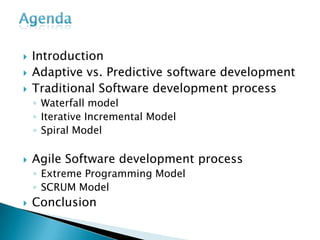
AgendaIntroductionAdaptive vs. Predictive software developmentTraditional Software development processWaterfall modelIterative Incremental ModelSpiral ModelAgile Software development processExtreme Programming ModelSCRUM ModelConclusion
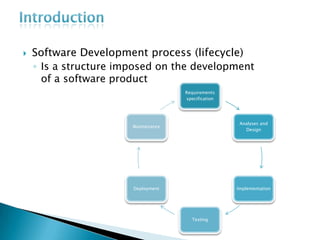
IntroductionSoftware Development process (lifecycle)Is a structure imposed on the development of a software product
Introduction (cont’d)
Adaptive vs. PredictiveAdaptive methods focus on adapting quickly to changeWhen the project requirement change the adapted team also changeAn adaptive team can not report exactly what tasks are being done next weekAn Example of adaptive methods is Agile
Adaptive vs. Predictive (cont’d)Predictive method focus on planning the future in detailsPredictive team can report exactly what features and tasks are planned for the entire length of the development processPredictive team have difficulty changing direction, the plan is typically optimized for the original destination and changing direction can require completed work to be started over
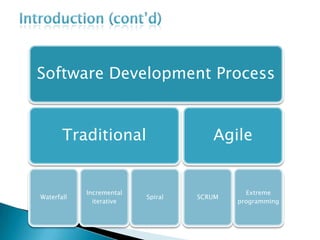
Traditional software development MethodsWaterfallClean RoomDSDM (Dynamic System Development Method)Iterative IncrementalRAD (Rapid Application Development)RUP (Rational Unified Process)SpiralV-ModelFDD (Feature Driven Development)
Waterfall ModelIs a sequential design process, often used in software development processesOriginates in the manufacturing and construction industries; highly structured physical environmentsThe Idea behind the waterfall model is“Measure Twice, Cut once”
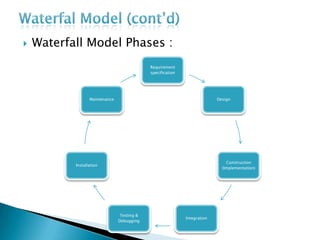
Waterfal Model (cont’d)Waterfall Model Phases :Waterfall Model (cont’d)
Waterfall Model (cont’d)Why Waterfall Provides a structured approach, it progress linearly, easily, understandable and explainableProvides easily markable milestones in the development processSuites the stable, unchanging requirements
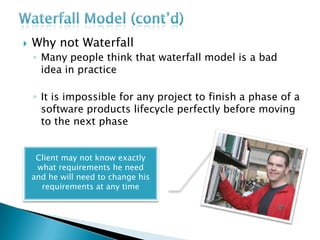
Waterfall Model (cont’d)Why not Waterfall Many people think that waterfall model is a bad idea in practiceIt is impossible for any project to finish a phase of a software products lifecycle perfectly before moving to the next phaseClient may not know exactly what requirements he need  and he will need to change his requirements at any time
Waterfall Model (cont’d)Why not Waterfall Many people think that waterfall model is a bad idea in practiceIt is impossible for any project to finish a phase of a software products lifecycle perfectly before moving to the next phaseDesigners may not be aware of future Implementation
Waterfall Model (cont’d)Why not Waterfall Many people think that waterfall model is a bad idea in practiceIt is impossible for any project to finish a phase of a software products lifecycle perfectly before moving to the next phaseStockholders may not be fully aware of the capabilities of the technology being implemented
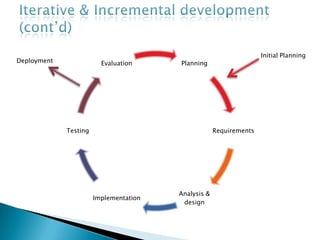
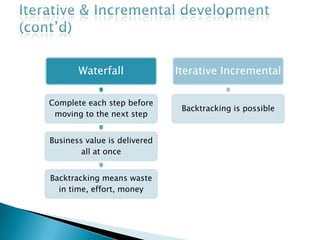
Iterative & Incremental developmentDeveloped in response to the weaknesses of the waterfall modelStarts with initial planning and ends with deployment with the cycle interactions in betweenIterative & incremental development is essential parts of the extreme programming & generally the Agile DevelopmentThe project is delivered through cross discipline work from the requirement to the deployment
Iterative & Incremental development (cont’d)Initial PlanningDeployment
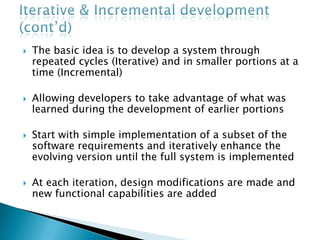
Iterative & Incremental development (cont’d)The basic idea is to develop a system through repeated cycles (Iterative) and in smaller portions at a time (Incremental)Allowing developers to take advantage of what was learned during the development of earlier portionsStart with simple implementation of a subset of the software requirements and iteratively enhance the evolving version until the full system is implementedAt each iteration, design modifications are made and new functional capabilities are added
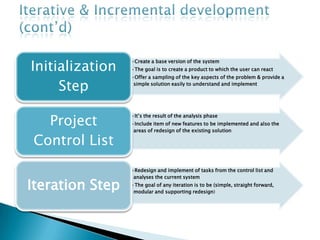
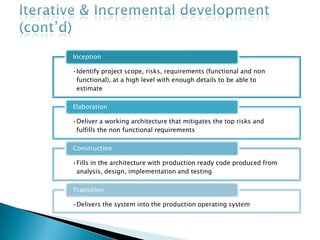
Iterative & Incremental development (cont’d)
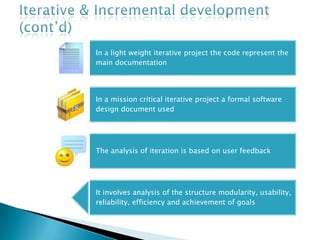
Iterative & Incremental development (cont’d)Implementation GuidelinesAny difficulty in design, coding & testing means the need of redesign and modificationModifications should fit easily isolated and easy to find modulesThe existing implementation should be analyzed frequently to determine how well it measures up to project goals
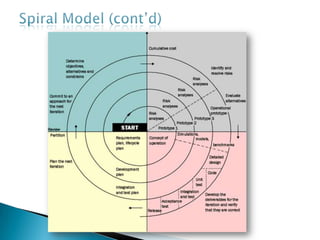
Spiral Model (cont’d)The spiral model was defined by Barry BoehmThis model was not the first model to discuss iteration, but it was the first model to explain why the iteration mattersaims at risk reduction by any means in any phase. The spiral model is often referred to as a risk-driven modelIntroducing prototyping in a Software Process aims at risk reduction at the requirements levelThere is always an element of risk involved in the other phases of development
Spiral Model (cont’d)
Spiral Model (cont’d)Quadrant 1Determining objectives of that phase, alternatives and constraintsThis is a way to define a strategy for achieving the goals of this iterationQuadrant 2The strategy is analyzed form the viewpoint of risk, and solutions to minimize these risks are investigated
Spiral Model (cont’d)Quadrant 3A solution is put into practice to produce the artifacts necessary to reach the goals identified in quadrant 1Quadrant 4The results of the risk-reduction strategies are assessed, and if all risks are resolved, the next phase is planned and startedIf some risks are left unsolved, another iteration can be made to continue to work
Spiral Model (cont’d)AdvantagesEmphasis on alternatives and constraints supports the reuse of existing solutions. Targets testing by treating it as a risk, which has to be addressed. Maintenance is just another phase of the spiral model. It is treated in the same way as development. Estimates (budget and schedule) get more realistic as work progresses, because important issues are discovered earlier.
Spiral Model (cont’d)DisadvantagesOnly intended for internal projects (inside a company), because risk is assessed as the project is developed. In case of external software development, all risk analysis must be performed by both client and developers before the contract is signedSpiral model is risk driven. Therefore it requires knowledgeable staff.Suitable for only large scale software development.
Agile software developmentGroup of software development methodologies based on iterative and incremental development Requirements and solutions evolve through collaboration between self organizing, cross functional teamsIntroduced in 2001It’s a light weight as a reaction against the heavy  weight methods
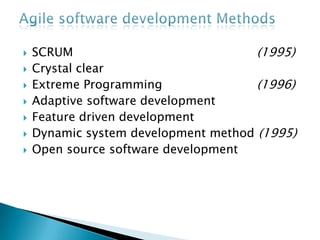
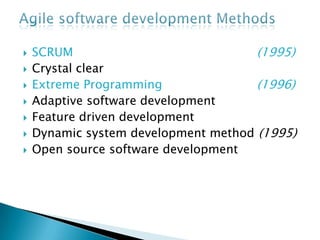
Agile software development MethodsSCRUM			                             (1995)Crystal clearExtreme Programming                         (1996)Adaptive software developmentFeature driven developmentDynamic system development method (1995)Open source software development
Agile software development Methods (cont’d)Agile ManifestoWe are uncovering better ways of developing software by doing it and helping other to doAgile ValuesIndividuals & interactions over process & toolsWorking software over comprehensive documentationCustomer collaboration over contract negotiationResponding to change over following a plan
Agile software development Methods (cont’d)Agile PrinciplesCustomer satisfaction by rapid delivery of useful software
Agile software development Methods (cont’d)Agile PrinciplesWelcome changing requirements even late in development
Agile software development Methods (cont’d)Agile PrinciplesWorking software is the principal measure of progress
Agile software development Methods (cont’d)Agile PrinciplesDaily cooperation between business people & developers
Agile software development Methods (cont’d)Agile PrinciplesFace to Face conversation is the best form of communication
Agile software development Methods (cont’d)Agile PrinciplesSelf-organized team that have motivated and trusted individuals
Agile software development Methods (cont’d)CharacteristicsBreak tasks into small increments with minimal planningIteration are short time frames from (1  4) weeksEach iteration involves a team working through a full software development cycleBy the end of the iteration a demo will be represented to stack holdersOne iteration may not add enough feature to market release but the goal is to have a release with minimal bugs
Agile software development Methods (cont’d)CharacteristicsTeam is usually cross functional and self organizingTeam member take the responsibility of the taskFace-to-face conversation for team in the same location and video for different locations that produce less written documentsAll team working in an open office called (bullpen)Small team size from (5  9) person
Agile software development Methods (cont’d)CharacteristicsEach team have a customer representative to answer mid iteration problemsBy the end of the iteration stockholders view demo and re evaluate the priorities of featuresFormal daily face to face communications to answer three questions (what they did the previous day? What they intend to do today? What their road blocks?)
Agile software development Methods (cont’d)Techniques to improve the quality and agility of project like:Unit testPair programmingTest driven DevelopmentDomain Driven DesignCode refactoring
SCRUM ModelIts one of the agile development methodsIt’s the skeleton that includes a set of practices and predefined roles
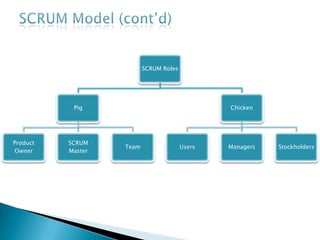
SCRUM Model (cont’d)
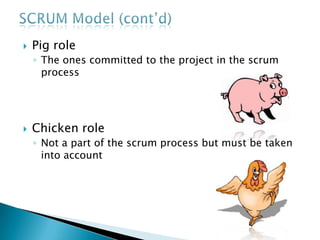
SCRUM Model (cont’d)Pig roleThe ones committed to the project in the scrum processChicken roleNot a part of the scrum process but must be taken into account
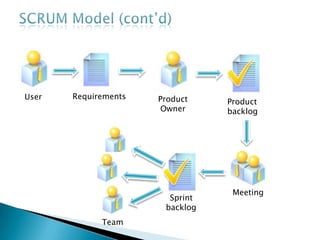
SCRUM Model (cont’d)Product OwnerRepresent the voice of the customerEnsure that the scrum teams works with the write things from a business perspectiveWrite user stories, prioritize them and add them to product backlog
SCRUM Model (cont’d)SCRUM MasterHelp the team to deliver the sprint goalIs not the leader of the team but he is self organizerEnsure that the SCRUM process is used as intendedHe is the enforcer of rules
SCRUM Model (cont’d)TeamDeliver the projectMade up of (5  9) people with cross functional to do the actual work (Developers, Designers, Testers)
SCRUM Model (cont’d)UsersThe users of the product, and his participation is very important for feedback to review and plan sprintStockholdersThe people who enable the project and the are important in sprint reviewManagersPeople who will set up the environment for the product
SCRUM Model (cont’d)RequirementsUserProductOwnerProductbacklogMeetingSprintbacklogTeam
SCRUM Model (cont’d)Sprint(2  4) week period and it is decided by teamIn the sprint the team create an increment of usable softwareDuring the sprint no one can change the sprint backlog
SCRUM Model (cont’d)Product BacklogHigh level document of the entire project that include a broad description of all required features and wish list itemsPrioritized by business value of each featureEditable by anyoneContains rough estimates of both business value (product owner )and development effort (team members)
SCRUM Model (cont’d)Burn downThe burn down chart is publically showing remaining work in the sprint backlogUpdated every dayGive a simple view of the sprint progress
SCRUM Model (cont’d)Sprint BacklogFeatures are broken down into tasksBest practice that tasks are normally estimated between 4h and 16hThe whole team understand exactly the business logic of each taskAny one them can pick task from task list, tasks in the task list are never assigned
SCRUM Model (cont’d)
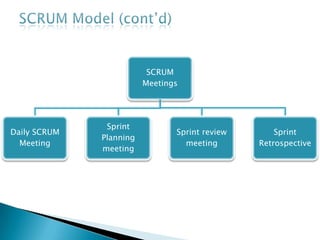
SCRUM Model (cont’d)Daily SCRUM MeetingProject status meetingStarts precisely on time. And there is a punishment for lateAll are welcomed but only pig may speakThe meeting is between (15 - 20) minutesAll attendees should stand to make it shortHappen in the same time, same location every day
SCRUM Model (cont’d)Daily SCRUM MeetingEvery one should answer three questionsWhat have you done since yesterday?What are you planning to do today?Do you have any problem preventing you from accomplish your goal?
SCRUM Model (cont’d)Sprint Planning MeetingHold at the beginning of each sprintDecide what work is to be donePrepare the sprint backlog8 hour limits
SCRUM Model (cont’d)Sprint review meetingHold at the end of the sprintReview the complete and incomplete work Present the completed work to stockholders4 hour limits
SCRUM Model (cont’d)Sprint Retrospective meetingAll team members reflects on the past sprintEvery member should answer What went well during the sprint?What could be improved in the next sprint
Extereme ProgrammingIntended to improve software quality and responsiveness to changing customer requirementsIntended to improve productivity and introduce checkpoints where new customer requirements can be adoptedProgramming in pairs or doing extensive code reviewUnit testing of all code (End of day testing)Avoiding programming of features until they are actually neededSimplicity and clarity in codeExpecting changes in the customer's requirementsFrequent communication with the customer and among programmers
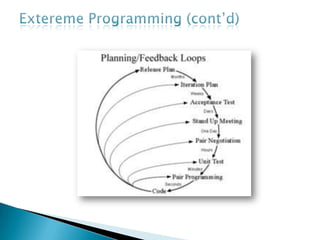
ExteremeProgramming (cont’d)
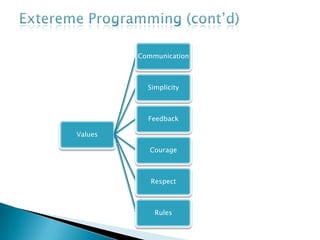
ExteremeProgramming (cont’d)ConceptsOrganizes people to produce higher quality software more productivelyAttempts to reduce the cost of change by having multiple short development cycles, rather than one long oneIntroduces a number of basic values, principles and practices on top of the agile programming framework
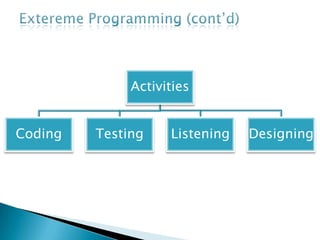
ExteremeProgramming (cont’d)
ExteremeProgramming (cont’d)CodingSoftware instructions a computer can interpret. Without code, there is no working productCoding can also be used to figure out the most suitable solutionCoding can also help to communicate thoughts about programming problemsCode must be always clear and concise and cannot be interpreted in more than one wayOther programmers can give feedback on this code by also coding their thoughts
ExteremeProgramming (cont’d)Testingif a little testing can eliminate a few flaws, a lot of testing can eliminate many more flawsUnit tests determine whether a given feature works as intended. writes as many automated tests as they can think of that might "break" the codeif all tests run successfully, then the coding is complete.Acceptance tests verify that the requirements as understood by the programmers satisfy the customer's actual requirements.
ExteremeProgramming (cont’d)DesigningThe system becomes too complex and the dependencies within the system cease to be clearAvoid this by creating a design structure that organizes the logic in the systemGood design will avoid lots of dependencies within a system
ExteremeProgramming (cont’d)ListeningProgrammers must listen to what the customers need the system to doThey must understand business logic needs well enough to give the customer feedback about the technical aspects of how the problem might be solved
ExteremeProgramming (cont’d)
ExteremeProgramming (cont’d)Communication This task is accomplished through documentationThe goal is to give all developers a shared view of the system which matches the view held by the users of the systemextreme programming favors simple designs, common metaphors, collaboration of users and programmers, frequent verbal communication, and feedback
ExteremeProgramming (cont’d)Simplicity Encourages starting with the simplest solutionthe focus on designing and coding for the needs of today instead of those of tomorrow, next week, or next monthThis is sometimes summed up as the "you aren't gonna need it" (YAGNI) approachCoding and designing for uncertain future requirements implies the risk of spending resources on something that might not be neededA simple design with very simple code could be easily understood by most programmers in the team
ExteremeProgramming (cont’d)Feedback Feedback from the system: by writing unit tests or running periodic integration testsFeedback from the customer: The functional tests (acceptance tests) are written by the customer and the testersFeedback from the team: When customers come up with new requirements the team directly gives an estimation of the time that it will take to implement
ExteremeProgramming (cont’d)Courage Courage enables developers to feel comfortable with refactoring their code when necessaryThis means reviewing the existing system and modifying it so that future changes can be implemented more easilycourage to remove source code that is obsolete, no matter how much effort was used to create that source code
ExteremeProgramming (cont’d)RespectThe respect value includes respect for others as well as self-respectProgrammers should never commit changes that break compilation, that make existing unit-tests fail, or that otherwise delay the work of their peersMembers respect their own work by always striving for high quality and seeking for the best design for the solution at hand through refactoring
ExteremeProgramming (cont’d)RulesBusiness people and developers do joint workOur highest priority is customer satisfactionDeliver working software frequentlyWorking softwareGlobal awarenessThe team must act as an effective social network
Software Development Process

Software Development Process

  • 1.
  • 2.
    AgendaIntroductionAdaptive vs. Predictivesoftware developmentTraditional Software development processWaterfall modelIterative Incremental ModelSpiral ModelAgile Software development processExtreme Programming ModelSCRUM ModelConclusion
  • 3.
    IntroductionSoftware Development process(lifecycle)Is a structure imposed on the development of a software product
  • 4.
  • 5.
    Adaptive vs. PredictiveAdaptivemethods focus on adapting quickly to changeWhen the project requirement change the adapted team also changeAn adaptive team can not report exactly what tasks are being done next weekAn Example of adaptive methods is Agile
  • 6.
    Adaptive vs. Predictive(cont’d)Predictive method focus on planning the future in detailsPredictive team can report exactly what features and tasks are planned for the entire length of the development processPredictive team have difficulty changing direction, the plan is typically optimized for the original destination and changing direction can require completed work to be started over
  • 7.
    Traditional software developmentMethodsWaterfallClean RoomDSDM (Dynamic System Development Method)Iterative IncrementalRAD (Rapid Application Development)RUP (Rational Unified Process)SpiralV-ModelFDD (Feature Driven Development)
  • 8.
    Traditional software developmentMethodsWaterfallClean RoomDSDM (Dynamic System Development Method)Iterative IncrementalRAD (Rapid Application Development)RUP (Rational Unified Process)SpiralV-ModelFDD (Feature Driven Development)
  • 9.
    Waterfall ModelIs asequential design process, often used in software development processesOriginates in the manufacturing and construction industries; highly structured physical environmentsThe Idea behind the waterfall model is“Measure Twice, Cut once”
  • 10.
    Waterfal Model (cont’d)WaterfallModel Phases :Waterfall Model (cont’d)
  • 11.
    Waterfall Model (cont’d)WhyWaterfall Provides a structured approach, it progress linearly, easily, understandable and explainableProvides easily markable milestones in the development processSuites the stable, unchanging requirements
  • 12.
    Waterfall Model (cont’d)Whynot Waterfall Many people think that waterfall model is a bad idea in practiceIt is impossible for any project to finish a phase of a software products lifecycle perfectly before moving to the next phaseClient may not know exactly what requirements he need and he will need to change his requirements at any time
  • 13.
    Waterfall Model (cont’d)Whynot Waterfall Many people think that waterfall model is a bad idea in practiceIt is impossible for any project to finish a phase of a software products lifecycle perfectly before moving to the next phaseDesigners may not be aware of future Implementation
  • 14.
    Waterfall Model (cont’d)Whynot Waterfall Many people think that waterfall model is a bad idea in practiceIt is impossible for any project to finish a phase of a software products lifecycle perfectly before moving to the next phaseStockholders may not be fully aware of the capabilities of the technology being implemented
  • 15.
    Iterative & IncrementaldevelopmentDeveloped in response to the weaknesses of the waterfall modelStarts with initial planning and ends with deployment with the cycle interactions in betweenIterative & incremental development is essential parts of the extreme programming & generally the Agile DevelopmentThe project is delivered through cross discipline work from the requirement to the deployment
  • 16.
    Iterative & Incrementaldevelopment (cont’d)Initial PlanningDeployment
  • 17.
    Iterative & Incrementaldevelopment (cont’d)The basic idea is to develop a system through repeated cycles (Iterative) and in smaller portions at a time (Incremental)Allowing developers to take advantage of what was learned during the development of earlier portionsStart with simple implementation of a subset of the software requirements and iteratively enhance the evolving version until the full system is implementedAt each iteration, design modifications are made and new functional capabilities are added
  • 18.
    Iterative & Incrementaldevelopment (cont’d)
  • 19.
    Iterative & Incrementaldevelopment (cont’d)
  • 20.
    Iterative & Incrementaldevelopment (cont’d)
  • 21.
    Iterative & Incrementaldevelopment (cont’d)
  • 22.
    Iterative & Incrementaldevelopment (cont’d)Implementation GuidelinesAny difficulty in design, coding & testing means the need of redesign and modificationModifications should fit easily isolated and easy to find modulesThe existing implementation should be analyzed frequently to determine how well it measures up to project goals
  • 23.
    Spiral Model (cont’d)Thespiral model was defined by Barry BoehmThis model was not the first model to discuss iteration, but it was the first model to explain why the iteration mattersaims at risk reduction by any means in any phase. The spiral model is often referred to as a risk-driven modelIntroducing prototyping in a Software Process aims at risk reduction at the requirements levelThere is always an element of risk involved in the other phases of development
  • 24.
  • 25.
    Spiral Model (cont’d)Quadrant1Determining objectives of that phase, alternatives and constraintsThis is a way to define a strategy for achieving the goals of this iterationQuadrant 2The strategy is analyzed form the viewpoint of risk, and solutions to minimize these risks are investigated
  • 26.
    Spiral Model (cont’d)Quadrant3A solution is put into practice to produce the artifacts necessary to reach the goals identified in quadrant 1Quadrant 4The results of the risk-reduction strategies are assessed, and if all risks are resolved, the next phase is planned and startedIf some risks are left unsolved, another iteration can be made to continue to work
  • 27.
    Spiral Model (cont’d)AdvantagesEmphasison alternatives and constraints supports the reuse of existing solutions. Targets testing by treating it as a risk, which has to be addressed. Maintenance is just another phase of the spiral model. It is treated in the same way as development. Estimates (budget and schedule) get more realistic as work progresses, because important issues are discovered earlier.
  • 28.
    Spiral Model (cont’d)DisadvantagesOnlyintended for internal projects (inside a company), because risk is assessed as the project is developed. In case of external software development, all risk analysis must be performed by both client and developers before the contract is signedSpiral model is risk driven. Therefore it requires knowledgeable staff.Suitable for only large scale software development.
  • 29.
    Agile software developmentGroupof software development methodologies based on iterative and incremental development Requirements and solutions evolve through collaboration between self organizing, cross functional teamsIntroduced in 2001It’s a light weight as a reaction against the heavy weight methods
  • 30.
    Agile software developmentMethodsSCRUM (1995)Crystal clearExtreme Programming (1996)Adaptive software developmentFeature driven developmentDynamic system development method (1995)Open source software development
  • 31.
    Agile software developmentMethodsSCRUM (1995)Crystal clearExtreme Programming (1996)Adaptive software developmentFeature driven developmentDynamic system development method (1995)Open source software development
  • 32.
    Agile software developmentMethods (cont’d)Agile ManifestoWe are uncovering better ways of developing software by doing it and helping other to doAgile ValuesIndividuals & interactions over process & toolsWorking software over comprehensive documentationCustomer collaboration over contract negotiationResponding to change over following a plan
  • 33.
    Agile software developmentMethods (cont’d)Agile PrinciplesCustomer satisfaction by rapid delivery of useful software
  • 34.
    Agile software developmentMethods (cont’d)Agile PrinciplesWelcome changing requirements even late in development
  • 35.
    Agile software developmentMethods (cont’d)Agile PrinciplesWorking software is the principal measure of progress
  • 36.
    Agile software developmentMethods (cont’d)Agile PrinciplesDaily cooperation between business people & developers
  • 37.
    Agile software developmentMethods (cont’d)Agile PrinciplesFace to Face conversation is the best form of communication
  • 38.
    Agile software developmentMethods (cont’d)Agile PrinciplesSelf-organized team that have motivated and trusted individuals
  • 39.
    Agile software developmentMethods (cont’d)CharacteristicsBreak tasks into small increments with minimal planningIteration are short time frames from (1  4) weeksEach iteration involves a team working through a full software development cycleBy the end of the iteration a demo will be represented to stack holdersOne iteration may not add enough feature to market release but the goal is to have a release with minimal bugs
  • 40.
    Agile software developmentMethods (cont’d)CharacteristicsTeam is usually cross functional and self organizingTeam member take the responsibility of the taskFace-to-face conversation for team in the same location and video for different locations that produce less written documentsAll team working in an open office called (bullpen)Small team size from (5  9) person
  • 41.
    Agile software developmentMethods (cont’d)CharacteristicsEach team have a customer representative to answer mid iteration problemsBy the end of the iteration stockholders view demo and re evaluate the priorities of featuresFormal daily face to face communications to answer three questions (what they did the previous day? What they intend to do today? What their road blocks?)
  • 42.
    Agile software developmentMethods (cont’d)Techniques to improve the quality and agility of project like:Unit testPair programmingTest driven DevelopmentDomain Driven DesignCode refactoring
  • 43.
    SCRUM ModelIts oneof the agile development methodsIt’s the skeleton that includes a set of practices and predefined roles
  • 44.
  • 45.
    SCRUM Model (cont’d)PigroleThe ones committed to the project in the scrum processChicken roleNot a part of the scrum process but must be taken into account
  • 46.
    SCRUM Model (cont’d)ProductOwnerRepresent the voice of the customerEnsure that the scrum teams works with the write things from a business perspectiveWrite user stories, prioritize them and add them to product backlog
  • 47.
    SCRUM Model (cont’d)SCRUMMasterHelp the team to deliver the sprint goalIs not the leader of the team but he is self organizerEnsure that the SCRUM process is used as intendedHe is the enforcer of rules
  • 48.
    SCRUM Model (cont’d)TeamDeliverthe projectMade up of (5  9) people with cross functional to do the actual work (Developers, Designers, Testers)
  • 49.
    SCRUM Model (cont’d)UsersTheusers of the product, and his participation is very important for feedback to review and plan sprintStockholdersThe people who enable the project and the are important in sprint reviewManagersPeople who will set up the environment for the product
  • 50.
  • 51.
    SCRUM Model (cont’d)Sprint(2 4) week period and it is decided by teamIn the sprint the team create an increment of usable softwareDuring the sprint no one can change the sprint backlog
  • 52.
    SCRUM Model (cont’d)ProductBacklogHigh level document of the entire project that include a broad description of all required features and wish list itemsPrioritized by business value of each featureEditable by anyoneContains rough estimates of both business value (product owner )and development effort (team members)
  • 53.
    SCRUM Model (cont’d)BurndownThe burn down chart is publically showing remaining work in the sprint backlogUpdated every dayGive a simple view of the sprint progress
  • 54.
    SCRUM Model (cont’d)SprintBacklogFeatures are broken down into tasksBest practice that tasks are normally estimated between 4h and 16hThe whole team understand exactly the business logic of each taskAny one them can pick task from task list, tasks in the task list are never assigned
  • 55.
  • 56.
    SCRUM Model (cont’d)DailySCRUM MeetingProject status meetingStarts precisely on time. And there is a punishment for lateAll are welcomed but only pig may speakThe meeting is between (15 - 20) minutesAll attendees should stand to make it shortHappen in the same time, same location every day
  • 57.
    SCRUM Model (cont’d)DailySCRUM MeetingEvery one should answer three questionsWhat have you done since yesterday?What are you planning to do today?Do you have any problem preventing you from accomplish your goal?
  • 58.
    SCRUM Model (cont’d)SprintPlanning MeetingHold at the beginning of each sprintDecide what work is to be donePrepare the sprint backlog8 hour limits
  • 59.
    SCRUM Model (cont’d)Sprintreview meetingHold at the end of the sprintReview the complete and incomplete work Present the completed work to stockholders4 hour limits
  • 60.
    SCRUM Model (cont’d)SprintRetrospective meetingAll team members reflects on the past sprintEvery member should answer What went well during the sprint?What could be improved in the next sprint
  • 61.
    Extereme ProgrammingIntended toimprove software quality and responsiveness to changing customer requirementsIntended to improve productivity and introduce checkpoints where new customer requirements can be adoptedProgramming in pairs or doing extensive code reviewUnit testing of all code (End of day testing)Avoiding programming of features until they are actually neededSimplicity and clarity in codeExpecting changes in the customer's requirementsFrequent communication with the customer and among programmers
  • 62.
  • 63.
    ExteremeProgramming (cont’d)ConceptsOrganizes peopleto produce higher quality software more productivelyAttempts to reduce the cost of change by having multiple short development cycles, rather than one long oneIntroduces a number of basic values, principles and practices on top of the agile programming framework
  • 64.
  • 65.
    ExteremeProgramming (cont’d)CodingSoftware instructionsa computer can interpret. Without code, there is no working productCoding can also be used to figure out the most suitable solutionCoding can also help to communicate thoughts about programming problemsCode must be always clear and concise and cannot be interpreted in more than one wayOther programmers can give feedback on this code by also coding their thoughts
  • 66.
    ExteremeProgramming (cont’d)Testingif alittle testing can eliminate a few flaws, a lot of testing can eliminate many more flawsUnit tests determine whether a given feature works as intended. writes as many automated tests as they can think of that might "break" the codeif all tests run successfully, then the coding is complete.Acceptance tests verify that the requirements as understood by the programmers satisfy the customer's actual requirements.
  • 67.
    ExteremeProgramming (cont’d)DesigningThe systembecomes too complex and the dependencies within the system cease to be clearAvoid this by creating a design structure that organizes the logic in the systemGood design will avoid lots of dependencies within a system
  • 68.
    ExteremeProgramming (cont’d)ListeningProgrammers mustlisten to what the customers need the system to doThey must understand business logic needs well enough to give the customer feedback about the technical aspects of how the problem might be solved
  • 69.
  • 70.
    ExteremeProgramming (cont’d)Communication This taskis accomplished through documentationThe goal is to give all developers a shared view of the system which matches the view held by the users of the systemextreme programming favors simple designs, common metaphors, collaboration of users and programmers, frequent verbal communication, and feedback
  • 71.
    ExteremeProgramming (cont’d)Simplicity Encourages startingwith the simplest solutionthe focus on designing and coding for the needs of today instead of those of tomorrow, next week, or next monthThis is sometimes summed up as the "you aren't gonna need it" (YAGNI) approachCoding and designing for uncertain future requirements implies the risk of spending resources on something that might not be neededA simple design with very simple code could be easily understood by most programmers in the team
  • 72.
    ExteremeProgramming (cont’d)Feedback Feedback fromthe system: by writing unit tests or running periodic integration testsFeedback from the customer: The functional tests (acceptance tests) are written by the customer and the testersFeedback from the team: When customers come up with new requirements the team directly gives an estimation of the time that it will take to implement
  • 73.
    ExteremeProgramming (cont’d)Courage Courage enablesdevelopers to feel comfortable with refactoring their code when necessaryThis means reviewing the existing system and modifying it so that future changes can be implemented more easilycourage to remove source code that is obsolete, no matter how much effort was used to create that source code
  • 74.
    ExteremeProgramming (cont’d)RespectThe respectvalue includes respect for others as well as self-respectProgrammers should never commit changes that break compilation, that make existing unit-tests fail, or that otherwise delay the work of their peersMembers respect their own work by always striving for high quality and seeking for the best design for the solution at hand through refactoring
  • 75.
    ExteremeProgramming (cont’d)RulesBusiness peopleand developers do joint workOur highest priority is customer satisfactionDeliver working software frequentlyWorking softwareGlobal awarenessThe team must act as an effective social network

Editor's Notes

  • #46 Pig and Chicken Story to open restaurant named Ham and Egg , The pig say I’m not accepted , I’m committed but you are just involved