
-Ankita Basu
-Pritha Guha
Software Models

A software life-cycle model is a descriptive and
diagrammatic representation of the software
life-cycle. This includes a series of identifiable
stages that a software product undergoes during
its lifetime.
The software life-cycle is also referred to as the
System Development life-cycle (SDLC).
Introduction
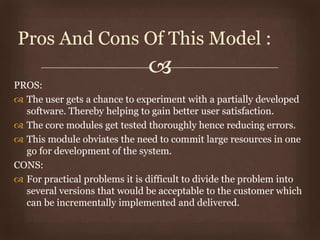

 Software development organizations have realised
that adherence to a suitable well-defined lifecycle
model helps to produce good quality products and
that without time and cost overruns.
 The primary advantage of adhering to a life-cycle
model is that it encourages development of software
in a systematic and disciplined manner.
Why use a life-cycle model?

There are five types of life-cycle models. Namely,
 Classical Waterfall Model.
 Iterative Waterfall Model.
 Evolutionary Model.
 Prototyping Model.
 Spiral Model.
Types of life-cycle models

The classical waterfall model is considered to
be a theoretical way of developing software
and is used to appreciate and develop proper
understanding of the other software models.
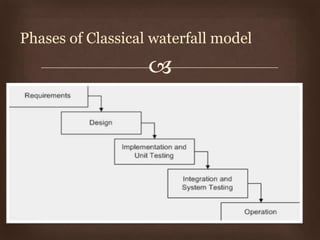
The diagrammatic representation of this
model resembles a cascade of waterfalls and
hence the name.
Classical Waterfall Model

Phases of Classical waterfall model

 The classical waterfall model, being an ideal
model, assumes the phases to be flawlessly done and
there’s no scope for rework at a later time.
 This model assumes the phases to be sequential but
in practical case it may over lap.
 It is difficult to accommodate requirement changes
after the development process starts.
Disadvantage of this Model :

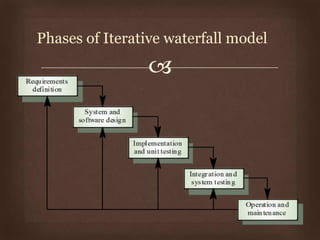
 The Iterative waterfall model is the Classical
Waterfall Model with some necessary changes so that
it becomes applicable to practical software
development projects.
 The main change made being the feedback paths
from every phase to its proceeding phases to allow
correction of the errors committed during a phase, as
an when detected in a later phase.
Iterative Waterfall Model

Phases of Iterative waterfall model

 This model cannot be used in projects where only
rough requirements are provided.
 The rigid phase sequence prescribed by the waterfall
model can result in wastage of resources and man-
power .
Disadvantage of this model

 This life-cycle model (also referred to as the
successive versions model or the incremental model)
first builds a simple working system, then functional
improvements and additions are made until the
desired system is realized.
Evolutionary Model

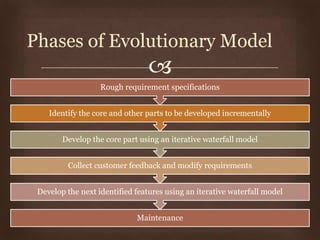
Phases of Evolutionary Model
Maintenance
Develop the next identified features using an iterative waterfall model
Collect customer feedback and modify requirements
Develop the core part using an iterative waterfall model
Identify the core and other parts to be developed incrementally
Rough requirement specifications

PROS:
 The user gets a chance to experiment with a partially developed
software. Thereby helping to gain better user satisfaction.
 The core modules get tested thoroughly hence reducing errors.
 This module obviates the need to commit large resources in one
go for development of the system.
CONS:
 For practical problems it is difficult to divide the problem into
several versions that would be acceptable to the customer which
can be incrementally implemented and delivered.
Pros And Cons Of This Model :

 This type of model requires that before carrying out
the development of the actual software, a working
prototype of the system should be built which is a
very crude version of the actual system, using
inefficient, inaccurate or dummy functions or in
short using short cuts.
Prototyping model

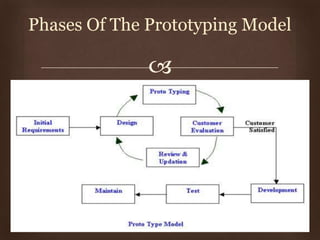
Phases Of The Prototyping Model

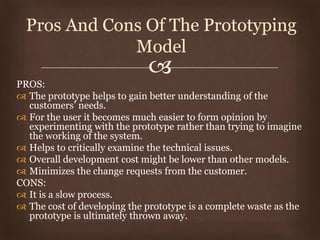
PROS:
 The prototype helps to gain better understanding of the
customers’ needs.
 For the user it becomes much easier to form opinion by
experimenting with the prototype rather than trying to imagine
the working of the system.
 Helps to critically examine the technical issues.
 Overall development cost might be lower than other models.
 Minimizes the change requests from the customer.
CONS:
 It is a slow process.
 The cost of developing the prototype is a complete waste as the
prototype is ultimately thrown away.
Pros And Cons Of The Prototyping
Model

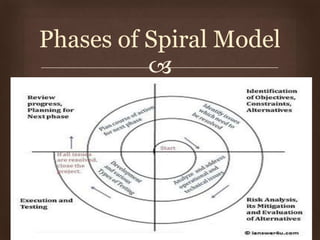
 The spiral model of a software appears like a spiral
with many loops.
 Over each loop, one or more features of the product
are elaborated and analyzed and the risks at that
point of time are identified and are resolved through
prototyping. Based on this, the identified features are
implemented.
Spiral Model

Phases of Spiral Model

CONS:
 Complex model.
 Requires knowledgeable staff.
 Not very suitable for development of a product as
outsourced projects.
PROS:
 For projects having many unknown risks that might show
up as the development proceeds, this would be the most
appropriate model.
 It is more powerful than all other software models as it
subsumes all the discussed models.
Pros And Cons Of This Model :

 The classical model cannot be used in practical
development projects because of its lack of error
correction mechanism.
 The iterative waterfall model, probably the most
widely used software model, is suitable only for well-
understood problems and not for very large projects
or projects with many types of risks.
Example: a simple data processing software, or
an embedded software if the development
team is experienced
Study Of The Different Models
From Their Usage

 The prototyping model is suitable for projects for
which the requirements are not well understood but
all the risks can be identified.
Example: especially popular for the development of
user interface part of the project.
 The evolutionary model is suitable for object-
oriented development projects.
 The spiral model, being the best of these models, is
suitable for development of technically challenging
and large projects prone to several kinds of risks. But
this model is generally not used due to its complexity
Study Of The Different Models
From Their Usage(Contd.)

 During the development of any type of software product
,adherence to a suitable process model has become
universal. We have discussed five important life-cycle
models. Different life-cycle models have their own
advantages and disadvantages. Therefore, an appropriate
life-cycle model should be chosen for the problem at hand.
Even though organizations may follow whichever life cycle
model is appropriate to a project, the final document
should reflect as if the product was developed using
classical waterfall model. This makes it easier for the
maintainers to understand the product document.
Conclusion

SA sir’s notes.
Fundamentals Of Software Engineering by
Rajib Mall.
Wikipedia
References:

Thank You…..!!

Software Engineering - Software Models

  • 1.
  • 2.
     A software life-cyclemodel is a descriptive and diagrammatic representation of the software life-cycle. This includes a series of identifiable stages that a software product undergoes during its lifetime. The software life-cycle is also referred to as the System Development life-cycle (SDLC). Introduction
  • 3.
      Software developmentorganizations have realised that adherence to a suitable well-defined lifecycle model helps to produce good quality products and that without time and cost overruns.  The primary advantage of adhering to a life-cycle model is that it encourages development of software in a systematic and disciplined manner. Why use a life-cycle model?
  • 4.
     There are fivetypes of life-cycle models. Namely,  Classical Waterfall Model.  Iterative Waterfall Model.  Evolutionary Model.  Prototyping Model.  Spiral Model. Types of life-cycle models
  • 5.
     The classical waterfallmodel is considered to be a theoretical way of developing software and is used to appreciate and develop proper understanding of the other software models. The diagrammatic representation of this model resembles a cascade of waterfalls and hence the name. Classical Waterfall Model
  • 6.
     Phases of Classicalwaterfall model
  • 7.
      The classicalwaterfall model, being an ideal model, assumes the phases to be flawlessly done and there’s no scope for rework at a later time.  This model assumes the phases to be sequential but in practical case it may over lap.  It is difficult to accommodate requirement changes after the development process starts. Disadvantage of this Model :
  • 8.
      The Iterativewaterfall model is the Classical Waterfall Model with some necessary changes so that it becomes applicable to practical software development projects.  The main change made being the feedback paths from every phase to its proceeding phases to allow correction of the errors committed during a phase, as an when detected in a later phase. Iterative Waterfall Model
  • 9.
     Phases of Iterativewaterfall model
  • 10.
      This modelcannot be used in projects where only rough requirements are provided.  The rigid phase sequence prescribed by the waterfall model can result in wastage of resources and man- power . Disadvantage of this model
  • 11.
      This life-cyclemodel (also referred to as the successive versions model or the incremental model) first builds a simple working system, then functional improvements and additions are made until the desired system is realized. Evolutionary Model
  • 12.
     Phases of EvolutionaryModel Maintenance Develop the next identified features using an iterative waterfall model Collect customer feedback and modify requirements Develop the core part using an iterative waterfall model Identify the core and other parts to be developed incrementally Rough requirement specifications
  • 13.
     PROS:  The usergets a chance to experiment with a partially developed software. Thereby helping to gain better user satisfaction.  The core modules get tested thoroughly hence reducing errors.  This module obviates the need to commit large resources in one go for development of the system. CONS:  For practical problems it is difficult to divide the problem into several versions that would be acceptable to the customer which can be incrementally implemented and delivered. Pros And Cons Of This Model :
  • 14.
      This typeof model requires that before carrying out the development of the actual software, a working prototype of the system should be built which is a very crude version of the actual system, using inefficient, inaccurate or dummy functions or in short using short cuts. Prototyping model
  • 15.
     Phases Of ThePrototyping Model
  • 16.
     PROS:  The prototypehelps to gain better understanding of the customers’ needs.  For the user it becomes much easier to form opinion by experimenting with the prototype rather than trying to imagine the working of the system.  Helps to critically examine the technical issues.  Overall development cost might be lower than other models.  Minimizes the change requests from the customer. CONS:  It is a slow process.  The cost of developing the prototype is a complete waste as the prototype is ultimately thrown away. Pros And Cons Of The Prototyping Model
  • 17.
      The spiralmodel of a software appears like a spiral with many loops.  Over each loop, one or more features of the product are elaborated and analyzed and the risks at that point of time are identified and are resolved through prototyping. Based on this, the identified features are implemented. Spiral Model
  • 18.
  • 19.
     CONS:  Complex model. Requires knowledgeable staff.  Not very suitable for development of a product as outsourced projects. PROS:  For projects having many unknown risks that might show up as the development proceeds, this would be the most appropriate model.  It is more powerful than all other software models as it subsumes all the discussed models. Pros And Cons Of This Model :
  • 20.
      The classicalmodel cannot be used in practical development projects because of its lack of error correction mechanism.  The iterative waterfall model, probably the most widely used software model, is suitable only for well- understood problems and not for very large projects or projects with many types of risks. Example: a simple data processing software, or an embedded software if the development team is experienced Study Of The Different Models From Their Usage
  • 21.
      The prototypingmodel is suitable for projects for which the requirements are not well understood but all the risks can be identified. Example: especially popular for the development of user interface part of the project.  The evolutionary model is suitable for object- oriented development projects.  The spiral model, being the best of these models, is suitable for development of technically challenging and large projects prone to several kinds of risks. But this model is generally not used due to its complexity Study Of The Different Models From Their Usage(Contd.)
  • 22.
      During thedevelopment of any type of software product ,adherence to a suitable process model has become universal. We have discussed five important life-cycle models. Different life-cycle models have their own advantages and disadvantages. Therefore, an appropriate life-cycle model should be chosen for the problem at hand. Even though organizations may follow whichever life cycle model is appropriate to a project, the final document should reflect as if the product was developed using classical waterfall model. This makes it easier for the maintainers to understand the product document. Conclusion
  • 23.
     SA sir’s notes. FundamentalsOf Software Engineering by Rajib Mall. Wikipedia References:
  • 24.