SOFTWARE DEVELOPMENT
LIFE CYCLE
BY ASHUTOSH THAPA
INTRODUCTION
 Software is said to have a life cycle composed of several phases.
 Each phases has a well defined starting and ending points with
clearly identifiable deliverables to the next phase.
 Software development life cycle describes a process used by
engineers and analyst to develop and deploy all aspects of an
information system.
 Sequence of activities carried out by analyst, designer and user to
develop an information system.
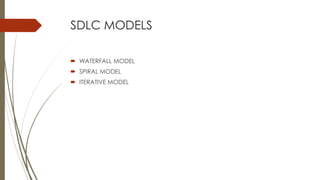
SDLC MODELS
 WATERFALL MODEL
 SPIRAL MODEL
 ITERATIVE MODEL
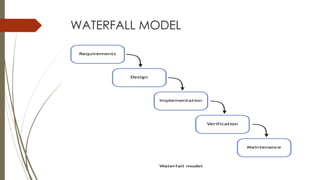
WATERFALL MODEL
WATERFALL MODEL
 REQUIREMENT DEFINITION :- the program developer and the client sit together to discuss
the requirements.
 SYSTEM AND SOFTWARE DESIGN :- the designer according to the given requirement makes
database,modules,forms etc.
 IMPLEMENTATION AND UNIT TESTING :- Here actual coding is started. The system is first
developed in small programs called unit.
 INTEGRATION AND SYSTEM TESTING :- In this phase the units are integrated into a complete
system.
 OPERATIONS AND MAINTENANCE :- In this phase the system is put into practical use.
ADVANTAGE AND DISADVANTAGE
 ADVANTAGE
 Easy to understand and implement.
 Widely used and known.
 DISADVANTAGE
 It is linear (Works sequentially).
 It is rigid (its not flexible).
 System requirement is needed early in the project.
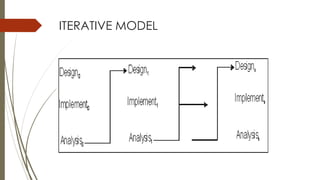
ITERATIVE MODEL
ITERATIVE MODEL
 Software is developed in increments.
 Project control lists keeps tracks of task.
 Each increment deletes the previous increment from project control list.
ADVANTAGE AND DISADVANTAGE
 ADVANTAGE
 Better testing.
 Combines the principles of both prototyping and waterfall models.
 DISADVANTAGE
 Iteration may be very long process.
 Costly system architecture as there is always a need to improve.
SPIRAL MODEL
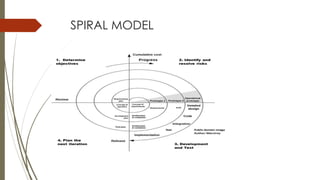
SPIRAL MODEL
 OBJECTIVE SETTING :-Specific objectives for that phase of the project
are defined.
 RISK ASSESMENT AND RISK REDUCTION :-For each of the identified
project risks, a detailed analysis is carried out.
 DEVELOPMENT AND VALIDATION :-After risk evaluation, a development
model for the system is chosen.
 PLANNING :-The project is reviewed and a decision made whether to
continue with a further loop of the spiral.
ADVANTAGE AND DISADVANTAGE
 ADVANTAGE
 High amount of risk analysis.
 Good for large and mission-critical projects.
 DISADVANTAGE
 Cost id high.
 Doesn’t work well for smaller projects.
 It is not suitable for low risk projects.
THANK YOU

01 software development life cycle

  • 1.
  • 2.
    INTRODUCTION  Software issaid to have a life cycle composed of several phases.  Each phases has a well defined starting and ending points with clearly identifiable deliverables to the next phase.  Software development life cycle describes a process used by engineers and analyst to develop and deploy all aspects of an information system.  Sequence of activities carried out by analyst, designer and user to develop an information system.
  • 3.
    SDLC MODELS  WATERFALLMODEL  SPIRAL MODEL  ITERATIVE MODEL
  • 4.
  • 5.
    WATERFALL MODEL  REQUIREMENTDEFINITION :- the program developer and the client sit together to discuss the requirements.  SYSTEM AND SOFTWARE DESIGN :- the designer according to the given requirement makes database,modules,forms etc.  IMPLEMENTATION AND UNIT TESTING :- Here actual coding is started. The system is first developed in small programs called unit.  INTEGRATION AND SYSTEM TESTING :- In this phase the units are integrated into a complete system.  OPERATIONS AND MAINTENANCE :- In this phase the system is put into practical use.
  • 6.
    ADVANTAGE AND DISADVANTAGE ADVANTAGE  Easy to understand and implement.  Widely used and known.  DISADVANTAGE  It is linear (Works sequentially).  It is rigid (its not flexible).  System requirement is needed early in the project.
  • 7.
  • 8.
    ITERATIVE MODEL  Softwareis developed in increments.  Project control lists keeps tracks of task.  Each increment deletes the previous increment from project control list.
  • 9.
    ADVANTAGE AND DISADVANTAGE ADVANTAGE  Better testing.  Combines the principles of both prototyping and waterfall models.  DISADVANTAGE  Iteration may be very long process.  Costly system architecture as there is always a need to improve.
  • 10.
  • 11.
    SPIRAL MODEL  OBJECTIVESETTING :-Specific objectives for that phase of the project are defined.  RISK ASSESMENT AND RISK REDUCTION :-For each of the identified project risks, a detailed analysis is carried out.  DEVELOPMENT AND VALIDATION :-After risk evaluation, a development model for the system is chosen.  PLANNING :-The project is reviewed and a decision made whether to continue with a further loop of the spiral.
  • 12.
    ADVANTAGE AND DISADVANTAGE ADVANTAGE  High amount of risk analysis.  Good for large and mission-critical projects.  DISADVANTAGE  Cost id high.  Doesn’t work well for smaller projects.  It is not suitable for low risk projects.
  • 13.