Chapter 1: Introduction to Statistics
Learning Outcomes
When you will complete this chapter, you would be
able to-
• Understand the purpose of statistics.
• Know the differences between descriptive and inferential
statistics.
• Understand the differences between a sample and a
population.
Contents
From this lecture, you are going to learn…
Statistics and types of statistics
Population and sample
Parameter and statistic
Sampling Techniques
1.5
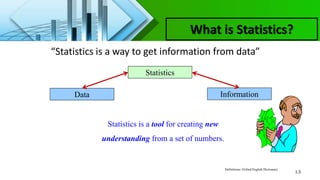
“Statistics is a way to get information from data”
Data
Statistics
Information
Definitions: Oxford English Dictionary
Statistics is a tool for creating new
understanding from a set of numbers.
What is Statistics?
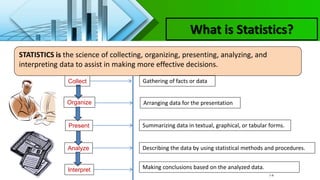
STATISTICS is the science of collecting, organizing, presenting, analyzing, and
interpreting data to assist in making more effective decisions.
1-6
Collect
Present
Analyze
Organize
Interpret
Gathering of facts or data
Summarizing data in textual, graphical, or tabular forms.
Describing the data by using statistical methods and procedures.
Making conclusions based on the analyzed data.
Arranging data for the presentation
What is Statistics?
7
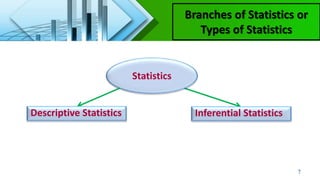
Branches of Statistics or
Types of Statistics
Statistics
Descriptive Statistics Inferential Statistics
8
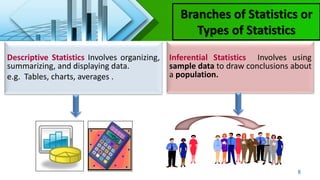
Descriptive Statistics Involves organizing,
summarizing, and displaying data.
e.g. Tables, charts, averages .
Inferential Statistics Involves using
sample data to draw conclusions about
a population.
a
A
a
Branches of Statistics or
Types of Statistics
9
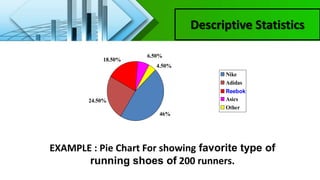
46%
24.50%
18.50%
6.50%
4.50%
Nike
Adidas
Reebok
Asics
Other
EXAMPLE : Pie Chart For showing favorite type of
running shoes of 200 runners.
Descriptive Statistics
Example:
The accounting department of a large firm will select a
sample of the invoices to check for accuracy for all the
invoices of the company.
Inferential Statistics
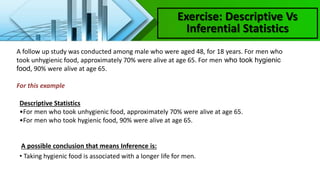
Exercise: Descriptive Vs
Inferential Statistics
A follow up study was conducted among male who were aged 48, for 18 years. For men who
took unhygienic food, approximately 70% were alive at age 65. For men who took hygienic
food, 90% were alive at age 65.
For this example
Descriptive Statistics
•For men who took unhygienic food, approximately 70% were alive at age 65.
•For men who took hygienic food, 90% were alive at age 65.
A possible conclusion that means Inference is:
• Taking hygienic food is associated with a longer life for men.
Larson/Farber 4th ed. 12
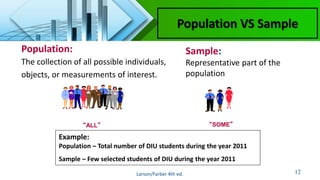
Population:
The collection of all possible individuals,
objects, or measurements of interest.
Sample:
Representative part of the
population
“ALL” “SOME”
Population VS Sample
Example:
Population – Total number of DIU students during the year 2011
Sample – Few selected students of DIU during the year 2011
13
Census,
Parameter VS Statistic
 Census: Collection of data from every member of a population.
 Parameter: measurable characteristic of a population. It is usually referred to
true or actual value.
Example: average CGPA from all the DIU students.
 Statistic: measurable characteristic of a sample.
Example: average CGPA from few students of DIU
14
Population, Sample, Parameter, Statistic
At a glance….
15
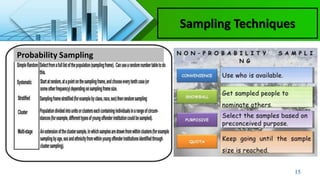
Sampling Techniques
Probability Sampling
Introduction to statistics _15_5 (2).pptx

Introduction to statistics _15_5 (2).pptx

  • 1.
  • 3.
    Learning Outcomes When youwill complete this chapter, you would be able to- • Understand the purpose of statistics. • Know the differences between descriptive and inferential statistics. • Understand the differences between a sample and a population.
  • 4.
    Contents From this lecture,you are going to learn… Statistics and types of statistics Population and sample Parameter and statistic Sampling Techniques
  • 5.
    1.5 “Statistics is away to get information from data” Data Statistics Information Definitions: Oxford English Dictionary Statistics is a tool for creating new understanding from a set of numbers. What is Statistics?
  • 6.
    STATISTICS is thescience of collecting, organizing, presenting, analyzing, and interpreting data to assist in making more effective decisions. 1-6 Collect Present Analyze Organize Interpret Gathering of facts or data Summarizing data in textual, graphical, or tabular forms. Describing the data by using statistical methods and procedures. Making conclusions based on the analyzed data. Arranging data for the presentation What is Statistics?
  • 7.
    7 Branches of Statisticsor Types of Statistics Statistics Descriptive Statistics Inferential Statistics
  • 8.
    8 Descriptive Statistics Involvesorganizing, summarizing, and displaying data. e.g. Tables, charts, averages . Inferential Statistics Involves using sample data to draw conclusions about a population. a A a Branches of Statistics or Types of Statistics
  • 9.
    9 46% 24.50% 18.50% 6.50% 4.50% Nike Adidas Reebok Asics Other EXAMPLE : PieChart For showing favorite type of running shoes of 200 runners. Descriptive Statistics
  • 10.
    Example: The accounting departmentof a large firm will select a sample of the invoices to check for accuracy for all the invoices of the company. Inferential Statistics
  • 11.
    Exercise: Descriptive Vs InferentialStatistics A follow up study was conducted among male who were aged 48, for 18 years. For men who took unhygienic food, approximately 70% were alive at age 65. For men who took hygienic food, 90% were alive at age 65. For this example Descriptive Statistics •For men who took unhygienic food, approximately 70% were alive at age 65. •For men who took hygienic food, 90% were alive at age 65. A possible conclusion that means Inference is: • Taking hygienic food is associated with a longer life for men.
  • 12.
    Larson/Farber 4th ed.12 Population: The collection of all possible individuals, objects, or measurements of interest. Sample: Representative part of the population “ALL” “SOME” Population VS Sample Example: Population – Total number of DIU students during the year 2011 Sample – Few selected students of DIU during the year 2011
  • 13.
    13 Census, Parameter VS Statistic Census: Collection of data from every member of a population.  Parameter: measurable characteristic of a population. It is usually referred to true or actual value. Example: average CGPA from all the DIU students.  Statistic: measurable characteristic of a sample. Example: average CGPA from few students of DIU
  • 14.
    14 Population, Sample, Parameter,Statistic At a glance….
  • 15.

Editor's Notes