By Mr. Jack
Mexico
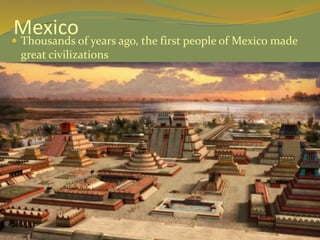
 Thousands of years ago, the first people of Mexico made
great civilizations
Mexico
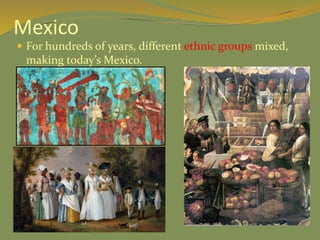
 For hundreds of years, different ethnic groups mixed,
making today’s Mexico.
The People
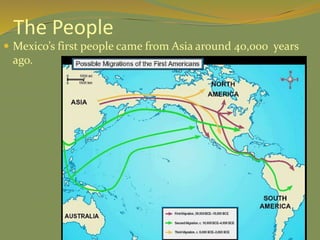
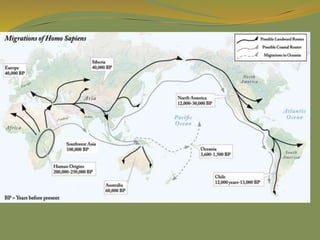
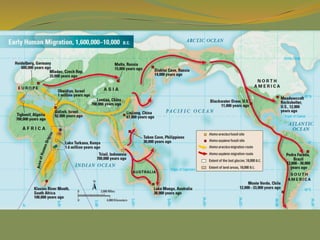
 Mexico’s first people came from Asia around 40,000 years
ago.
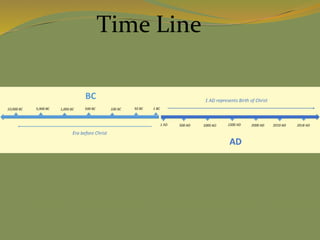
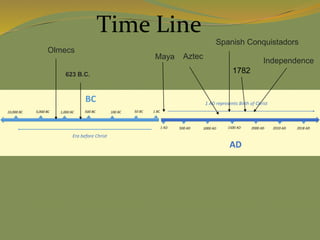
Time Line
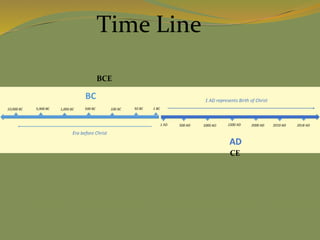
Time Line
BCE
CE
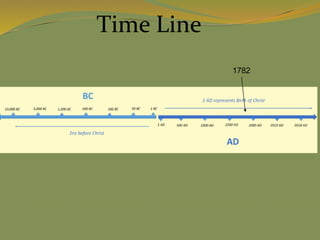
Time Line
1782
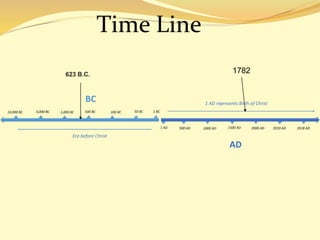
Time Line
1782
623 B.C.
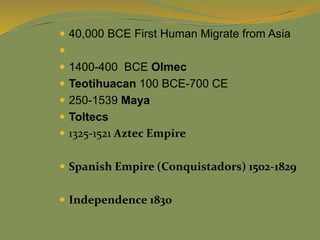
 40,000 BCE First Human Migrate from Asia

 1400-400 BCE Olmec
 Teotihuacan 100 BCE-700 CE
 250-1539 Maya
 Toltecs
 1325-1521 Aztec Empire
 Spanish Empire (Conquistadors) 1502-1829
 Independence 1830
Time Line
1782
623 B.C.
Olmecs
Aztec
Maya
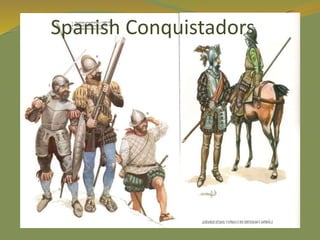
Spanish Conquistadors
Independence
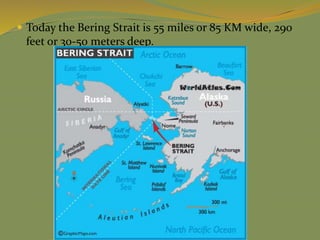
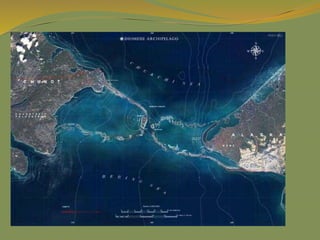
 Today the Bering Strait is 55 miles or 85 KM wide, 290
feet or 30-50 meters deep.
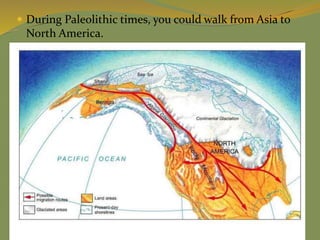
 During Paleolithic times, you could walk from Asia to
North America.
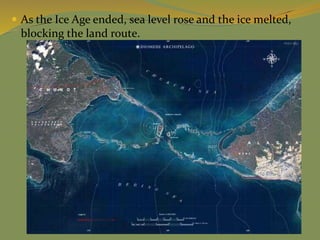
 As the Ice Age ended, sea level rose and the ice melted,
blocking the land route.
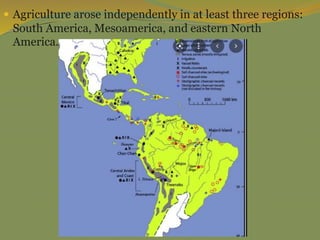
 Agriculture arose independently in at least three regions:
South America, Mesoamerica, and eastern North
America.
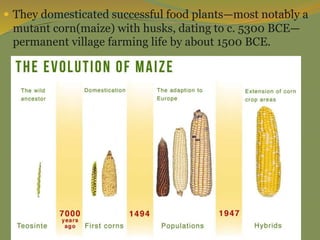
 They domesticated successful food plants—most notably a
mutant corn(maize) with husks, dating to c. 5300 BCE—
permanent village farming life by about 1500 BCE.
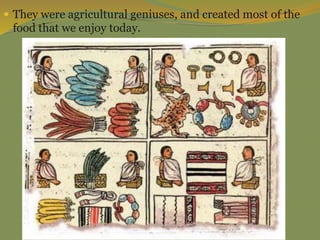
 They were agricultural geniuses, and created most of the
food that we enjoy today.
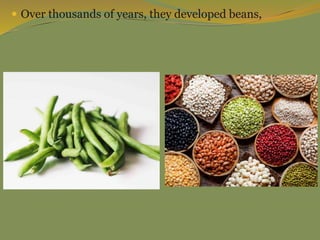
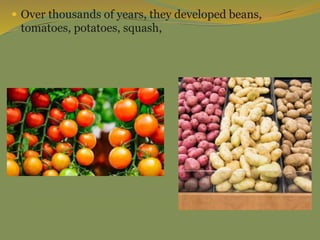
 Over thousands of years, they developed beans,
tomatoes, potatoes, squash,
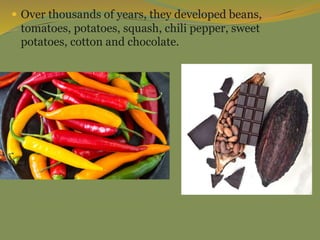
 Over thousands of years, they developed beans,
tomatoes, potatoes, squash, chili pepper, sweet
potatoes, cotton and chocolate.
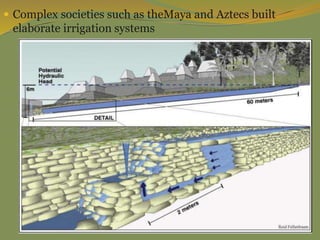
 Complex societies such as theMaya and Aztecs built
elaborate irrigation systems
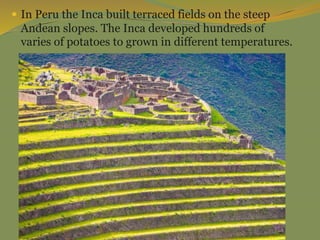
 In Peru the Inca built terraced fields on the steep
Andean slopes. The Inca developed hundreds of
varies of potatoes to grown in different temperatures.
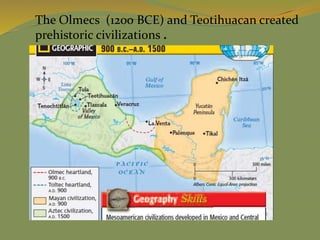
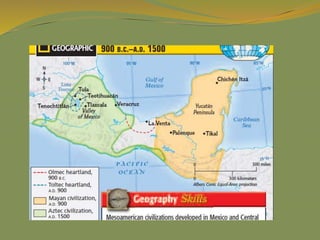
The Olmecs (1200 BCE) and Teotihuacan created
prehistoric civilizations .
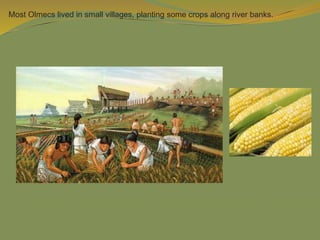
Most Olmecs lived in small villages, planting some crops along river banks.
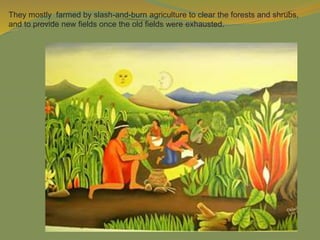
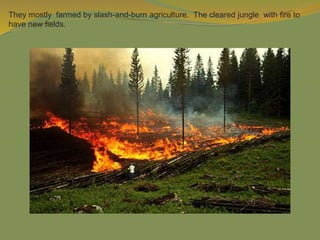
They mostly farmed by slash-and-burn agriculture to clear the forests and shrubs,
and to provide new fields once the old fields were exhausted.
They mostly farmed by slash-and-burn agriculture. The cleared jungle with fire to
have new fields.
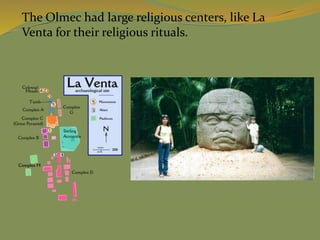
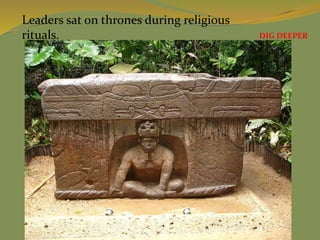
The Olmec had large religious centers, like La
Venta for their religious rituals.
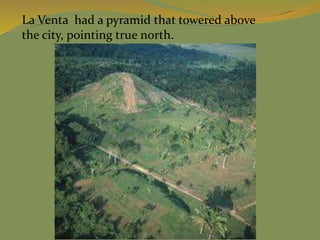
La Venta had a pyramid that towered above
the city, pointing true north.
Leaders sat on thrones during religious
rituals. DIG DEEPER
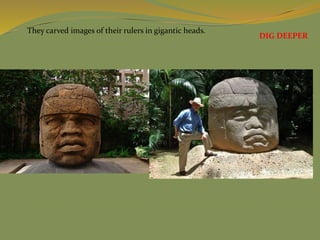
They carved images of their rulers in gigantic heads.
DIG DEEPER
The Olmec may have been the first civilization in the region to develop a writing system.
Symbols found in 2002 and 2006 date from 650 BCE] and 900 BCE.
Cascajal Block
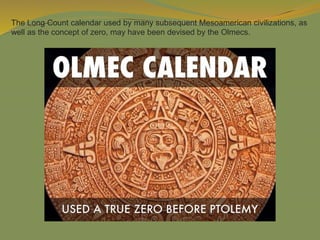
The Long Count calendar used by many subsequent Mesoamerican civilizations, as
well as the concept of zero, may have been devised by the Olmecs.
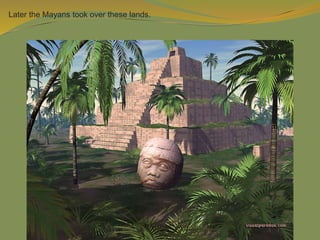
Later the Mayans took over these lands.
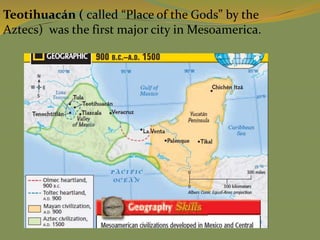
Teotihuacán ( called “Place of the Gods” by the
Aztecs) was the first major city in Mesoamerica.
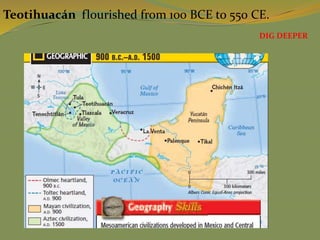
Teotihuacán flourished from 100 BCE to 550 CE.
DIG DEEPER
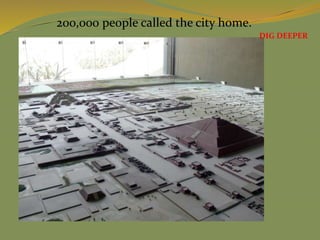
200,000 people called the city home.
DIG DEEPER
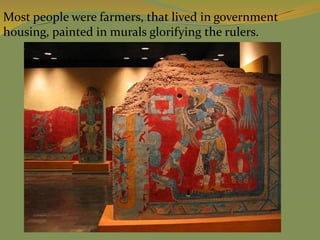
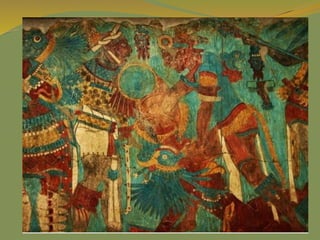
Most people were farmers, that lived in government
housing, painted in murals glorifying the rulers.
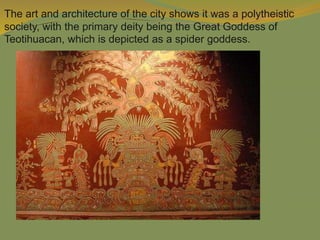
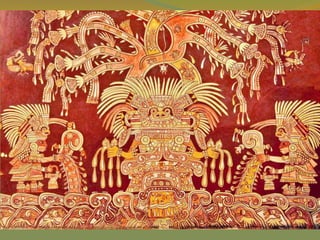
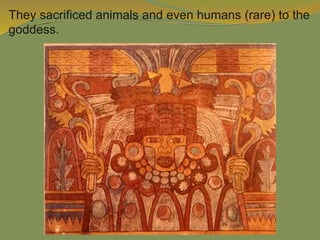
The art and architecture of the city shows it was a polytheistic
society, with the primary deity being the Great Goddess of
Teotihuacan, which is depicted as a spider goddess.
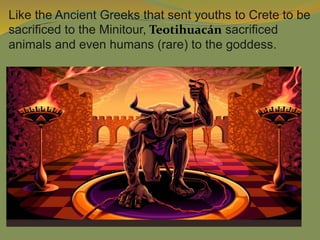
Like the Ancient Greeks that sent youths to Crete to be
sacrificed to the Minitour, Teotihuacán sacrificed
animals and even humans (rare) to the goddess.
They sacrificed animals and even humans (rare) to the
goddess.
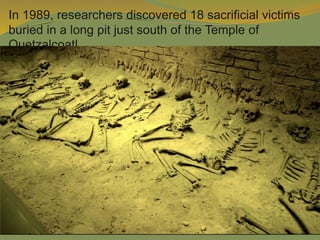
In 1989, researchers discovered 18 sacrificial victims
buried in a long pit just south of the Temple of
Quetzalcoatl.
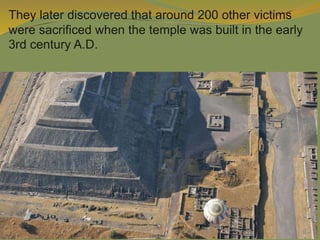
They later discovered that around 200 other victims
were sacrificed when the temple was built in the early
3rd century A.D.
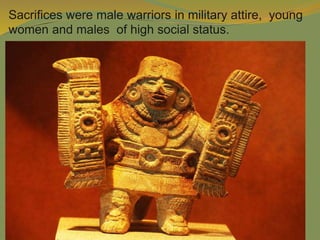
Sacrifices were male warriors in military attire, young
women and males of high social status.
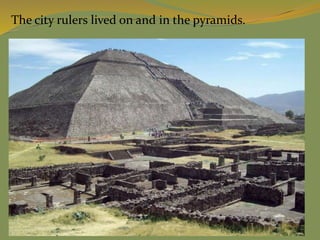
The city rulers lived on and in the pyramids.
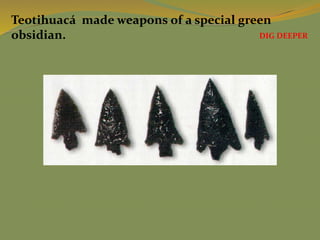
Teotihuacá made weapons of a special green
obsidian. DIG DEEPER
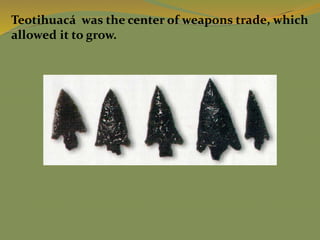
Teotihuacá was the center of weapons trade, which
allowed it to grow.
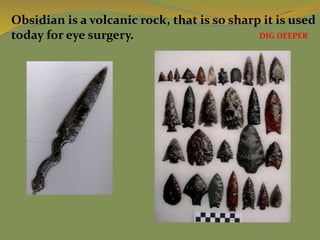
Obsidian is a volcanic rock, that is so sharp it is used
today for eye surgery. DIG DEEPER
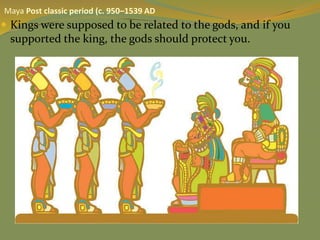
Obsidian is a volcanic rock, that is so sharp it is used
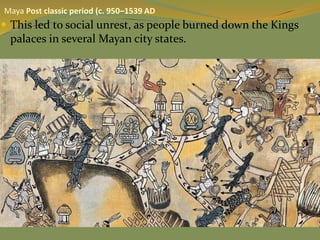
today for eye surgery. DIG DEEPER
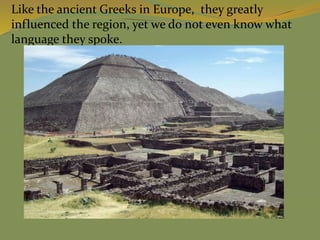
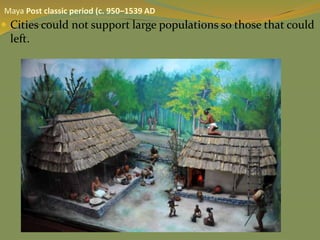
Like the ancient Greeks in Europe, they greatly
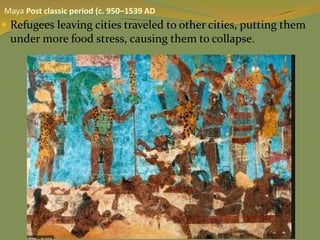
influenced the region, yet we do not even know what
language they spoke.
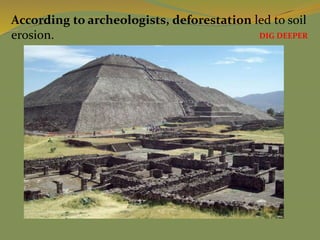
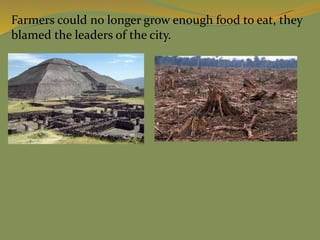
According to archeologists, deforestation led to soil
erosion. DIG DEEPER
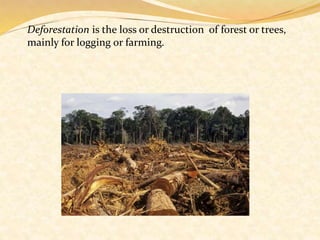
Deforestation is the loss or destruction of forest or trees,
mainly for logging or farming.
Farmers could no longer grow enough food to eat, they
blamed the leaders of the city.
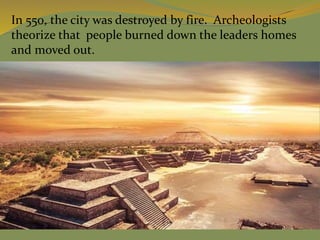
In 550, the city was destroyed by fire. Archeologists
theorize that people burned down the leaders homes
and moved out.
Around 600 A.D., major buildings were deliberately burned and artworks and religious
sculptures were destroyed, suggesting an uprising from the poor against the ruling elite
Another theory holds that invaders sacked and burned it—though Teotihuacan exerted
its military power over other cultures, the city lacked fortifications and military structures
By 750 A.D., the remaining inhabitants of the city had all abandoned their homes to join
neighboring cultures or return to their ancestral homes.
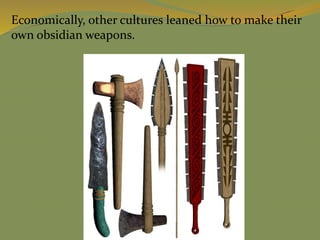
Economically, other cultures leaned how to make their
own obsidian weapons.
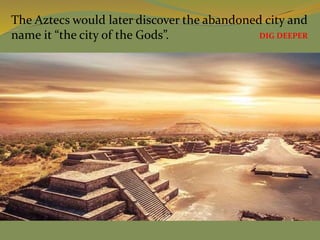
The Aztecs would later discover the abandoned city and
name it “the city of the Gods”. DIG DEEPER
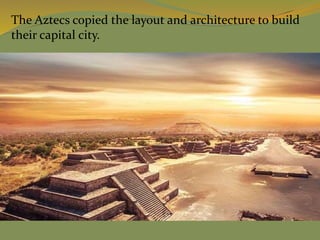
The Aztecs copied the layout and architecture to build
their capital city.
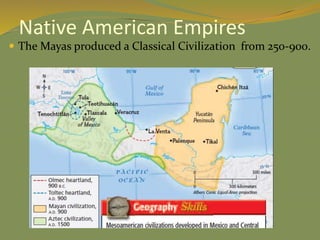
Native American Empires
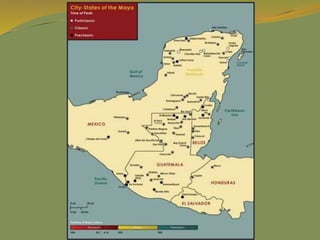
 The Mayas produced a Classical Civilization from 250-900.
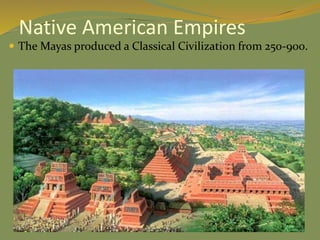
Native American Empires
 The Mayas produced a Classical Civilization from 250-900.
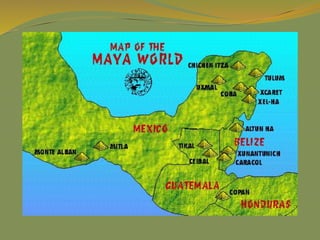
Maya
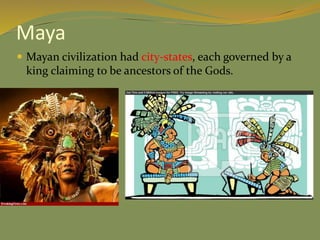
 Mayan civilization had city-states, each governed by a
king claiming to be ancestors of the Gods.
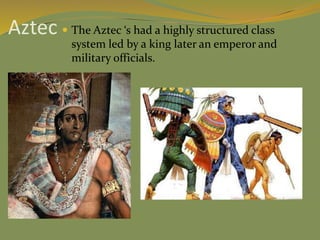
 city state
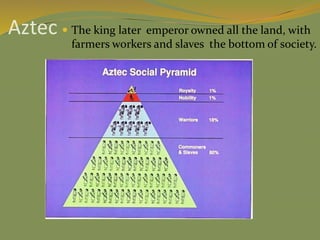
 nounhistorical
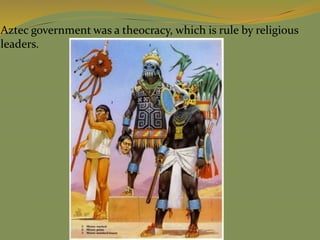
 a city that with its surrounding territory forms an
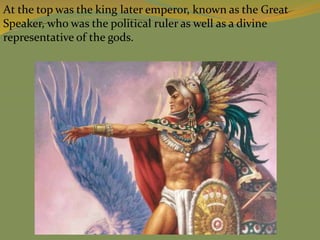
independent state.
Maya
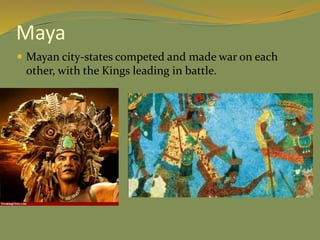
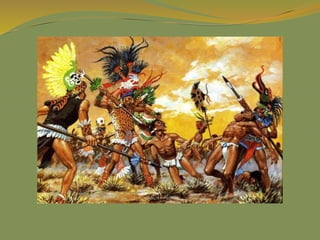
 Mayan city-states competed and made war on each
other, with the Kings leading in battle.
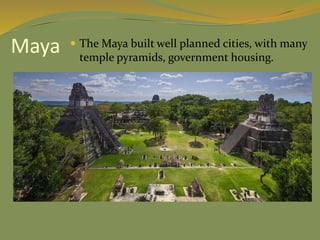
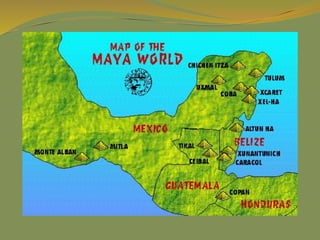
Maya  The Maya built well planned cities, with many
temple pyramids, government housing.
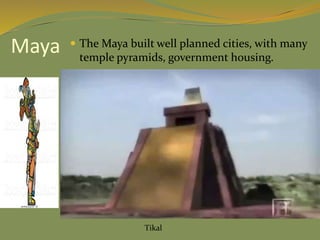
Maya  The Maya built well planned cities, with many
temple pyramids, government housing.
Tikal
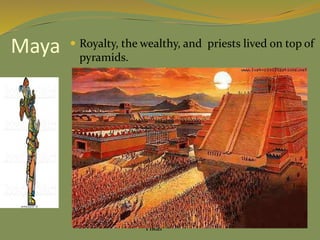
Maya  Royalty, the wealthy, and priests lived on top of
pyramids.
Tikal
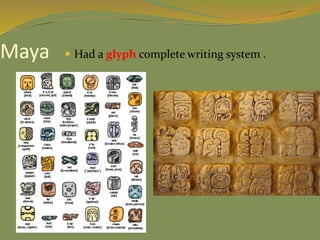
Maya  Had a glyph complete writing system .
 Glyph is a writing system using symbols instead of
letters.
Maya
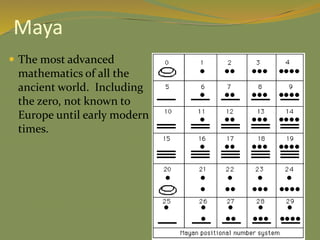
 The most advanced
mathematics of all the
ancient world. Including
the zero, not known to
Europe until early modern
times.
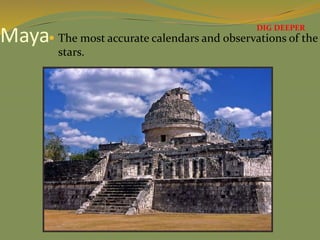
Maya The most accurate calendars and observations of the
stars.
DIG DEEPER
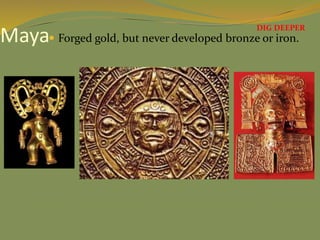
Maya Forged gold, but never developed bronze or iron.
DIG DEEPER
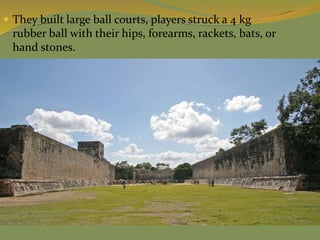
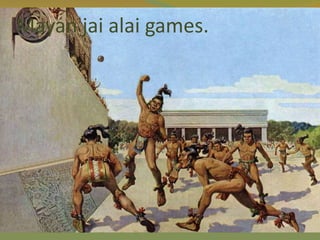
 They built large ball courts, players struck a 4 kg
rubber ball with their hips, forearms, rackets, bats, or
hand stones.
Mayan jai alai games.
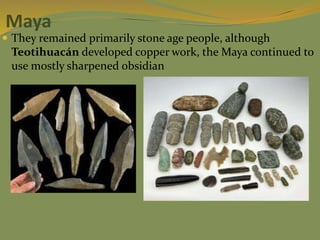
 They remained primarily stone age people, although
Teotihuacán developed copper work, the Maya continued to
use mostly sharpened obsidian
Maya
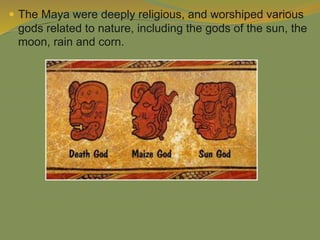
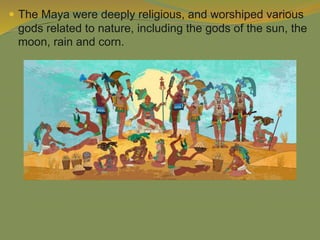
 The Maya were deeply religious, and worshiped various
gods related to nature, including the gods of the sun, the
moon, rain and corn.
 The Maya were deeply religious, and worshiped various
gods related to nature, including the gods of the sun, the
moon, rain and corn.
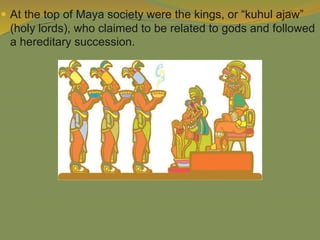
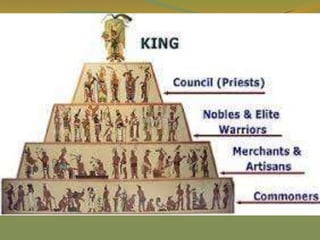
 At the top of Maya society were the kings, or “kuhul ajaw”
(holy lords), who claimed to be related to gods and followed
a hereditary succession.
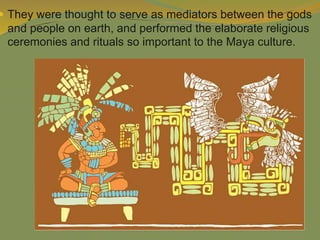
 They were thought to serve as mediators between the gods
and people on earth, and performed the elaborate religious
ceremonies and rituals so important to the Maya culture.
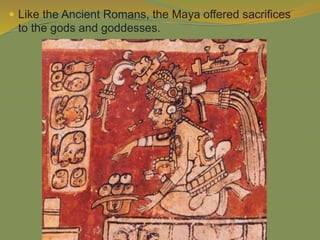
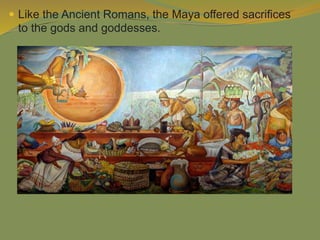
 Like the Ancient Romans, the Maya offered sacrifices
to the gods and goddesses.
 Like the Ancient Romans, the Maya offered sacrifices
to the gods and goddesses.
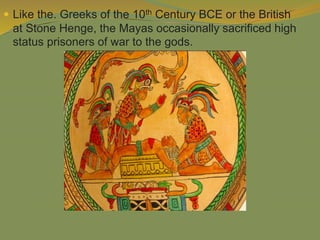
 Like the. Greeks of the 10th Century BCE or the British
at Stone Henge, the Mayas occasionally sacrificed high
status prisoners of war to the gods.
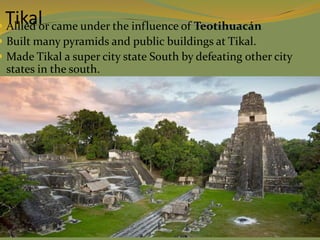
Tikal
 Allied or came under the influence of Teotihuacán
 Built many pyramids and public buildings at Tikal.
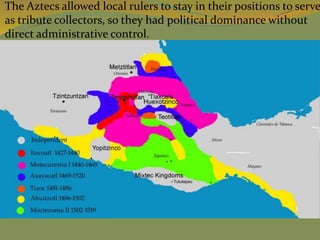
 Made Tikal a super city state South by defeating other city
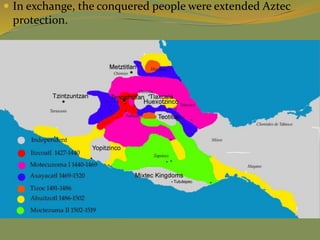
states in the south.
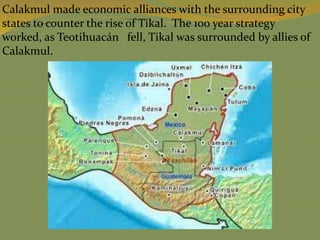
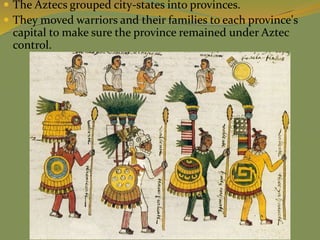
Calakmul made economic alliances with the surrounding city
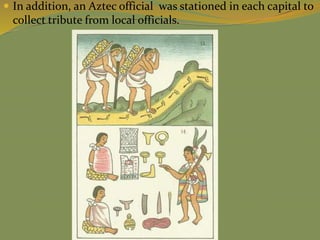
states to counter the rise of Tikal. The 100 year strategy
worked, as Teotihuacán fell, Tikal was surrounded by allies of
Calakmul.
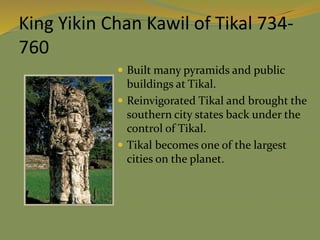
King Yikin Chan Kawil of Tikal 734-
760
 Built many pyramids and public
buildings at Tikal.
 Reinvigorated Tikal and brought the
southern city states back under the
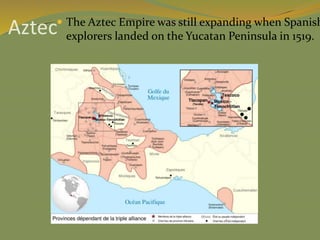
control of Tikal.
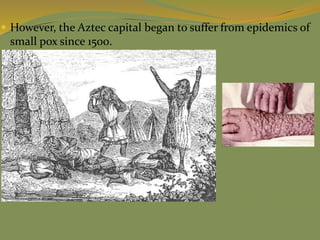
 Tikal becomes one of the largest
cities on the planet.
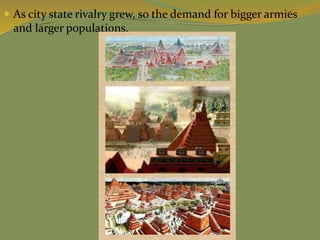
 As city state rivalry grew, so the demand for bigger armies
and larger populations.
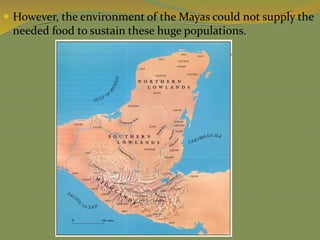
 However, the environment of the Mayas could not supply the
needed food to sustain these huge populations.
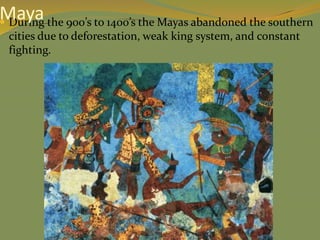
 During the 900’s to 1400’s the Mayas abandoned the southern
cities due to deforestation, weak king system, and constant
fighting.
Maya
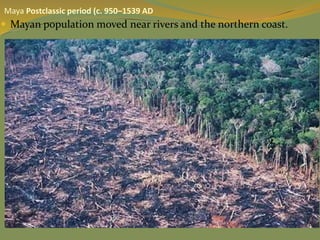
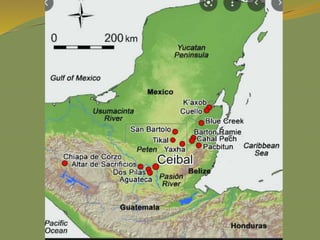
 Mayan population moved near rivers and the northern coast.
Maya Postclassic period (c. 950–1539 AD
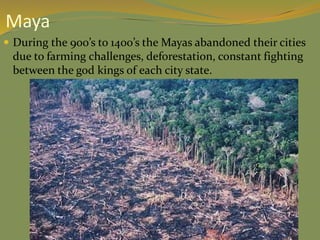
 During the 900’s to 1400’s the Mayas abandoned their cities
due to farming challenges, deforestation, constant fighting
between the god kings of each city state.
Maya
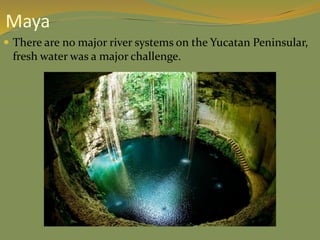
 There are no major river systems on the Yucatan Peninsular,
fresh water was a major challenge.
Maya
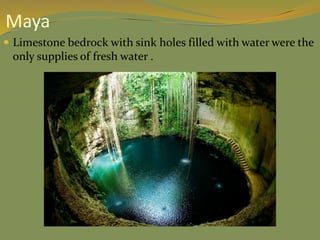
 Limestone bedrock with sink holes filled with water were the
only supplies of fresh water .
Maya
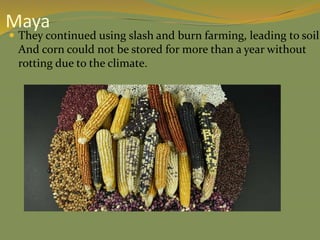
 They continued using slash and burn farming, leading to soil
And corn could not be stored for more than a year without
rotting due to the climate.
Maya
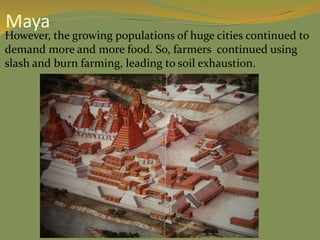
 However, the growing populations of huge cities continued to
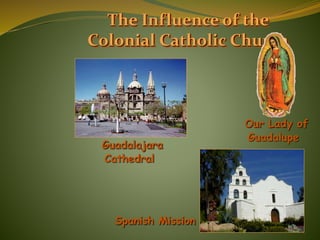
demand more and more food. So, farmers continued using
slash and burn farming, leading to soil exhaustion.
Maya
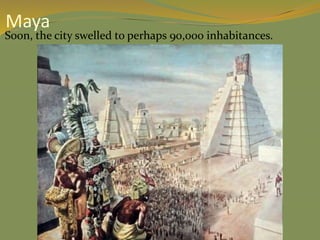
 Soon, the city swelled to perhaps 90,000 inhabitances.
Maya
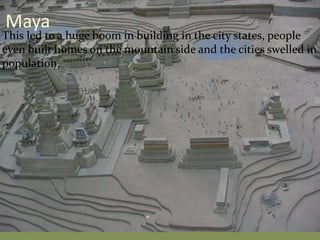
This led to a huge boom in building in the city states, people
even built homes on the mountain side and the cities swelled in
population.
Maya
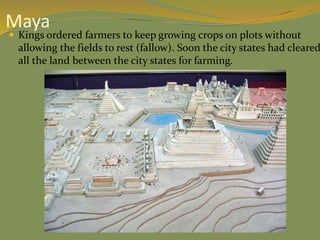
 Kings ordered farmers to keep growing crops on plots without
allowing the fields to rest (fallow). Soon the city states had cleared
all the land between the city states for farming.
Maya
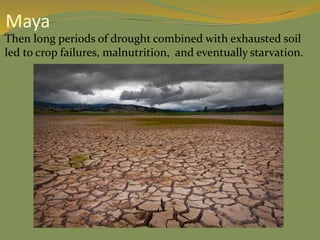
 Then long periods of drought combined with exhausted soil
led to crop failures, malnutrition, and eventually starvation.
Maya
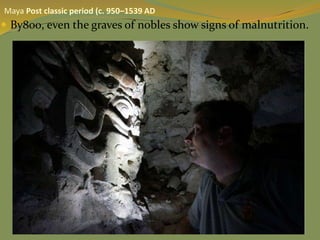
 By800, even the graves of nobles show signs of malnutrition.
Maya Post classic period (c. 950–1539 AD
 Kings were supposed to be related to the gods, and if you
supported the king, the gods should protect you.
Maya Post classic period (c. 950–1539 AD
 This led to social unrest, as people burned down the Kings
palaces in several Mayan city states.
Maya Post classic period (c. 950–1539 AD
 Cities could not support large populations so those that could
left.
Maya Post classic period (c. 950–1539 AD
 Refugees leaving cities traveled to other cities, putting them
under more food stress, causing them to collapse.
Maya Post classic period (c. 950–1539 AD
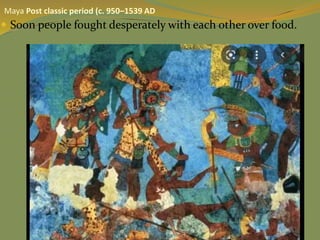
 Soon people fought desperately with each other over food.
Maya Post classic period (c. 950–1539 AD
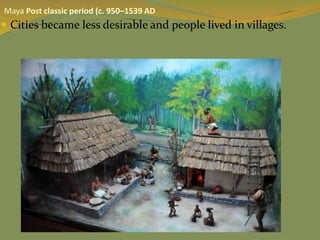
 Cities became less desirable and people lived in villages.
Maya Post classic period (c. 950–1539 AD
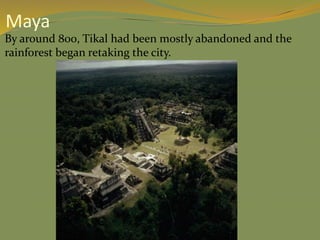
 By around 800, Tikal had been mostly abandoned and the
rainforest began retaking the city.
Maya
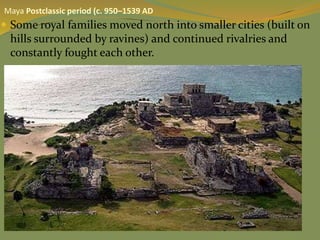
 Some royal families moved north into smaller cities (built on
hills surrounded by ravines) and continued rivalries and
constantly fought each other.
Maya Postclassic period (c. 950–1539 AD
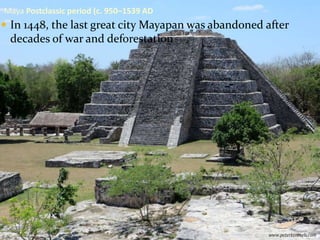
 In 1448, the last great city Mayapan was abandoned after
decades of war and deforestation
Maya Postclassic period (c. 950–1539 AD
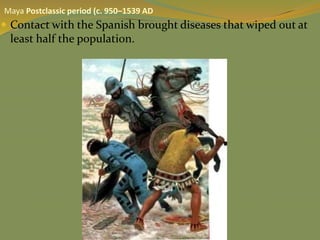
 Contact with the Spanish brought diseases that wiped out at
least half the population.
Maya Postclassic period (c. 950–1539 AD
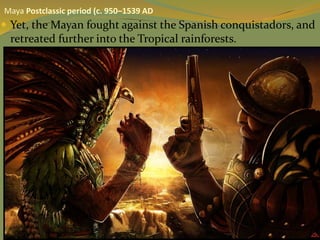
 Yet, the Mayan fought against the Spanish conquistadors, and
retreated further into the Tropical rainforests.
Maya Postclassic period (c. 950–1539 AD
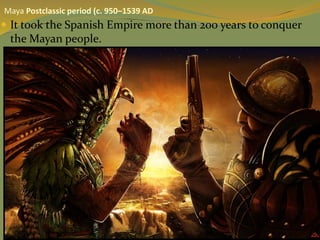
 It took the Spanish Empire more than 200 years to conquer
the Mayan people.
Maya Postclassic period (c. 950–1539 AD
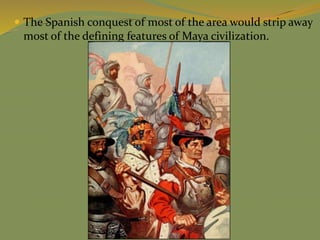
 The Spanish conquest of most of the area would strip away
most of the defining features of Maya civilization.
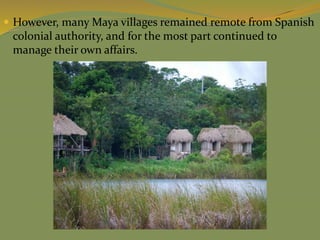
 However, many Maya villages remained remote from Spanish
colonial authority, and for the most part continued to
manage their own affairs.
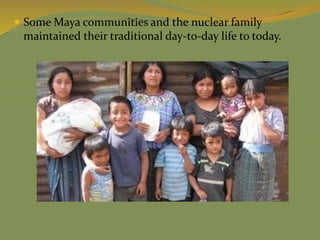
 Some Maya communities and the nuclear family
maintained their traditional day-to-day life to today.
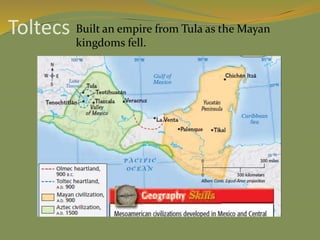
Toltecs Built an empire from Tula as the Mayan
kingdoms fell.
Toltecs
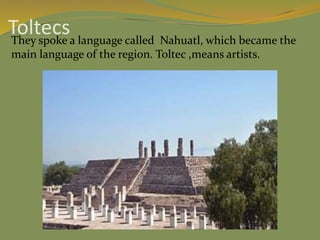
They spoke a language called Nahuatl, which became the
main language of the region. Toltec ,means artists.
Toltecs
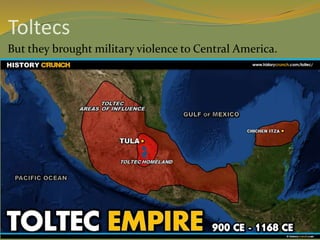
But they brought military violence to Central America.
Toltecs
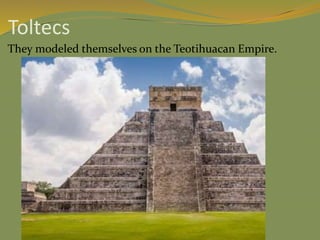
They modeled themselves on the Teotihuacan Empire.
Toltecs
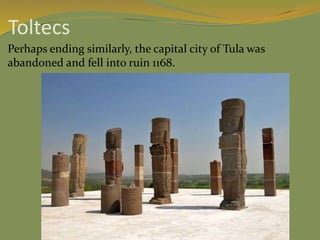
Perhaps ending similarly, the capital city of Tula was
abandoned and fell into ruin 1168.
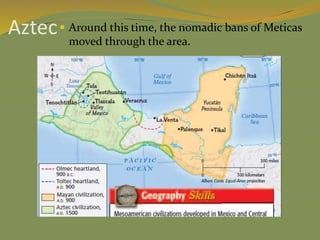
Aztec Around this time, the nomadic bans of Meticas
moved through the area.
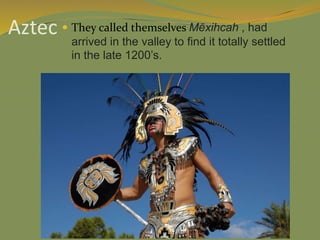
Aztec  They called themselves Mēxihcah , had
arrived in the valley to find it totally settled
in the late 1200’s.
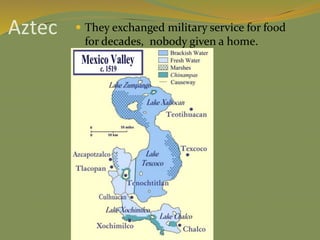
Aztec  They exchanged military service for food
for decades, nobody given a home.
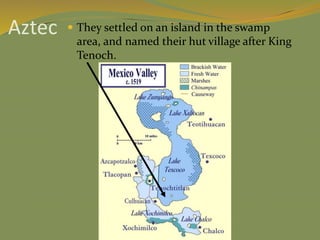
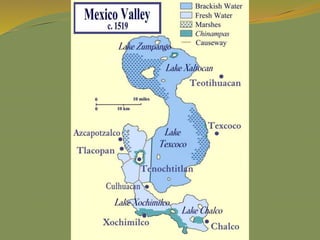
Aztec  They settled on an island in the swamp
area, and named their hut village after King
Tenoch.
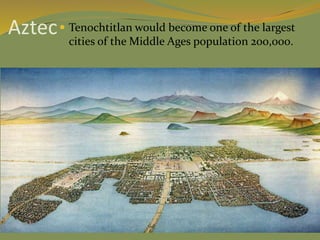
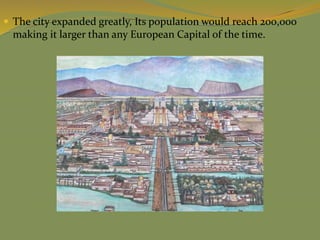
Aztec Tenochtitlan would become one of the largest
cities of the Middle Ages population 200,000.
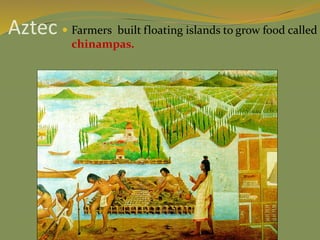
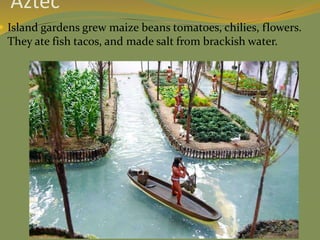
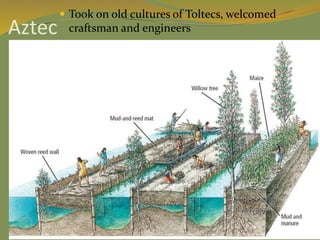
Aztec  Farmers built floating islands to grow food called
chinampas.
Aztec
 Island gardens grew maize beans tomatoes, chilies, flowers.
They ate fish tacos, and made salt from brackish water.
Aztec
 Took on old cultures of Toltecs, welcomed
craftsman and engineers
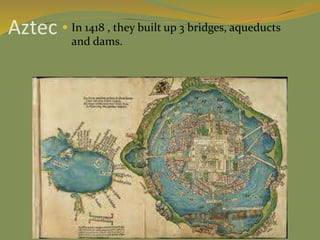
Aztec  In 1418 , they built up 3 bridges, aqueducts
and dams.
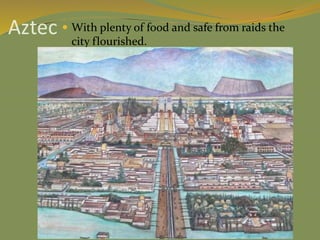
Aztec  With plenty of food and safe from raids the
city flourished.
Aztec  The Aztec ‘s had a highly structured class
system led by a king later an emperor and
military officials.
Aztec  The king later emperor owned all the land, with
farmers workers and slaves the bottom of society.
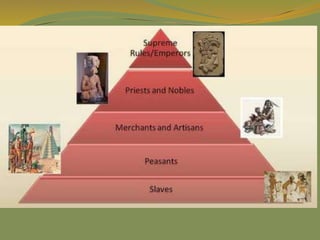
Aztec government was a theocracy, which is rule by religious
leaders.
At the top was the king later emperor, known as the Great
Speaker, who was the political ruler as well as a divine
representative of the gods.
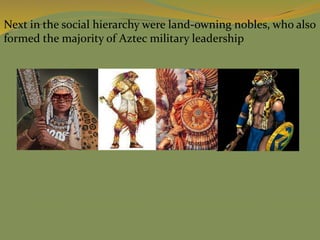
Next in the social hierarchy were land-owning nobles, who also
formed the majority of Aztec military leadership
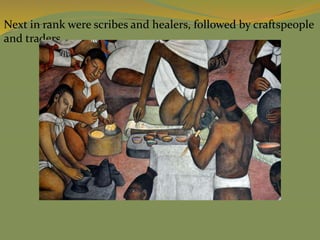
Next in rank were scribes and healers, followed by craftspeople
and traders..
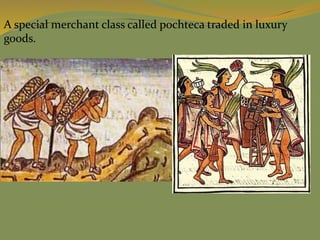
A special merchant class called pochteca traded in luxury
goods.
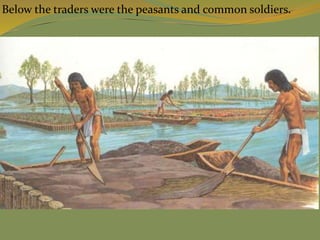
Below the traders were the peasants and common soldiers.
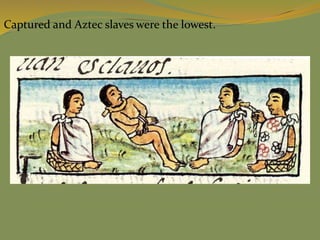
Captured and Aztec slaves were the lowest.
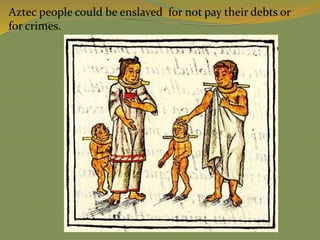
Aztec people could be enslaved for not pay their debts or
for crimes.
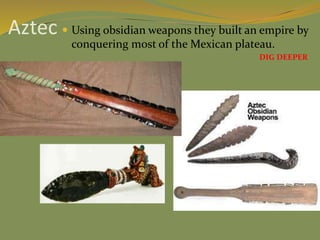
Aztec  Using obsidian weapons they built an empire by
conquering most of the Mexican plateau.
DIG DEEPER
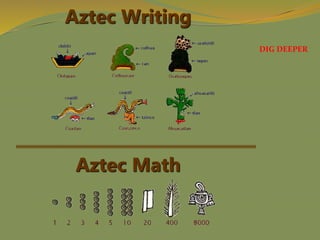
Aztec Math
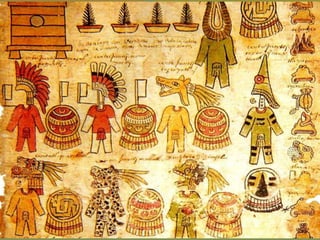
Aztec Writing
DIG DEEPER
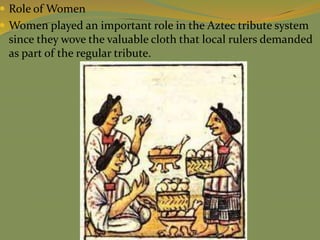
 Role of Women
 Women played an important role in the Aztec tribute system
since they wove the valuable cloth that local rulers demanded
as part of the regular tribute.
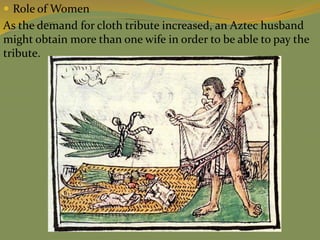
 Role of Women
As the demand for cloth tribute increased, an Aztec husband
might obtain more than one wife in order to be able to pay the
tribute.
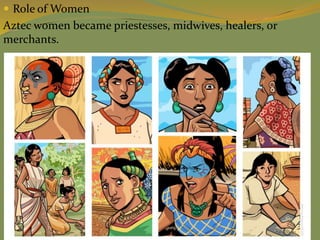
 Role of Women
Aztec women became priestesses, midwives, healers, or
merchants.
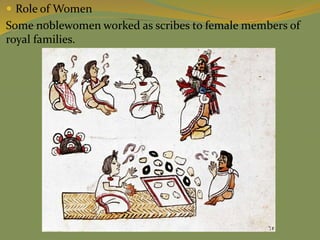
 Role of Women
Some noblewomen worked as scribes to female members of
royal families.
 The city expanded greatly, Its population would reach 200,000
making it larger than any European Capital of the time.
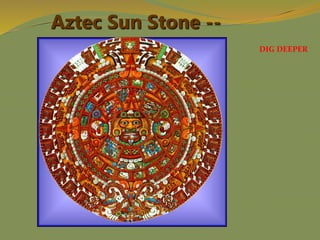
Aztec Sun Stone --
Calendar DIG DEEPER
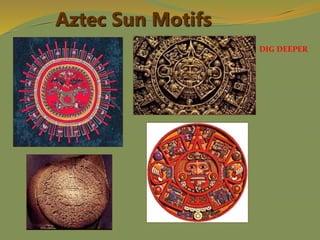
Aztec Sun Motifs
DIG DEEPER
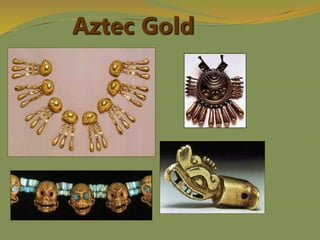
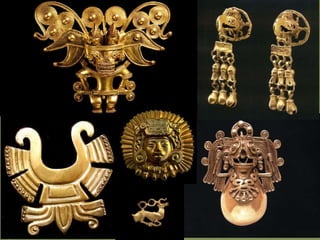
Aztec Gold
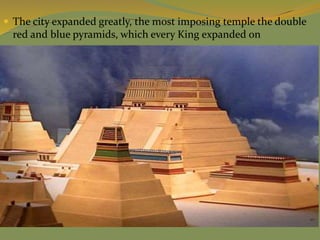
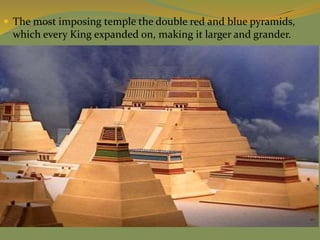
 The city expanded greatly, the most imposing temple the double
red and blue pyramids, which every King expanded on
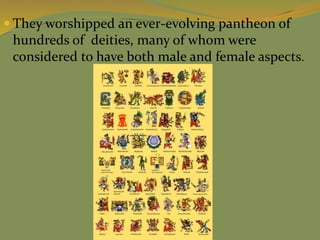
 They worshipped an ever-evolving pantheon of
hundreds of deities, many of whom were
considered to have both male and female aspects.
 The most imposing temple the double red and blue pyramids,
which every King expanded on, making it larger and grander.
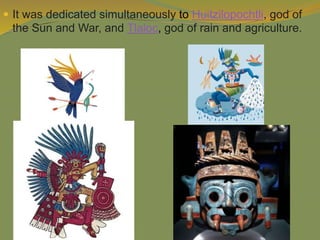
 It was dedicated simultaneously to Huitzilopochtli, god of
the Sun and War, and Tlaloc, god of rain and agriculture.
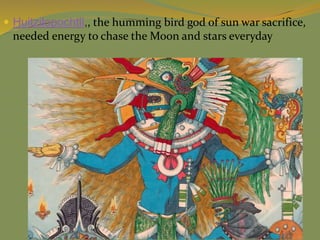
 Huitzilopochtli,, the humming bird god of sun war sacrifice,
needed energy to chase the Moon and stars everyday
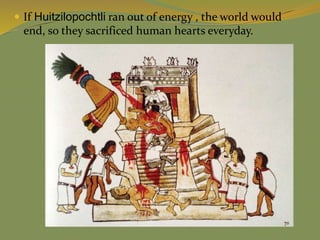
 If Huitzilopochtli ran out of energy , the world would
end, so they sacrificed human hearts everyday.
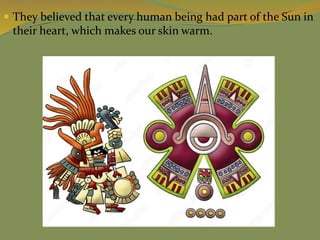
 They believed that every human being had part of the Sun in
their heart, which makes our skin warm.
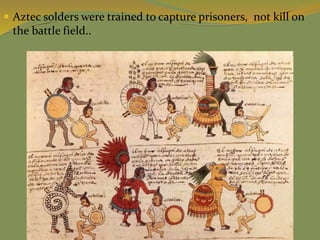
 Aztec solders were trained to capture prisoners, not kill on
the battle field..
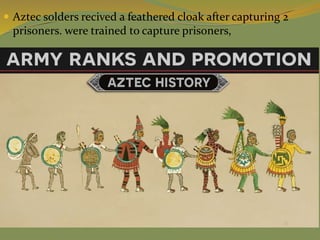
 Aztec solders recived a feathered cloak after capturing 2
prisoners. were trained to capture prisoners,
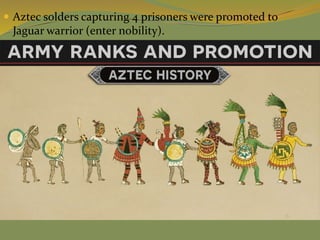
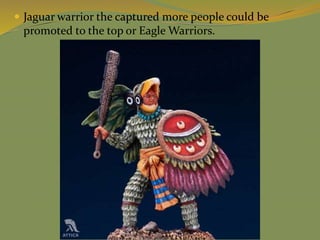
 Aztec solders capturing 4 prisoners were promoted to
Jaguar warrior (enter nobility).
 Jaguar warrior the captured more people could be
promoted to the top or Eagle Warriors.
 Some historians argue that capturing people for sacrifice
simply moved the place of death of warfare.
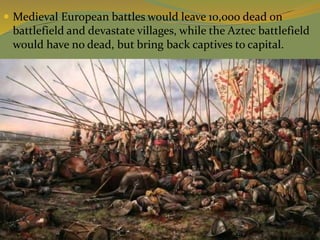
 Medieval European battles would leave 10,000 dead on
battlefield and devastate villages, while the Aztec battlefield
would have no dead, but bring back captives to capital.
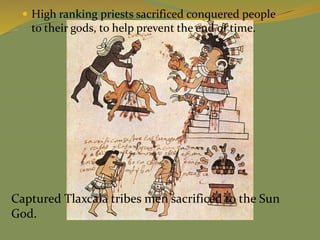
Captured Tlaxcala tribes men sacrificed to the Sun
God.
 High ranking priests sacrificed conquered people
to their gods, to help prevent the end of time.
 One affect would be to terrify people into behaving. Yet, may
be comparable to the spectacular public punishments and
executions in Europe that would last until the 18th Century.
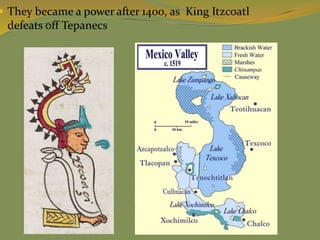
 They became a power after 1400, as King Itzcoatl
defeats off Tepanecs
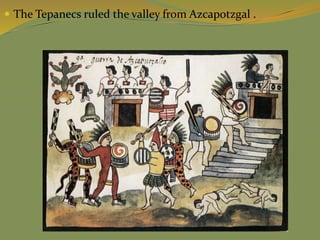
 The Tepanecs ruled the valley from Azcapotzgal .
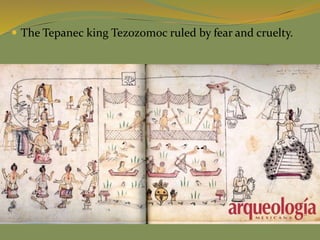
 The Tepanec king Tezozomoc ruled by fear and cruelty.
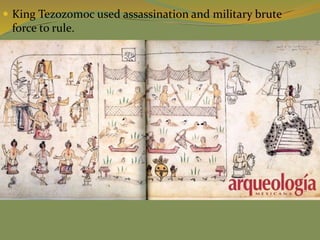
 King Tezozomoc used assassination and military brute
force to rule.
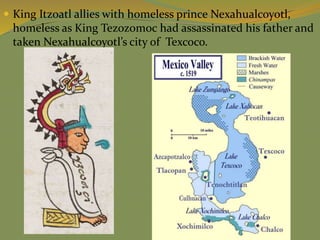
 King Itzoatl allies with homeless prince Nexahualcoyotl,
homeless as King Tezozomoc had assassinated his father and
taken Nexahualcoyotl’s city of Texcoco.
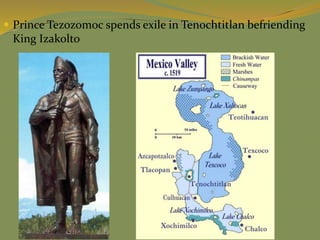
 Prince Tezozomoc spends exile in Tenochtitlan befriending
King Izakolto
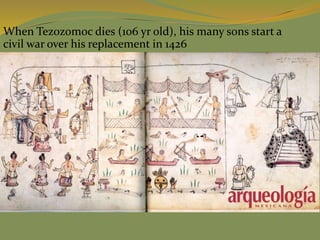
When Tezozomoc dies (106 yr old), his many sons start a
civil war over his replacement in 1426
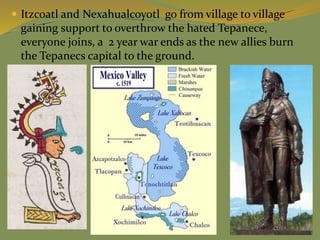
 Itzcoatl and Nexahualcoyotl go from village to village
gaining support to overthrow the hated Tepanece,
everyone joins, a 2 year war ends as the new allies burn
the Tepanecs capital to the ground.
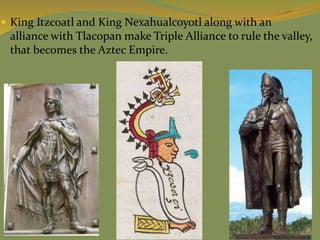
 King Itzcoatl and King Nexahualcoyotl along with an
alliance with Tlacopan make Triple Alliance to rule the valley,
that becomes the Aztec Empire.
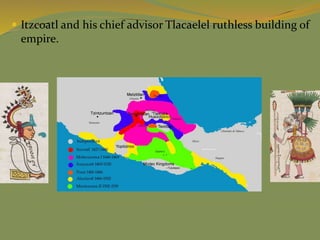
 Itzcoatl and his chief advisor Tlacaelel ruthless building of
empire.
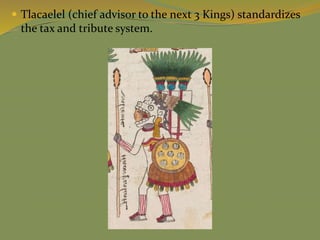
 Tlacaelel (chief advisor to the next 3 Kings) standardizes
the tax and tribute system.
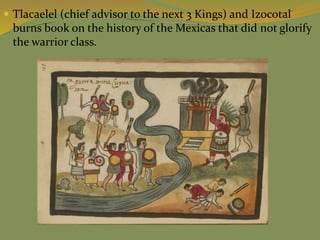
 Tlacaelel (chief advisor to the next 3 Kings) and Izocotal
burns book on the history of the Mexicas that did not glorify
the warrior class.
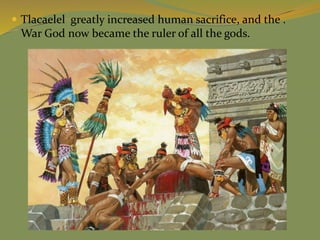
 Tlacaelel greatly increased human sacrifice, and the .
War God now became the ruler of all the gods.
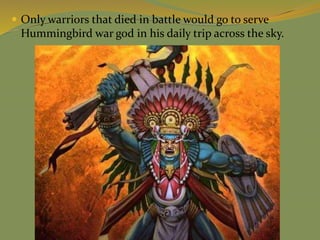
 Only warriors that died in battle would go to serve
Hummingbird war god in his daily trip across the sky.
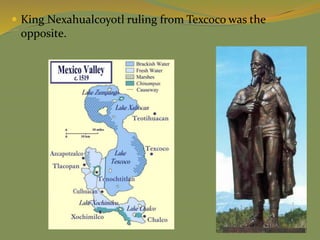
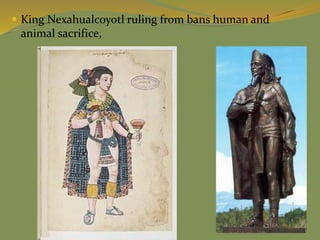
 King Nexahualcoyotl ruling from Texcoco was the
opposite.
 King Nexahualcoyotl ruling from bans human and
animal sacrifice,
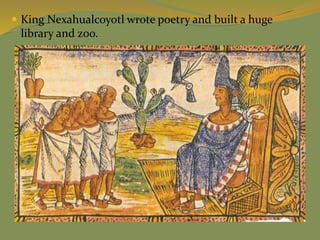
 King Nexahualcoyotl wrote poetry and built a huge
library and zoo.
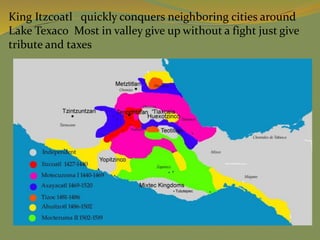
King Itzcoatl quickly conquers neighboring cities around
Lake Texaco Most in valley give up without a fight just give
tribute and taxes
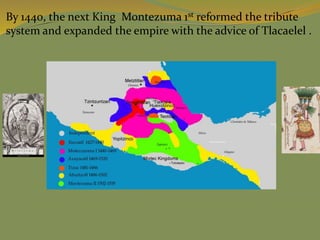
By 1440, the next King Montezuma 1st reformed the tribute
system and expanded the empire with the advice of Tlacaelel .
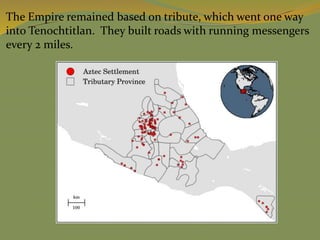
The Empire remained based on tribute, which went one way
into Tenochtitlan. They built roads with running messengers
every 2 miles.
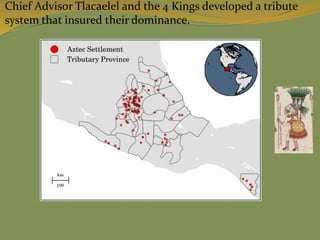
 Chief Advisor Tlacaelel and the 4 Kings developed a tribute
system that insured their dominance.
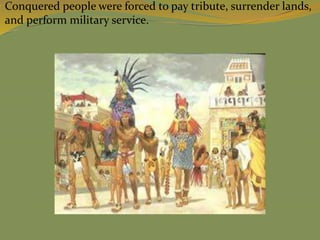
 Conquered people were forced to pay tribute, surrender lands,
and perform military service.
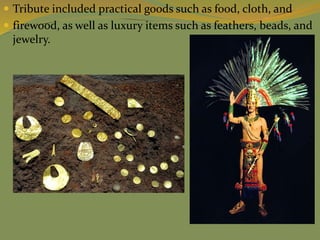
 Tribute included practical goods such as food, cloth, and
 firewood, as well as luxury items such as feathers, beads, and
jewelry.
 The Aztecs allowed local rulers to stay in their positions to serve
as tribute collectors, so they had political dominance without
direct administrative control.
 In exchange, the conquered people were extended Aztec
protection.
 The Aztecs grouped city-states into provinces.
 They moved warriors and their families to each province's
capital to make sure the province remained under Aztec
control.
 In addition, an Aztec official was stationed in each capital to
collect tribute from local officials.
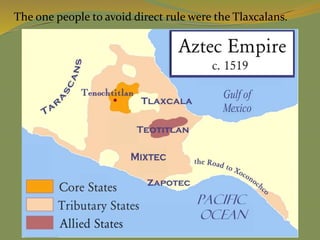
The one people to avoid direct rule were the Tlaxcalans.
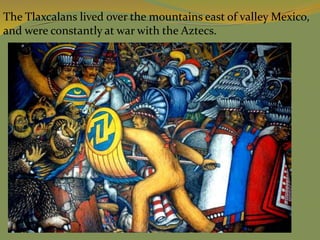
The Tlaxcalans lived over the mountains east of valley Mexico,
and were constantly at war with the Aztecs.
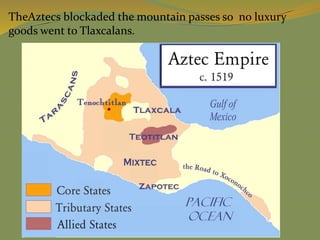
TheAztecs blockaded the mountain passes so no luxury
goods went to Tlaxcalans.
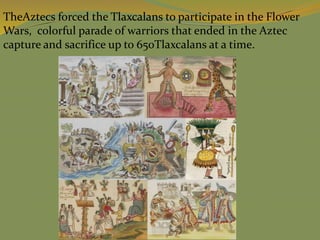
TheAztecs forced the Tlaxcalans to participate in the Flower
Wars, colorful parade of warriors that ended in the Aztec
capture and sacrifice up to 650Tlaxcalans at a time.
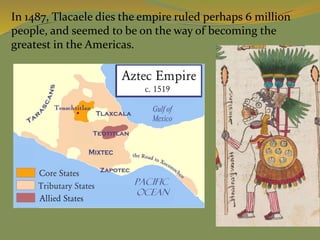
In 1487, Tlacaele dies the empire ruled perhaps 6 million
people, and seemed to be on the way of becoming the
greatest in the Americas.
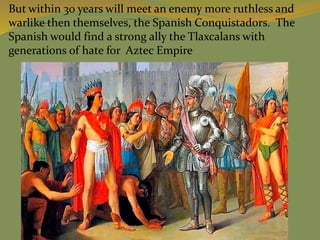
But within 30 years will meet an enemy more ruthless and
warlike then themselves, the Spanish Conquistadors. The
Spanish would find a strong ally the Tlaxcalans with
generations of hate for Aztec Empire
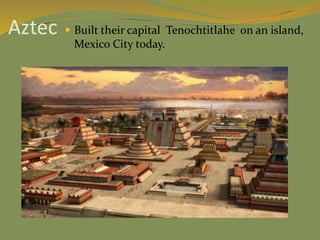
Aztec  Built their capital Tenochtitlahe on an island,
Mexico City today.
Aztec The Aztec Empire was still expanding when Spanish
explorers landed on the Yucatan Peninsula in 1519.
 However, the Aztec capital began to suffer from epidemics of
small pox since 1500.
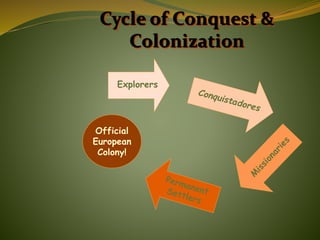
Cycle of Conquest &
Colonization
Explorers
Official
European
Colony!
Spanish Conquistadors
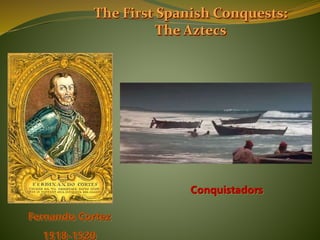
Fernando Cortez
1518-1520
The First Spanish Conquests:
The Aztecs
Conquistadors
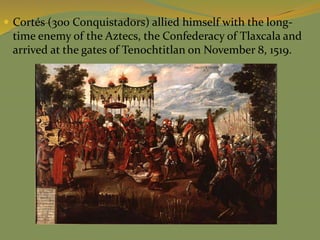
 Cortés (300 Conquistadors) allied himself with the long-
time enemy of the Aztecs, the Confederacy of Tlaxcala and
arrived at the gates of Tenochtitlan on November 8, 1519.
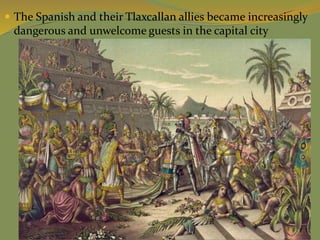
 The Spanish and their Tlaxcallan allies became increasingly
dangerous and unwelcome guests in the capital city
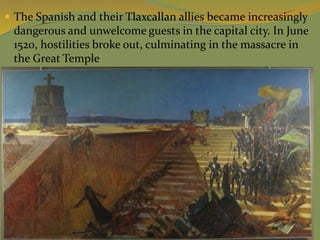
 The Spanish and their Tlaxcallan allies became increasingly
dangerous and unwelcome guests in the capital city. In June
1520, hostilities broke out, culminating in the massacre in
the Great Temple
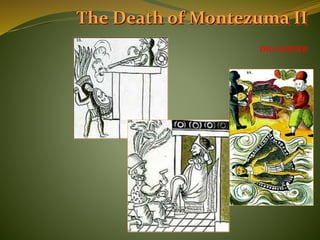
The Death of Montezuma II
DIG DEEPER
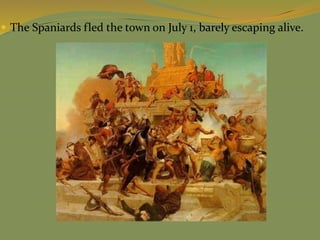
 The Spaniards fled the town on July 1, barely escaping alive.
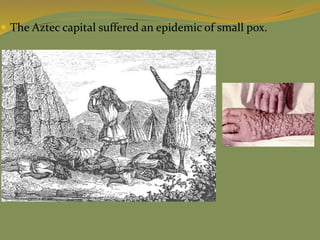
 The Aztec capital suffered an epidemic of small pox.
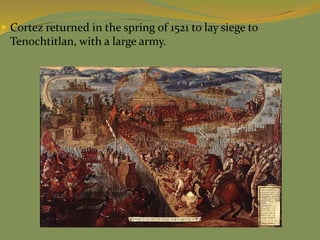
 Cortez returned in the spring of 1521 to lay siege to
Tenochtitlan, with a large army.
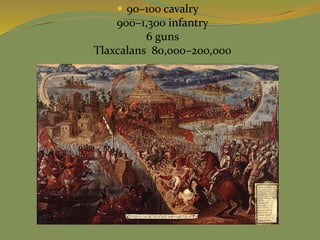
 90–100 cavalry
900–1,300 infantry
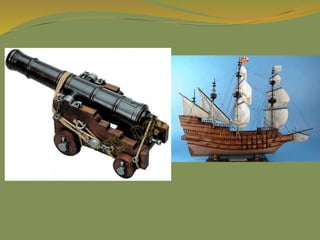
6 guns
Tlaxcalans 80,000–200,000
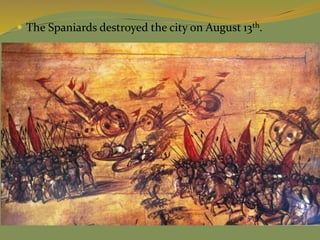
 The Spaniards destroyed the city on August 13th.
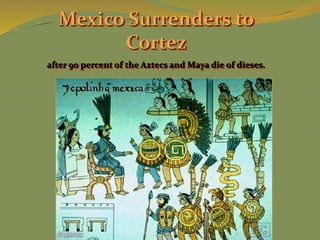
Mexico Surrenders to
Cortez
after 90 percent of the Aztecs and Maya die of dieses.
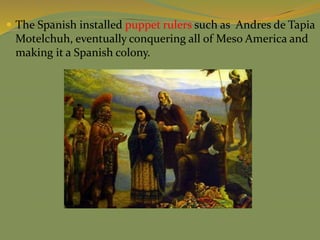
 The Spanish installed puppet rulers such as Andres de Tapia
Motelchuh, eventually conquering all of Meso America and
making it a Spanish colony.
 A puppet ruler is a person who has a title indicating
possession of political power, but who, in reality, is
controlled by outside individuals or forces. Such
outside power can be exercised by a foreign
government, in which case the puppet ruler's domain
is called a puppet state.
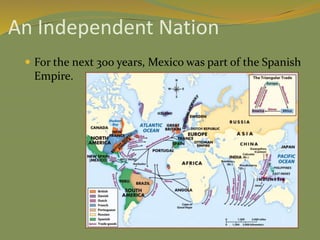
An Independent Nation
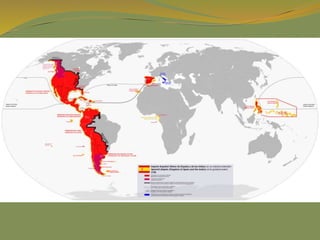
 For the next 300 years, Mexico was part of the Spanish
Empire.
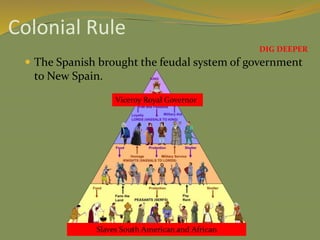
Colonial Rule
 The Spanish brought the feudal system of government
to New Spain.
DIG DEEPER
Viceroy Royal Governor
Slaves South American and African
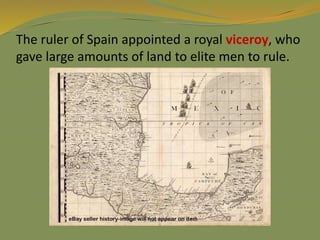
The ruler of Spain appointed a royal viceroy, who
gave large amounts of land to elite men to rule.
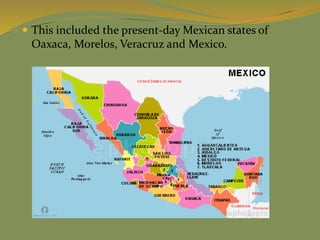
 This included the present-day Mexican states of
Oaxaca, Morelos, Veracruz and Mexico.
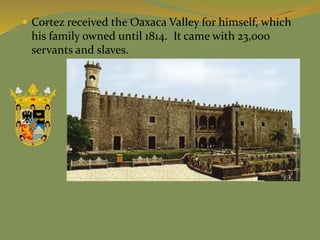
 Cortez received the Oaxaca Valley for himself, which
his family owned until 1814. It came with 23,000
servants and slaves.
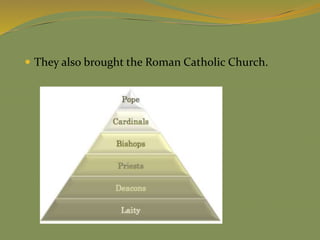
 They also brought the Roman Catholic Church.
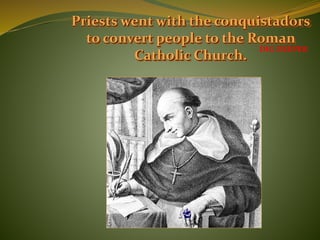
Priests went with the conquistadors
to convert people to the Roman
Catholic Church.
DIG DEEPER
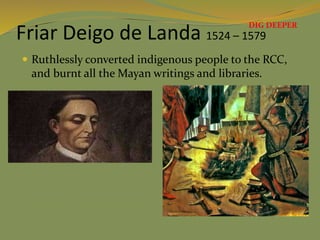
Friar Deigo de Landa 1524 – 1579
 Ruthlessly converted indigenous people to the RCC,
and burnt all the Mayan writings and libraries.
DIG DEEPER
The Influence of the
Colonial Catholic Church
Guadalajara
Cathedral
Our Lady of
Guadalupe
Spanish Mission
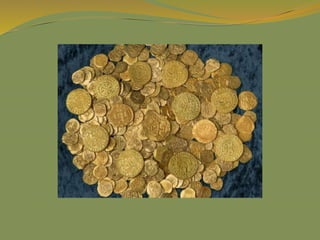
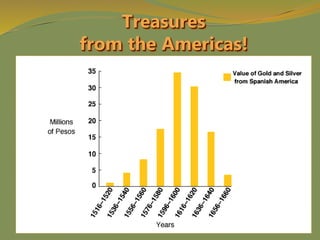
Treasures
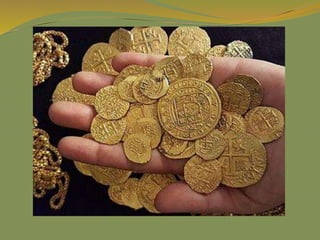
from the Americas!
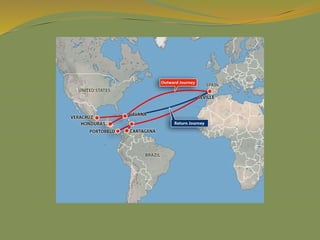
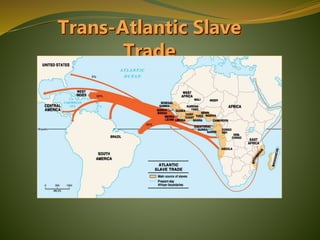
Trans-Atlantic Slave
Trade
 End

1.6 AP Olmecs Maya Aztecpost3.pptx

  • 1.
  • 2.
    Mexico  Thousands ofyears ago, the first people of Mexico made great civilizations
  • 3.
    Mexico  For hundredsof years, different ethnic groups mixed, making today’s Mexico.
  • 4.
    The People  Mexico’sfirst people came from Asia around 40,000 years ago.
  • 5.
  • 6.
  • 7.
  • 8.
  • 9.
     40,000 BCEFirst Human Migrate from Asia   1400-400 BCE Olmec  Teotihuacan 100 BCE-700 CE  250-1539 Maya  Toltecs  1325-1521 Aztec Empire  Spanish Empire (Conquistadors) 1502-1829  Independence 1830
  • 10.
  • 12.
     Today theBering Strait is 55 miles or 85 KM wide, 290 feet or 30-50 meters deep.
  • 14.
     During Paleolithictimes, you could walk from Asia to North America.
  • 15.
     As theIce Age ended, sea level rose and the ice melted, blocking the land route.
  • 17.
     Agriculture aroseindependently in at least three regions: South America, Mesoamerica, and eastern North America.
  • 18.
     They domesticatedsuccessful food plants—most notably a mutant corn(maize) with husks, dating to c. 5300 BCE— permanent village farming life by about 1500 BCE.
  • 19.
     They wereagricultural geniuses, and created most of the food that we enjoy today.
  • 20.
     Over thousandsof years, they developed beans,
  • 21.
     Over thousandsof years, they developed beans, tomatoes, potatoes, squash,
  • 22.
     Over thousandsof years, they developed beans, tomatoes, potatoes, squash, chili pepper, sweet potatoes, cotton and chocolate.
  • 23.
     Complex societiessuch as theMaya and Aztecs built elaborate irrigation systems
  • 24.
     In Peruthe Inca built terraced fields on the steep Andean slopes. The Inca developed hundreds of varies of potatoes to grown in different temperatures.
  • 25.
    The Olmecs (1200BCE) and Teotihuacan created prehistoric civilizations .
  • 26.
    Most Olmecs livedin small villages, planting some crops along river banks.
  • 28.
    They mostly farmedby slash-and-burn agriculture to clear the forests and shrubs, and to provide new fields once the old fields were exhausted.
  • 29.
    They mostly farmedby slash-and-burn agriculture. The cleared jungle with fire to have new fields.
  • 30.
    The Olmec hadlarge religious centers, like La Venta for their religious rituals.
  • 32.
    La Venta hada pyramid that towered above the city, pointing true north.
  • 33.
    Leaders sat onthrones during religious rituals. DIG DEEPER
  • 35.
    They carved imagesof their rulers in gigantic heads. DIG DEEPER
  • 36.
    The Olmec mayhave been the first civilization in the region to develop a writing system. Symbols found in 2002 and 2006 date from 650 BCE] and 900 BCE. Cascajal Block
  • 37.
    The Long Countcalendar used by many subsequent Mesoamerican civilizations, as well as the concept of zero, may have been devised by the Olmecs.
  • 38.
    Later the Mayanstook over these lands.
  • 39.
    Teotihuacán ( called“Place of the Gods” by the Aztecs) was the first major city in Mesoamerica.
  • 40.
    Teotihuacán flourished from100 BCE to 550 CE. DIG DEEPER
  • 41.
    200,000 people calledthe city home. DIG DEEPER
  • 42.
    Most people werefarmers, that lived in government housing, painted in murals glorifying the rulers.
  • 44.
    The art andarchitecture of the city shows it was a polytheistic society, with the primary deity being the Great Goddess of Teotihuacan, which is depicted as a spider goddess.
  • 46.
    Like the AncientGreeks that sent youths to Crete to be sacrificed to the Minitour, Teotihuacán sacrificed animals and even humans (rare) to the goddess.
  • 47.
    They sacrificed animalsand even humans (rare) to the goddess.
  • 48.
    In 1989, researchersdiscovered 18 sacrificial victims buried in a long pit just south of the Temple of Quetzalcoatl.
  • 49.
    They later discoveredthat around 200 other victims were sacrificed when the temple was built in the early 3rd century A.D.
  • 50.
    Sacrifices were malewarriors in military attire, young women and males of high social status.
  • 51.
    The city rulerslived on and in the pyramids.
  • 52.
    Teotihuacá made weaponsof a special green obsidian. DIG DEEPER
  • 53.
    Teotihuacá was thecenter of weapons trade, which allowed it to grow.
  • 54.
    Obsidian is avolcanic rock, that is so sharp it is used today for eye surgery. DIG DEEPER
  • 55.
    Obsidian is avolcanic rock, that is so sharp it is used today for eye surgery. DIG DEEPER
  • 56.
    Like the ancientGreeks in Europe, they greatly influenced the region, yet we do not even know what language they spoke.
  • 57.
    According to archeologists,deforestation led to soil erosion. DIG DEEPER
  • 58.
    Deforestation is theloss or destruction of forest or trees, mainly for logging or farming.
  • 59.
    Farmers could nolonger grow enough food to eat, they blamed the leaders of the city.
  • 60.
    In 550, thecity was destroyed by fire. Archeologists theorize that people burned down the leaders homes and moved out.
  • 61.
    Around 600 A.D.,major buildings were deliberately burned and artworks and religious sculptures were destroyed, suggesting an uprising from the poor against the ruling elite Another theory holds that invaders sacked and burned it—though Teotihuacan exerted its military power over other cultures, the city lacked fortifications and military structures By 750 A.D., the remaining inhabitants of the city had all abandoned their homes to join neighboring cultures or return to their ancestral homes.
  • 62.
    Economically, other culturesleaned how to make their own obsidian weapons.
  • 63.
    The Aztecs wouldlater discover the abandoned city and name it “the city of the Gods”. DIG DEEPER
  • 64.
    The Aztecs copiedthe layout and architecture to build their capital city.
  • 65.
    Native American Empires The Mayas produced a Classical Civilization from 250-900.
  • 66.
    Native American Empires The Mayas produced a Classical Civilization from 250-900.
  • 67.
    Maya  Mayan civilizationhad city-states, each governed by a king claiming to be ancestors of the Gods.
  • 68.
     city state nounhistorical  a city that with its surrounding territory forms an independent state.
  • 69.
    Maya  Mayan city-statescompeted and made war on each other, with the Kings leading in battle.
  • 70.
    Maya  TheMaya built well planned cities, with many temple pyramids, government housing.
  • 72.
    Maya  TheMaya built well planned cities, with many temple pyramids, government housing. Tikal
  • 73.
    Maya  Royalty,the wealthy, and priests lived on top of pyramids. Tikal
  • 74.
    Maya  Hada glyph complete writing system .
  • 75.
     Glyph isa writing system using symbols instead of letters.
  • 77.
    Maya  The mostadvanced mathematics of all the ancient world. Including the zero, not known to Europe until early modern times.
  • 78.
    Maya The mostaccurate calendars and observations of the stars. DIG DEEPER
  • 79.
    Maya Forged gold,but never developed bronze or iron. DIG DEEPER
  • 80.
     They builtlarge ball courts, players struck a 4 kg rubber ball with their hips, forearms, rackets, bats, or hand stones.
  • 81.
  • 83.
     They remainedprimarily stone age people, although Teotihuacán developed copper work, the Maya continued to use mostly sharpened obsidian Maya
  • 84.
     The Mayawere deeply religious, and worshiped various gods related to nature, including the gods of the sun, the moon, rain and corn.
  • 85.
     The Mayawere deeply religious, and worshiped various gods related to nature, including the gods of the sun, the moon, rain and corn.
  • 86.
     At thetop of Maya society were the kings, or “kuhul ajaw” (holy lords), who claimed to be related to gods and followed a hereditary succession.
  • 87.
     They werethought to serve as mediators between the gods and people on earth, and performed the elaborate religious ceremonies and rituals so important to the Maya culture.
  • 90.
     Like theAncient Romans, the Maya offered sacrifices to the gods and goddesses.
  • 91.
     Like theAncient Romans, the Maya offered sacrifices to the gods and goddesses.
  • 92.
     Like the.Greeks of the 10th Century BCE or the British at Stone Henge, the Mayas occasionally sacrificed high status prisoners of war to the gods.
  • 93.
    Tikal  Allied orcame under the influence of Teotihuacán  Built many pyramids and public buildings at Tikal.  Made Tikal a super city state South by defeating other city states in the south.
  • 94.
    Calakmul made economicalliances with the surrounding city states to counter the rise of Tikal. The 100 year strategy worked, as Teotihuacán fell, Tikal was surrounded by allies of Calakmul.
  • 95.
    King Yikin ChanKawil of Tikal 734- 760  Built many pyramids and public buildings at Tikal.  Reinvigorated Tikal and brought the southern city states back under the control of Tikal.  Tikal becomes one of the largest cities on the planet.
  • 96.
     As citystate rivalry grew, so the demand for bigger armies and larger populations.
  • 97.
     However, theenvironment of the Mayas could not supply the needed food to sustain these huge populations.
  • 98.
     During the900’s to 1400’s the Mayas abandoned the southern cities due to deforestation, weak king system, and constant fighting. Maya
  • 99.
     Mayan populationmoved near rivers and the northern coast. Maya Postclassic period (c. 950–1539 AD
  • 100.
     During the900’s to 1400’s the Mayas abandoned their cities due to farming challenges, deforestation, constant fighting between the god kings of each city state. Maya
  • 101.
     There areno major river systems on the Yucatan Peninsular, fresh water was a major challenge. Maya
  • 102.
     Limestone bedrockwith sink holes filled with water were the only supplies of fresh water . Maya
  • 105.
     They continuedusing slash and burn farming, leading to soil And corn could not be stored for more than a year without rotting due to the climate. Maya
  • 106.
     However, thegrowing populations of huge cities continued to demand more and more food. So, farmers continued using slash and burn farming, leading to soil exhaustion. Maya
  • 107.
     Soon, thecity swelled to perhaps 90,000 inhabitances. Maya
  • 108.
    This led toa huge boom in building in the city states, people even built homes on the mountain side and the cities swelled in population. Maya
  • 109.
     Kings orderedfarmers to keep growing crops on plots without allowing the fields to rest (fallow). Soon the city states had cleared all the land between the city states for farming. Maya
  • 110.
     Then longperiods of drought combined with exhausted soil led to crop failures, malnutrition, and eventually starvation. Maya
  • 111.
     By800, eventhe graves of nobles show signs of malnutrition. Maya Post classic period (c. 950–1539 AD
  • 112.
     Kings weresupposed to be related to the gods, and if you supported the king, the gods should protect you. Maya Post classic period (c. 950–1539 AD
  • 113.
     This ledto social unrest, as people burned down the Kings palaces in several Mayan city states. Maya Post classic period (c. 950–1539 AD
  • 114.
     Cities couldnot support large populations so those that could left. Maya Post classic period (c. 950–1539 AD
  • 115.
     Refugees leavingcities traveled to other cities, putting them under more food stress, causing them to collapse. Maya Post classic period (c. 950–1539 AD
  • 116.
     Soon peoplefought desperately with each other over food. Maya Post classic period (c. 950–1539 AD
  • 117.
     Cities becameless desirable and people lived in villages. Maya Post classic period (c. 950–1539 AD
  • 118.
     By around800, Tikal had been mostly abandoned and the rainforest began retaking the city. Maya
  • 119.
     Some royalfamilies moved north into smaller cities (built on hills surrounded by ravines) and continued rivalries and constantly fought each other. Maya Postclassic period (c. 950–1539 AD
  • 122.
     In 1448,the last great city Mayapan was abandoned after decades of war and deforestation Maya Postclassic period (c. 950–1539 AD
  • 123.
     Contact withthe Spanish brought diseases that wiped out at least half the population. Maya Postclassic period (c. 950–1539 AD
  • 124.
     Yet, theMayan fought against the Spanish conquistadors, and retreated further into the Tropical rainforests. Maya Postclassic period (c. 950–1539 AD
  • 125.
     It tookthe Spanish Empire more than 200 years to conquer the Mayan people. Maya Postclassic period (c. 950–1539 AD
  • 126.
     The Spanishconquest of most of the area would strip away most of the defining features of Maya civilization.
  • 127.
     However, manyMaya villages remained remote from Spanish colonial authority, and for the most part continued to manage their own affairs.
  • 128.
     Some Mayacommunities and the nuclear family maintained their traditional day-to-day life to today.
  • 129.
    Toltecs Built anempire from Tula as the Mayan kingdoms fell.
  • 130.
    Toltecs They spoke alanguage called Nahuatl, which became the main language of the region. Toltec ,means artists.
  • 131.
    Toltecs But they broughtmilitary violence to Central America.
  • 132.
    Toltecs They modeled themselveson the Teotihuacan Empire.
  • 133.
    Toltecs Perhaps ending similarly,the capital city of Tula was abandoned and fell into ruin 1168.
  • 134.
    Aztec Around thistime, the nomadic bans of Meticas moved through the area.
  • 136.
    Aztec  Theycalled themselves Mēxihcah , had arrived in the valley to find it totally settled in the late 1200’s.
  • 137.
    Aztec  Theyexchanged military service for food for decades, nobody given a home.
  • 138.
    Aztec  Theysettled on an island in the swamp area, and named their hut village after King Tenoch.
  • 139.
    Aztec Tenochtitlan wouldbecome one of the largest cities of the Middle Ages population 200,000.
  • 140.
    Aztec  Farmersbuilt floating islands to grow food called chinampas.
  • 141.
    Aztec  Island gardensgrew maize beans tomatoes, chilies, flowers. They ate fish tacos, and made salt from brackish water.
  • 142.
    Aztec  Took onold cultures of Toltecs, welcomed craftsman and engineers
  • 143.
    Aztec  In1418 , they built up 3 bridges, aqueducts and dams.
  • 144.
    Aztec  Withplenty of food and safe from raids the city flourished.
  • 145.
    Aztec  TheAztec ‘s had a highly structured class system led by a king later an emperor and military officials.
  • 146.
    Aztec  Theking later emperor owned all the land, with farmers workers and slaves the bottom of society.
  • 147.
    Aztec government wasa theocracy, which is rule by religious leaders.
  • 148.
    At the topwas the king later emperor, known as the Great Speaker, who was the political ruler as well as a divine representative of the gods.
  • 149.
    Next in thesocial hierarchy were land-owning nobles, who also formed the majority of Aztec military leadership
  • 150.
    Next in rankwere scribes and healers, followed by craftspeople and traders..
  • 151.
    A special merchantclass called pochteca traded in luxury goods.
  • 152.
    Below the traderswere the peasants and common soldiers.
  • 153.
    Captured and Aztecslaves were the lowest.
  • 154.
    Aztec people couldbe enslaved for not pay their debts or for crimes.
  • 155.
    Aztec  Usingobsidian weapons they built an empire by conquering most of the Mexican plateau. DIG DEEPER
  • 156.
  • 157.
     Role ofWomen  Women played an important role in the Aztec tribute system since they wove the valuable cloth that local rulers demanded as part of the regular tribute.
  • 158.
     Role ofWomen As the demand for cloth tribute increased, an Aztec husband might obtain more than one wife in order to be able to pay the tribute.
  • 159.
     Role ofWomen Aztec women became priestesses, midwives, healers, or merchants.
  • 160.
     Role ofWomen Some noblewomen worked as scribes to female members of royal families.
  • 161.
     The cityexpanded greatly, Its population would reach 200,000 making it larger than any European Capital of the time.
  • 163.
    Aztec Sun Stone-- Calendar DIG DEEPER
  • 164.
  • 165.
  • 167.
     The cityexpanded greatly, the most imposing temple the double red and blue pyramids, which every King expanded on
  • 168.
     They worshippedan ever-evolving pantheon of hundreds of deities, many of whom were considered to have both male and female aspects.
  • 169.
     The mostimposing temple the double red and blue pyramids, which every King expanded on, making it larger and grander.
  • 170.
     It wasdedicated simultaneously to Huitzilopochtli, god of the Sun and War, and Tlaloc, god of rain and agriculture.
  • 171.
     Huitzilopochtli,, thehumming bird god of sun war sacrifice, needed energy to chase the Moon and stars everyday
  • 172.
     If Huitzilopochtliran out of energy , the world would end, so they sacrificed human hearts everyday.
  • 173.
     They believedthat every human being had part of the Sun in their heart, which makes our skin warm.
  • 174.
     Aztec solderswere trained to capture prisoners, not kill on the battle field..
  • 175.
     Aztec soldersrecived a feathered cloak after capturing 2 prisoners. were trained to capture prisoners,
  • 176.
     Aztec solderscapturing 4 prisoners were promoted to Jaguar warrior (enter nobility).
  • 177.
     Jaguar warriorthe captured more people could be promoted to the top or Eagle Warriors.
  • 178.
     Some historiansargue that capturing people for sacrifice simply moved the place of death of warfare.
  • 179.
     Medieval Europeanbattles would leave 10,000 dead on battlefield and devastate villages, while the Aztec battlefield would have no dead, but bring back captives to capital.
  • 180.
    Captured Tlaxcala tribesmen sacrificed to the Sun God.  High ranking priests sacrificed conquered people to their gods, to help prevent the end of time.
  • 181.
     One affectwould be to terrify people into behaving. Yet, may be comparable to the spectacular public punishments and executions in Europe that would last until the 18th Century.
  • 182.
     They becamea power after 1400, as King Itzcoatl defeats off Tepanecs
  • 183.
     The Tepanecsruled the valley from Azcapotzgal .
  • 184.
     The Tepanecking Tezozomoc ruled by fear and cruelty.
  • 185.
     King Tezozomocused assassination and military brute force to rule.
  • 186.
     King Itzoatlallies with homeless prince Nexahualcoyotl, homeless as King Tezozomoc had assassinated his father and taken Nexahualcoyotl’s city of Texcoco.
  • 187.
     Prince Tezozomocspends exile in Tenochtitlan befriending King Izakolto
  • 188.
    When Tezozomoc dies(106 yr old), his many sons start a civil war over his replacement in 1426
  • 189.
     Itzcoatl andNexahualcoyotl go from village to village gaining support to overthrow the hated Tepanece, everyone joins, a 2 year war ends as the new allies burn the Tepanecs capital to the ground.
  • 190.
     King Itzcoatland King Nexahualcoyotl along with an alliance with Tlacopan make Triple Alliance to rule the valley, that becomes the Aztec Empire.
  • 191.
     Itzcoatl andhis chief advisor Tlacaelel ruthless building of empire.
  • 192.
     Tlacaelel (chiefadvisor to the next 3 Kings) standardizes the tax and tribute system.
  • 193.
     Tlacaelel (chiefadvisor to the next 3 Kings) and Izocotal burns book on the history of the Mexicas that did not glorify the warrior class.
  • 194.
     Tlacaelel greatlyincreased human sacrifice, and the . War God now became the ruler of all the gods.
  • 195.
     Only warriorsthat died in battle would go to serve Hummingbird war god in his daily trip across the sky.
  • 196.
     King Nexahualcoyotlruling from Texcoco was the opposite.
  • 197.
     King Nexahualcoyotlruling from bans human and animal sacrifice,
  • 198.
     King Nexahualcoyotlwrote poetry and built a huge library and zoo.
  • 199.
    King Itzcoatl quicklyconquers neighboring cities around Lake Texaco Most in valley give up without a fight just give tribute and taxes
  • 200.
    By 1440, thenext King Montezuma 1st reformed the tribute system and expanded the empire with the advice of Tlacaelel .
  • 201.
    The Empire remainedbased on tribute, which went one way into Tenochtitlan. They built roads with running messengers every 2 miles.
  • 202.
     Chief AdvisorTlacaelel and the 4 Kings developed a tribute system that insured their dominance.
  • 203.
     Conquered peoplewere forced to pay tribute, surrender lands, and perform military service.
  • 204.
     Tribute includedpractical goods such as food, cloth, and  firewood, as well as luxury items such as feathers, beads, and jewelry.
  • 205.
     The Aztecsallowed local rulers to stay in their positions to serve as tribute collectors, so they had political dominance without direct administrative control.
  • 206.
     In exchange,the conquered people were extended Aztec protection.
  • 207.
     The Aztecsgrouped city-states into provinces.  They moved warriors and their families to each province's capital to make sure the province remained under Aztec control.
  • 208.
     In addition,an Aztec official was stationed in each capital to collect tribute from local officials.
  • 209.
    The one peopleto avoid direct rule were the Tlaxcalans.
  • 210.
    The Tlaxcalans livedover the mountains east of valley Mexico, and were constantly at war with the Aztecs.
  • 211.
    TheAztecs blockaded themountain passes so no luxury goods went to Tlaxcalans.
  • 212.
    TheAztecs forced theTlaxcalans to participate in the Flower Wars, colorful parade of warriors that ended in the Aztec capture and sacrifice up to 650Tlaxcalans at a time.
  • 213.
    In 1487, Tlacaeledies the empire ruled perhaps 6 million people, and seemed to be on the way of becoming the greatest in the Americas.
  • 214.
    But within 30years will meet an enemy more ruthless and warlike then themselves, the Spanish Conquistadors. The Spanish would find a strong ally the Tlaxcalans with generations of hate for Aztec Empire
  • 216.
    Aztec  Builttheir capital Tenochtitlahe on an island, Mexico City today.
  • 217.
    Aztec The AztecEmpire was still expanding when Spanish explorers landed on the Yucatan Peninsula in 1519.
  • 218.
     However, theAztec capital began to suffer from epidemics of small pox since 1500.
  • 220.
    Cycle of Conquest& Colonization Explorers Official European Colony!
  • 221.
  • 223.
    Fernando Cortez 1518-1520 The FirstSpanish Conquests: The Aztecs Conquistadors
  • 224.
     Cortés (300Conquistadors) allied himself with the long- time enemy of the Aztecs, the Confederacy of Tlaxcala and arrived at the gates of Tenochtitlan on November 8, 1519.
  • 225.
     The Spanishand their Tlaxcallan allies became increasingly dangerous and unwelcome guests in the capital city
  • 226.
     The Spanishand their Tlaxcallan allies became increasingly dangerous and unwelcome guests in the capital city. In June 1520, hostilities broke out, culminating in the massacre in the Great Temple
  • 227.
    The Death ofMontezuma II DIG DEEPER
  • 228.
     The Spaniardsfled the town on July 1, barely escaping alive.
  • 229.
     The Azteccapital suffered an epidemic of small pox.
  • 230.
     Cortez returnedin the spring of 1521 to lay siege to Tenochtitlan, with a large army.
  • 231.
     90–100 cavalry 900–1,300infantry 6 guns Tlaxcalans 80,000–200,000
  • 232.
     The Spaniardsdestroyed the city on August 13th.
  • 233.
    Mexico Surrenders to Cortez after90 percent of the Aztecs and Maya die of dieses.
  • 234.
     The Spanishinstalled puppet rulers such as Andres de Tapia Motelchuh, eventually conquering all of Meso America and making it a Spanish colony.
  • 235.
     A puppetruler is a person who has a title indicating possession of political power, but who, in reality, is controlled by outside individuals or forces. Such outside power can be exercised by a foreign government, in which case the puppet ruler's domain is called a puppet state.
  • 236.
    An Independent Nation For the next 300 years, Mexico was part of the Spanish Empire.
  • 237.
    Colonial Rule  TheSpanish brought the feudal system of government to New Spain. DIG DEEPER Viceroy Royal Governor Slaves South American and African
  • 239.
    The ruler ofSpain appointed a royal viceroy, who gave large amounts of land to elite men to rule.
  • 240.
     This includedthe present-day Mexican states of Oaxaca, Morelos, Veracruz and Mexico.
  • 241.
     Cortez receivedthe Oaxaca Valley for himself, which his family owned until 1814. It came with 23,000 servants and slaves.
  • 242.
     They alsobrought the Roman Catholic Church.
  • 243.
    Priests went withthe conquistadors to convert people to the Roman Catholic Church. DIG DEEPER
  • 244.
    Friar Deigo deLanda 1524 – 1579  Ruthlessly converted indigenous people to the RCC, and burnt all the Mayan writings and libraries. DIG DEEPER
  • 245.
    The Influence ofthe Colonial Catholic Church Guadalajara Cathedral Our Lady of Guadalupe Spanish Mission
  • 247.
  • 252.
  • 253.