Prehistory & Antiquity
Englandwas settled by humans for at
least 500,000 years.
The first modern humans (homo sapiens) arrived during the Ice Age
(about 35,000 to 10,000 years ago), when the sea levels were lower, and
Britain was connected to the European mainland Between 1,500 and 500
BCE
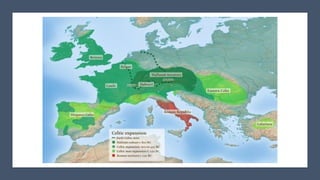
Celtic tribes migrated from Central Europe and France to Britain and
mixed with the indigenous inhabitants, creating a new culture slightly
distinct from the Continental Celtic one.
This was the Bronze Age.
The Romans tried a first time to invade Britannia (the Latin name of the island)
in 55 BCE under Julius Caesar, but weren't successful until 43 CE, during the reign
of Emperor Claudius.
5.
• With theRomans gone, the Celtic tribes started fighting with each others again
• One of the local chieftain had the not so brilliant idea to request help from some
Germanic tribes from the North of present-day Germany and South of Denmark.
• These were the Angles, Saxons and Jutes, who arrived in the 5th and 6th
centuries.
The Anglo-Saxons
The Germanic tribes did not go back home after the fight, and on
the contrary felt strong enough to seize the whole of the country
for themselves, which they did, pushing back all the Celtic tribes
6.
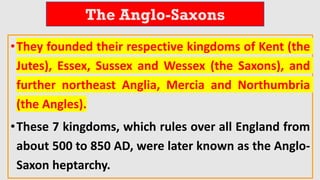
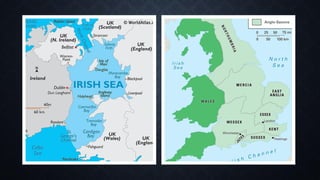
•They founded theirrespective kingdoms of Kent (the
Jutes), Essex, Sussex and Wessex (the Saxons), and
further northeast Anglia, Mercia and Northumbria
(the Angles).
•These 7 kingdoms, which rules over all England from
about 500 to 850 AD, were later known as the Anglo-
Saxon heptarchy.
The Anglo-Saxons
8.
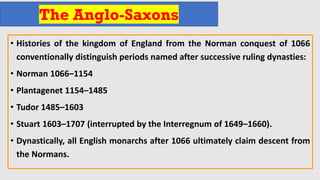
• Histories ofthe kingdom of England from the Norman conquest of 1066
conventionally distinguish periods named after successive ruling dynasties:
• Norman 1066–1154
• Plantagenet 1154–1485
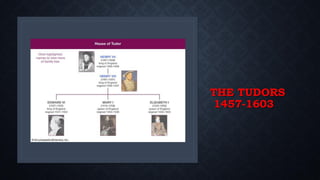
• Tudor 1485–1603
• Stuart 1603–1707 (interrupted by the Interregnum of 1649–1660).
• Dynastically, all English monarchs after 1066 ultimately claim descent from
the Normans.
The Anglo-Saxons
9.
• In 1066,a Norman expedition invaded and conquered England.
• The Norman dynasty, established by William the Conqueror, ruled
England for over half a century before the period of succession
crisis known as the Anarchy (1135–1154).
• Following the Anarchy, England came under the rule of the House
of Plantagenet, a dynasty which later inherited claims to the
Kingdom of France.
• During this period, Magna Carta was signed.
Norman Conquest
10.
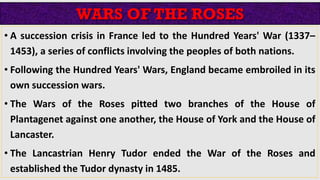
WARS OF THEROSES
• A succession crisis in France led to the Hundred Years' War (1337–
1453), a series of conflicts involving the peoples of both nations.
• Following the Hundred Years' Wars, England became embroiled in its
own succession wars.
• The Wars of the Roses pitted two branches of the House of
Plantagenet against one another, the House of York and the House of
Lancaster.
• The Lancastrian Henry Tudor ended the War of the Roses and
established the Tudor dynasty in 1485.
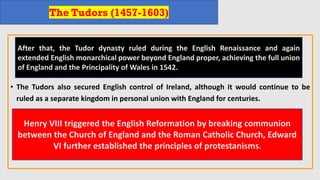
• The Tudorsalso secured English control of Ireland, although it would continue to be
ruled as a separate kingdom in personal union with England for centuries.
The Tudors (1457-1603)
Henry VIII triggered the English Reformation by breaking communion
between the Church of England and the Roman Catholic Church, Edward
VI further established the principles of protestanisms.
After that, the Tudor dynasty ruled during the English Renaissance and again
extended English monarchical power beyond England proper, achieving the full union
of England and the Principality of Wales in 1542.
13.
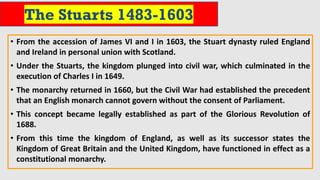
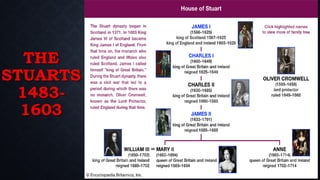
• From theaccession of James VI and I in 1603, the Stuart dynasty ruled England
and Ireland in personal union with Scotland.
• Under the Stuarts, the kingdom plunged into civil war, which culminated in the
execution of Charles I in 1649.
• The monarchy returned in 1660, but the Civil War had established the precedent
that an English monarch cannot govern without the consent of Parliament.
• This concept became legally established as part of the Glorious Revolution of
1688.
• From this time the kingdom of England, as well as its successor states the
Kingdom of Great Britain and the United Kingdom, have functioned in effect as a
constitutional monarchy.
The Stuarts 1483-1603
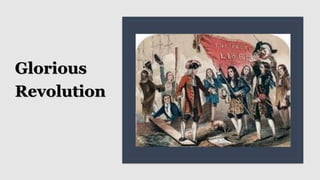
GLORIOUS REVOLUTION
• Thereoccurred a revolution in England in 1688 A.D. which was
peaceful in nature but had a great significance otherwise.
• As a result of this revolution the Rule of Law took the place of the
despotic rule.
• On23rd of December 1688 A.D. James Il fled from England to France
and the parliament handed over the Crown to his daughter Mary
son-in-law, William of popularly known as the Orange.
• The revolution is called Glorious revolution of 1688 or bloodless
revolution
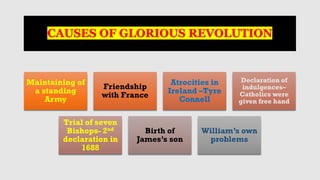
CAUSES OF GLORIOUSREVOLUTION
• Efforts by James II to restore Catholic Ascendency
• In June 1688, two events turned dissent into a crisis; the first, on 10
June, was the birth of James's son and heir James Francis Edward,
• Efforts to repeal test act
• Arbitrary legislations
• Ecclesiastical court– old name of prerogative court
• Interference in the internal matters of universities– sir Isaac
Newton case
• Cruel treatment of his enemies– bloody Mary- duke of Monmouth
18.
CAUSES OF GLORIOUSREVOLUTION
Maintaining of
a standing
Army
Friendship
with France
Atrocities in
Ireland –Tyre
Connell
Declaration of
indulgences–
Catholics were
given free hand
Trial of seven
Bishops- 2nd
declaration in
1688
Birth of
James’s son
William’s own
problems
19.
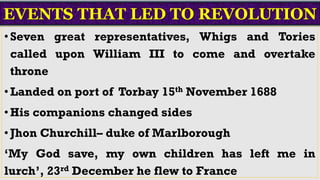
EVENTS THAT LEDTO REVOLUTION
•Seven great representatives, Whigs and Tories
called upon William III to come and overtake
throne
•Landed on port of Torbay 15th November 1688
•His companions changed sides
•Jhon Churchill– duke of Marlborough
‘My God save, my own children has left me in
lurch’, 23rd December he flew to France
20.
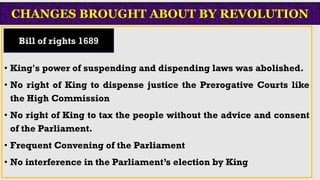
CHANGES BROUGHT ABOUTBY REVOLUTION
• King's power of suspending and dispending laws was abolished.
• No right of King to dispense justice the Prerogative Courts like
the High Commission
• No right of King to tax the people without the advice and consent
of the Parliament.
• Frequent Convening of the Parliament
• No interference in the Parliament’s election by King
Bill of rights 1689
21.
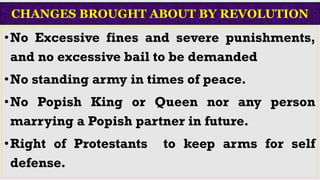
CHANGES BROUGHT ABOUTBY REVOLUTION
•No Excessive fines and severe punishments,
and no excessive bail to be demanded
•No standing army in times of peace.
•No Popish King or Queen nor any person
marrying a Popish partner in future.
•Right of Protestants to keep arms for self
defense.
22.
CHANGES BROUGHT ABOUTBY REVOLUTION
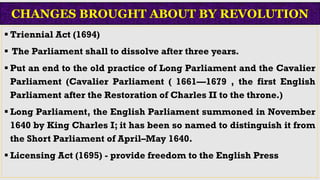
▪ Triennial Act (1694)
▪ The Parliament shall to dissolve after three years.
▪ Put an end to the old practice of Long Parliament and the Cavalier
Parliament (Cavalier Parliament ( 1661—1679 , the first English
Parliament after the Restoration of Charles II to the throne.)
▪ Long Parliament, the English Parliament summoned in November
1640 by King Charles I; it has been so named to distinguish it from
the Short Parliament of April–May 1640.
▪ Licensing Act (1695) - provide freedom to the English Press
23.
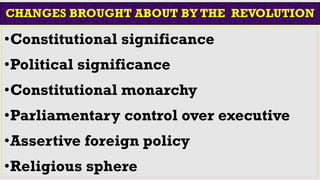
CHANGES BROUGHT ABOUTBY THE REVOLUTION
•Constitutional significance
•Political significance
•Constitutional monarchy
•Parliamentary control over executive
•Assertive foreign policy
•Religious sphere
24.
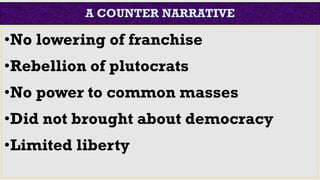
A COUNTER NARRATIVE
•Nolowering of franchise
•Rebellion of plutocrats
•No power to common masses
•Did not brought about democracy
•Limited liberty
25.
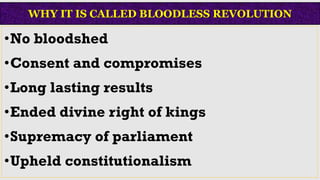
WHY IT ISCALLED BLOODLESS REVOLUTION
•No bloodshed
•Consent and compromises
•Long lasting results
•Ended divine right of kings
•Supremacy of parliament
•Upheld constitutionalism
26.
WHY IT ISCALLED BLOODLESS REVOLUTION
•No arbitrary taxation
•Independent foreign policy
•Religious toleration
•Judiciary was made independent
•Roman church was abandoned for good
•Domination of England started
27.
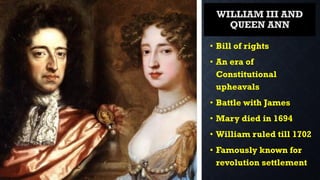
WILLIAM III AND
QUEENANN
• Bill of rights
• An era of
Constitutional
upheavals
• Battle with James
• Mary died in 1694
• William ruled till 1702
• Famously known for
revolution settlement
28.
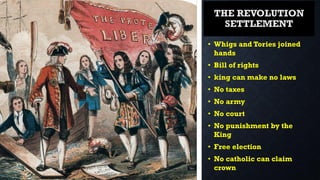
THE REVOLUTION
SETTLEMENT
• Whigsand Tories joined
hands
• Bill of rights
• king can make no laws
• No taxes
• No army
• No court
• No punishment by the
King
• Free election
• No catholic can claim
crown
29.
IMPORTANCE OF BILLOF RIGHT
• Supremacy of parliament
• No divine right
• No royal despotism
• Fundamental rights
• Certain other acts:
• Mutiny act
• Law of grant and supplies
• Toleration act 36 out 39 common book
• Triennial act 1694
30.
ACT OF SETTLEMENT1701
•Queen Ann after William- Sophia electors of
Hanover
•No relation with pope of Rome
• No catholic can take throne
• No arbitrary war by king
•No member from colonies to privy council
• No pardon from king
31.
THE ACT OFSETTLEMENT (1701)
➢A catholic cannot be a King
➢No war, except for self defense, without sanction of the
Parliament
➢No foreign visit of King without the consent of the
Parliament – this was to control foreign policy.
➢A person born in England, Scotland and Ireland or the
Dominion was eligible to become member of the Privy
Council or the House of Commons.
32.
THE ACT OFSETTLEMENT (1701)
•Described by Robertson as "an important
corollary to the Declaration of Rights".
•limitations on the Prerogatives of the Crown,
with further Declaratory principles securing
the rights and liberties of the subjects in the
form of giving rights to the Parliament
33.
THE ACT OFSETTLEMENT (1701)
•After the death of Princess Anne, the throne of
England would be occupied by Princess Sophia
(grand daughter of James I of England), the
Electoress of Hanover.
•After Sophia, the crown was to pass on to her
children.
•This cause was significant in so far as the line of
succession was laid down by the Parliament
34.
•What was soglorious about the Glorious
Revolution? Discuss its significance in the
British History. (2019)
•What was so glorious about the Glorious
Revolution? Discuss its significance in the
British History. (2020)
Past paper questions