Quadratic
Inequalities
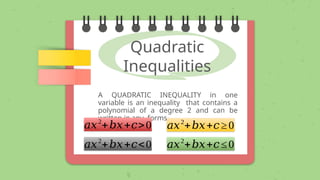
A QUADRATIC INEQUALITYin one
variable is an inequality that contains a
polynomial of a degree 2 and can be
written in any forms
𝑎𝑥2
+𝑏𝑥+𝑐>0
𝑎𝑥2
+𝑏𝑥+𝑐<0
𝑎𝑥2
+𝑏𝑥+𝑐≥0
𝑎𝑥2
+𝑏𝑥+𝑐≤0
4.
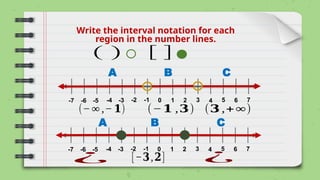
Write the intervalnotation for each
region in the number lines.
( ) [ ]
0 1 2 3 4 5 6 7
-1
-2
-3
-4
-5
-6
-7
0 1 2 3 4 5 6 7
-1
-2
-3
-4
-5
-6
-7
A B C
A B C
(−∞ ,−𝟏) (−𝟏 ,𝟑) (𝟑 ,+∞)
¿ [−𝟑,𝟐] ¿
5.
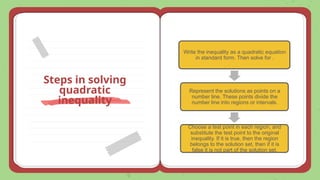
Steps in solving
quadratic
inequality
Writethe inequality as a quadratic equation
in standard form. Then solve for .
Represent the solutions as points on a
number line. These points divide the
number line into regions or intervals.
Choose a test point in each region, and
substitute the test point to the original
inequality. If it is true, then the region
belongs to the solution set, then if it is
false it is not part of the solution set.
6.
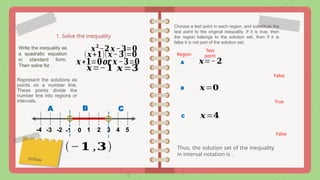
1. Solve theinequality
𝒙𝟐
−𝟐 𝒙−𝟑=𝟎
Write the inequality as
a quadratic equation
in standard form.
Then solve for .
(𝒙+𝟏)(𝒙−𝟑)=𝟎
𝒙+𝟏=𝟎𝒐𝒓 𝒙 −𝟑=𝟎 𝒙=−𝟐
𝒙=𝟑
Represent the solutions as
points on a number line.
These points divide the
number line into regions or
intervals.
0 1 4
2 3 5
-4 -3 -2 -1
hollow
A B C
Choose a test point in each region, and substitute the
test point to the original inequality. If it is true, then
the region belongs to the solution set, then if it is
false it is not part of the solution set.
A
Region
Test
point
False
𝒙=−𝟏
B 𝒙=𝟎
True
C 𝒙=𝟒
False
Thus, the solution set of the inequality
in interval notation is .
(−𝟏 ,𝟑)
7.
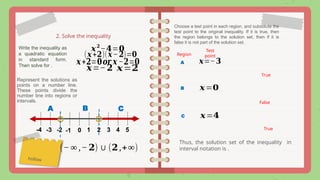
2. Solve theinequality
𝒙𝟐
−𝟒=𝟎
Write the inequality as
a quadratic equation
in standard form.
Then solve for .
(𝒙+𝟐)(𝒙−𝟐)=𝟎
𝒙+𝟐=𝟎𝒐𝒓 𝒙 −𝟐=𝟎 𝒙=−𝟑
𝒙=𝟐
Represent the solutions as
points on a number line.
These points divide the
number line into regions or
intervals.
0 1 4
2 3 5
-4 -3 -2 -1
hollow
A B C
Choose a test point in each region, and substitute the
test point to the original inequality. If it is true, then
the region belongs to the solution set, then if it is
false it is not part of the solution set.
A
Region
Test
point
True
𝒙=−𝟐
B 𝒙=𝟎
False
C 𝒙=𝟒
True
Thus, the solution set of the inequality in
interval notation is .
(−∞ ,−𝟐)∪(𝟐,+∞)
8.
3. Solve theinequality
𝒙𝟐
−𝟐 𝒙−𝟖=𝟎
Write the inequality as
a quadratic equation
in standard form.
Then solve for .
(𝒙+𝟐)(𝒙−𝟒)=𝟎
𝒙+𝟐=𝟎𝒐𝒓 𝒙 −𝟒=𝟎 𝒙=−𝟒
𝒙=𝟒
Represent the solutions as
points on a number line.
These points divide the
number line into regions or
intervals.
0 1 4
2 3 5
-4 -3 -2 -1
shaded
A B C
Choose a test point in each region, and substitute the
test point to the original inequality. If it is true, then
the region belongs to the solution set, then if it is
false it is not part of the solution set.
A
Region
Test
point
True
𝒙=−𝟐
B 𝒙=𝟐
False
C 𝒙=𝟓
True
Thus, the solution set of the inequality in
interval notation is .
(− ∞ ,−𝟐 ] ∪ ¿
9.
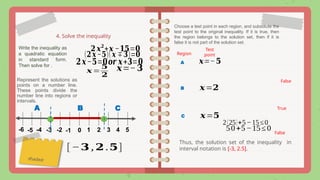
4. Solve theinequality
𝟐 𝒙𝟐
+𝒙 −𝟏𝟓=𝟎
Write the inequality as
a quadratic equation
in standard form.
Then solve for .
(𝟐𝒙−𝟓)(𝒙∓𝟑)=𝟎
𝟐𝒙−𝟓=𝟎𝒐𝒓 𝒙+𝟑=𝟎 𝒙=−𝟓
𝒙=−𝟑
Represent the solutions as
points on a number line.
These points divide the
number line into regions or
intervals.
0 1 4
2 3 5
-4 -3 -2 -1
shaded
A B C
Choose a test point in each region, and substitute the
test point to the original inequality. If it is true, then
the region belongs to the solution set, then if it is
false it is not part of the solution set.
A
Region
Test
point
False
𝒙=
𝟓
𝟐
B 𝒙=𝟐
True
C 𝒙=𝟓
2(25)+5−15≤0
False
Thus, the solution set of the inequality in
interval notation is [-3, 2.5].
[−𝟑 , 𝟐 .𝟓]
-6 -5 50+5−15≤0
11.
CREDITS: This presentation
templatewas created by
Slidesgo, including icons by
Flaticon, and infographics &
images by Freepik.
Thanks!
Please keep
this slide for
attribution.
![3. Solve the inequality
𝒙𝟐
−𝟐 𝒙−𝟖=𝟎
Write the inequality as
a quadratic equation
in standard form.
Then solve for .
(𝒙+𝟐)(𝒙−𝟒)=𝟎
𝒙+𝟐=𝟎𝒐𝒓 𝒙 −𝟒=𝟎 𝒙=−𝟒
𝒙=𝟒
Represent the solutions as
points on a number line.
These points divide the
number line into regions or
intervals.
0 1 4
2 3 5
-4 -3 -2 -1
shaded
A B C
Choose a test point in each region, and substitute the
test point to the original inequality. If it is true, then
the region belongs to the solution set, then if it is
false it is not part of the solution set.
A
Region
Test
point
True
𝒙=−𝟐
B 𝒙=𝟐
False
C 𝒙=𝟓
True
Thus, the solution set of the inequality in
interval notation is .
(− ∞ ,−𝟐 ] ∪ ¿](https://image.slidesharecdn.com/2solvingquadraticinequalities-260111050052-b7f9e5c7/85/2-solving-Quadratic-Inequalities-math-pptx-8-320.jpg)