Angles and Parallel Lines
Trasversal
Parallel lines
Angles are formed
by parallel line
Angles and
Parallel Lines
1
2
3
Transversal
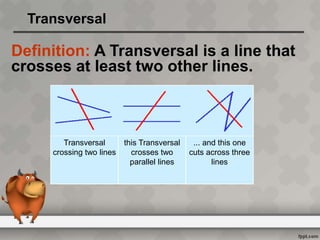
Definition: A Transversal is a line that
crosses at least two other lines.
Transversal
crossing two lines
this Transversal
crosses two
parallel lines
... and this one
cuts across three
lines
Paralell lines
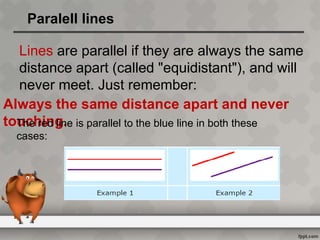
Lines are parallel if they are always the same
distance apart (called "equidistant"), and will
never meet. Just remember:
Always the same distance apart and never
touching.The red line is parallel to the blue line in both these
cases:
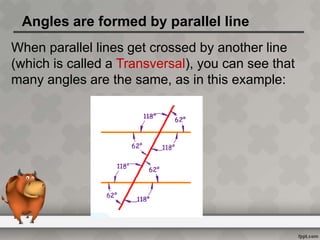
Angles are formed by parallel line
When parallel lines get crossed by another line
(which is called a Transversal), you can see that
many angles are the same, as in this example:
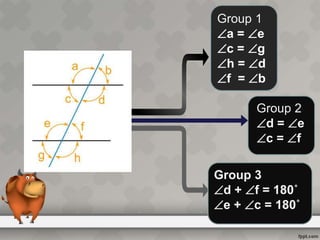
Group 1
a = e
c = g
h = d
f = b
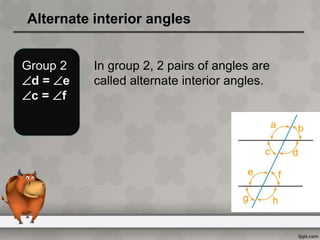
Group 2
d = e
c = f
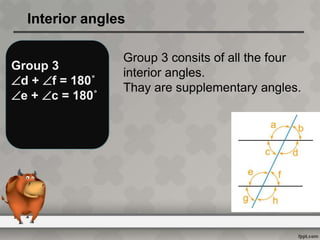
Group 3
d + f = 180˚
e + c = 180˚
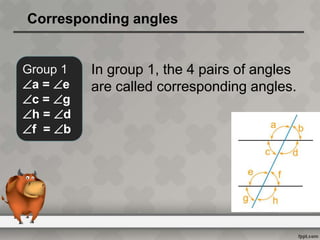
Corresponding angles
Group 1
a = e
c = g
h = d
f = b
In group 1, the 4 pairs of angles
are called corresponding angles.
Alternate interior angles
Group 2
d = e
c = f
In group 2, 2 pairs of angles are
called alternate interior angles.
Interior angles
Group 3
d + f = 180˚
e + c = 180˚
Group 3 consits of all the four
interior angles.
Thay are supplementary angles.
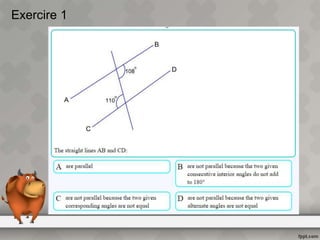
Exercire 1
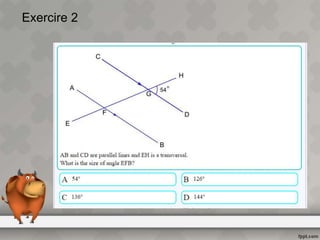
Exercire 2

Parallel Line

  • 1.
  • 2.
    Trasversal Parallel lines Angles areformed by parallel line Angles and Parallel Lines 1 2 3
  • 3.
    Transversal Definition: A Transversalis a line that crosses at least two other lines. Transversal crossing two lines this Transversal crosses two parallel lines ... and this one cuts across three lines
  • 4.
    Paralell lines Lines areparallel if they are always the same distance apart (called "equidistant"), and will never meet. Just remember: Always the same distance apart and never touching.The red line is parallel to the blue line in both these cases:
  • 5.
    Angles are formedby parallel line When parallel lines get crossed by another line (which is called a Transversal), you can see that many angles are the same, as in this example:
  • 6.
    Group 1 a =e c = g h = d f = b Group 2 d = e c = f Group 3 d + f = 180˚ e + c = 180˚
  • 7.
    Corresponding angles Group 1 a= e c = g h = d f = b In group 1, the 4 pairs of angles are called corresponding angles.
  • 8.
    Alternate interior angles Group2 d = e c = f In group 2, 2 pairs of angles are called alternate interior angles.
  • 9.
    Interior angles Group 3 d+ f = 180˚ e + c = 180˚ Group 3 consits of all the four interior angles. Thay are supplementary angles.
  • 10.
  • 11.