WAP - Wireless Application Protocol
• Goals
– deliver Internet content and enhanced services to mobile
devices and users (mobile phones, PDAs)
– independence from wireless network standards
– open for everyone to participate, protocol specifications will
be proposed to standardization bodies
– applications should scale well beyond current transport
media and device types and should also be applicable to
future developments
• Platforms
– e.g., GSM (900, 1800, 1900), CDMA IS-95, TDMA IS-136, 3rd
generation systems (IMT-2000, UMTS, W-CDMA)
• Forum
– WAP Forum, co-founded by Ericsson, Motorola, Nokia,
Unwired Planet
– further information http://www.wapforum.org
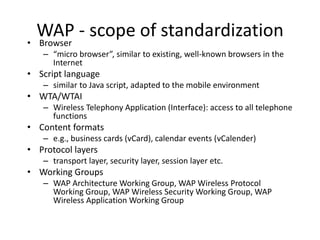
WAP - scope of standardization
• Browser
– “micro browser”, similar to existing, well-known browsers in the
Internet
• Script language
– similar to Java script, adapted to the mobile environment
• WTA/WTAI
– Wireless Telephony Application (Interface): access to all telephone
functions
• Content formats
– e.g., business cards (vCard), calendar events (vCalender)
• Protocol layers
– transport layer, security layer, session layer etc.
• Working Groups
– WAP Architecture Working Group, WAP Wireless Protocol
Working Group, WAP Wireless Security Working Group, WAP
Wireless Application Working Group
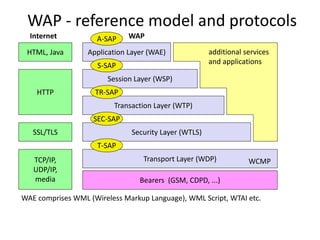
WAP - reference model and protocols
Bearers (GSM, CDPD, ...)
Security Layer (WTLS)
Session Layer (WSP)
Application Layer (WAE)
Transport Layer (WDP)TCP/IP,
UDP/IP,
media
SSL/TLS
HTML, Java
HTTP
Internet WAP
WAE comprises WML (Wireless Markup Language), WML Script, WTAI etc.
Transaction Layer (WTP)
additional services
and applications
WCMP
A-SAP
S-SAP
TR-SAP
SEC-SAP
T-SAP
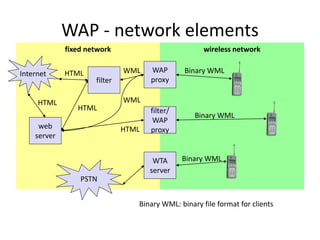
WAP - network elements
wireless networkfixed network
WAP
proxy
WTA
server
filter/
WAP
proxyweb
server
filter
PSTN
Internet
Binary WML: binary file format for clients
Binary WML
Binary WML
Binary WML
HTML
HTML
HTML WML
WMLHTML
WDP - Wireless Datagram Protocol
• Protocol of the transport layer within the WAP
architecture
– uses directly transport mechanisms of different network
technologies
– offers a common interface for higher layer protocols
– allows for transparent communication using different
transport technologies
– if IP is used, then WDP more or less translates to UDP
• Goals of WDP
– create a worldwide interoperable transport system with the
help of WDP adapted to the different underlying technologies
– transmission services such as SMS in GSM might change, new
services can replace the old ones
WTLS - Wireless Transport Layer
Security
• Goals
– data integrity
• prevention of changes in data
– privacy
• prevention of tapping
– authentication
• creation of authenticated relations between a mobile device and a server
– protection against denial-of-service attacks
• protection against repetition of data and unverified data
• WTLS
– is based on the TLS (Transport Layer Security) protocol (former SSL,
Secure Sockets Layer)
– optimized for low-bandwidth communication channels
WTP - Wireless Transaction Protocol• Goals
– different transaction services, offloads applications
• application can select reliability, efficiency
– support of different communication scenarios
• class 0: unreliable message transfer
• class 1: reliable message transfer without result message
• class 2: reliable message transfer with exactly one reliable result message
– supports peer-to-peer, client/server and multicast applications
– low memory requirements, suited to simple devices (< 10kbyte )
– efficient for wireless transmission
• segmentation/reassembly
• selective retransmission
• header compression
• optimized connection setup (setup with data transfer)
WSP - Wireless Session Protocol• Goals
– HTTP 1.1 functionality
• Request/reply, content type negotiation, ...
– support of client/server, transactions, push technology
– key management, authentication, Internet security services
– session management (interruption, resume,...)
• Services
– session management (establish, release, suspend, resume)
– capability negotiation
– content encoding
• WSP/B (Browsing)
– HTTP/1.1 functionality - but binary encoded
– exchange of session headers
– push and pull data transfer
– asynchronous requests
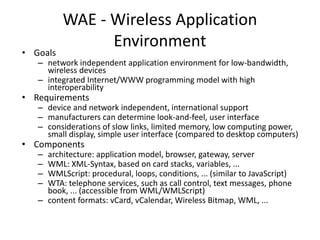
WAE - Wireless Application
Environment
• Goals
– network independent application environment for low-bandwidth,
wireless devices
– integrated Internet/WWW programming model with high
interoperability
• Requirements
– device and network independent, international support
– manufacturers can determine look-and-feel, user interface
– considerations of slow links, limited memory, low computing power,
small display, simple user interface (compared to desktop computers)
• Components
– architecture: application model, browser, gateway, server
– WML: XML-Syntax, based on card stacks, variables, ...
– WMLScript: procedural, loops, conditions, ... (similar to JavaScript)
– WTA: telephone services, such as call control, text messages, phone
book, ... (accessible from WML/WMLScript)
– content formats: vCard, vCalendar, Wireless Bitmap, WML, ...
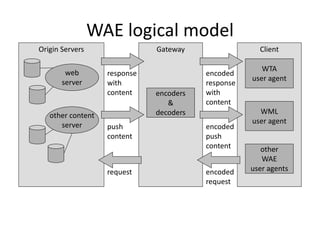
Origin Servers
WAE logical model
web
server
other content
server
Gateway Client
other
WAE
user agents
WML
user agent
WTA
user agent
encoders
&
decoders
encoded
request
request
encoded
response
with
content
response
with
content
push
content
encoded
push
content
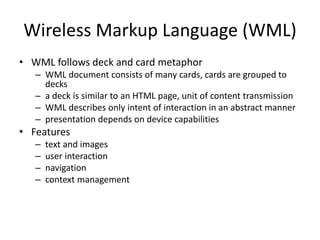
Wireless Markup Language (WML)
• WML follows deck and card metaphor
– WML document consists of many cards, cards are grouped to
decks
– a deck is similar to an HTML page, unit of content transmission
– WML describes only intent of interaction in an abstract manner
– presentation depends on device capabilities
• Features
– text and images
– user interaction
– navigation
– context management
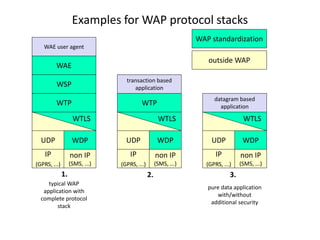
Examples for WAP protocol stacks
WAE
WSP
WTP
UDP
IP
(GPRS, ...)
WDP
non IP
(SMS, ...)
WTLS
WAE user agent
WAP standardization
outside WAP
WTP
UDP
IP
(GPRS, ...)
WDP
non IP
(SMS, ...)
WTLS
UDP
IP
(GPRS, ...)
WDP
non IP
(SMS, ...)
WTLS
transaction based
application
datagram based
application
typical WAP
application with
complete protocol
stack
pure data application
with/without
additional security
1. 2. 3.
ACTIVITY-1 –
SCALE-UP – Random Groups (7) -
Students of each group will be made to
discuss on “Applications of WAP in
Mobile Environments”, and share points
satellite systems
satellite systems to extend cellular phone systems (e.g., GSM or AMPS)
In general, a satellite is anything that orbits something else, as, for example, the
moon orbits the earth.
Using Internet Protocol in Satellite News Gathering and Corporate Network
Solutions
• One of the best reasons to select an IP-based solution is because Internet protocol (IP)
is the fastest growing communications medium.
• Communications across the country and around the world are based on Internet
protocol.
• There is rapid growth in the number of applications available and in their
efficiency. Because we run Internet protocol, we can always accommodate new
advances in technology and do not have to constantly upgrade our systems; it allows for
future expansion and will not become quickly outdated.
• Growth of file based workflows in the news industry and satellite newsgathering, an IP
based solution is a logical choice for news and media outlets.
Localization of mobile stations
Mechanisms similar to GSM
Gateways maintain registers with user data
• HLR (Home Location Register): static user data
• VLR (Visitor Location Register): (last known) location of the mobile station
• SUMR (Satellite User Mapping Register):
• positions of all satellites
• satellite assigned to a mobile station
Registration of mobile stations
• Localization of the mobile station via the satellite’s position
• requesting user data from HLR
• updating VLR and SUMR
Calling a mobile station
• connection setup using the appropriate satellite
• localization using HLR/VLR similar to GSM
ACTIVITY-2 - PROBLEM BASED LEARNING – Groups (Boys & Girls) – With the basic
knowledge on satellite systems, students will be made to discuss on “Mobile Satellite
Communication by Non - Geo-stationary satellite and identify the Latitude, Longitude,
Orbit Cycle, and Working”, and share points among the fellow-mates.
Handover in satellite systems
Handovers are needed to maintain calls when moving between cells in active/dedicated
mode (CELL_DCH Mode).
Several additional situations for handover in satellite systems compared to cellular
terrestrial mobile phone networks caused by the movement of the satellites
Intra satellite handover
• handover from one spot beam to another
• mobile station still in the footprint of the satellite, but in another cell
Inter satellite handover
• handover from one satellite to another satellite
• mobile station leaves the footprint of one satellite
Gateway handover
• Handover from one gateway to another
• mobile station still in the footprint of a satellite, but gateway leaves the footprint
Inter system handover
• Handover from the satellite network to a terrestrial cellular network
• mobile station can reach a terrestrial network again which might be cheaper, has a
lower latency etc.
ACTIVITY-3 - PEER LED TEAM BASED LEARNING –
Random Groups – Students will be made to discuss
on “Location Aided Routing in Mobile Networks”,
and share points in groups.

WAP

  • 1.
    WAP - WirelessApplication Protocol • Goals – deliver Internet content and enhanced services to mobile devices and users (mobile phones, PDAs) – independence from wireless network standards – open for everyone to participate, protocol specifications will be proposed to standardization bodies – applications should scale well beyond current transport media and device types and should also be applicable to future developments • Platforms – e.g., GSM (900, 1800, 1900), CDMA IS-95, TDMA IS-136, 3rd generation systems (IMT-2000, UMTS, W-CDMA) • Forum – WAP Forum, co-founded by Ericsson, Motorola, Nokia, Unwired Planet – further information http://www.wapforum.org
  • 2.
    WAP - scopeof standardization • Browser – “micro browser”, similar to existing, well-known browsers in the Internet • Script language – similar to Java script, adapted to the mobile environment • WTA/WTAI – Wireless Telephony Application (Interface): access to all telephone functions • Content formats – e.g., business cards (vCard), calendar events (vCalender) • Protocol layers – transport layer, security layer, session layer etc. • Working Groups – WAP Architecture Working Group, WAP Wireless Protocol Working Group, WAP Wireless Security Working Group, WAP Wireless Application Working Group
  • 3.
    WAP - referencemodel and protocols Bearers (GSM, CDPD, ...) Security Layer (WTLS) Session Layer (WSP) Application Layer (WAE) Transport Layer (WDP)TCP/IP, UDP/IP, media SSL/TLS HTML, Java HTTP Internet WAP WAE comprises WML (Wireless Markup Language), WML Script, WTAI etc. Transaction Layer (WTP) additional services and applications WCMP A-SAP S-SAP TR-SAP SEC-SAP T-SAP
  • 4.
    WAP - networkelements wireless networkfixed network WAP proxy WTA server filter/ WAP proxyweb server filter PSTN Internet Binary WML: binary file format for clients Binary WML Binary WML Binary WML HTML HTML HTML WML WMLHTML
  • 5.
    WDP - WirelessDatagram Protocol • Protocol of the transport layer within the WAP architecture – uses directly transport mechanisms of different network technologies – offers a common interface for higher layer protocols – allows for transparent communication using different transport technologies – if IP is used, then WDP more or less translates to UDP • Goals of WDP – create a worldwide interoperable transport system with the help of WDP adapted to the different underlying technologies – transmission services such as SMS in GSM might change, new services can replace the old ones
  • 6.
    WTLS - WirelessTransport Layer Security • Goals – data integrity • prevention of changes in data – privacy • prevention of tapping – authentication • creation of authenticated relations between a mobile device and a server – protection against denial-of-service attacks • protection against repetition of data and unverified data • WTLS – is based on the TLS (Transport Layer Security) protocol (former SSL, Secure Sockets Layer) – optimized for low-bandwidth communication channels
  • 7.
    WTP - WirelessTransaction Protocol• Goals – different transaction services, offloads applications • application can select reliability, efficiency – support of different communication scenarios • class 0: unreliable message transfer • class 1: reliable message transfer without result message • class 2: reliable message transfer with exactly one reliable result message – supports peer-to-peer, client/server and multicast applications – low memory requirements, suited to simple devices (< 10kbyte ) – efficient for wireless transmission • segmentation/reassembly • selective retransmission • header compression • optimized connection setup (setup with data transfer)
  • 8.
    WSP - WirelessSession Protocol• Goals – HTTP 1.1 functionality • Request/reply, content type negotiation, ... – support of client/server, transactions, push technology – key management, authentication, Internet security services – session management (interruption, resume,...) • Services – session management (establish, release, suspend, resume) – capability negotiation – content encoding • WSP/B (Browsing) – HTTP/1.1 functionality - but binary encoded – exchange of session headers – push and pull data transfer – asynchronous requests
  • 9.
    WAE - WirelessApplication Environment • Goals – network independent application environment for low-bandwidth, wireless devices – integrated Internet/WWW programming model with high interoperability • Requirements – device and network independent, international support – manufacturers can determine look-and-feel, user interface – considerations of slow links, limited memory, low computing power, small display, simple user interface (compared to desktop computers) • Components – architecture: application model, browser, gateway, server – WML: XML-Syntax, based on card stacks, variables, ... – WMLScript: procedural, loops, conditions, ... (similar to JavaScript) – WTA: telephone services, such as call control, text messages, phone book, ... (accessible from WML/WMLScript) – content formats: vCard, vCalendar, Wireless Bitmap, WML, ...
  • 10.
    Origin Servers WAE logicalmodel web server other content server Gateway Client other WAE user agents WML user agent WTA user agent encoders & decoders encoded request request encoded response with content response with content push content encoded push content
  • 11.
    Wireless Markup Language(WML) • WML follows deck and card metaphor – WML document consists of many cards, cards are grouped to decks – a deck is similar to an HTML page, unit of content transmission – WML describes only intent of interaction in an abstract manner – presentation depends on device capabilities • Features – text and images – user interaction – navigation – context management
  • 12.
    Examples for WAPprotocol stacks WAE WSP WTP UDP IP (GPRS, ...) WDP non IP (SMS, ...) WTLS WAE user agent WAP standardization outside WAP WTP UDP IP (GPRS, ...) WDP non IP (SMS, ...) WTLS UDP IP (GPRS, ...) WDP non IP (SMS, ...) WTLS transaction based application datagram based application typical WAP application with complete protocol stack pure data application with/without additional security 1. 2. 3.
  • 13.
    ACTIVITY-1 – SCALE-UP –Random Groups (7) - Students of each group will be made to discuss on “Applications of WAP in Mobile Environments”, and share points
  • 14.
    satellite systems satellite systemsto extend cellular phone systems (e.g., GSM or AMPS) In general, a satellite is anything that orbits something else, as, for example, the moon orbits the earth. Using Internet Protocol in Satellite News Gathering and Corporate Network Solutions • One of the best reasons to select an IP-based solution is because Internet protocol (IP) is the fastest growing communications medium. • Communications across the country and around the world are based on Internet protocol. • There is rapid growth in the number of applications available and in their efficiency. Because we run Internet protocol, we can always accommodate new advances in technology and do not have to constantly upgrade our systems; it allows for future expansion and will not become quickly outdated. • Growth of file based workflows in the news industry and satellite newsgathering, an IP based solution is a logical choice for news and media outlets.
  • 15.
    Localization of mobilestations Mechanisms similar to GSM Gateways maintain registers with user data • HLR (Home Location Register): static user data • VLR (Visitor Location Register): (last known) location of the mobile station • SUMR (Satellite User Mapping Register): • positions of all satellites • satellite assigned to a mobile station Registration of mobile stations • Localization of the mobile station via the satellite’s position • requesting user data from HLR • updating VLR and SUMR Calling a mobile station • connection setup using the appropriate satellite • localization using HLR/VLR similar to GSM
  • 16.
    ACTIVITY-2 - PROBLEMBASED LEARNING – Groups (Boys & Girls) – With the basic knowledge on satellite systems, students will be made to discuss on “Mobile Satellite Communication by Non - Geo-stationary satellite and identify the Latitude, Longitude, Orbit Cycle, and Working”, and share points among the fellow-mates.
  • 17.
    Handover in satellitesystems Handovers are needed to maintain calls when moving between cells in active/dedicated mode (CELL_DCH Mode). Several additional situations for handover in satellite systems compared to cellular terrestrial mobile phone networks caused by the movement of the satellites Intra satellite handover • handover from one spot beam to another • mobile station still in the footprint of the satellite, but in another cell Inter satellite handover • handover from one satellite to another satellite • mobile station leaves the footprint of one satellite Gateway handover • Handover from one gateway to another • mobile station still in the footprint of a satellite, but gateway leaves the footprint Inter system handover • Handover from the satellite network to a terrestrial cellular network • mobile station can reach a terrestrial network again which might be cheaper, has a lower latency etc.
  • 18.
    ACTIVITY-3 - PEERLED TEAM BASED LEARNING – Random Groups – Students will be made to discuss on “Location Aided Routing in Mobile Networks”, and share points in groups.