IEEE WIRELESS
STANDARDS
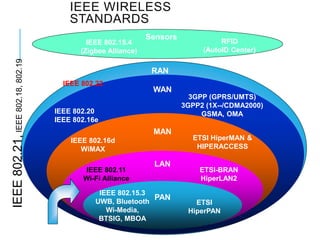
IEEE 802.15.3
UWB, Bluetooth
Wi-Media,
BTSIG, MBOA
WAN
MAN
LAN
PAN
ETSI
HiperPAN
IEEE 802.11
Wi-Fi Alliance
ETSI-BRAN
HiperLAN2
IEEE 802.16d
WiMAX
ETSI HiperMAN &
HIPERACCESS
IEEE 802.20
IEEE 802.16e
3GPP (GPRS/UMTS)
3GPP2 (1X--/CDMA2000)
GSMA, OMA
Sensors
IEEE 802.15.4
(Zigbee Alliance)
RFID
(AutoID Center)
RAN
IEEE 802.22
IEEE
802.21,
IEEE
802.18,
802.19
WIRELESS LAYERED
ARCHITECTURE
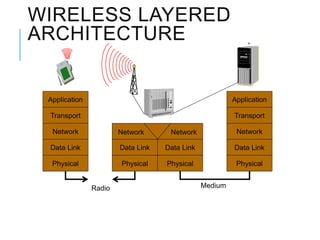
Application
Transport
Network
Data Link
Physical
Medium
Data Link
Physical
Application
Transport
Network
Data Link
Physical
Data Link
Physical
Network Network
Radio
WIRELESS APPLICATION PROTOCOL
(WAP)
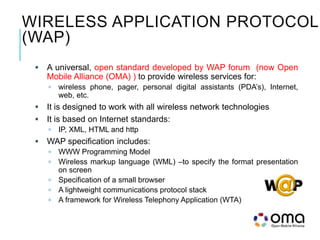
 A universal, open standard developed by WAP forum (now Open
Mobile Alliance (OMA) ) to provide wireless services for:
 wireless phone, pager, personal digital assistants (PDA’s), Internet,
web, etc.
 It is designed to work with all wireless network technologies
 It is based on Internet standards:
 IP, XML, HTML and http
 WAP specification includes:
 WWW Programming Model
 Wireless markup language (WML) –to specify the format presentation
on screen
 Specification of a small browser
 A lightweight communications protocol stack
 A framework for Wireless Telephony Application (WTA)
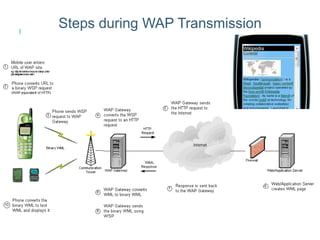
Steps during WAP Transmission
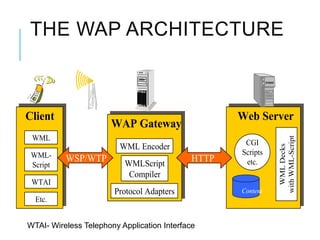
THE WAP ARCHITECTURE
Web Server
Content
CGI
Scripts
etc.
WML
Decks
with
WML-Script
WAP Gateway
WML Encoder
WMLScript
Compiler
Protocol Adapters
Client
WML
WML-
Script
WTAI
Etc.
HTTP
WSP/WTP
WTAI- Wireless Telephony Application Interface
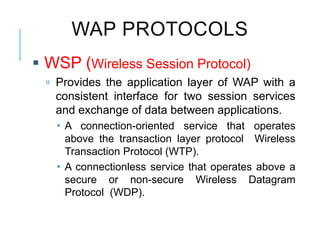
WAP PROTOCOLS
 WSP (Wireless Session Protocol)
 Provides the application layer of WAP with a
consistent interface for two session services
and exchange of data between applications.
 A connection-oriented service that operates
above the transaction layer protocol Wireless
Transaction Protocol (WTP).
 A connectionless service that operates above a
secure or non-secure Wireless Datagram
Protocol (WDP).
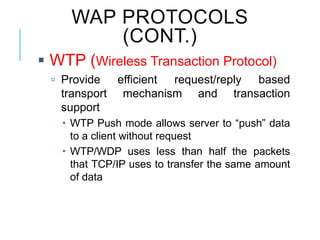
WAP PROTOCOLS
(CONT.)
 WTP (Wireless Transaction Protocol)
 Provide efficient request/reply based
transport mechanism and transaction
support
 WTP Push mode allows server to “push” data
to a client without request
 WTP/WDP uses less than half the packets
that TCP/IP uses to transfer the same amount
of data
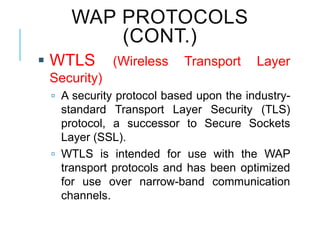
WAP PROTOCOLS
(CONT.)
 WTLS (Wireless Transport Layer
Security)
 A security protocol based upon the industry-
standard Transport Layer Security (TLS)
protocol, a successor to Secure Sockets
Layer (SSL).
 WTLS is intended for use with the WAP
transport protocols and has been optimized
for use over narrow-band communication
channels.
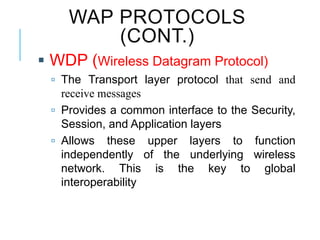
WAP PROTOCOLS
(CONT.)
 WDP (Wireless Datagram Protocol)
 The Transport layer protocol that send and
receive messages
 Provides a common interface to the Security,
Session, and Application layers
 Allows these upper layers to function
independently of the underlying wireless
network. This is the key to global
interoperability
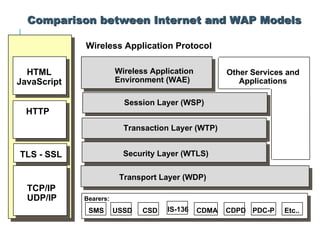
HTML
JavaScript
HTTP
TLS - SSL
TCP/IP
UDP/IP
Wireless Application Protocol
Wireless Application
Environment (WAE)
Session Layer (WSP)
Security Layer (WTLS)
Transport Layer (WDP)
Other Services and
Applications
Transaction Layer (WTP)
SMS USSD CSD IS-136 CDMA CDPD PDC-P Etc..
Bearers:
Comparison between Internet and WAP Models
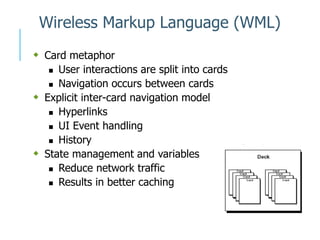
Wireless Markup Language (WML)
 Card metaphor
 User interactions are split into cards
 Navigation occurs between cards
 Explicit inter-card navigation model
 Hyperlinks
 UI Event handling
 History
 State management and variables
 Reduce network traffic
 Results in better caching
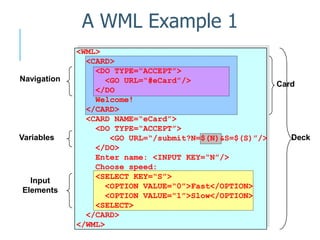
Input
Elements
Deck
Card
Navigation
Variables
<WML>
<CARD>
<DO TYPE=“ACCEPT”>
<GO URL=“#eCard”/>
</DO
Welcome!
</CARD>
<CARD NAME=“eCard”>
<DO TYPE=“ACCEPT”>
<GO URL=“/submit?N=$(N)&S=$(S)”/>
</DO>
Enter name: <INPUT KEY=“N”/>
Choose speed:
<SELECT KEY=“S”>
<OPTION VALUE=“0”>Fast</OPTION>
<OPTION VALUE=“1”>Slow</OPTION>
<SELECT>
</CARD>
</WML>
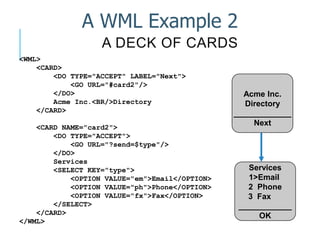
A WML Example 1
<WML>
<CARD>
<DO TYPE="ACCEPT" LABEL="Next">
<GO URL="#card2"/>
</DO>
Acme Inc.<BR/>Directory
</CARD>
<CARD NAME="card2">
<DO TYPE="ACCEPT">
<GO URL="?send=$type"/>
</DO>
Services
<SELECT KEY="type">
<OPTION VALUE="em">Email</OPTION>
<OPTION VALUE="ph">Phone</OPTION>
<OPTION VALUE="fx">Fax</OPTION>
</SELECT>
</CARD>
</WML>
Acme Inc.
Directory
_____________
Next
Services
1>Email
2 Phone
3 Fax
____________
OK
A WML Example 2
A DECK OF CARDS
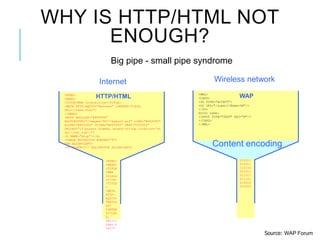
WHY IS HTTP/HTML NOT
ENOUGH?
Big pipe - small pipe syndrome
Wireless network
<HTML>
<HEAD>
<TITLE>NNN Interactive</TITLE>
<META HTTP-EQUIV="Refresh" CONTENT="1800,
URL=/index.html">
</HEAD>
<BODY BGCOLOR="#FFFFFF"
BACKGROUND="/images/9607/bgbar5.gif" LINK="#0A3990"
ALINK="#FF0000" VLINK="#FF0000" TEXT="000000"
ONLOAD="if(parent.frames.length!=0)top.location='ht
tp://nnn.com';">
<A NAME="#top"></A>
<TABLE WIDTH=599 BORDER="0">
<TR ALIGN=LEFT>
<TD WIDTH=117 VALIGN=TOP ALIGN=LEFT>
<HTML>
<HEAD>
<TITLE
>NNN
Intera
ctive<
/TITLE
>
<META
HTTP-
EQUIV=
"Refre
sh"
CONTEN
T="180
0,
URL=/i
ndex.h
tml">
Internet
<WML>
<CARD>
<DO TYPE="ACCEPT">
<GO URL="/submit?Name=$N"/>
</DO>
Enter name:
<INPUT TYPE="TEXT" KEY="N"/>
</CARD>
</WML>
010011
010011
110110
010011
011011
011101
010010
011010
Content encoding
HTTP/HTML WAP
Source: WAP Forum
IETF MOBILE IP PROTOCOL
 Mobile IP was developed as a means for
transparently dealing with problems of mobile
users
 Enables hosts to stay connected to the
Internet regardless of their location
 Mobile IP (MIP) or IP mobility allows a host to
have a unique (location-independent) IP
address.
 Each host has a home agent (permanent
home address) on its home network.
 The home agent forward IP packets when
mobile host away from home.
 When away from home, mobile host has a
care-of-address (CoA)
 care-of-address = address of foreign agent
within the foreign subnet - the foreign agent
delivers forwarded packets to mobile host
 care-of-address may also be a temporary IP
address on the foreign network
MOBILE IP PROTOCOL –
CONT.
WHAT MOBILE IP
MEANS?
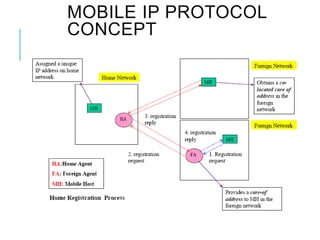
When a Mobile Host (MH) enters a visited area, it requires the
services of a Foreign Agent (FA). The FA provides registration and
packet-forwarding services to the visiting terminals. Each mobile
IP host uses one permanent IP address (home address) and one
temporary address (care-of address) if away from the home
network. Thus, the IP packet exchange consists of three
mechanisms:
Discovering the care-of address.
Registering the care-of address with the home agent.
The home agent redirecting the received datagrams to the
foreign network using care-of address.
Care-of IP addresses are temporary IP addresses are given by the
network outside the home network so devices can stay connected
while on the move. The device gets a new care-of address if the
user moves to another network.
MOBILE IP PROTOCOL
CONCEPT
FUTURE OF MOBILITY
ARCHITECTURE
Architecture of Seamless Enterprise Connectivity
Source: CSC NTIS
IP Backbone/
Internet
Multi-mode terminal
w/MobileIP client
& IPSec Client
Public
WLAN
802.11 Access
Points
Ethernet
WLAN
Gateway
802.11 Access Points
Ethernet
WLAN
Gateway,
Home Server
Enterprise
Corporate LAN
VPN
Firewall
Firewall
CDMA
BS
BS
MSC
Firewall
GSM/UMTS
BS
BSC
BS
Mobile devices can
connect to office networks
anytime from anywhere….
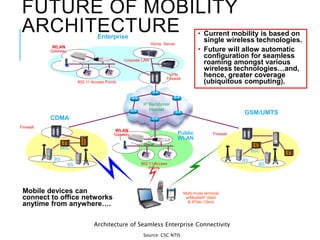
• Current mobility is based on
single wireless technologies.
• Future will allow automatic
configuration for seamless
roaming amongst various
wireless technologies…and,
hence, greater coverage
(ubiquitous computing).
COURSE MATERIALS
CREDITED TO:
Network + Guide to Network (4e) – Tamara Dean, 2009
Business Data Communication and Networking (9e) –
Fitzgerald, Dennis, 2007
CompTIA Network+ Study Guide - Todd Lammle, 2009
D. Johnson and D. Maltz. "Protocols for Adaptive
Wireless and Mobile Networking", IEEE Personal
Communication, 3(1), February 1996
Ayman Abdel Hamid, Computer Science Department,
Virginia Tech. ,2006

Chapter 4v4 Network protocols and standards 2.pptx

  • 1.
    IEEE WIRELESS STANDARDS IEEE 802.15.3 UWB,Bluetooth Wi-Media, BTSIG, MBOA WAN MAN LAN PAN ETSI HiperPAN IEEE 802.11 Wi-Fi Alliance ETSI-BRAN HiperLAN2 IEEE 802.16d WiMAX ETSI HiperMAN & HIPERACCESS IEEE 802.20 IEEE 802.16e 3GPP (GPRS/UMTS) 3GPP2 (1X--/CDMA2000) GSMA, OMA Sensors IEEE 802.15.4 (Zigbee Alliance) RFID (AutoID Center) RAN IEEE 802.22 IEEE 802.21, IEEE 802.18, 802.19
  • 2.
    WIRELESS LAYERED ARCHITECTURE Application Transport Network Data Link Physical Medium DataLink Physical Application Transport Network Data Link Physical Data Link Physical Network Network Radio
  • 3.
    WIRELESS APPLICATION PROTOCOL (WAP) A universal, open standard developed by WAP forum (now Open Mobile Alliance (OMA) ) to provide wireless services for:  wireless phone, pager, personal digital assistants (PDA’s), Internet, web, etc.  It is designed to work with all wireless network technologies  It is based on Internet standards:  IP, XML, HTML and http  WAP specification includes:  WWW Programming Model  Wireless markup language (WML) –to specify the format presentation on screen  Specification of a small browser  A lightweight communications protocol stack  A framework for Wireless Telephony Application (WTA)
  • 4.
    Steps during WAPTransmission
  • 5.
    THE WAP ARCHITECTURE WebServer Content CGI Scripts etc. WML Decks with WML-Script WAP Gateway WML Encoder WMLScript Compiler Protocol Adapters Client WML WML- Script WTAI Etc. HTTP WSP/WTP WTAI- Wireless Telephony Application Interface
  • 6.
    WAP PROTOCOLS  WSP(Wireless Session Protocol)  Provides the application layer of WAP with a consistent interface for two session services and exchange of data between applications.  A connection-oriented service that operates above the transaction layer protocol Wireless Transaction Protocol (WTP).  A connectionless service that operates above a secure or non-secure Wireless Datagram Protocol (WDP).
  • 7.
    WAP PROTOCOLS (CONT.)  WTP(Wireless Transaction Protocol)  Provide efficient request/reply based transport mechanism and transaction support  WTP Push mode allows server to “push” data to a client without request  WTP/WDP uses less than half the packets that TCP/IP uses to transfer the same amount of data
  • 8.
    WAP PROTOCOLS (CONT.)  WTLS(Wireless Transport Layer Security)  A security protocol based upon the industry- standard Transport Layer Security (TLS) protocol, a successor to Secure Sockets Layer (SSL).  WTLS is intended for use with the WAP transport protocols and has been optimized for use over narrow-band communication channels.
  • 9.
    WAP PROTOCOLS (CONT.)  WDP(Wireless Datagram Protocol)  The Transport layer protocol that send and receive messages  Provides a common interface to the Security, Session, and Application layers  Allows these upper layers to function independently of the underlying wireless network. This is the key to global interoperability
  • 10.
    HTML JavaScript HTTP TLS - SSL TCP/IP UDP/IP WirelessApplication Protocol Wireless Application Environment (WAE) Session Layer (WSP) Security Layer (WTLS) Transport Layer (WDP) Other Services and Applications Transaction Layer (WTP) SMS USSD CSD IS-136 CDMA CDPD PDC-P Etc.. Bearers: Comparison between Internet and WAP Models
  • 11.
    Wireless Markup Language(WML)  Card metaphor  User interactions are split into cards  Navigation occurs between cards  Explicit inter-card navigation model  Hyperlinks  UI Event handling  History  State management and variables  Reduce network traffic  Results in better caching
  • 12.
    Input Elements Deck Card Navigation Variables <WML> <CARD> <DO TYPE=“ACCEPT”> <GO URL=“#eCard”/> </DO Welcome! </CARD> <CARDNAME=“eCard”> <DO TYPE=“ACCEPT”> <GO URL=“/submit?N=$(N)&S=$(S)”/> </DO> Enter name: <INPUT KEY=“N”/> Choose speed: <SELECT KEY=“S”> <OPTION VALUE=“0”>Fast</OPTION> <OPTION VALUE=“1”>Slow</OPTION> <SELECT> </CARD> </WML> A WML Example 1
  • 13.
    <WML> <CARD> <DO TYPE="ACCEPT" LABEL="Next"> <GOURL="#card2"/> </DO> Acme Inc.<BR/>Directory </CARD> <CARD NAME="card2"> <DO TYPE="ACCEPT"> <GO URL="?send=$type"/> </DO> Services <SELECT KEY="type"> <OPTION VALUE="em">Email</OPTION> <OPTION VALUE="ph">Phone</OPTION> <OPTION VALUE="fx">Fax</OPTION> </SELECT> </CARD> </WML> Acme Inc. Directory _____________ Next Services 1>Email 2 Phone 3 Fax ____________ OK A WML Example 2 A DECK OF CARDS
  • 14.
    WHY IS HTTP/HTMLNOT ENOUGH? Big pipe - small pipe syndrome Wireless network <HTML> <HEAD> <TITLE>NNN Interactive</TITLE> <META HTTP-EQUIV="Refresh" CONTENT="1800, URL=/index.html"> </HEAD> <BODY BGCOLOR="#FFFFFF" BACKGROUND="/images/9607/bgbar5.gif" LINK="#0A3990" ALINK="#FF0000" VLINK="#FF0000" TEXT="000000" ONLOAD="if(parent.frames.length!=0)top.location='ht tp://nnn.com';"> <A NAME="#top"></A> <TABLE WIDTH=599 BORDER="0"> <TR ALIGN=LEFT> <TD WIDTH=117 VALIGN=TOP ALIGN=LEFT> <HTML> <HEAD> <TITLE >NNN Intera ctive< /TITLE > <META HTTP- EQUIV= "Refre sh" CONTEN T="180 0, URL=/i ndex.h tml"> Internet <WML> <CARD> <DO TYPE="ACCEPT"> <GO URL="/submit?Name=$N"/> </DO> Enter name: <INPUT TYPE="TEXT" KEY="N"/> </CARD> </WML> 010011 010011 110110 010011 011011 011101 010010 011010 Content encoding HTTP/HTML WAP Source: WAP Forum
  • 17.
    IETF MOBILE IPPROTOCOL  Mobile IP was developed as a means for transparently dealing with problems of mobile users  Enables hosts to stay connected to the Internet regardless of their location  Mobile IP (MIP) or IP mobility allows a host to have a unique (location-independent) IP address.  Each host has a home agent (permanent home address) on its home network.  The home agent forward IP packets when mobile host away from home.
  • 18.
     When awayfrom home, mobile host has a care-of-address (CoA)  care-of-address = address of foreign agent within the foreign subnet - the foreign agent delivers forwarded packets to mobile host  care-of-address may also be a temporary IP address on the foreign network MOBILE IP PROTOCOL – CONT.
  • 19.
    WHAT MOBILE IP MEANS? Whena Mobile Host (MH) enters a visited area, it requires the services of a Foreign Agent (FA). The FA provides registration and packet-forwarding services to the visiting terminals. Each mobile IP host uses one permanent IP address (home address) and one temporary address (care-of address) if away from the home network. Thus, the IP packet exchange consists of three mechanisms: Discovering the care-of address. Registering the care-of address with the home agent. The home agent redirecting the received datagrams to the foreign network using care-of address. Care-of IP addresses are temporary IP addresses are given by the network outside the home network so devices can stay connected while on the move. The device gets a new care-of address if the user moves to another network.
  • 20.
  • 21.
    FUTURE OF MOBILITY ARCHITECTURE Architectureof Seamless Enterprise Connectivity Source: CSC NTIS IP Backbone/ Internet Multi-mode terminal w/MobileIP client & IPSec Client Public WLAN 802.11 Access Points Ethernet WLAN Gateway 802.11 Access Points Ethernet WLAN Gateway, Home Server Enterprise Corporate LAN VPN Firewall Firewall CDMA BS BS MSC Firewall GSM/UMTS BS BSC BS Mobile devices can connect to office networks anytime from anywhere…. • Current mobility is based on single wireless technologies. • Future will allow automatic configuration for seamless roaming amongst various wireless technologies…and, hence, greater coverage (ubiquitous computing).
  • 22.
    COURSE MATERIALS CREDITED TO: Network+ Guide to Network (4e) – Tamara Dean, 2009 Business Data Communication and Networking (9e) – Fitzgerald, Dennis, 2007 CompTIA Network+ Study Guide - Todd Lammle, 2009 D. Johnson and D. Maltz. "Protocols for Adaptive Wireless and Mobile Networking", IEEE Personal Communication, 3(1), February 1996 Ayman Abdel Hamid, Computer Science Department, Virginia Tech. ,2006