

Queuing Analysis
Based on noted from Appendix A of
Stallings Operating System text
02/05/16 1
Queuing Model and
Analysis
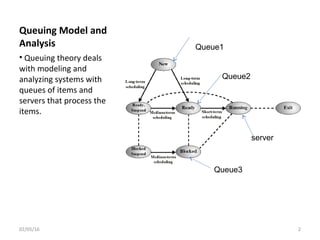
• Queuing theory deals
with modeling and
analyzing systems with
queues of items and
servers that process the
items.
02/05/16 2
Queue1
Queue2
Queue3
server
Goals of Queuing Analysis
• Typically used in analysis of networking system; examples,
– increase in disk access time
– Increase in process load
– Increase in rate of arrival of packets, processes
• Especially useful of analysis of performance when either the
load on a system is expected to increase or a design change is
contemplated.
• While it is a popular method in network analysis, it has gained
popularity within a system esp. with the advent of multi-core
processors.
02/05/16 3
Analysis methods
• After the fact analysis: let the system run
some n number times, collect the “real” data
and analyze – problems?
• Predict some simple trends /projections based
on experience – problems?
• Develop analytical model based on queuing
theory – problems?
• Run simulation (not real systems) and collect
data to analyze –problems?
02/05/16 4
02/05/16 5
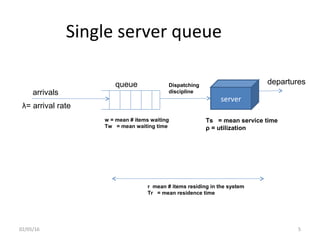
Single server queue
w = mean # items waiting
Tw = mean waiting time
queue
arrivals
λ= arrival rate
server
Dispatching
discipline
departures
Ts = mean service time
ρ = utilization
r mean # items residing in the system
Tr = mean residence time
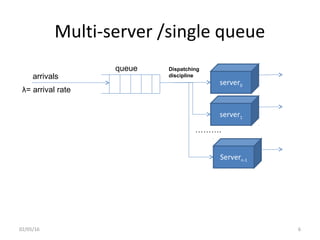
Multi-server /single queue
02/05/16 6
queue
arrivals
λ= arrival rate
Dispatching
discipline
server0
server1
Servern-1
……….
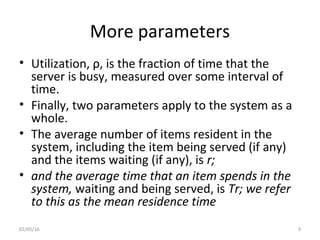
Multi-server /Multiple queues
02/05/16 7
server0
server1
Servern-1
……….
queue
arrivals queue
queue
Parameters
• Items arrive at the facility at some average
rate (items arriving per second) l.
• At any given time, a certain number of items
will be waiting in the queue (zero or more);
• The average number waiting is w, and the
mean time that an item must wait is Tw.
• The server handles incoming items with an
average service time Ts;
02/05/16 8
More parameters
• Utilization, ρ, is the fraction of time that the
server is busy, measured over some interval of
time.
• Finally, two parameters apply to the system as a
whole.
• The average number of items resident in the
system, including the item being served (if any)
and the items waiting (if any), is r;
• and the average time that an item spends in the
system, waiting and being served, is Tr; we refer
to this as the mean residence time
02/05/16 9
Analysis
• As the arrival rate, which is the rate of traffic passing through the
system, increases, the utilization increases and with it, congestion.
The queue becomes longer, increasing waiting time. At ρ = 1, the
server becomes saturated, working 100% of the time.
• Thus, the theoretical maximum input rate that can be handled by
the system is:
λmax = 1/Ts
• However, queues become very large near system saturation,
growing without bound when ρ = 1. Practical considerations, such
as response time requirements or buffer sizes, usually limit the
input rate for a single server to 70-90% of the theoretical
maximum.
• For multi server queue for N servers:
λmax = N/Ts
02/05/16 10
Specific Metrics
• The fundamental task of a queuing analysis is as follows: Given the
following information as input:
· Arrival rate
· Service time
• Provide as output information concerning:
· Items waiting
· Waiting time
· Items in residence
· Residence time.
• We would like to know their average values (w, Tw, r, Tr) and the
respective variability the σ’s
• We are also interested in some probabilities: what is probability
that items waiting in line < M is 0.99?
02/05/16 11
Important Assumptions
• The arrival rate obeys the Poisson distribution, which is equivalent
to saying that the inter-arrival times are exponential;
• On other words, the arrivals occur randomly and independent of
one another.
• A convenient notation has been developed for summarizing the
principal assumptions that are made in developing a queuing
model.
• The notation is X/Y/N, where X refers to the distribution of the
inter-arrival times, Y refers to the distribution of service times, and
N refers to the number of servers.
• M/M/1 refers to a single-server queuing model with Poisson
arrivals and exponential service times.
• M/G/1 and M/M/1 and M/D/1
02/05/16 12
Little’s Law
• Very simple law that works from a Case
Western Reserve University professor Dr.
Little
• Average number of customers in a system =
average arrival rate * average time spent in
the system
• r = Tr * λ
• w = Tw * λ
• Tr = Tw + Ts
02/05/16 13
Examples
• Page 21-22-23
• Database server (can be substituted for any
server).
• Tightly-coupled multi-processor system
• Necessary formulae are in pages: 14, 18 (Table
3 and Table 4)
02/05/16 14

Queuing analysis

  • 1.
    Queuing Analysis Based onnoted from Appendix A of Stallings Operating System text 02/05/16 1
  • 2.
    Queuing Model and Analysis •Queuing theory deals with modeling and analyzing systems with queues of items and servers that process the items. 02/05/16 2 Queue1 Queue2 Queue3 server
  • 3.
    Goals of QueuingAnalysis • Typically used in analysis of networking system; examples, – increase in disk access time – Increase in process load – Increase in rate of arrival of packets, processes • Especially useful of analysis of performance when either the load on a system is expected to increase or a design change is contemplated. • While it is a popular method in network analysis, it has gained popularity within a system esp. with the advent of multi-core processors. 02/05/16 3
  • 4.
    Analysis methods • Afterthe fact analysis: let the system run some n number times, collect the “real” data and analyze – problems? • Predict some simple trends /projections based on experience – problems? • Develop analytical model based on queuing theory – problems? • Run simulation (not real systems) and collect data to analyze –problems? 02/05/16 4
  • 5.
    02/05/16 5 Single serverqueue w = mean # items waiting Tw = mean waiting time queue arrivals λ= arrival rate server Dispatching discipline departures Ts = mean service time ρ = utilization r mean # items residing in the system Tr = mean residence time
  • 6.
    Multi-server /single queue 02/05/166 queue arrivals λ= arrival rate Dispatching discipline server0 server1 Servern-1 ……….
  • 7.
    Multi-server /Multiple queues 02/05/167 server0 server1 Servern-1 ………. queue arrivals queue queue
  • 8.
    Parameters • Items arriveat the facility at some average rate (items arriving per second) l. • At any given time, a certain number of items will be waiting in the queue (zero or more); • The average number waiting is w, and the mean time that an item must wait is Tw. • The server handles incoming items with an average service time Ts; 02/05/16 8
  • 9.
    More parameters • Utilization,ρ, is the fraction of time that the server is busy, measured over some interval of time. • Finally, two parameters apply to the system as a whole. • The average number of items resident in the system, including the item being served (if any) and the items waiting (if any), is r; • and the average time that an item spends in the system, waiting and being served, is Tr; we refer to this as the mean residence time 02/05/16 9
  • 10.
    Analysis • As thearrival rate, which is the rate of traffic passing through the system, increases, the utilization increases and with it, congestion. The queue becomes longer, increasing waiting time. At ρ = 1, the server becomes saturated, working 100% of the time. • Thus, the theoretical maximum input rate that can be handled by the system is: λmax = 1/Ts • However, queues become very large near system saturation, growing without bound when ρ = 1. Practical considerations, such as response time requirements or buffer sizes, usually limit the input rate for a single server to 70-90% of the theoretical maximum. • For multi server queue for N servers: λmax = N/Ts 02/05/16 10
  • 11.
    Specific Metrics • Thefundamental task of a queuing analysis is as follows: Given the following information as input: · Arrival rate · Service time • Provide as output information concerning: · Items waiting · Waiting time · Items in residence · Residence time. • We would like to know their average values (w, Tw, r, Tr) and the respective variability the σ’s • We are also interested in some probabilities: what is probability that items waiting in line < M is 0.99? 02/05/16 11
  • 12.
    Important Assumptions • Thearrival rate obeys the Poisson distribution, which is equivalent to saying that the inter-arrival times are exponential; • On other words, the arrivals occur randomly and independent of one another. • A convenient notation has been developed for summarizing the principal assumptions that are made in developing a queuing model. • The notation is X/Y/N, where X refers to the distribution of the inter-arrival times, Y refers to the distribution of service times, and N refers to the number of servers. • M/M/1 refers to a single-server queuing model with Poisson arrivals and exponential service times. • M/G/1 and M/M/1 and M/D/1 02/05/16 12
  • 13.
    Little’s Law • Verysimple law that works from a Case Western Reserve University professor Dr. Little • Average number of customers in a system = average arrival rate * average time spent in the system • r = Tr * λ • w = Tw * λ • Tr = Tw + Ts 02/05/16 13
  • 14.
    Examples • Page 21-22-23 •Database server (can be substituted for any server). • Tightly-coupled multi-processor system • Necessary formulae are in pages: 14, 18 (Table 3 and Table 4) 02/05/16 14