Wireless Application 
Protocol – WAP 
BY 
• D.S.ANUCIA DEVI 
• B.TECT( CSE )
 INTRODUCTION 
 MOBILE APPLICATION 
 WHAT IS WAP? 
 WTA FEATURES 
WHAT IS WSP? 
 IMPORTANCE OF WAP 
 BENEFITS OF WAP 
 REFERENCE AND RESOURCES 
 CONCLUSION
• WAP is a hot topic that has been widely hyped 
in the mobile industry and outside of it. 
• It has become imperative for all Information 
Technology companies in Nordic countries 
and beyond to have a WAP division. 
• Many advertising agencies and "dotcoms" 
have announced WAP services.
 Vehicles 
◦ transmission of news, road condition etc 
◦ ad-hoc network with near vehicles to prevent 
accidents 
 Emergencies 
◦ early transmission of patient data to the hospital 
◦ ad-hoc network in case of earthquakes, cyclones 
◦ military ... 
 Traveling salesmen 
◦ direct access to central customer files 
◦ consistent databases for all agents 
◦ mobile office
 Empowers mobile users with wireless devices to easily 
access and interact with information and services. 
 A “standard” created by wireless and Internet companies 
to enable Internet access from a cellular phone 
 wapforum.org: 
◦ co-founded by Ericsson, Motorola, Nokia, Phone.com 
◦ 450 members in 2000, comprise of Handset manufacturers, 
Wireless service providers, ISPs, Software companies in the 
wireless industry 
◦ Goals 
 deliver Internet services to mobile devices 
 enable applications to scale across a variety of transport 
options and device types 
 independence from wireless network standards 
 GSM, CDMA IS-95, TDMA IS-136, 3G systems (UMTS, W-CDMA)
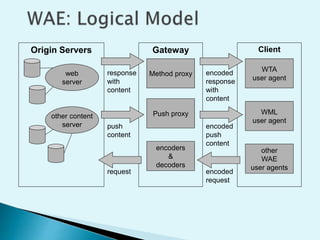
Origin Servers 
web 
server 
other content 
server 
Gateway Client 
WTA 
user agent 
WML 
user agent 
other 
WAE 
user agents 
Push proxy 
encoded 
request 
request 
encoded 
response 
with 
content 
response 
with 
content 
push 
content 
encoded 
push 
content 
Method proxy 
encoders 
& 
decoders
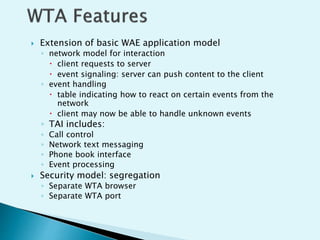
 Extension of basic WAE application model 
◦ network model for interaction 
 client requests to server 
 event signaling: server can push content to the client 
◦ event handling 
 table indicating how to react on certain events from the 
network 
 client may now be able to handle unknown events 
◦ TAI includes: 
◦ Call control 
◦ Network text messaging 
◦ Phone book interface 
◦ Event processing 
 Security model: segregation 
◦ Separate WTA browser 
◦ Separate WTA port
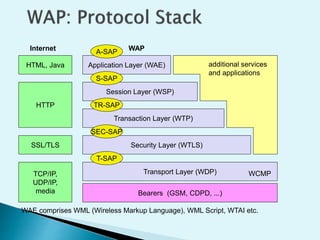
Internet WAP 
A-SAP 
Application Layer (WAE) 
S-SAP 
Session Layer (WSP) 
TR-SAP 
Transaction Layer (WTP) 
Security Layer (WTLS) 
HTML, Java 
HTTP 
additional services 
and applications 
SEC-SAP 
T-SAP 
TCP/IP, Transport Layer (WDP) 
UDP/IP, 
media 
Bearers (GSM, CDPD, ...) 
SSL/TLS 
WCMP 
WAE comprises WML (Wireless Markup Language), WML Script, WTAI etc.
 Goals 
◦ HTTP 1.1 functionality 
 Request/reply, content type negotiation, ... 
◦ support of client/server transactions, push technology 
◦ key management, authentication, Internet security services 
 WSP Services 
◦ provides shared state between client and server, optimizes 
content transfer 
◦ session management (establish, release, suspend, resume) 
◦ efficient capability negotiation 
◦ content encoding 
◦ push 
 WSP/B (Browsing) 
◦ HTTP/1.1 functionality - but binary encoded 
◦ exchange of session headers 
◦ push and pull data transfer 
◦ asynchronous requests
 It provides a standardized way of linking the 
Internet to mobile phones, thereby linking 
two of the hottest industries anywhere. 
 Its founder members include the major 
wireless vendors of Nokia, Ericsson and 
Motorola, plus a newcomer Phone.com.
• END USER: 
• Mobile phones have become dominant tools in 
communications and at the same time the internet has become a 
de facto platform for information. 
• By adopting a common protocol the end user will be provided 
with more value added services which are easy to access and 
easy to use directly from mobile phone Telephony oriented 
services will be made easier to understand and to use. 
• OPERATORS: 
• The operators can differentiate by launching special services, for 
example for banking stock trading, directory services etc. 
• A further differentiation is that the protocol makes it possible to 
tailor-make specific menus with in the mobile phones, 
facilitating the use of the services. This customization can be 
made over the air.
 Books 
◦ Mobile communications: Jochen Schiller, Addison Wesley 2000 
◦ Understanding WAP: 
 Official Website (specifications) 
◦ www.wapforum.org 
 Technical/Developer Info and tools 
◦ www.palopt.com.au/wap 
◦ www.wap.net 
 Major players 
◦ www.nokia.com/wap 
◦ www.ericsson.se/wap 
◦ phone.com 
 Open Source effort 
◦ www.wapgateway.org (Kennel WAP gateway project)
• The WAP technology has a structured architecture designed and 
is based on the standards of the original WWW model. 
• Since the technology has been developed by the WAP Forum, it 
has become a technology with an architecture that is scalable, 
interoperable, efficient, reliable and secure. 
• In the future we will see the technology a part of the day today 
life and the users of the wireless terminals will be able to read 
news, buy consort tickets and get access to intra and extranet. 
However the WAP technology in the near future will meet the 
user requirements that it will have difficulties to deliver. 
• The need for sending pictures and video is increasing day by day 
and hence WAP technology may be overtaken by some other 
technologies which have the aforementioned capabilities such as 
GPRS or UMTS.
-BY 
D.S.ANUCIA DEVI

Wireless application protocol wap

  • 1.
    Wireless Application Protocol– WAP BY • D.S.ANUCIA DEVI • B.TECT( CSE )
  • 2.
     INTRODUCTION MOBILE APPLICATION  WHAT IS WAP?  WTA FEATURES WHAT IS WSP?  IMPORTANCE OF WAP  BENEFITS OF WAP  REFERENCE AND RESOURCES  CONCLUSION
  • 3.
    • WAP isa hot topic that has been widely hyped in the mobile industry and outside of it. • It has become imperative for all Information Technology companies in Nordic countries and beyond to have a WAP division. • Many advertising agencies and "dotcoms" have announced WAP services.
  • 4.
     Vehicles ◦transmission of news, road condition etc ◦ ad-hoc network with near vehicles to prevent accidents  Emergencies ◦ early transmission of patient data to the hospital ◦ ad-hoc network in case of earthquakes, cyclones ◦ military ...  Traveling salesmen ◦ direct access to central customer files ◦ consistent databases for all agents ◦ mobile office
  • 5.
     Empowers mobileusers with wireless devices to easily access and interact with information and services.  A “standard” created by wireless and Internet companies to enable Internet access from a cellular phone  wapforum.org: ◦ co-founded by Ericsson, Motorola, Nokia, Phone.com ◦ 450 members in 2000, comprise of Handset manufacturers, Wireless service providers, ISPs, Software companies in the wireless industry ◦ Goals  deliver Internet services to mobile devices  enable applications to scale across a variety of transport options and device types  independence from wireless network standards  GSM, CDMA IS-95, TDMA IS-136, 3G systems (UMTS, W-CDMA)
  • 6.
    Origin Servers web server other content server Gateway Client WTA user agent WML user agent other WAE user agents Push proxy encoded request request encoded response with content response with content push content encoded push content Method proxy encoders & decoders
  • 7.
     Extension ofbasic WAE application model ◦ network model for interaction  client requests to server  event signaling: server can push content to the client ◦ event handling  table indicating how to react on certain events from the network  client may now be able to handle unknown events ◦ TAI includes: ◦ Call control ◦ Network text messaging ◦ Phone book interface ◦ Event processing  Security model: segregation ◦ Separate WTA browser ◦ Separate WTA port
  • 8.
    Internet WAP A-SAP Application Layer (WAE) S-SAP Session Layer (WSP) TR-SAP Transaction Layer (WTP) Security Layer (WTLS) HTML, Java HTTP additional services and applications SEC-SAP T-SAP TCP/IP, Transport Layer (WDP) UDP/IP, media Bearers (GSM, CDPD, ...) SSL/TLS WCMP WAE comprises WML (Wireless Markup Language), WML Script, WTAI etc.
  • 9.
     Goals ◦HTTP 1.1 functionality  Request/reply, content type negotiation, ... ◦ support of client/server transactions, push technology ◦ key management, authentication, Internet security services  WSP Services ◦ provides shared state between client and server, optimizes content transfer ◦ session management (establish, release, suspend, resume) ◦ efficient capability negotiation ◦ content encoding ◦ push  WSP/B (Browsing) ◦ HTTP/1.1 functionality - but binary encoded ◦ exchange of session headers ◦ push and pull data transfer ◦ asynchronous requests
  • 10.
     It providesa standardized way of linking the Internet to mobile phones, thereby linking two of the hottest industries anywhere.  Its founder members include the major wireless vendors of Nokia, Ericsson and Motorola, plus a newcomer Phone.com.
  • 11.
    • END USER: • Mobile phones have become dominant tools in communications and at the same time the internet has become a de facto platform for information. • By adopting a common protocol the end user will be provided with more value added services which are easy to access and easy to use directly from mobile phone Telephony oriented services will be made easier to understand and to use. • OPERATORS: • The operators can differentiate by launching special services, for example for banking stock trading, directory services etc. • A further differentiation is that the protocol makes it possible to tailor-make specific menus with in the mobile phones, facilitating the use of the services. This customization can be made over the air.
  • 12.
     Books ◦Mobile communications: Jochen Schiller, Addison Wesley 2000 ◦ Understanding WAP:  Official Website (specifications) ◦ www.wapforum.org  Technical/Developer Info and tools ◦ www.palopt.com.au/wap ◦ www.wap.net  Major players ◦ www.nokia.com/wap ◦ www.ericsson.se/wap ◦ phone.com  Open Source effort ◦ www.wapgateway.org (Kennel WAP gateway project)
  • 13.
    • The WAPtechnology has a structured architecture designed and is based on the standards of the original WWW model. • Since the technology has been developed by the WAP Forum, it has become a technology with an architecture that is scalable, interoperable, efficient, reliable and secure. • In the future we will see the technology a part of the day today life and the users of the wireless terminals will be able to read news, buy consort tickets and get access to intra and extranet. However the WAP technology in the near future will meet the user requirements that it will have difficulties to deliver. • The need for sending pictures and video is increasing day by day and hence WAP technology may be overtaken by some other technologies which have the aforementioned capabilities such as GPRS or UMTS.
  • 14.