Implementation Techniques Software Architecture Lecture 16
Objectives Concepts Implementation as a mapping problem Architecture implementation frameworks Evaluating frameworks Relationships between middleware, frameworks, component models Building new frameworks Concurrency and generative technologies Ensuring architecture-to-implementation consistency Examples Different frameworks for pipe-and-filter Different frameworks for the C2 style Application Implementing Lunar Lander in different frameworks
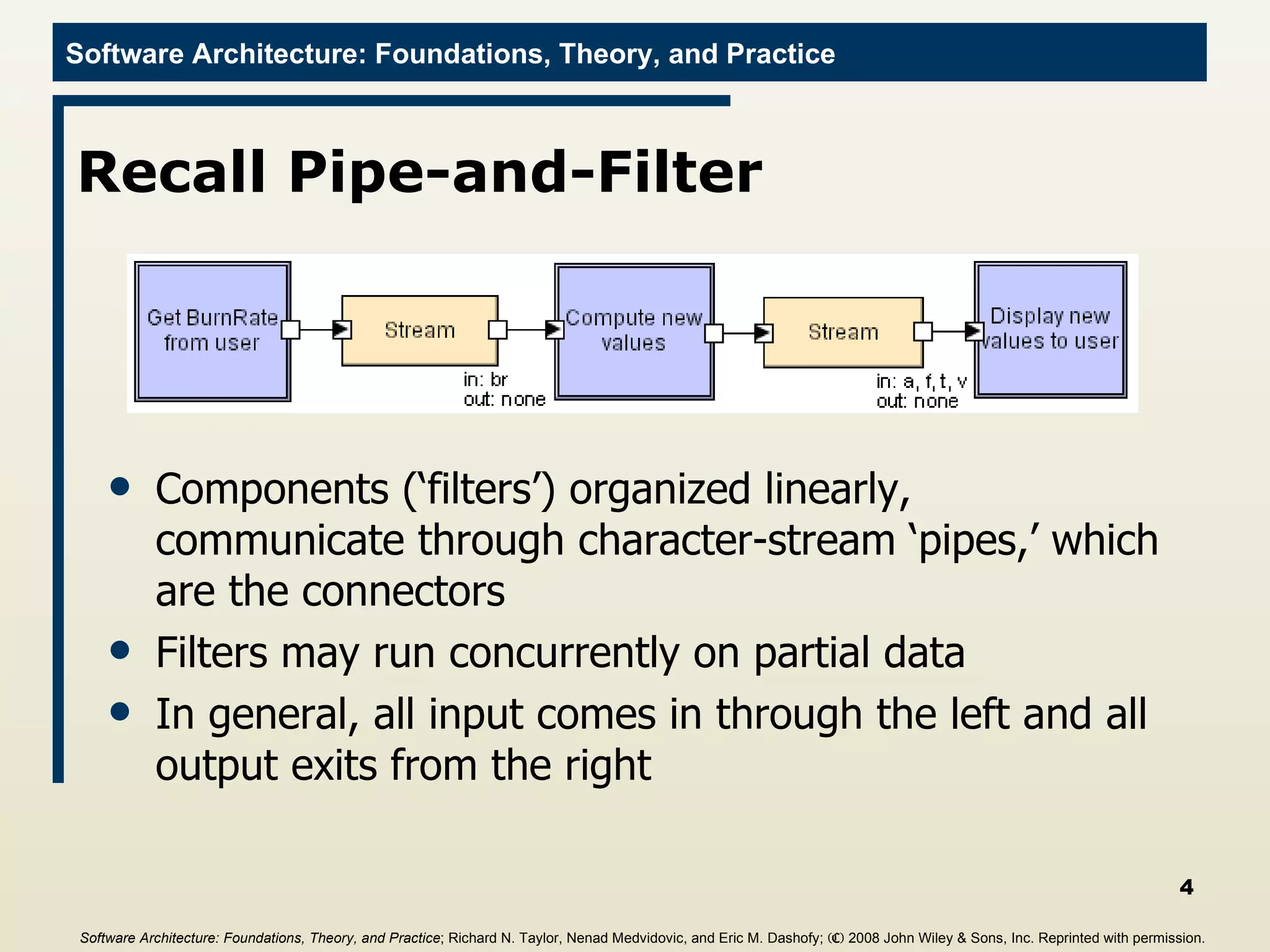
Recall Pipe-and-Filter Components (‘filters’) organized linearly, communicate through character-stream ‘pipes,’ which are the connectors Filters may run concurrently on partial data In general, all input comes in through the left and all output exits from the right Software Architecture: Foundations, Theory, and Practice ; Richard N. Taylor, Nenad Medvidovic, and Eric M. Dashofy;  (C)  2008 John Wiley & Sons, Inc. Reprinted with permission.
Framework #1: stdio Standard I/O framework used in C programming language Each process is a filter Reads input from standard input (aka ‘stdin’) Writes output to standard output (aka ‘stdout’) Also a third, unbuffered output stream called standard error (‘stderr’) not considered here Low and high level operations getchar (…),  putchar (…) move one character at a time printf (…) and  scanf (…) move and format entire strings Different implementations may vary in details (buffering strategy, etc.)
Evaluating stdio Platform support Available with most, if not all, implementations of C programming language Operates somewhat differently on OSes with no concurrency (e.g., MS-DOS) Fidelity Good support for developing P&F applications, but no restriction that apps have to use this style Matching assumptions Filters are processes and pipes are implicit. In-process P&F applications might require modifications Efficiency Whether filters make maximal use of concurrency is partially up to filter implementations and partially up to the OS
Framework #2: java.io Standard I/O framework used in Java language Object-oriented Can be used for in-process or inter-process P&F applications All stream classes derive from InputStream or OutputStream Distinguished objects (System.in and System.out) for writing to process’ standard streams Additional capabilities (formatting, buffering) provided by creating composite streams (e.g., a Formatting-Buffered-InputStream)
Evaluating java.io Platform support Available with all Java implementations on many platforms Platform-specific differences abstracted away Fidelity Good support for developing P&F applications, but no restriction that apps have to use this style Matching assumptions Easy to construct intra- and inter-process P&F applications Concurrency can be an issue; many calls are blocking Efficiency Users have fine-grained control over, e.g., buffering Very high efficiency mechanisms (memory mapped I/O, channels) not available (but are in java.nio)
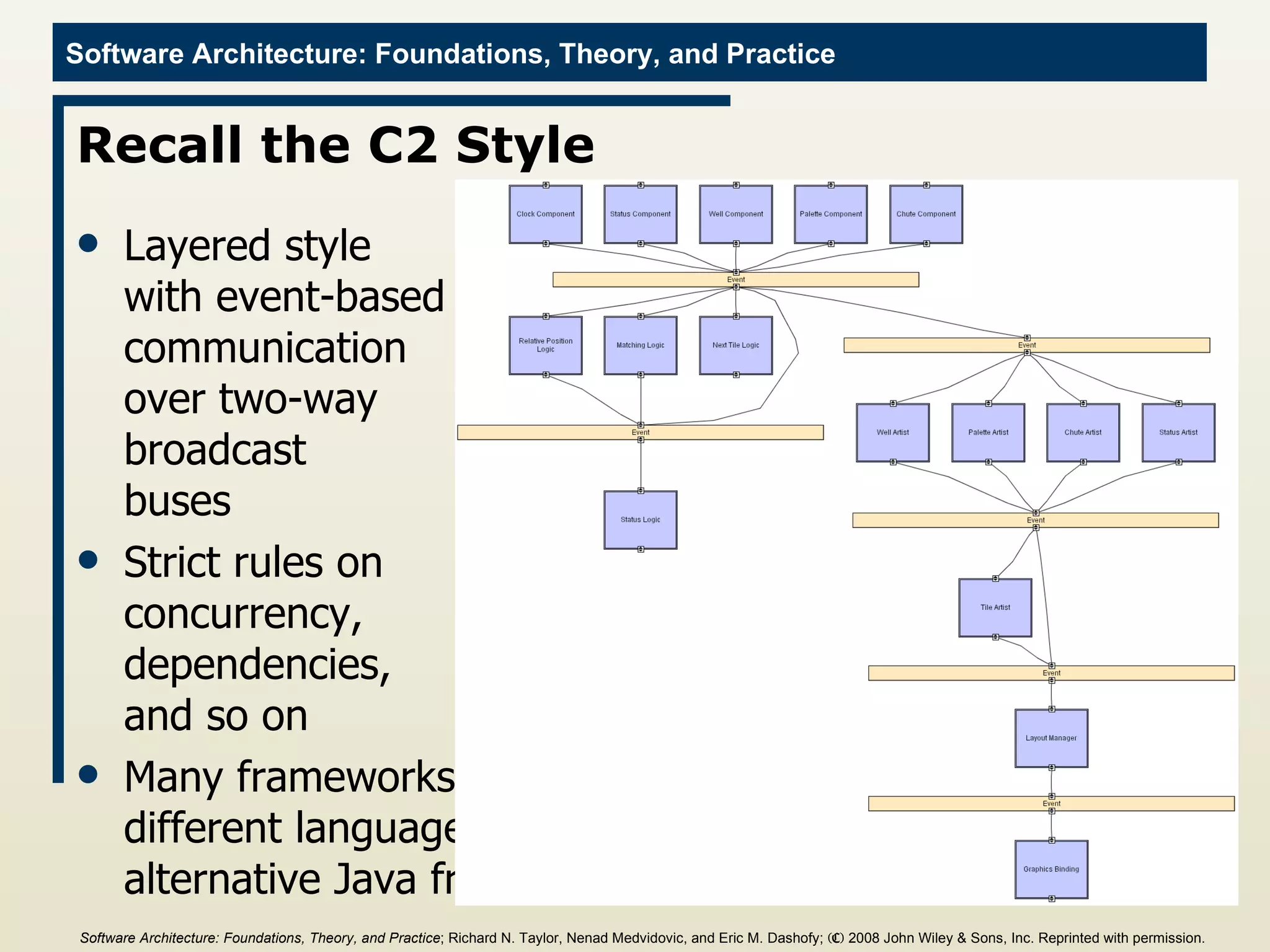
Recall the C2 Style Layered style with event-based communication over two-way broadcast buses Strict rules on  concurrency, dependencies,  and so on Many frameworks developed for  different languages; focus on two alternative Java frameworks here Software Architecture: Foundations, Theory, and Practice ; Richard N. Taylor, Nenad Medvidovic, and Eric M. Dashofy;  (C)  2008 John Wiley & Sons, Inc. Reprinted with permission.
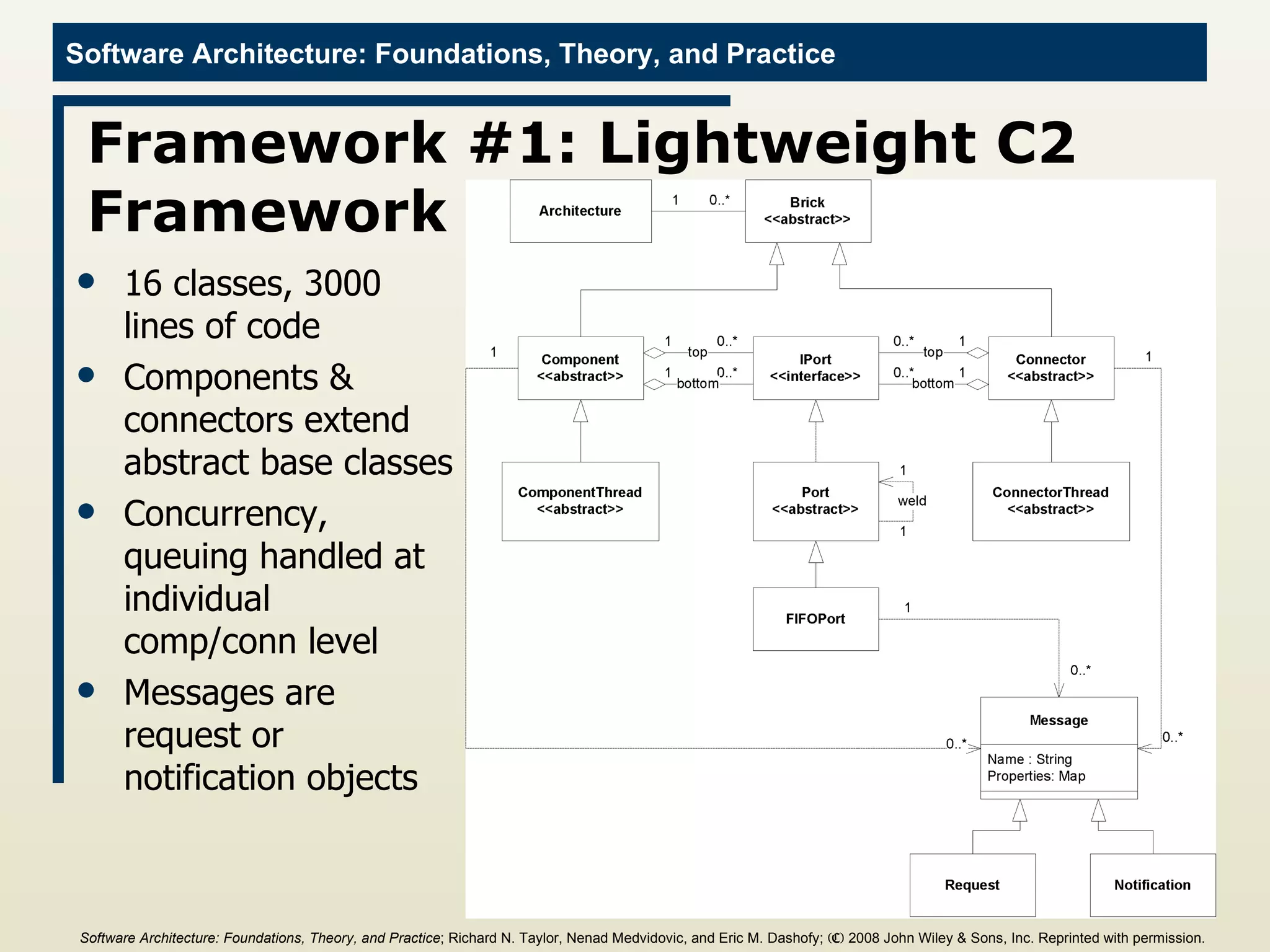
Framework #1: Lightweight C2 Framework 16 classes, 3000  lines of code Components & connectors extend abstract base classes Concurrency, queuing handled at individual comp/conn level Messages are request or notification objects Software Architecture: Foundations, Theory, and Practice ; Richard N. Taylor, Nenad Medvidovic, and Eric M. Dashofy;  (C)  2008 John Wiley & Sons, Inc. Reprinted with permission.
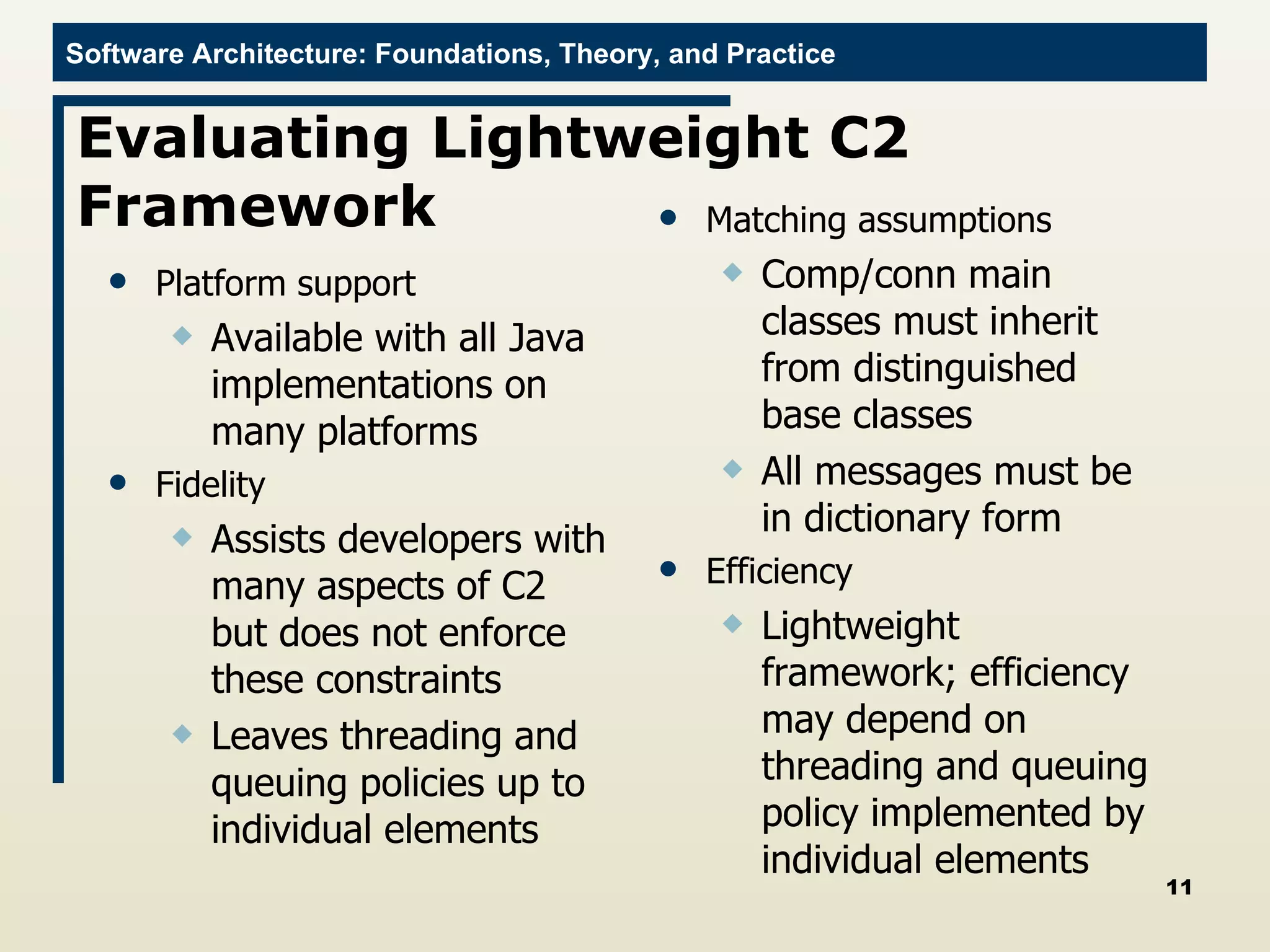
Evaluating Lightweight C2 Framework Platform support Available with all Java implementations on many platforms Fidelity Assists developers with many aspects of C2 but does not enforce these constraints Leaves threading and queuing policies up to individual elements Matching assumptions Comp/conn main classes must inherit from distinguished base classes All messages must be in dictionary form Efficiency Lightweight framework; efficiency may depend on threading and queuing policy implemented by individual elements
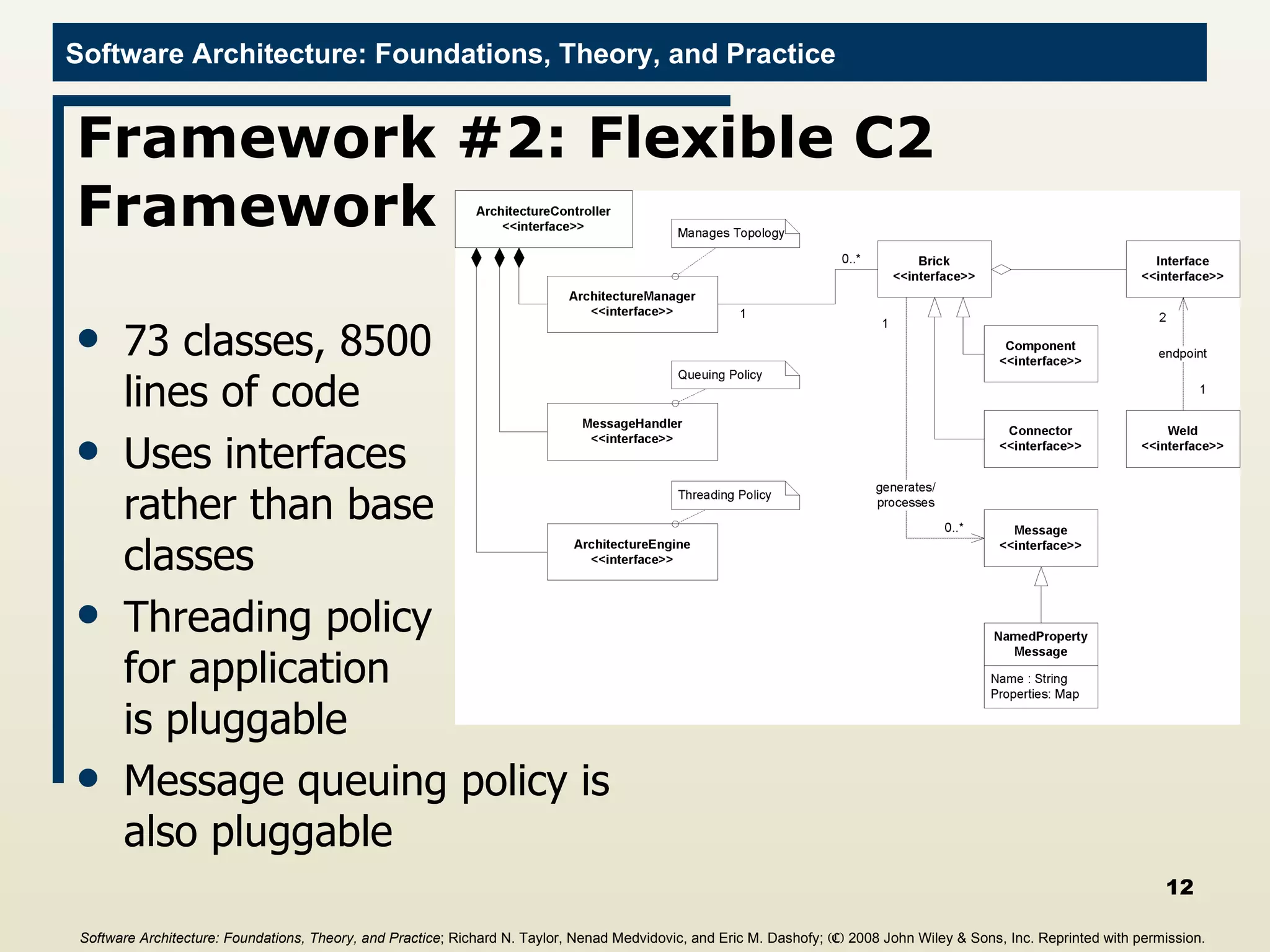
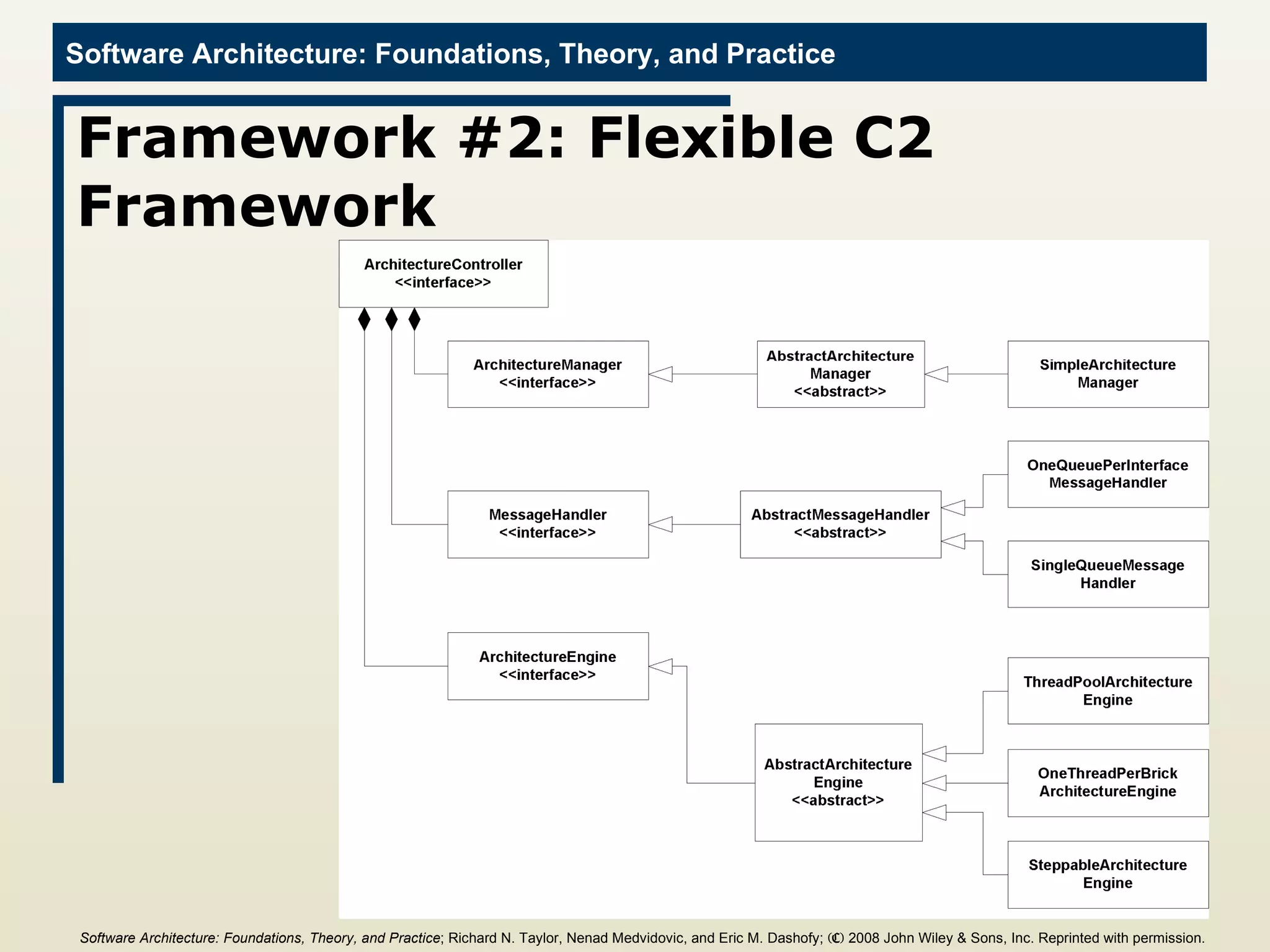
Framework #2: Flexible C2 Framework 73 classes, 8500 lines of code Uses interfaces rather than base classes Threading policy for application is pluggable Message queuing policy is also pluggable Software Architecture: Foundations, Theory, and Practice ; Richard N. Taylor, Nenad Medvidovic, and Eric M. Dashofy;  (C)  2008 John Wiley & Sons, Inc. Reprinted with permission.
Framework #2: Flexible C2 Framework Software Architecture: Foundations, Theory, and Practice ; Richard N. Taylor, Nenad Medvidovic, and Eric M. Dashofy;  (C)  2008 John Wiley & Sons, Inc. Reprinted with permission.
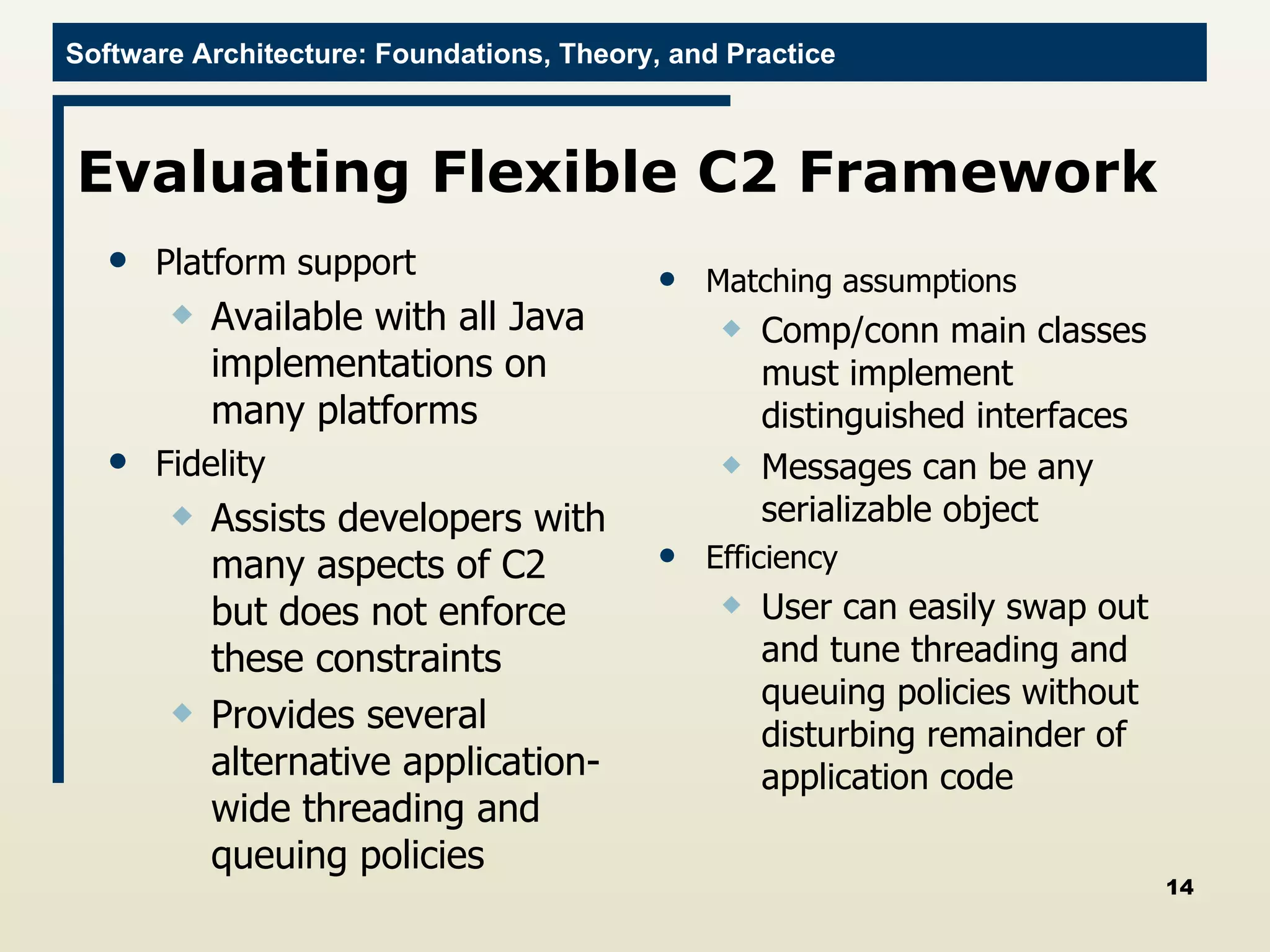
Evaluating Flexible C2 Framework Platform support Available with all Java implementations on many platforms Fidelity Assists developers with many aspects of C2 but does not enforce these constraints Provides several alternative application-wide threading and queuing policies Matching assumptions Comp/conn main classes must implement distinguished interfaces Messages can be any serializable object Efficiency User can easily swap out and tune threading and queuing policies without disturbing remainder of application code
Objectives Concepts Implementation as a mapping problem Architecture implementation frameworks Evaluating frameworks Relationships between middleware, frameworks, component models Building new frameworks Concurrency and generative technologies Ensuring architecture-to-implementation consistency Examples Different frameworks for pipe-and-filter Different frameworks for the C2 style Application Implementing Lunar Lander in different frameworks
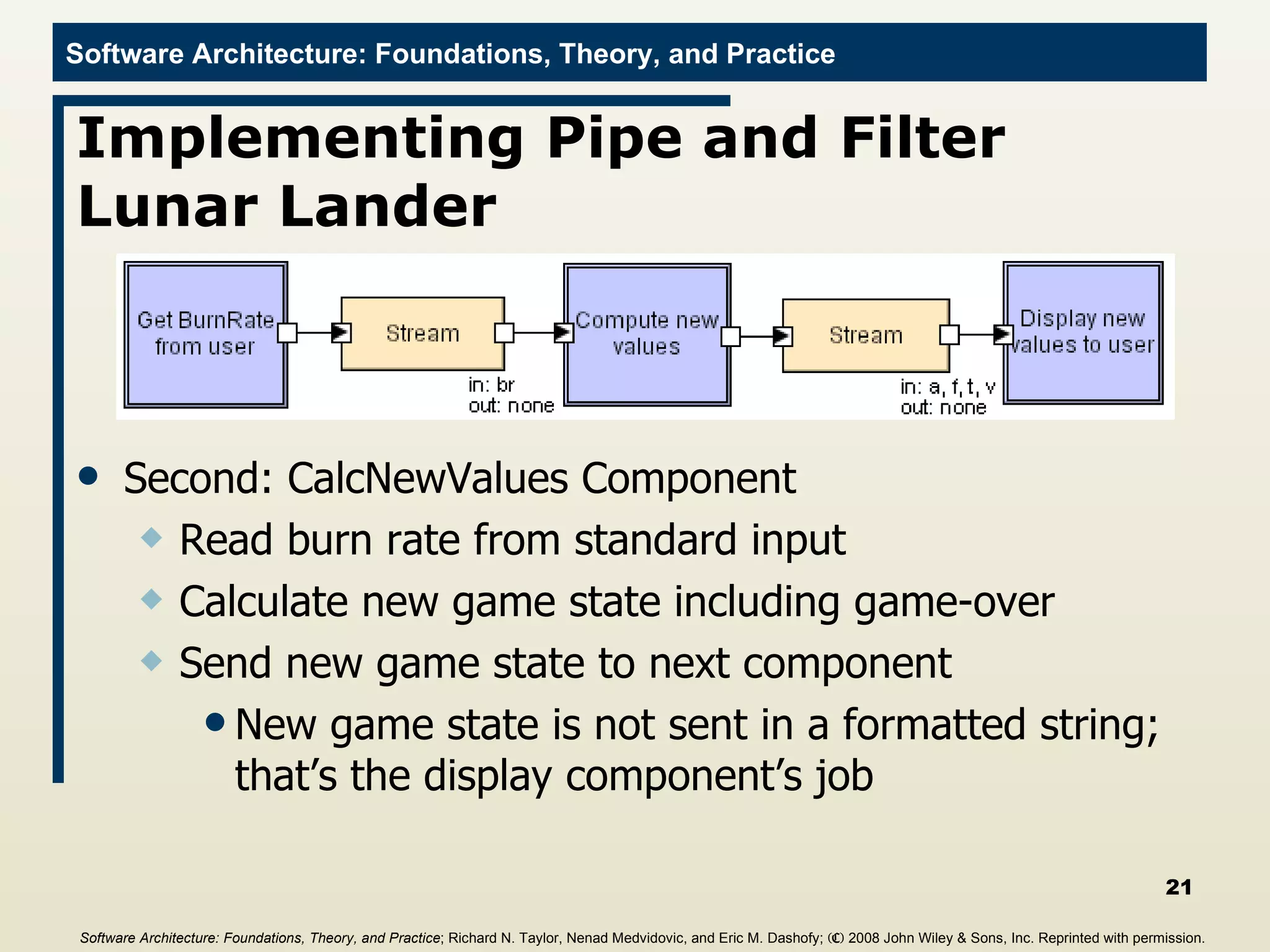
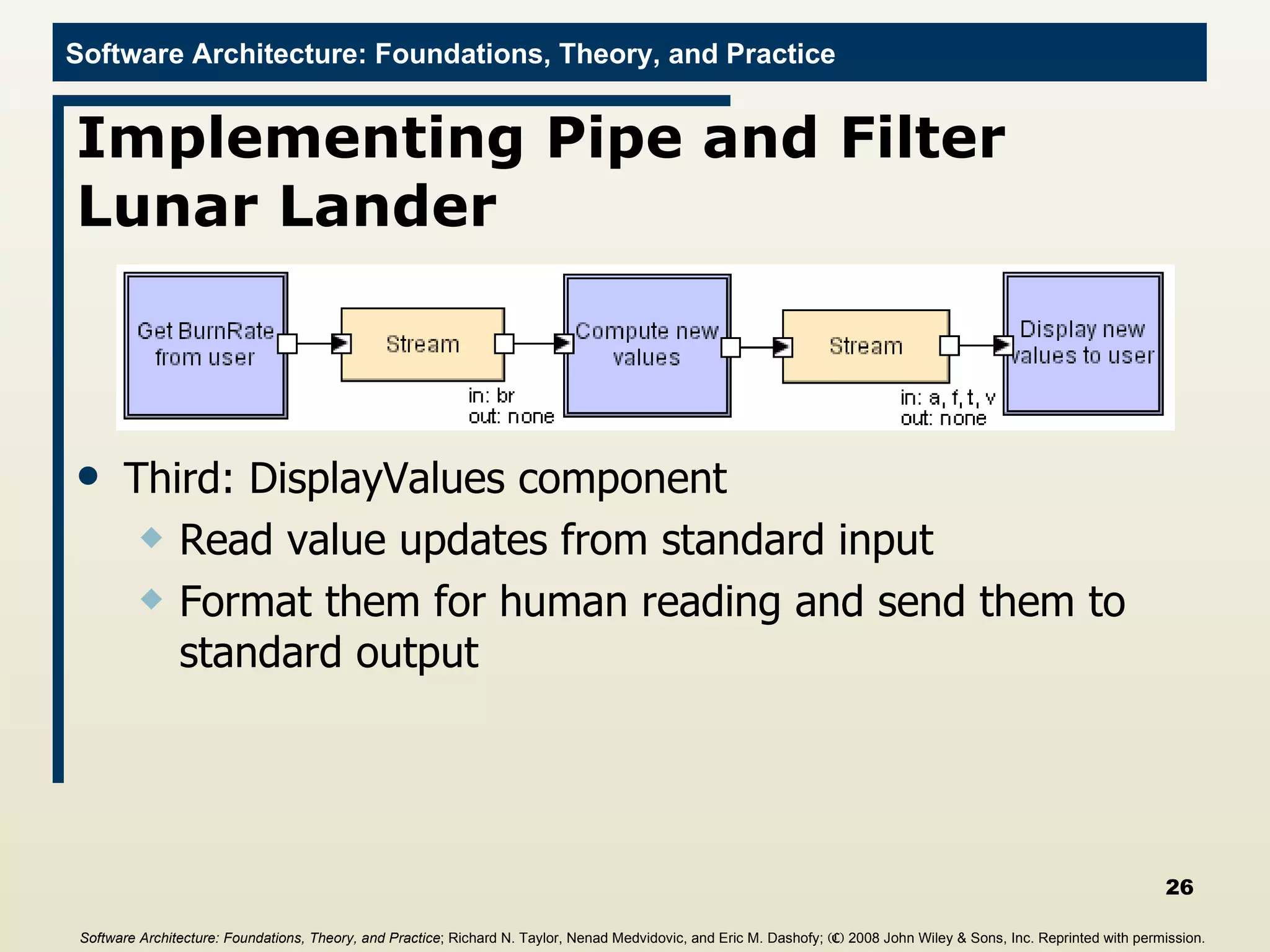
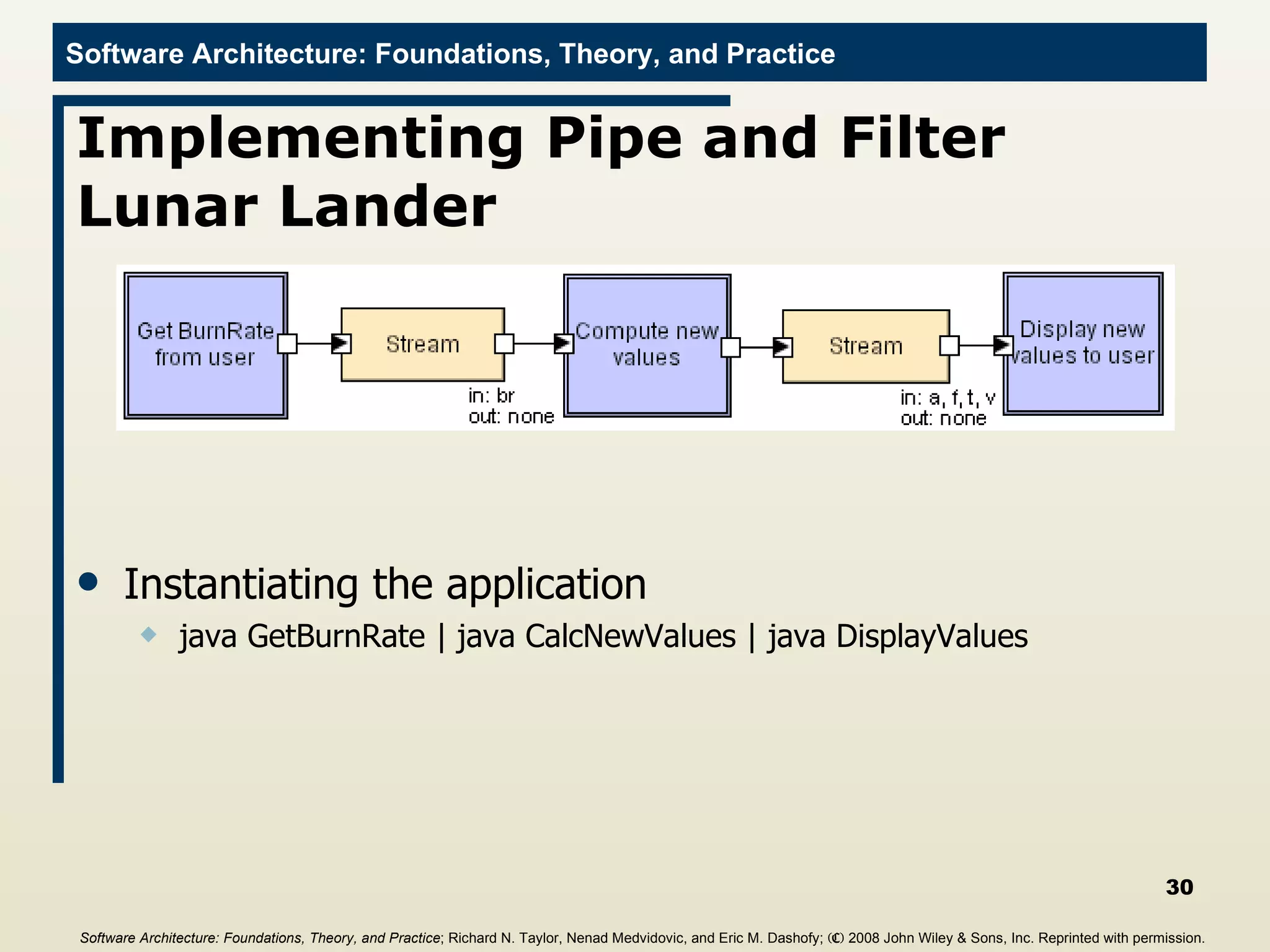
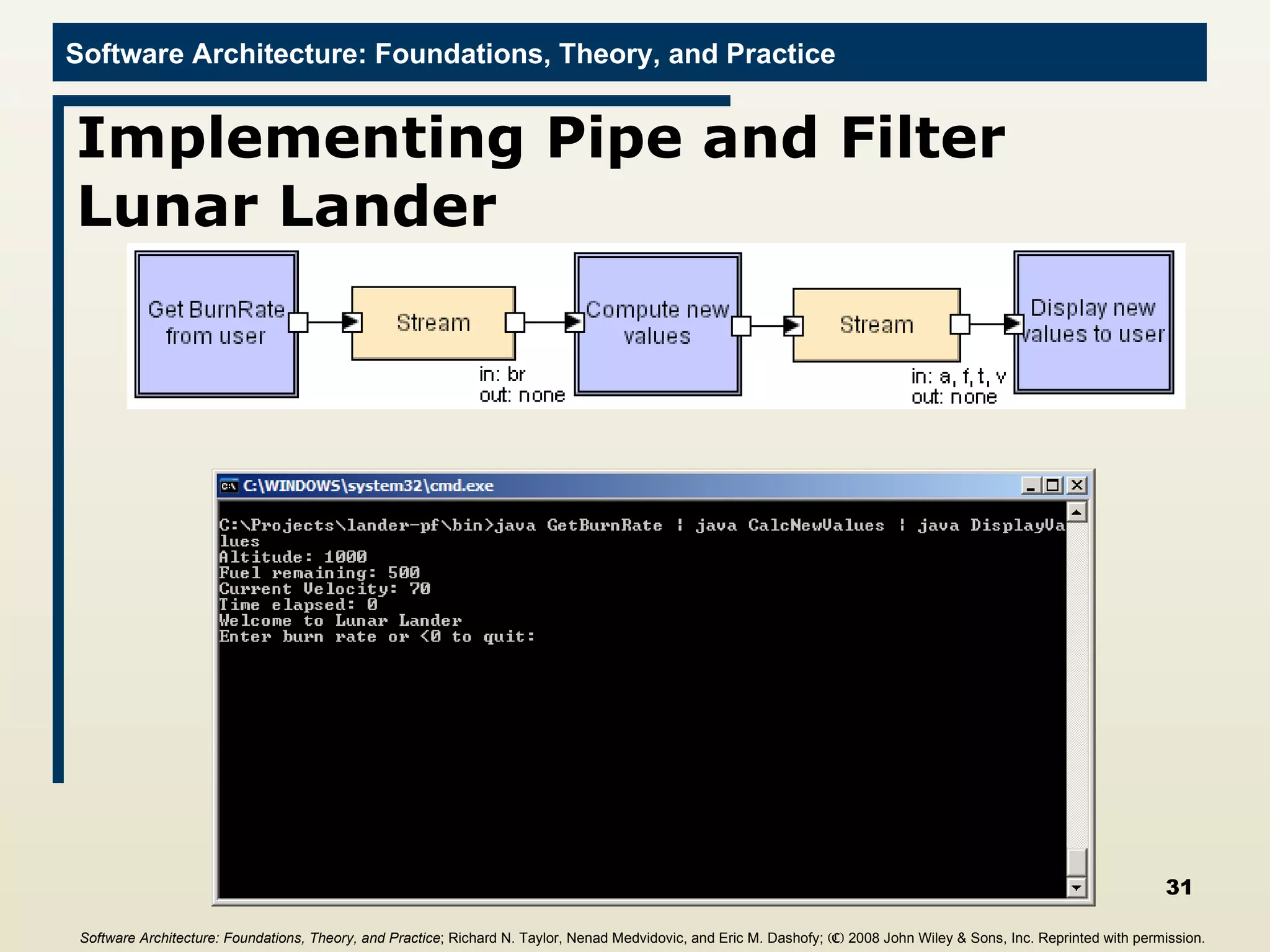
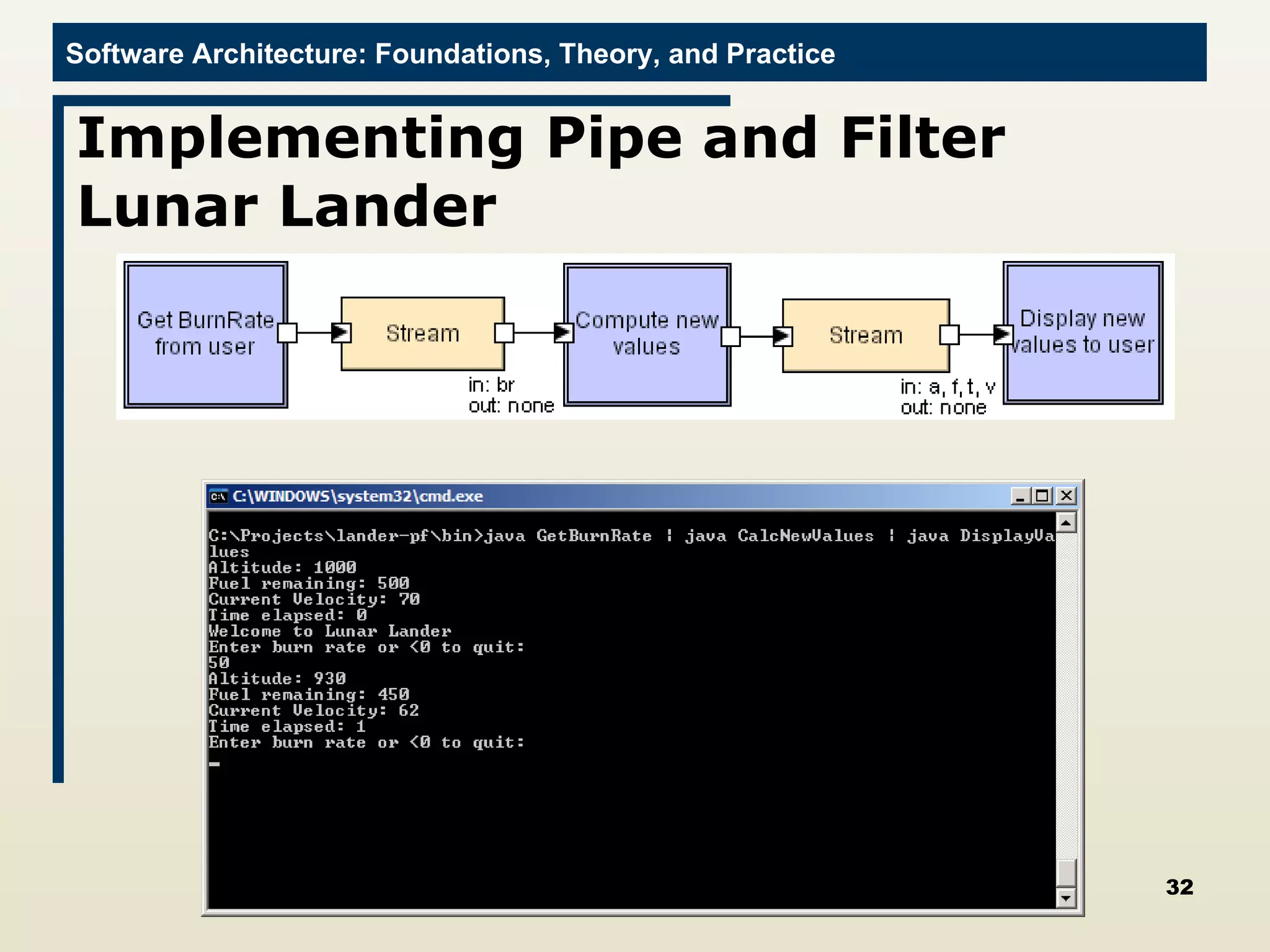
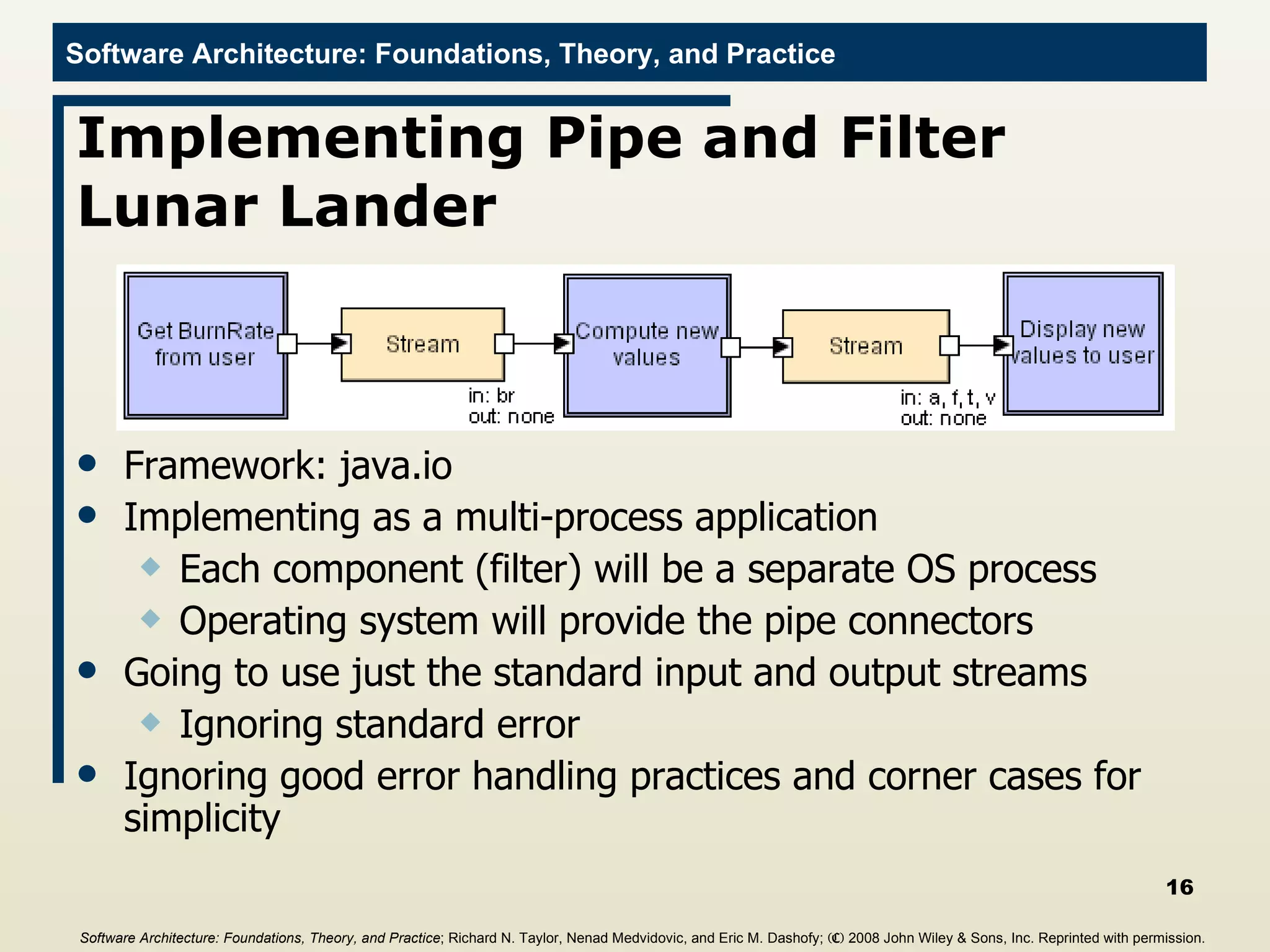
Implementing Pipe and Filter Lunar Lander Framework: java.io Implementing as a multi-process application Each component (filter) will be a separate OS process Operating system will provide the pipe connectors Going to use just the standard input and output streams Ignoring standard error Ignoring good error handling practices and corner cases for simplicity Software Architecture: Foundations, Theory, and Practice ; Richard N. Taylor, Nenad Medvidovic, and Eric M. Dashofy;  (C)  2008 John Wiley & Sons, Inc. Reprinted with permission.
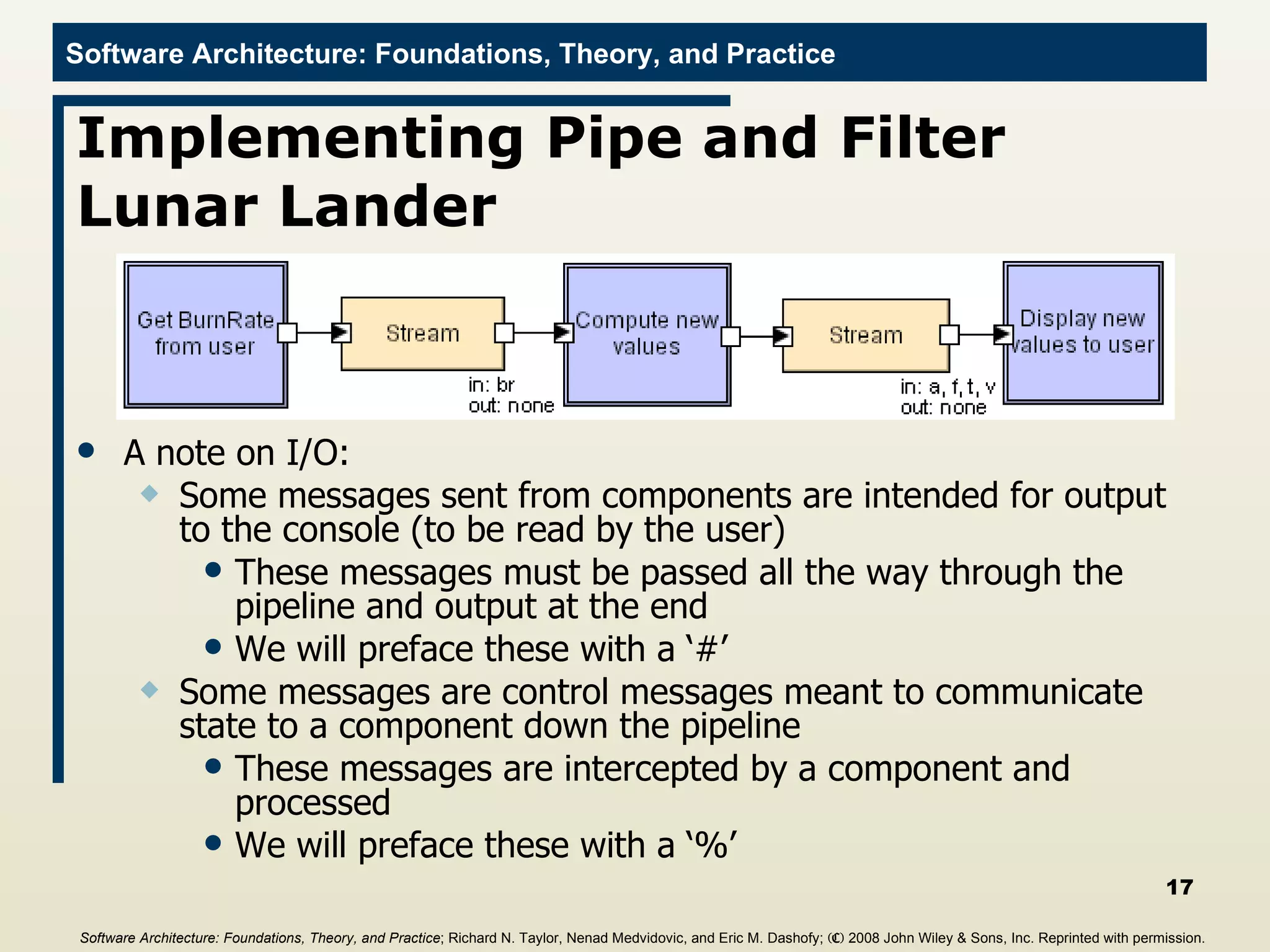
Implementing Pipe and Filter Lunar Lander A note on I/O: Some messages sent from components are intended for output to the console (to be read by the user) These messages must be passed all the way through the pipeline and output at the end We will preface these with a ‘#’ Some messages are control messages meant to communicate state to a component down the pipeline These messages are intercepted by a component and processed We will preface these with a ‘%’ Software Architecture: Foundations, Theory, and Practice ; Richard N. Taylor, Nenad Medvidovic, and Eric M. Dashofy;  (C)  2008 John Wiley & Sons, Inc. Reprinted with permission.
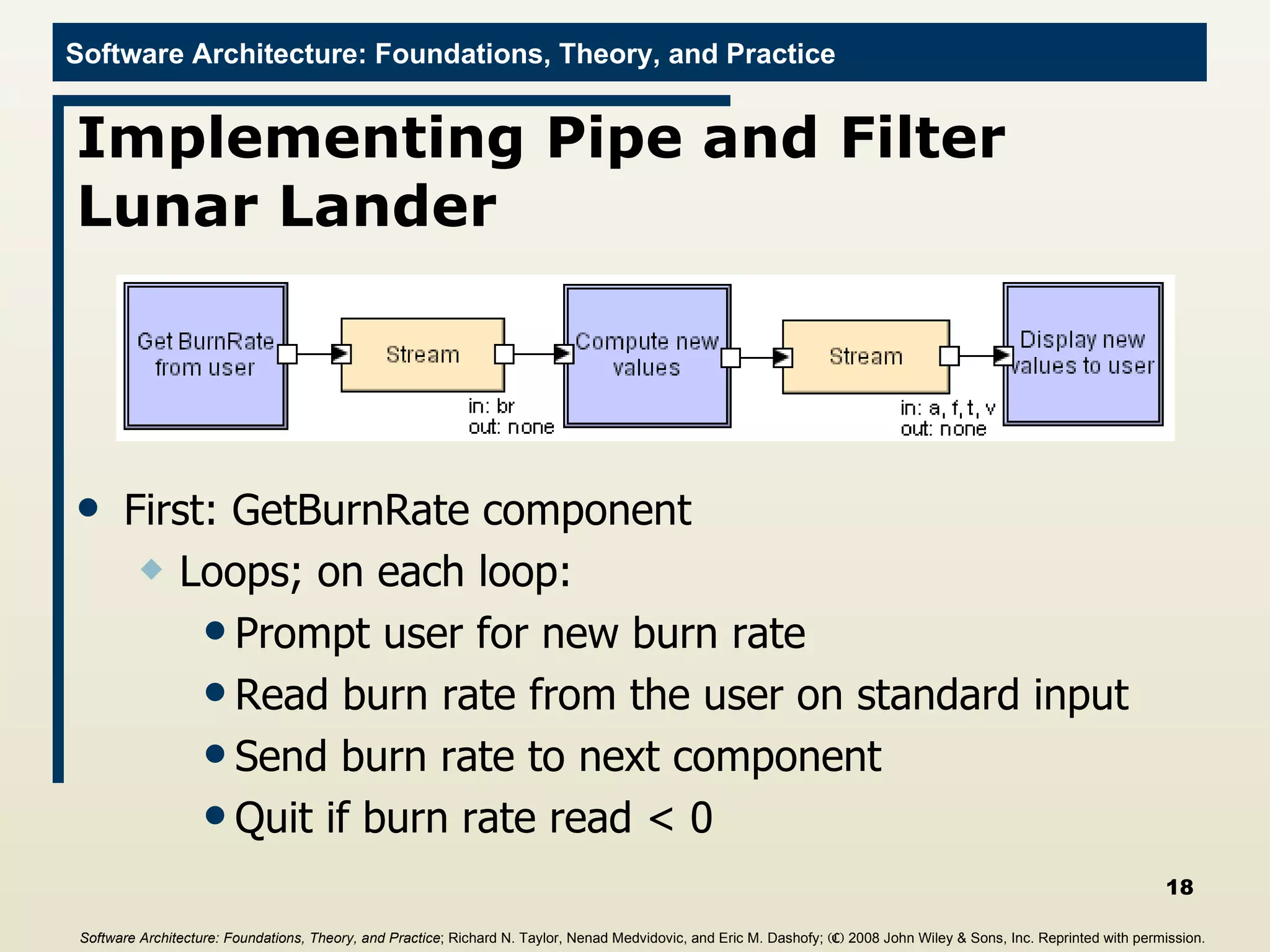
Implementing Pipe and Filter Lunar Lander First: GetBurnRate component Loops; on each loop: Prompt user for new burn rate Read burn rate from the user on standard input Send burn rate to next component Quit if burn rate read < 0 Software Architecture: Foundations, Theory, and Practice ; Richard N. Taylor, Nenad Medvidovic, and Eric M. Dashofy;  (C)  2008 John Wiley & Sons, Inc. Reprinted with permission.
GetBurnRate Filter //Import the java.io framework import java.io.*; public class GetBurnRate{ public static void main(String[] args){ //Send welcome message System.out.println(&quot;#Welcome to Lunar Lander&quot;); try{ //Begin reading from System input BufferedReader inputReader =  new BufferedReader(new InputStreamReader(System.in)); //Set initial burn rate to 0  int burnRate = 0; do{ //Prompt user System.out.println(&quot;#Enter burn rate or <0 to quit:&quot;); . . . Software Architecture: Foundations, Theory, and Practice ; Richard N. Taylor, Nenad Medvidovic, and Eric M. Dashofy;  (C)  2008 John Wiley & Sons, Inc. Reprinted with permission.
GetBurnRate Filter //Import the java.io framework import java.io.*; public class GetBurnRate{ public static void main(String[] args){ //Send welcome message System.out.println(&quot;#Welcome to Lunar Lander&quot;); try{ //Begin reading from System input BufferedReader inputReader =  new BufferedReader(new InputStreamReader(System.in)); //Set initial burn rate to 0  int burnRate = 0; do{ //Prompt user System.out.println(&quot;#Enter burn rate or <0 to quit:&quot;); . . . . . . //Read user response try{ String burnRateString = inputReader.readLine(); burnRate = Integer.parseInt(burnRateString); //Send user-supplied burn rate to next filter  System.out.println(&quot;%&quot; + burnRate); } catch(NumberFormatException nfe){ System.out.println(&quot;#Invalid burn rate.&quot;); } }while(burnRate >= 0); inputReader.close(); } catch(IOException ioe){ ioe.printStackTrace(); } } } Software Architecture: Foundations, Theory, and Practice ; Richard N. Taylor, Nenad Medvidovic, and Eric M. Dashofy;  (C)  2008 John Wiley & Sons, Inc. Reprinted with permission.
Implementing Pipe and Filter Lunar Lander Second: CalcNewValues Component Read burn rate from standard input Calculate new game state including game-over Send new game state to next component New game state is not sent in a formatted string; that’s the display component’s job Software Architecture: Foundations, Theory, and Practice ; Richard N. Taylor, Nenad Medvidovic, and Eric M. Dashofy;  (C)  2008 John Wiley & Sons, Inc. Reprinted with permission.
CalcBurnRate Filter import java.io.*; public class CalcNewValues{ public static void main(String[] args){ //Initialize values final int GRAVITY = 2; int altitude = 1000; int fuel = 500; int velocity = 70; int time = 0; try{ BufferedReader inputReader = new  BufferedReader(new InputStreamReader(System.in)); //Print initial values System.out.println(&quot;%a&quot; + altitude); System.out.println(&quot;%f&quot; + fuel); System.out.println(&quot;%v&quot; + velocity); System.out.println(&quot;%t&quot; + time); . . . Software Architecture: Foundations, Theory, and Practice ; Richard N. Taylor, Nenad Medvidovic, and Eric M. Dashofy;  (C)  2008 John Wiley & Sons, Inc. Reprinted with permission.
CalcBurnRate Filter import java.io.*; public class CalcNewValues{ public static void main(String[] args){ //Initialize values final int GRAVITY = 2; int altitude = 1000; int fuel = 500; int velocity = 70; int time = 0; try{ BufferedReader inputReader = new  BufferedReader(new InputStreamReader(System.in)); //Print initial values System.out.println(&quot;%a&quot; + altitude); System.out.println(&quot;%f&quot; + fuel); System.out.println(&quot;%v&quot; + velocity); System.out.println(&quot;%t&quot; + time); . . . String inputLine = null; do{ inputLine = inputReader.readLine(); if((inputLine != null) &&  (inputLine.length() > 0)){ if(inputLine.startsWith(&quot;#&quot;)){ //This is a status line of text, and  //should be passed down the pipeline System.out.println(inputLine); } else if(inputLine.startsWith(&quot;%&quot;)){ //This is an input burn rate try{ int burnRate = Integer.parseInt(inputLine.substring(1)); if(altitude <= 0){ System.out.println(&quot;#The game is over.&quot;); } else if(burnRate > fuel){ System.out.println(&quot;#Sorry, you don't&quot; +  &quot;have that much fuel.&quot;); } . . . Software Architecture: Foundations, Theory, and Practice ; Richard N. Taylor, Nenad Medvidovic, and Eric M. Dashofy;  (C)  2008 John Wiley & Sons, Inc. Reprinted with permission.
CalcBurnRate Filter import java.io.*; public class CalcNewValues{ public static void main(String[] args){ //Initialize values final int GRAVITY = 2; int altitude = 1000; int fuel = 500; int velocity = 70; int time = 0; try{ BufferedReader inputReader = new  BufferedReader(new InputStreamReader(System.in)); //Print initial values System.out.println(&quot;%a&quot; + altitude); System.out.println(&quot;%f&quot; + fuel); System.out.println(&quot;%v&quot; + velocity); System.out.println(&quot;%t&quot; + time); . . . String inputLine = null; do{ inputLine = inputReader.readLine(); if((inputLine != null) &&  (inputLine.length() > 0)){ if(inputLine.startsWith(&quot;#&quot;)){ //This is a status line of text, and  //should be passed down the pipeline System.out.println(inputLine); } else if(inputLine.startsWith(&quot;%&quot;)){ //This is an input burn rate try{ int burnRate = Integer.parseInt(inputLine.substring(1)); if(altitude <= 0){ System.out.println(&quot;#The game is over.&quot;); } else if(burnRate > fuel){ System.out.println(&quot;#Sorry, you don't&quot; +  &quot;have that much fuel.&quot;); } . . . else{ //Calculate new application state time = time + 1; altitude = altitude - velocity; velocity = ((velocity + GRAVITY) * 10 - burnRate * 2) / 10; fuel = fuel - burnRate; if(altitude <= 0){ altitude = 0; if(velocity <= 5){ System.out.println(&quot;#You have landed safely.&quot;); } else{ System.out.println(&quot;#You have crashed.&quot;); } } } //Print new values System.out.println(&quot;%a&quot; + altitude); System.out.println(&quot;%f&quot; + fuel); System.out.println(&quot;%v&quot; + velocity); System.out.println(&quot;%t&quot; + time); } catch(NumberFormatException nfe){ } . . . Software Architecture: Foundations, Theory, and Practice ; Richard N. Taylor, Nenad Medvidovic, and Eric M. Dashofy;  (C)  2008 John Wiley & Sons, Inc. Reprinted with permission.
CalcBurnRate Filter import java.io.*; public class CalcNewValues{ public static void main(String[] args){ //Initialize values final int GRAVITY = 2; int altitude = 1000; int fuel = 500; int velocity = 70; int time = 0; try{ BufferedReader inputReader = new  BufferedReader(new InputStreamReader(System.in)); //Print initial values System.out.println(&quot;%a&quot; + altitude); System.out.println(&quot;%f&quot; + fuel); System.out.println(&quot;%v&quot; + velocity); System.out.println(&quot;%t&quot; + time); . . . String inputLine = null; do{ inputLine = inputReader.readLine(); if((inputLine != null) &&  (inputLine.length() > 0)){ if(inputLine.startsWith(&quot;#&quot;)){ //This is a status line of text, and  //should be passed down the pipeline System.out.println(inputLine); } else if(inputLine.startsWith(&quot;%&quot;)){ //This is an input burn rate try{ int burnRate = Integer.parseInt(inputLine.substring(1)); if(altitude <= 0){ System.out.println(&quot;#The game is over.&quot;); } else if(burnRate > fuel){ System.out.println(&quot;#Sorry, you don't&quot; +  &quot;have that much fuel.&quot;); } . . . else{ //Calculate new application state time = time + 1; altitude = altitude - velocity; velocity = ((velocity + GRAVITY) * 10 - burnRate * 2) / 10; fuel = fuel - burnRate; if(altitude <= 0){ altitude = 0; if(velocity <= 5){ System.out.println(&quot;#You have landed safely.&quot;); } else{ System.out.println(&quot;#You have crashed.&quot;); } } } //Print new values System.out.println(&quot;%a&quot; + altitude); System.out.println(&quot;%f&quot; + fuel); System.out.println(&quot;%v&quot; + velocity); System.out.println(&quot;%t&quot; + time); } catch(NumberFormatException nfe){ } . . . } } }while((inputLine != null) && (altitude > 0)); inputReader.close(); } catch(IOException ioe){ ioe.printStackTrace(); } } } Software Architecture: Foundations, Theory, and Practice ; Richard N. Taylor, Nenad Medvidovic, and Eric M. Dashofy;  (C)  2008 John Wiley & Sons, Inc. Reprinted with permission.
Implementing Pipe and Filter Lunar Lander Third: DisplayValues component Read value updates from standard input Format them for human reading and send them to standard output Software Architecture: Foundations, Theory, and Practice ; Richard N. Taylor, Nenad Medvidovic, and Eric M. Dashofy;  (C)  2008 John Wiley & Sons, Inc. Reprinted with permission.
DisplayValues Filter import java.io.*; public class DisplayValues{ public static void main(String[] args){ try{ BufferedReader inputReader = new  BufferedReader(new InputStreamReader(System.in)); String inputLine = null; do{ inputLine = inputReader.readLine(); if((inputLine != null) &&  (inputLine.length() > 0)){ if(inputLine.startsWith(&quot;#&quot;)){ //This is a status line of text, and  //should be passed down the pipeline with  //the pound-sign stripped off System.out.println(inputLine.substring(1)); } . . . Software Architecture: Foundations, Theory, and Practice ; Richard N. Taylor, Nenad Medvidovic, and Eric M. Dashofy;  (C)  2008 John Wiley & Sons, Inc. Reprinted with permission.
DisplayValues Filter import java.io.*; public class DisplayValues{ public static void main(String[] args){ try{ BufferedReader inputReader = new  BufferedReader(new InputStreamReader(System.in)); String inputLine = null; do{ inputLine = inputReader.readLine(); if((inputLine != null) &&  (inputLine.length() > 0)){ if(inputLine.startsWith(&quot;#&quot;)){ //This is a status line of text, and  //should be passed down the pipeline with  //the pound-sign stripped off System.out.println(inputLine.substring(1)); } . . . else if(inputLine.startsWith(&quot;%&quot;)){ //This is a value to display if(inputLine.length() > 1){ try{ char valueType = inputLine.charAt(1); int value = Integer.parseInt(inputLine.substring(2)); switch(valueType){ case 'a': System.out.println(&quot;Altitude: &quot; + value); break; case 'f': System.out.println(&quot;Fuel remaining: &quot; + value); break; case 'v': System.out.println(&quot;Current Velocity: “ + value); break; case 't': System.out.println(&quot;Time elapsed: &quot; + value); break; } } catch(NumberFormatException nfe){ } . . . Software Architecture: Foundations, Theory, and Practice ; Richard N. Taylor, Nenad Medvidovic, and Eric M. Dashofy;  (C)  2008 John Wiley & Sons, Inc. Reprinted with permission.
DisplayValues Filter import java.io.*; public class DisplayValues{ public static void main(String[] args){ try{ BufferedReader inputReader = new  BufferedReader(new InputStreamReader(System.in)); String inputLine = null; do{ inputLine = inputReader.readLine(); if((inputLine != null) &&  (inputLine.length() > 0)){ if(inputLine.startsWith(&quot;#&quot;)){ //This is a status line of text, and  //should be passed down the pipeline with  //the pound-sign stripped off System.out.println(inputLine.substring(1)); } . . . else if(inputLine.startsWith(&quot;%&quot;)){ //This is a value to display if(inputLine.length() > 1){ try{ char valueType = inputLine.charAt(1); int value = Integer.parseInt(inputLine.substring(2)); switch(valueType){ case 'a': System.out.println(&quot;Altitude: &quot; + value); break; case 'f': System.out.println(&quot;Fuel remaining: &quot; + value); break; case 'v': System.out.println(&quot;Current Velocity: “ + value); break; case 't': System.out.println(&quot;Time elapsed: &quot; + value); break; } } catch(NumberFormatException nfe){ } . . . } } } }while(inputLine != null); inputReader.close(); } catch(IOException ioe){ ioe.printStackTrace(); } } } Software Architecture: Foundations, Theory, and Practice ; Richard N. Taylor, Nenad Medvidovic, and Eric M. Dashofy;  (C)  2008 John Wiley & Sons, Inc. Reprinted with permission.
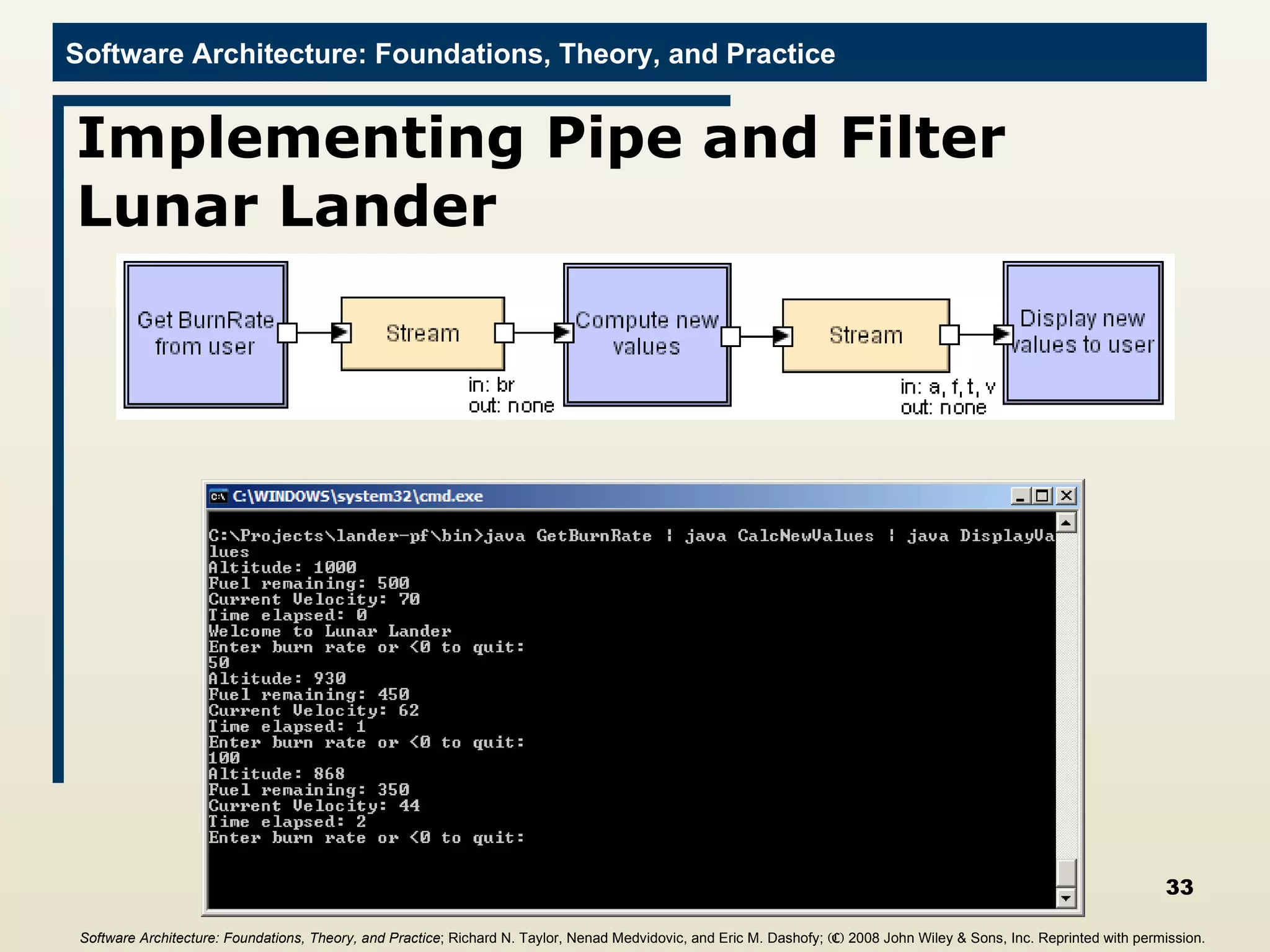
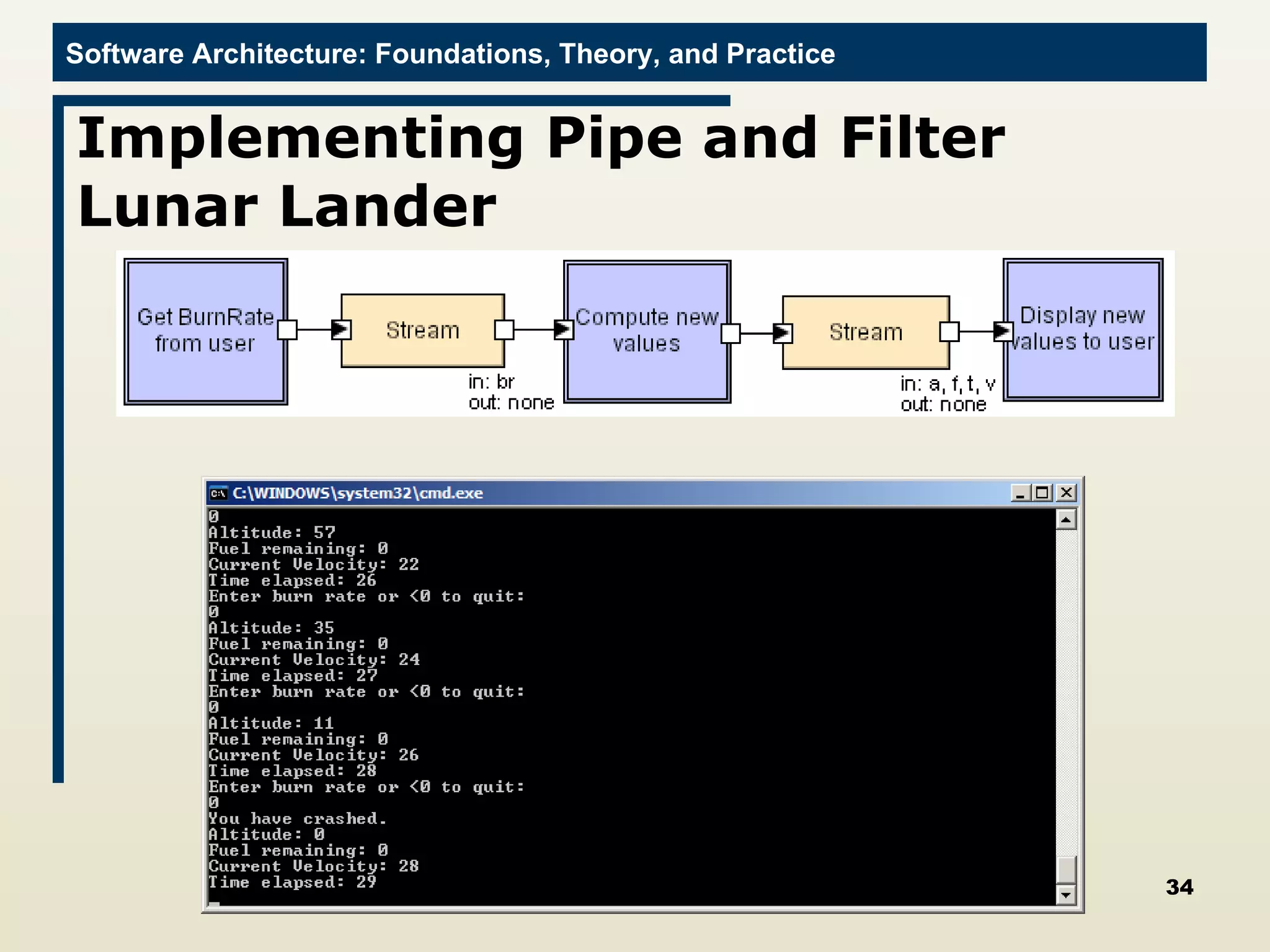
Implementing Pipe and Filter Lunar Lander Instantiating the application java GetBurnRate | java CalcNewValues | java DisplayValues Software Architecture: Foundations, Theory, and Practice ; Richard N. Taylor, Nenad Medvidovic, and Eric M. Dashofy;  (C)  2008 John Wiley & Sons, Inc. Reprinted with permission.
Implementing Pipe and Filter Lunar Lander Software Architecture: Foundations, Theory, and Practice ; Richard N. Taylor, Nenad Medvidovic, and Eric M. Dashofy;  (C)  2008 John Wiley & Sons, Inc. Reprinted with permission.
Implementing Pipe and Filter Lunar Lander
Implementing Pipe and Filter Lunar Lander Software Architecture: Foundations, Theory, and Practice ; Richard N. Taylor, Nenad Medvidovic, and Eric M. Dashofy;  (C)  2008 John Wiley & Sons, Inc. Reprinted with permission.
Implementing Pipe and Filter Lunar Lander
Takeaways java.io provides a number of useful facilities Stream objects (System.in, System.out) Buffering wrappers OS provides some of the facilities Pipes Concurrency support Note that this version of the application would not work if it operated in batch-sequential mode We had other communication mechanisms available, but did not use them to conform to the P&F style We had to develop a new (albeit simple) protocol to get the correct behavior
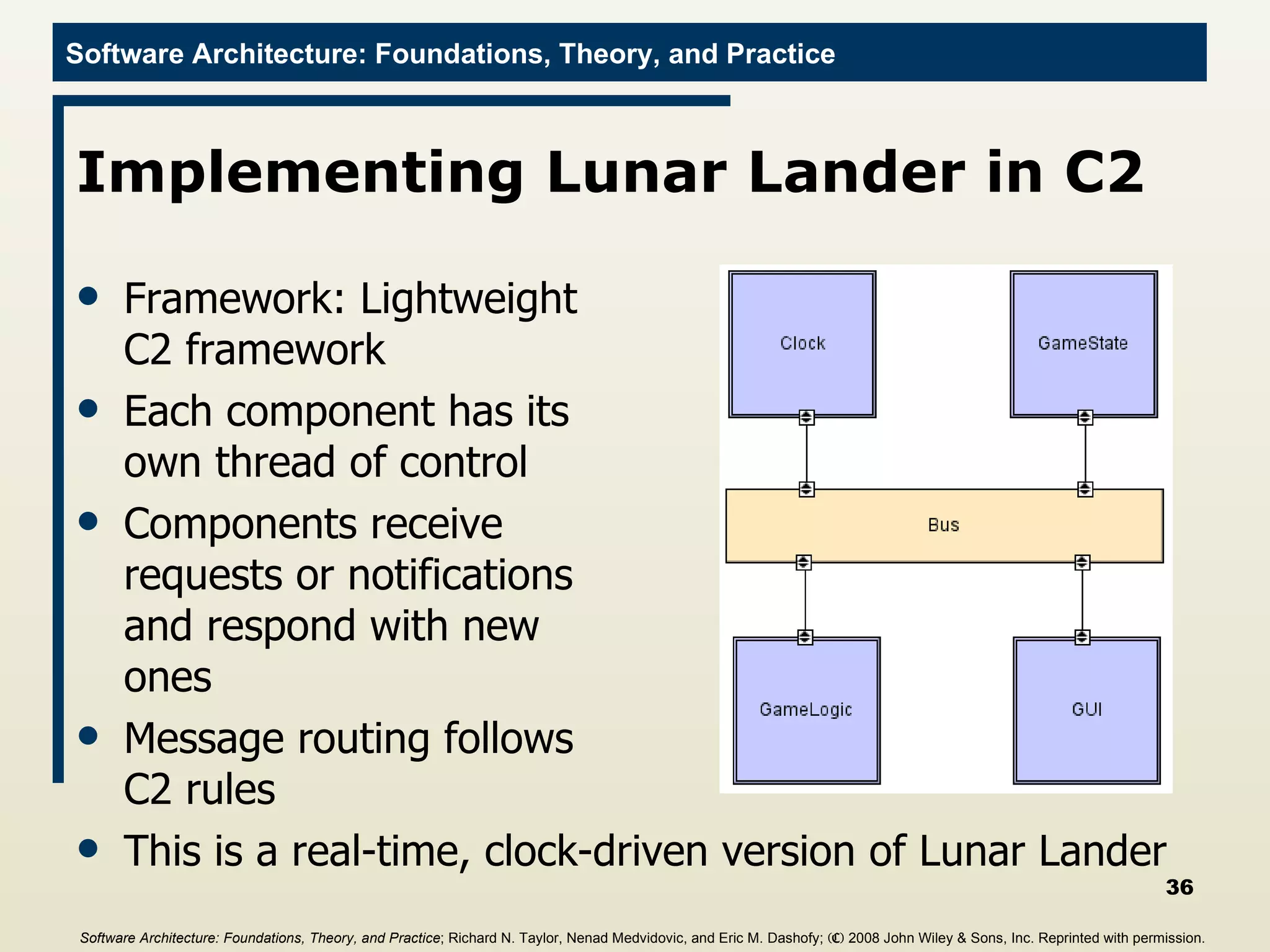
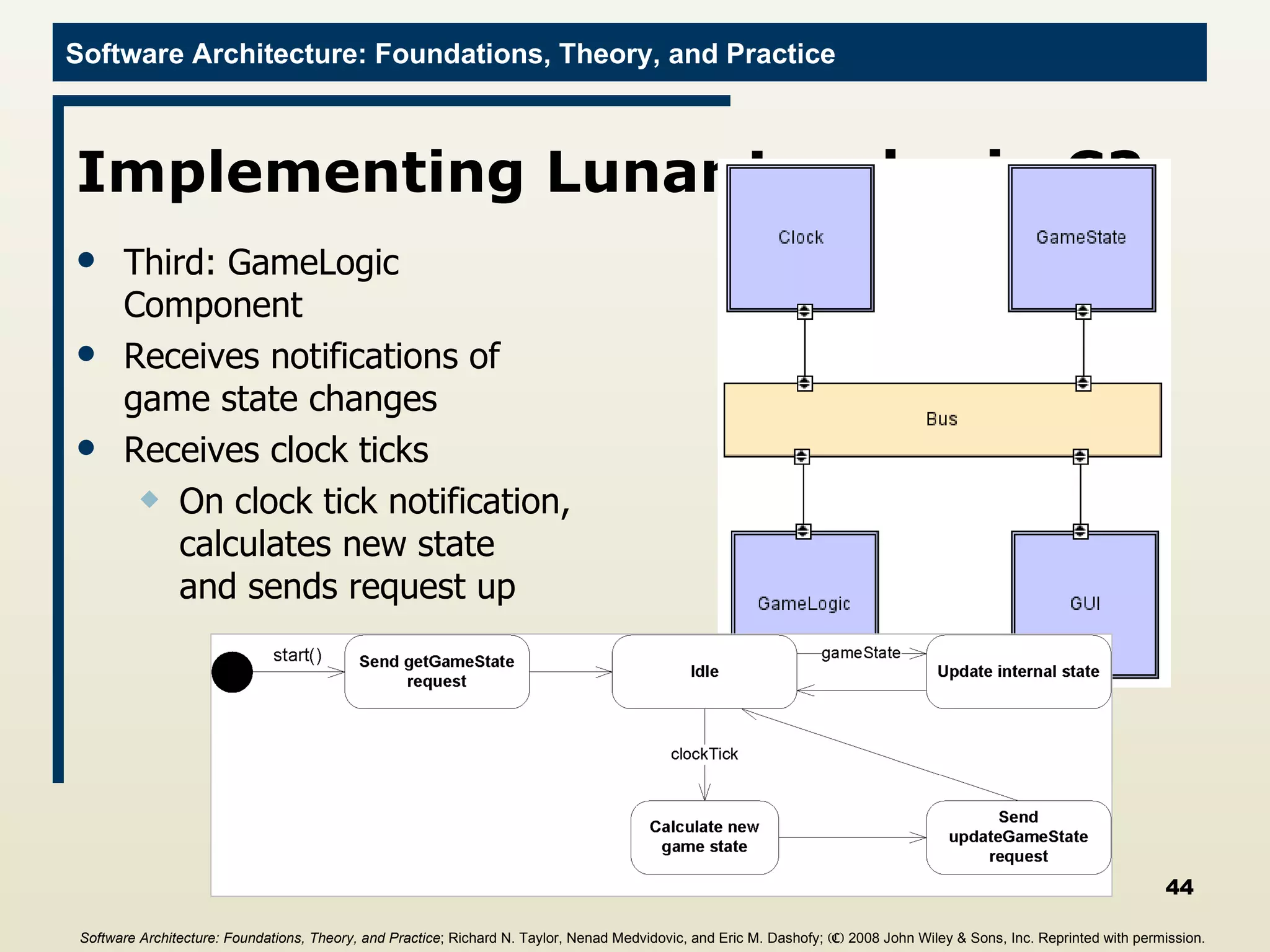
Implementing Lunar Lander in C2 Framework: Lightweight C2 framework Each component has its own thread of control Components receive requests or notifications and respond with new ones Message routing follows C2 rules This is a real-time, clock-driven version of Lunar Lander Software Architecture: Foundations, Theory, and Practice ; Richard N. Taylor, Nenad Medvidovic, and Eric M. Dashofy;  (C)  2008 John Wiley & Sons, Inc. Reprinted with permission.
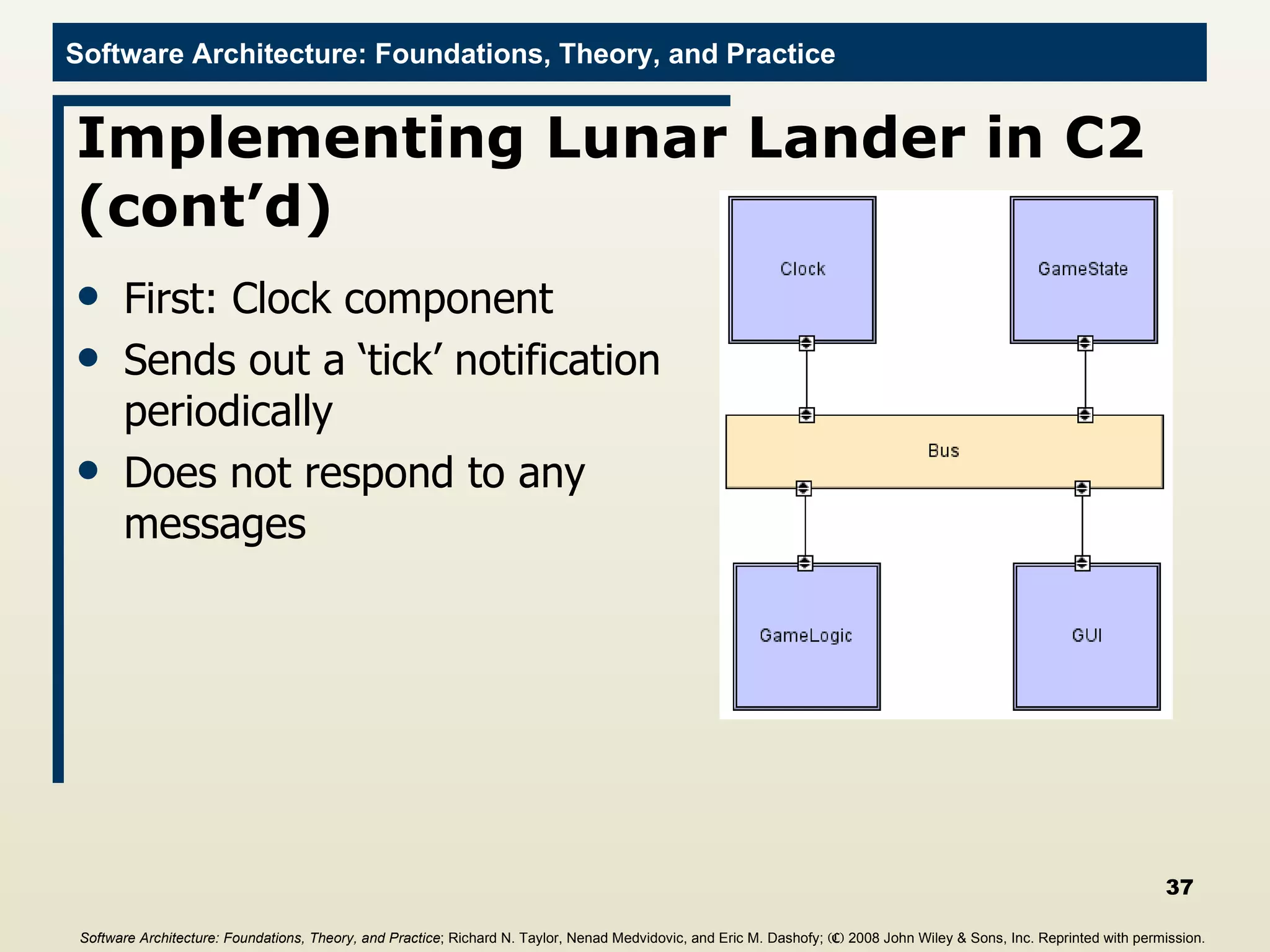
Implementing Lunar Lander in C2 (cont’d) First: Clock component Sends out a ‘tick’ notification periodically Does not respond to any messages Software Architecture: Foundations, Theory, and Practice ; Richard N. Taylor, Nenad Medvidovic, and Eric M. Dashofy;  (C)  2008 John Wiley & Sons, Inc. Reprinted with permission.
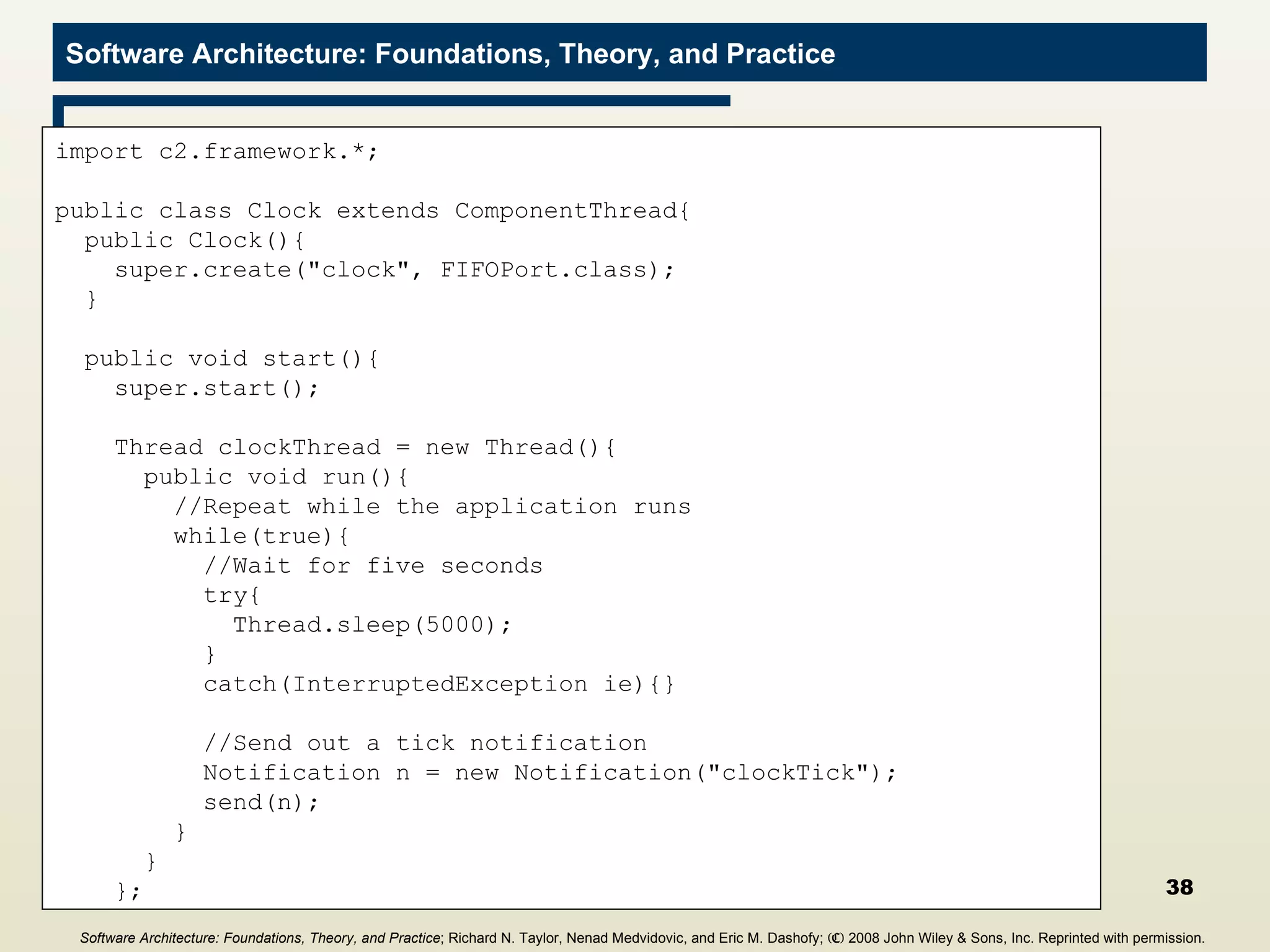
Clock Component import c2.framework.*; public class Clock extends ComponentThread{ public Clock(){ super.create(&quot;clock&quot;, FIFOPort.class); } public void start(){ super.start(); Thread clockThread = new Thread(){ public void run(){ //Repeat while the application runs while(true){ //Wait for five seconds try{ Thread.sleep(5000); } catch(InterruptedException ie){} //Send out a tick notification Notification n = new Notification(&quot;clockTick&quot;); send(n); } } }; Software Architecture: Foundations, Theory, and Practice ; Richard N. Taylor, Nenad Medvidovic, and Eric M. Dashofy;  (C)  2008 John Wiley & Sons, Inc. Reprinted with permission.
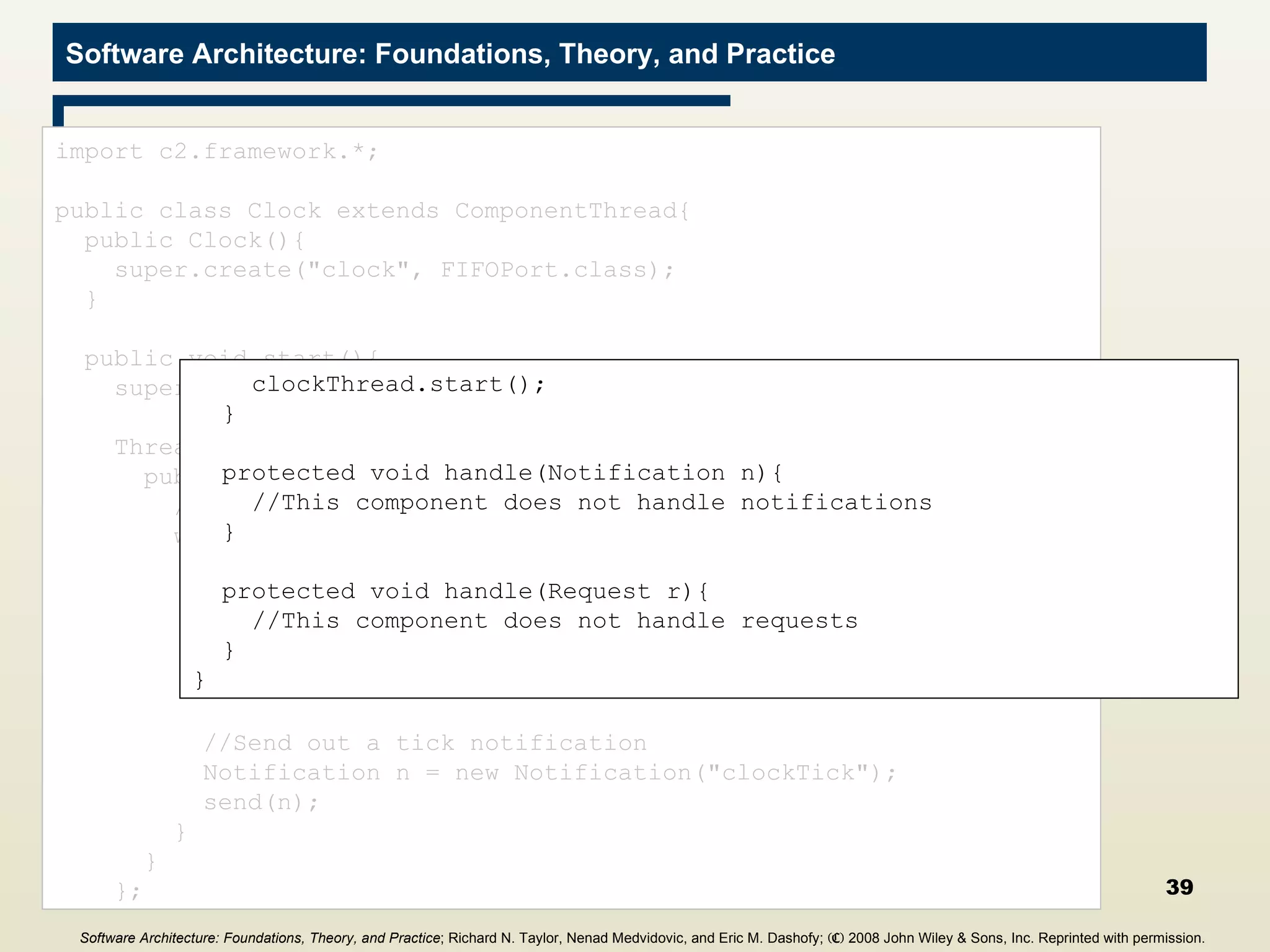
Clock Component import c2.framework.*; public class Clock extends ComponentThread{ public Clock(){ super.create(&quot;clock&quot;, FIFOPort.class); } public void start(){ super.start(); Thread clockThread = new Thread(){ public void run(){ //Repeat while the application runs while(true){ //Wait for five seconds try{ Thread.sleep(5000); } catch(InterruptedException ie){} //Send out a tick notification Notification n = new Notification(&quot;clockTick&quot;); send(n); } } }; clockThread.start(); } protected void handle(Notification n){ //This component does not handle notifications } protected void handle(Request r){ //This component does not handle requests } } Software Architecture: Foundations, Theory, and Practice ; Richard N. Taylor, Nenad Medvidovic, and Eric M. Dashofy;  (C)  2008 John Wiley & Sons, Inc. Reprinted with permission.
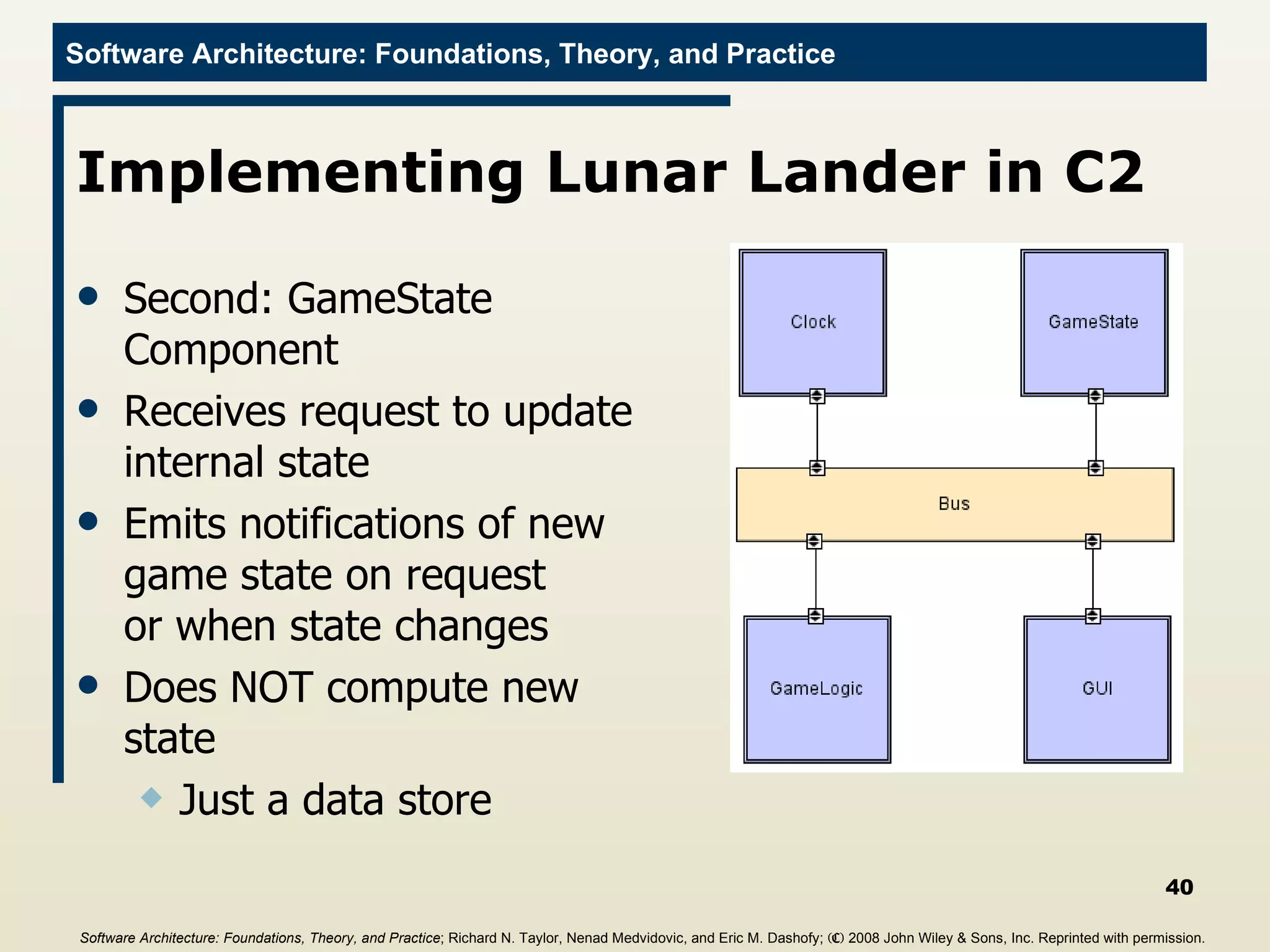
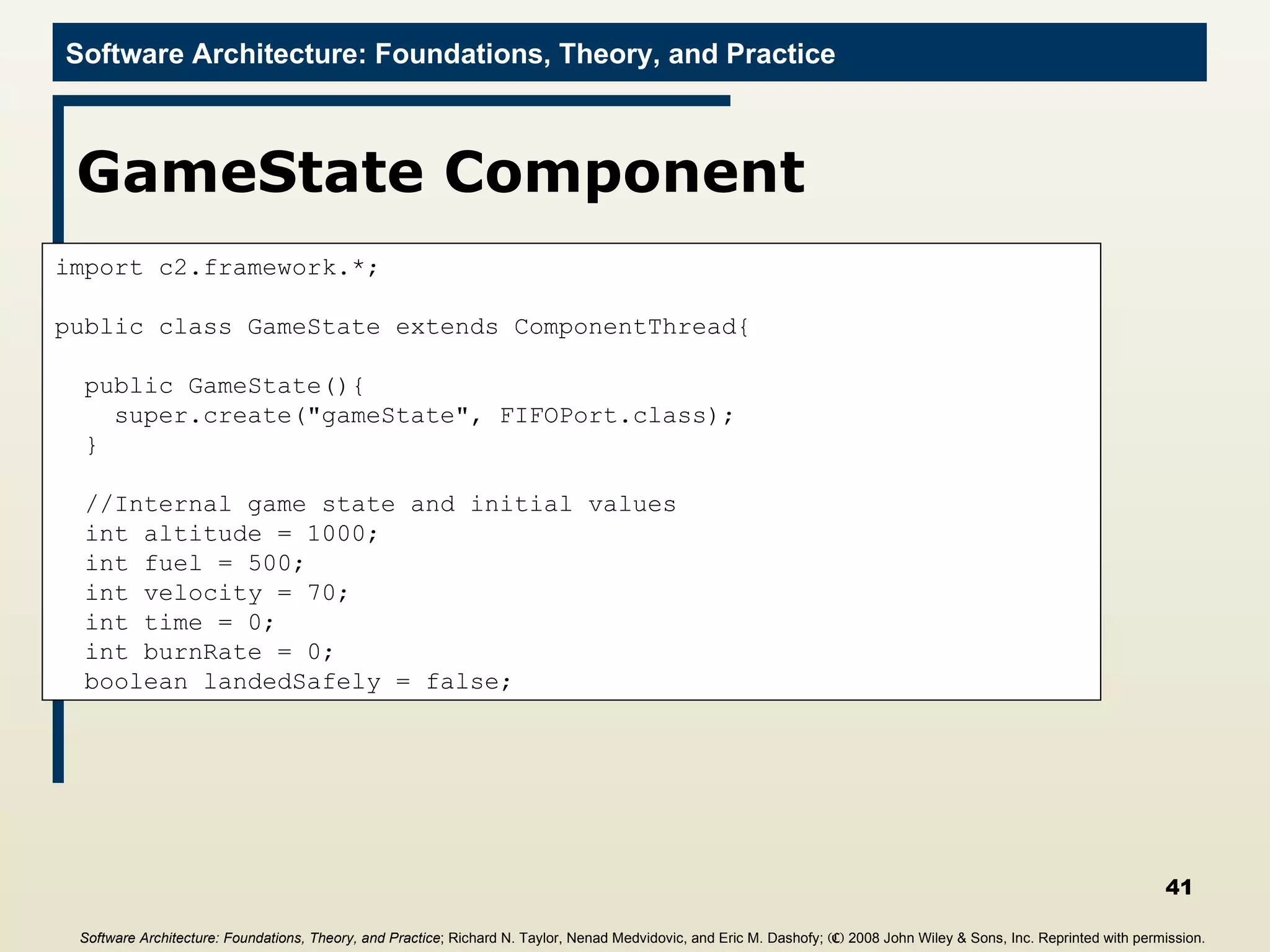
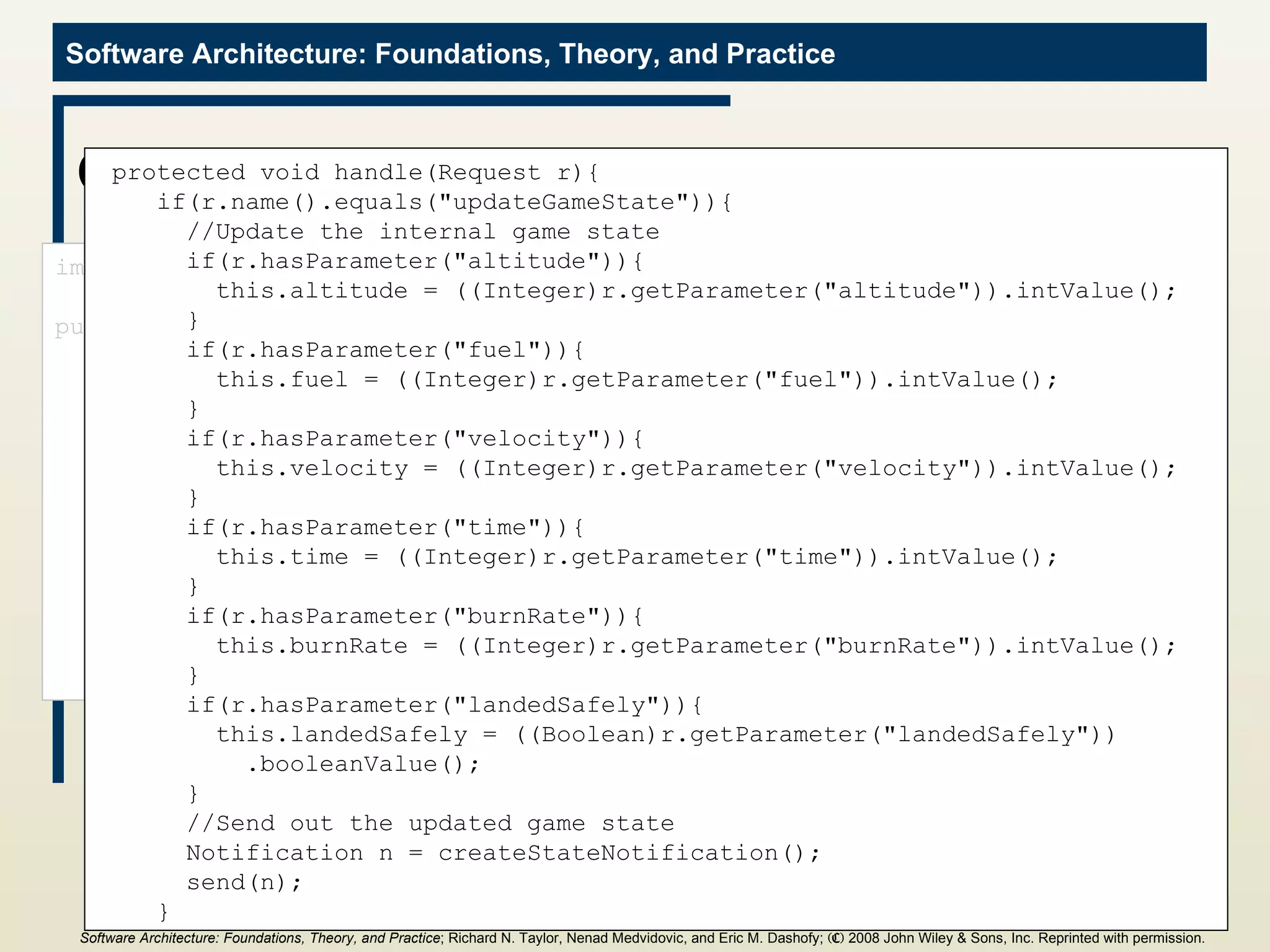
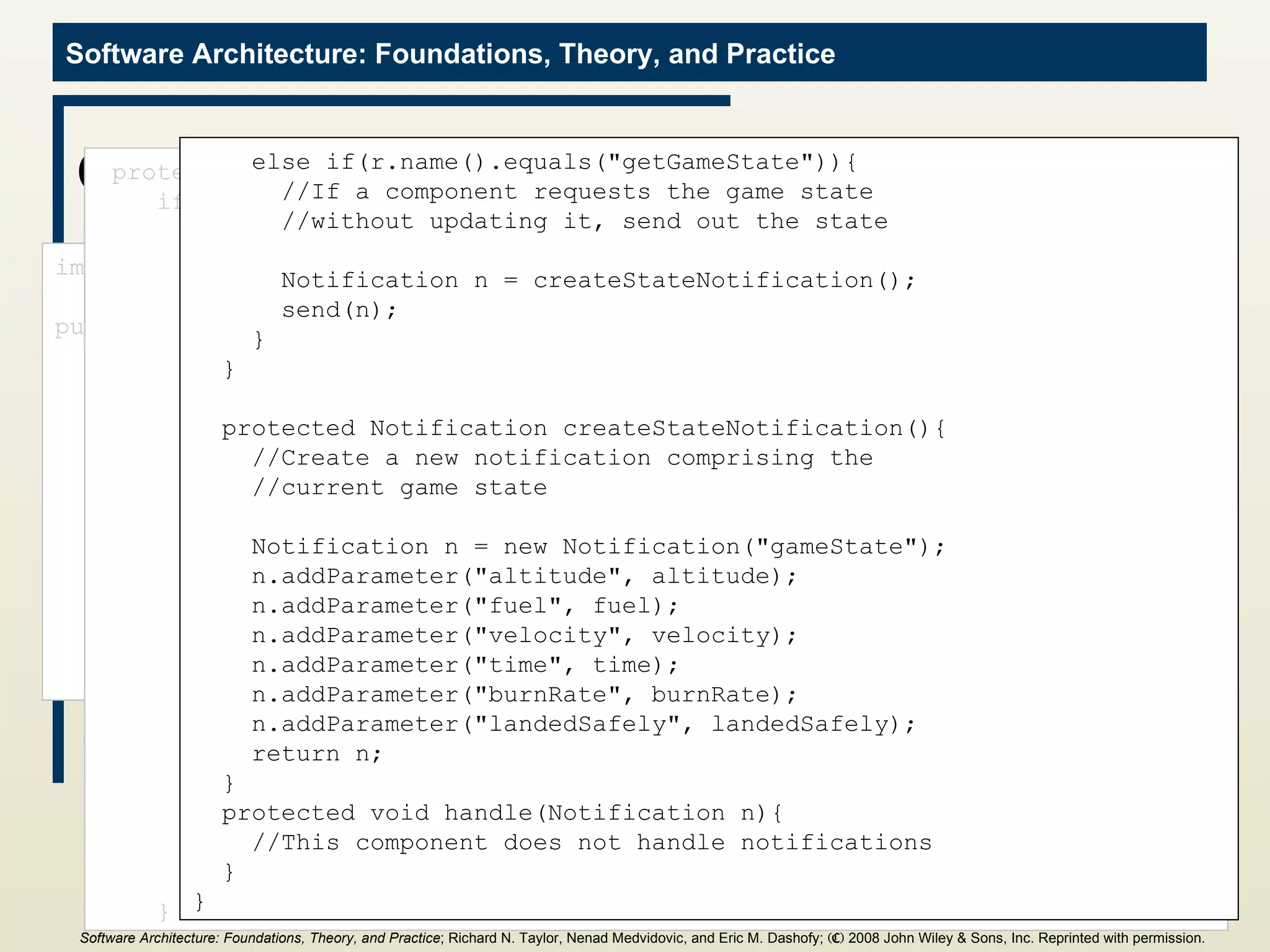
Implementing Lunar Lander in C2 Second: GameState Component Receives request to update internal state Emits notifications of new game state on request or when state changes Does NOT compute new state Just a data store Software Architecture: Foundations, Theory, and Practice ; Richard N. Taylor, Nenad Medvidovic, and Eric M. Dashofy;  (C)  2008 John Wiley & Sons, Inc. Reprinted with permission.
GameState Component import c2.framework.*; public class GameState extends ComponentThread{ public GameState(){ super.create(&quot;gameState&quot;, FIFOPort.class); } //Internal game state and initial values int altitude = 1000; int fuel = 500; int velocity = 70; int time = 0; int burnRate = 0; boolean landedSafely = false; Software Architecture: Foundations, Theory, and Practice ; Richard N. Taylor, Nenad Medvidovic, and Eric M. Dashofy;  (C)  2008 John Wiley & Sons, Inc. Reprinted with permission.
GameState Component import c2.framework.*; public class GameState extends ComponentThread{ public GameState(){ super.create(&quot;gameState&quot;, FIFOPort.class); } //Internal game state and initial values int altitude = 1000; int fuel = 500; int velocity = 70; int time = 0; int burnRate = 0; boolean landedSafely = false; protected void handle(Request r){ if(r.name().equals(&quot;updateGameState&quot;)){ //Update the internal game state if(r.hasParameter(&quot;altitude&quot;)){ this.altitude = ((Integer)r.getParameter(&quot;altitude&quot;)).intValue(); } if(r.hasParameter(&quot;fuel&quot;)){ this.fuel = ((Integer)r.getParameter(&quot;fuel&quot;)).intValue(); } if(r.hasParameter(&quot;velocity&quot;)){ this.velocity = ((Integer)r.getParameter(&quot;velocity&quot;)).intValue(); } if(r.hasParameter(&quot;time&quot;)){ this.time = ((Integer)r.getParameter(&quot;time&quot;)).intValue(); } if(r.hasParameter(&quot;burnRate&quot;)){ this.burnRate = ((Integer)r.getParameter(&quot;burnRate&quot;)).intValue(); } if(r.hasParameter(&quot;landedSafely&quot;)){ this.landedSafely = ((Boolean)r.getParameter(&quot;landedSafely&quot;)) .booleanValue(); } //Send out the updated game state Notification n = createStateNotification(); send(n); } Software Architecture: Foundations, Theory, and Practice ; Richard N. Taylor, Nenad Medvidovic, and Eric M. Dashofy;  (C)  2008 John Wiley & Sons, Inc. Reprinted with permission.
GameState Component import c2.framework.*; public class GameState extends ComponentThread{ public GameState(){ super.create(&quot;gameState&quot;, FIFOPort.class); } //Internal game state and initial values int altitude = 1000; int fuel = 500; int velocity = 70; int time = 0; int burnRate = 0; boolean landedSafely = false; protected void handle(Request r){ if(r.name().equals(&quot;updateGameState&quot;)){ //Update the internal game state if(r.hasParameter(&quot;altitude&quot;)){ this.altitude = ((Integer)r.getParameter(&quot;altitude&quot;)).intValue(); } if(r.hasParameter(&quot;fuel&quot;)){ this.fuel = ((Integer)r.getParameter(&quot;fuel&quot;)).intValue(); } if(r.hasParameter(&quot;velocity&quot;)){ this.velocity = ((Integer)r.getParameter(&quot;velocity&quot;)).intValue(); } if(r.hasParameter(&quot;time&quot;)){ this.time = ((Integer)r.getParameter(&quot;time&quot;)).intValue(); } if(r.hasParameter(&quot;burnRate&quot;)){ this.burnRate = ((Integer)r.getParameter(&quot;burnRate&quot;)).intValue(); } if(r.hasParameter(&quot;landedSafely&quot;)){ this.landedSafely = ((Boolean)r.getParameter(&quot;landedSafely&quot;)) .booleanValue(); } //Send out the updated game state Notification n = createStateNotification(); send(n); } else if(r.name().equals(&quot;getGameState&quot;)){ //If a component requests the game state //without updating it, send out the state Notification n = createStateNotification(); send(n); } } protected Notification createStateNotification(){ //Create a new notification comprising the //current game state Notification n = new Notification(&quot;gameState&quot;); n.addParameter(&quot;altitude&quot;, altitude); n.addParameter(&quot;fuel&quot;, fuel); n.addParameter(&quot;velocity&quot;, velocity); n.addParameter(&quot;time&quot;, time); n.addParameter(&quot;burnRate&quot;, burnRate); n.addParameter(&quot;landedSafely&quot;, landedSafely); return n; } protected void handle(Notification n){ //This component does not handle notifications } } Software Architecture: Foundations, Theory, and Practice ; Richard N. Taylor, Nenad Medvidovic, and Eric M. Dashofy;  (C)  2008 John Wiley & Sons, Inc. Reprinted with permission.
Implementing Lunar Lander in C2 Third: GameLogic Component Receives notifications of game state changes Receives clock ticks On clock tick notification, calculates new state and sends request up Software Architecture: Foundations, Theory, and Practice ; Richard N. Taylor, Nenad Medvidovic, and Eric M. Dashofy;  (C)  2008 John Wiley & Sons, Inc. Reprinted with permission.
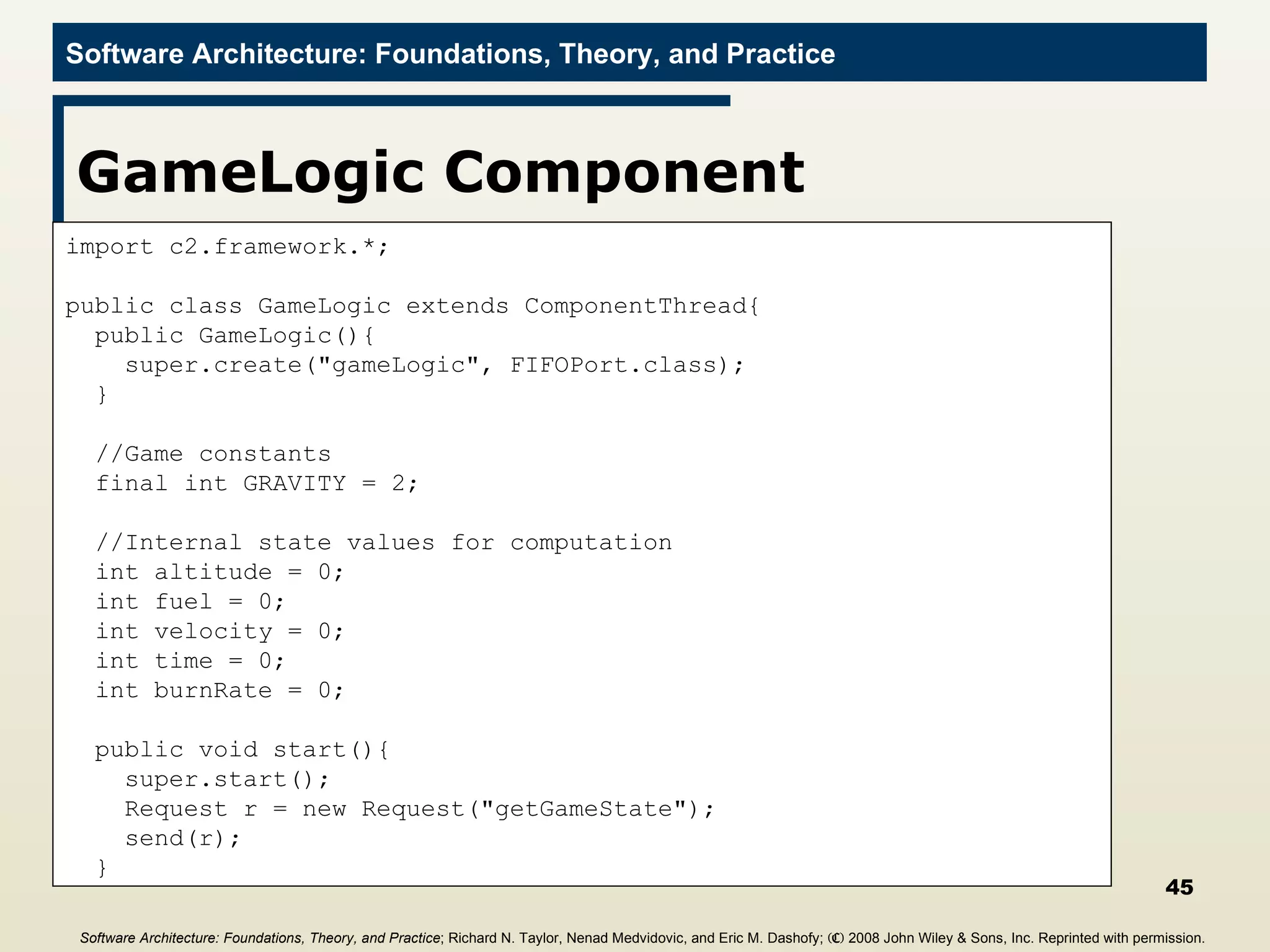
GameLogic Component import c2.framework.*; public class GameLogic extends ComponentThread{ public GameLogic(){ super.create(&quot;gameLogic&quot;, FIFOPort.class); } //Game constants final int GRAVITY = 2; //Internal state values for computation int altitude = 0; int fuel = 0; int velocity = 0; int time = 0; int burnRate = 0; public void start(){ super.start(); Request r = new Request(&quot;getGameState&quot;); send(r); } Software Architecture: Foundations, Theory, and Practice ; Richard N. Taylor, Nenad Medvidovic, and Eric M. Dashofy;  (C)  2008 John Wiley & Sons, Inc. Reprinted with permission.
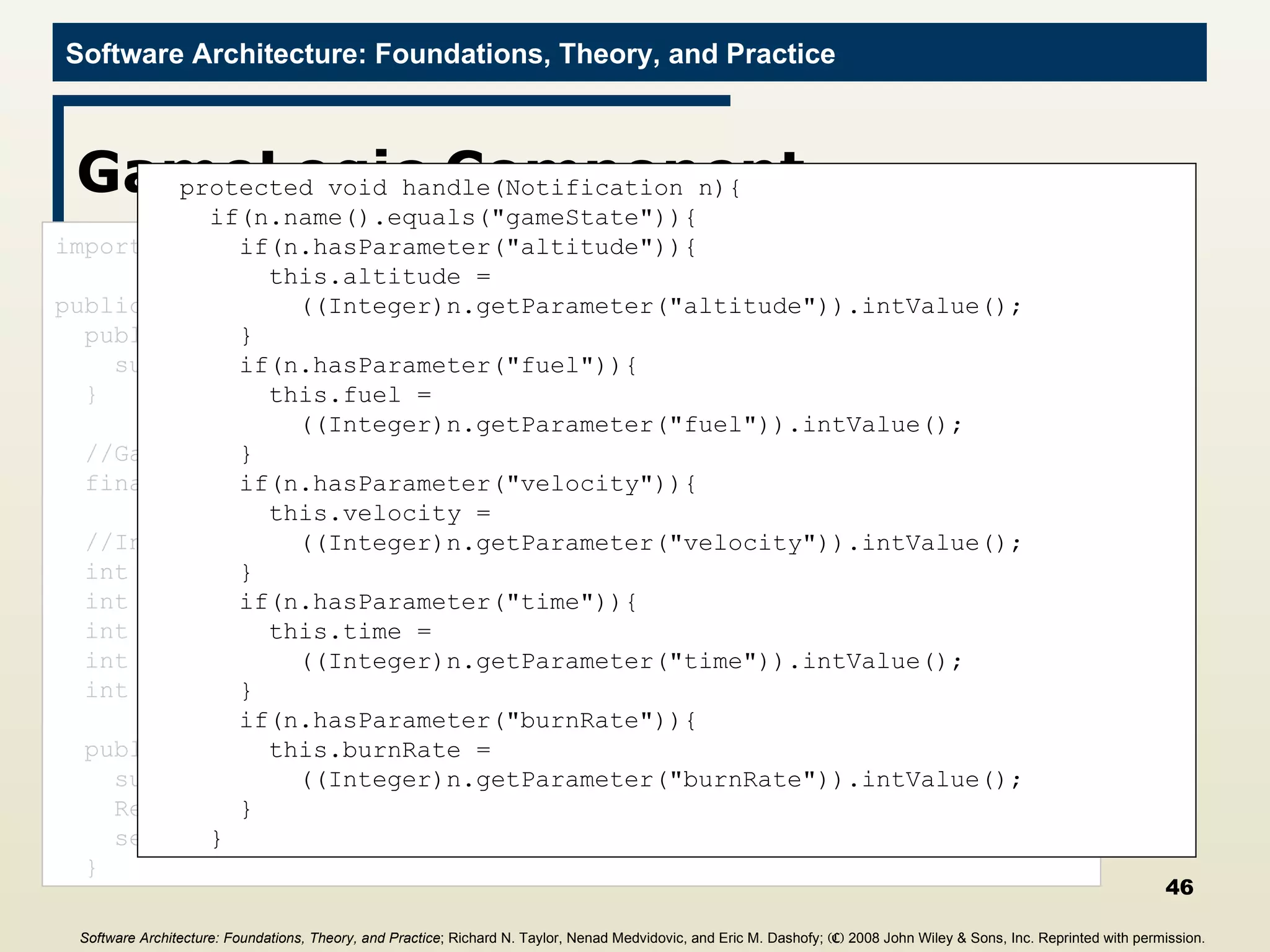
GameLogic Component import c2.framework.*; public class GameLogic extends ComponentThread{ public GameLogic(){ super.create(&quot;gameLogic&quot;, FIFOPort.class); } //Game constants final int GRAVITY = 2; //Internal state values for computation int altitude = 0; int fuel = 0; int velocity = 0; int time = 0; int burnRate = 0; public void start(){ super.start(); Request r = new Request(&quot;getGameState&quot;); send(r); } protected void handle(Notification n){ if(n.name().equals(&quot;gameState&quot;)){ if(n.hasParameter(&quot;altitude&quot;)){ this.altitude =  ((Integer)n.getParameter(&quot;altitude&quot;)).intValue(); } if(n.hasParameter(&quot;fuel&quot;)){ this.fuel =  ((Integer)n.getParameter(&quot;fuel&quot;)).intValue(); } if(n.hasParameter(&quot;velocity&quot;)){ this.velocity =  ((Integer)n.getParameter(&quot;velocity&quot;)).intValue(); } if(n.hasParameter(&quot;time&quot;)){ this.time =  ((Integer)n.getParameter(&quot;time&quot;)).intValue(); } if(n.hasParameter(&quot;burnRate&quot;)){ this.burnRate =  ((Integer)n.getParameter(&quot;burnRate&quot;)).intValue(); } } Software Architecture: Foundations, Theory, and Practice ; Richard N. Taylor, Nenad Medvidovic, and Eric M. Dashofy;  (C)  2008 John Wiley & Sons, Inc. Reprinted with permission.
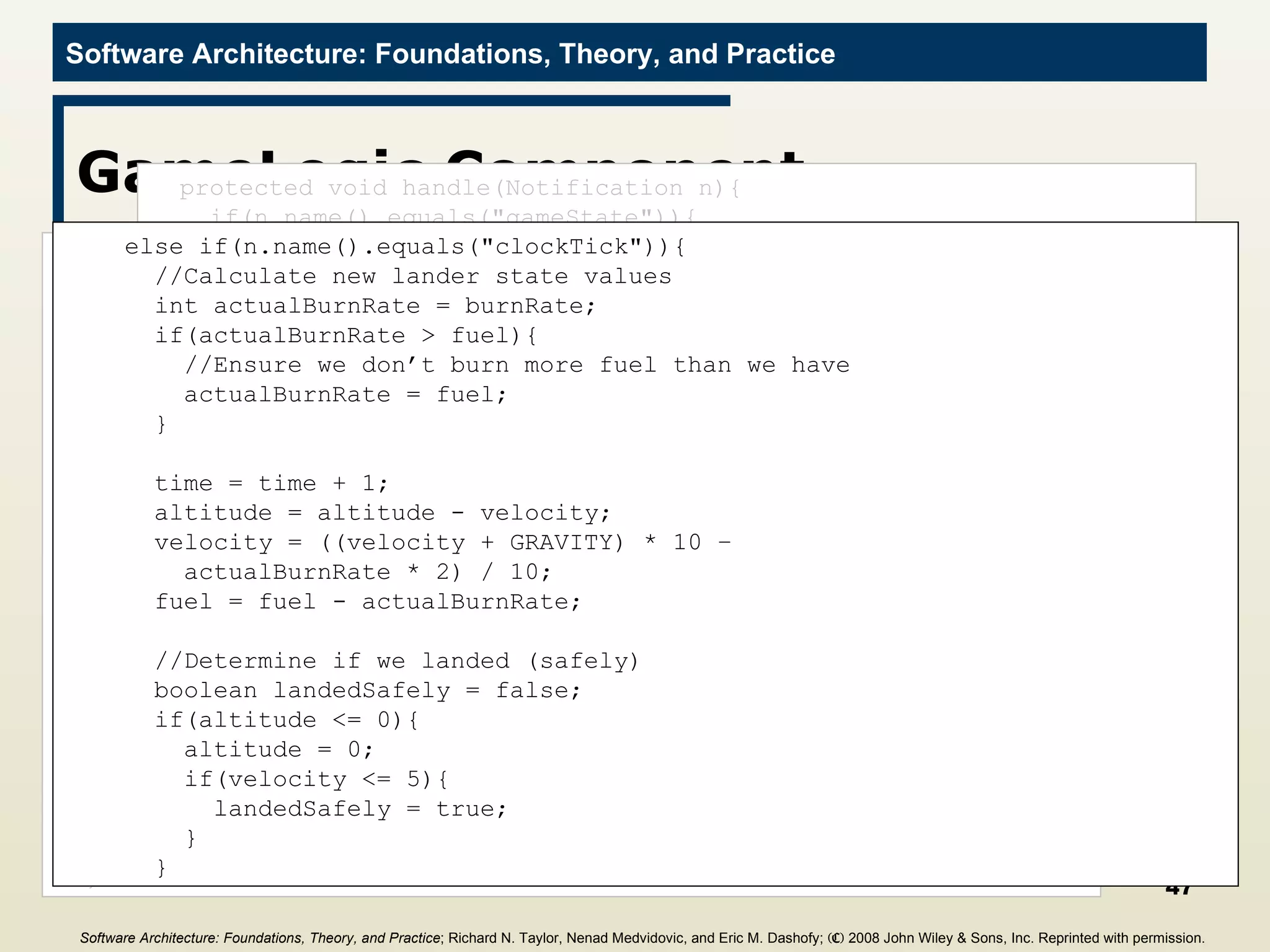
GameLogic Component import c2.framework.*; public class GameLogic extends ComponentThread{ public GameLogic(){ super.create(&quot;gameLogic&quot;, FIFOPort.class); } //Game constants final int GRAVITY = 2; //Internal state values for computation int altitude = 0; int fuel = 0; int velocity = 0; int time = 0; int burnRate = 0; public void start(){ super.start(); Request r = new Request(&quot;getGameState&quot;); send(r); } protected void handle(Notification n){ if(n.name().equals(&quot;gameState&quot;)){ if(n.hasParameter(&quot;altitude&quot;)){ this.altitude =  ((Integer)n.getParameter(&quot;altitude&quot;)).intValue(); } if(n.hasParameter(&quot;fuel&quot;)){ this.fuel =  ((Integer)n.getParameter(&quot;fuel&quot;)).intValue(); } if(n.hasParameter(&quot;velocity&quot;)){ this.velocity =  ((Integer)n.getParameter(&quot;velocity&quot;)).intValue(); } if(n.hasParameter(&quot;time&quot;)){ this.time =  ((Integer)n.getParameter(&quot;time&quot;)).intValue(); } if(n.hasParameter(&quot;burnRate&quot;)){ this.burnRate =  ((Integer)n.getParameter(&quot;burnRate&quot;)).intValue(); } } else if(n.name().equals(&quot;clockTick&quot;)){ //Calculate new lander state values int actualBurnRate = burnRate; if(actualBurnRate > fuel){ //Ensure we don’t burn more fuel than we have actualBurnRate = fuel; } time = time + 1; altitude = altitude - velocity; velocity = ((velocity + GRAVITY) * 10 – actualBurnRate * 2) / 10; fuel = fuel - actualBurnRate; //Determine if we landed (safely) boolean landedSafely = false; if(altitude <= 0){ altitude = 0; if(velocity <= 5){ landedSafely = true; } } Software Architecture: Foundations, Theory, and Practice ; Richard N. Taylor, Nenad Medvidovic, and Eric M. Dashofy;  (C)  2008 John Wiley & Sons, Inc. Reprinted with permission.
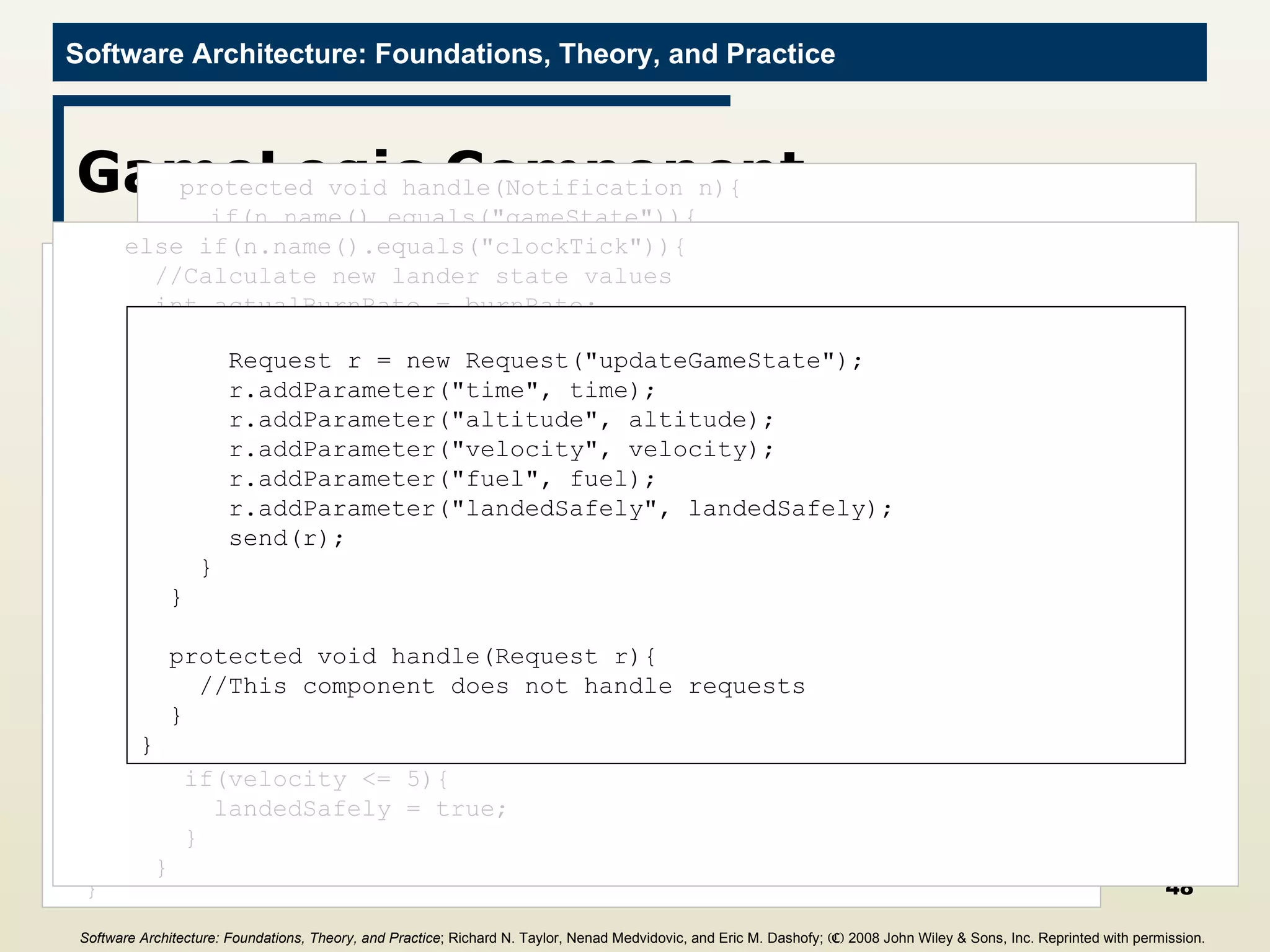
GameLogic Component import c2.framework.*; public class GameLogic extends ComponentThread{ public GameLogic(){ super.create(&quot;gameLogic&quot;, FIFOPort.class); } //Game constants final int GRAVITY = 2; //Internal state values for computation int altitude = 0; int fuel = 0; int velocity = 0; int time = 0; int burnRate = 0; public void start(){ super.start(); Request r = new Request(&quot;getGameState&quot;); send(r); } protected void handle(Notification n){ if(n.name().equals(&quot;gameState&quot;)){ if(n.hasParameter(&quot;altitude&quot;)){ this.altitude =  ((Integer)n.getParameter(&quot;altitude&quot;)).intValue(); } if(n.hasParameter(&quot;fuel&quot;)){ this.fuel =  ((Integer)n.getParameter(&quot;fuel&quot;)).intValue(); } if(n.hasParameter(&quot;velocity&quot;)){ this.velocity =  ((Integer)n.getParameter(&quot;velocity&quot;)).intValue(); } if(n.hasParameter(&quot;time&quot;)){ this.time =  ((Integer)n.getParameter(&quot;time&quot;)).intValue(); } if(n.hasParameter(&quot;burnRate&quot;)){ this.burnRate =  ((Integer)n.getParameter(&quot;burnRate&quot;)).intValue(); } } else if(n.name().equals(&quot;clockTick&quot;)){ //Calculate new lander state values int actualBurnRate = burnRate; if(actualBurnRate > fuel){ //Ensure we don’t burn more fuel than we have actualBurnRate = fuel; } time = time + 1; altitude = altitude - velocity; velocity = ((velocity + GRAVITY) * 10 – actualBurnRate * 2) / 10; fuel = fuel - actualBurnRate; //Determine if we landed (safely) boolean landedSafely = false; if(altitude <= 0){ altitude = 0; if(velocity <= 5){ landedSafely = true; } } Request r = new Request(&quot;updateGameState&quot;); r.addParameter(&quot;time&quot;, time); r.addParameter(&quot;altitude&quot;, altitude); r.addParameter(&quot;velocity&quot;, velocity); r.addParameter(&quot;fuel&quot;, fuel); r.addParameter(&quot;landedSafely&quot;, landedSafely); send(r); } } protected void handle(Request r){ //This component does not handle requests } } Software Architecture: Foundations, Theory, and Practice ; Richard N. Taylor, Nenad Medvidovic, and Eric M. Dashofy;  (C)  2008 John Wiley & Sons, Inc. Reprinted with permission.
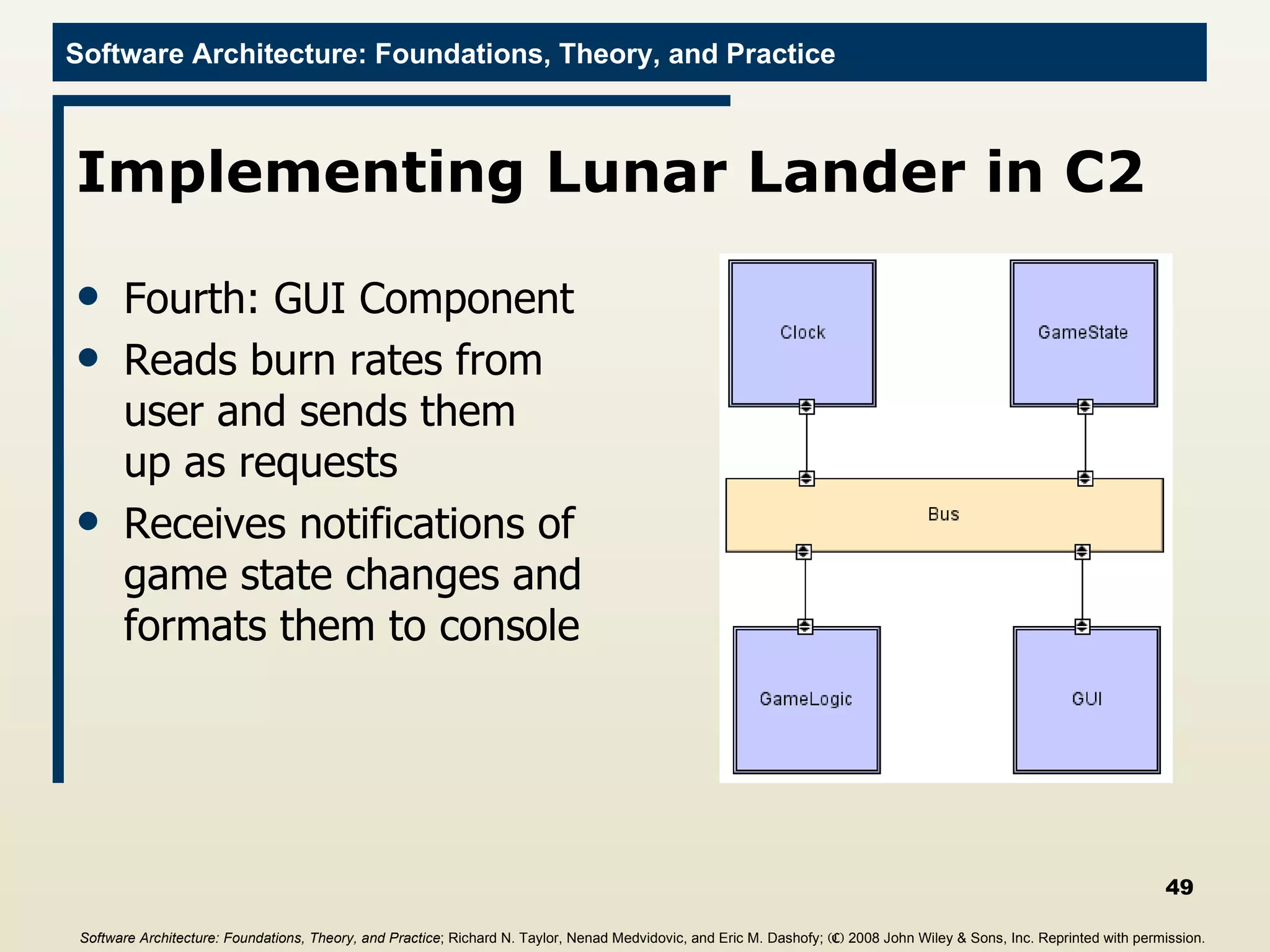
Implementing Lunar Lander in C2 Fourth: GUI Component Reads burn rates from user and sends them up as requests Receives notifications of game state changes and formats them to console Software Architecture: Foundations, Theory, and Practice ; Richard N. Taylor, Nenad Medvidovic, and Eric M. Dashofy;  (C)  2008 John Wiley & Sons, Inc. Reprinted with permission.
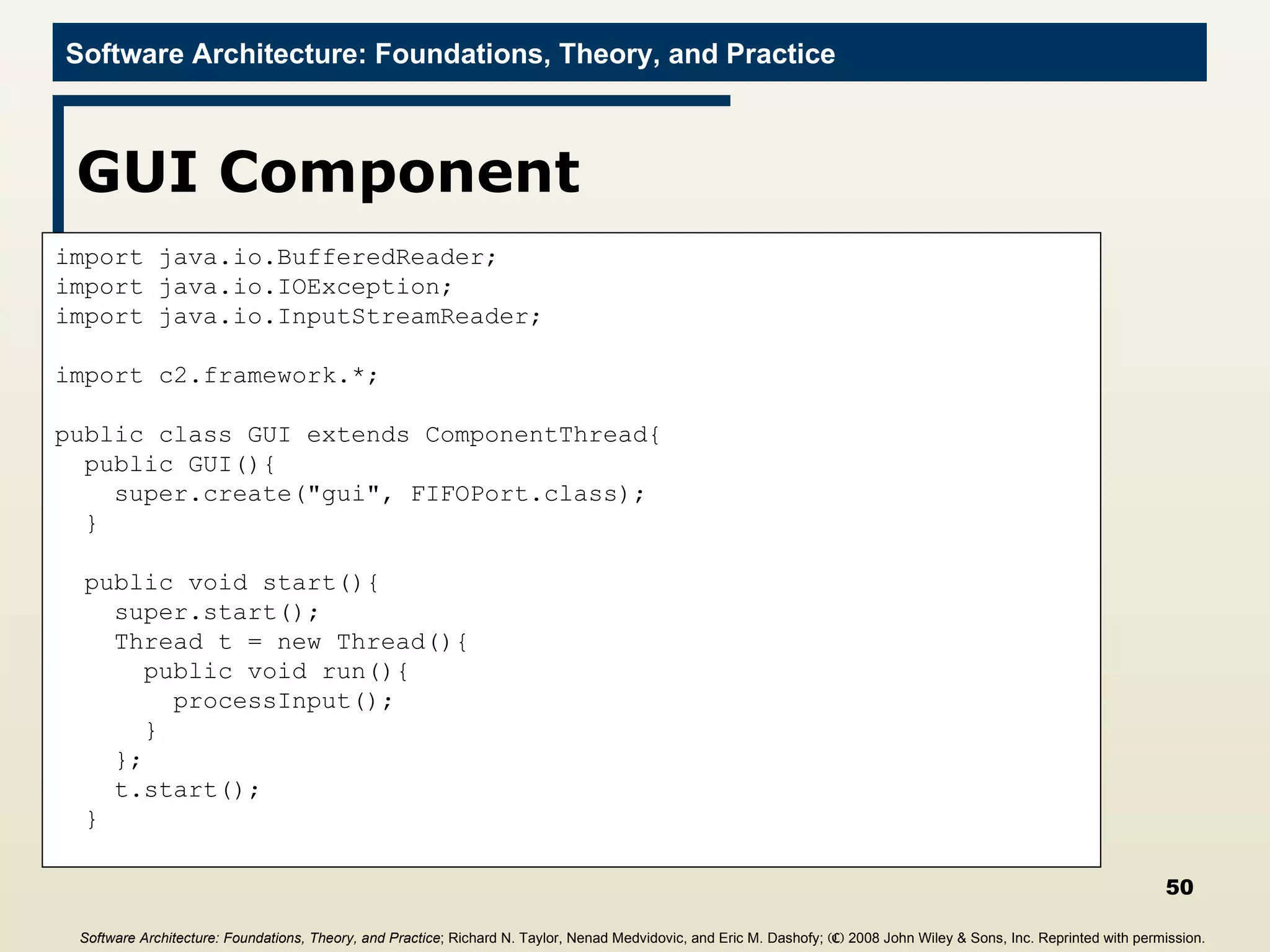
GUI Component import java.io.BufferedReader; import java.io.IOException; import java.io.InputStreamReader; import c2.framework.*; public class GUI extends ComponentThread{ public GUI(){ super.create(&quot;gui&quot;, FIFOPort.class); } public void start(){ super.start(); Thread t = new Thread(){ public void run(){ processInput(); } }; t.start(); } Software Architecture: Foundations, Theory, and Practice ; Richard N. Taylor, Nenad Medvidovic, and Eric M. Dashofy;  (C)  2008 John Wiley & Sons, Inc. Reprinted with permission.
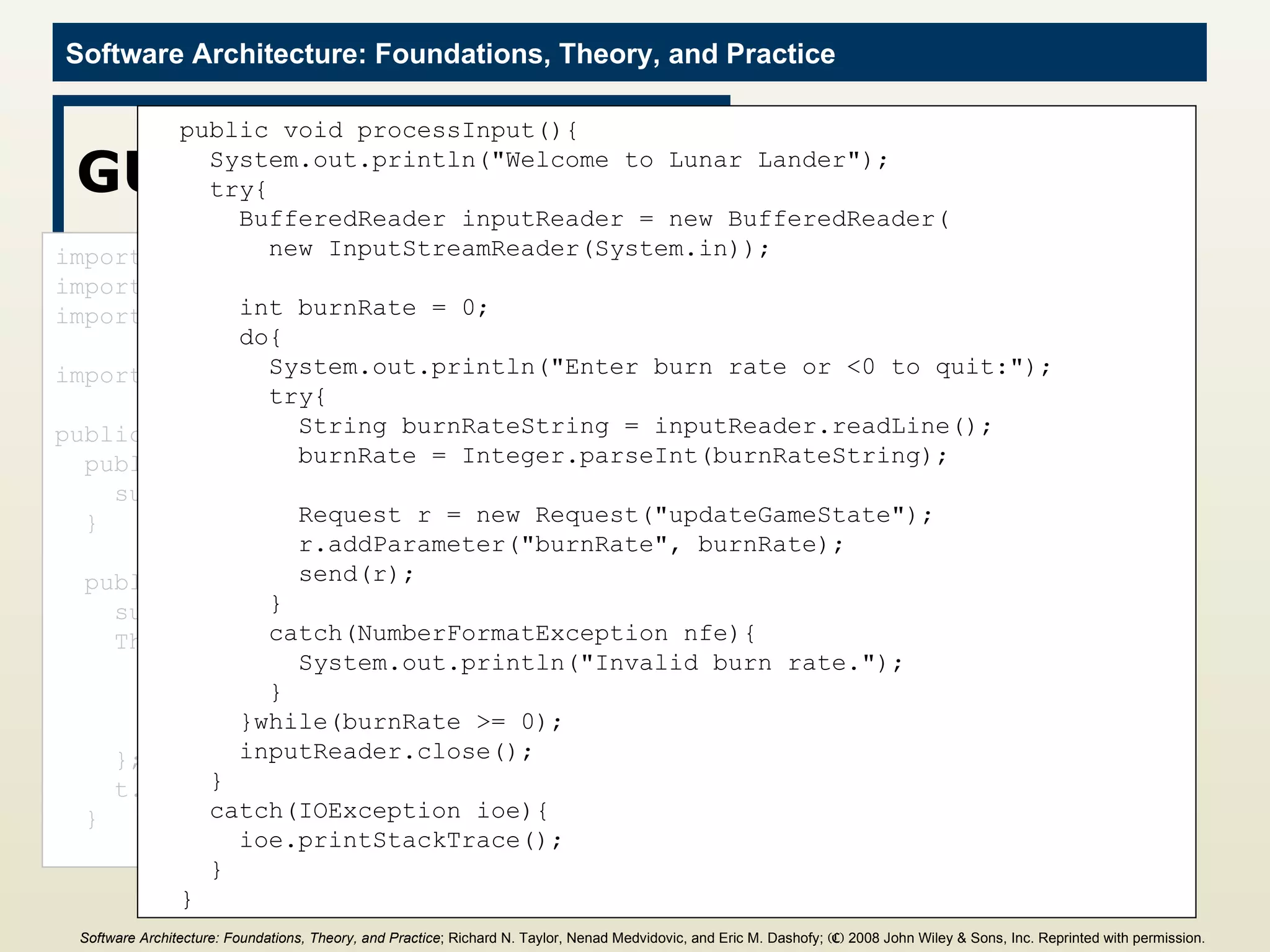
GUI Component import java.io.BufferedReader; import java.io.IOException; import java.io.InputStreamReader; import c2.framework.*; public class GUI extends ComponentThread{ public GUI(){ super.create(&quot;gui&quot;, FIFOPort.class); } public void start(){ super.start(); Thread t = new Thread(){ public void run(){ processInput(); } }; t.start(); } public void processInput(){ System.out.println(&quot;Welcome to Lunar Lander&quot;); try{ BufferedReader inputReader = new BufferedReader( new InputStreamReader(System.in)); int burnRate = 0; do{ System.out.println(&quot;Enter burn rate or <0 to quit:&quot;); try{ String burnRateString = inputReader.readLine(); burnRate = Integer.parseInt(burnRateString); Request r = new Request(&quot;updateGameState&quot;); r.addParameter(&quot;burnRate&quot;, burnRate); send(r); } catch(NumberFormatException nfe){ System.out.println(&quot;Invalid burn rate.&quot;); } }while(burnRate >= 0); inputReader.close(); } catch(IOException ioe){ ioe.printStackTrace(); } } Software Architecture: Foundations, Theory, and Practice ; Richard N. Taylor, Nenad Medvidovic, and Eric M. Dashofy;  (C)  2008 John Wiley & Sons, Inc. Reprinted with permission.
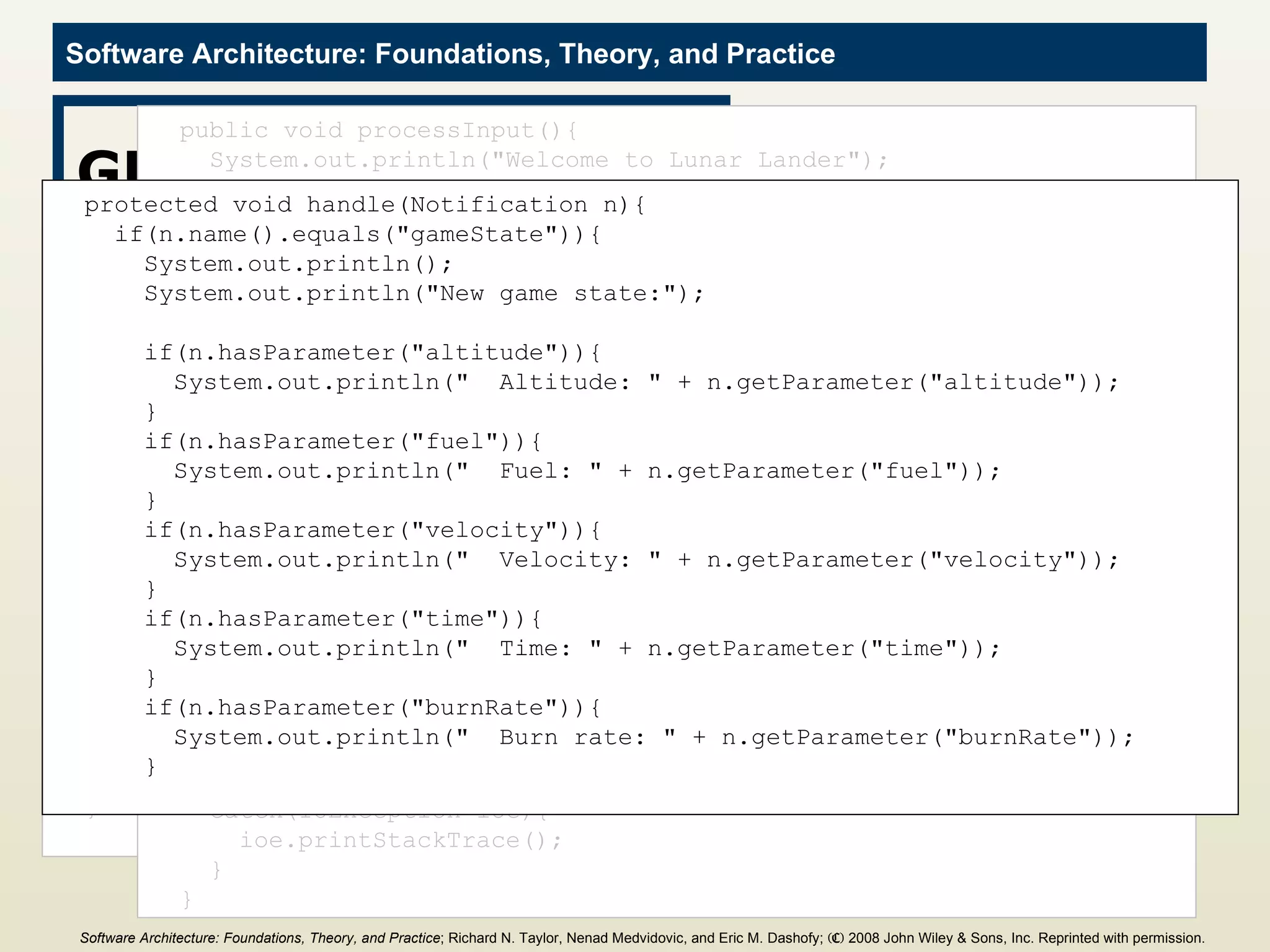
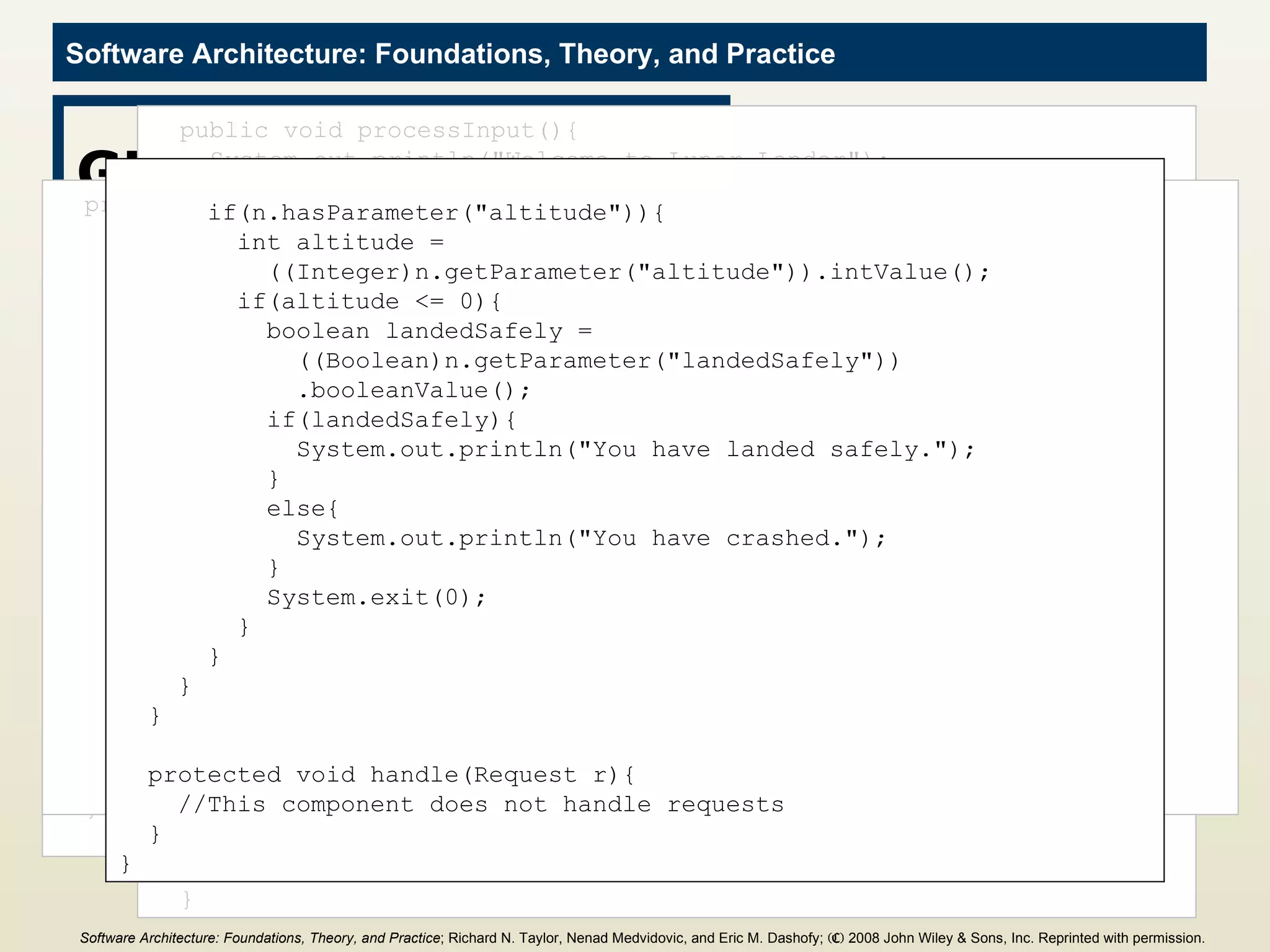
GUI Component import java.io.BufferedReader; import java.io.IOException; import java.io.InputStreamReader; import c2.framework.*; public class GUI extends ComponentThread{ public GUI(){ super.create(&quot;gui&quot;, FIFOPort.class); } public void start(){ super.start(); Thread t = new Thread(){ public void run(){ processInput(); } }; t.start(); } public void processInput(){ System.out.println(&quot;Welcome to Lunar Lander&quot;); try{ BufferedReader inputReader = new BufferedReader( new InputStreamReader(System.in)); int burnRate = 0; do{ System.out.println(&quot;Enter burn rate or <0 to quit:&quot;); try{ String burnRateString = inputReader.readLine(); burnRate = Integer.parseInt(burnRateString); Request r = new Request(&quot;updateGameState&quot;); r.addParameter(&quot;burnRate&quot;, burnRate); send(r); } catch(NumberFormatException nfe){ System.out.println(&quot;Invalid burn rate.&quot;); } }while(burnRate >= 0); inputReader.close(); } catch(IOException ioe){ ioe.printStackTrace(); } } protected void handle(Notification n){ if(n.name().equals(&quot;gameState&quot;)){ System.out.println(); System.out.println(&quot;New game state:&quot;); if(n.hasParameter(&quot;altitude&quot;)){ System.out.println(&quot;  Altitude: &quot; + n.getParameter(&quot;altitude&quot;)); } if(n.hasParameter(&quot;fuel&quot;)){ System.out.println(&quot;  Fuel: &quot; + n.getParameter(&quot;fuel&quot;)); } if(n.hasParameter(&quot;velocity&quot;)){ System.out.println(&quot;  Velocity: &quot; + n.getParameter(&quot;velocity&quot;)); } if(n.hasParameter(&quot;time&quot;)){ System.out.println(&quot;  Time: &quot; + n.getParameter(&quot;time&quot;)); } if(n.hasParameter(&quot;burnRate&quot;)){ System.out.println(&quot;  Burn rate: &quot; + n.getParameter(&quot;burnRate&quot;)); } Software Architecture: Foundations, Theory, and Practice ; Richard N. Taylor, Nenad Medvidovic, and Eric M. Dashofy;  (C)  2008 John Wiley & Sons, Inc. Reprinted with permission.
GUI Component import java.io.BufferedReader; import java.io.IOException; import java.io.InputStreamReader; import c2.framework.*; public class GUI extends ComponentThread{ public GUI(){ super.create(&quot;gui&quot;, FIFOPort.class); } public void start(){ super.start(); Thread t = new Thread(){ public void run(){ processInput(); } }; t.start(); } public void processInput(){ System.out.println(&quot;Welcome to Lunar Lander&quot;); try{ BufferedReader inputReader = new BufferedReader( new InputStreamReader(System.in)); int burnRate = 0; do{ System.out.println(&quot;Enter burn rate or <0 to quit:&quot;); try{ String burnRateString = inputReader.readLine(); burnRate = Integer.parseInt(burnRateString); Request r = new Request(&quot;updateGameState&quot;); r.addParameter(&quot;burnRate&quot;, burnRate); send(r); } catch(NumberFormatException nfe){ System.out.println(&quot;Invalid burn rate.&quot;); } }while(burnRate >= 0); inputReader.close(); } catch(IOException ioe){ ioe.printStackTrace(); } } protected void handle(Notification n){ if(n.name().equals(&quot;gameState&quot;)){ System.out.println(); System.out.println(&quot;New game state:&quot;); if(n.hasParameter(&quot;altitude&quot;)){ System.out.println(&quot;  Altitude: &quot; + n.getParameter(&quot;altitude&quot;)); } if(n.hasParameter(&quot;fuel&quot;)){ System.out.println(&quot;  Fuel: &quot; + n.getParameter(&quot;fuel&quot;)); } if(n.hasParameter(&quot;velocity&quot;)){ System.out.println(&quot;  Velocity: &quot; + n.getParameter(&quot;velocity&quot;)); } if(n.hasParameter(&quot;time&quot;)){ System.out.println(&quot;  Time: &quot; + n.getParameter(&quot;time&quot;)); } if(n.hasParameter(&quot;burnRate&quot;)){ System.out.println(&quot;  Burn rate: &quot; + n.getParameter(&quot;burnRate&quot;)); } if(n.hasParameter(&quot;altitude&quot;)){ int altitude =  ((Integer)n.getParameter(&quot;altitude&quot;)).intValue(); if(altitude <= 0){ boolean landedSafely =  ((Boolean)n.getParameter(&quot;landedSafely&quot;)) .booleanValue(); if(landedSafely){ System.out.println(&quot;You have landed safely.&quot;); } else{ System.out.println(&quot;You have crashed.&quot;); } System.exit(0); } } } } protected void handle(Request r){ //This component does not handle requests } } Software Architecture: Foundations, Theory, and Practice ; Richard N. Taylor, Nenad Medvidovic, and Eric M. Dashofy;  (C)  2008 John Wiley & Sons, Inc. Reprinted with permission.
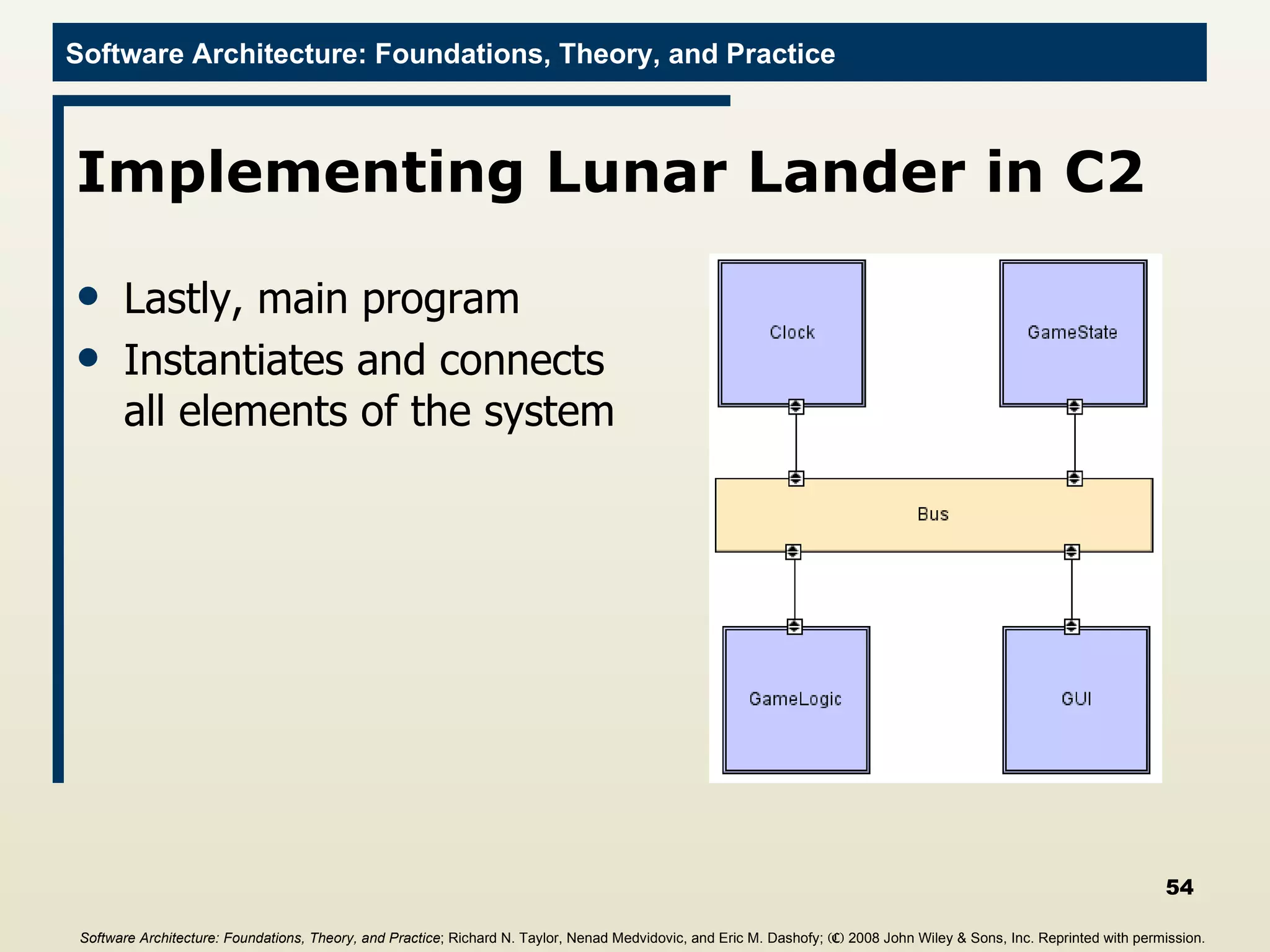
Implementing Lunar Lander in C2 Lastly, main program Instantiates and connects all elements of the system Software Architecture: Foundations, Theory, and Practice ; Richard N. Taylor, Nenad Medvidovic, and Eric M. Dashofy;  (C)  2008 John Wiley & Sons, Inc. Reprinted with permission.
Main Program import c2.framework.*; public class LunarLander{ public static void main(String[] args){ //Create the Lunar Lander architecture Architecture lunarLander = new  SimpleArchitecture(&quot;LunarLander&quot;); //Create the components Component clock = new Clock(); Component gameState = new GameState(); Component gameLogic = new GameLogic(); Component gui = new GUI(); //Create the connectors Connector bus = new ConnectorThread(&quot;bus&quot;); //Add the components and connectors to the architecture lunarLander.addComponent(clock); lunarLander.addComponent(gameState); lunarLander.addComponent(gameLogic); lunarLander.addComponent(gui); lunarLander.addConnector(bus); Software Architecture: Foundations, Theory, and Practice ; Richard N. Taylor, Nenad Medvidovic, and Eric M. Dashofy;  (C)  2008 John Wiley & Sons, Inc. Reprinted with permission.
Main Program import c2.framework.*; public class LunarLander{ public static void main(String[] args){ //Create the Lunar Lander architecture Architecture lunarLander = new  SimpleArchitecture(&quot;LunarLander&quot;); //Create the components Component clock = new Clock(); Component gameState = new GameState(); Component gameLogic = new GameLogic(); Component gui = new GUI(); //Create the connectors Connector bus = new ConnectorThread(&quot;bus&quot;); //Add the components and connectors to the architecture lunarLander.addComponent(clock); lunarLander.addComponent(gameState); lunarLander.addComponent(gameLogic); lunarLander.addComponent(gui); lunarLander.addConnector(bus); //Create the welds (links) between components and //connectors lunarLander.weld(clock, bus); lunarLander.weld(gameState, bus); lunarLander.weld(bus, gameLogic); lunarLander.weld(bus, gui); //Start the application lunarLander.start(); } } Software Architecture: Foundations, Theory, and Practice ; Richard N. Taylor, Nenad Medvidovic, and Eric M. Dashofy;  (C)  2008 John Wiley & Sons, Inc. Reprinted with permission.
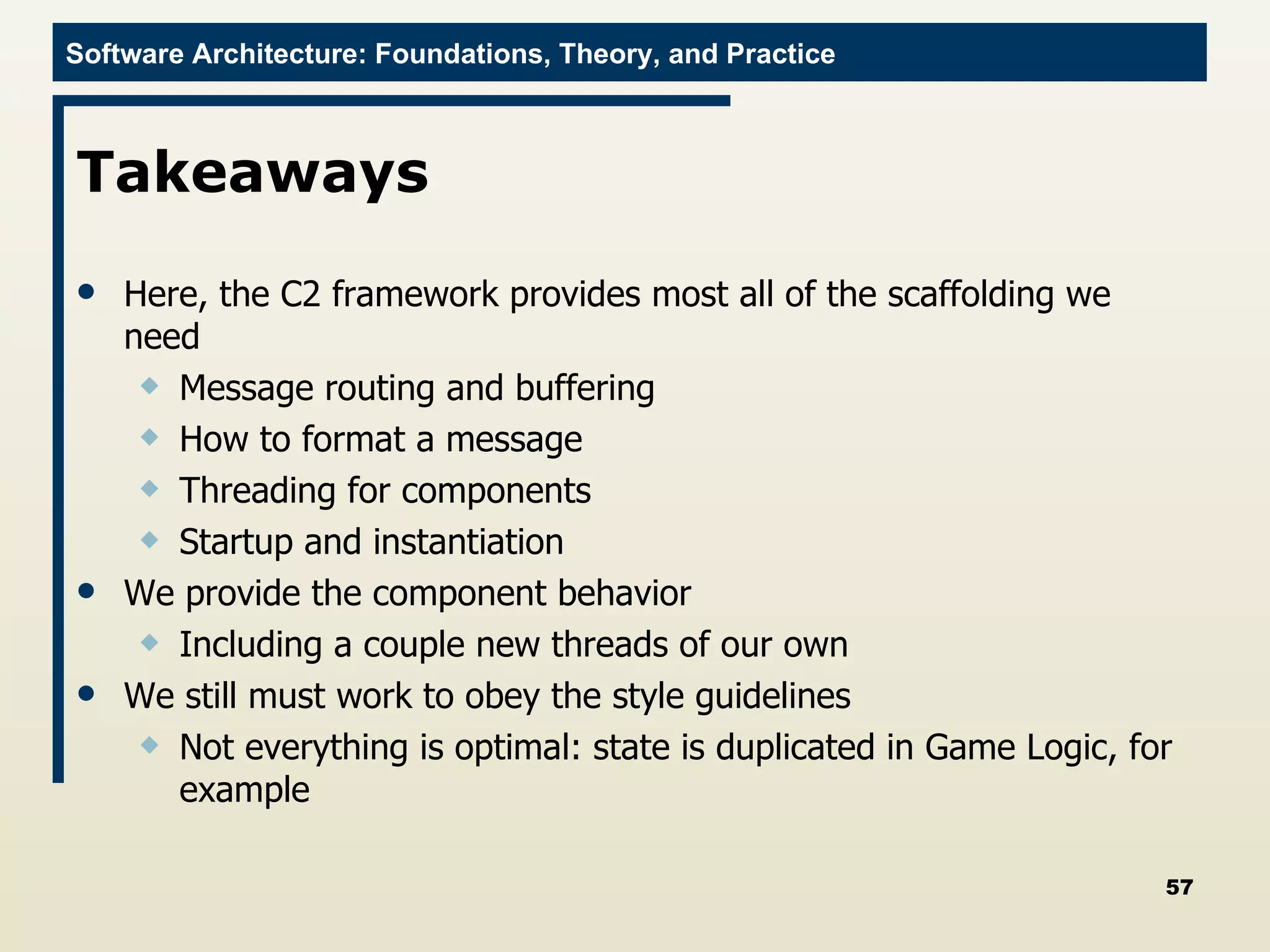
Takeaways Here, the C2 framework provides most all of the scaffolding we need Message routing and buffering How to format a message Threading for components Startup and instantiation We provide the component behavior Including a couple new threads of our own We still must work to obey the style guidelines Not everything is optimal: state is duplicated in Game Logic, for example

16 implementation techniques

  • 1.
    Implementation Techniques SoftwareArchitecture Lecture 16
  • 2.
    Objectives Concepts Implementationas a mapping problem Architecture implementation frameworks Evaluating frameworks Relationships between middleware, frameworks, component models Building new frameworks Concurrency and generative technologies Ensuring architecture-to-implementation consistency Examples Different frameworks for pipe-and-filter Different frameworks for the C2 style Application Implementing Lunar Lander in different frameworks
  • 3.
    Objectives Concepts Implementationas a mapping problem Architecture implementation frameworks Evaluating frameworks Relationships between middleware, frameworks, component models Building new frameworks Concurrency and generative technologies Ensuring architecture-to-implementation consistency Examples Different frameworks for pipe-and-filter Different frameworks for the C2 style Application Implementing Lunar Lander in different frameworks
  • 4.
    Recall Pipe-and-Filter Components(‘filters’) organized linearly, communicate through character-stream ‘pipes,’ which are the connectors Filters may run concurrently on partial data In general, all input comes in through the left and all output exits from the right Software Architecture: Foundations, Theory, and Practice ; Richard N. Taylor, Nenad Medvidovic, and Eric M. Dashofy; (C) 2008 John Wiley & Sons, Inc. Reprinted with permission.
  • 5.
    Framework #1: stdioStandard I/O framework used in C programming language Each process is a filter Reads input from standard input (aka ‘stdin’) Writes output to standard output (aka ‘stdout’) Also a third, unbuffered output stream called standard error (‘stderr’) not considered here Low and high level operations getchar (…), putchar (…) move one character at a time printf (…) and scanf (…) move and format entire strings Different implementations may vary in details (buffering strategy, etc.)
  • 6.
    Evaluating stdio Platformsupport Available with most, if not all, implementations of C programming language Operates somewhat differently on OSes with no concurrency (e.g., MS-DOS) Fidelity Good support for developing P&F applications, but no restriction that apps have to use this style Matching assumptions Filters are processes and pipes are implicit. In-process P&F applications might require modifications Efficiency Whether filters make maximal use of concurrency is partially up to filter implementations and partially up to the OS
  • 7.
    Framework #2: java.ioStandard I/O framework used in Java language Object-oriented Can be used for in-process or inter-process P&F applications All stream classes derive from InputStream or OutputStream Distinguished objects (System.in and System.out) for writing to process’ standard streams Additional capabilities (formatting, buffering) provided by creating composite streams (e.g., a Formatting-Buffered-InputStream)
  • 8.
    Evaluating java.io Platformsupport Available with all Java implementations on many platforms Platform-specific differences abstracted away Fidelity Good support for developing P&F applications, but no restriction that apps have to use this style Matching assumptions Easy to construct intra- and inter-process P&F applications Concurrency can be an issue; many calls are blocking Efficiency Users have fine-grained control over, e.g., buffering Very high efficiency mechanisms (memory mapped I/O, channels) not available (but are in java.nio)
  • 9.
    Recall the C2Style Layered style with event-based communication over two-way broadcast buses Strict rules on concurrency, dependencies, and so on Many frameworks developed for different languages; focus on two alternative Java frameworks here Software Architecture: Foundations, Theory, and Practice ; Richard N. Taylor, Nenad Medvidovic, and Eric M. Dashofy; (C) 2008 John Wiley & Sons, Inc. Reprinted with permission.
  • 10.
    Framework #1: LightweightC2 Framework 16 classes, 3000 lines of code Components & connectors extend abstract base classes Concurrency, queuing handled at individual comp/conn level Messages are request or notification objects Software Architecture: Foundations, Theory, and Practice ; Richard N. Taylor, Nenad Medvidovic, and Eric M. Dashofy; (C) 2008 John Wiley & Sons, Inc. Reprinted with permission.
  • 11.
    Evaluating Lightweight C2Framework Platform support Available with all Java implementations on many platforms Fidelity Assists developers with many aspects of C2 but does not enforce these constraints Leaves threading and queuing policies up to individual elements Matching assumptions Comp/conn main classes must inherit from distinguished base classes All messages must be in dictionary form Efficiency Lightweight framework; efficiency may depend on threading and queuing policy implemented by individual elements
  • 12.
    Framework #2: FlexibleC2 Framework 73 classes, 8500 lines of code Uses interfaces rather than base classes Threading policy for application is pluggable Message queuing policy is also pluggable Software Architecture: Foundations, Theory, and Practice ; Richard N. Taylor, Nenad Medvidovic, and Eric M. Dashofy; (C) 2008 John Wiley & Sons, Inc. Reprinted with permission.
  • 13.
    Framework #2: FlexibleC2 Framework Software Architecture: Foundations, Theory, and Practice ; Richard N. Taylor, Nenad Medvidovic, and Eric M. Dashofy; (C) 2008 John Wiley & Sons, Inc. Reprinted with permission.
  • 14.
    Evaluating Flexible C2Framework Platform support Available with all Java implementations on many platforms Fidelity Assists developers with many aspects of C2 but does not enforce these constraints Provides several alternative application-wide threading and queuing policies Matching assumptions Comp/conn main classes must implement distinguished interfaces Messages can be any serializable object Efficiency User can easily swap out and tune threading and queuing policies without disturbing remainder of application code
  • 15.
    Objectives Concepts Implementationas a mapping problem Architecture implementation frameworks Evaluating frameworks Relationships between middleware, frameworks, component models Building new frameworks Concurrency and generative technologies Ensuring architecture-to-implementation consistency Examples Different frameworks for pipe-and-filter Different frameworks for the C2 style Application Implementing Lunar Lander in different frameworks
  • 16.
    Implementing Pipe andFilter Lunar Lander Framework: java.io Implementing as a multi-process application Each component (filter) will be a separate OS process Operating system will provide the pipe connectors Going to use just the standard input and output streams Ignoring standard error Ignoring good error handling practices and corner cases for simplicity Software Architecture: Foundations, Theory, and Practice ; Richard N. Taylor, Nenad Medvidovic, and Eric M. Dashofy; (C) 2008 John Wiley & Sons, Inc. Reprinted with permission.
  • 17.
    Implementing Pipe andFilter Lunar Lander A note on I/O: Some messages sent from components are intended for output to the console (to be read by the user) These messages must be passed all the way through the pipeline and output at the end We will preface these with a ‘#’ Some messages are control messages meant to communicate state to a component down the pipeline These messages are intercepted by a component and processed We will preface these with a ‘%’ Software Architecture: Foundations, Theory, and Practice ; Richard N. Taylor, Nenad Medvidovic, and Eric M. Dashofy; (C) 2008 John Wiley & Sons, Inc. Reprinted with permission.
  • 18.
    Implementing Pipe andFilter Lunar Lander First: GetBurnRate component Loops; on each loop: Prompt user for new burn rate Read burn rate from the user on standard input Send burn rate to next component Quit if burn rate read < 0 Software Architecture: Foundations, Theory, and Practice ; Richard N. Taylor, Nenad Medvidovic, and Eric M. Dashofy; (C) 2008 John Wiley & Sons, Inc. Reprinted with permission.
  • 19.
    GetBurnRate Filter //Importthe java.io framework import java.io.*; public class GetBurnRate{ public static void main(String[] args){ //Send welcome message System.out.println(&quot;#Welcome to Lunar Lander&quot;); try{ //Begin reading from System input BufferedReader inputReader = new BufferedReader(new InputStreamReader(System.in)); //Set initial burn rate to 0 int burnRate = 0; do{ //Prompt user System.out.println(&quot;#Enter burn rate or <0 to quit:&quot;); . . . Software Architecture: Foundations, Theory, and Practice ; Richard N. Taylor, Nenad Medvidovic, and Eric M. Dashofy; (C) 2008 John Wiley & Sons, Inc. Reprinted with permission.
  • 20.
    GetBurnRate Filter //Importthe java.io framework import java.io.*; public class GetBurnRate{ public static void main(String[] args){ //Send welcome message System.out.println(&quot;#Welcome to Lunar Lander&quot;); try{ //Begin reading from System input BufferedReader inputReader = new BufferedReader(new InputStreamReader(System.in)); //Set initial burn rate to 0 int burnRate = 0; do{ //Prompt user System.out.println(&quot;#Enter burn rate or <0 to quit:&quot;); . . . . . . //Read user response try{ String burnRateString = inputReader.readLine(); burnRate = Integer.parseInt(burnRateString); //Send user-supplied burn rate to next filter System.out.println(&quot;%&quot; + burnRate); } catch(NumberFormatException nfe){ System.out.println(&quot;#Invalid burn rate.&quot;); } }while(burnRate >= 0); inputReader.close(); } catch(IOException ioe){ ioe.printStackTrace(); } } } Software Architecture: Foundations, Theory, and Practice ; Richard N. Taylor, Nenad Medvidovic, and Eric M. Dashofy; (C) 2008 John Wiley & Sons, Inc. Reprinted with permission.
  • 21.
    Implementing Pipe andFilter Lunar Lander Second: CalcNewValues Component Read burn rate from standard input Calculate new game state including game-over Send new game state to next component New game state is not sent in a formatted string; that’s the display component’s job Software Architecture: Foundations, Theory, and Practice ; Richard N. Taylor, Nenad Medvidovic, and Eric M. Dashofy; (C) 2008 John Wiley & Sons, Inc. Reprinted with permission.
  • 22.
    CalcBurnRate Filter importjava.io.*; public class CalcNewValues{ public static void main(String[] args){ //Initialize values final int GRAVITY = 2; int altitude = 1000; int fuel = 500; int velocity = 70; int time = 0; try{ BufferedReader inputReader = new BufferedReader(new InputStreamReader(System.in)); //Print initial values System.out.println(&quot;%a&quot; + altitude); System.out.println(&quot;%f&quot; + fuel); System.out.println(&quot;%v&quot; + velocity); System.out.println(&quot;%t&quot; + time); . . . Software Architecture: Foundations, Theory, and Practice ; Richard N. Taylor, Nenad Medvidovic, and Eric M. Dashofy; (C) 2008 John Wiley & Sons, Inc. Reprinted with permission.
  • 23.
    CalcBurnRate Filter importjava.io.*; public class CalcNewValues{ public static void main(String[] args){ //Initialize values final int GRAVITY = 2; int altitude = 1000; int fuel = 500; int velocity = 70; int time = 0; try{ BufferedReader inputReader = new BufferedReader(new InputStreamReader(System.in)); //Print initial values System.out.println(&quot;%a&quot; + altitude); System.out.println(&quot;%f&quot; + fuel); System.out.println(&quot;%v&quot; + velocity); System.out.println(&quot;%t&quot; + time); . . . String inputLine = null; do{ inputLine = inputReader.readLine(); if((inputLine != null) && (inputLine.length() > 0)){ if(inputLine.startsWith(&quot;#&quot;)){ //This is a status line of text, and //should be passed down the pipeline System.out.println(inputLine); } else if(inputLine.startsWith(&quot;%&quot;)){ //This is an input burn rate try{ int burnRate = Integer.parseInt(inputLine.substring(1)); if(altitude <= 0){ System.out.println(&quot;#The game is over.&quot;); } else if(burnRate > fuel){ System.out.println(&quot;#Sorry, you don't&quot; + &quot;have that much fuel.&quot;); } . . . Software Architecture: Foundations, Theory, and Practice ; Richard N. Taylor, Nenad Medvidovic, and Eric M. Dashofy; (C) 2008 John Wiley & Sons, Inc. Reprinted with permission.
  • 24.
    CalcBurnRate Filter importjava.io.*; public class CalcNewValues{ public static void main(String[] args){ //Initialize values final int GRAVITY = 2; int altitude = 1000; int fuel = 500; int velocity = 70; int time = 0; try{ BufferedReader inputReader = new BufferedReader(new InputStreamReader(System.in)); //Print initial values System.out.println(&quot;%a&quot; + altitude); System.out.println(&quot;%f&quot; + fuel); System.out.println(&quot;%v&quot; + velocity); System.out.println(&quot;%t&quot; + time); . . . String inputLine = null; do{ inputLine = inputReader.readLine(); if((inputLine != null) && (inputLine.length() > 0)){ if(inputLine.startsWith(&quot;#&quot;)){ //This is a status line of text, and //should be passed down the pipeline System.out.println(inputLine); } else if(inputLine.startsWith(&quot;%&quot;)){ //This is an input burn rate try{ int burnRate = Integer.parseInt(inputLine.substring(1)); if(altitude <= 0){ System.out.println(&quot;#The game is over.&quot;); } else if(burnRate > fuel){ System.out.println(&quot;#Sorry, you don't&quot; + &quot;have that much fuel.&quot;); } . . . else{ //Calculate new application state time = time + 1; altitude = altitude - velocity; velocity = ((velocity + GRAVITY) * 10 - burnRate * 2) / 10; fuel = fuel - burnRate; if(altitude <= 0){ altitude = 0; if(velocity <= 5){ System.out.println(&quot;#You have landed safely.&quot;); } else{ System.out.println(&quot;#You have crashed.&quot;); } } } //Print new values System.out.println(&quot;%a&quot; + altitude); System.out.println(&quot;%f&quot; + fuel); System.out.println(&quot;%v&quot; + velocity); System.out.println(&quot;%t&quot; + time); } catch(NumberFormatException nfe){ } . . . Software Architecture: Foundations, Theory, and Practice ; Richard N. Taylor, Nenad Medvidovic, and Eric M. Dashofy; (C) 2008 John Wiley & Sons, Inc. Reprinted with permission.
  • 25.
    CalcBurnRate Filter importjava.io.*; public class CalcNewValues{ public static void main(String[] args){ //Initialize values final int GRAVITY = 2; int altitude = 1000; int fuel = 500; int velocity = 70; int time = 0; try{ BufferedReader inputReader = new BufferedReader(new InputStreamReader(System.in)); //Print initial values System.out.println(&quot;%a&quot; + altitude); System.out.println(&quot;%f&quot; + fuel); System.out.println(&quot;%v&quot; + velocity); System.out.println(&quot;%t&quot; + time); . . . String inputLine = null; do{ inputLine = inputReader.readLine(); if((inputLine != null) && (inputLine.length() > 0)){ if(inputLine.startsWith(&quot;#&quot;)){ //This is a status line of text, and //should be passed down the pipeline System.out.println(inputLine); } else if(inputLine.startsWith(&quot;%&quot;)){ //This is an input burn rate try{ int burnRate = Integer.parseInt(inputLine.substring(1)); if(altitude <= 0){ System.out.println(&quot;#The game is over.&quot;); } else if(burnRate > fuel){ System.out.println(&quot;#Sorry, you don't&quot; + &quot;have that much fuel.&quot;); } . . . else{ //Calculate new application state time = time + 1; altitude = altitude - velocity; velocity = ((velocity + GRAVITY) * 10 - burnRate * 2) / 10; fuel = fuel - burnRate; if(altitude <= 0){ altitude = 0; if(velocity <= 5){ System.out.println(&quot;#You have landed safely.&quot;); } else{ System.out.println(&quot;#You have crashed.&quot;); } } } //Print new values System.out.println(&quot;%a&quot; + altitude); System.out.println(&quot;%f&quot; + fuel); System.out.println(&quot;%v&quot; + velocity); System.out.println(&quot;%t&quot; + time); } catch(NumberFormatException nfe){ } . . . } } }while((inputLine != null) && (altitude > 0)); inputReader.close(); } catch(IOException ioe){ ioe.printStackTrace(); } } } Software Architecture: Foundations, Theory, and Practice ; Richard N. Taylor, Nenad Medvidovic, and Eric M. Dashofy; (C) 2008 John Wiley & Sons, Inc. Reprinted with permission.
  • 26.
    Implementing Pipe andFilter Lunar Lander Third: DisplayValues component Read value updates from standard input Format them for human reading and send them to standard output Software Architecture: Foundations, Theory, and Practice ; Richard N. Taylor, Nenad Medvidovic, and Eric M. Dashofy; (C) 2008 John Wiley & Sons, Inc. Reprinted with permission.
  • 27.
    DisplayValues Filter importjava.io.*; public class DisplayValues{ public static void main(String[] args){ try{ BufferedReader inputReader = new BufferedReader(new InputStreamReader(System.in)); String inputLine = null; do{ inputLine = inputReader.readLine(); if((inputLine != null) && (inputLine.length() > 0)){ if(inputLine.startsWith(&quot;#&quot;)){ //This is a status line of text, and //should be passed down the pipeline with //the pound-sign stripped off System.out.println(inputLine.substring(1)); } . . . Software Architecture: Foundations, Theory, and Practice ; Richard N. Taylor, Nenad Medvidovic, and Eric M. Dashofy; (C) 2008 John Wiley & Sons, Inc. Reprinted with permission.
  • 28.
    DisplayValues Filter importjava.io.*; public class DisplayValues{ public static void main(String[] args){ try{ BufferedReader inputReader = new BufferedReader(new InputStreamReader(System.in)); String inputLine = null; do{ inputLine = inputReader.readLine(); if((inputLine != null) && (inputLine.length() > 0)){ if(inputLine.startsWith(&quot;#&quot;)){ //This is a status line of text, and //should be passed down the pipeline with //the pound-sign stripped off System.out.println(inputLine.substring(1)); } . . . else if(inputLine.startsWith(&quot;%&quot;)){ //This is a value to display if(inputLine.length() > 1){ try{ char valueType = inputLine.charAt(1); int value = Integer.parseInt(inputLine.substring(2)); switch(valueType){ case 'a': System.out.println(&quot;Altitude: &quot; + value); break; case 'f': System.out.println(&quot;Fuel remaining: &quot; + value); break; case 'v': System.out.println(&quot;Current Velocity: “ + value); break; case 't': System.out.println(&quot;Time elapsed: &quot; + value); break; } } catch(NumberFormatException nfe){ } . . . Software Architecture: Foundations, Theory, and Practice ; Richard N. Taylor, Nenad Medvidovic, and Eric M. Dashofy; (C) 2008 John Wiley & Sons, Inc. Reprinted with permission.
  • 29.
    DisplayValues Filter importjava.io.*; public class DisplayValues{ public static void main(String[] args){ try{ BufferedReader inputReader = new BufferedReader(new InputStreamReader(System.in)); String inputLine = null; do{ inputLine = inputReader.readLine(); if((inputLine != null) && (inputLine.length() > 0)){ if(inputLine.startsWith(&quot;#&quot;)){ //This is a status line of text, and //should be passed down the pipeline with //the pound-sign stripped off System.out.println(inputLine.substring(1)); } . . . else if(inputLine.startsWith(&quot;%&quot;)){ //This is a value to display if(inputLine.length() > 1){ try{ char valueType = inputLine.charAt(1); int value = Integer.parseInt(inputLine.substring(2)); switch(valueType){ case 'a': System.out.println(&quot;Altitude: &quot; + value); break; case 'f': System.out.println(&quot;Fuel remaining: &quot; + value); break; case 'v': System.out.println(&quot;Current Velocity: “ + value); break; case 't': System.out.println(&quot;Time elapsed: &quot; + value); break; } } catch(NumberFormatException nfe){ } . . . } } } }while(inputLine != null); inputReader.close(); } catch(IOException ioe){ ioe.printStackTrace(); } } } Software Architecture: Foundations, Theory, and Practice ; Richard N. Taylor, Nenad Medvidovic, and Eric M. Dashofy; (C) 2008 John Wiley & Sons, Inc. Reprinted with permission.
  • 30.
    Implementing Pipe andFilter Lunar Lander Instantiating the application java GetBurnRate | java CalcNewValues | java DisplayValues Software Architecture: Foundations, Theory, and Practice ; Richard N. Taylor, Nenad Medvidovic, and Eric M. Dashofy; (C) 2008 John Wiley & Sons, Inc. Reprinted with permission.
  • 31.
    Implementing Pipe andFilter Lunar Lander Software Architecture: Foundations, Theory, and Practice ; Richard N. Taylor, Nenad Medvidovic, and Eric M. Dashofy; (C) 2008 John Wiley & Sons, Inc. Reprinted with permission.
  • 32.
    Implementing Pipe andFilter Lunar Lander
  • 33.
    Implementing Pipe andFilter Lunar Lander Software Architecture: Foundations, Theory, and Practice ; Richard N. Taylor, Nenad Medvidovic, and Eric M. Dashofy; (C) 2008 John Wiley & Sons, Inc. Reprinted with permission.
  • 34.
    Implementing Pipe andFilter Lunar Lander
  • 35.
    Takeaways java.io providesa number of useful facilities Stream objects (System.in, System.out) Buffering wrappers OS provides some of the facilities Pipes Concurrency support Note that this version of the application would not work if it operated in batch-sequential mode We had other communication mechanisms available, but did not use them to conform to the P&F style We had to develop a new (albeit simple) protocol to get the correct behavior
  • 36.
    Implementing Lunar Landerin C2 Framework: Lightweight C2 framework Each component has its own thread of control Components receive requests or notifications and respond with new ones Message routing follows C2 rules This is a real-time, clock-driven version of Lunar Lander Software Architecture: Foundations, Theory, and Practice ; Richard N. Taylor, Nenad Medvidovic, and Eric M. Dashofy; (C) 2008 John Wiley & Sons, Inc. Reprinted with permission.
  • 37.
    Implementing Lunar Landerin C2 (cont’d) First: Clock component Sends out a ‘tick’ notification periodically Does not respond to any messages Software Architecture: Foundations, Theory, and Practice ; Richard N. Taylor, Nenad Medvidovic, and Eric M. Dashofy; (C) 2008 John Wiley & Sons, Inc. Reprinted with permission.
  • 38.
    Clock Component importc2.framework.*; public class Clock extends ComponentThread{ public Clock(){ super.create(&quot;clock&quot;, FIFOPort.class); } public void start(){ super.start(); Thread clockThread = new Thread(){ public void run(){ //Repeat while the application runs while(true){ //Wait for five seconds try{ Thread.sleep(5000); } catch(InterruptedException ie){} //Send out a tick notification Notification n = new Notification(&quot;clockTick&quot;); send(n); } } }; Software Architecture: Foundations, Theory, and Practice ; Richard N. Taylor, Nenad Medvidovic, and Eric M. Dashofy; (C) 2008 John Wiley & Sons, Inc. Reprinted with permission.
  • 39.
    Clock Component importc2.framework.*; public class Clock extends ComponentThread{ public Clock(){ super.create(&quot;clock&quot;, FIFOPort.class); } public void start(){ super.start(); Thread clockThread = new Thread(){ public void run(){ //Repeat while the application runs while(true){ //Wait for five seconds try{ Thread.sleep(5000); } catch(InterruptedException ie){} //Send out a tick notification Notification n = new Notification(&quot;clockTick&quot;); send(n); } } }; clockThread.start(); } protected void handle(Notification n){ //This component does not handle notifications } protected void handle(Request r){ //This component does not handle requests } } Software Architecture: Foundations, Theory, and Practice ; Richard N. Taylor, Nenad Medvidovic, and Eric M. Dashofy; (C) 2008 John Wiley & Sons, Inc. Reprinted with permission.
  • 40.
    Implementing Lunar Landerin C2 Second: GameState Component Receives request to update internal state Emits notifications of new game state on request or when state changes Does NOT compute new state Just a data store Software Architecture: Foundations, Theory, and Practice ; Richard N. Taylor, Nenad Medvidovic, and Eric M. Dashofy; (C) 2008 John Wiley & Sons, Inc. Reprinted with permission.
  • 41.
    GameState Component importc2.framework.*; public class GameState extends ComponentThread{ public GameState(){ super.create(&quot;gameState&quot;, FIFOPort.class); } //Internal game state and initial values int altitude = 1000; int fuel = 500; int velocity = 70; int time = 0; int burnRate = 0; boolean landedSafely = false; Software Architecture: Foundations, Theory, and Practice ; Richard N. Taylor, Nenad Medvidovic, and Eric M. Dashofy; (C) 2008 John Wiley & Sons, Inc. Reprinted with permission.
  • 42.
    GameState Component importc2.framework.*; public class GameState extends ComponentThread{ public GameState(){ super.create(&quot;gameState&quot;, FIFOPort.class); } //Internal game state and initial values int altitude = 1000; int fuel = 500; int velocity = 70; int time = 0; int burnRate = 0; boolean landedSafely = false; protected void handle(Request r){ if(r.name().equals(&quot;updateGameState&quot;)){ //Update the internal game state if(r.hasParameter(&quot;altitude&quot;)){ this.altitude = ((Integer)r.getParameter(&quot;altitude&quot;)).intValue(); } if(r.hasParameter(&quot;fuel&quot;)){ this.fuel = ((Integer)r.getParameter(&quot;fuel&quot;)).intValue(); } if(r.hasParameter(&quot;velocity&quot;)){ this.velocity = ((Integer)r.getParameter(&quot;velocity&quot;)).intValue(); } if(r.hasParameter(&quot;time&quot;)){ this.time = ((Integer)r.getParameter(&quot;time&quot;)).intValue(); } if(r.hasParameter(&quot;burnRate&quot;)){ this.burnRate = ((Integer)r.getParameter(&quot;burnRate&quot;)).intValue(); } if(r.hasParameter(&quot;landedSafely&quot;)){ this.landedSafely = ((Boolean)r.getParameter(&quot;landedSafely&quot;)) .booleanValue(); } //Send out the updated game state Notification n = createStateNotification(); send(n); } Software Architecture: Foundations, Theory, and Practice ; Richard N. Taylor, Nenad Medvidovic, and Eric M. Dashofy; (C) 2008 John Wiley & Sons, Inc. Reprinted with permission.
  • 43.
    GameState Component importc2.framework.*; public class GameState extends ComponentThread{ public GameState(){ super.create(&quot;gameState&quot;, FIFOPort.class); } //Internal game state and initial values int altitude = 1000; int fuel = 500; int velocity = 70; int time = 0; int burnRate = 0; boolean landedSafely = false; protected void handle(Request r){ if(r.name().equals(&quot;updateGameState&quot;)){ //Update the internal game state if(r.hasParameter(&quot;altitude&quot;)){ this.altitude = ((Integer)r.getParameter(&quot;altitude&quot;)).intValue(); } if(r.hasParameter(&quot;fuel&quot;)){ this.fuel = ((Integer)r.getParameter(&quot;fuel&quot;)).intValue(); } if(r.hasParameter(&quot;velocity&quot;)){ this.velocity = ((Integer)r.getParameter(&quot;velocity&quot;)).intValue(); } if(r.hasParameter(&quot;time&quot;)){ this.time = ((Integer)r.getParameter(&quot;time&quot;)).intValue(); } if(r.hasParameter(&quot;burnRate&quot;)){ this.burnRate = ((Integer)r.getParameter(&quot;burnRate&quot;)).intValue(); } if(r.hasParameter(&quot;landedSafely&quot;)){ this.landedSafely = ((Boolean)r.getParameter(&quot;landedSafely&quot;)) .booleanValue(); } //Send out the updated game state Notification n = createStateNotification(); send(n); } else if(r.name().equals(&quot;getGameState&quot;)){ //If a component requests the game state //without updating it, send out the state Notification n = createStateNotification(); send(n); } } protected Notification createStateNotification(){ //Create a new notification comprising the //current game state Notification n = new Notification(&quot;gameState&quot;); n.addParameter(&quot;altitude&quot;, altitude); n.addParameter(&quot;fuel&quot;, fuel); n.addParameter(&quot;velocity&quot;, velocity); n.addParameter(&quot;time&quot;, time); n.addParameter(&quot;burnRate&quot;, burnRate); n.addParameter(&quot;landedSafely&quot;, landedSafely); return n; } protected void handle(Notification n){ //This component does not handle notifications } } Software Architecture: Foundations, Theory, and Practice ; Richard N. Taylor, Nenad Medvidovic, and Eric M. Dashofy; (C) 2008 John Wiley & Sons, Inc. Reprinted with permission.
  • 44.
    Implementing Lunar Landerin C2 Third: GameLogic Component Receives notifications of game state changes Receives clock ticks On clock tick notification, calculates new state and sends request up Software Architecture: Foundations, Theory, and Practice ; Richard N. Taylor, Nenad Medvidovic, and Eric M. Dashofy; (C) 2008 John Wiley & Sons, Inc. Reprinted with permission.
  • 45.
    GameLogic Component importc2.framework.*; public class GameLogic extends ComponentThread{ public GameLogic(){ super.create(&quot;gameLogic&quot;, FIFOPort.class); } //Game constants final int GRAVITY = 2; //Internal state values for computation int altitude = 0; int fuel = 0; int velocity = 0; int time = 0; int burnRate = 0; public void start(){ super.start(); Request r = new Request(&quot;getGameState&quot;); send(r); } Software Architecture: Foundations, Theory, and Practice ; Richard N. Taylor, Nenad Medvidovic, and Eric M. Dashofy; (C) 2008 John Wiley & Sons, Inc. Reprinted with permission.
  • 46.
    GameLogic Component importc2.framework.*; public class GameLogic extends ComponentThread{ public GameLogic(){ super.create(&quot;gameLogic&quot;, FIFOPort.class); } //Game constants final int GRAVITY = 2; //Internal state values for computation int altitude = 0; int fuel = 0; int velocity = 0; int time = 0; int burnRate = 0; public void start(){ super.start(); Request r = new Request(&quot;getGameState&quot;); send(r); } protected void handle(Notification n){ if(n.name().equals(&quot;gameState&quot;)){ if(n.hasParameter(&quot;altitude&quot;)){ this.altitude = ((Integer)n.getParameter(&quot;altitude&quot;)).intValue(); } if(n.hasParameter(&quot;fuel&quot;)){ this.fuel = ((Integer)n.getParameter(&quot;fuel&quot;)).intValue(); } if(n.hasParameter(&quot;velocity&quot;)){ this.velocity = ((Integer)n.getParameter(&quot;velocity&quot;)).intValue(); } if(n.hasParameter(&quot;time&quot;)){ this.time = ((Integer)n.getParameter(&quot;time&quot;)).intValue(); } if(n.hasParameter(&quot;burnRate&quot;)){ this.burnRate = ((Integer)n.getParameter(&quot;burnRate&quot;)).intValue(); } } Software Architecture: Foundations, Theory, and Practice ; Richard N. Taylor, Nenad Medvidovic, and Eric M. Dashofy; (C) 2008 John Wiley & Sons, Inc. Reprinted with permission.
  • 47.
    GameLogic Component importc2.framework.*; public class GameLogic extends ComponentThread{ public GameLogic(){ super.create(&quot;gameLogic&quot;, FIFOPort.class); } //Game constants final int GRAVITY = 2; //Internal state values for computation int altitude = 0; int fuel = 0; int velocity = 0; int time = 0; int burnRate = 0; public void start(){ super.start(); Request r = new Request(&quot;getGameState&quot;); send(r); } protected void handle(Notification n){ if(n.name().equals(&quot;gameState&quot;)){ if(n.hasParameter(&quot;altitude&quot;)){ this.altitude = ((Integer)n.getParameter(&quot;altitude&quot;)).intValue(); } if(n.hasParameter(&quot;fuel&quot;)){ this.fuel = ((Integer)n.getParameter(&quot;fuel&quot;)).intValue(); } if(n.hasParameter(&quot;velocity&quot;)){ this.velocity = ((Integer)n.getParameter(&quot;velocity&quot;)).intValue(); } if(n.hasParameter(&quot;time&quot;)){ this.time = ((Integer)n.getParameter(&quot;time&quot;)).intValue(); } if(n.hasParameter(&quot;burnRate&quot;)){ this.burnRate = ((Integer)n.getParameter(&quot;burnRate&quot;)).intValue(); } } else if(n.name().equals(&quot;clockTick&quot;)){ //Calculate new lander state values int actualBurnRate = burnRate; if(actualBurnRate > fuel){ //Ensure we don’t burn more fuel than we have actualBurnRate = fuel; } time = time + 1; altitude = altitude - velocity; velocity = ((velocity + GRAVITY) * 10 – actualBurnRate * 2) / 10; fuel = fuel - actualBurnRate; //Determine if we landed (safely) boolean landedSafely = false; if(altitude <= 0){ altitude = 0; if(velocity <= 5){ landedSafely = true; } } Software Architecture: Foundations, Theory, and Practice ; Richard N. Taylor, Nenad Medvidovic, and Eric M. Dashofy; (C) 2008 John Wiley & Sons, Inc. Reprinted with permission.
  • 48.
    GameLogic Component importc2.framework.*; public class GameLogic extends ComponentThread{ public GameLogic(){ super.create(&quot;gameLogic&quot;, FIFOPort.class); } //Game constants final int GRAVITY = 2; //Internal state values for computation int altitude = 0; int fuel = 0; int velocity = 0; int time = 0; int burnRate = 0; public void start(){ super.start(); Request r = new Request(&quot;getGameState&quot;); send(r); } protected void handle(Notification n){ if(n.name().equals(&quot;gameState&quot;)){ if(n.hasParameter(&quot;altitude&quot;)){ this.altitude = ((Integer)n.getParameter(&quot;altitude&quot;)).intValue(); } if(n.hasParameter(&quot;fuel&quot;)){ this.fuel = ((Integer)n.getParameter(&quot;fuel&quot;)).intValue(); } if(n.hasParameter(&quot;velocity&quot;)){ this.velocity = ((Integer)n.getParameter(&quot;velocity&quot;)).intValue(); } if(n.hasParameter(&quot;time&quot;)){ this.time = ((Integer)n.getParameter(&quot;time&quot;)).intValue(); } if(n.hasParameter(&quot;burnRate&quot;)){ this.burnRate = ((Integer)n.getParameter(&quot;burnRate&quot;)).intValue(); } } else if(n.name().equals(&quot;clockTick&quot;)){ //Calculate new lander state values int actualBurnRate = burnRate; if(actualBurnRate > fuel){ //Ensure we don’t burn more fuel than we have actualBurnRate = fuel; } time = time + 1; altitude = altitude - velocity; velocity = ((velocity + GRAVITY) * 10 – actualBurnRate * 2) / 10; fuel = fuel - actualBurnRate; //Determine if we landed (safely) boolean landedSafely = false; if(altitude <= 0){ altitude = 0; if(velocity <= 5){ landedSafely = true; } } Request r = new Request(&quot;updateGameState&quot;); r.addParameter(&quot;time&quot;, time); r.addParameter(&quot;altitude&quot;, altitude); r.addParameter(&quot;velocity&quot;, velocity); r.addParameter(&quot;fuel&quot;, fuel); r.addParameter(&quot;landedSafely&quot;, landedSafely); send(r); } } protected void handle(Request r){ //This component does not handle requests } } Software Architecture: Foundations, Theory, and Practice ; Richard N. Taylor, Nenad Medvidovic, and Eric M. Dashofy; (C) 2008 John Wiley & Sons, Inc. Reprinted with permission.
  • 49.
    Implementing Lunar Landerin C2 Fourth: GUI Component Reads burn rates from user and sends them up as requests Receives notifications of game state changes and formats them to console Software Architecture: Foundations, Theory, and Practice ; Richard N. Taylor, Nenad Medvidovic, and Eric M. Dashofy; (C) 2008 John Wiley & Sons, Inc. Reprinted with permission.
  • 50.
    GUI Component importjava.io.BufferedReader; import java.io.IOException; import java.io.InputStreamReader; import c2.framework.*; public class GUI extends ComponentThread{ public GUI(){ super.create(&quot;gui&quot;, FIFOPort.class); } public void start(){ super.start(); Thread t = new Thread(){ public void run(){ processInput(); } }; t.start(); } Software Architecture: Foundations, Theory, and Practice ; Richard N. Taylor, Nenad Medvidovic, and Eric M. Dashofy; (C) 2008 John Wiley & Sons, Inc. Reprinted with permission.
  • 51.
    GUI Component importjava.io.BufferedReader; import java.io.IOException; import java.io.InputStreamReader; import c2.framework.*; public class GUI extends ComponentThread{ public GUI(){ super.create(&quot;gui&quot;, FIFOPort.class); } public void start(){ super.start(); Thread t = new Thread(){ public void run(){ processInput(); } }; t.start(); } public void processInput(){ System.out.println(&quot;Welcome to Lunar Lander&quot;); try{ BufferedReader inputReader = new BufferedReader( new InputStreamReader(System.in)); int burnRate = 0; do{ System.out.println(&quot;Enter burn rate or <0 to quit:&quot;); try{ String burnRateString = inputReader.readLine(); burnRate = Integer.parseInt(burnRateString); Request r = new Request(&quot;updateGameState&quot;); r.addParameter(&quot;burnRate&quot;, burnRate); send(r); } catch(NumberFormatException nfe){ System.out.println(&quot;Invalid burn rate.&quot;); } }while(burnRate >= 0); inputReader.close(); } catch(IOException ioe){ ioe.printStackTrace(); } } Software Architecture: Foundations, Theory, and Practice ; Richard N. Taylor, Nenad Medvidovic, and Eric M. Dashofy; (C) 2008 John Wiley & Sons, Inc. Reprinted with permission.
  • 52.
    GUI Component importjava.io.BufferedReader; import java.io.IOException; import java.io.InputStreamReader; import c2.framework.*; public class GUI extends ComponentThread{ public GUI(){ super.create(&quot;gui&quot;, FIFOPort.class); } public void start(){ super.start(); Thread t = new Thread(){ public void run(){ processInput(); } }; t.start(); } public void processInput(){ System.out.println(&quot;Welcome to Lunar Lander&quot;); try{ BufferedReader inputReader = new BufferedReader( new InputStreamReader(System.in)); int burnRate = 0; do{ System.out.println(&quot;Enter burn rate or <0 to quit:&quot;); try{ String burnRateString = inputReader.readLine(); burnRate = Integer.parseInt(burnRateString); Request r = new Request(&quot;updateGameState&quot;); r.addParameter(&quot;burnRate&quot;, burnRate); send(r); } catch(NumberFormatException nfe){ System.out.println(&quot;Invalid burn rate.&quot;); } }while(burnRate >= 0); inputReader.close(); } catch(IOException ioe){ ioe.printStackTrace(); } } protected void handle(Notification n){ if(n.name().equals(&quot;gameState&quot;)){ System.out.println(); System.out.println(&quot;New game state:&quot;); if(n.hasParameter(&quot;altitude&quot;)){ System.out.println(&quot; Altitude: &quot; + n.getParameter(&quot;altitude&quot;)); } if(n.hasParameter(&quot;fuel&quot;)){ System.out.println(&quot; Fuel: &quot; + n.getParameter(&quot;fuel&quot;)); } if(n.hasParameter(&quot;velocity&quot;)){ System.out.println(&quot; Velocity: &quot; + n.getParameter(&quot;velocity&quot;)); } if(n.hasParameter(&quot;time&quot;)){ System.out.println(&quot; Time: &quot; + n.getParameter(&quot;time&quot;)); } if(n.hasParameter(&quot;burnRate&quot;)){ System.out.println(&quot; Burn rate: &quot; + n.getParameter(&quot;burnRate&quot;)); } Software Architecture: Foundations, Theory, and Practice ; Richard N. Taylor, Nenad Medvidovic, and Eric M. Dashofy; (C) 2008 John Wiley & Sons, Inc. Reprinted with permission.
  • 53.
    GUI Component importjava.io.BufferedReader; import java.io.IOException; import java.io.InputStreamReader; import c2.framework.*; public class GUI extends ComponentThread{ public GUI(){ super.create(&quot;gui&quot;, FIFOPort.class); } public void start(){ super.start(); Thread t = new Thread(){ public void run(){ processInput(); } }; t.start(); } public void processInput(){ System.out.println(&quot;Welcome to Lunar Lander&quot;); try{ BufferedReader inputReader = new BufferedReader( new InputStreamReader(System.in)); int burnRate = 0; do{ System.out.println(&quot;Enter burn rate or <0 to quit:&quot;); try{ String burnRateString = inputReader.readLine(); burnRate = Integer.parseInt(burnRateString); Request r = new Request(&quot;updateGameState&quot;); r.addParameter(&quot;burnRate&quot;, burnRate); send(r); } catch(NumberFormatException nfe){ System.out.println(&quot;Invalid burn rate.&quot;); } }while(burnRate >= 0); inputReader.close(); } catch(IOException ioe){ ioe.printStackTrace(); } } protected void handle(Notification n){ if(n.name().equals(&quot;gameState&quot;)){ System.out.println(); System.out.println(&quot;New game state:&quot;); if(n.hasParameter(&quot;altitude&quot;)){ System.out.println(&quot; Altitude: &quot; + n.getParameter(&quot;altitude&quot;)); } if(n.hasParameter(&quot;fuel&quot;)){ System.out.println(&quot; Fuel: &quot; + n.getParameter(&quot;fuel&quot;)); } if(n.hasParameter(&quot;velocity&quot;)){ System.out.println(&quot; Velocity: &quot; + n.getParameter(&quot;velocity&quot;)); } if(n.hasParameter(&quot;time&quot;)){ System.out.println(&quot; Time: &quot; + n.getParameter(&quot;time&quot;)); } if(n.hasParameter(&quot;burnRate&quot;)){ System.out.println(&quot; Burn rate: &quot; + n.getParameter(&quot;burnRate&quot;)); } if(n.hasParameter(&quot;altitude&quot;)){ int altitude = ((Integer)n.getParameter(&quot;altitude&quot;)).intValue(); if(altitude <= 0){ boolean landedSafely = ((Boolean)n.getParameter(&quot;landedSafely&quot;)) .booleanValue(); if(landedSafely){ System.out.println(&quot;You have landed safely.&quot;); } else{ System.out.println(&quot;You have crashed.&quot;); } System.exit(0); } } } } protected void handle(Request r){ //This component does not handle requests } } Software Architecture: Foundations, Theory, and Practice ; Richard N. Taylor, Nenad Medvidovic, and Eric M. Dashofy; (C) 2008 John Wiley & Sons, Inc. Reprinted with permission.
  • 54.
    Implementing Lunar Landerin C2 Lastly, main program Instantiates and connects all elements of the system Software Architecture: Foundations, Theory, and Practice ; Richard N. Taylor, Nenad Medvidovic, and Eric M. Dashofy; (C) 2008 John Wiley & Sons, Inc. Reprinted with permission.
  • 55.
    Main Program importc2.framework.*; public class LunarLander{ public static void main(String[] args){ //Create the Lunar Lander architecture Architecture lunarLander = new SimpleArchitecture(&quot;LunarLander&quot;); //Create the components Component clock = new Clock(); Component gameState = new GameState(); Component gameLogic = new GameLogic(); Component gui = new GUI(); //Create the connectors Connector bus = new ConnectorThread(&quot;bus&quot;); //Add the components and connectors to the architecture lunarLander.addComponent(clock); lunarLander.addComponent(gameState); lunarLander.addComponent(gameLogic); lunarLander.addComponent(gui); lunarLander.addConnector(bus); Software Architecture: Foundations, Theory, and Practice ; Richard N. Taylor, Nenad Medvidovic, and Eric M. Dashofy; (C) 2008 John Wiley & Sons, Inc. Reprinted with permission.
  • 56.
    Main Program importc2.framework.*; public class LunarLander{ public static void main(String[] args){ //Create the Lunar Lander architecture Architecture lunarLander = new SimpleArchitecture(&quot;LunarLander&quot;); //Create the components Component clock = new Clock(); Component gameState = new GameState(); Component gameLogic = new GameLogic(); Component gui = new GUI(); //Create the connectors Connector bus = new ConnectorThread(&quot;bus&quot;); //Add the components and connectors to the architecture lunarLander.addComponent(clock); lunarLander.addComponent(gameState); lunarLander.addComponent(gameLogic); lunarLander.addComponent(gui); lunarLander.addConnector(bus); //Create the welds (links) between components and //connectors lunarLander.weld(clock, bus); lunarLander.weld(gameState, bus); lunarLander.weld(bus, gameLogic); lunarLander.weld(bus, gui); //Start the application lunarLander.start(); } } Software Architecture: Foundations, Theory, and Practice ; Richard N. Taylor, Nenad Medvidovic, and Eric M. Dashofy; (C) 2008 John Wiley & Sons, Inc. Reprinted with permission.
  • 57.
    Takeaways Here, theC2 framework provides most all of the scaffolding we need Message routing and buffering How to format a message Threading for components Startup and instantiation We provide the component behavior Including a couple new threads of our own We still must work to obey the style guidelines Not everything is optimal: state is duplicated in Game Logic, for example