Modeling and Notations Software Architecture Lecture 10
Continuing Our Survey Generic approaches Natural language PowerPoint-style modeling UML, the Unified Modeling Language Early architecture description languages Darwin Rapide Wright Domain- and style-specific languages Koala Weaves AADL Extensible architecture description languages Acme ADML xADL
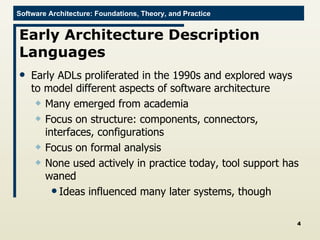
Early Architecture Description Languages Early ADLs proliferated in the 1990s and explored ways to model different aspects of software architecture Many emerged from academia Focus on structure: components, connectors, interfaces, configurations Focus on formal analysis None used actively in practice today, tool support has waned Ideas influenced many later systems, though
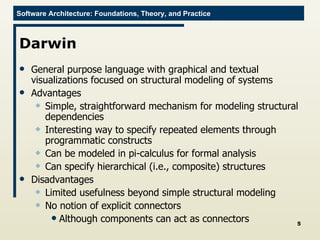
Darwin General purpose language with graphical and textual visualizations focused on structural modeling of systems Advantages Simple, straightforward mechanism for modeling structural dependencies Interesting way to specify repeated elements through programmatic constructs Can be modeled in pi-calculus for formal analysis Can specify hierarchical (i.e., composite) structures Disadvantages Limited usefulness beyond simple structural modeling No notion of explicit connectors Although components can act as connectors
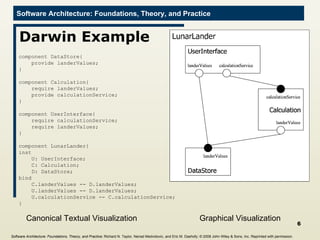
Darwin Example component DataStore{ provide landerValues; } component Calculation{ require landerValues; provide calculationService; } component UserInterface{ require calculationService; require landerValues; } component LunarLander{ inst U: UserInterface; C: Calculation; D: DataStore; bind C.landerValues -- D.landerValues; U.landerValues -- D.landerValues; U.calculationService -- C.calculationService;  } Canonical Textual Visualization Graphical Visualization Software Architecture: Foundations, Theory, and Practice ; Richard N. Taylor, Nenad Medvidovic, and Eric M. Dashofy; ©  2008 John Wiley & Sons, Inc. Reprinted with permission.
Programmatic Darwin Constructs component WebServer{ provide httpService; } component WebClient{ require httpService; } component WebApplication(int numClients){ inst S: WebServer; array C[numClients]: WebClient; forall k:0..numClients-1{ inst C[k] @ k; bind C[k].httpService -- S.httpService; } } Software Architecture: Foundations, Theory, and Practice ; Richard N. Taylor, Nenad Medvidovic, and Eric M. Dashofy; ©  2008 John Wiley & Sons, Inc. Reprinted with permission.
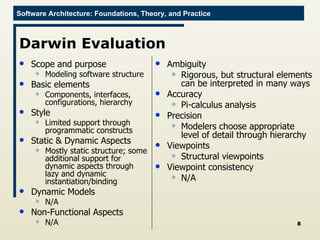
Darwin Evaluation Scope and purpose Modeling software structure Basic elements Components, interfaces, configurations, hierarchy Style Limited support through programmatic constructs Static & Dynamic Aspects Mostly static structure; some additional support for dynamic aspects through lazy and dynamic instantiation/binding  Dynamic Models N/A Non-Functional Aspects N/A Ambiguity Rigorous, but structural elements can be interpreted in many ways Accuracy Pi-calculus analysis Precision Modelers choose appropriate level of detail through hierarchy Viewpoints Structural viewpoints Viewpoint consistency N/A
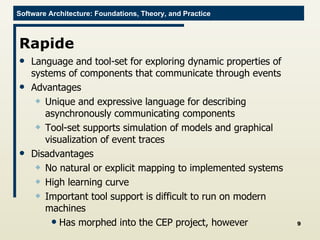
Rapide Language and tool-set for exploring dynamic properties of systems of components that communicate through events Advantages Unique and expressive language for describing asynchronously communicating components Tool-set supports simulation of models and graphical visualization of event traces Disadvantages No natural or explicit mapping to implemented systems High learning curve Important tool support is difficult to run on modern machines Has morphed into the CEP project, however
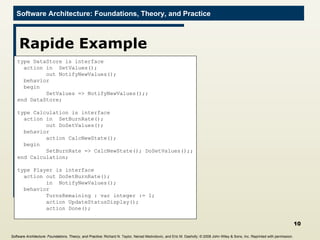
Rapide Example type DataStore is interface action in  SetValues(); out NotifyNewValues(); behavior begin SetValues => NotifyNewValues();; end DataStore; type Calculation is interface action in  SetBurnRate(); out DoSetValues(); behavior action CalcNewState(); begin SetBurnRate => CalcNewState(); DoSetValues();; end Calculation; type Player is interface action out DoSetBurnRate(); in  NotifyNewValues(); behavior TurnsRemaining : var integer := 1; action UpdateStatusDisplay(); action Done(); Software Architecture: Foundations, Theory, and Practice ; Richard N. Taylor, Nenad Medvidovic, and Eric M. Dashofy; ©  2008 John Wiley & Sons, Inc. Reprinted with permission.
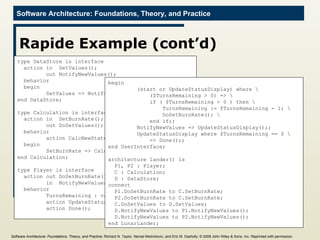
Rapide Example (cont’d) type DataStore is interface action in  SetValues(); out NotifyNewValues(); behavior begin SetValues => NotifyNewValues();; end DataStore; type Calculation is interface action in  SetBurnRate(); out DoSetValues(); behavior action CalcNewState(); begin SetBurnRate => CalcNewState(); DoSetValues();; end Calculation; type Player is interface action out DoSetBurnRate(); in  NotifyNewValues(); behavior TurnsRemaining : var integer := 1; action UpdateStatusDisplay(); action Done(); begin (start or UpdateStatusDisplay) where \  ($TurnsRemaining > 0) => \ if ( $TurnsRemaining > 0 ) then \ TurnsRemaining := $TurnsRemaining - 1; \  DoSetBurnRate(); \ end if;; NotifyNewValues => UpdateStatusDisplay();; UpdateStatusDisplay where $TurnsRemaining == 0 \ => Done();; end UserInterface; architecture lander() is P1, P2 : Player; C : Calculation; D : DataStore; connect P1.DoSetBurnRate to C.SetBurnRate; P2.DoSetBurnRate to C.SetBurnRate; C.DoSetValues to D.SetValues; D.NotifyNewValues to P1.NotifyNewValues(); D.NotifyNewValues to P2.NotifyNewValues(); end LunarLander; Software Architecture: Foundations, Theory, and Practice ; Richard N. Taylor, Nenad Medvidovic, and Eric M. Dashofy; ©  2008 John Wiley & Sons, Inc. Reprinted with permission.
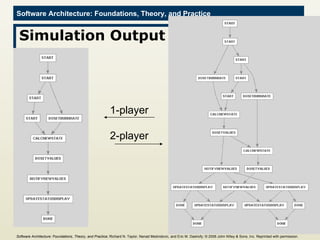
Simulation Output 1-player 2-player Software Architecture: Foundations, Theory, and Practice ; Richard N. Taylor, Nenad Medvidovic, and Eric M. Dashofy; ©  2008 John Wiley & Sons, Inc. Reprinted with permission.
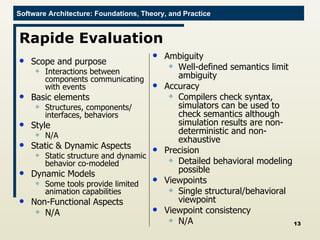
Rapide Evaluation Scope and purpose Interactions between components communicating with events Basic elements Structures, components/ interfaces, behaviors Style N/A Static & Dynamic Aspects Static structure and dynamic behavior co-modeled  Dynamic Models Some tools provide limited animation capabilities Non-Functional Aspects N/A Ambiguity Well-defined semantics limit ambiguity Accuracy Compilers check syntax, simulators can be used to check semantics although simulation results are non-deterministic and non-exhaustive Precision Detailed behavioral modeling possible Viewpoints Single structural/behavioral viewpoint Viewpoint consistency N/A
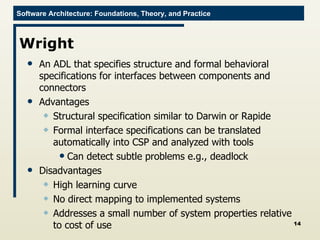
Wright An ADL that specifies structure and formal behavioral specifications for interfaces between components and connectors Advantages Structural specification similar to Darwin or Rapide Formal interface specifications can be translated automatically into CSP and analyzed with tools Can detect subtle problems e.g., deadlock Disadvantages High learning curve No direct mapping to implemented systems Addresses a small number of system properties relative to cost of use
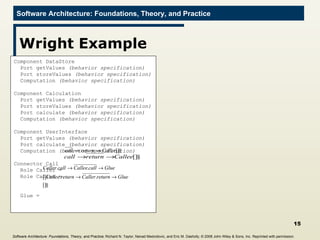
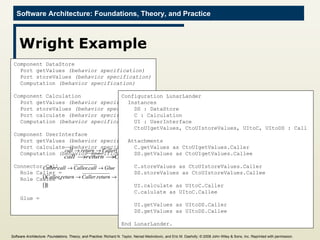
Wright Example Component DataStore Port getValues  (behavior specification) Port storeValues  (behavior specification) Computation  (behavior specification) Component Calculation Port getValues  (behavior specification) Port storeValues  (behavior specification) Port calculate  (behavior specification) Computation  (behavior specification)  Component UserInterface Port getValues  (behavior specification) Port calculate  (behavior specification) Computation  (behavior specification) Connector Call Role Caller =  Role Callee =  Glue =  Software Architecture: Foundations, Theory, and Practice ; Richard N. Taylor, Nenad Medvidovic, and Eric M. Dashofy; ©  2008 John Wiley & Sons, Inc. Reprinted with permission.
Wright Example Component DataStore Port getValues  (behavior specification) Port storeValues  (behavior specification) Computation  (behavior specification) Component Calculation Port getValues  (behavior specification) Port storeValues  (behavior specification) Port calculate  (behavior specification) Computation  (behavior specification)  Component UserInterface Port getValues  (behavior specification) Port calculate  (behavior specification) Computation  (behavior specification) Connector Call Role Caller =  Role Callee =  Glue =  Configuration LunarLander Instances DS : DataStore C : Calculation UI : UserInterface CtoUIgetValues, CtoUIstoreValues, UItoC, UItoDS : Call  Attachments C.getValues as CtoUIgetValues.Caller DS.getValues as CtoUIgetValues.Callee C.storeValues as CtoUIstoreValues.Caller DS.storeValues as CtoUIstoreValues.Callee UI.calculate as UItoC.Caller C.calulate as UItoC.Callee UI.getValues as UItoDS.Caller DS.getValues as UItoDS.Callee End LunarLander. Software Architecture: Foundations, Theory, and Practice ; Richard N. Taylor, Nenad Medvidovic, and Eric M. Dashofy; ©  2008 John Wiley & Sons, Inc. Reprinted with permission.
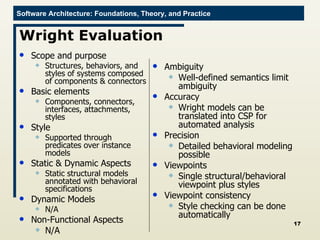
Wright Evaluation Scope and purpose Structures, behaviors, and styles of systems composed of components & connectors Basic elements Components, connectors, interfaces, attachments, styles Style Supported through predicates over instance models Static & Dynamic Aspects Static structural models annotated with behavioral specifications  Dynamic Models N/A Non-Functional Aspects N/A Ambiguity Well-defined semantics limit ambiguity Accuracy Wright models can be translated into CSP for automated analysis Precision Detailed behavioral modeling possible Viewpoints Single structural/behavioral viewpoint plus styles Viewpoint consistency Style checking can be done automatically
Domain- and Style-Specific ADLs Notations we have surveyed thus far have been generically applicable to many types of software systems If you restrict the target domain, you can provide more advanced features and/or reduce complexity We’ll talk a lot more about domain-specific software engineering later in the course
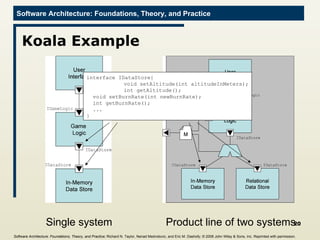
Koala Darwin-inspired notation for specifying product lines of embedded consumer-electronics devices Advantages Advanced product-line features let you specify many systems in a single model Direct mapping to implemented systems promotes design and code reuse Disadvantages Limited to structural specification with additional focus on interfaces
Koala Example Single system Product line of two systems Software Architecture: Foundations, Theory, and Practice ; Richard N. Taylor, Nenad Medvidovic, and Eric M. Dashofy; ©  2008 John Wiley & Sons, Inc. Reprinted with permission.   interface IDataStore{ void setAltitude(int altitudeInMeters); int getAltitude(); void setBurnRate(int newBurnRate); int getBurnRate(); ... }
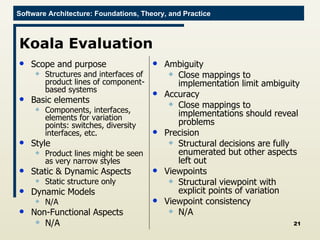
Koala Evaluation Scope and purpose Structures and interfaces of product lines of component-based systems Basic elements Components, interfaces, elements for variation points: switches, diversity interfaces, etc. Style Product lines might be seen as very narrow styles Static & Dynamic Aspects Static structure only  Dynamic Models N/A Non-Functional Aspects N/A Ambiguity Close mappings to implementation limit ambiguity Accuracy Close mappings to implementations should reveal problems Precision Structural decisions are fully enumerated but other aspects left out Viewpoints Structural viewpoint with explicit points of variation Viewpoint consistency N/A
Weaves An architectural style and notation for modeling systems of small-grain tool fragments that communicate through data flows of objects Advantages Extremely optimized notation Even simpler than Darwin diagrams Close mapping to implemented systems Disadvantages Addresses structure and data flows only
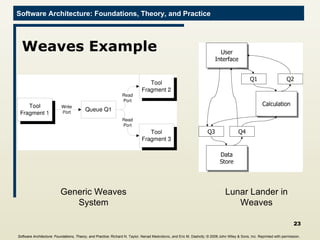
Weaves Example Generic Weaves System Lunar Lander in Weaves Software Architecture: Foundations, Theory, and Practice ; Richard N. Taylor, Nenad Medvidovic, and Eric M. Dashofy; ©  2008 John Wiley & Sons, Inc. Reprinted with permission.
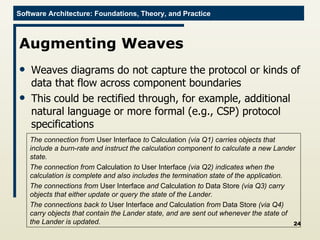
Augmenting Weaves Weaves diagrams do not capture the protocol or kinds of data that flow across component boundaries This could be rectified through, for example, additional natural language or more formal (e.g., CSP) protocol specifications The connection from  User Interface  to  Calculation  (via Q1) carries objects that include a burn-rate and instruct the calculation component to calculate a new Lander state.  The connection from  Calculation  to  User Interface  (via Q2) indicates when the calculation is complete and also includes the termination state of the application.  The connections from  User Interface  and  Calculation  to  Data Store  (via Q3) carry objects that either update or query the state of the Lander.  The connections back to  User Interface  and  Calculation  from  Data Store  (via Q4) carry objects that contain the Lander state, and are sent out whenever the state of the Lander is updated.
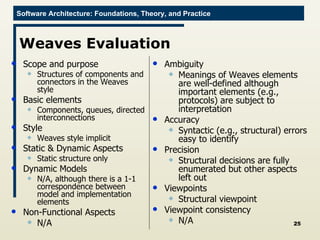
Weaves Evaluation Scope and purpose Structures of components and connectors in the Weaves style Basic elements Components, queues, directed interconnections Style Weaves style implicit Static & Dynamic Aspects Static structure only Dynamic Models N/A, although there is a 1-1 correspondence between model and implementation elements Non-Functional Aspects N/A Ambiguity Meanings of Weaves elements are well-defined although important elements (e.g., protocols) are subject to interpretation Accuracy Syntactic (e.g., structural) errors easy to identify Precision Structural decisions are fully enumerated but other aspects left out Viewpoints Structural viewpoint Viewpoint consistency N/A
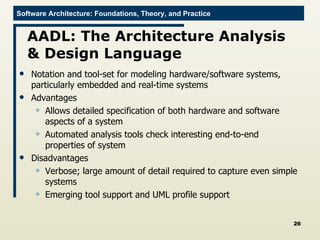
AADL: The Architecture Analysis & Design Language Notation and tool-set for modeling hardware/software systems, particularly embedded and real-time systems Advantages Allows detailed specification of both hardware and software aspects of a system Automated analysis tools check interesting end-to-end properties of system Disadvantages Verbose; large amount of detail required to capture even simple systems Emerging tool support and UML profile support
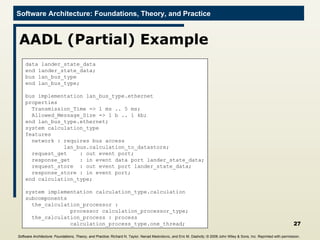
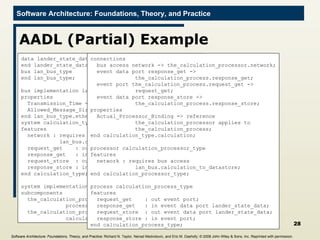
AADL (Partial) Example data lander_state_data end lander_state_data; bus lan_bus_type end lan_bus_type; bus implementation lan_bus_type.ethernet properties Transmission_Time => 1 ms .. 5 ms; Allowed_Message_Size => 1 b .. 1 kb; end lan_bus_type.ethernet; system calculation_type features network : requires bus access    lan_bus.calculation_to_datastore; request_get  : out event port; response_get  : in event data port lander_state_data; request_store  : out event port lander_state_data; response_store : in event port; end calculation_type; system implementation calculation_type.calculation subcomponents the_calculation_processor :    processor calculation_processor_type; the_calculation_process : process    calculation_process_type.one_thread; Software Architecture: Foundations, Theory, and Practice ; Richard N. Taylor, Nenad Medvidovic, and Eric M. Dashofy; ©  2008 John Wiley & Sons, Inc. Reprinted with permission.
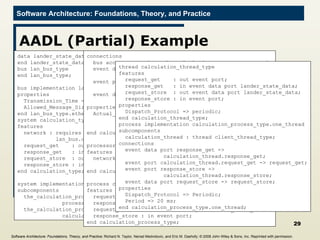
AADL (Partial) Example data lander_state_data end lander_state_data; bus lan_bus_type end lan_bus_type; bus implementation lan_bus_type.ethernet properties Transmission_Time => 1 ms .. 5 ms; Allowed_Message_Size => 1 b .. 1 kb; end lan_bus_type.ethernet; system calculation_type features network : requires bus access    lan_bus.calculation_to_datastore; request_get  : out event port; response_get  : in event data port lander_state_data; request_store  : out event port lander_state_data; response_store : in event port; end calculation_type; system implementation calculation_type.calculation subcomponents the_calculation_processor :    processor calculation_processor_type; the_calculation_process : process    calculation_process_type.one_thread; connections bus access network -> the_calculation_processor.network; event data port response_get ->    the_calculation_process.response_get; event port the_calculation_process.request_get ->    request_get; event data port response_store ->    the_calculation_process.response_store; properties Actual_Processor_Binding => reference   the_calculation_processor applies to  the_calculation_process; end calculation_type.calculation; processor calculation_processor_type features network : requires bus access    lan_bus.calculation_to_datastore; end calculation_processor_type; process calculation_process_type features request_get  : out event port; response_get  : in event data port lander_state_data; request_store  : out event data port lander_state_data; response_store : in event port; end calculation_process_type; Software Architecture: Foundations, Theory, and Practice ; Richard N. Taylor, Nenad Medvidovic, and Eric M. Dashofy; ©  2008 John Wiley & Sons, Inc. Reprinted with permission.
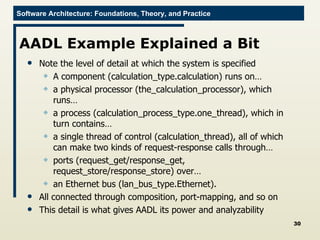
AADL (Partial) Example data lander_state_data end lander_state_data; bus lan_bus_type end lan_bus_type; bus implementation lan_bus_type.ethernet properties Transmission_Time => 1 ms .. 5 ms; Allowed_Message_Size => 1 b .. 1 kb; end lan_bus_type.ethernet; system calculation_type features network : requires bus access    lan_bus.calculation_to_datastore; request_get  : out event port; response_get  : in event data port lander_state_data; request_store  : out event port lander_state_data; response_store : in event port; end calculation_type; system implementation calculation_type.calculation subcomponents the_calculation_processor :    processor calculation_processor_type; the_calculation_process : process    calculation_process_type.one_thread; connections bus access network -> the_calculation_processor.network; event data port response_get ->    the_calculation_process.response_get; event port the_calculation_process.request_get ->    request_get; event data port response_store ->    the_calculation_process.response_store; properties Actual_Processor_Binding => reference   the_calculation_processor applies to  the_calculation_process; end calculation_type.calculation; processor calculation_processor_type features network : requires bus access    lan_bus.calculation_to_datastore; end calculation_processor_type; process calculation_process_type features request_get  : out event port; response_get  : in event data port lander_state_data; request_store  : out event data port lander_state_data; response_store : in event port; end calculation_process_type; thread calculation_thread_type features request_get  : out event port; response_get  : in event data port lander_state_data; request_store  : out event data port lander_state_data; response_store : in event port; properties Dispatch_Protocol => periodic; end calculation_thread_type; process implementation calculation_process_type.one_thread subcomponents calculation_thread : thread client_thread_type; connections event data port response_get ->    calculation_thread.response_get; event port calculation_thread.request_get -> request_get; event port response_store ->    calculation_thread.response_store; event data port request_store -> request_store; properties Dispatch_Protocol => Periodic; Period => 20 ms; end calculation_process_type.one_thread;  Software Architecture: Foundations, Theory, and Practice ; Richard N. Taylor, Nenad Medvidovic, and Eric M. Dashofy; ©  2008 John Wiley & Sons, Inc. Reprinted with permission.
AADL Example Explained a Bit Note the level of detail at which the system is specified A component (calculation_type.calculation) runs on… a physical processor (the_calculation_processor), which runs… a process (calculation_process_type.one_thread), which in turn contains… a single thread of control (calculation_thread), all of which can make two kinds of request-response calls through… ports (request_get/response_get, request_store/response_store) over… an Ethernet bus (lan_bus_type.Ethernet).  All connected through composition, port-mapping, and so on This detail is what gives AADL its power and analyzability
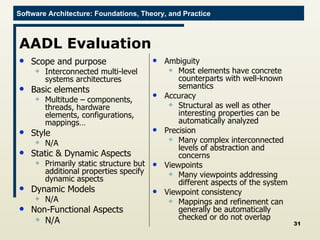
AADL Evaluation Scope and purpose Interconnected multi-level systems architectures Basic elements Multitude – components, threads, hardware elements, configurations, mappings… Style N/A Static & Dynamic Aspects Primarily static structure but additional properties specify dynamic aspects Dynamic Models N/A Non-Functional Aspects N/A Ambiguity Most elements have concrete counterparts with well-known semantics Accuracy Structural as well as other interesting properties can be automatically analyzed Precision Many complex interconnected levels of abstraction and concerns Viewpoints Many viewpoints addressing different aspects of the system Viewpoint consistency Mappings and refinement can generally be automatically checked or do not overlap
Extensible ADLs There is a tension between The expressiveness of general-purpose ADLs and The optimization and customization of more specialized ADLs How do we get the best of both worlds? Use multiple notations in tandem (Difficult to keep consistent, often means excessive redundancy) Overload an existing notation or ADL (e.g., UML profiles) Increases confusion, doesn’t work well if the custom features don’t map naturally onto existing features Add additional features we want to an existing ADL But existing ADLs provide little or no guidance for this Extensible ADLs attempt to provide such guidance
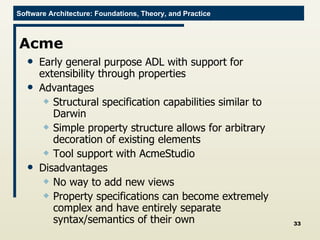
Acme Early general purpose ADL with support for extensibility through properties Advantages Structural specification capabilities similar to Darwin Simple property structure allows for arbitrary decoration of existing elements Tool support with AcmeStudio Disadvantages No way to add new views Property specifications can become extremely complex and have entirely separate syntax/semantics of their own
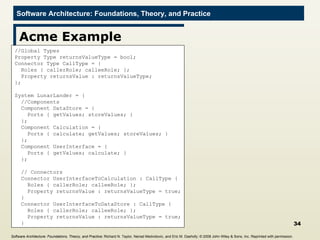
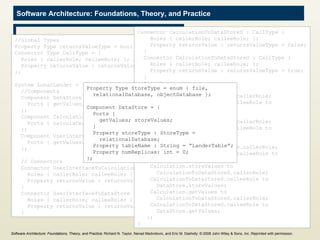
Acme Example //Global Types Property Type returnsValueType = bool; Connector Type CallType = { Roles { callerRole; calleeRole; }; Property returnsValue : returnsValueType;  }; System LunarLander = { //Components Component DataStore = {  Ports { getValues; storeValues; } }; Component Calculation = { Ports { calculate; getValues; storeValues; } }; Component UserInterface = { Ports { getValues; calculate; } }; // Connectors Connector UserInterfaceToCalculation : CallType { Roles { callerRole; calleeRole; }; Property returnsValue : returnsValueType = true; } Connector UserInterfaceToDataStore : CallType { Roles { callerRole; calleeRole; }; Property returnsValue : returnsValueType = true; } Software Architecture: Foundations, Theory, and Practice ; Richard N. Taylor, Nenad Medvidovic, and Eric M. Dashofy; ©  2008 John Wiley & Sons, Inc. Reprinted with permission.
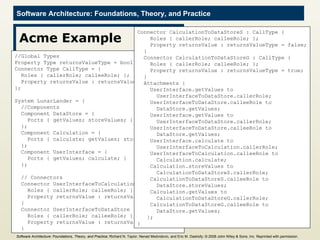
Acme Example //Global Types Property Type returnsValueType = bool; Connector Type CallType = { Roles { callerRole; calleeRole; }; Property returnsValue : returnsValueType;  }; System LunarLander = { //Components Component DataStore = {  Ports { getValues; storeValues; } }; Component Calculation = { Ports { calculate; getValues; storeValues; } }; Component UserInterface = { Ports { getValues; calculate; } }; // Connectors Connector UserInterfaceToCalculation : CallType { Roles { callerRole; calleeRole; }; Property returnsValue : returnsValueType = true; } Connector UserInterfaceToDataStore : CallType { Roles { callerRole; calleeRole; }; Property returnsValue : returnsValueType = true; } Connector CalculationToDataStoreS : CallType { Roles { callerRole; calleeRole; }; Property returnsValue : returnsValueType = false; } Connector CalculationToDataStoreG : CallType { Roles { callerRole; calleeRole; }; Property returnsValue : returnsValueType = true; } Attachments { UserInterface.getValues to    UserInterfaceToDataStore.callerRole; UserInterfaceToDataStore.calleeRole to DataStore.getValues; UserInterface.getValues to    UserInterfaceToDataStore.callerRole; UserInterfaceToDataStore.calleeRole to DataStore.getValues; UserInterface.calculate to UserInterfaceToCalculation.callerRole; UserInterfaceToCalculation.calleeRole to Calculation.calculate; Calculation.storeValues to  CalculationToDataStoreS.callerRole; CalculationToDataStoreS.calleeRole to DataStore.storeValues; Calculation.getValues to CalculationToDataStoreG.callerRole; CalculationToDataStoreG.calleeRole to DataStore.getValues; }; }  Software Architecture: Foundations, Theory, and Practice ; Richard N. Taylor, Nenad Medvidovic, and Eric M. Dashofy; ©  2008 John Wiley & Sons, Inc. Reprinted with permission.
Acme Extensions //Global Types Property Type returnsValueType = bool; Connector Type CallType = { Roles { callerRole; calleeRole; }; Property returnsValue : returnsValueType;  }; System LunarLander = { //Components Component DataStore = {  Ports { getValues; storeValues; } }; Component Calculation = { Ports { calculate; getValues; storeValues; } }; Component UserInterface = { Ports { getValues; calculate; } }; // Connectors Connector UserInterfaceToCalculation : CallType { Roles { callerRole; calleeRole; }; Property returnsValue : returnsValueType = true; } Connector UserInterfaceToDataStore : CallType { Roles { callerRole; calleeRole; }; Property returnsValue : returnsValueType = true; } Connector CalculationToDataStoreS : CallType { Roles { callerRole; calleeRole; }; Property returnsValue : returnsValueType = false; } Connector CalculationToDataStoreG : CallType { Roles { callerRole; calleeRole; }; Property returnsValue : returnsValueType = true; } Attachments { UserInterface.getValues to    UserInterfaceToDataStore.callerRole; UserInterfaceToDataStore.calleeRole to DataStore.getValues; UserInterface.getValues to    UserInterfaceToDataStore.callerRole; UserInterfaceToDataStore.calleeRole to DataStore.getValues; UserInterface.calculate to UserInterfaceToCalculation.callerRole; UserInterfaceToCalculation.calleeRole to Calculation.calculate; Calculation.storeValues to  CalculationToDataStoreS.callerRole; CalculationToDataStoreS.calleeRole to DataStore.storeValues; Calculation.getValues to CalculationToDataStoreG.callerRole; CalculationToDataStoreG.calleeRole to DataStore.getValues; }; }  Property Type StoreType = enum { file,  relationalDatabase, objectDatabase }; Component DataStore = { Ports { getValues; storeValues;  } Property storeType : StoreType =  relationalDatabase; Property tableName : String = “LanderTable”; Property numReplicas: int = 0; };  Software Architecture: Foundations, Theory, and Practice ; Richard N. Taylor, Nenad Medvidovic, and Eric M. Dashofy; ©  2008 John Wiley & Sons, Inc. Reprinted with permission.
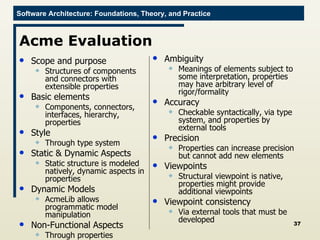
Acme Evaluation Scope and purpose Structures of components and connectors with extensible properties Basic elements Components, connectors, interfaces, hierarchy, properties Style Through type system Static & Dynamic Aspects Static structure is modeled natively, dynamic aspects in properties Dynamic Models AcmeLib allows programmatic model manipulation Non-Functional Aspects Through properties Ambiguity Meanings of elements subject to some interpretation, properties may have arbitrary level of rigor/formality Accuracy Checkable syntactically, via type system, and properties by external tools Precision Properties can increase precision but cannot add new elements Viewpoints Structural viewpoint is native, properties might provide additional viewpoints Viewpoint consistency Via external tools that must be developed
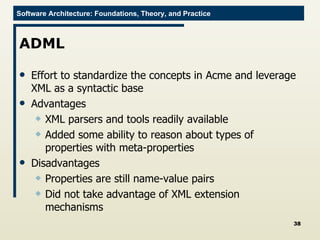
ADML Effort to standardize the concepts in Acme and leverage XML as a syntactic base Advantages XML parsers and tools readily available Added some ability to reason about types of properties with meta-properties Disadvantages Properties are still name-value pairs Did not take advantage of XML extension mechanisms
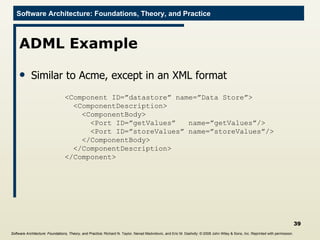
ADML Example Similar to Acme, except in an XML format <Component ID=”datastore” name=”Data Store”> <ComponentDescription> <ComponentBody> <Port ID=”getValues”  name=”getValues”/> <Port ID=”storeValues” name=”storeValues”/> </ComponentBody> </ComponentDescription> </Component>  Software Architecture: Foundations, Theory, and Practice ; Richard N. Taylor, Nenad Medvidovic, and Eric M. Dashofy; ©  2008 John Wiley & Sons, Inc. Reprinted with permission.
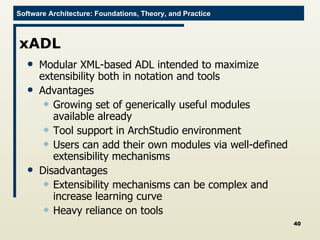
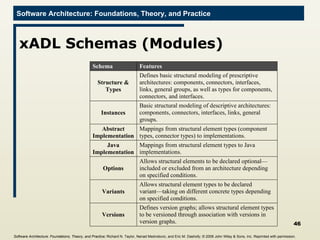
xADL Modular XML-based ADL intended to maximize extensibility both in notation and tools Advantages Growing set of generically useful modules available already Tool support in ArchStudio environment Users can add their own modules via well-defined extensibility mechanisms Disadvantages Extensibility mechanisms can be complex and increase learning curve Heavy reliance on tools
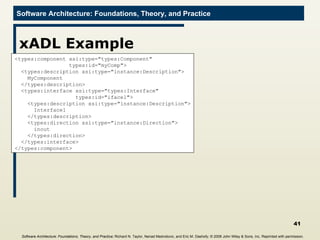
xADL Example <types:component xsi:type=&quot;types:Component&quot;    types:id=&quot;myComp&quot;> <types:description xsi:type=&quot;instance:Description&quot;>   MyComponent </types:description>  <types:interface xsi:type=&quot;types:Interface&quot;  types:id=&quot;iface1&quot;> <types:description xsi:type=&quot;instance:Description&quot;> Interface1 </types:description> <types:direction xsi:type=&quot;instance:Direction&quot;> inout </types:direction> </types:interface> </types:component> Software Architecture: Foundations, Theory, and Practice ; Richard N. Taylor, Nenad Medvidovic, and Eric M. Dashofy; ©  2008 John Wiley & Sons, Inc. Reprinted with permission.
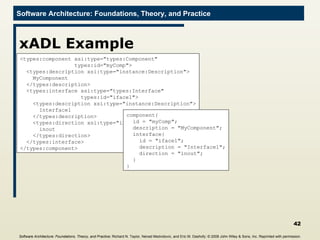
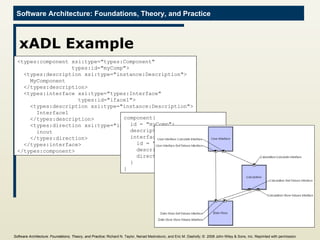
xADL Example <types:component xsi:type=&quot;types:Component&quot;    types:id=&quot;myComp&quot;> <types:description xsi:type=&quot;instance:Description&quot;>   MyComponent </types:description>  <types:interface xsi:type=&quot;types:Interface&quot;  types:id=&quot;iface1&quot;> <types:description xsi:type=&quot;instance:Description&quot;> Interface1 </types:description> <types:direction xsi:type=&quot;instance:Direction&quot;> inout </types:direction> </types:interface> </types:component> component{ id = &quot;myComp&quot;; description = &quot;MyComponent&quot;;  interface{ id = &quot;iface1&quot;; description = &quot;Interface1&quot;; direction = &quot;inout&quot;; } } Software Architecture: Foundations, Theory, and Practice ; Richard N. Taylor, Nenad Medvidovic, and Eric M. Dashofy; ©  2008 John Wiley & Sons, Inc. Reprinted with permission.
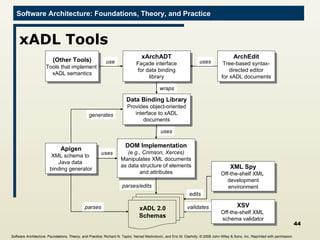
xADL Tools Software Architecture: Foundations, Theory, and Practice ; Richard N. Taylor, Nenad Medvidovic, and Eric M. Dashofy; ©  2008 John Wiley & Sons, Inc. Reprinted with permission.
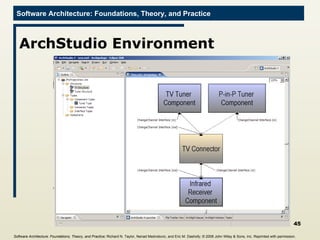
ArchStudio Environment Software Architecture: Foundations, Theory, and Practice ; Richard N. Taylor, Nenad Medvidovic, and Eric M. Dashofy; ©  2008 John Wiley & Sons, Inc. Reprinted with permission.
xADL Schemas (Modules) Software Architecture: Foundations, Theory, and Practice ; Richard N. Taylor, Nenad Medvidovic, and Eric M. Dashofy; ©  2008 John Wiley & Sons, Inc. Reprinted with permission.
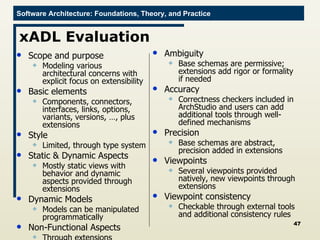
xADL Evaluation Scope and purpose Modeling various architectural concerns with explicit focus on extensibility Basic elements Components, connectors, interfaces, links, options, variants, versions, …, plus extensions Style Limited, through type system Static & Dynamic Aspects Mostly static views with behavior and dynamic aspects provided through extensions Dynamic Models Models can be manipulated programmatically Non-Functional Aspects Through extensions Ambiguity Base schemas are permissive; extensions add rigor or formality if needed Accuracy Correctness checkers included in ArchStudio and users can add additional tools through well-defined mechanisms Precision Base schemas are abstract, precision added in extensions Viewpoints Several viewpoints provided natively, new viewpoints through extensions Viewpoint consistency Checkable through external tools and additional consistency rules
Caveat 1 The preceding overview optimized for breadth rather than depth Semantics and capabilities of many of these notations quite deep and subtle Some even have entire books written about them You are encouraged to investigate individual notations more deeply
Caveat 2 Some systems are difficult to model in traditional ways ‘ Agile’ systems that are not explicitly designed above the level of code modules Extremely large, complex, or dynamic systems (e.g., the Web) Can model limited or less complex aspects Can model one instance of the system (e.g., one Web application) Exploit regularity Model the style Model the protocols

10 modeling and_notations

  • 1.
    Modeling and NotationsSoftware Architecture Lecture 10
  • 2.
    Continuing Our SurveyGeneric approaches Natural language PowerPoint-style modeling UML, the Unified Modeling Language Early architecture description languages Darwin Rapide Wright Domain- and style-specific languages Koala Weaves AADL Extensible architecture description languages Acme ADML xADL
  • 3.
    Continuing Our SurveyGeneric approaches Natural language PowerPoint-style modeling UML, the Unified Modeling Language Early architecture description languages Darwin Rapide Wright Domain- and style-specific languages Koala Weaves AADL Extensible architecture description languages Acme ADML xADL
  • 4.
    Early Architecture DescriptionLanguages Early ADLs proliferated in the 1990s and explored ways to model different aspects of software architecture Many emerged from academia Focus on structure: components, connectors, interfaces, configurations Focus on formal analysis None used actively in practice today, tool support has waned Ideas influenced many later systems, though
  • 5.
    Darwin General purposelanguage with graphical and textual visualizations focused on structural modeling of systems Advantages Simple, straightforward mechanism for modeling structural dependencies Interesting way to specify repeated elements through programmatic constructs Can be modeled in pi-calculus for formal analysis Can specify hierarchical (i.e., composite) structures Disadvantages Limited usefulness beyond simple structural modeling No notion of explicit connectors Although components can act as connectors
  • 6.
    Darwin Example componentDataStore{ provide landerValues; } component Calculation{ require landerValues; provide calculationService; } component UserInterface{ require calculationService; require landerValues; } component LunarLander{ inst U: UserInterface; C: Calculation; D: DataStore; bind C.landerValues -- D.landerValues; U.landerValues -- D.landerValues; U.calculationService -- C.calculationService; } Canonical Textual Visualization Graphical Visualization Software Architecture: Foundations, Theory, and Practice ; Richard N. Taylor, Nenad Medvidovic, and Eric M. Dashofy; © 2008 John Wiley & Sons, Inc. Reprinted with permission.
  • 7.
    Programmatic Darwin Constructscomponent WebServer{ provide httpService; } component WebClient{ require httpService; } component WebApplication(int numClients){ inst S: WebServer; array C[numClients]: WebClient; forall k:0..numClients-1{ inst C[k] @ k; bind C[k].httpService -- S.httpService; } } Software Architecture: Foundations, Theory, and Practice ; Richard N. Taylor, Nenad Medvidovic, and Eric M. Dashofy; © 2008 John Wiley & Sons, Inc. Reprinted with permission.
  • 8.
    Darwin Evaluation Scopeand purpose Modeling software structure Basic elements Components, interfaces, configurations, hierarchy Style Limited support through programmatic constructs Static & Dynamic Aspects Mostly static structure; some additional support for dynamic aspects through lazy and dynamic instantiation/binding Dynamic Models N/A Non-Functional Aspects N/A Ambiguity Rigorous, but structural elements can be interpreted in many ways Accuracy Pi-calculus analysis Precision Modelers choose appropriate level of detail through hierarchy Viewpoints Structural viewpoints Viewpoint consistency N/A
  • 9.
    Rapide Language andtool-set for exploring dynamic properties of systems of components that communicate through events Advantages Unique and expressive language for describing asynchronously communicating components Tool-set supports simulation of models and graphical visualization of event traces Disadvantages No natural or explicit mapping to implemented systems High learning curve Important tool support is difficult to run on modern machines Has morphed into the CEP project, however
  • 10.
    Rapide Example typeDataStore is interface action in SetValues(); out NotifyNewValues(); behavior begin SetValues => NotifyNewValues();; end DataStore; type Calculation is interface action in SetBurnRate(); out DoSetValues(); behavior action CalcNewState(); begin SetBurnRate => CalcNewState(); DoSetValues();; end Calculation; type Player is interface action out DoSetBurnRate(); in NotifyNewValues(); behavior TurnsRemaining : var integer := 1; action UpdateStatusDisplay(); action Done(); Software Architecture: Foundations, Theory, and Practice ; Richard N. Taylor, Nenad Medvidovic, and Eric M. Dashofy; © 2008 John Wiley & Sons, Inc. Reprinted with permission.
  • 11.
    Rapide Example (cont’d)type DataStore is interface action in SetValues(); out NotifyNewValues(); behavior begin SetValues => NotifyNewValues();; end DataStore; type Calculation is interface action in SetBurnRate(); out DoSetValues(); behavior action CalcNewState(); begin SetBurnRate => CalcNewState(); DoSetValues();; end Calculation; type Player is interface action out DoSetBurnRate(); in NotifyNewValues(); behavior TurnsRemaining : var integer := 1; action UpdateStatusDisplay(); action Done(); begin (start or UpdateStatusDisplay) where \ ($TurnsRemaining > 0) => \ if ( $TurnsRemaining > 0 ) then \ TurnsRemaining := $TurnsRemaining - 1; \ DoSetBurnRate(); \ end if;; NotifyNewValues => UpdateStatusDisplay();; UpdateStatusDisplay where $TurnsRemaining == 0 \ => Done();; end UserInterface; architecture lander() is P1, P2 : Player; C : Calculation; D : DataStore; connect P1.DoSetBurnRate to C.SetBurnRate; P2.DoSetBurnRate to C.SetBurnRate; C.DoSetValues to D.SetValues; D.NotifyNewValues to P1.NotifyNewValues(); D.NotifyNewValues to P2.NotifyNewValues(); end LunarLander; Software Architecture: Foundations, Theory, and Practice ; Richard N. Taylor, Nenad Medvidovic, and Eric M. Dashofy; © 2008 John Wiley & Sons, Inc. Reprinted with permission.
  • 12.
    Simulation Output 1-player2-player Software Architecture: Foundations, Theory, and Practice ; Richard N. Taylor, Nenad Medvidovic, and Eric M. Dashofy; © 2008 John Wiley & Sons, Inc. Reprinted with permission.
  • 13.
    Rapide Evaluation Scopeand purpose Interactions between components communicating with events Basic elements Structures, components/ interfaces, behaviors Style N/A Static & Dynamic Aspects Static structure and dynamic behavior co-modeled Dynamic Models Some tools provide limited animation capabilities Non-Functional Aspects N/A Ambiguity Well-defined semantics limit ambiguity Accuracy Compilers check syntax, simulators can be used to check semantics although simulation results are non-deterministic and non-exhaustive Precision Detailed behavioral modeling possible Viewpoints Single structural/behavioral viewpoint Viewpoint consistency N/A
  • 14.
    Wright An ADLthat specifies structure and formal behavioral specifications for interfaces between components and connectors Advantages Structural specification similar to Darwin or Rapide Formal interface specifications can be translated automatically into CSP and analyzed with tools Can detect subtle problems e.g., deadlock Disadvantages High learning curve No direct mapping to implemented systems Addresses a small number of system properties relative to cost of use
  • 15.
    Wright Example ComponentDataStore Port getValues (behavior specification) Port storeValues (behavior specification) Computation (behavior specification) Component Calculation Port getValues (behavior specification) Port storeValues (behavior specification) Port calculate (behavior specification) Computation (behavior specification) Component UserInterface Port getValues (behavior specification) Port calculate (behavior specification) Computation (behavior specification) Connector Call Role Caller = Role Callee = Glue = Software Architecture: Foundations, Theory, and Practice ; Richard N. Taylor, Nenad Medvidovic, and Eric M. Dashofy; © 2008 John Wiley & Sons, Inc. Reprinted with permission.
  • 16.
    Wright Example ComponentDataStore Port getValues (behavior specification) Port storeValues (behavior specification) Computation (behavior specification) Component Calculation Port getValues (behavior specification) Port storeValues (behavior specification) Port calculate (behavior specification) Computation (behavior specification) Component UserInterface Port getValues (behavior specification) Port calculate (behavior specification) Computation (behavior specification) Connector Call Role Caller = Role Callee = Glue = Configuration LunarLander Instances DS : DataStore C : Calculation UI : UserInterface CtoUIgetValues, CtoUIstoreValues, UItoC, UItoDS : Call Attachments C.getValues as CtoUIgetValues.Caller DS.getValues as CtoUIgetValues.Callee C.storeValues as CtoUIstoreValues.Caller DS.storeValues as CtoUIstoreValues.Callee UI.calculate as UItoC.Caller C.calulate as UItoC.Callee UI.getValues as UItoDS.Caller DS.getValues as UItoDS.Callee End LunarLander. Software Architecture: Foundations, Theory, and Practice ; Richard N. Taylor, Nenad Medvidovic, and Eric M. Dashofy; © 2008 John Wiley & Sons, Inc. Reprinted with permission.
  • 17.
    Wright Evaluation Scopeand purpose Structures, behaviors, and styles of systems composed of components & connectors Basic elements Components, connectors, interfaces, attachments, styles Style Supported through predicates over instance models Static & Dynamic Aspects Static structural models annotated with behavioral specifications Dynamic Models N/A Non-Functional Aspects N/A Ambiguity Well-defined semantics limit ambiguity Accuracy Wright models can be translated into CSP for automated analysis Precision Detailed behavioral modeling possible Viewpoints Single structural/behavioral viewpoint plus styles Viewpoint consistency Style checking can be done automatically
  • 18.
    Domain- and Style-SpecificADLs Notations we have surveyed thus far have been generically applicable to many types of software systems If you restrict the target domain, you can provide more advanced features and/or reduce complexity We’ll talk a lot more about domain-specific software engineering later in the course
  • 19.
    Koala Darwin-inspired notationfor specifying product lines of embedded consumer-electronics devices Advantages Advanced product-line features let you specify many systems in a single model Direct mapping to implemented systems promotes design and code reuse Disadvantages Limited to structural specification with additional focus on interfaces
  • 20.
    Koala Example Singlesystem Product line of two systems Software Architecture: Foundations, Theory, and Practice ; Richard N. Taylor, Nenad Medvidovic, and Eric M. Dashofy; © 2008 John Wiley & Sons, Inc. Reprinted with permission. interface IDataStore{ void setAltitude(int altitudeInMeters); int getAltitude(); void setBurnRate(int newBurnRate); int getBurnRate(); ... }
  • 21.
    Koala Evaluation Scopeand purpose Structures and interfaces of product lines of component-based systems Basic elements Components, interfaces, elements for variation points: switches, diversity interfaces, etc. Style Product lines might be seen as very narrow styles Static & Dynamic Aspects Static structure only Dynamic Models N/A Non-Functional Aspects N/A Ambiguity Close mappings to implementation limit ambiguity Accuracy Close mappings to implementations should reveal problems Precision Structural decisions are fully enumerated but other aspects left out Viewpoints Structural viewpoint with explicit points of variation Viewpoint consistency N/A
  • 22.
    Weaves An architecturalstyle and notation for modeling systems of small-grain tool fragments that communicate through data flows of objects Advantages Extremely optimized notation Even simpler than Darwin diagrams Close mapping to implemented systems Disadvantages Addresses structure and data flows only
  • 23.
    Weaves Example GenericWeaves System Lunar Lander in Weaves Software Architecture: Foundations, Theory, and Practice ; Richard N. Taylor, Nenad Medvidovic, and Eric M. Dashofy; © 2008 John Wiley & Sons, Inc. Reprinted with permission.
  • 24.
    Augmenting Weaves Weavesdiagrams do not capture the protocol or kinds of data that flow across component boundaries This could be rectified through, for example, additional natural language or more formal (e.g., CSP) protocol specifications The connection from User Interface to Calculation (via Q1) carries objects that include a burn-rate and instruct the calculation component to calculate a new Lander state. The connection from Calculation to User Interface (via Q2) indicates when the calculation is complete and also includes the termination state of the application. The connections from User Interface and Calculation to Data Store (via Q3) carry objects that either update or query the state of the Lander. The connections back to User Interface and Calculation from Data Store (via Q4) carry objects that contain the Lander state, and are sent out whenever the state of the Lander is updated.
  • 25.
    Weaves Evaluation Scopeand purpose Structures of components and connectors in the Weaves style Basic elements Components, queues, directed interconnections Style Weaves style implicit Static & Dynamic Aspects Static structure only Dynamic Models N/A, although there is a 1-1 correspondence between model and implementation elements Non-Functional Aspects N/A Ambiguity Meanings of Weaves elements are well-defined although important elements (e.g., protocols) are subject to interpretation Accuracy Syntactic (e.g., structural) errors easy to identify Precision Structural decisions are fully enumerated but other aspects left out Viewpoints Structural viewpoint Viewpoint consistency N/A
  • 26.
    AADL: The ArchitectureAnalysis & Design Language Notation and tool-set for modeling hardware/software systems, particularly embedded and real-time systems Advantages Allows detailed specification of both hardware and software aspects of a system Automated analysis tools check interesting end-to-end properties of system Disadvantages Verbose; large amount of detail required to capture even simple systems Emerging tool support and UML profile support
  • 27.
    AADL (Partial) Exampledata lander_state_data end lander_state_data; bus lan_bus_type end lan_bus_type; bus implementation lan_bus_type.ethernet properties Transmission_Time => 1 ms .. 5 ms; Allowed_Message_Size => 1 b .. 1 kb; end lan_bus_type.ethernet; system calculation_type features network : requires bus access lan_bus.calculation_to_datastore; request_get : out event port; response_get : in event data port lander_state_data; request_store : out event port lander_state_data; response_store : in event port; end calculation_type; system implementation calculation_type.calculation subcomponents the_calculation_processor : processor calculation_processor_type; the_calculation_process : process calculation_process_type.one_thread; Software Architecture: Foundations, Theory, and Practice ; Richard N. Taylor, Nenad Medvidovic, and Eric M. Dashofy; © 2008 John Wiley & Sons, Inc. Reprinted with permission.
  • 28.
    AADL (Partial) Exampledata lander_state_data end lander_state_data; bus lan_bus_type end lan_bus_type; bus implementation lan_bus_type.ethernet properties Transmission_Time => 1 ms .. 5 ms; Allowed_Message_Size => 1 b .. 1 kb; end lan_bus_type.ethernet; system calculation_type features network : requires bus access lan_bus.calculation_to_datastore; request_get : out event port; response_get : in event data port lander_state_data; request_store : out event port lander_state_data; response_store : in event port; end calculation_type; system implementation calculation_type.calculation subcomponents the_calculation_processor : processor calculation_processor_type; the_calculation_process : process calculation_process_type.one_thread; connections bus access network -> the_calculation_processor.network; event data port response_get -> the_calculation_process.response_get; event port the_calculation_process.request_get -> request_get; event data port response_store -> the_calculation_process.response_store; properties Actual_Processor_Binding => reference the_calculation_processor applies to the_calculation_process; end calculation_type.calculation; processor calculation_processor_type features network : requires bus access lan_bus.calculation_to_datastore; end calculation_processor_type; process calculation_process_type features request_get : out event port; response_get : in event data port lander_state_data; request_store : out event data port lander_state_data; response_store : in event port; end calculation_process_type; Software Architecture: Foundations, Theory, and Practice ; Richard N. Taylor, Nenad Medvidovic, and Eric M. Dashofy; © 2008 John Wiley & Sons, Inc. Reprinted with permission.
  • 29.
    AADL (Partial) Exampledata lander_state_data end lander_state_data; bus lan_bus_type end lan_bus_type; bus implementation lan_bus_type.ethernet properties Transmission_Time => 1 ms .. 5 ms; Allowed_Message_Size => 1 b .. 1 kb; end lan_bus_type.ethernet; system calculation_type features network : requires bus access lan_bus.calculation_to_datastore; request_get : out event port; response_get : in event data port lander_state_data; request_store : out event port lander_state_data; response_store : in event port; end calculation_type; system implementation calculation_type.calculation subcomponents the_calculation_processor : processor calculation_processor_type; the_calculation_process : process calculation_process_type.one_thread; connections bus access network -> the_calculation_processor.network; event data port response_get -> the_calculation_process.response_get; event port the_calculation_process.request_get -> request_get; event data port response_store -> the_calculation_process.response_store; properties Actual_Processor_Binding => reference the_calculation_processor applies to the_calculation_process; end calculation_type.calculation; processor calculation_processor_type features network : requires bus access lan_bus.calculation_to_datastore; end calculation_processor_type; process calculation_process_type features request_get : out event port; response_get : in event data port lander_state_data; request_store : out event data port lander_state_data; response_store : in event port; end calculation_process_type; thread calculation_thread_type features request_get : out event port; response_get : in event data port lander_state_data; request_store : out event data port lander_state_data; response_store : in event port; properties Dispatch_Protocol => periodic; end calculation_thread_type; process implementation calculation_process_type.one_thread subcomponents calculation_thread : thread client_thread_type; connections event data port response_get -> calculation_thread.response_get; event port calculation_thread.request_get -> request_get; event port response_store -> calculation_thread.response_store; event data port request_store -> request_store; properties Dispatch_Protocol => Periodic; Period => 20 ms; end calculation_process_type.one_thread; Software Architecture: Foundations, Theory, and Practice ; Richard N. Taylor, Nenad Medvidovic, and Eric M. Dashofy; © 2008 John Wiley & Sons, Inc. Reprinted with permission.
  • 30.
    AADL Example Explaineda Bit Note the level of detail at which the system is specified A component (calculation_type.calculation) runs on… a physical processor (the_calculation_processor), which runs… a process (calculation_process_type.one_thread), which in turn contains… a single thread of control (calculation_thread), all of which can make two kinds of request-response calls through… ports (request_get/response_get, request_store/response_store) over… an Ethernet bus (lan_bus_type.Ethernet). All connected through composition, port-mapping, and so on This detail is what gives AADL its power and analyzability
  • 31.
    AADL Evaluation Scopeand purpose Interconnected multi-level systems architectures Basic elements Multitude – components, threads, hardware elements, configurations, mappings… Style N/A Static & Dynamic Aspects Primarily static structure but additional properties specify dynamic aspects Dynamic Models N/A Non-Functional Aspects N/A Ambiguity Most elements have concrete counterparts with well-known semantics Accuracy Structural as well as other interesting properties can be automatically analyzed Precision Many complex interconnected levels of abstraction and concerns Viewpoints Many viewpoints addressing different aspects of the system Viewpoint consistency Mappings and refinement can generally be automatically checked or do not overlap
  • 32.
    Extensible ADLs Thereis a tension between The expressiveness of general-purpose ADLs and The optimization and customization of more specialized ADLs How do we get the best of both worlds? Use multiple notations in tandem (Difficult to keep consistent, often means excessive redundancy) Overload an existing notation or ADL (e.g., UML profiles) Increases confusion, doesn’t work well if the custom features don’t map naturally onto existing features Add additional features we want to an existing ADL But existing ADLs provide little or no guidance for this Extensible ADLs attempt to provide such guidance
  • 33.
    Acme Early generalpurpose ADL with support for extensibility through properties Advantages Structural specification capabilities similar to Darwin Simple property structure allows for arbitrary decoration of existing elements Tool support with AcmeStudio Disadvantages No way to add new views Property specifications can become extremely complex and have entirely separate syntax/semantics of their own
  • 34.
    Acme Example //GlobalTypes Property Type returnsValueType = bool; Connector Type CallType = { Roles { callerRole; calleeRole; }; Property returnsValue : returnsValueType; }; System LunarLander = { //Components Component DataStore = { Ports { getValues; storeValues; } }; Component Calculation = { Ports { calculate; getValues; storeValues; } }; Component UserInterface = { Ports { getValues; calculate; } }; // Connectors Connector UserInterfaceToCalculation : CallType { Roles { callerRole; calleeRole; }; Property returnsValue : returnsValueType = true; } Connector UserInterfaceToDataStore : CallType { Roles { callerRole; calleeRole; }; Property returnsValue : returnsValueType = true; } Software Architecture: Foundations, Theory, and Practice ; Richard N. Taylor, Nenad Medvidovic, and Eric M. Dashofy; © 2008 John Wiley & Sons, Inc. Reprinted with permission.
  • 35.
    Acme Example //GlobalTypes Property Type returnsValueType = bool; Connector Type CallType = { Roles { callerRole; calleeRole; }; Property returnsValue : returnsValueType; }; System LunarLander = { //Components Component DataStore = { Ports { getValues; storeValues; } }; Component Calculation = { Ports { calculate; getValues; storeValues; } }; Component UserInterface = { Ports { getValues; calculate; } }; // Connectors Connector UserInterfaceToCalculation : CallType { Roles { callerRole; calleeRole; }; Property returnsValue : returnsValueType = true; } Connector UserInterfaceToDataStore : CallType { Roles { callerRole; calleeRole; }; Property returnsValue : returnsValueType = true; } Connector CalculationToDataStoreS : CallType { Roles { callerRole; calleeRole; }; Property returnsValue : returnsValueType = false; } Connector CalculationToDataStoreG : CallType { Roles { callerRole; calleeRole; }; Property returnsValue : returnsValueType = true; } Attachments { UserInterface.getValues to UserInterfaceToDataStore.callerRole; UserInterfaceToDataStore.calleeRole to DataStore.getValues; UserInterface.getValues to UserInterfaceToDataStore.callerRole; UserInterfaceToDataStore.calleeRole to DataStore.getValues; UserInterface.calculate to UserInterfaceToCalculation.callerRole; UserInterfaceToCalculation.calleeRole to Calculation.calculate; Calculation.storeValues to CalculationToDataStoreS.callerRole; CalculationToDataStoreS.calleeRole to DataStore.storeValues; Calculation.getValues to CalculationToDataStoreG.callerRole; CalculationToDataStoreG.calleeRole to DataStore.getValues; }; } Software Architecture: Foundations, Theory, and Practice ; Richard N. Taylor, Nenad Medvidovic, and Eric M. Dashofy; © 2008 John Wiley & Sons, Inc. Reprinted with permission.
  • 36.
    Acme Extensions //GlobalTypes Property Type returnsValueType = bool; Connector Type CallType = { Roles { callerRole; calleeRole; }; Property returnsValue : returnsValueType; }; System LunarLander = { //Components Component DataStore = { Ports { getValues; storeValues; } }; Component Calculation = { Ports { calculate; getValues; storeValues; } }; Component UserInterface = { Ports { getValues; calculate; } }; // Connectors Connector UserInterfaceToCalculation : CallType { Roles { callerRole; calleeRole; }; Property returnsValue : returnsValueType = true; } Connector UserInterfaceToDataStore : CallType { Roles { callerRole; calleeRole; }; Property returnsValue : returnsValueType = true; } Connector CalculationToDataStoreS : CallType { Roles { callerRole; calleeRole; }; Property returnsValue : returnsValueType = false; } Connector CalculationToDataStoreG : CallType { Roles { callerRole; calleeRole; }; Property returnsValue : returnsValueType = true; } Attachments { UserInterface.getValues to UserInterfaceToDataStore.callerRole; UserInterfaceToDataStore.calleeRole to DataStore.getValues; UserInterface.getValues to UserInterfaceToDataStore.callerRole; UserInterfaceToDataStore.calleeRole to DataStore.getValues; UserInterface.calculate to UserInterfaceToCalculation.callerRole; UserInterfaceToCalculation.calleeRole to Calculation.calculate; Calculation.storeValues to CalculationToDataStoreS.callerRole; CalculationToDataStoreS.calleeRole to DataStore.storeValues; Calculation.getValues to CalculationToDataStoreG.callerRole; CalculationToDataStoreG.calleeRole to DataStore.getValues; }; } Property Type StoreType = enum { file, relationalDatabase, objectDatabase }; Component DataStore = { Ports { getValues; storeValues; } Property storeType : StoreType = relationalDatabase; Property tableName : String = “LanderTable”; Property numReplicas: int = 0; }; Software Architecture: Foundations, Theory, and Practice ; Richard N. Taylor, Nenad Medvidovic, and Eric M. Dashofy; © 2008 John Wiley & Sons, Inc. Reprinted with permission.
  • 37.
    Acme Evaluation Scopeand purpose Structures of components and connectors with extensible properties Basic elements Components, connectors, interfaces, hierarchy, properties Style Through type system Static & Dynamic Aspects Static structure is modeled natively, dynamic aspects in properties Dynamic Models AcmeLib allows programmatic model manipulation Non-Functional Aspects Through properties Ambiguity Meanings of elements subject to some interpretation, properties may have arbitrary level of rigor/formality Accuracy Checkable syntactically, via type system, and properties by external tools Precision Properties can increase precision but cannot add new elements Viewpoints Structural viewpoint is native, properties might provide additional viewpoints Viewpoint consistency Via external tools that must be developed
  • 38.
    ADML Effort tostandardize the concepts in Acme and leverage XML as a syntactic base Advantages XML parsers and tools readily available Added some ability to reason about types of properties with meta-properties Disadvantages Properties are still name-value pairs Did not take advantage of XML extension mechanisms
  • 39.
    ADML Example Similarto Acme, except in an XML format <Component ID=”datastore” name=”Data Store”> <ComponentDescription> <ComponentBody> <Port ID=”getValues” name=”getValues”/> <Port ID=”storeValues” name=”storeValues”/> </ComponentBody> </ComponentDescription> </Component> Software Architecture: Foundations, Theory, and Practice ; Richard N. Taylor, Nenad Medvidovic, and Eric M. Dashofy; © 2008 John Wiley & Sons, Inc. Reprinted with permission.
  • 40.
    xADL Modular XML-basedADL intended to maximize extensibility both in notation and tools Advantages Growing set of generically useful modules available already Tool support in ArchStudio environment Users can add their own modules via well-defined extensibility mechanisms Disadvantages Extensibility mechanisms can be complex and increase learning curve Heavy reliance on tools
  • 41.
    xADL Example <types:componentxsi:type=&quot;types:Component&quot; types:id=&quot;myComp&quot;> <types:description xsi:type=&quot;instance:Description&quot;> MyComponent </types:description> <types:interface xsi:type=&quot;types:Interface&quot; types:id=&quot;iface1&quot;> <types:description xsi:type=&quot;instance:Description&quot;> Interface1 </types:description> <types:direction xsi:type=&quot;instance:Direction&quot;> inout </types:direction> </types:interface> </types:component> Software Architecture: Foundations, Theory, and Practice ; Richard N. Taylor, Nenad Medvidovic, and Eric M. Dashofy; © 2008 John Wiley & Sons, Inc. Reprinted with permission.
  • 42.
    xADL Example <types:componentxsi:type=&quot;types:Component&quot; types:id=&quot;myComp&quot;> <types:description xsi:type=&quot;instance:Description&quot;> MyComponent </types:description> <types:interface xsi:type=&quot;types:Interface&quot; types:id=&quot;iface1&quot;> <types:description xsi:type=&quot;instance:Description&quot;> Interface1 </types:description> <types:direction xsi:type=&quot;instance:Direction&quot;> inout </types:direction> </types:interface> </types:component> component{ id = &quot;myComp&quot;; description = &quot;MyComponent&quot;; interface{ id = &quot;iface1&quot;; description = &quot;Interface1&quot;; direction = &quot;inout&quot;; } } Software Architecture: Foundations, Theory, and Practice ; Richard N. Taylor, Nenad Medvidovic, and Eric M. Dashofy; © 2008 John Wiley & Sons, Inc. Reprinted with permission.
  • 43.
    xADL Example <types:componentxsi:type=&quot;types:Component&quot; types:id=&quot;myComp&quot;> <types:description xsi:type=&quot;instance:Description&quot;> MyComponent </types:description> <types:interface xsi:type=&quot;types:Interface&quot; types:id=&quot;iface1&quot;> <types:description xsi:type=&quot;instance:Description&quot;> Interface1 </types:description> <types:direction xsi:type=&quot;instance:Direction&quot;> inout </types:direction> </types:interface> </types:component> component{ id = &quot;myComp&quot;; description = &quot;MyComponent&quot;; interface{ id = &quot;iface1&quot;; description = &quot;Interface1&quot;; direction = &quot;inout&quot;; } } Software Architecture: Foundations, Theory, and Practice ; Richard N. Taylor, Nenad Medvidovic, and Eric M. Dashofy; © 2008 John Wiley & Sons, Inc. Reprinted with permission.
  • 44.
    xADL Tools SoftwareArchitecture: Foundations, Theory, and Practice ; Richard N. Taylor, Nenad Medvidovic, and Eric M. Dashofy; © 2008 John Wiley & Sons, Inc. Reprinted with permission.
  • 45.
    ArchStudio Environment SoftwareArchitecture: Foundations, Theory, and Practice ; Richard N. Taylor, Nenad Medvidovic, and Eric M. Dashofy; © 2008 John Wiley & Sons, Inc. Reprinted with permission.
  • 46.
    xADL Schemas (Modules)Software Architecture: Foundations, Theory, and Practice ; Richard N. Taylor, Nenad Medvidovic, and Eric M. Dashofy; © 2008 John Wiley & Sons, Inc. Reprinted with permission.
  • 47.
    xADL Evaluation Scopeand purpose Modeling various architectural concerns with explicit focus on extensibility Basic elements Components, connectors, interfaces, links, options, variants, versions, …, plus extensions Style Limited, through type system Static & Dynamic Aspects Mostly static views with behavior and dynamic aspects provided through extensions Dynamic Models Models can be manipulated programmatically Non-Functional Aspects Through extensions Ambiguity Base schemas are permissive; extensions add rigor or formality if needed Accuracy Correctness checkers included in ArchStudio and users can add additional tools through well-defined mechanisms Precision Base schemas are abstract, precision added in extensions Viewpoints Several viewpoints provided natively, new viewpoints through extensions Viewpoint consistency Checkable through external tools and additional consistency rules
  • 48.
    Caveat 1 Thepreceding overview optimized for breadth rather than depth Semantics and capabilities of many of these notations quite deep and subtle Some even have entire books written about them You are encouraged to investigate individual notations more deeply
  • 49.
    Caveat 2 Somesystems are difficult to model in traditional ways ‘ Agile’ systems that are not explicitly designed above the level of code modules Extremely large, complex, or dynamic systems (e.g., the Web) Can model limited or less complex aspects Can model one instance of the system (e.g., one Web application) Exploit regularity Model the style Model the protocols