Standards Software Architecture Lecture 26
Objectives Concepts What are standards? Why use standards? And why not? (drawbacks) Deciding when to adopt a standard Prevalent Architectural Standards Conceptual standards Notational standards Standard tools Process standards
What are standards? Definition:  a  standard  is a form of agreement between parties Many kinds of standards For notations, tools, processes, organizations, domains There is a prevalent view that complying to standard ‘X’ ensures that a constructed system has high quality This is almost never strictly true But that doesn’t mean standards are worthless! Here, we will attempt to put standards in perspective
De jure  and  de facto  standards Some standards are controlled by a body considered authoritative ANSI, ISO, ECMA, W3C, IETF These standards are called  de jure  (“from law”) De jure  standards usually are formally defined and documented are evolved through a rigorous, well-known process are managed by an independent body, governmental agency, or multi-organizational coalition rather than a single individual or company
De jure  and  de facto  standards (cont’d) Some standards emerge through widespread awareness and use These standards are called  de facto  (“in practice”) De facto  standards usually are created by a single individual organization to address a particular need are adopted due to technical superiority or market dominance of the creating organization evolve through an emergent, market-driven process are managed by the creating organization or the users themselves, rather than through a formal custodial body
Examples of  de jure  and  de facto De jure  standards UML (managed by OMG) CORBA (also managed by OMG) HTTP protocol (managed by IETF) De facto  standards PDF format (managed by Adobe) May become  de jure  through ISO Windows (managed by Microsoft) There is a substantial gray area between these two
Gray-area Standards HTML Officially standardized by W3C, indicating  de jure Flavors and browser-specific extensions developed by Microsoft, Netscape, and others, creating  de facto  variants None of these has power to force users to use standard JavaScript Developed by Netscape; copied (as JScript) by Microsoft After substantial adoption and possibly under threat of forking/splintering, Netscape submits it to ECMA Now standardized as ECMAScript ( de jure ) JavaScript and variants continue to be developed as compatible extensions of ECMAScript
Another spectrum Standards (whether  de jure  or  de facto ) can be: Open Allow public participation in the standardization process Anyone can submit ideas or changes for review Closed (a.k.a. proprietary) Only the custodians of a standard can participate in its evolution
Open vs. closed standards Another spectrum with a gray area Some standards bodies have high barriers to entry (e.g., steep membership fees, vote of existing membership) Some standards (e.g., Java) have aspects of both Sun Microsystems is effectively in control of Java as a  de facto  standard There is an open “community process” by which external parties can participate in a limited way
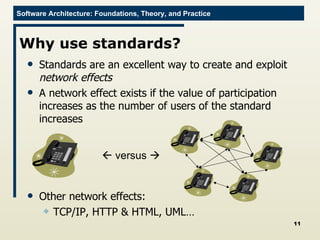
Why use standards? Standards are an excellent way to create and exploit  network effects A network effect exists if the value of participation increases as the number of users of the standard increases Other network effects: TCP/IP, HTTP & HTML, UML…    versus  
Why use standards? (cont’d) To ensure interoperability between products developed by different organizations Usually in the interest of fostering a network effect To carry hard-won engineering knowledge from one project to another To take advantage of hard-won engineering knowledge created by others As an effort to attract tool vendors To create economies of scale in tools To attempt to control the standard’s evolution in your favor
Drawbacks of standards Limits your agility Remember that doing ‘good’ architecture-based development means identifying what is important in  your  project Standards often attempt to apply the same techniques to a too-broad variety of situations The most widely adopted standards are often the most general
Overspecification vs. underspecification A perennial tension in standards use and development Overspecification A standard prescribes too much and therefore limits its applicability too much Underspecification A standard prescribes too little and therefore doesn’t provide enough guidance Possibly in an effort to broaden adoption
Two different kinds of underspecification Two compromises often made in negotiation when disagreements occur Leave the disagreeable part of the standard unspecified or purposefully ambiguous Include both opinions in the standard but make them both optional Both of these weaken the standard’s value Consider the different kinds of reduction in interoperability imposed by these strategies Although they may improve adoption!
When to adopt a standard? Early adoption Benefits Improved ability to influence the standard Get your own goals incorporated; exclude competitors Early to market If standard becomes successful, early marketers will profit Early experience Leverage enhanced experience to your benefit
When to adopt a standard? (cont’d) Early adoption Drawbacks Risk of failure Standard may not be successful for reasons out of your control Moving target Early standards tend to evolve and ‘churn’ more than mature ones, and may be ‘buggy’ Lack of support Early standards tend to have immature (or no) support from tool and solution vendors
When to adopt a standard? (cont’d) Late adoption Benefits Maturity of standard Better support Drawbacks Inability to influence the standard Restriction of innovation
Objectives Concepts What are standards? Why use standards? And why not? (drawbacks) Deciding when to adopt a standard Prevalent Architectural Standards Conceptual standards Notational standards Standard tools Process standards
IEEE 1471 Recommended practice for architecture description Often mandated for use in government projects Scope is limited to architecture descriptions (as opposed to processes, etc.) Does not prescribe a particular notation for models Does prescribe a minimal amount of content that should be contained in models Identifies the importance of stakeholders and advocates models that are tailored to stakeholder needs A notion of views and viewpoints similar to the ones used in this course
IEEE 1471 (cont’d) Very high level Purposefully light on specification Does not advocate any specific notation or process Useful as a starting point for thinking about architecture Defines key terms Advocates focus on stakeholders Being compliant does NOT ensure that you are doing good architecture-centric development
Department of Defense Architecture Framework DoDAF, evolved from C4ISR Has some other international analogs (MoDAF) ‘ Framework’ here refers to a process or set of viewpoints that should be used in capturing an architecture Not necessarily an architecture implementation framework Identifies specific viewpoints that should be captured Includes what kinds of information should be captured Does not prescribe a particular notation for doing the capture
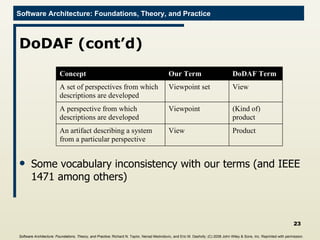
DoDAF (cont’d) Some vocabulary inconsistency with our terms (and IEEE 1471 among others) Software Architecture: Foundations, Theory, and Practice ; Richard N. Taylor, Nenad Medvidovic, and Eric M. Dashofy; (C)  2008 John Wiley & Sons, Inc. Reprinted with permission.
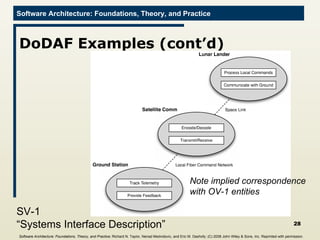
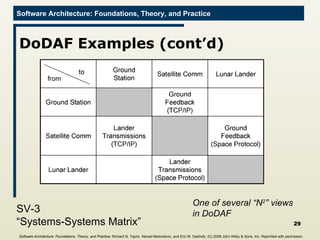
DoDAF (cont’d) Three views (in our terms: viewpoint sets) Operational View (OV) “ Identifies what needs to be accomplished, and who does it” Defines processes and activities, the operational elements that participate in those activities, and the information exchanges that occur between the elements Systems View (SV) Describe the systems that provide or support operational functions and the interconnections between them Systems in SV associated with elements in OV
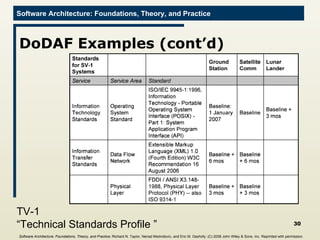
DoDAF (cont’d) Three views (in our terms: viewpoint sets) Technical Standards View (TV) Identify standards, (engineering) guidelines, rules, conventions, and other documents To ensure that implemented systems meet their requirements and are consistent with respect to the fact that they are implemented according to a common set of rules Also a few products address cross cutting concerns that affect All Views (AV) E.g., dictionary of terms
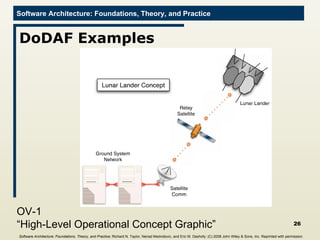
DoDAF Examples OV-1 “High-Level Operational Concept Graphic” Software Architecture: Foundations, Theory, and Practice ; Richard N. Taylor, Nenad Medvidovic, and Eric M. Dashofy; (C)  2008 John Wiley & Sons, Inc. Reprinted with permission.
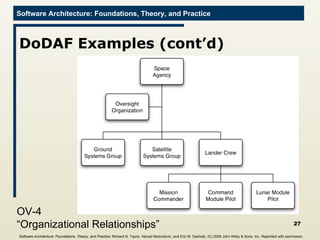
DoDAF Examples (cont’d) OV-4 “Organizational Relationships” Software Architecture: Foundations, Theory, and Practice ; Richard N. Taylor, Nenad Medvidovic, and Eric M. Dashofy; (C)  2008 John Wiley & Sons, Inc. Reprinted with permission.
DoDAF Examples (cont’d) SV-1 “Systems Interface Description” Note implied correspondence with OV-1 entities Software Architecture: Foundations, Theory, and Practice ; Richard N. Taylor, Nenad Medvidovic, and Eric M. Dashofy; (C)  2008 John Wiley & Sons, Inc. Reprinted with permission.
DoDAF Examples (cont’d) SV-3 “Systems-Systems Matrix” One of several “N 2 ” views in DoDAF Software Architecture: Foundations, Theory, and Practice ; Richard N. Taylor, Nenad Medvidovic, and Eric M. Dashofy; (C)  2008 John Wiley & Sons, Inc. Reprinted with permission.
DoDAF Examples (cont’d) TV-1 “Technical Standards Profile ” Software Architecture: Foundations, Theory, and Practice ; Richard N. Taylor, Nenad Medvidovic, and Eric M. Dashofy; (C)  2008 John Wiley & Sons, Inc. Reprinted with permission.
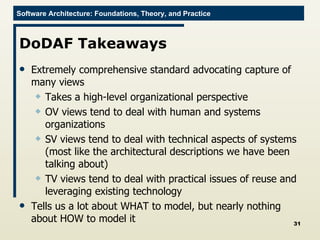
DoDAF Takeaways Extremely comprehensive standard advocating capture of many views Takes a high-level organizational perspective OV views tend to deal with human and systems organizations SV views tend to deal with technical aspects of systems (most like the architectural descriptions we have been talking about) TV views tend to deal with practical issues of reuse and leveraging existing technology Tells us a lot about WHAT to model, but nearly nothing about HOW to model it
The Open Group Architecture Framework TOGAF – an “enterprise architecture” framework Focuses beyond hardware/software How can enterprises build systems to achieve business goals? Four key areas addressed Business concerns, which address business strategies, organizations, and processes; Application concerns, which address applications to be deployed, their interactions, and their relationships to business processes; Data concerns, which address the structure of physical and logical data assets of an organization and the resources that manage these assets; and Technology concerns, which address issues of infrastructure and middleware.
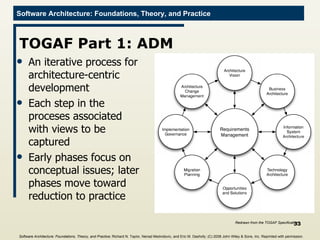
TOGAF Part 1: ADM An iterative process for architecture-centric development Each step in the proceses associated with views to be captured Early phases focus on conceptual issues; later phases move toward reduction to practice Redrawn from the TOGAF Specification Software Architecture: Foundations, Theory, and Practice ; Richard N. Taylor, Nenad Medvidovic, and Eric M. Dashofy; (C)  2008 John Wiley & Sons, Inc. Reprinted with permission.
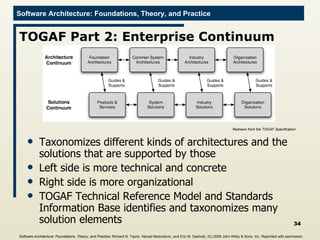
TOGAF Part 2: Enterprise Continuum Taxonomizes different kinds of architectures and the solutions that are supported by those Left side is more technical and concrete Right side is more organizational TOGAF Technical Reference Model and Standards Information Base identifies and taxonomizes many solution elements Redrawn from the TOGAF Specification Software Architecture: Foundations, Theory, and Practice ; Richard N. Taylor, Nenad Medvidovic, and Eric M. Dashofy; (C)  2008 John Wiley & Sons, Inc. Reprinted with permission.
TOGAF Part 3: TOGAF Resource Base A collection of useful information and resources that can be employed in following the ADM process Includes advice on how to set up boards and contracts for managing architecture checklists for various phases of the ADM process a catalog of different models that exist for evaluating architectures how to identify and prioritize different skills needed to develop architectures ....
TOGAF Takeaways Large size and broad scope looks at systems development from an enterprise perspective More suited to developing entire organizational information systems rather than indivdiual applications A collection and clearinghouse for IT “best practices” of all sorts
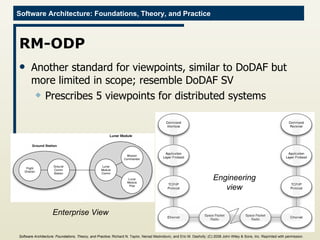
RM-ODP Another standard for viewpoints, similar to DoDAF but more limited in scope; resemble DoDAF SV Prescribes 5 viewpoints for distributed systems Engineering view Enterprise View Software Architecture: Foundations, Theory, and Practice ; Richard N. Taylor, Nenad Medvidovic, and Eric M. Dashofy; (C)  2008 John Wiley & Sons, Inc. Reprinted with permission.
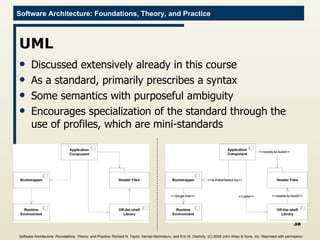
UML Discussed extensively already in this course As a standard, primarily prescribes a syntax Some semantics with purposeful ambiguity Encourages specialization of the standard through the use of profiles, which are mini-standards Software Architecture: Foundations, Theory, and Practice ; Richard N. Taylor, Nenad Medvidovic, and Eric M. Dashofy; (C)  2008 John Wiley & Sons, Inc. Reprinted with permission.
UML Takeaways Provide a common syntactic framework to express many common types of design decisions Profiles are needed to improve rigor But profiles can only specialize existing UML diagram types, not create new ones Documenting a system in UML does not ensure overall system quality You can document a bad architecture in UML as easily as a good one
SysML An extended version of UML Developed by a large consortium of organizations (mainly large system integrators and developers) Intended to mitigate UML’s “software bias” SysML group found UML standard insufficient and profiles not enough to resolve this Developed new diagram types to capture system-engineering specific views Limited momentum among tool vendors; focus shifting to more heavily use UML profiles
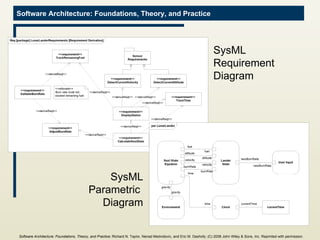
SysML Diagrams SysML Requirement  Diagram SysML Parametric  Diagram Software Architecture: Foundations, Theory, and Practice ; Richard N. Taylor, Nenad Medvidovic, and Eric M. Dashofy; (C)  2008 John Wiley & Sons, Inc. Reprinted with permission.
Standard UML Tools E.g., Rational Rose, ArgoUML, Microsoft Visio These are  de facto  standards All support drawing UML diagrams Vary along several dimensions Support for built-in UML extension mechanisms Profiles, stereotypes, tagged values, constraints Support for UML consistency checking Ability to generate other artifacts Generation of UML from other artifacts Traceability to other systems Support for capturing non-UML information
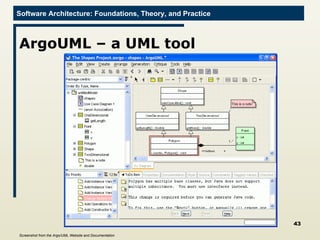
ArgoUML – a UML tool Screenshot from the Argo/UML Website and Documentation
Telelogic System Architect Formerly Popkin System Architect; popular among architects Supports 50+ different diagram types UML, IDEF, OMT, generic flowcharting, even GUI design Variants for DoDAF, service-oriented architectures, enterprise resource planning Effectively generic diagram editor specialized for many different diagram types with different symbols, connections Very little understanding of diagram semantics Specialized variants have some understanding of semantics but generally less than notation-specific editors
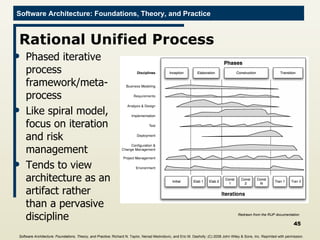
Rational Unified Process Phased iterative process framework/meta-process Like spiral model, focus on iteration and risk management Tends to view architecture as an artifact rather than a pervasive discipline Redrawn from the RUP documentation Software Architecture: Foundations, Theory, and Practice ; Richard N. Taylor, Nenad Medvidovic, and Eric M. Dashofy; (C)  2008 John Wiley & Sons, Inc. Reprinted with permission.
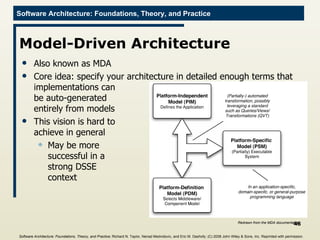
Model-Driven Architecture Also known as MDA Core idea: specify your architecture in detailed enough terms that implementations can be auto-generated entirely from models This vision is hard to achieve in general May be more  successful in a strong DSSE context Redrawn from the MDA documentation Software Architecture: Foundations, Theory, and Practice ; Richard N. Taylor, Nenad Medvidovic, and Eric M. Dashofy; (C)  2008 John Wiley & Sons, Inc. Reprinted with permission.
Overall Takeaways Standards confer many benefits Network effects, reusable engineering knowledge, interoperability, common vocabulary and understanding But are not a panacea! Knowledge of a breadth of standards is needed to be a good architect, but it is critical to maintain perspective Caveats This has been a very quick tour through complex standards; many standards are hundreds of pages and can’t adequately be explained in five minutes Most available online – investigate yourself!

26 standards

  • 1.
  • 2.
    Objectives Concepts Whatare standards? Why use standards? And why not? (drawbacks) Deciding when to adopt a standard Prevalent Architectural Standards Conceptual standards Notational standards Standard tools Process standards
  • 3.
    Objectives Concepts Whatare standards? Why use standards? And why not? (drawbacks) Deciding when to adopt a standard Prevalent Architectural Standards Conceptual standards Notational standards Standard tools Process standards
  • 4.
    What are standards?Definition: a standard is a form of agreement between parties Many kinds of standards For notations, tools, processes, organizations, domains There is a prevalent view that complying to standard ‘X’ ensures that a constructed system has high quality This is almost never strictly true But that doesn’t mean standards are worthless! Here, we will attempt to put standards in perspective
  • 5.
    De jure and de facto standards Some standards are controlled by a body considered authoritative ANSI, ISO, ECMA, W3C, IETF These standards are called de jure (“from law”) De jure standards usually are formally defined and documented are evolved through a rigorous, well-known process are managed by an independent body, governmental agency, or multi-organizational coalition rather than a single individual or company
  • 6.
    De jure and de facto standards (cont’d) Some standards emerge through widespread awareness and use These standards are called de facto (“in practice”) De facto standards usually are created by a single individual organization to address a particular need are adopted due to technical superiority or market dominance of the creating organization evolve through an emergent, market-driven process are managed by the creating organization or the users themselves, rather than through a formal custodial body
  • 7.
    Examples of de jure and de facto De jure standards UML (managed by OMG) CORBA (also managed by OMG) HTTP protocol (managed by IETF) De facto standards PDF format (managed by Adobe) May become de jure through ISO Windows (managed by Microsoft) There is a substantial gray area between these two
  • 8.
    Gray-area Standards HTMLOfficially standardized by W3C, indicating de jure Flavors and browser-specific extensions developed by Microsoft, Netscape, and others, creating de facto variants None of these has power to force users to use standard JavaScript Developed by Netscape; copied (as JScript) by Microsoft After substantial adoption and possibly under threat of forking/splintering, Netscape submits it to ECMA Now standardized as ECMAScript ( de jure ) JavaScript and variants continue to be developed as compatible extensions of ECMAScript
  • 9.
    Another spectrum Standards(whether de jure or de facto ) can be: Open Allow public participation in the standardization process Anyone can submit ideas or changes for review Closed (a.k.a. proprietary) Only the custodians of a standard can participate in its evolution
  • 10.
    Open vs. closedstandards Another spectrum with a gray area Some standards bodies have high barriers to entry (e.g., steep membership fees, vote of existing membership) Some standards (e.g., Java) have aspects of both Sun Microsystems is effectively in control of Java as a de facto standard There is an open “community process” by which external parties can participate in a limited way
  • 11.
    Why use standards?Standards are an excellent way to create and exploit network effects A network effect exists if the value of participation increases as the number of users of the standard increases Other network effects: TCP/IP, HTTP & HTML, UML…  versus 
  • 12.
    Why use standards?(cont’d) To ensure interoperability between products developed by different organizations Usually in the interest of fostering a network effect To carry hard-won engineering knowledge from one project to another To take advantage of hard-won engineering knowledge created by others As an effort to attract tool vendors To create economies of scale in tools To attempt to control the standard’s evolution in your favor
  • 13.
    Drawbacks of standardsLimits your agility Remember that doing ‘good’ architecture-based development means identifying what is important in your project Standards often attempt to apply the same techniques to a too-broad variety of situations The most widely adopted standards are often the most general
  • 14.
    Overspecification vs. underspecificationA perennial tension in standards use and development Overspecification A standard prescribes too much and therefore limits its applicability too much Underspecification A standard prescribes too little and therefore doesn’t provide enough guidance Possibly in an effort to broaden adoption
  • 15.
    Two different kindsof underspecification Two compromises often made in negotiation when disagreements occur Leave the disagreeable part of the standard unspecified or purposefully ambiguous Include both opinions in the standard but make them both optional Both of these weaken the standard’s value Consider the different kinds of reduction in interoperability imposed by these strategies Although they may improve adoption!
  • 16.
    When to adopta standard? Early adoption Benefits Improved ability to influence the standard Get your own goals incorporated; exclude competitors Early to market If standard becomes successful, early marketers will profit Early experience Leverage enhanced experience to your benefit
  • 17.
    When to adopta standard? (cont’d) Early adoption Drawbacks Risk of failure Standard may not be successful for reasons out of your control Moving target Early standards tend to evolve and ‘churn’ more than mature ones, and may be ‘buggy’ Lack of support Early standards tend to have immature (or no) support from tool and solution vendors
  • 18.
    When to adopta standard? (cont’d) Late adoption Benefits Maturity of standard Better support Drawbacks Inability to influence the standard Restriction of innovation
  • 19.
    Objectives Concepts Whatare standards? Why use standards? And why not? (drawbacks) Deciding when to adopt a standard Prevalent Architectural Standards Conceptual standards Notational standards Standard tools Process standards
  • 20.
    IEEE 1471 Recommendedpractice for architecture description Often mandated for use in government projects Scope is limited to architecture descriptions (as opposed to processes, etc.) Does not prescribe a particular notation for models Does prescribe a minimal amount of content that should be contained in models Identifies the importance of stakeholders and advocates models that are tailored to stakeholder needs A notion of views and viewpoints similar to the ones used in this course
  • 21.
    IEEE 1471 (cont’d)Very high level Purposefully light on specification Does not advocate any specific notation or process Useful as a starting point for thinking about architecture Defines key terms Advocates focus on stakeholders Being compliant does NOT ensure that you are doing good architecture-centric development
  • 22.
    Department of DefenseArchitecture Framework DoDAF, evolved from C4ISR Has some other international analogs (MoDAF) ‘ Framework’ here refers to a process or set of viewpoints that should be used in capturing an architecture Not necessarily an architecture implementation framework Identifies specific viewpoints that should be captured Includes what kinds of information should be captured Does not prescribe a particular notation for doing the capture
  • 23.
    DoDAF (cont’d) Somevocabulary inconsistency with our terms (and IEEE 1471 among others) Software Architecture: Foundations, Theory, and Practice ; Richard N. Taylor, Nenad Medvidovic, and Eric M. Dashofy; (C) 2008 John Wiley & Sons, Inc. Reprinted with permission.
  • 24.
    DoDAF (cont’d) Threeviews (in our terms: viewpoint sets) Operational View (OV) “ Identifies what needs to be accomplished, and who does it” Defines processes and activities, the operational elements that participate in those activities, and the information exchanges that occur between the elements Systems View (SV) Describe the systems that provide or support operational functions and the interconnections between them Systems in SV associated with elements in OV
  • 25.
    DoDAF (cont’d) Threeviews (in our terms: viewpoint sets) Technical Standards View (TV) Identify standards, (engineering) guidelines, rules, conventions, and other documents To ensure that implemented systems meet their requirements and are consistent with respect to the fact that they are implemented according to a common set of rules Also a few products address cross cutting concerns that affect All Views (AV) E.g., dictionary of terms
  • 26.
    DoDAF Examples OV-1“High-Level Operational Concept Graphic” Software Architecture: Foundations, Theory, and Practice ; Richard N. Taylor, Nenad Medvidovic, and Eric M. Dashofy; (C) 2008 John Wiley & Sons, Inc. Reprinted with permission.
  • 27.
    DoDAF Examples (cont’d)OV-4 “Organizational Relationships” Software Architecture: Foundations, Theory, and Practice ; Richard N. Taylor, Nenad Medvidovic, and Eric M. Dashofy; (C) 2008 John Wiley & Sons, Inc. Reprinted with permission.
  • 28.
    DoDAF Examples (cont’d)SV-1 “Systems Interface Description” Note implied correspondence with OV-1 entities Software Architecture: Foundations, Theory, and Practice ; Richard N. Taylor, Nenad Medvidovic, and Eric M. Dashofy; (C) 2008 John Wiley & Sons, Inc. Reprinted with permission.
  • 29.
    DoDAF Examples (cont’d)SV-3 “Systems-Systems Matrix” One of several “N 2 ” views in DoDAF Software Architecture: Foundations, Theory, and Practice ; Richard N. Taylor, Nenad Medvidovic, and Eric M. Dashofy; (C) 2008 John Wiley & Sons, Inc. Reprinted with permission.
  • 30.
    DoDAF Examples (cont’d)TV-1 “Technical Standards Profile ” Software Architecture: Foundations, Theory, and Practice ; Richard N. Taylor, Nenad Medvidovic, and Eric M. Dashofy; (C) 2008 John Wiley & Sons, Inc. Reprinted with permission.
  • 31.
    DoDAF Takeaways Extremelycomprehensive standard advocating capture of many views Takes a high-level organizational perspective OV views tend to deal with human and systems organizations SV views tend to deal with technical aspects of systems (most like the architectural descriptions we have been talking about) TV views tend to deal with practical issues of reuse and leveraging existing technology Tells us a lot about WHAT to model, but nearly nothing about HOW to model it
  • 32.
    The Open GroupArchitecture Framework TOGAF – an “enterprise architecture” framework Focuses beyond hardware/software How can enterprises build systems to achieve business goals? Four key areas addressed Business concerns, which address business strategies, organizations, and processes; Application concerns, which address applications to be deployed, their interactions, and their relationships to business processes; Data concerns, which address the structure of physical and logical data assets of an organization and the resources that manage these assets; and Technology concerns, which address issues of infrastructure and middleware.
  • 33.
    TOGAF Part 1:ADM An iterative process for architecture-centric development Each step in the proceses associated with views to be captured Early phases focus on conceptual issues; later phases move toward reduction to practice Redrawn from the TOGAF Specification Software Architecture: Foundations, Theory, and Practice ; Richard N. Taylor, Nenad Medvidovic, and Eric M. Dashofy; (C) 2008 John Wiley & Sons, Inc. Reprinted with permission.
  • 34.
    TOGAF Part 2:Enterprise Continuum Taxonomizes different kinds of architectures and the solutions that are supported by those Left side is more technical and concrete Right side is more organizational TOGAF Technical Reference Model and Standards Information Base identifies and taxonomizes many solution elements Redrawn from the TOGAF Specification Software Architecture: Foundations, Theory, and Practice ; Richard N. Taylor, Nenad Medvidovic, and Eric M. Dashofy; (C) 2008 John Wiley & Sons, Inc. Reprinted with permission.
  • 35.
    TOGAF Part 3:TOGAF Resource Base A collection of useful information and resources that can be employed in following the ADM process Includes advice on how to set up boards and contracts for managing architecture checklists for various phases of the ADM process a catalog of different models that exist for evaluating architectures how to identify and prioritize different skills needed to develop architectures ....
  • 36.
    TOGAF Takeaways Largesize and broad scope looks at systems development from an enterprise perspective More suited to developing entire organizational information systems rather than indivdiual applications A collection and clearinghouse for IT “best practices” of all sorts
  • 37.
    RM-ODP Another standardfor viewpoints, similar to DoDAF but more limited in scope; resemble DoDAF SV Prescribes 5 viewpoints for distributed systems Engineering view Enterprise View Software Architecture: Foundations, Theory, and Practice ; Richard N. Taylor, Nenad Medvidovic, and Eric M. Dashofy; (C) 2008 John Wiley & Sons, Inc. Reprinted with permission.
  • 38.
    UML Discussed extensivelyalready in this course As a standard, primarily prescribes a syntax Some semantics with purposeful ambiguity Encourages specialization of the standard through the use of profiles, which are mini-standards Software Architecture: Foundations, Theory, and Practice ; Richard N. Taylor, Nenad Medvidovic, and Eric M. Dashofy; (C) 2008 John Wiley & Sons, Inc. Reprinted with permission.
  • 39.
    UML Takeaways Providea common syntactic framework to express many common types of design decisions Profiles are needed to improve rigor But profiles can only specialize existing UML diagram types, not create new ones Documenting a system in UML does not ensure overall system quality You can document a bad architecture in UML as easily as a good one
  • 40.
    SysML An extendedversion of UML Developed by a large consortium of organizations (mainly large system integrators and developers) Intended to mitigate UML’s “software bias” SysML group found UML standard insufficient and profiles not enough to resolve this Developed new diagram types to capture system-engineering specific views Limited momentum among tool vendors; focus shifting to more heavily use UML profiles
  • 41.
    SysML Diagrams SysMLRequirement Diagram SysML Parametric Diagram Software Architecture: Foundations, Theory, and Practice ; Richard N. Taylor, Nenad Medvidovic, and Eric M. Dashofy; (C) 2008 John Wiley & Sons, Inc. Reprinted with permission.
  • 42.
    Standard UML ToolsE.g., Rational Rose, ArgoUML, Microsoft Visio These are de facto standards All support drawing UML diagrams Vary along several dimensions Support for built-in UML extension mechanisms Profiles, stereotypes, tagged values, constraints Support for UML consistency checking Ability to generate other artifacts Generation of UML from other artifacts Traceability to other systems Support for capturing non-UML information
  • 43.
    ArgoUML – aUML tool Screenshot from the Argo/UML Website and Documentation
  • 44.
    Telelogic System ArchitectFormerly Popkin System Architect; popular among architects Supports 50+ different diagram types UML, IDEF, OMT, generic flowcharting, even GUI design Variants for DoDAF, service-oriented architectures, enterprise resource planning Effectively generic diagram editor specialized for many different diagram types with different symbols, connections Very little understanding of diagram semantics Specialized variants have some understanding of semantics but generally less than notation-specific editors
  • 45.
    Rational Unified ProcessPhased iterative process framework/meta-process Like spiral model, focus on iteration and risk management Tends to view architecture as an artifact rather than a pervasive discipline Redrawn from the RUP documentation Software Architecture: Foundations, Theory, and Practice ; Richard N. Taylor, Nenad Medvidovic, and Eric M. Dashofy; (C) 2008 John Wiley & Sons, Inc. Reprinted with permission.
  • 46.
    Model-Driven Architecture Alsoknown as MDA Core idea: specify your architecture in detailed enough terms that implementations can be auto-generated entirely from models This vision is hard to achieve in general May be more successful in a strong DSSE context Redrawn from the MDA documentation Software Architecture: Foundations, Theory, and Practice ; Richard N. Taylor, Nenad Medvidovic, and Eric M. Dashofy; (C) 2008 John Wiley & Sons, Inc. Reprinted with permission.
  • 47.
    Overall Takeaways Standardsconfer many benefits Network effects, reusable engineering knowledge, interoperability, common vocabulary and understanding But are not a panacea! Knowledge of a breadth of standards is needed to be a good architect, but it is critical to maintain perspective Caveats This has been a very quick tour through complex standards; many standards are hundreds of pages and can’t adequately be explained in five minutes Most available online – investigate yourself!