Overview of Adaptive Modulation & CodingTechnique
(AMC)
Presented By
NAME: SUMAN BHATTACHARYYA
1
Table of Content
 Introduction
 Adaptive modulation & Coding
 Block Diagram
 Importance of AMC
 Constraints
 Goal
 Current system using AMC
 Advantages of AMC
 Challenges of AMC
 Conclusion
 References
2
Introduction
 Adaptive modulation and coding enables robust
and spectrally efficient transmission over time-
varying channels.
 AMC was introduced in the late sixties and early
seventies.
 The basic idea behind it is to adopting
transmission parameters according to channel
conditions by monitoring and measuring them.
3
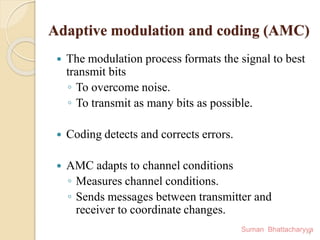
Adaptive modulation and coding (AMC)
 The modulation process formats the signal to best
transmit bits
◦ To overcome noise.
◦ To transmit as many bits as possible.
 Coding detects and corrects errors.
 AMC adapts to channel conditions
◦ Measures channel conditions.
◦ Sends messages between transmitter and
receiver to coordinate changes.
4
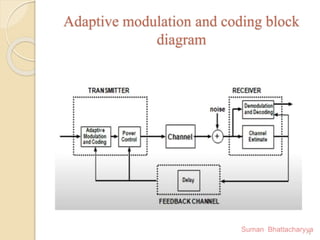
Adaptive modulation and coding block
diagram
5
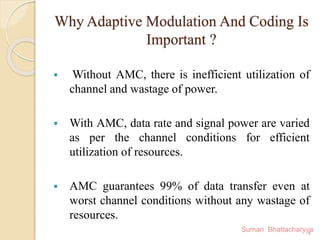
Why Adaptive Modulation And Coding Is
Important ?
 Without AMC, there is inefficient utilization of
channel and wastage of power.
 With AMC, data rate and signal power are varied
as per the channel conditions for efficient
utilization of resources.
 AMC guarantees 99% of data transfer even at
worst channel conditions without any wastage of
resources.
6
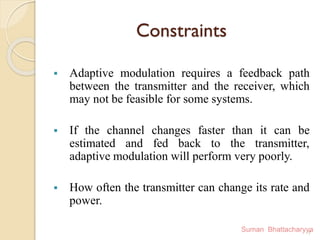
Constraints
 Adaptive modulation requires a feedback path
between the transmitter and the receiver, which
may not be feasible for some systems.
 If the channel changes faster than it can be
estimated and fed back to the transmitter,
adaptive modulation will perform very poorly.
 How often the transmitter can change its rate and
power.
7
Goal Of Adaptive modulation and coding
 Adaptive Modulation & Coding is used to
improve the operational efficiency of Microwave
links by increasing network capacity over the
existing infrastructure.
 Adaptive Modulation means dynamically varying
the modulation in an errorless manner in order to
maximize the throughput under momentary
propagation conditions.
8
CURRENT SYSTEMS USING AMC
 EGPRS for data transmission in GSM cellular
system uses 8PSK with 5 different code rates and
GMSK with 4 different code rates. Total 9
different coding and modulation schemes.
 GPRS for data transmission in IS-136 TDMA
cellular systems can use 4, 8, and 16 level PSK
modulation.
9
Advantages Of Adaptive Modulation And
Coding
 Adaptive Modulation & Coding allows a wireless
system to choose the highest order modulation
depending on the channel conditions.
 Adaptive Modulation & Coding allows the system
to overcome fading and other interference.
 Maximize the throughput.
10
Challenges
 AMC is sensitive to measurement error and delay.
In order to select the appropriate modulation, the
scheduler must be aware of the channel quality.
 Errors in the channel estimate will cause the
control to select the wrong data rate and either
transmit at too high a power, wasting system
capacity, or too low a power, raising the block
error rate.
 Complexity is very High.
11
Conclusion
 Adaptive modulation is one method to improve
the throughput and/or range.
 The use of adaptive modulation allows wireless
technologies to optimize throughput, yielding
higher throughputs while also covering long
distances.
12
References
 Wireless Communications by Andrea Goldsmith
(Edition 2005)
 https://iopscience.iop.org/article/10.1088/1757-
899X/78/1/012016#:~:text=Adaptive%20Modulation%2
0and%20Coding%20(AMC,MIMO%20antenna%20con
figuration%20is%20studied.
 https://www.academia.edu/36992931/Implementation_w
ith_Adaptive_Modulation_Technique_and_OFDM_Base
d_Approach
 https://uweb.engr.arizona.edu/~ivan/JOCN_AMC_FSO_
MAy10.pdf
13
Thank You….
14

Adaptive Modulation and Coding Techniques

  • 1.
    Overview of AdaptiveModulation & CodingTechnique (AMC) Presented By NAME: SUMAN BHATTACHARYYA 1
  • 2.
    Table of Content Introduction  Adaptive modulation & Coding  Block Diagram  Importance of AMC  Constraints  Goal  Current system using AMC  Advantages of AMC  Challenges of AMC  Conclusion  References 2
  • 3.
    Introduction  Adaptive modulationand coding enables robust and spectrally efficient transmission over time- varying channels.  AMC was introduced in the late sixties and early seventies.  The basic idea behind it is to adopting transmission parameters according to channel conditions by monitoring and measuring them. 3
  • 4.
    Adaptive modulation andcoding (AMC)  The modulation process formats the signal to best transmit bits ◦ To overcome noise. ◦ To transmit as many bits as possible.  Coding detects and corrects errors.  AMC adapts to channel conditions ◦ Measures channel conditions. ◦ Sends messages between transmitter and receiver to coordinate changes. 4
  • 5.
    Adaptive modulation andcoding block diagram 5
  • 6.
    Why Adaptive ModulationAnd Coding Is Important ?  Without AMC, there is inefficient utilization of channel and wastage of power.  With AMC, data rate and signal power are varied as per the channel conditions for efficient utilization of resources.  AMC guarantees 99% of data transfer even at worst channel conditions without any wastage of resources. 6
  • 7.
    Constraints  Adaptive modulationrequires a feedback path between the transmitter and the receiver, which may not be feasible for some systems.  If the channel changes faster than it can be estimated and fed back to the transmitter, adaptive modulation will perform very poorly.  How often the transmitter can change its rate and power. 7
  • 8.
    Goal Of Adaptivemodulation and coding  Adaptive Modulation & Coding is used to improve the operational efficiency of Microwave links by increasing network capacity over the existing infrastructure.  Adaptive Modulation means dynamically varying the modulation in an errorless manner in order to maximize the throughput under momentary propagation conditions. 8
  • 9.
    CURRENT SYSTEMS USINGAMC  EGPRS for data transmission in GSM cellular system uses 8PSK with 5 different code rates and GMSK with 4 different code rates. Total 9 different coding and modulation schemes.  GPRS for data transmission in IS-136 TDMA cellular systems can use 4, 8, and 16 level PSK modulation. 9
  • 10.
    Advantages Of AdaptiveModulation And Coding  Adaptive Modulation & Coding allows a wireless system to choose the highest order modulation depending on the channel conditions.  Adaptive Modulation & Coding allows the system to overcome fading and other interference.  Maximize the throughput. 10
  • 11.
    Challenges  AMC issensitive to measurement error and delay. In order to select the appropriate modulation, the scheduler must be aware of the channel quality.  Errors in the channel estimate will cause the control to select the wrong data rate and either transmit at too high a power, wasting system capacity, or too low a power, raising the block error rate.  Complexity is very High. 11
  • 12.
    Conclusion  Adaptive modulationis one method to improve the throughput and/or range.  The use of adaptive modulation allows wireless technologies to optimize throughput, yielding higher throughputs while also covering long distances. 12
  • 13.
    References  Wireless Communicationsby Andrea Goldsmith (Edition 2005)  https://iopscience.iop.org/article/10.1088/1757- 899X/78/1/012016#:~:text=Adaptive%20Modulation%2 0and%20Coding%20(AMC,MIMO%20antenna%20con figuration%20is%20studied.  https://www.academia.edu/36992931/Implementation_w ith_Adaptive_Modulation_Technique_and_OFDM_Base d_Approach  https://uweb.engr.arizona.edu/~ivan/JOCN_AMC_FSO_ MAy10.pdf 13
  • 14.