Software Product Lines


     Paolo Ciancarini
Agenda

•  Design for reuse
•  Software product lines
•  Organizational strategies
Motivation
Complexity, size, and number of software-
intensive systems a major problem for
software companies
•  routine functionality is custom-written repeatedly
   from scratch, over and over
•  a quagmire of data formats and applications
•  ambiguities and interoperability conflicts not only
   across different companies but even among
   groups within the same company
Family of systems
There is a need to
•  reduce the development effort
•  increase productivity
moving from designing single products to producing
engineering families of products
•  identifying generic solutions to common problems
•  building related products by assembling components
•  providing universal platforms
•  synthesizing systems automatically
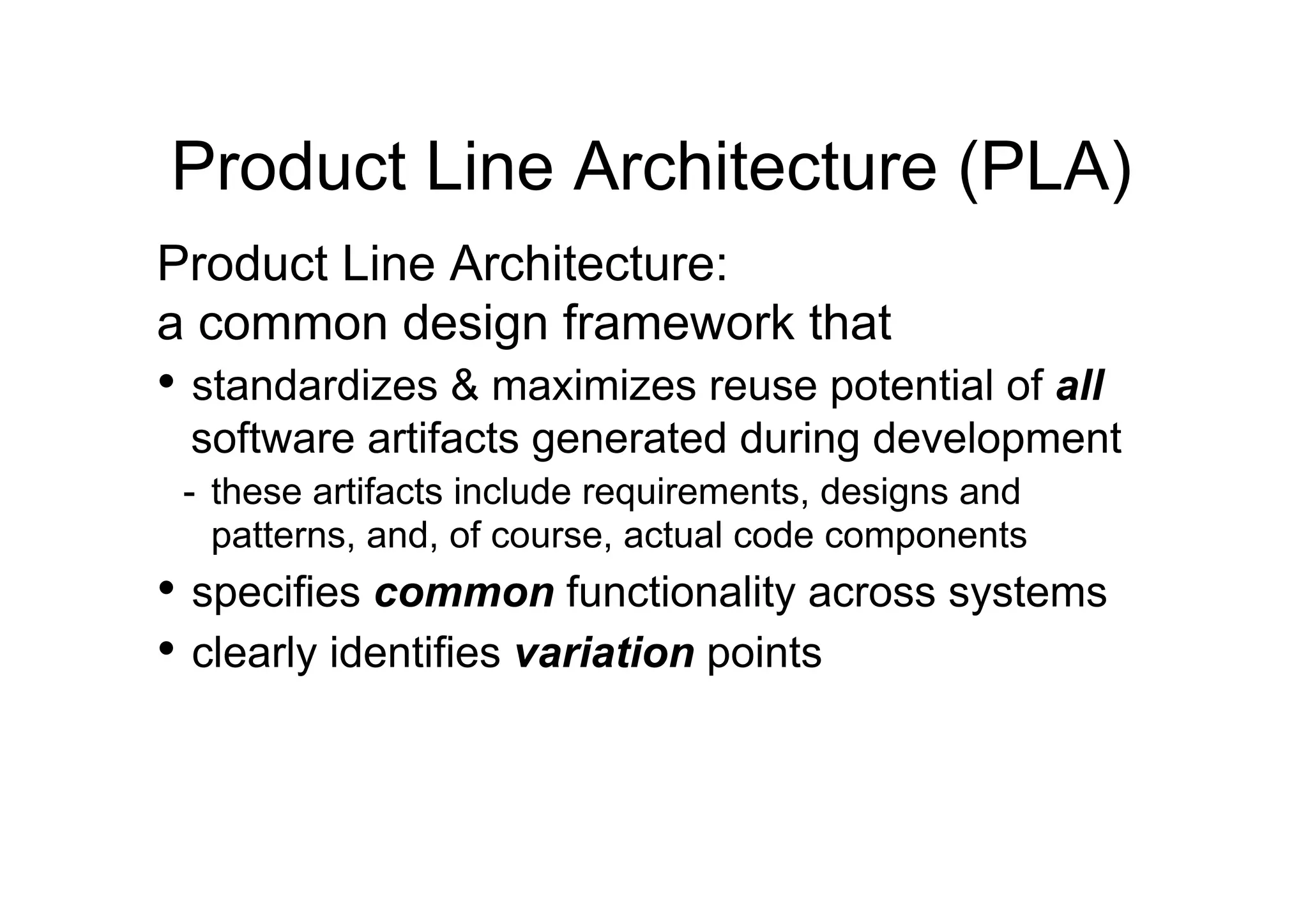
Product Line Architecture (PLA)
Product Line Architecture:
a common design framework that
•  standardizes & maximizes reuse potential of all
 software artifacts generated during development
 -  these artifacts include requirements, designs and
    patterns, and, of course, actual code components
•  specifies common functionality across systems
•  clearly identifies variation points
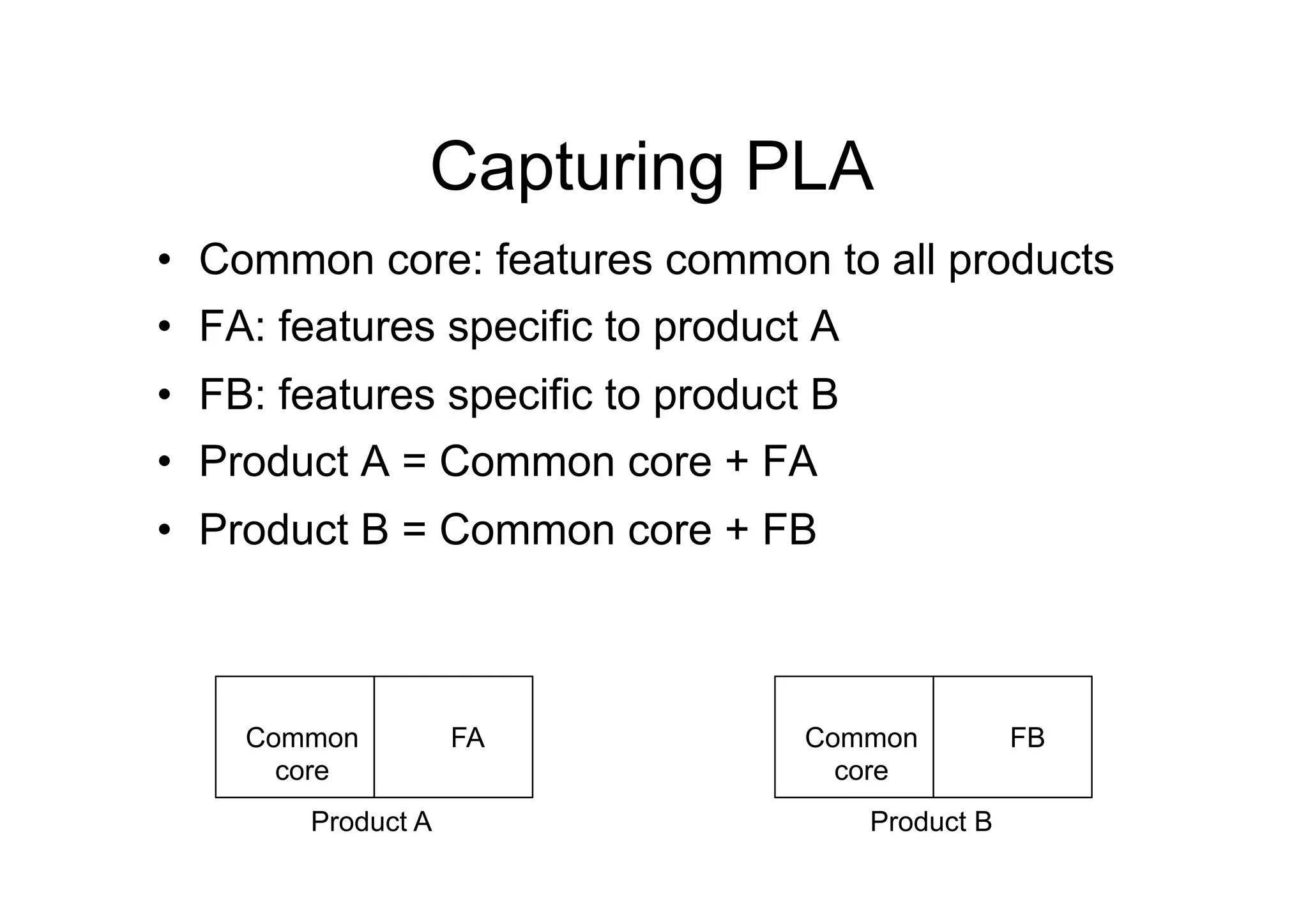
Capturing PLA
•  Common core: features common to all products
•  FA: features specific to product A
•  FB: features specific to product B
•  Product A = Common core + FA
•  Product B = Common core + FB


    Common          FA             Common           FB
      core                           core
        Product A                       Product B
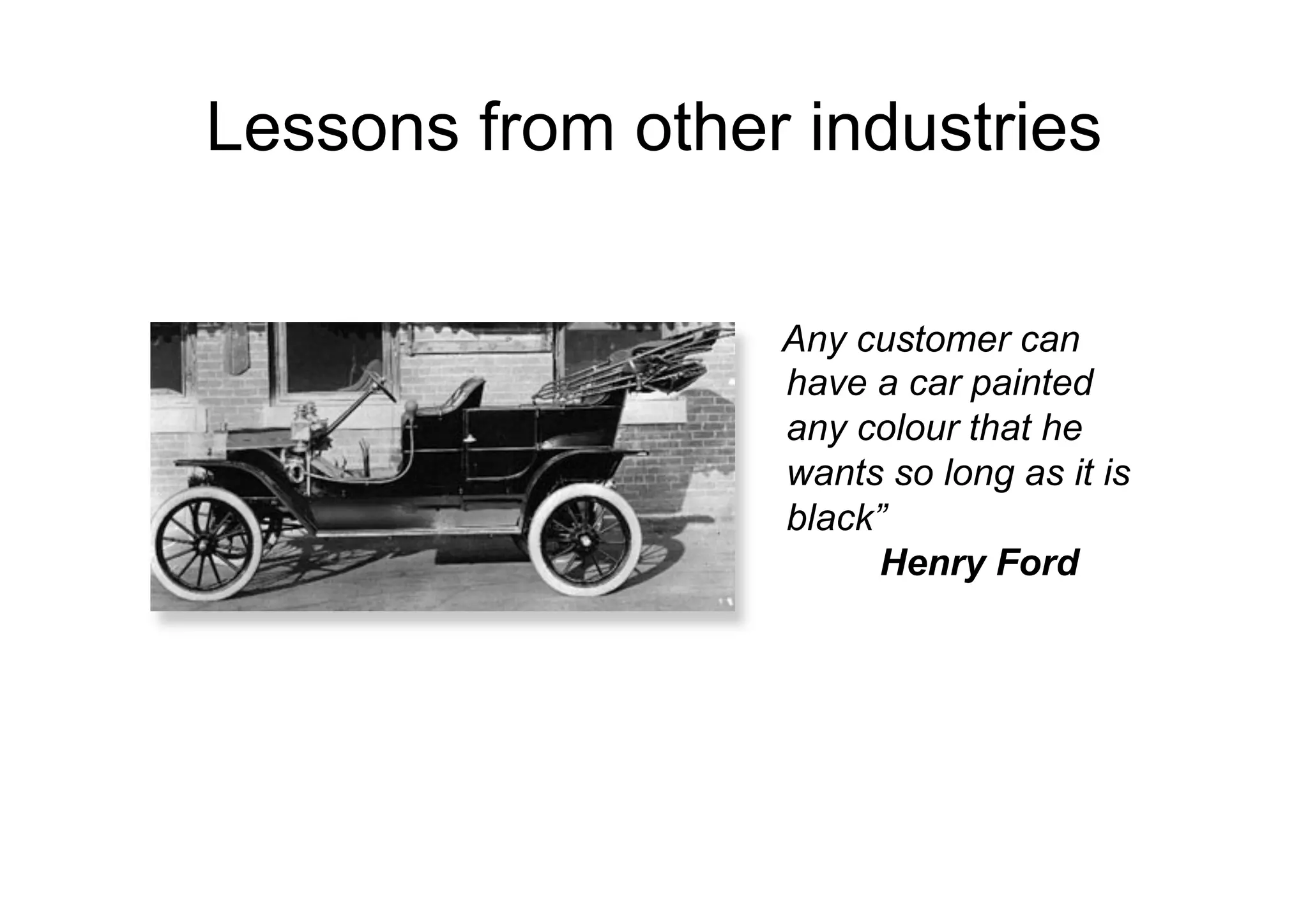
Lessons from other industries

•  Any customer can have     Any customer can
   a car painted any         have a car painted
   colour that he wants so   any colour that he
   long as it is black” -    wants so long as it is
   Henry Ford                black”
                                  Henry Ford
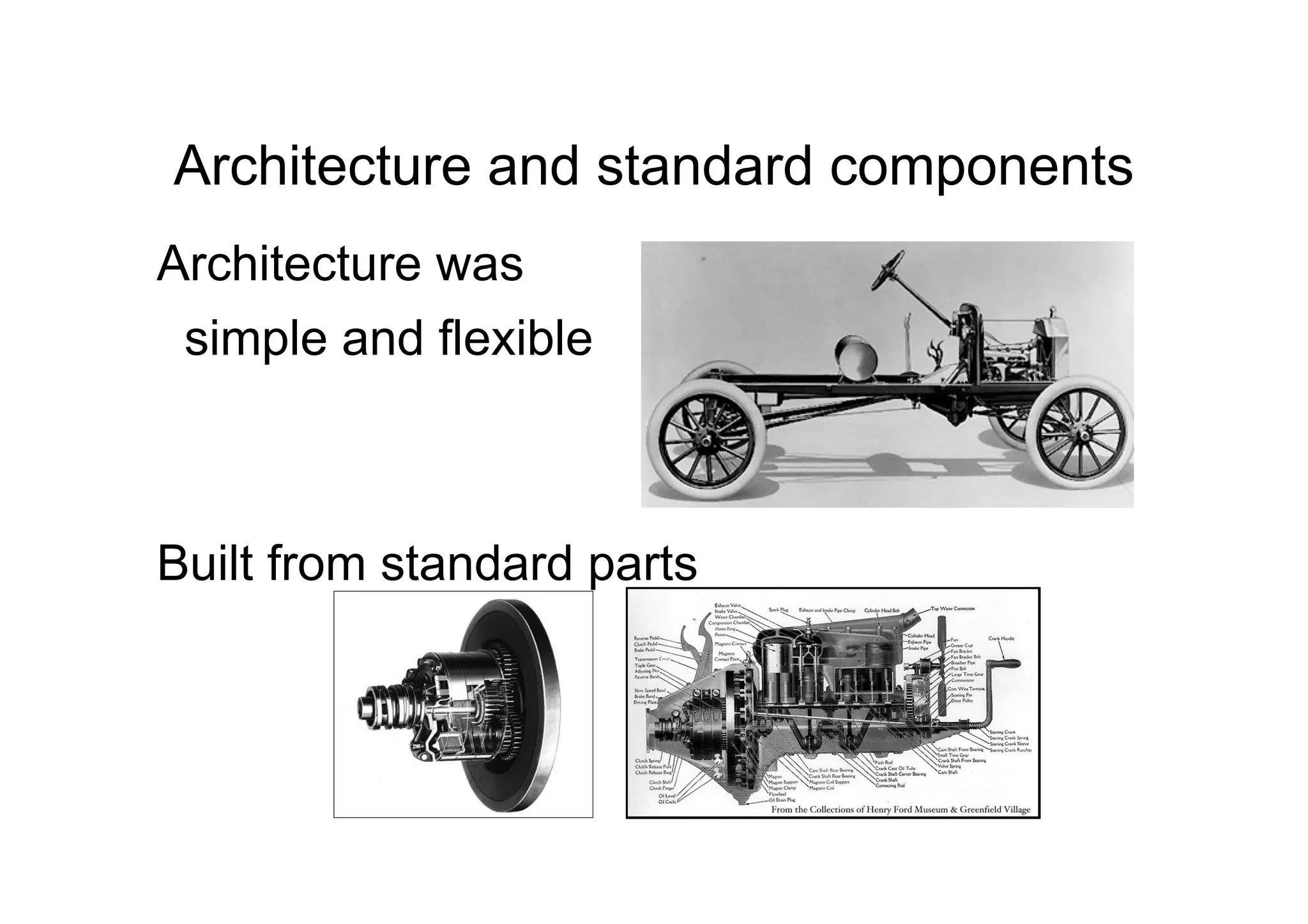
Architecture and standard components
Architecture was
 simple and flexible


Built from standard parts
Standards and diversity
What varied?
 Use features to satisfy diversity of needs
Why it worked?
 Standard architecture and common parts
What resulted?
 Product and assembly lines
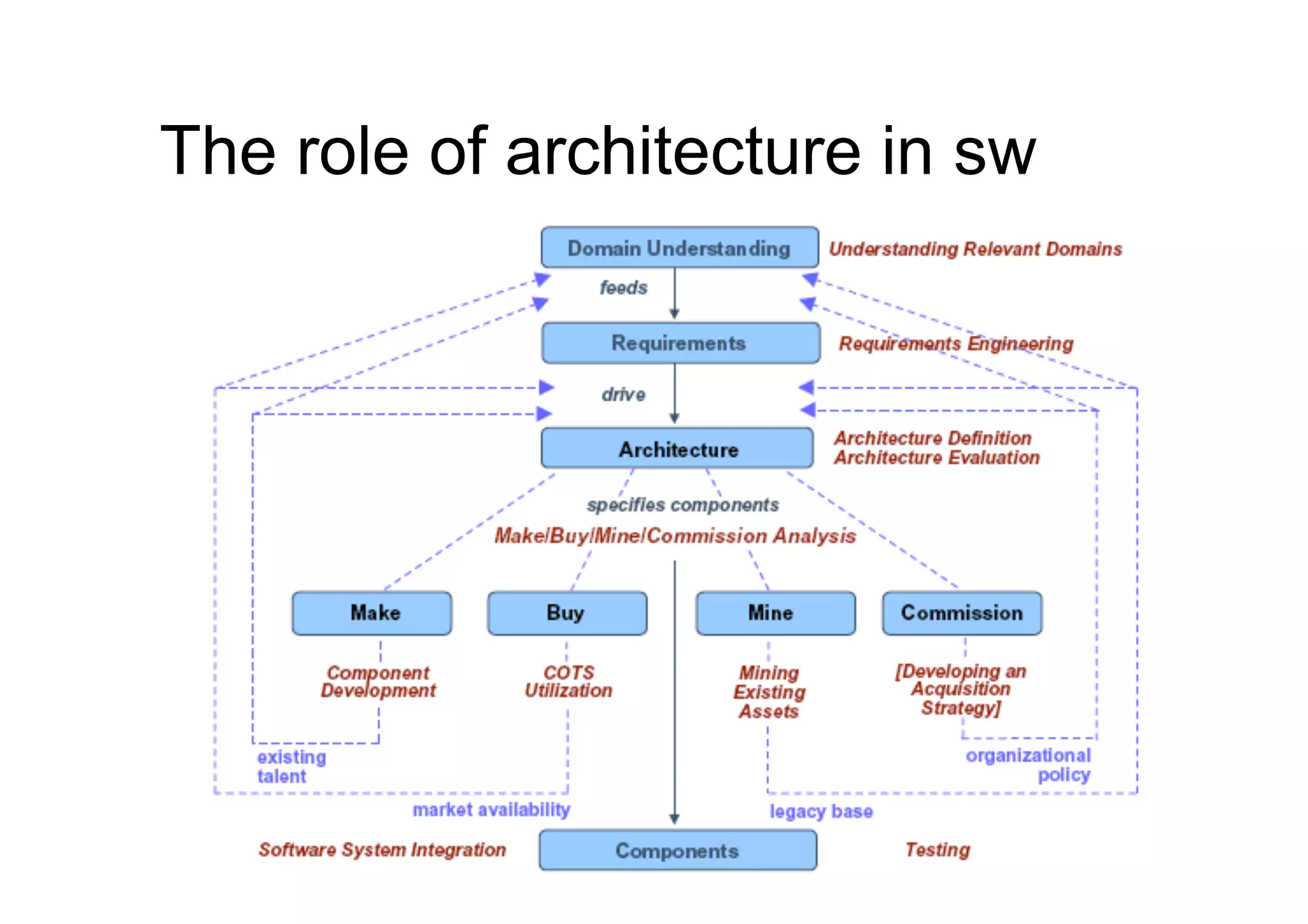
The role of architecture in sw
Component based development
Software factories exploit component-based
development (CBD)
•  They engineer applications by composing
   prefabricated components in the hope that this
   will increase software reuse
•  Strategy: building software systematically and
   opportunistically exploting reference
   architectures about a domain and competitive
   knowledge for systems in that domain
Domain
What is a domain?
•  Area of expertise with specialized particular tasks
•  Populated by products with reusable structures

Example: software for a car
•  Console
•  Engine
•  Brakes
•  …
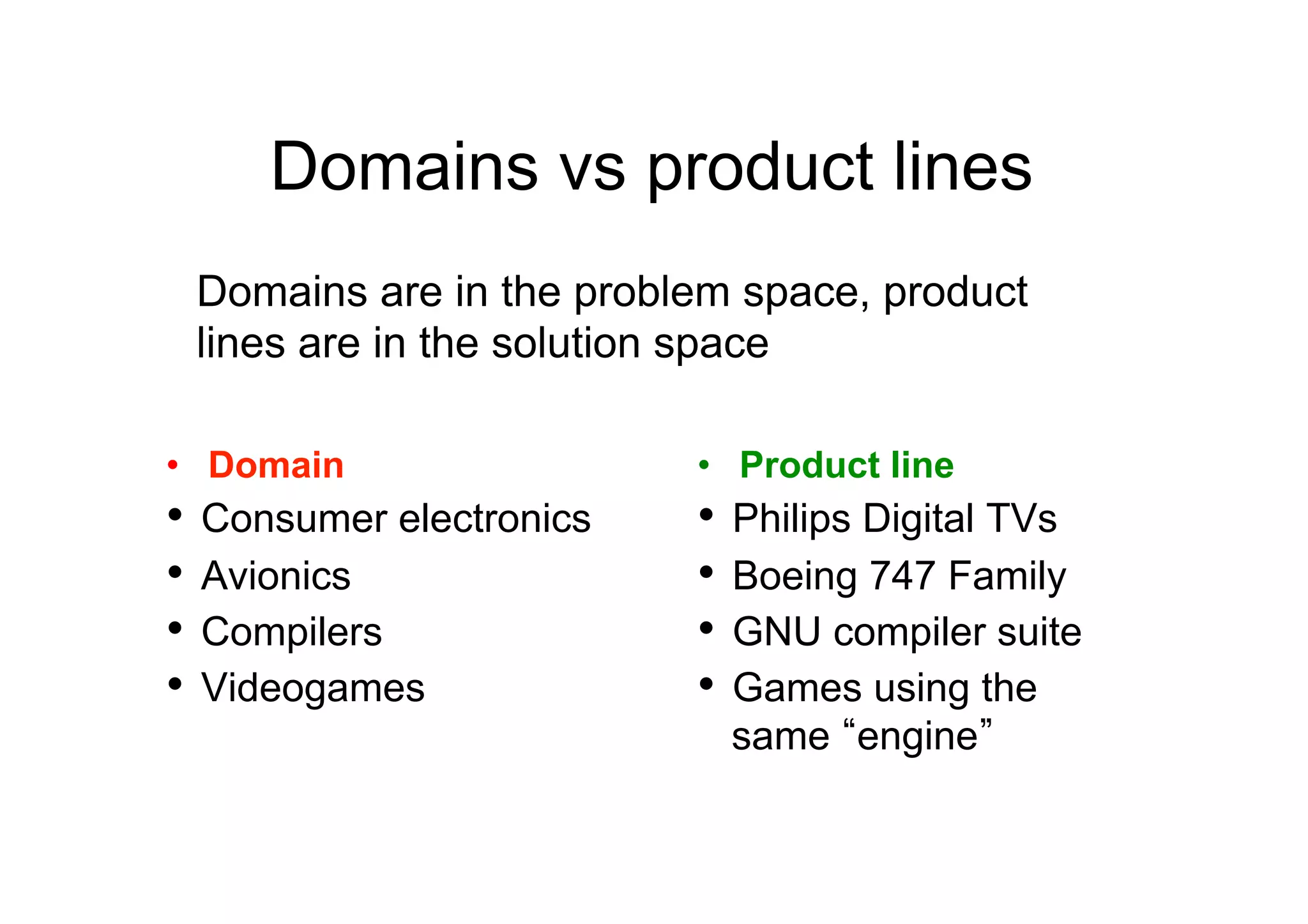
Domains vs product lines
 Domains are in the problem space, product
 lines are in the solution space

•  Domain                 •  Product line
•  Consumer electronics   •  Philips Digital TVs
•  Avionics               •  Boeing 747 Family
•  Compilers              •  GNU compiler suite
•  Videogames             •  Games using the
                           same engine
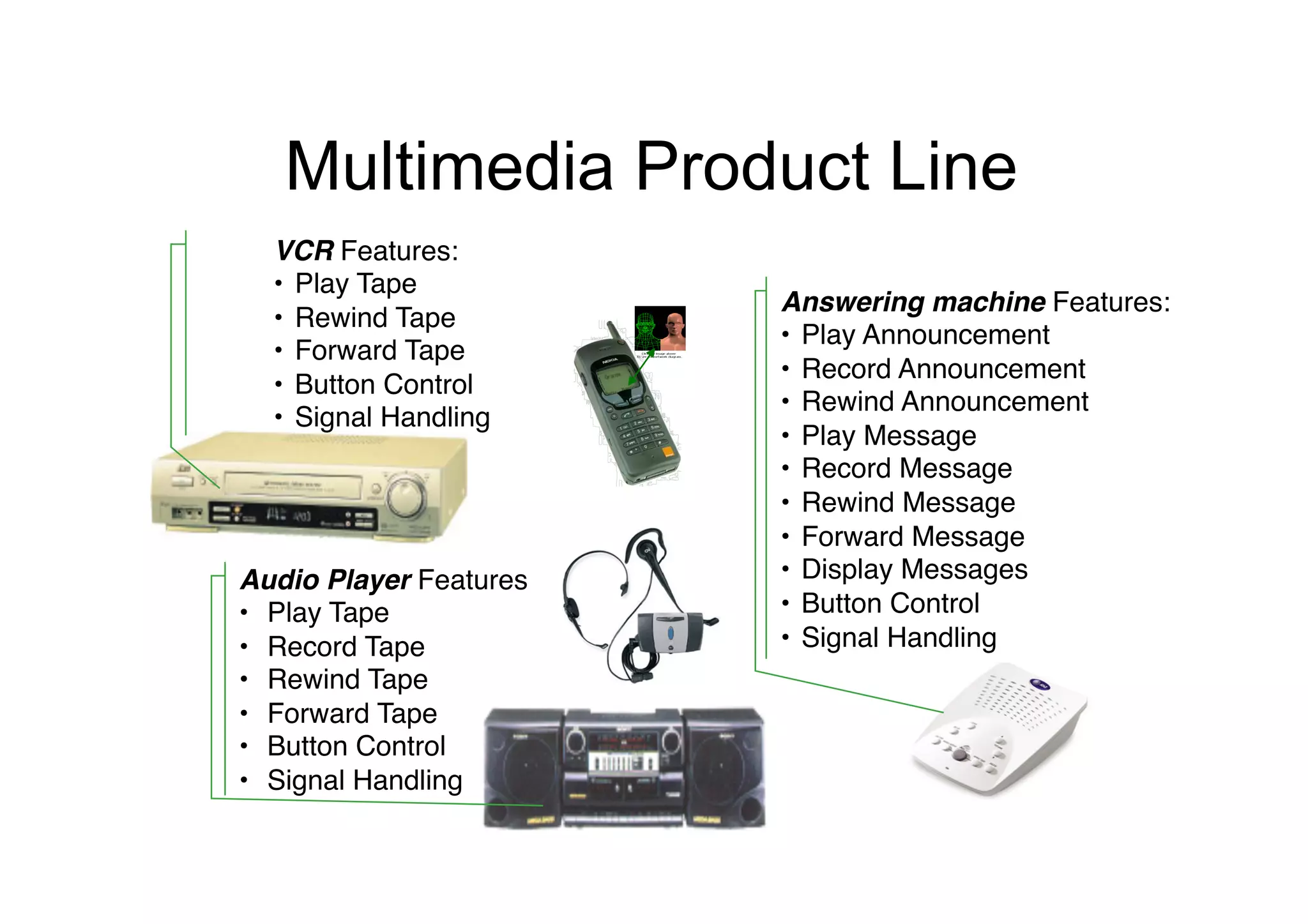
Multimedia Product Line
  VCR Features:"
  •  Play Tape"
                          Answering machine Features:"
  •  Rewind Tape"
                          •  Play Announcement"
  •  Forward Tape"
                          •  Record Announcement"
  •  Button Control"
                          •  Rewind Announcement"
  •  Signal Handling"
                          •  Play Message"
                          •  Record Message"
                          •  Rewind Message"
                          •  Forward Message"
Audio Player Features "   •  Display Messages"
•  Play Tape"             •  Button Control"
•  Record Tape"           •  Signal Handling"
•  Rewind Tape"
•  Forward Tape"
•  Button Control"
•  Signal Handling"
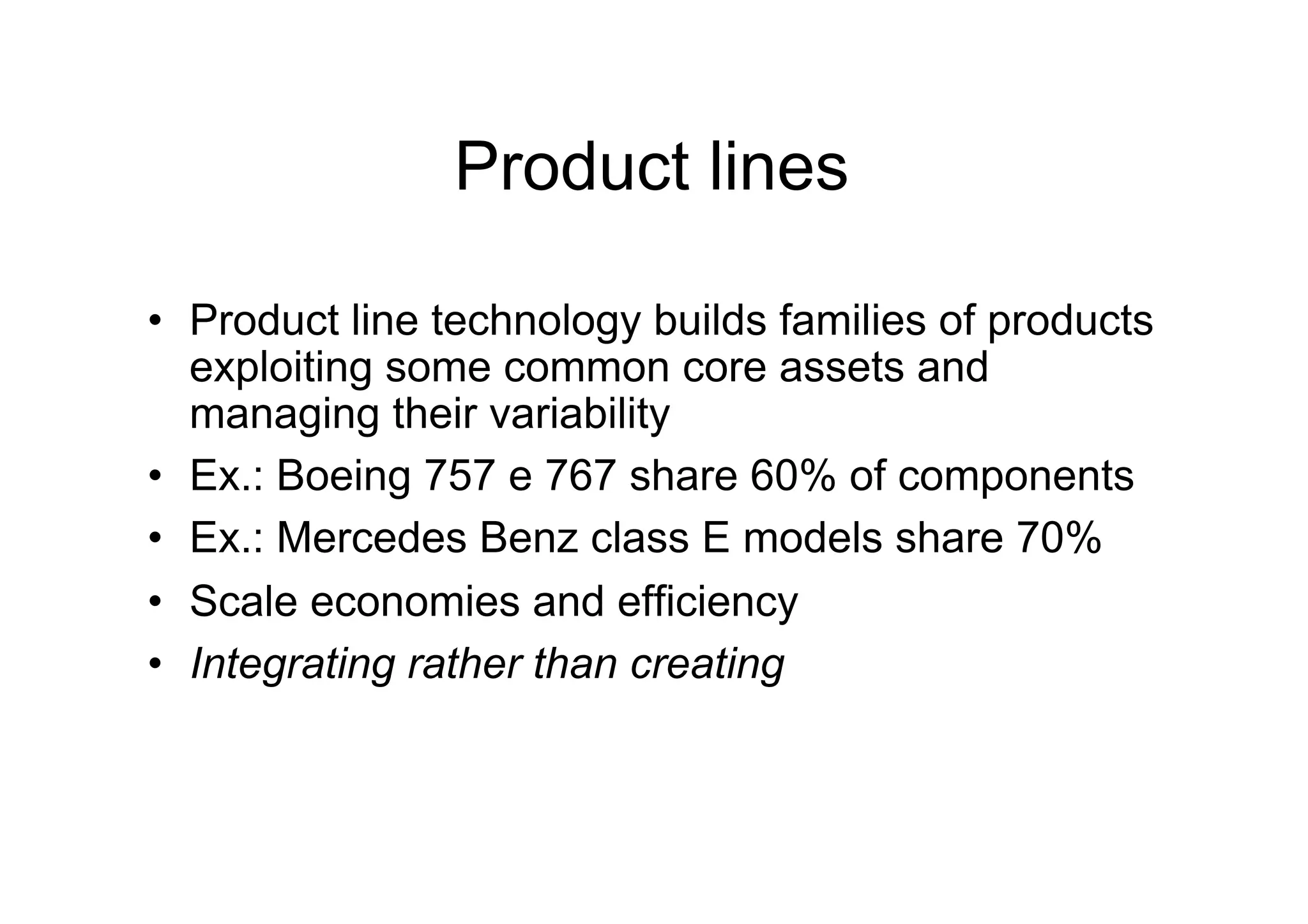
Product lines

•  Product line technology builds families of products
   exploiting some common core assets and
   managing their variability
•  Ex.: Boeing 757 e 767 share 60% of components
•  Ex.: Mercedes Benz class E models share 70%
•  Scale economies and efficiency
•  Integrating rather than creating
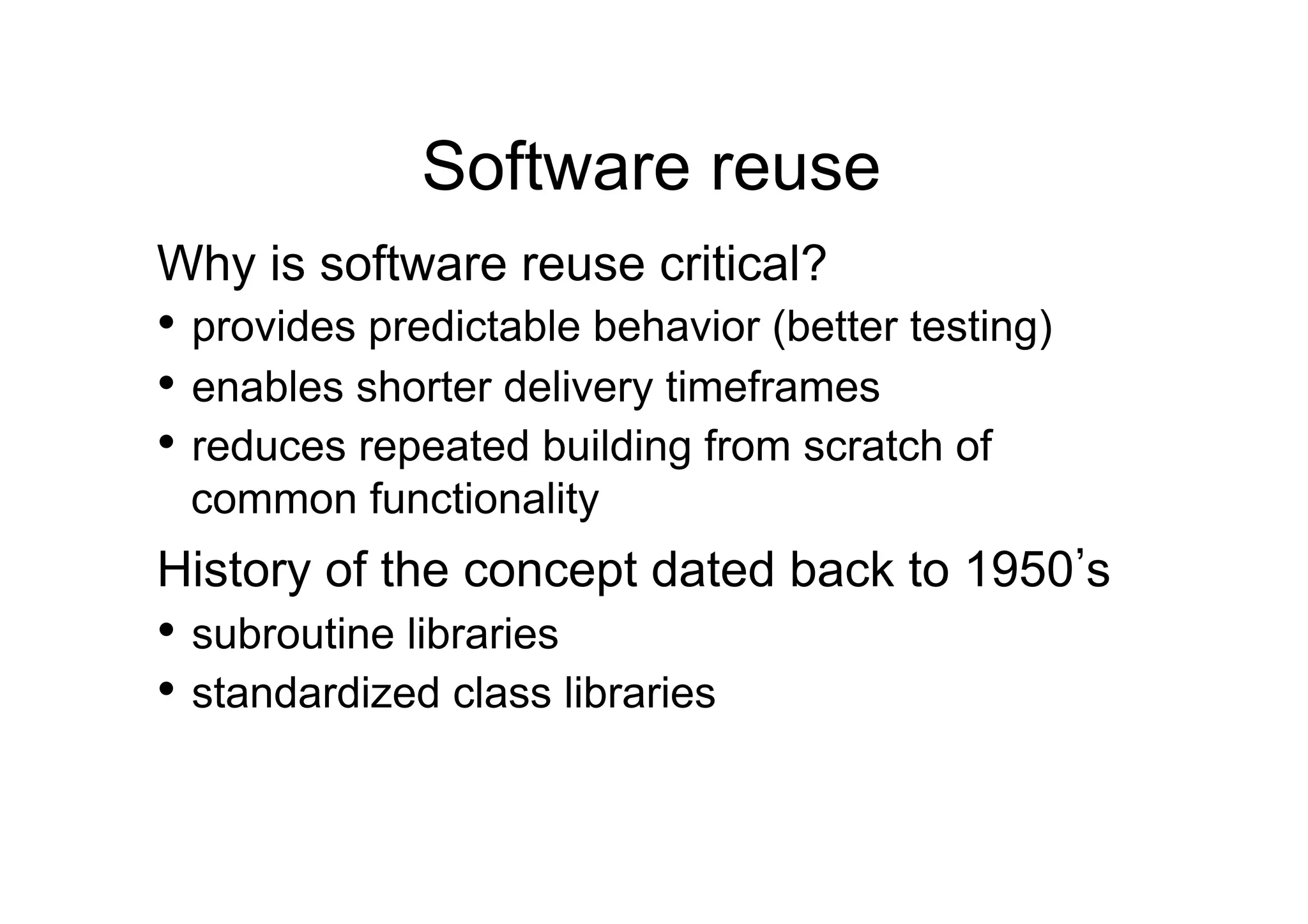
Software reuse
Why is software reuse critical?
•  provides predictable behavior (better testing)
•  enables shorter delivery timeframes
•  reduces repeated building from scratch of
 common functionality
History of the concept dated back to 1950 s
•  subroutine libraries
•  standardized class libraries
Old ways to reusing software
Old definitions of sw reuse include:
•  Re-use is considered as a means to support the
  construction of new programs using in a
  systematical way existing designs, design
  fragments, program texts, documentation, or
  other forms of program representation.
•  Reusability is the extent to which a software
  component can be used (with or without
  adaptation) in multiple problem solutions.
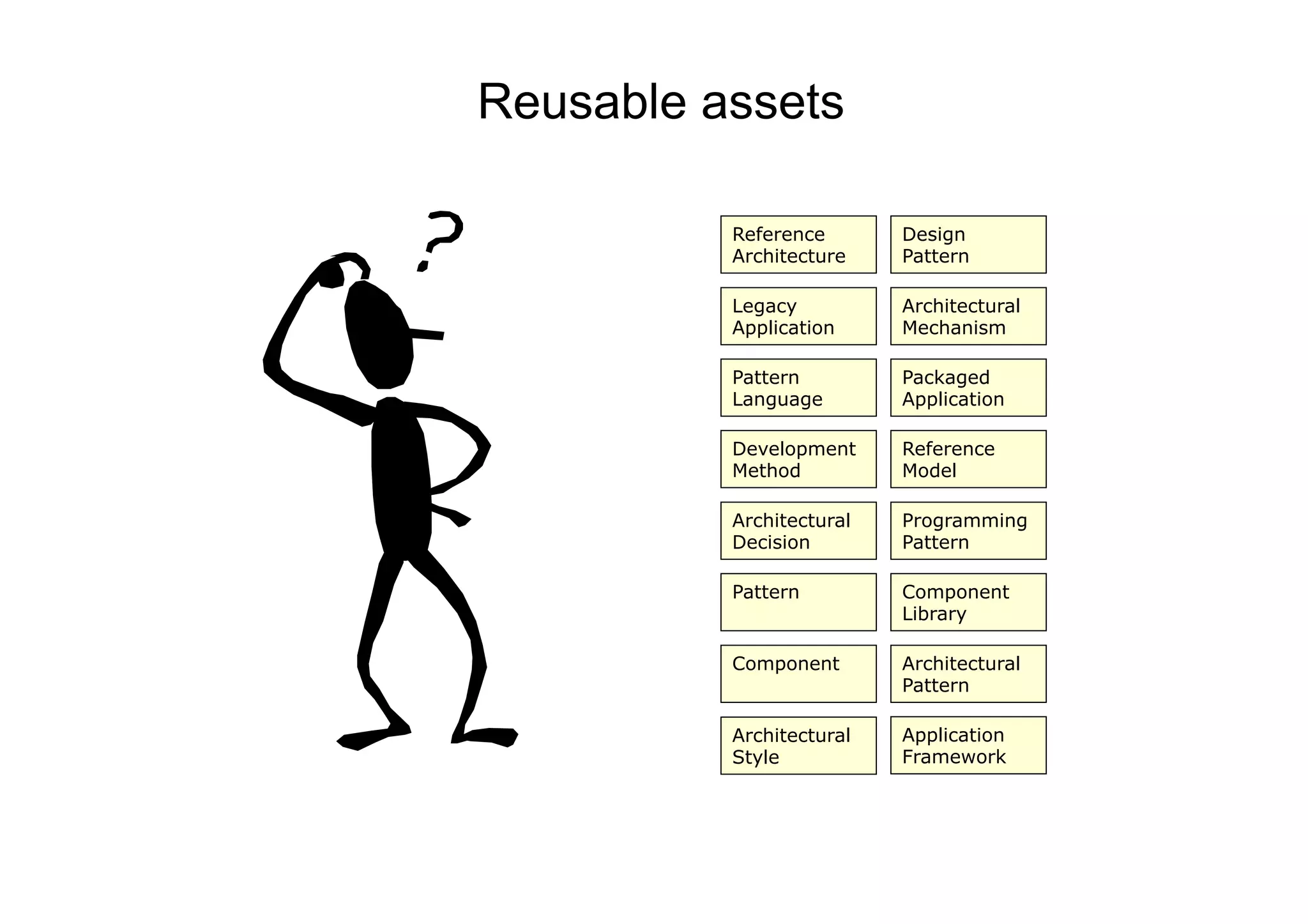
Reusable assets

          Reference       Design
          Architecture    Pattern

          Legacy          Architectural
          Application     Mechanism

          Pattern         Packaged
          Language        Application

          Development     Reference
          Method          Model

          Architectural   Programming
          Decision        Pattern

          Pattern         Component
                          Library

          Component       Architectural
                          Pattern

          Architectural   Application
          Style           Framework
Reuse
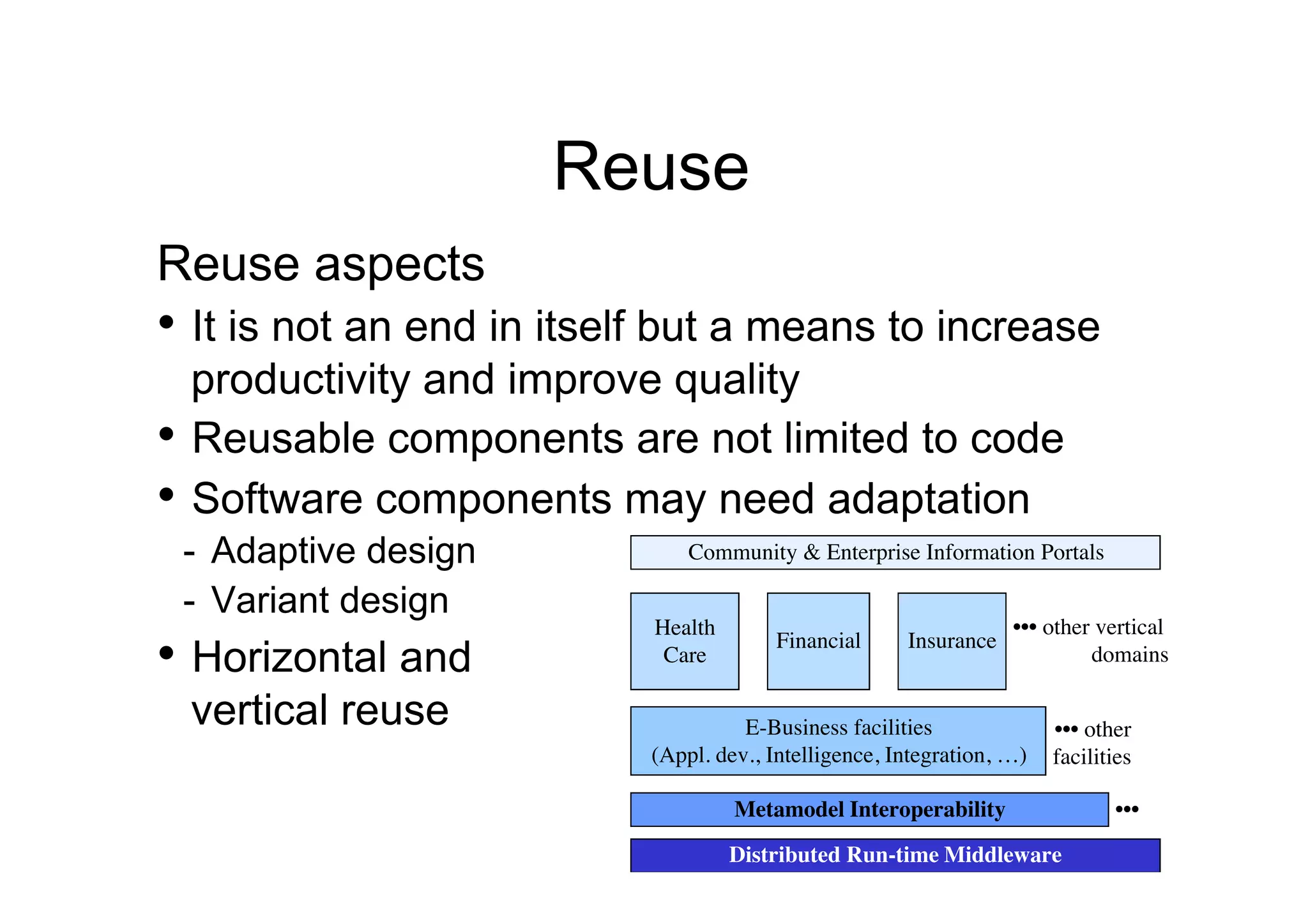
Reuse aspects
•  It is not an end in itself but a means to increase
   productivity and improve quality
•  Reusable components are not limited to code
•  Software components may need adaptation
 -  Adaptive design            Community & Enterprise Information Portals

 -  Variant design
                           Health                                  ••• other vertical
•  Horizontal and           Care
                                        Financial      Insurance
                                                                            domains

 vertical reuse                      E-Business facilities              ••• other
                           (Appl. dev., Intelligence, Integration, …)   facilities

                                    Metamodel Interoperability                 •••
                                    Distributed Run-time Middleware
Benefits
By planning ahead in support of families of
multiple systems, an organization
•  reduces the development time and cost of new
   products
•  reduces risk and improves quality
•  manages its legacy assets more efficiently
•  evolves a common marketing strategy
•  makes decisions based on the (value of) the
   asset base and the strategic goals
Software product lines (SPL)
Definition by Clemens and Northrop (SEI, 2002):
•  A set of software-intensive systems that share a
   common, managed set of features satisfying the
   specific needs of a particular market segment
•  They are developed from a common set of core
   assets in a prescribed way

•  Example: software for TV sets (Philips)
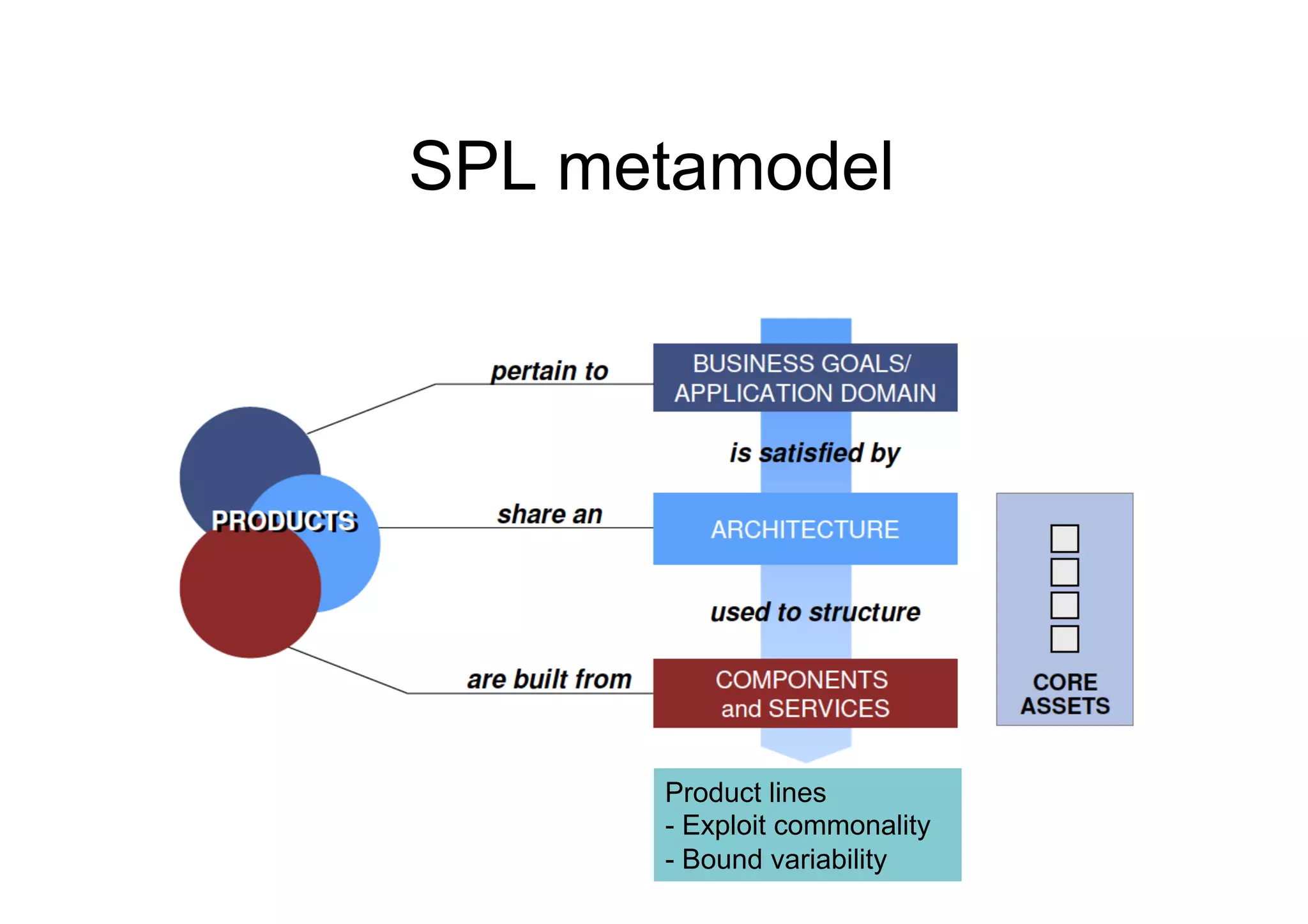
SPL metamodel


      Product lines
      -  Exploit commonality
      -  Bound variability
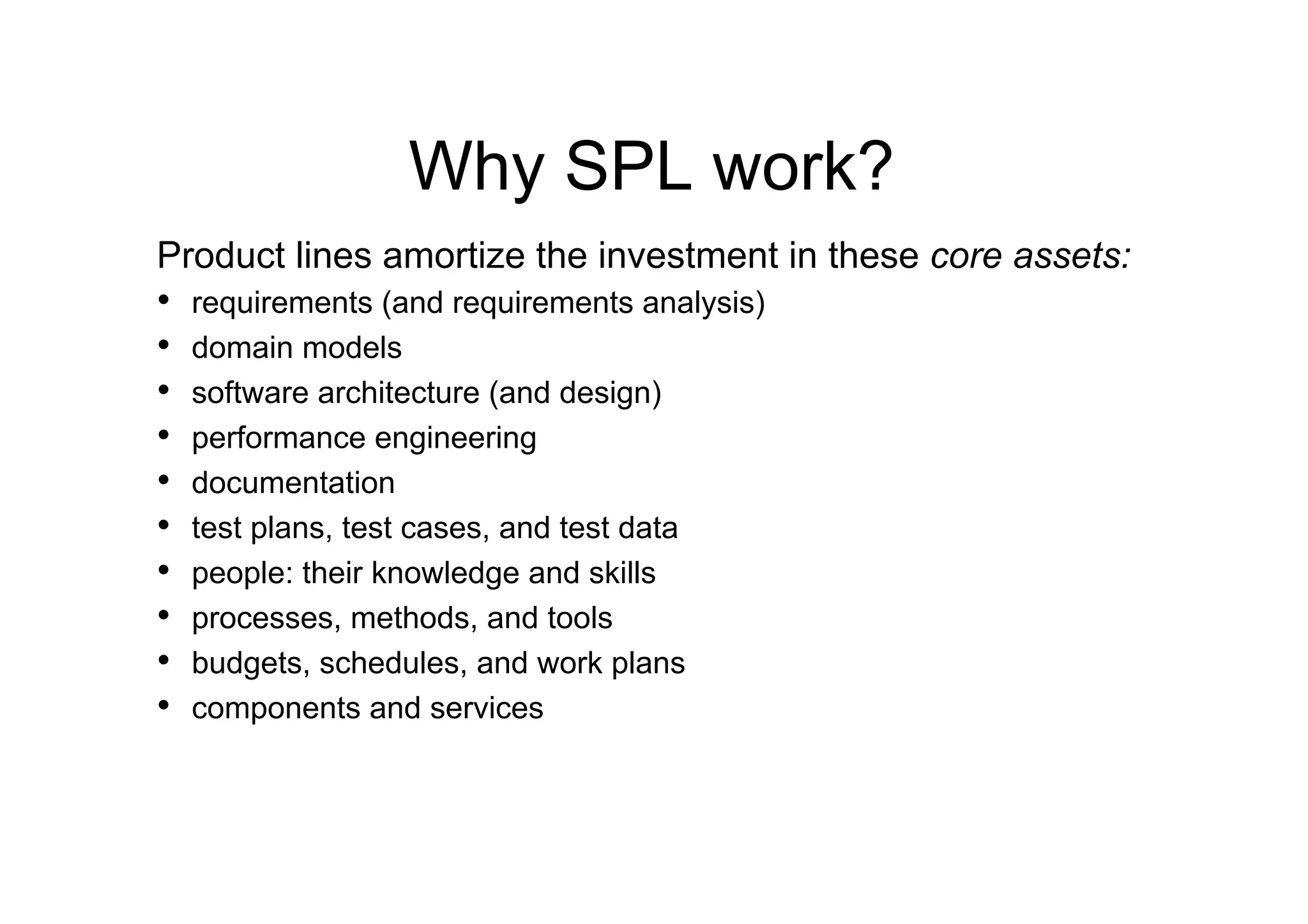
Why SPL work?
Product lines amortize the investment in these core assets:
•  requirements (and requirements analysis)
•  domain models
•  software architecture (and design)
•  performance engineering
•  documentation
•  test plans, test cases, and test data
•  people: their knowledge and skills
•  processes, methods, and tools
•  budgets, schedules, and work plans
•  components and services
A few success stories
•  Celsius tech: family of naval command and control systems
•  Ericsson AXE: family of telecommunications switches
•  Lucent Technologies: 5ESS telecom switch
•  US Naval Undersea Warfare Center: A-7°
•  SALION: Acquisition Management Systems
•  Toshiba: Electric Power Generation Plant
•  BOEING: Bold Stroke Avionics SW Family
•  BOSCH: Gasoline Systems
•  CUMMINS Inc.: Diesel SPL
•  LSI: RAID controller firmware SPL
•  GM: General Motors Powertrain (GMPT)
•  PHILIPS: Medical Systems
•  Nokia: mobile phones
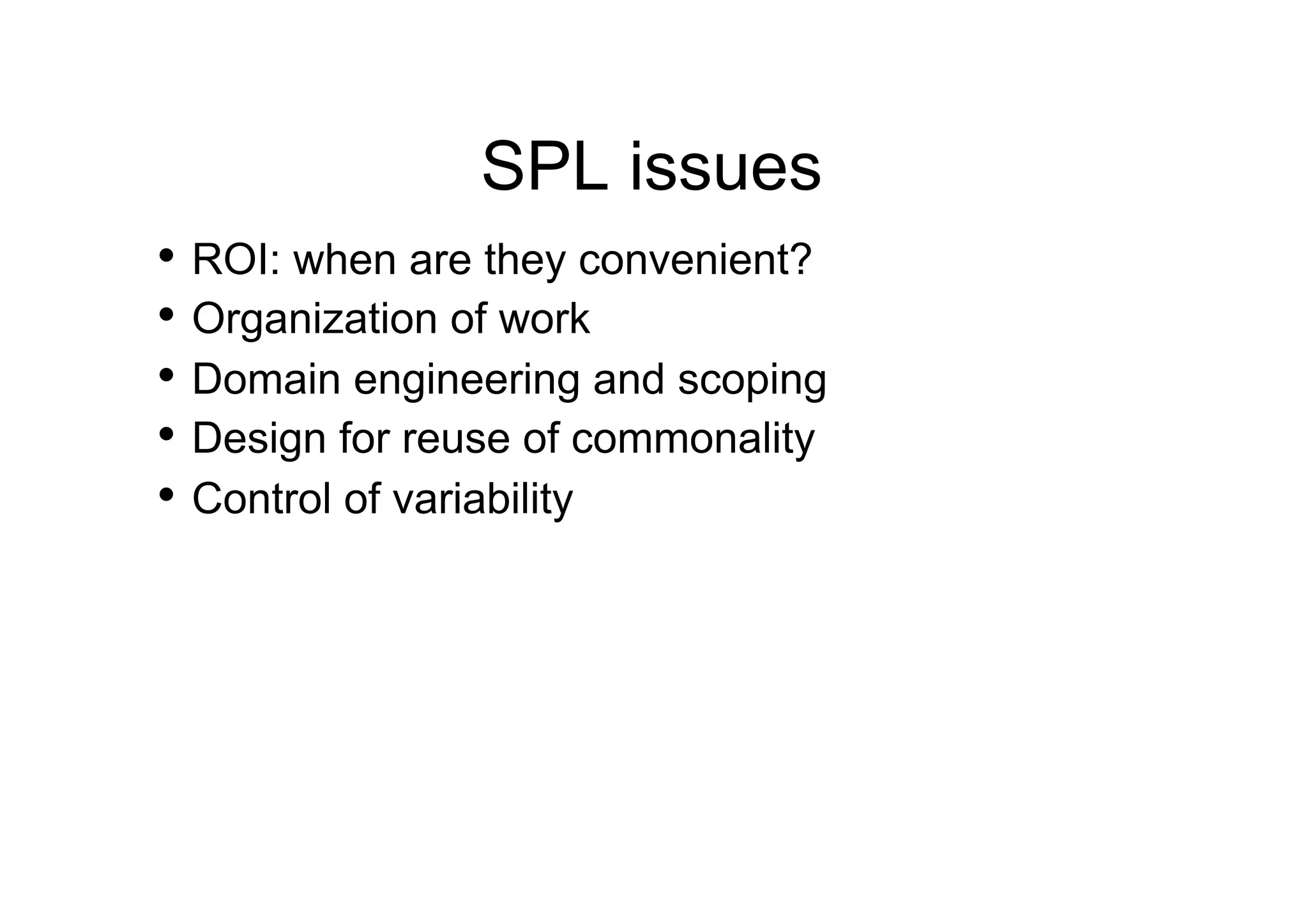
SPL issues
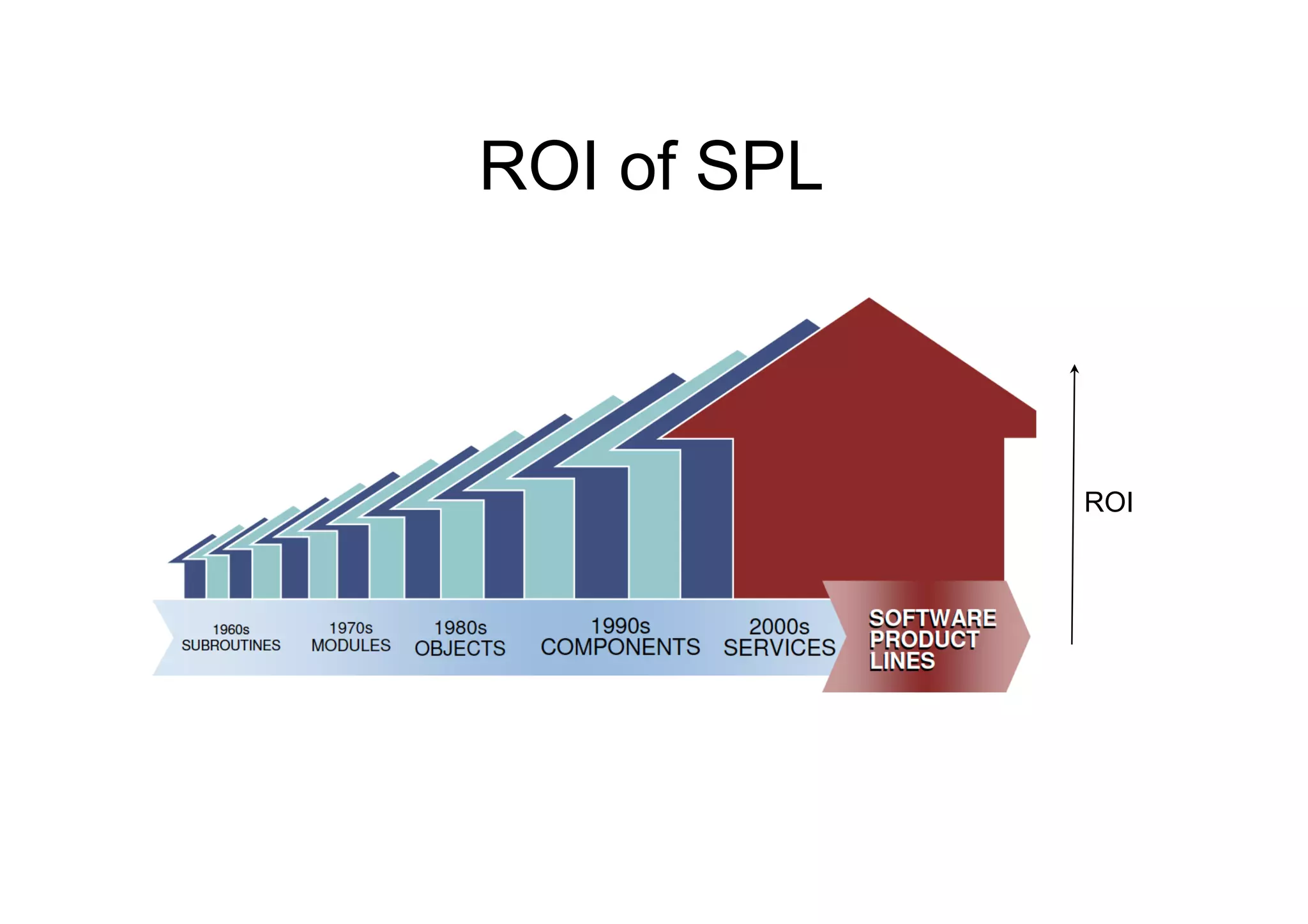
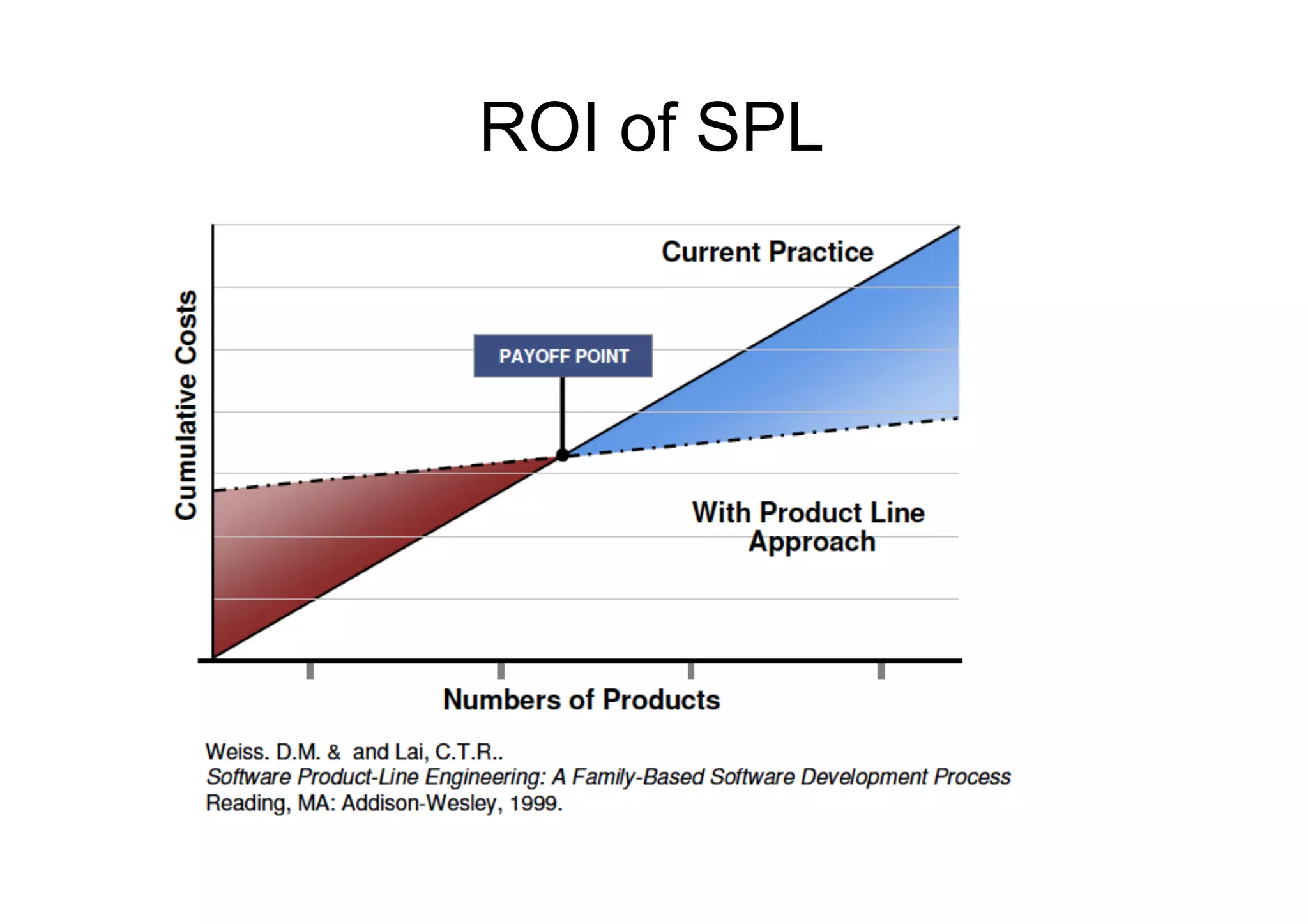
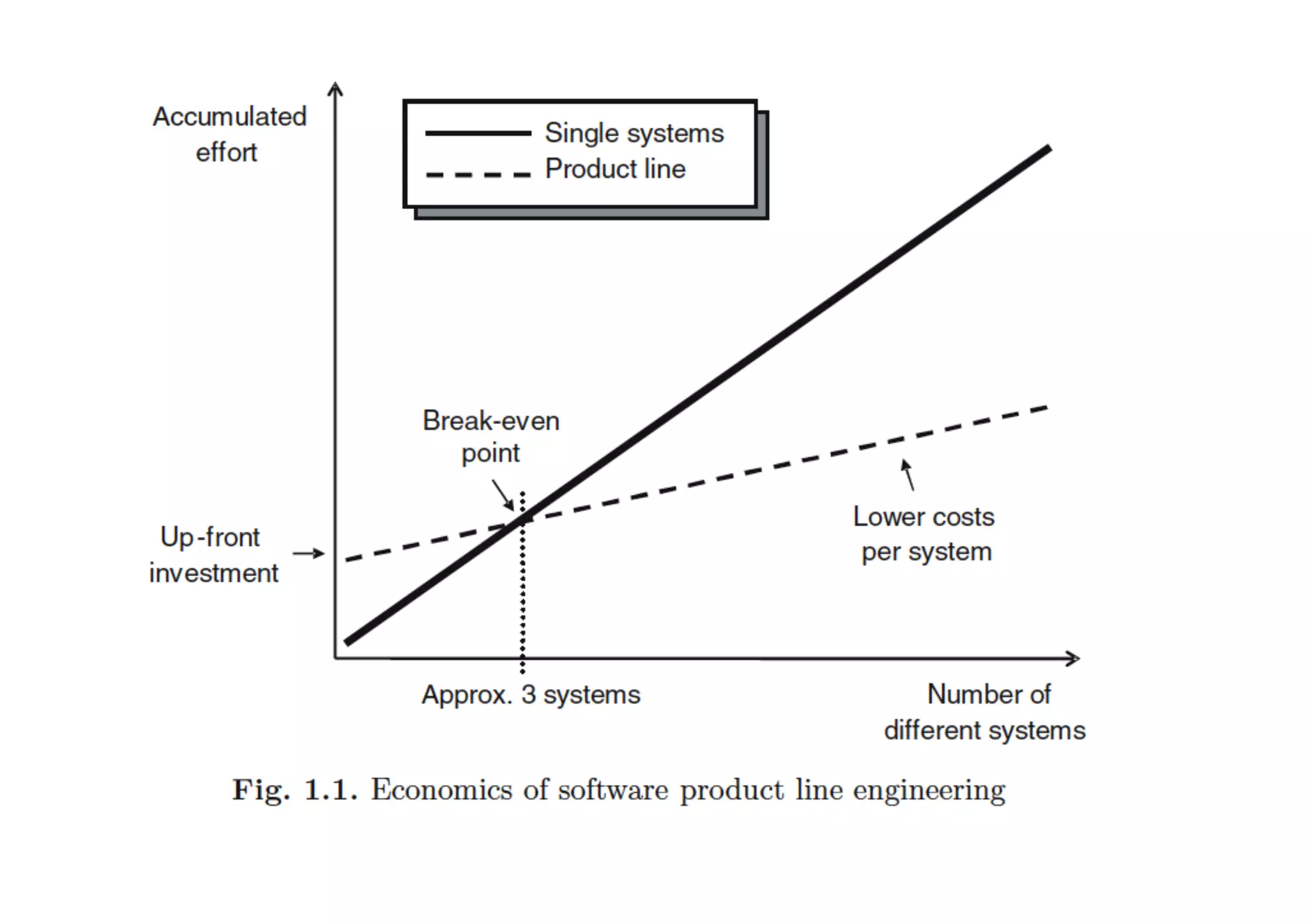
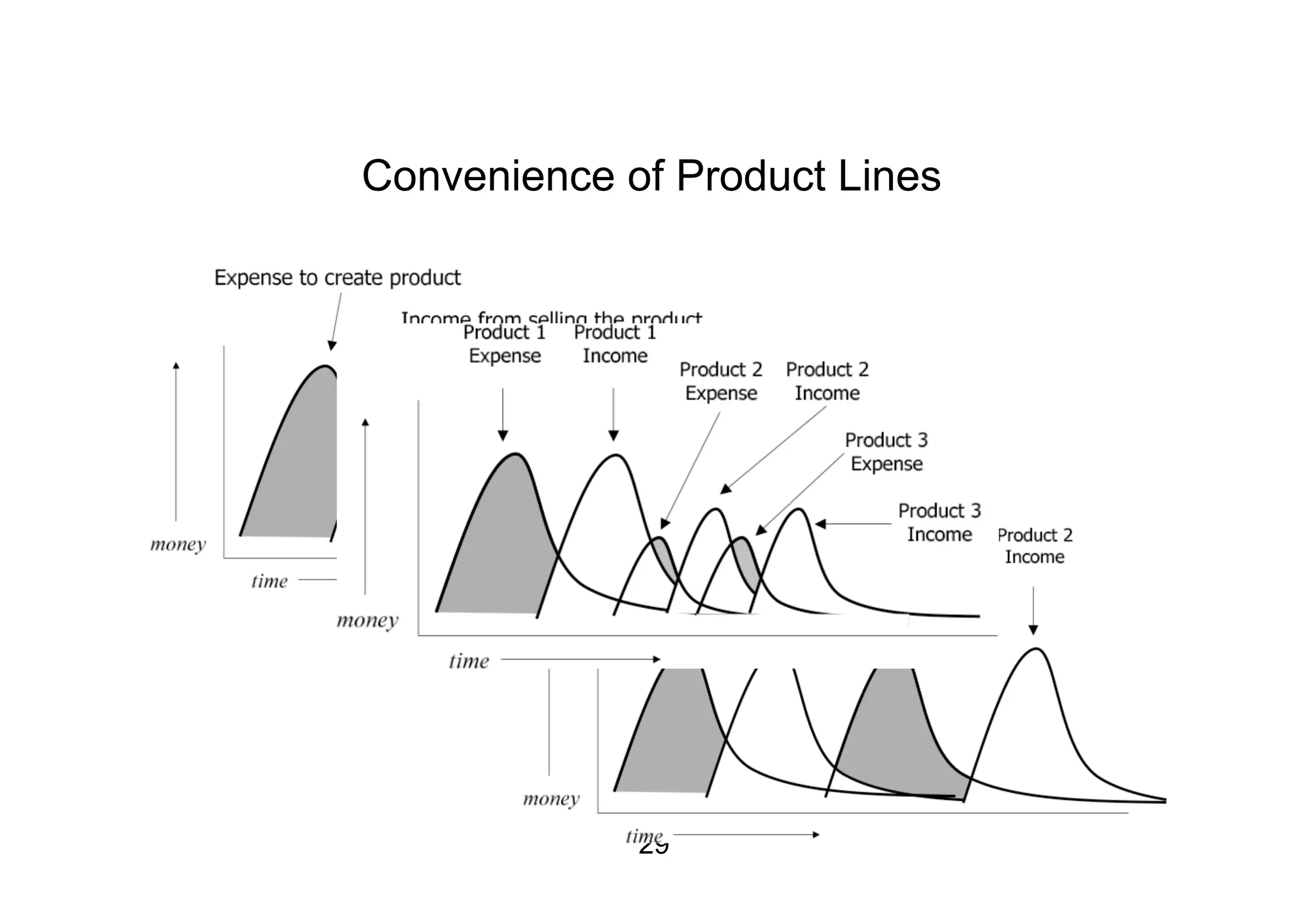
•  ROI: when are they convenient?
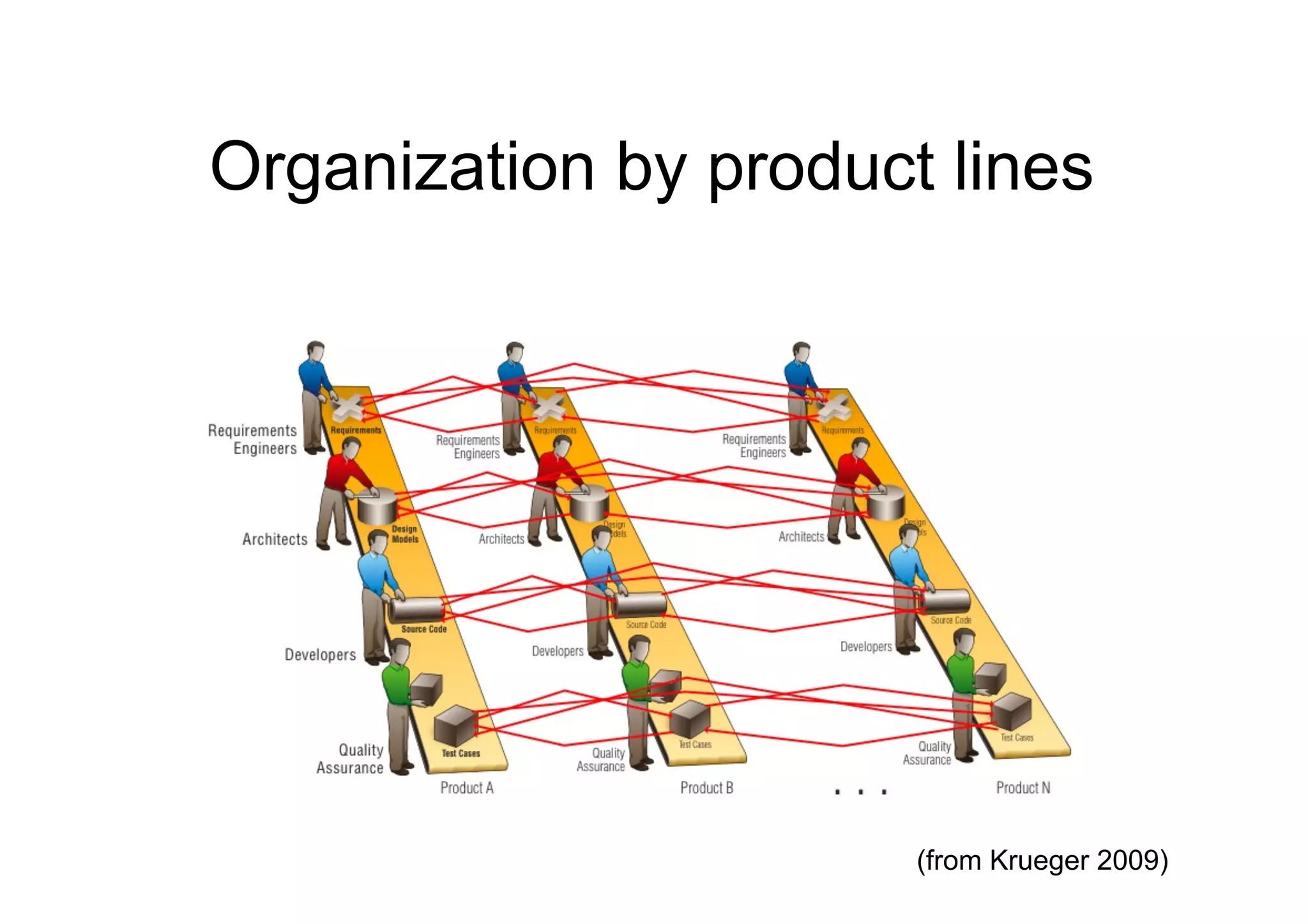
•  Organization of work
•  Domain engineering and scoping
•  Design for reuse of commonality
•  Control of variability
ROI of SPL


             ROI
ROI of SPL
Convenience of Product Lines


             29
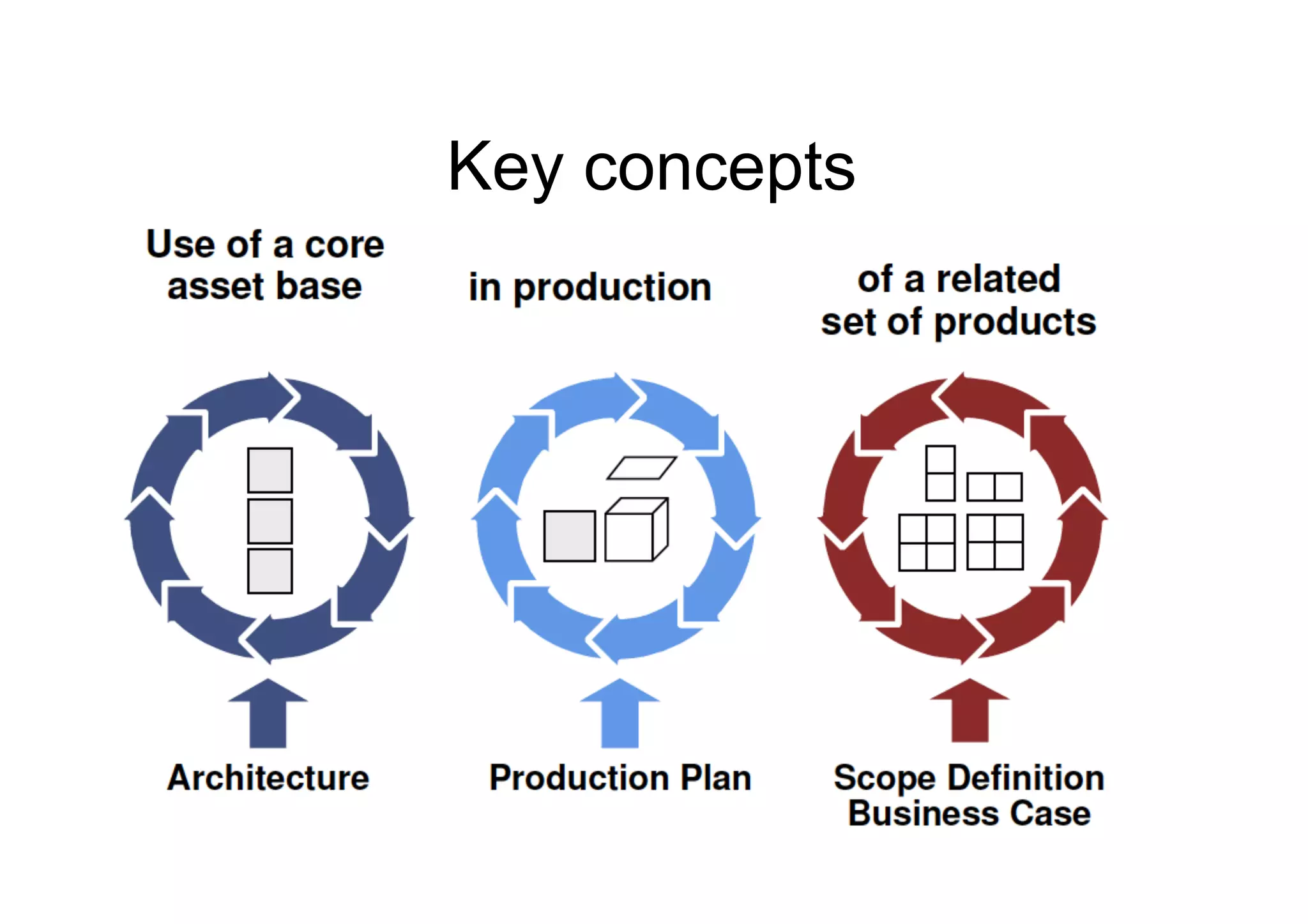
Key concepts
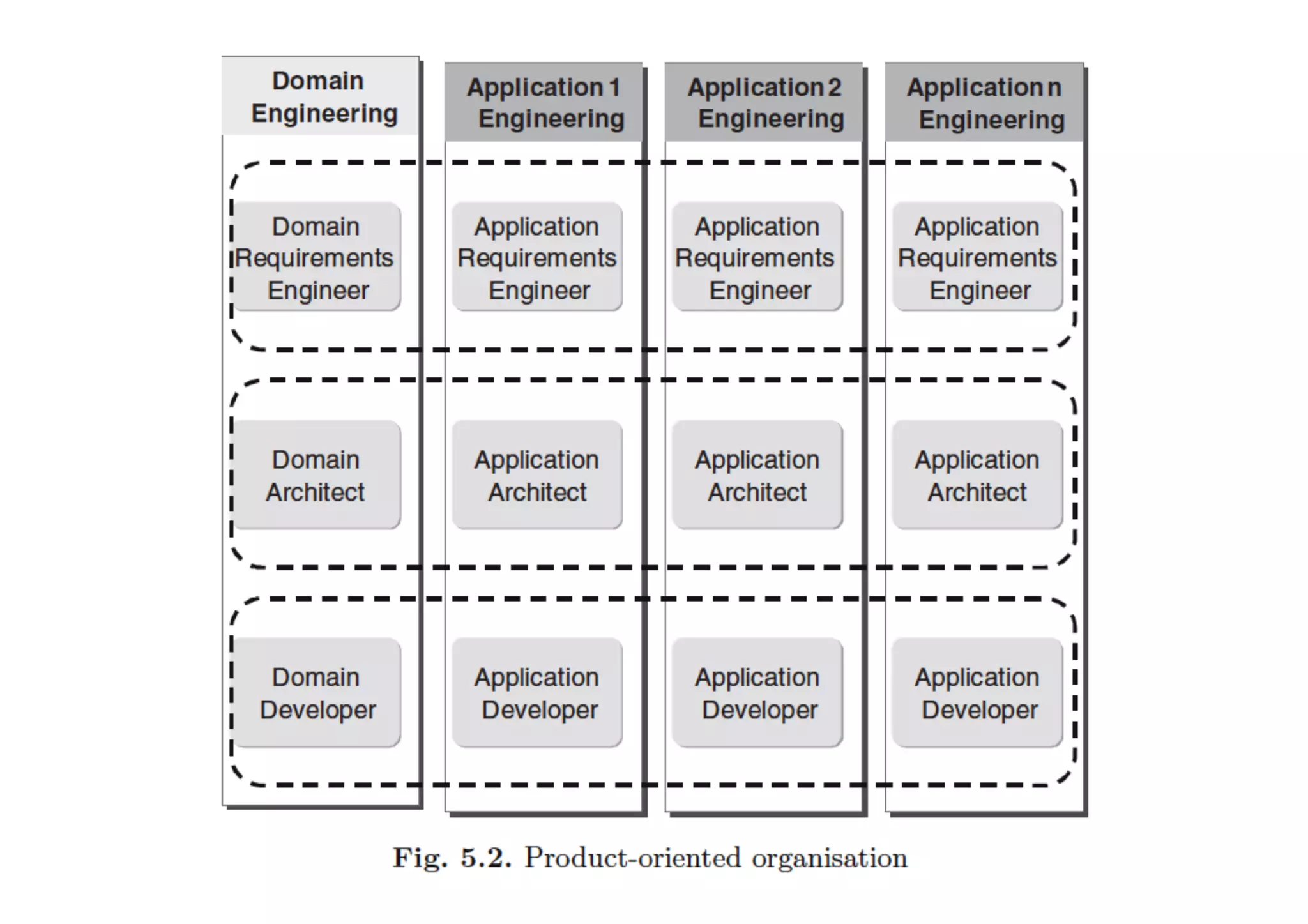
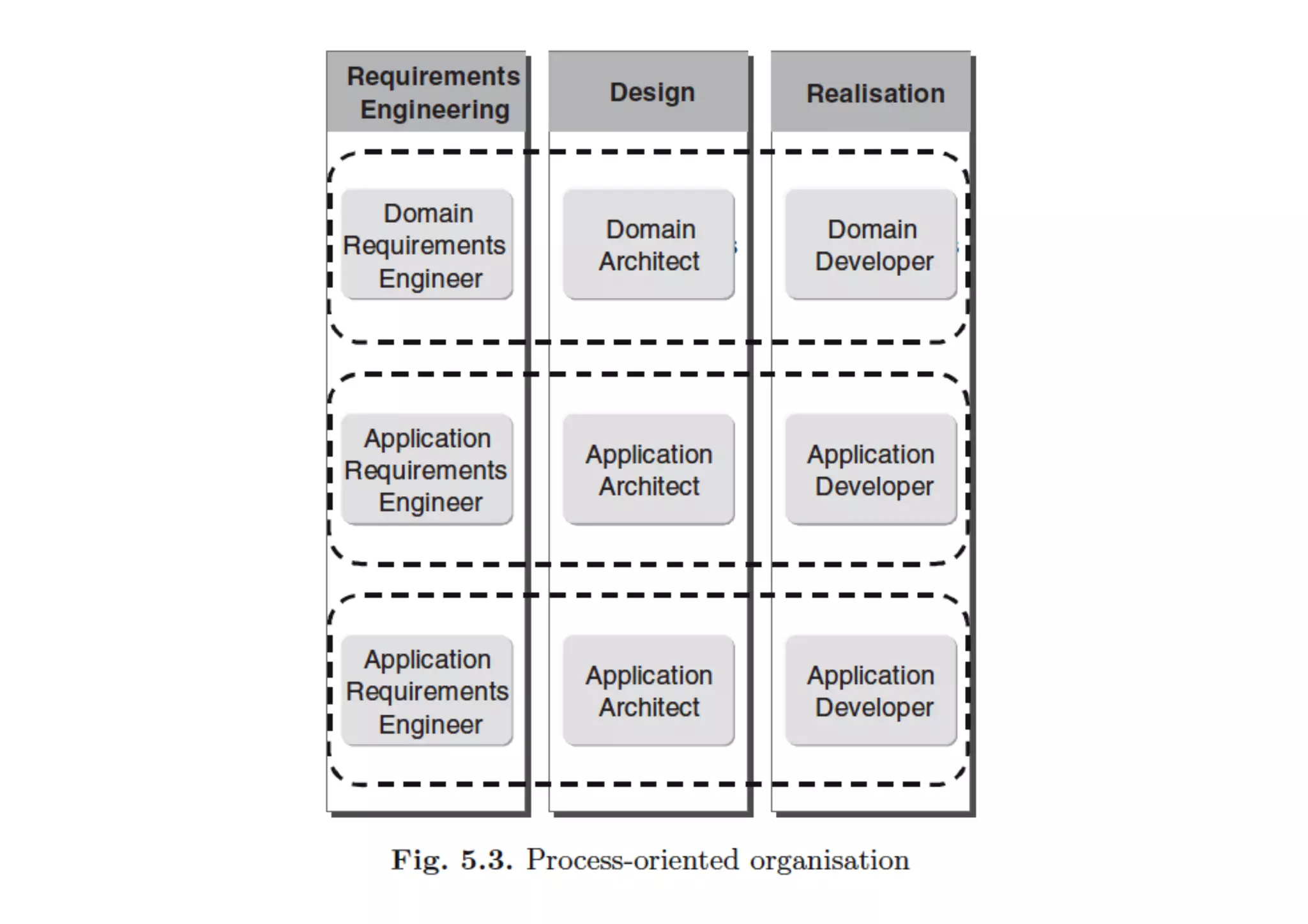
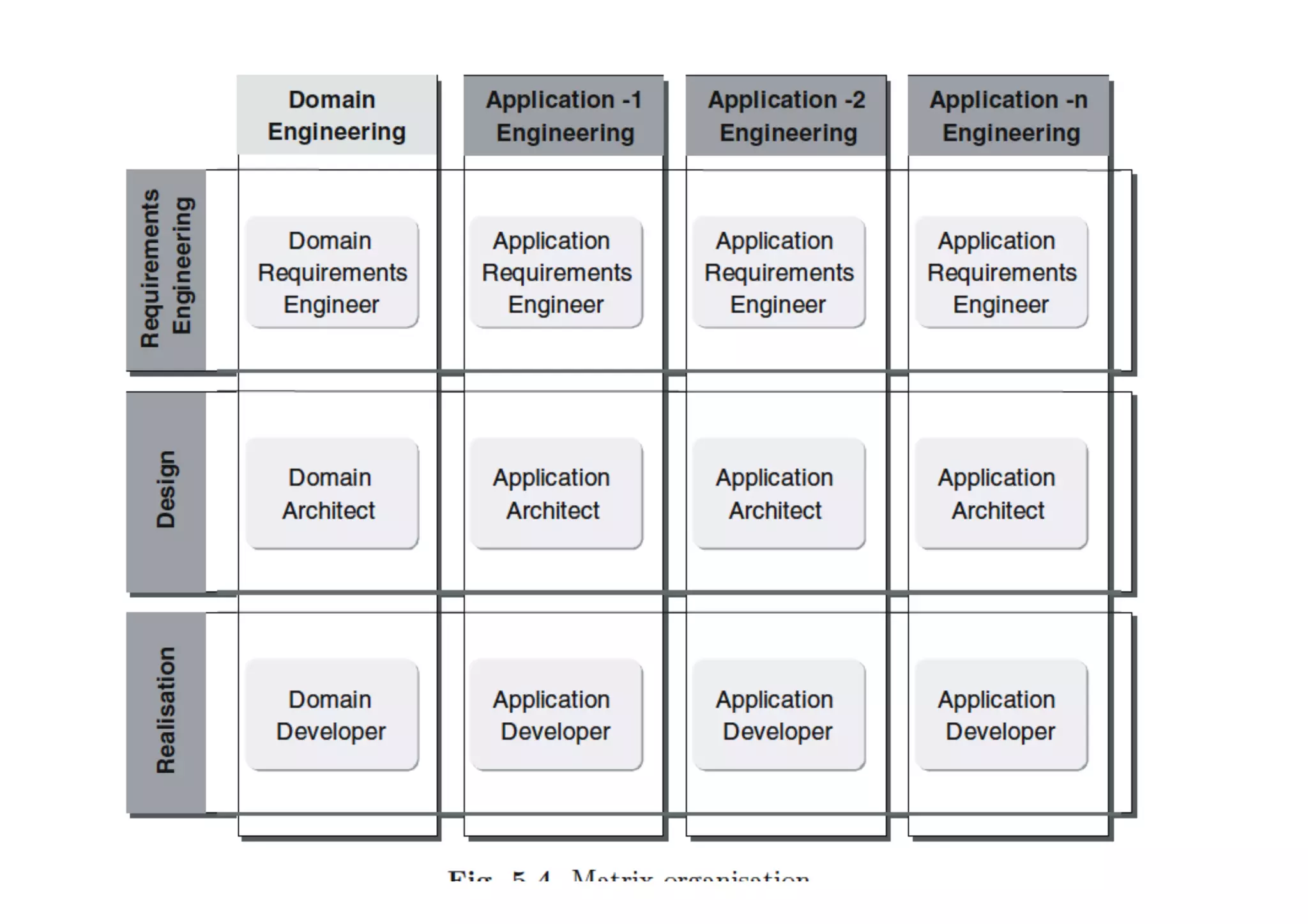
Organization by product lines


                       (from Krueger 2009)
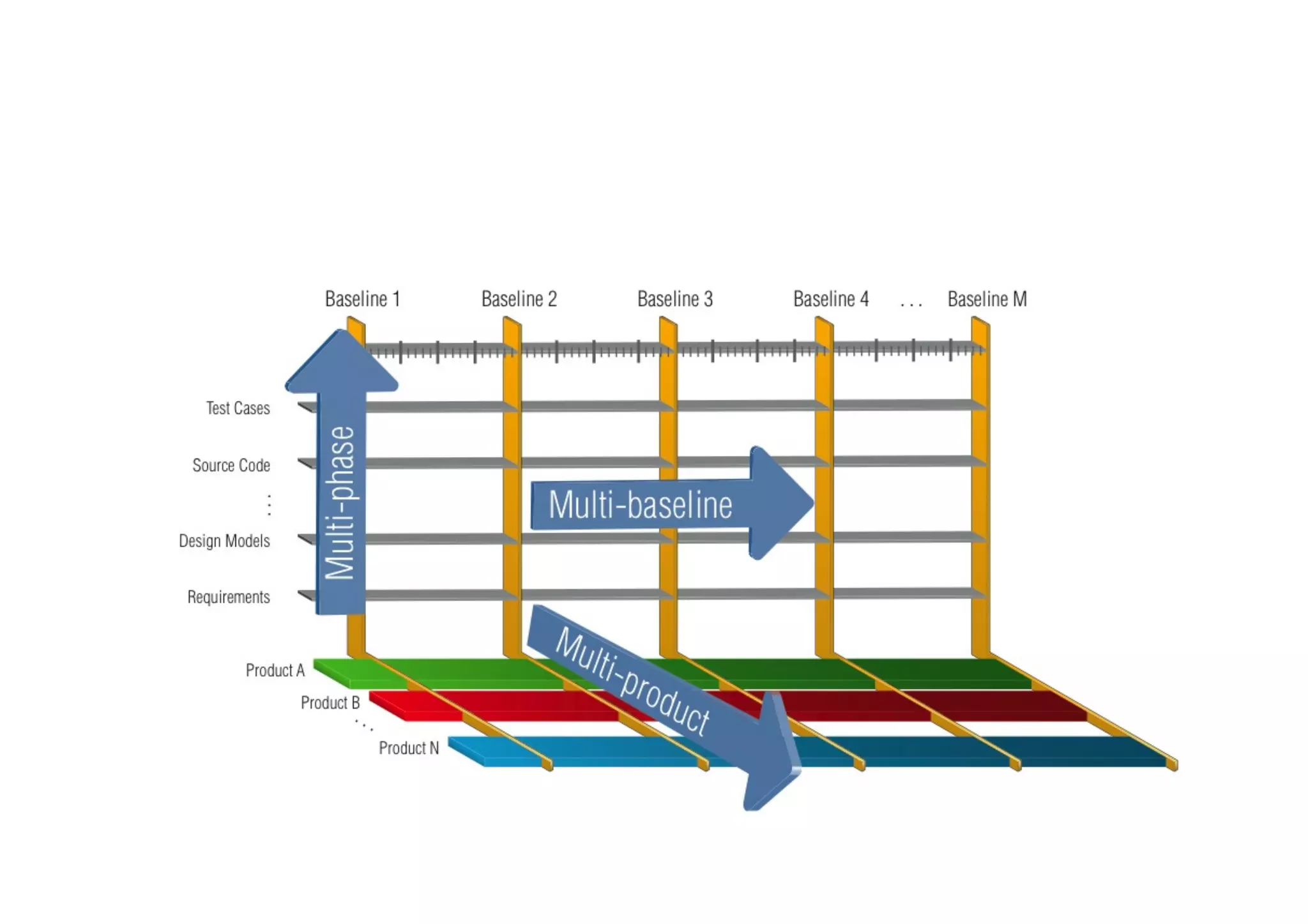
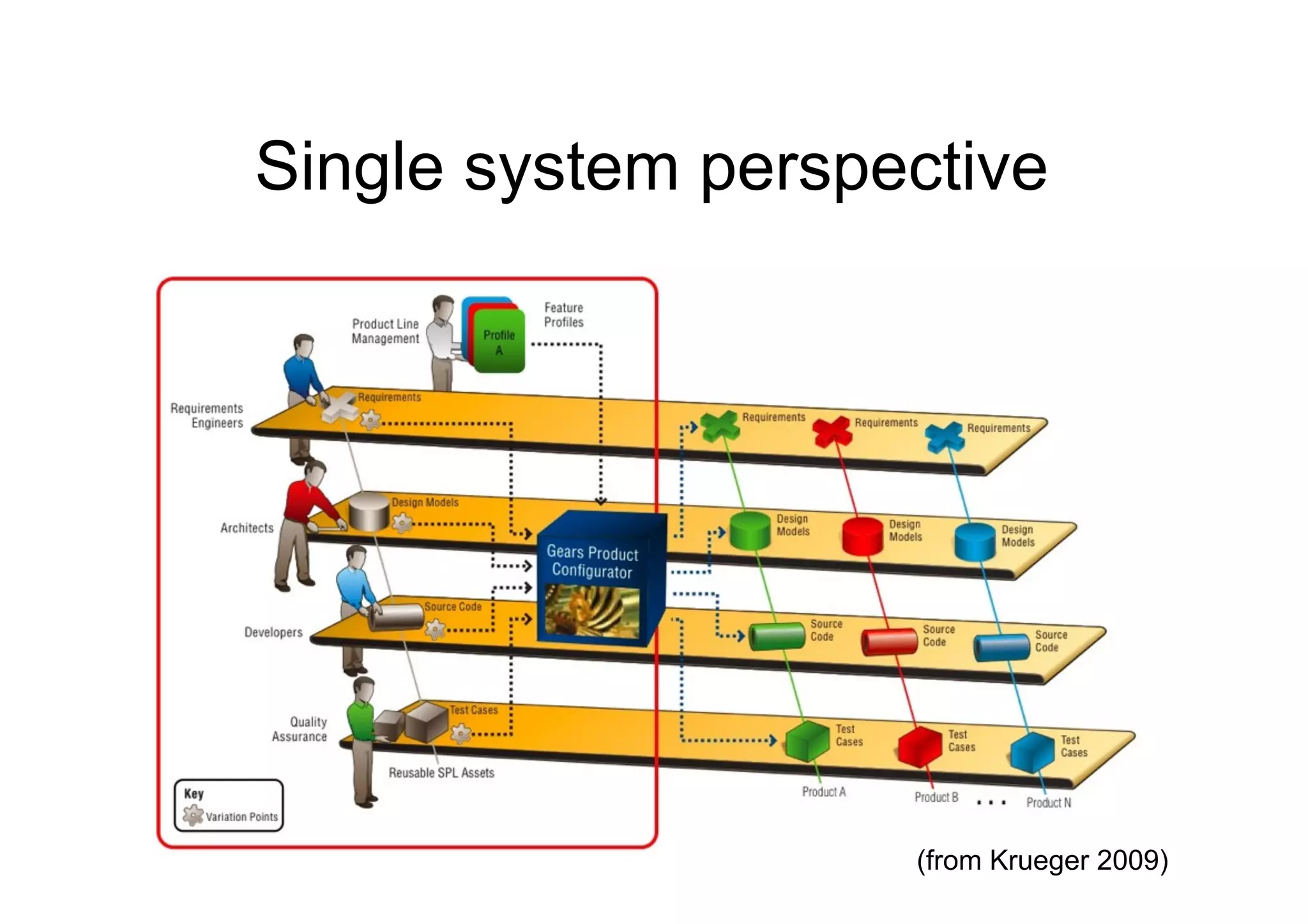
Single system perspective


                    (from Krueger 2009)
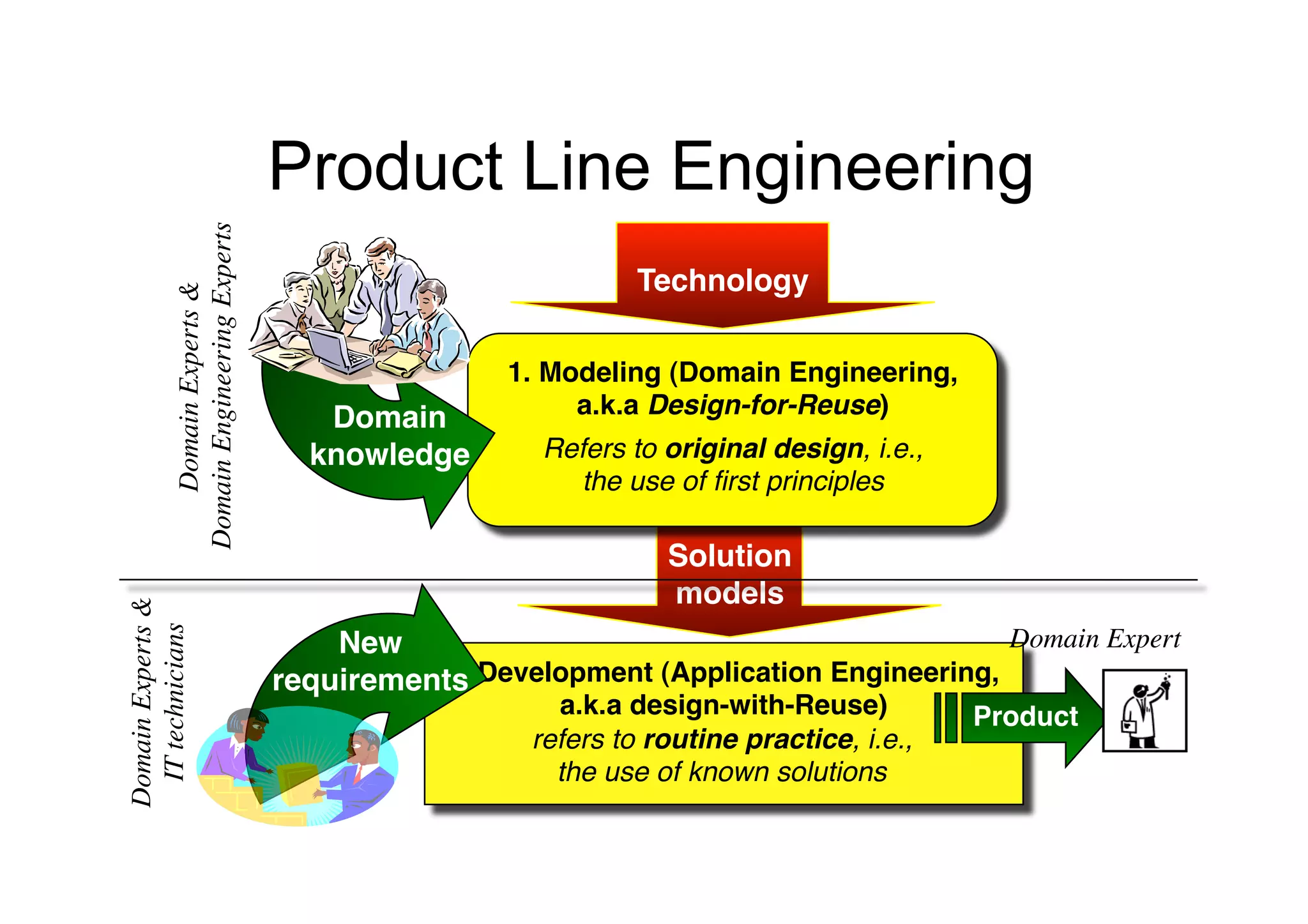
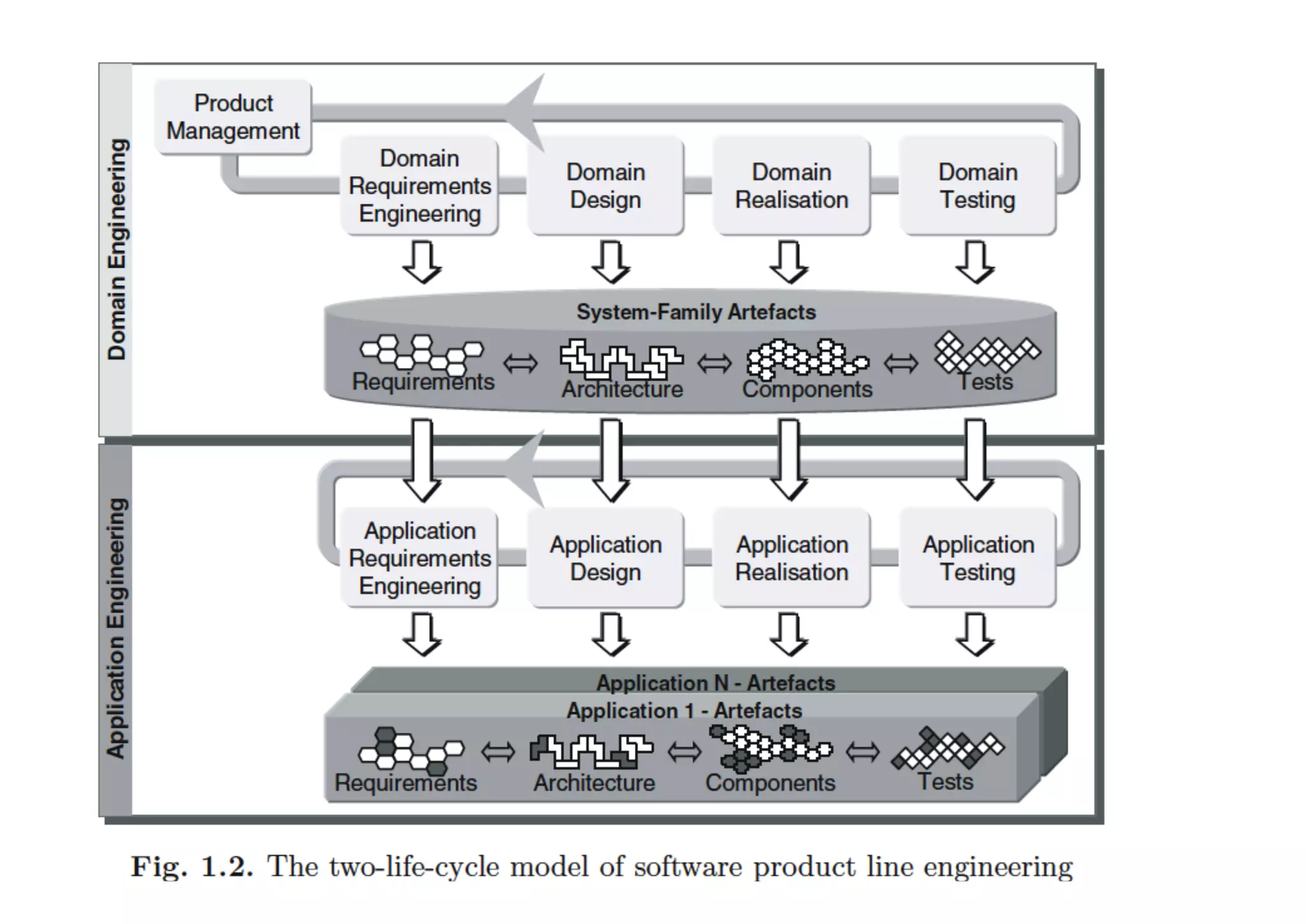
Product Line Engineering
PL Engineering uses domain-driven, model-
based methodology for building software
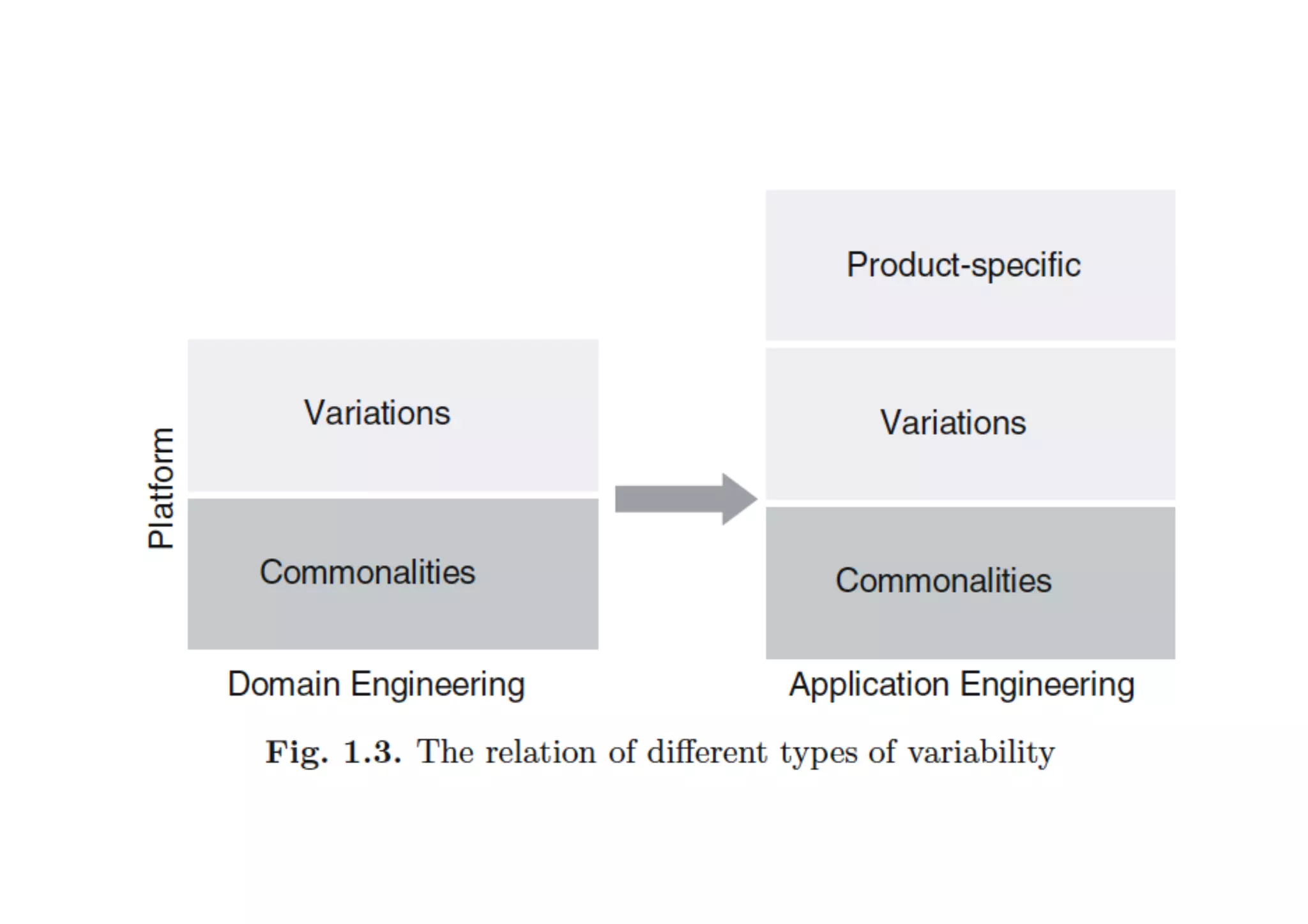
•  Two complementary processes
 -  Modeling (domain engineering)
 -  Development (applications engineering)
Product Line Engineering
              Domain Engineering Experts	

                                                                              "
                                                                          Technology"
                 Domain Experts &	


                                                               1. Modeling (Domain Engineering,
                                                 Domain
            a.k.a Design-for-Reuse)"
                                                knowledge"        Refers to original design, i.e.,

                                                                    the use of first principles"
                                                                                "
                                                                             Solution 

                                                                             models"
Domain Experts &	

 IT technicians	


                                                  New
                                             Domain Expert	

                                              requirements"Development (Application Engineering, 

                                                        2.
                                                                   a.k.a design-with-Reuse)"           Product"
                                                                 refers to routine practice, i.e., 

                                                                   the use of known solutions"
Reusable assets
Reuse in general needs to be planned for
•  create a reusable asset, i.e. one that is fully
   documented, has good code and robust scripts;
   is verified independently with high confidence
•  create a usable asset, i.e. one that is adaptable
   and that is usable in a variety of simulators
Design for reuse/use involves
•  analysis to identify explicitly variations to
   anticipate adaptations, and
•  design for adaptability, engineered a priori to
   create assets for future developments
Problems
Design for commonality
•  standardizing assets by encapsulating common
 features
Analysis of variation
•  must explicitly identify variations that anticipate
 adaptations
Control of variability
•  provide assets flexibility without compromising
 commonality
Levels of reuse
•  Domain-independent components
 -  Designed for reuse to fit any product (e.g., general
    purpose class libraries)
•  Domain-specific components
 -  Designed for reuse to fit several different products in a
    given market (e.g., multi-media, jpeg encoders, data
    communications, digital signal processing, ...)
•  Product-specific components
 -  Designed for reuse within a specific application (to
    generate various instances or products)
SPL: main issues
There are several issues to consider
•  Scoping the SPL (i.e. identify domain and
   assets)
•  Define a reference architecture
•  Define a PLA
•  Identification of reusable components at the
   appropriate level of abstraction
•  Variability management
•  Architectural compliance
•  SPL maintenance
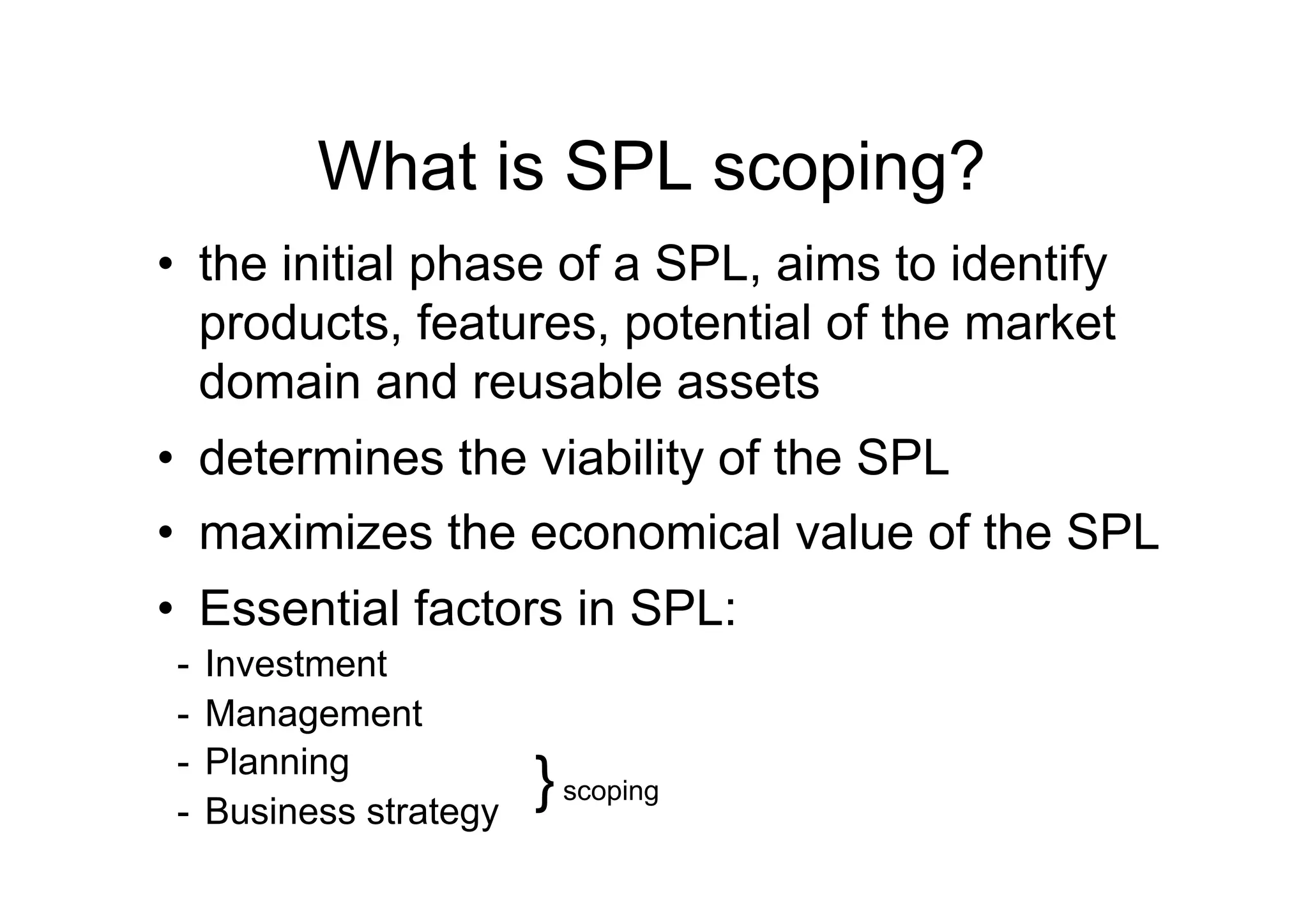
What is SPL scoping?
•  the initial phase of a SPL, aims to identify
   products, features, potential of the market
   domain and reusable assets
•  determines the viability of the SPL
•  maximizes the economical value of the SPL
•  Essential factors in SPL:
-  Investment
-  Management
-  Planning
-  Business strategy
                       } scoping
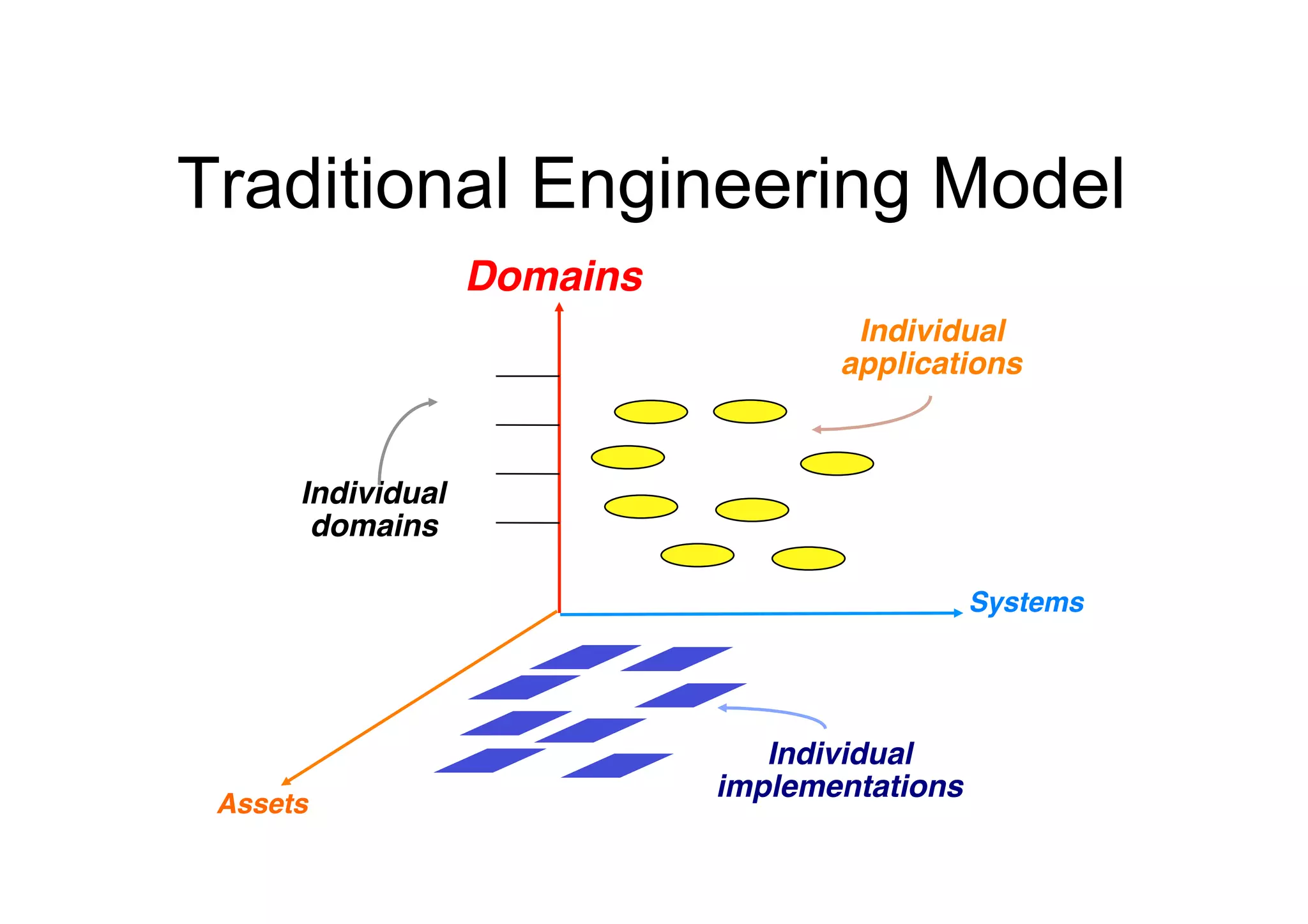
Traditional Engineering Model
                     Domains!
                                        Individual !
                                       applications!


      Individual !
       domains!

                                               Systems!


                                   Individual

                                implementations!
 Assets!
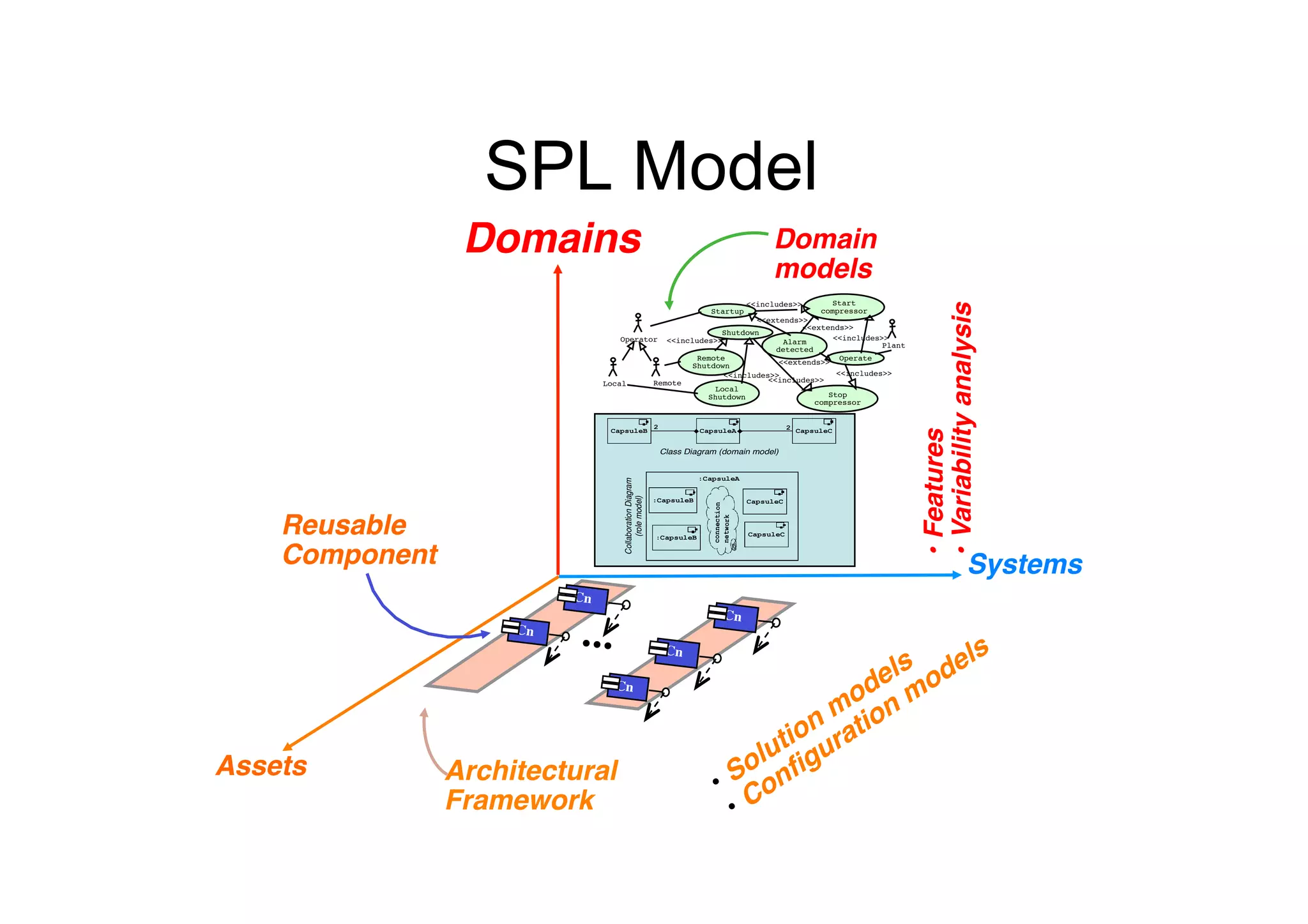
SPL Model
                  Domains!                                                                           Domain

                                                                                                     models!


                                                                                                                        • Variability analysis!
                                                                      <<includes>>!       Start

                                                              Startup!                 compressor!
                                                                        <<extends>>!
                                                                                   <<extends>>!
                                                                Shutdown!
                                          Operator! <<includes>>!              Alarm
     <<includes>>!
                                                                                                     Plant!
                                                                             detected!
                                                           Remote!                          Operate!
                                                          Shutdown!           <<extends>>!
                                                                 <<includes>>!             <<includes>>!
                                      Local!     Remote!                   <<includes>>!
                                                               Local

                                                             Shutdown!                   Stop

                                                                                      compressor!


                                                                                                                        • Features!
                                                                  2                                        2 CapsuleC
                                       CapsuleB                                CapsuleA


                                                                      Class Diagram (domain model)


                                                                               :CapsuleA


                                          Collaboration Diagram
                                               (role model)
                                                                  :CapsuleB                     CapsuleC


                                                                                  connection
    Reusable 


                                                                                  network
                                                                  :CapsuleB                     CapsuleC


    Component!                                                                                                                            Systems!
                              Cn	

                                                                                        Cn	

                      Cn	

                               •••"                                    Cn	


                                        Cn	


Assets!          Architectural

                 Framework!
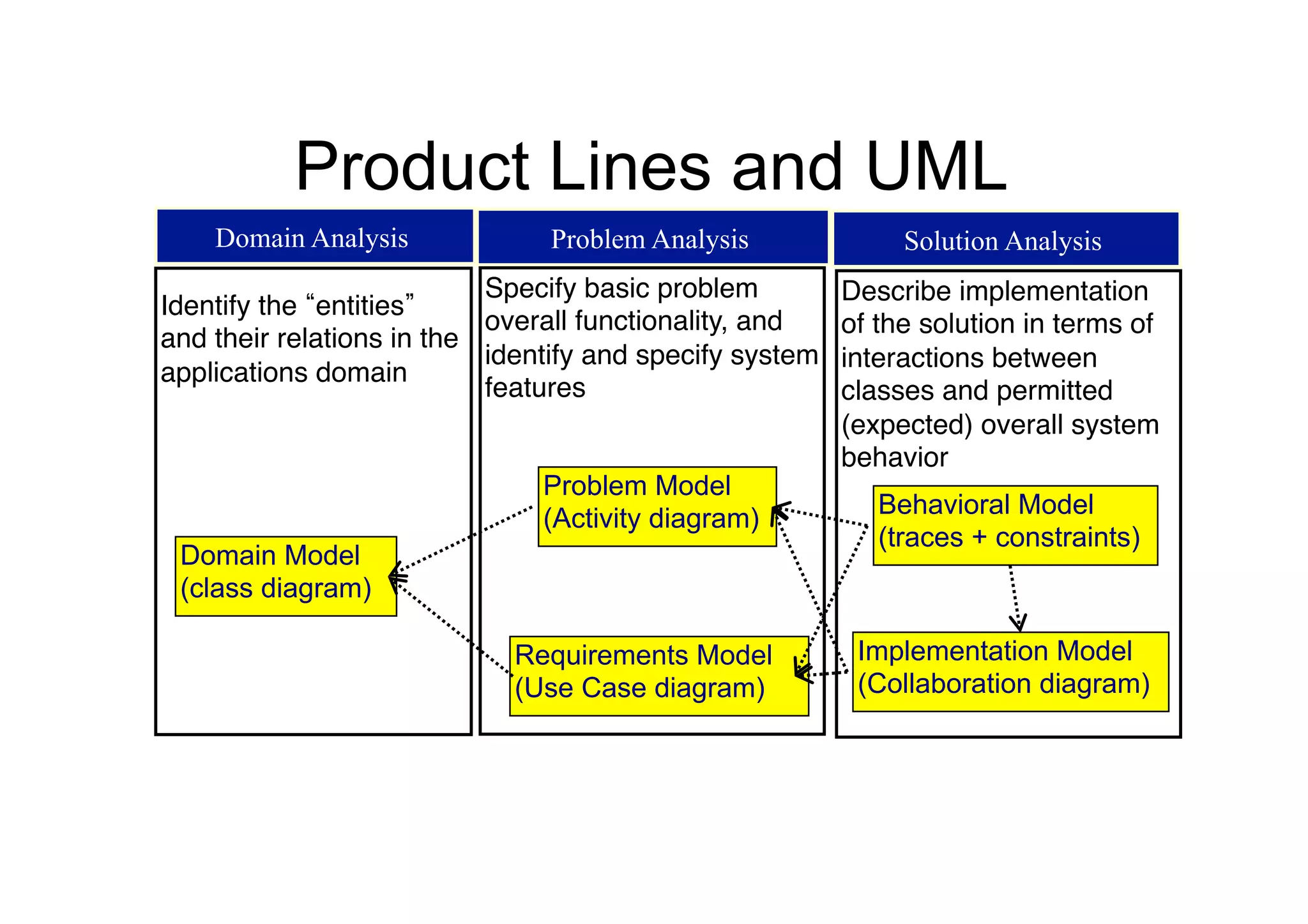
Product Lines and UML
    Domain Analysis             Problem Analysis              Solution Analysis
                           Specify basic problem         Describe implementation
Identify the entities
                           overall functionality, and    of the solution in terms of
and their relations in the
                           identify and specify system   interactions between
applications domain"
                           features"                     classes and permitted
                                                         (expected) overall system
                                                         behavior"
                               Problem Model
                               (Activity diagram)           Behavioral Model
                                                            (traces + constraints)
 Domain Model
 (class diagram)

                             Requirements Model           Implementation Model
                             (Use Case diagram)           (Collaboration diagram)
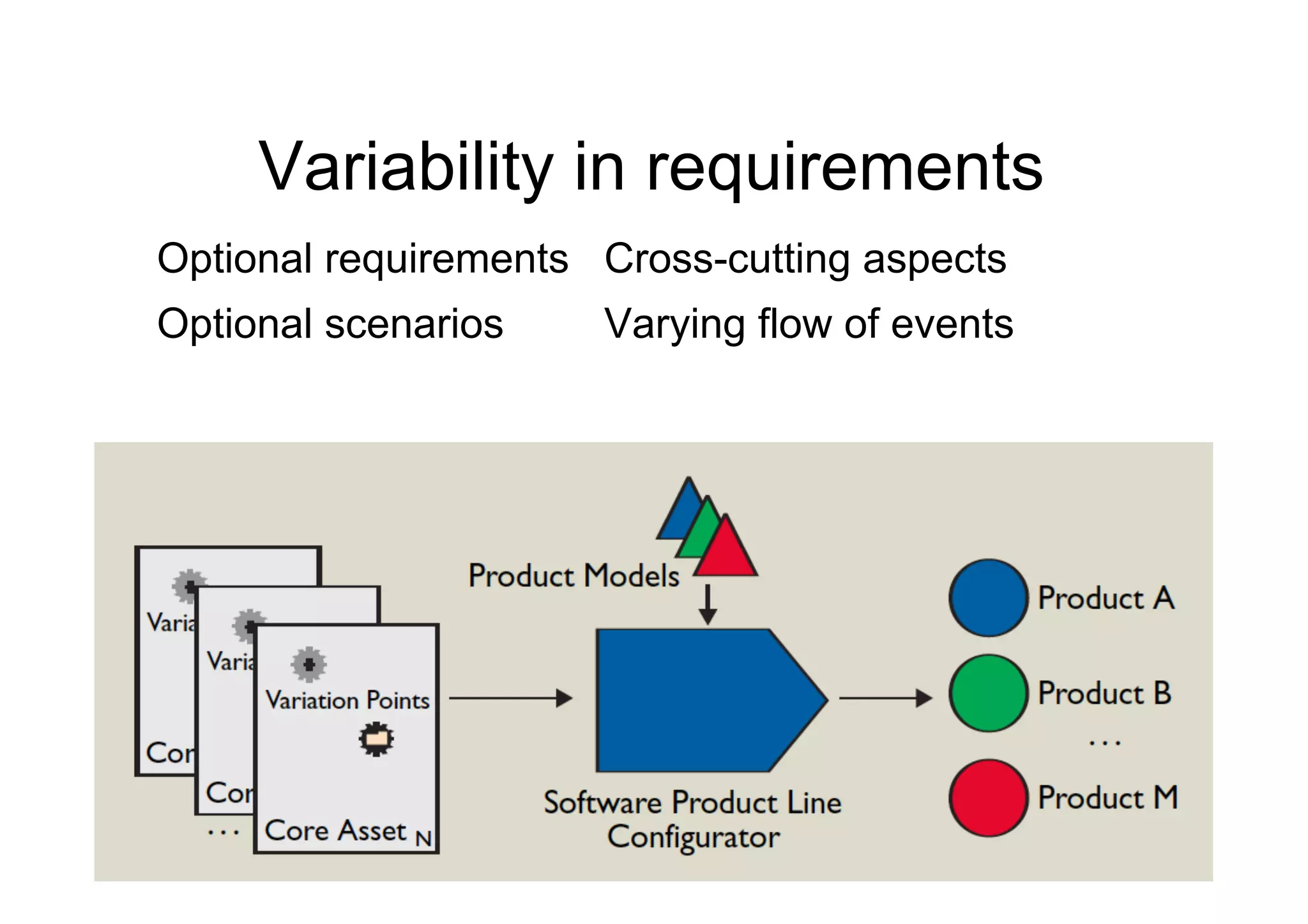
Variability in requirements
Optional requirements Cross-cutting aspects
Optional scenarios    Varying flow of events
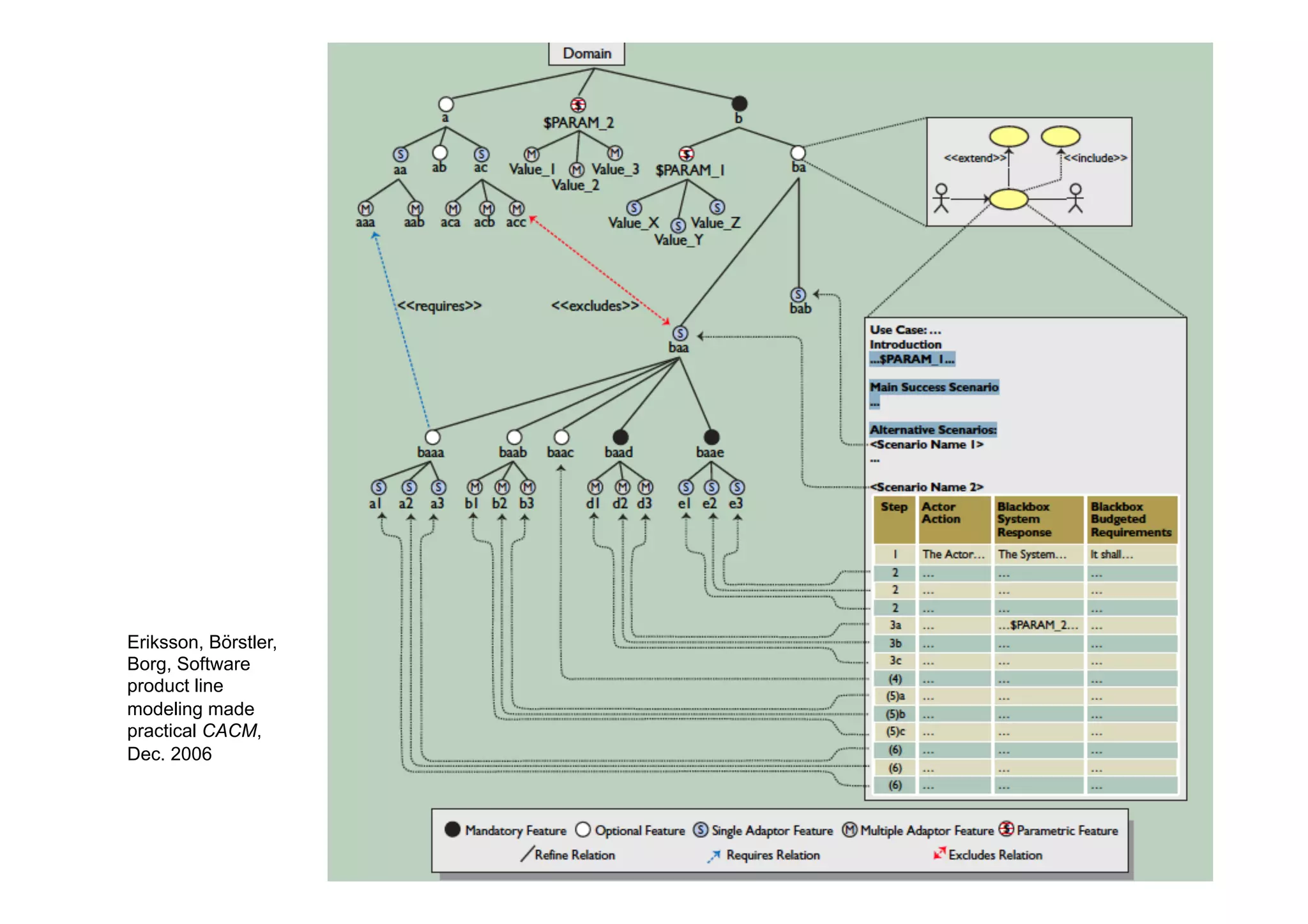
Eriksson, Börstler,
Borg, Software
product line
modeling made
practical CACM,
Dec. 2006
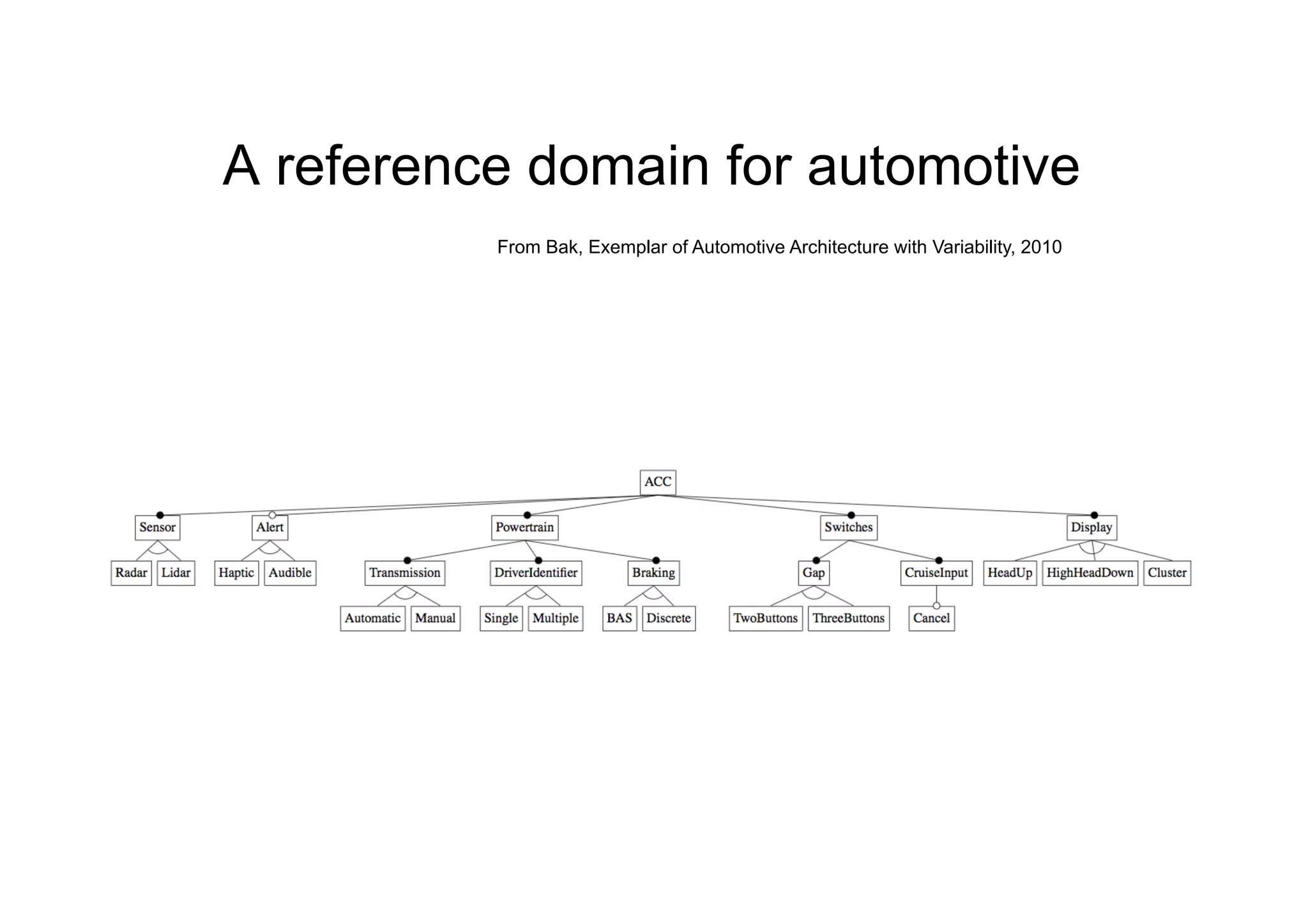
A reference domain for automotive
          From Bak, Exemplar of Automotive Architecture with Variability, 2010
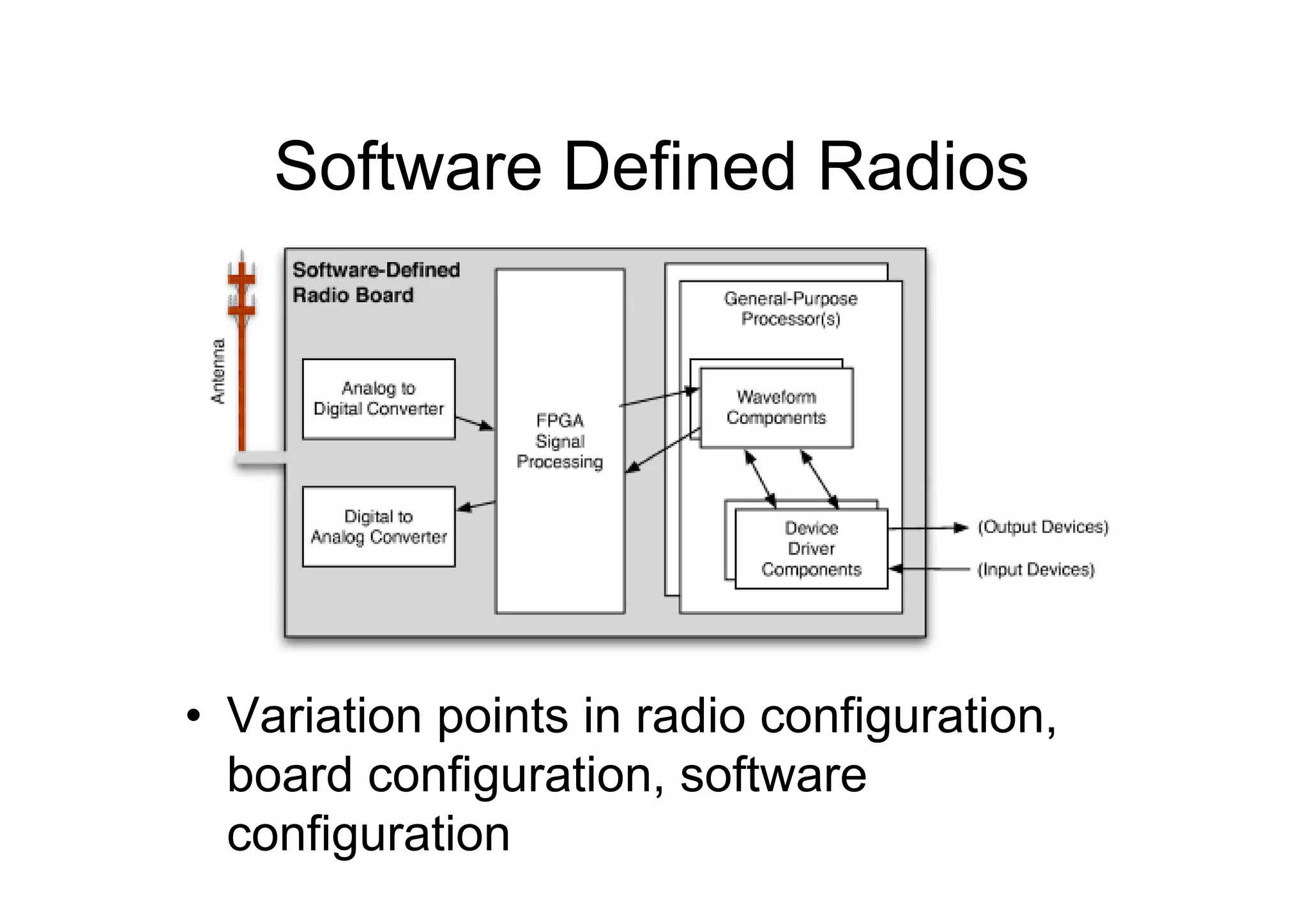
Software Defined Radios


•  Variation points in radio configuration,
   board configuration, software
   configuration
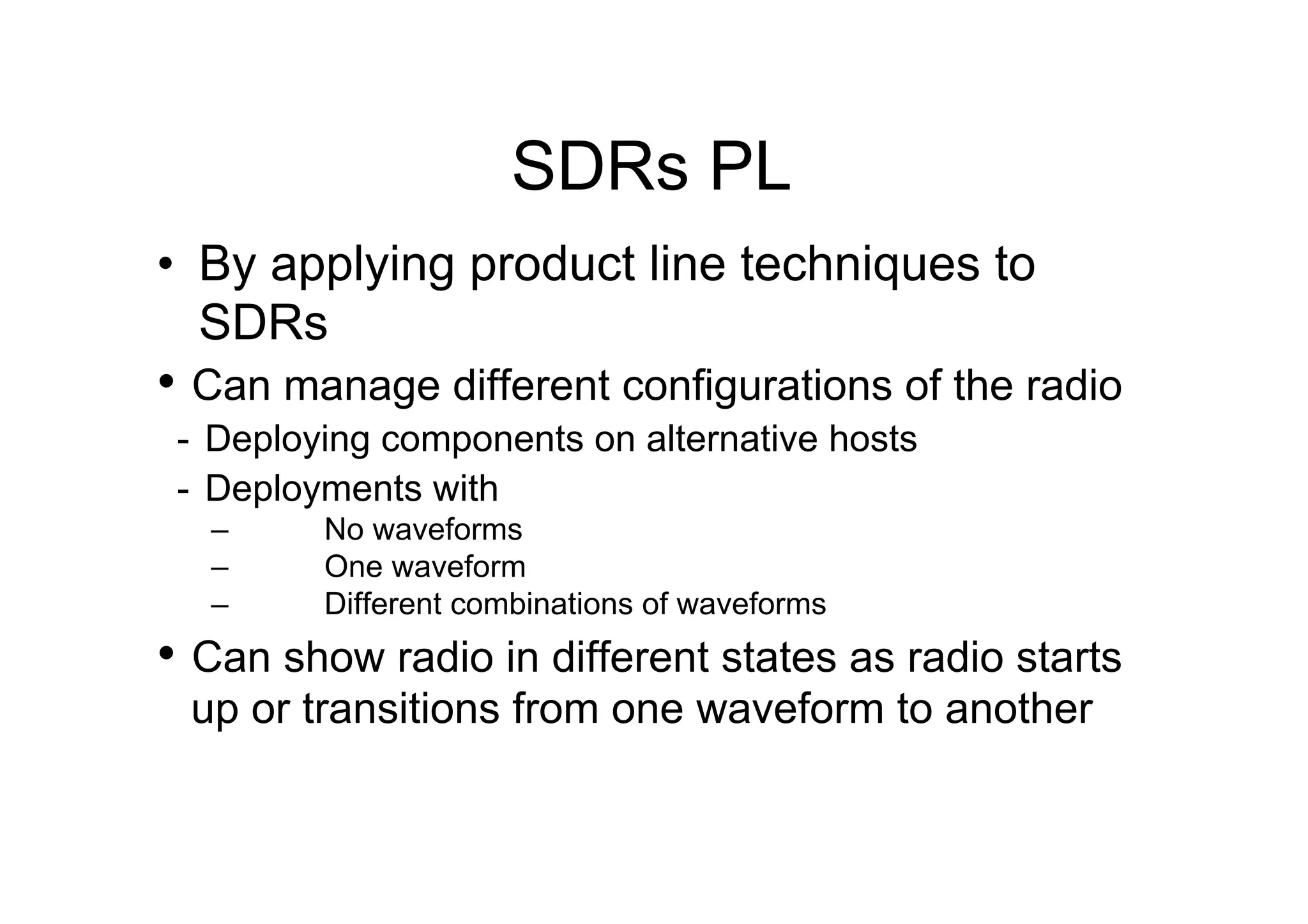
SDRs PL
•  By applying product line techniques to
   SDRs
•  Can manage different configurations of the radio
 -  Deploying components on alternative hosts
 -  Deployments with
   –     No waveforms
   –     One waveform
   –     Different combinations of waveforms
•  Can show radio in different states as radio starts
 up or transitions from one waveform to another
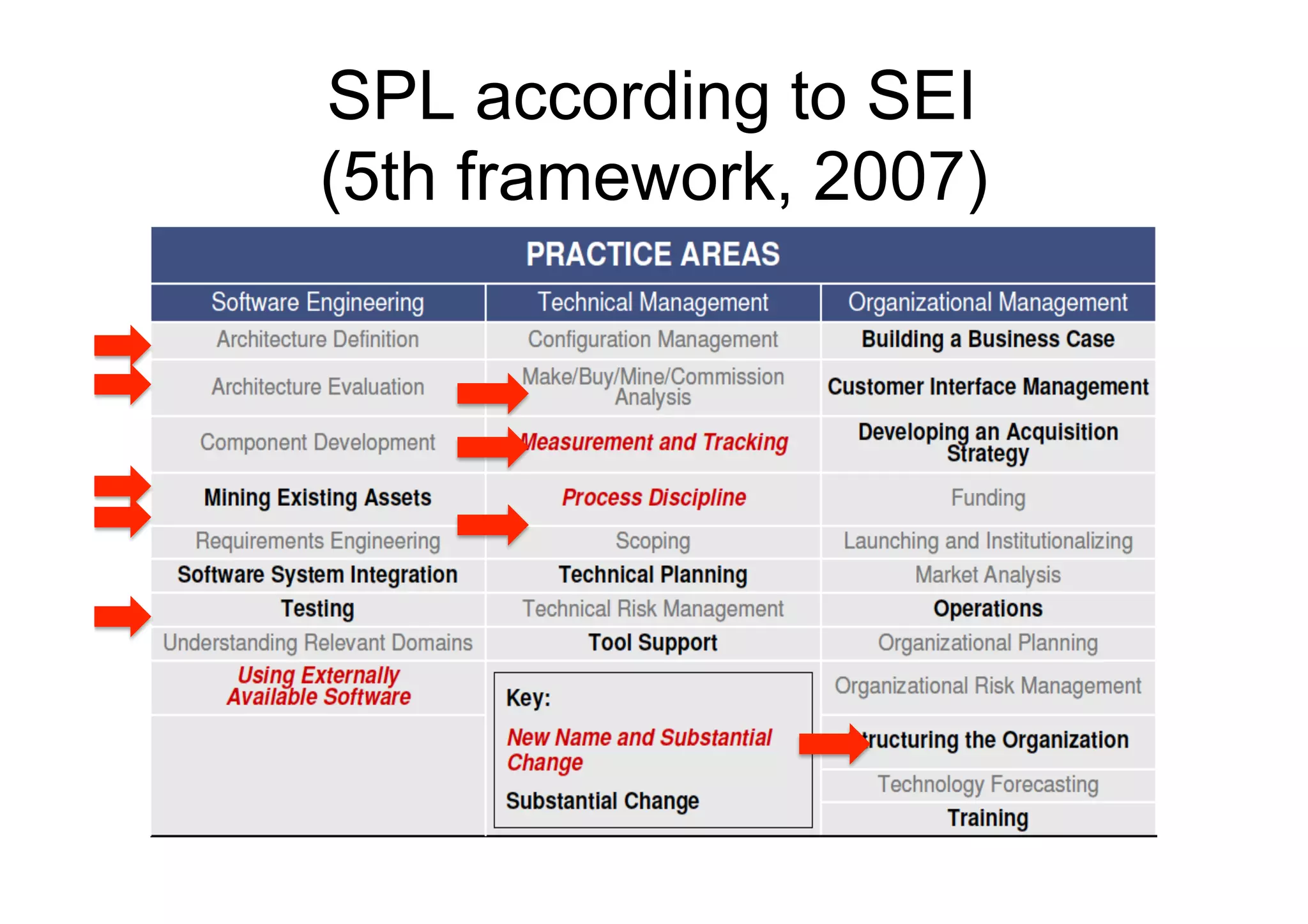
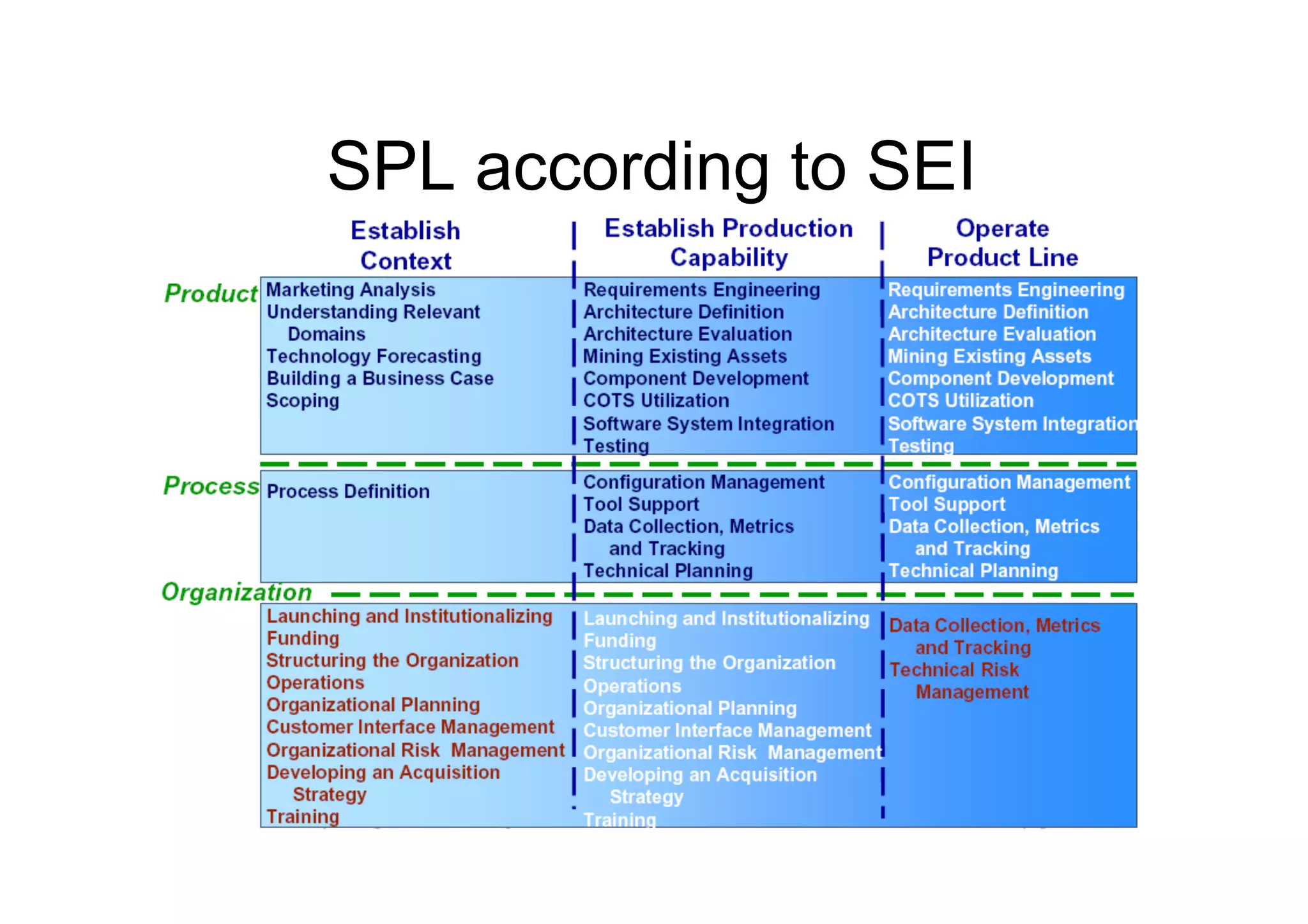
SPL according to SEI
(5th framework, 2007)
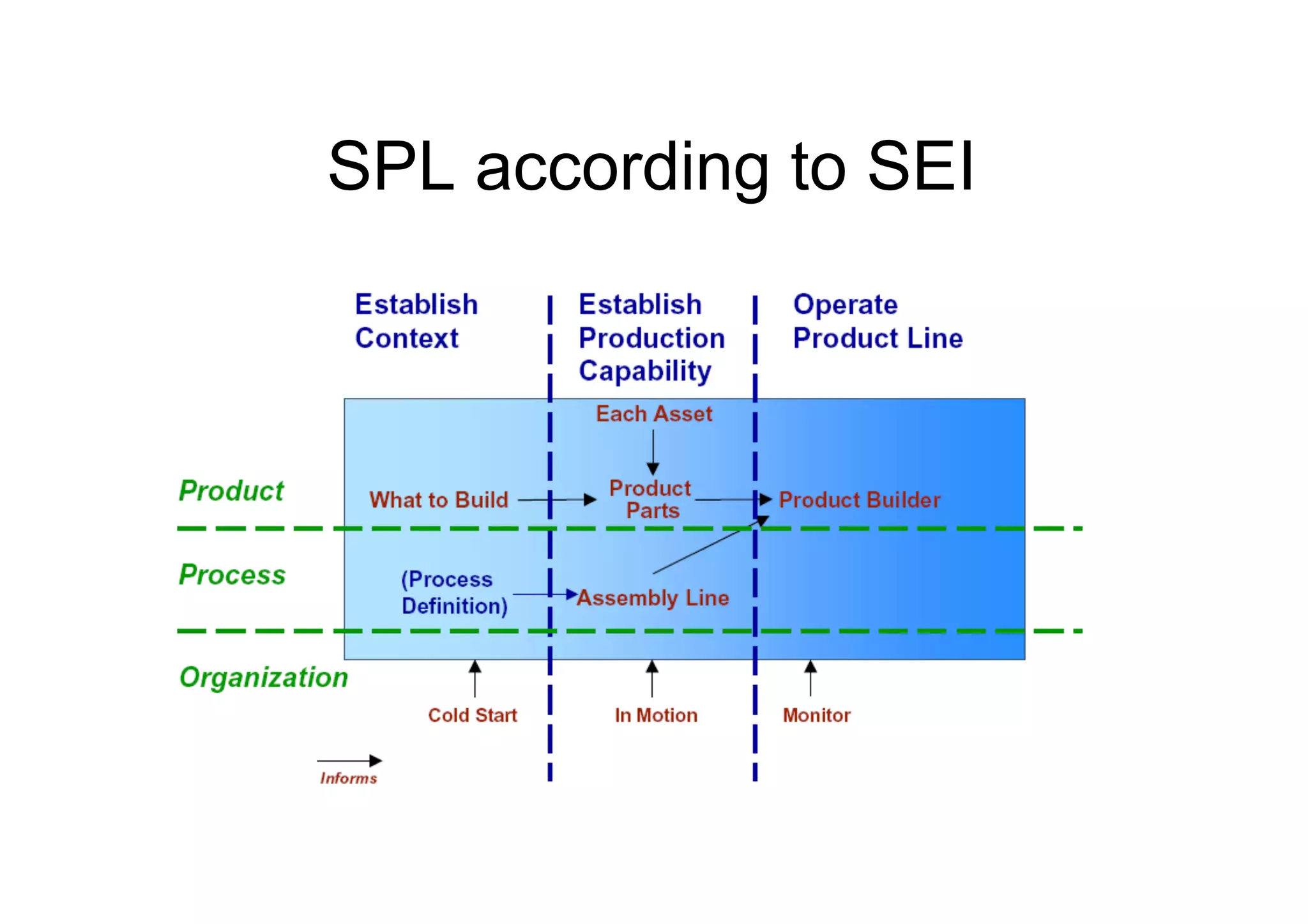
SPL according to SEI
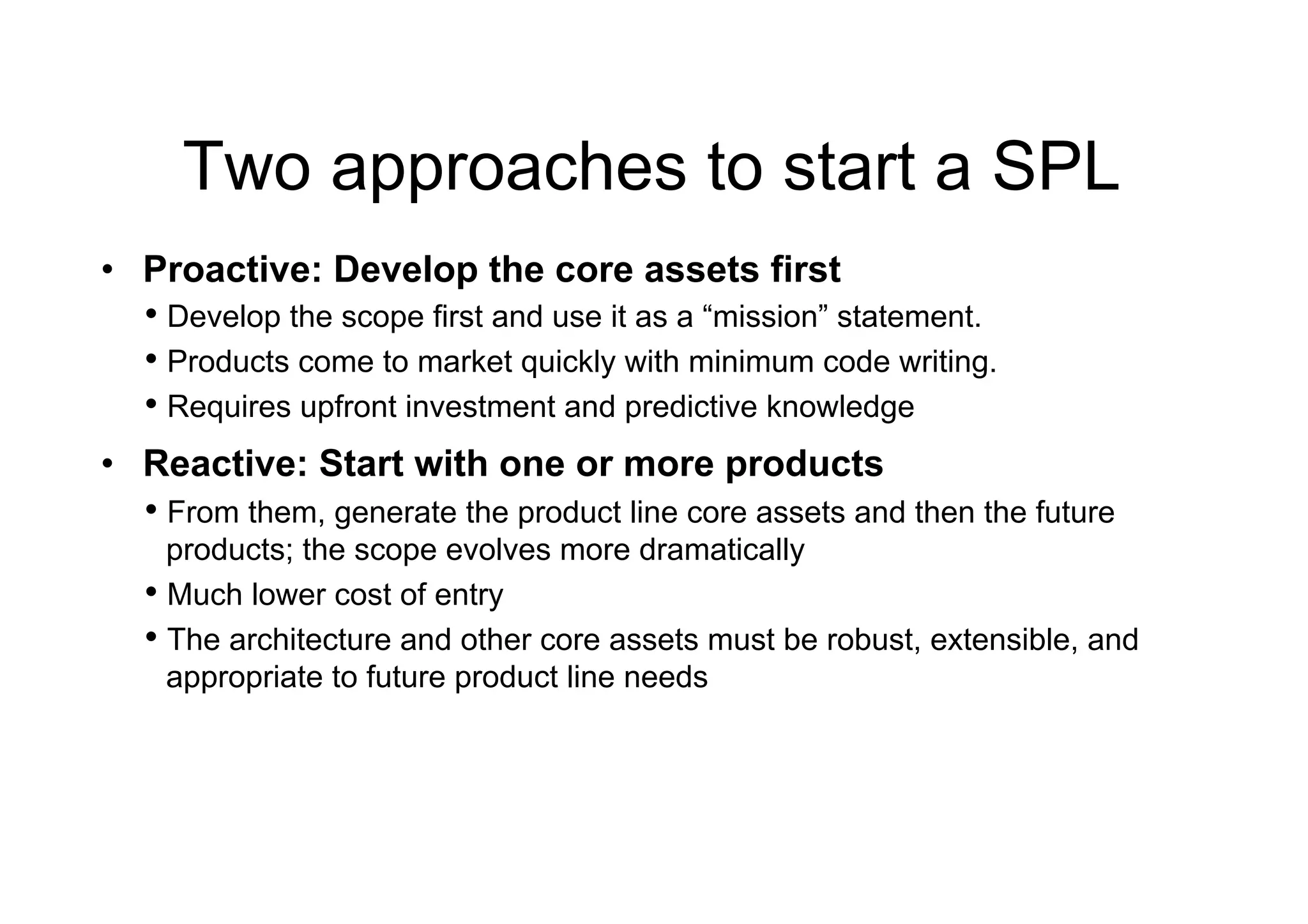
Two approaches to start a SPL
•  Proactive: Develop the core assets first
   •  Develop the scope first and use it as a “mission” statement.
   •  Products come to market quickly with minimum code writing.
   •  Requires upfront investment and predictive knowledge
•  Reactive: Start with one or more products
   •  From them, generate the product line core assets and then the future
      products; the scope evolves more dramatically
   •  Much lower cost of entry
   •  The architecture and other core assets must be robust, extensible, and
      appropriate to future product line needs
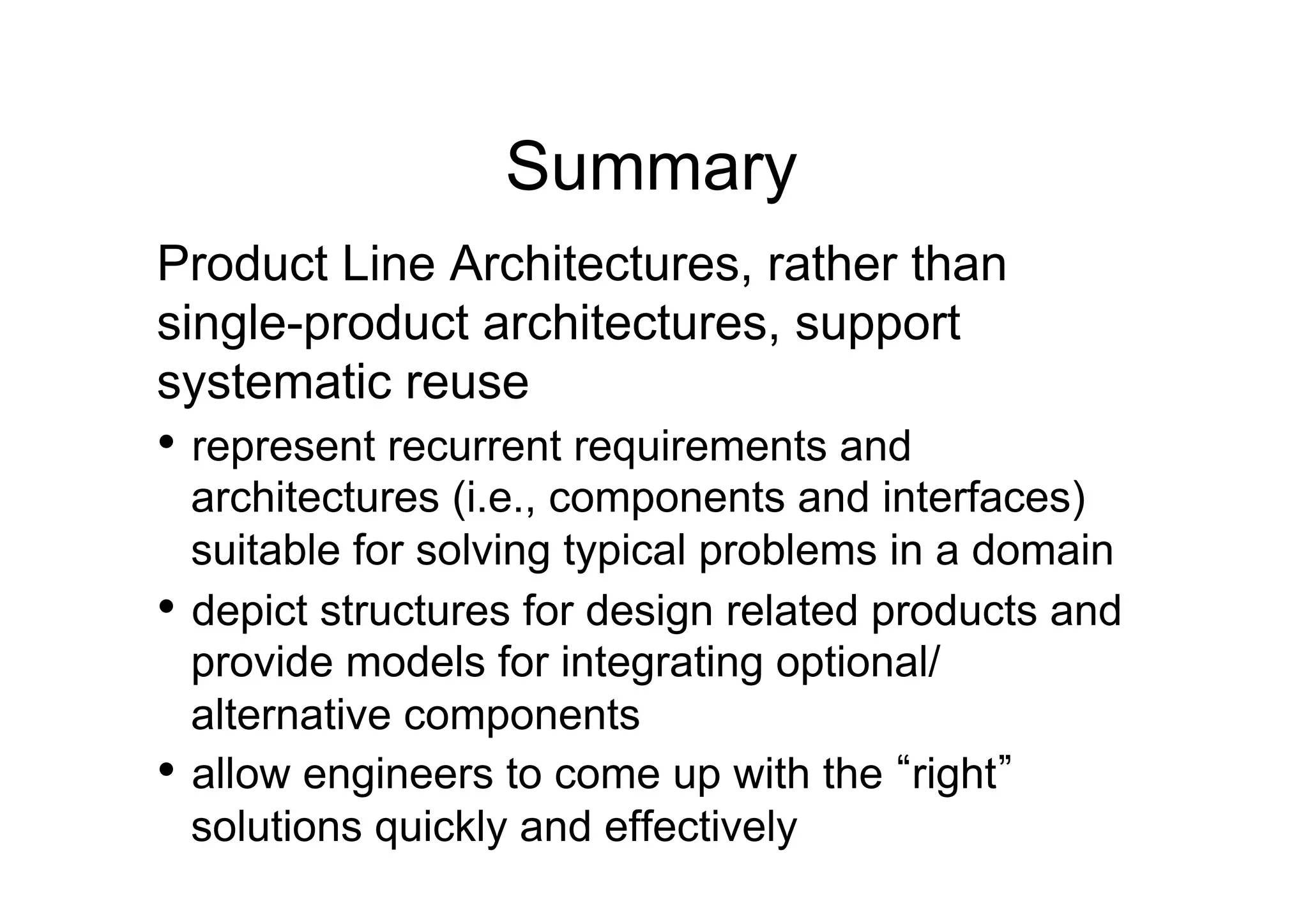
Summary
Product Line Architectures, rather than
single-product architectures, support
systematic reuse
•  represent recurrent requirements and
   architectures (i.e., components and interfaces)
   suitable for solving typical problems in a domain
•  depict structures for design related products and
   provide models for integrating optional/
   alternative components
•  allow engineers to come up with the right
   solutions quickly and effectively
Architecture-Centric Development Activities
Architecture-specific activities for SPL include:
•  creating the business case for the system
•  understanding the requirements
•  creating and/or selecting the architecture
•  documenting and communicating the architecture
•  analyzing or evaluating the architecture
•  implementing the system based on the architecture
•  ensuring that the implementation conforms to the
   architecture
From SA to PLA
•  Of all a product line’s core assets, the product
   line architecture is the most important one for
   ensuring technical success.
•  If an organization already uses disciplined
   practices to develop single-product software
   under the aegis of a software architecture, it is
   well poised to
    •  define a product line architecture
    •  Identify the core assets
    •  Build products from those core assets.
Test questions
•  What is a software product line?
•  What is a product line architecture?
•  What is variability management?
References
•  Clemens & Northrop, Software Product Lines, Addison Wesley, 2002
•  Gomaa, Designing SPL with UML, Addison Wesley, 2005
•  Pohl & Böckle, SPL Engineering: foundations, principles, and
   techniques, Springer 2005
•  vanderLinden & Schmid & Rommes, SPL in action, Springer, 2007
•  van Gurp & Bosch & Svahnberg, On the notion of variability in SPL,
   Conf. on Sw Architecture, 2001
•  Eriksson, Bostler, Borg, Software product line modeling made
   practical. An example from the Swedish defense industry, CACM 2006
•  Krueger & Jackson, Requirements engineering for systems and
   software product lines, White paper IBM Rationa,l 2009
Conferences
•  SPLC 2011, Munich, Germany
•  Workshop on Variability in Software Product Line
   Architectures
•  Wokshop on Product LinE Approaches in Software
   Engineering (PLEASE)
Sites
•  www.sei.cmu.edu/productlines
•  www.biglever.com
Questions?

7 - Architetture Software - Software product line

  • 1.
    Software Product Lines Paolo Ciancarini
  • 2.
    Agenda •  Design forreuse •  Software product lines •  Organizational strategies
  • 3.
    Motivation Complexity, size, andnumber of software- intensive systems a major problem for software companies •  routine functionality is custom-written repeatedly from scratch, over and over •  a quagmire of data formats and applications •  ambiguities and interoperability conflicts not only across different companies but even among groups within the same company
  • 4.
    Family of systems Thereis a need to •  reduce the development effort •  increase productivity moving from designing single products to producing engineering families of products •  identifying generic solutions to common problems •  building related products by assembling components •  providing universal platforms •  synthesizing systems automatically
  • 5.
    Product Line Architecture(PLA) Product Line Architecture: a common design framework that •  standardizes & maximizes reuse potential of all software artifacts generated during development -  these artifacts include requirements, designs and patterns, and, of course, actual code components •  specifies common functionality across systems •  clearly identifies variation points
  • 6.
    Capturing PLA •  Commoncore: features common to all products •  FA: features specific to product A •  FB: features specific to product B •  Product A = Common core + FA •  Product B = Common core + FB Common FA Common FB core core Product A Product B
  • 7.
    Lessons from otherindustries •  Any customer can have Any customer can a car painted any have a car painted colour that he wants so any colour that he long as it is black” - wants so long as it is Henry Ford black” Henry Ford
  • 8.
    Architecture and standardcomponents Architecture was simple and flexible Built from standard parts
  • 9.
    Standards and diversity Whatvaried? Use features to satisfy diversity of needs Why it worked? Standard architecture and common parts What resulted? Product and assembly lines
  • 10.
    The role ofarchitecture in sw
  • 11.
    Component based development Softwarefactories exploit component-based development (CBD) •  They engineer applications by composing prefabricated components in the hope that this will increase software reuse •  Strategy: building software systematically and opportunistically exploting reference architectures about a domain and competitive knowledge for systems in that domain
  • 12.
    Domain What is adomain? •  Area of expertise with specialized particular tasks •  Populated by products with reusable structures Example: software for a car •  Console •  Engine •  Brakes •  …
  • 13.
    Domains vs productlines Domains are in the problem space, product lines are in the solution space •  Domain •  Product line •  Consumer electronics •  Philips Digital TVs •  Avionics •  Boeing 747 Family •  Compilers •  GNU compiler suite •  Videogames •  Games using the same engine
  • 14.
    Multimedia Product Line VCR Features:" •  Play Tape" Answering machine Features:" •  Rewind Tape" •  Play Announcement" •  Forward Tape" •  Record Announcement" •  Button Control" •  Rewind Announcement" •  Signal Handling" •  Play Message" •  Record Message" •  Rewind Message" •  Forward Message" Audio Player Features " •  Display Messages" •  Play Tape" •  Button Control" •  Record Tape" •  Signal Handling" •  Rewind Tape" •  Forward Tape" •  Button Control" •  Signal Handling"
  • 15.
    Product lines •  Productline technology builds families of products exploiting some common core assets and managing their variability •  Ex.: Boeing 757 e 767 share 60% of components •  Ex.: Mercedes Benz class E models share 70% •  Scale economies and efficiency •  Integrating rather than creating
  • 16.
    Software reuse Why issoftware reuse critical? •  provides predictable behavior (better testing) •  enables shorter delivery timeframes •  reduces repeated building from scratch of common functionality History of the concept dated back to 1950 s •  subroutine libraries •  standardized class libraries
  • 17.
    Old ways toreusing software Old definitions of sw reuse include: •  Re-use is considered as a means to support the construction of new programs using in a systematical way existing designs, design fragments, program texts, documentation, or other forms of program representation. •  Reusability is the extent to which a software component can be used (with or without adaptation) in multiple problem solutions.
  • 18.
    Reusable assets Reference Design Architecture Pattern Legacy Architectural Application Mechanism Pattern Packaged Language Application Development Reference Method Model Architectural Programming Decision Pattern Pattern Component Library Component Architectural Pattern Architectural Application Style Framework
  • 19.
    Reuse Reuse aspects •  Itis not an end in itself but a means to increase productivity and improve quality •  Reusable components are not limited to code •  Software components may need adaptation -  Adaptive design Community & Enterprise Information Portals -  Variant design Health ••• other vertical •  Horizontal and Care Financial Insurance domains vertical reuse E-Business facilities ••• other (Appl. dev., Intelligence, Integration, …) facilities Metamodel Interoperability ••• Distributed Run-time Middleware
  • 20.
    Benefits By planning aheadin support of families of multiple systems, an organization •  reduces the development time and cost of new products •  reduces risk and improves quality •  manages its legacy assets more efficiently •  evolves a common marketing strategy •  makes decisions based on the (value of) the asset base and the strategic goals
  • 21.
    Software product lines(SPL) Definition by Clemens and Northrop (SEI, 2002): •  A set of software-intensive systems that share a common, managed set of features satisfying the specific needs of a particular market segment •  They are developed from a common set of core assets in a prescribed way •  Example: software for TV sets (Philips)
  • 22.
    SPL metamodel Product lines -  Exploit commonality -  Bound variability
  • 23.
    Why SPL work? Productlines amortize the investment in these core assets: •  requirements (and requirements analysis) •  domain models •  software architecture (and design) •  performance engineering •  documentation •  test plans, test cases, and test data •  people: their knowledge and skills •  processes, methods, and tools •  budgets, schedules, and work plans •  components and services
  • 24.
    A few successstories •  Celsius tech: family of naval command and control systems •  Ericsson AXE: family of telecommunications switches •  Lucent Technologies: 5ESS telecom switch •  US Naval Undersea Warfare Center: A-7° •  SALION: Acquisition Management Systems •  Toshiba: Electric Power Generation Plant •  BOEING: Bold Stroke Avionics SW Family •  BOSCH: Gasoline Systems •  CUMMINS Inc.: Diesel SPL •  LSI: RAID controller firmware SPL •  GM: General Motors Powertrain (GMPT) •  PHILIPS: Medical Systems •  Nokia: mobile phones
  • 25.
    SPL issues •  ROI:when are they convenient? •  Organization of work •  Domain engineering and scoping •  Design for reuse of commonality •  Control of variability
  • 26.
  • 27.
  • 29.
  • 30.
  • 31.
    Organization by productlines (from Krueger 2009)
  • 33.
    Single system perspective (from Krueger 2009)
  • 37.
    Product Line Engineering PLEngineering uses domain-driven, model- based methodology for building software •  Two complementary processes -  Modeling (domain engineering) -  Development (applications engineering)
  • 38.
    Product Line Engineering Domain Engineering Experts " Technology" Domain Experts & 1. Modeling (Domain Engineering, Domain
 a.k.a Design-for-Reuse)" knowledge" Refers to original design, i.e.,
 the use of first principles" " Solution 
 models" Domain Experts & IT technicians New
 Domain Expert requirements"Development (Application Engineering, 
 2. a.k.a design-with-Reuse)" Product" refers to routine practice, i.e., 
 the use of known solutions"
  • 40.
    Reusable assets Reuse ingeneral needs to be planned for •  create a reusable asset, i.e. one that is fully documented, has good code and robust scripts; is verified independently with high confidence •  create a usable asset, i.e. one that is adaptable and that is usable in a variety of simulators Design for reuse/use involves •  analysis to identify explicitly variations to anticipate adaptations, and •  design for adaptability, engineered a priori to create assets for future developments
  • 41.
    Problems Design for commonality • standardizing assets by encapsulating common features Analysis of variation •  must explicitly identify variations that anticipate adaptations Control of variability •  provide assets flexibility without compromising commonality
  • 42.
    Levels of reuse • Domain-independent components -  Designed for reuse to fit any product (e.g., general purpose class libraries) •  Domain-specific components -  Designed for reuse to fit several different products in a given market (e.g., multi-media, jpeg encoders, data communications, digital signal processing, ...) •  Product-specific components -  Designed for reuse within a specific application (to generate various instances or products)
  • 43.
    SPL: main issues Thereare several issues to consider •  Scoping the SPL (i.e. identify domain and assets) •  Define a reference architecture •  Define a PLA •  Identification of reusable components at the appropriate level of abstraction •  Variability management •  Architectural compliance •  SPL maintenance
  • 44.
    What is SPLscoping? •  the initial phase of a SPL, aims to identify products, features, potential of the market domain and reusable assets •  determines the viability of the SPL •  maximizes the economical value of the SPL •  Essential factors in SPL: -  Investment -  Management -  Planning -  Business strategy } scoping
  • 45.
    Traditional Engineering Model Domains! Individual ! applications! Individual ! domains! Systems! Individual
 implementations! Assets!
  • 46.
    SPL Model Domains! Domain
 models! • Variability analysis! <<includes>>! Start
 Startup! compressor! <<extends>>! <<extends>>! Shutdown! Operator! <<includes>>! Alarm
 <<includes>>! Plant! detected! Remote! Operate! Shutdown! <<extends>>! <<includes>>! <<includes>>! Local! Remote! <<includes>>! Local
 Shutdown! Stop
 compressor! • Features! 2 2 CapsuleC CapsuleB CapsuleA Class Diagram (domain model) :CapsuleA Collaboration Diagram (role model) :CapsuleB CapsuleC connection Reusable 
 network :CapsuleB CapsuleC Component! Systems! Cn Cn Cn •••" Cn Cn Assets! Architectural
 Framework!
  • 47.
    Product Lines andUML Domain Analysis Problem Analysis Solution Analysis Specify basic problem Describe implementation Identify the entities overall functionality, and of the solution in terms of and their relations in the identify and specify system interactions between applications domain" features" classes and permitted (expected) overall system behavior" Problem Model (Activity diagram) Behavioral Model (traces + constraints) Domain Model (class diagram) Requirements Model Implementation Model (Use Case diagram) (Collaboration diagram)
  • 50.
    Variability in requirements Optionalrequirements Cross-cutting aspects Optional scenarios Varying flow of events
  • 51.
    Eriksson, Börstler, Borg, Software productline modeling made practical CACM, Dec. 2006
  • 52.
    A reference domainfor automotive From Bak, Exemplar of Automotive Architecture with Variability, 2010
  • 53.
    Software Defined Radios • Variation points in radio configuration, board configuration, software configuration
  • 54.
    SDRs PL •  Byapplying product line techniques to SDRs •  Can manage different configurations of the radio -  Deploying components on alternative hosts -  Deployments with –  No waveforms –  One waveform –  Different combinations of waveforms •  Can show radio in different states as radio starts up or transitions from one waveform to another
  • 55.
    SPL according toSEI (5th framework, 2007)
  • 56.
  • 57.
  • 58.
    Two approaches tostart a SPL •  Proactive: Develop the core assets first •  Develop the scope first and use it as a “mission” statement. •  Products come to market quickly with minimum code writing. •  Requires upfront investment and predictive knowledge •  Reactive: Start with one or more products •  From them, generate the product line core assets and then the future products; the scope evolves more dramatically •  Much lower cost of entry •  The architecture and other core assets must be robust, extensible, and appropriate to future product line needs
  • 59.
    Summary Product Line Architectures,rather than single-product architectures, support systematic reuse •  represent recurrent requirements and architectures (i.e., components and interfaces) suitable for solving typical problems in a domain •  depict structures for design related products and provide models for integrating optional/ alternative components •  allow engineers to come up with the right solutions quickly and effectively
  • 60.
    Architecture-Centric Development Activities Architecture-specificactivities for SPL include: •  creating the business case for the system •  understanding the requirements •  creating and/or selecting the architecture •  documenting and communicating the architecture •  analyzing or evaluating the architecture •  implementing the system based on the architecture •  ensuring that the implementation conforms to the architecture
  • 61.
    From SA toPLA •  Of all a product line’s core assets, the product line architecture is the most important one for ensuring technical success. •  If an organization already uses disciplined practices to develop single-product software under the aegis of a software architecture, it is well poised to •  define a product line architecture •  Identify the core assets •  Build products from those core assets.
  • 62.
    Test questions •  Whatis a software product line? •  What is a product line architecture? •  What is variability management?
  • 63.
    References •  Clemens &Northrop, Software Product Lines, Addison Wesley, 2002 •  Gomaa, Designing SPL with UML, Addison Wesley, 2005 •  Pohl & Böckle, SPL Engineering: foundations, principles, and techniques, Springer 2005 •  vanderLinden & Schmid & Rommes, SPL in action, Springer, 2007 •  van Gurp & Bosch & Svahnberg, On the notion of variability in SPL, Conf. on Sw Architecture, 2001 •  Eriksson, Bostler, Borg, Software product line modeling made practical. An example from the Swedish defense industry, CACM 2006 •  Krueger & Jackson, Requirements engineering for systems and software product lines, White paper IBM Rationa,l 2009
  • 64.
    Conferences •  SPLC 2011,Munich, Germany •  Workshop on Variability in Software Product Line Architectures •  Wokshop on Product LinE Approaches in Software Engineering (PLEASE)
  • 65.
  • 66.