Testing EmbeddedSoftwareJohn RegehrUniversity of Utah
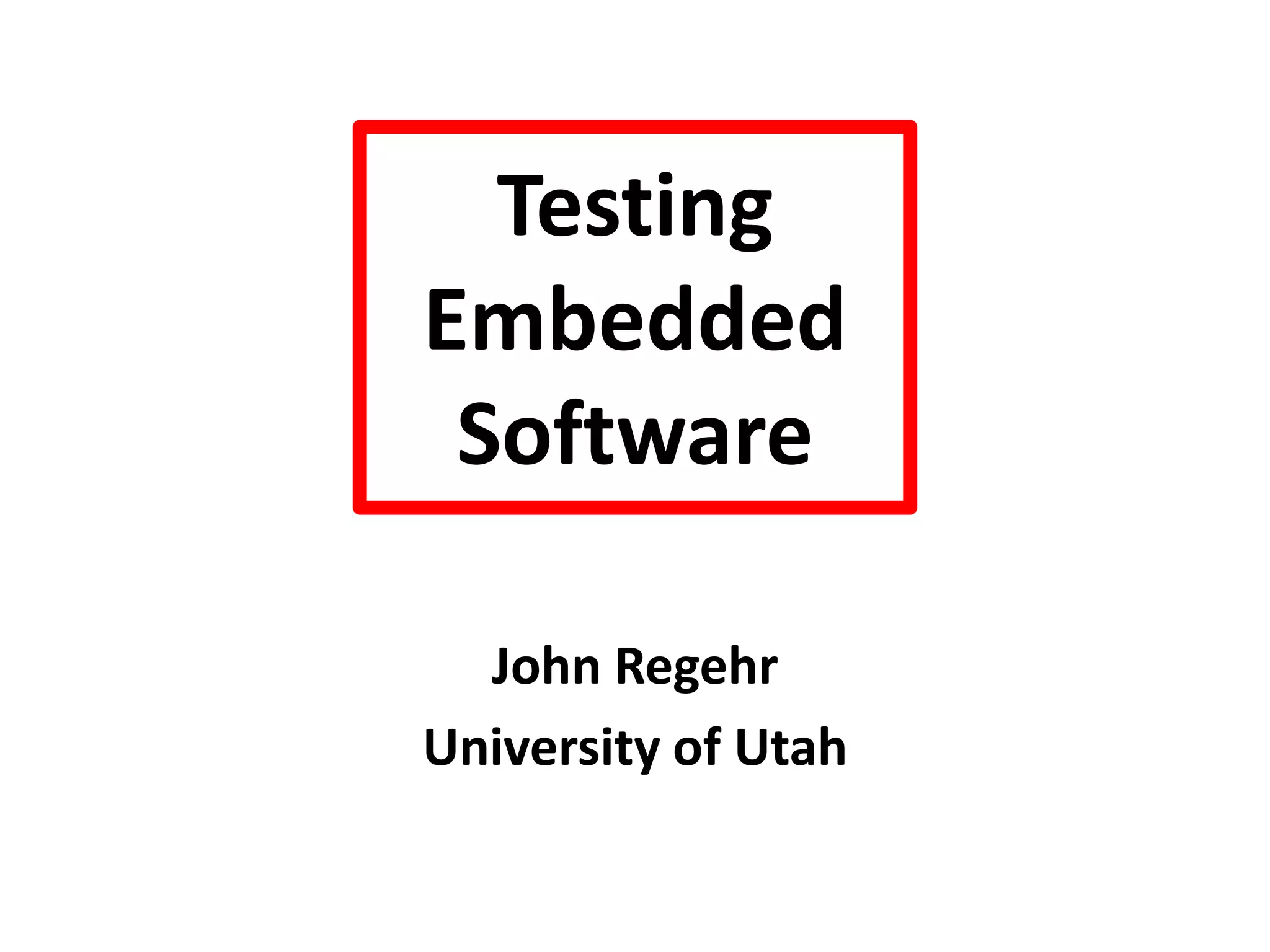
“Over 15 billion ARM based chips shipped to date”[ARM web site, 2011]“The microcontroller market is forecast to reach over $16 billion worldwide in 2011”[Microcontroller Market Tracker, 2011]2
3
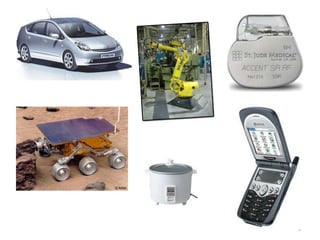
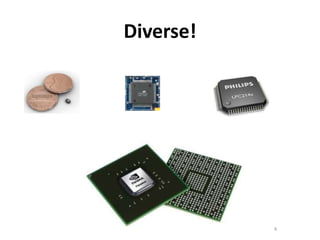
Diverse!4
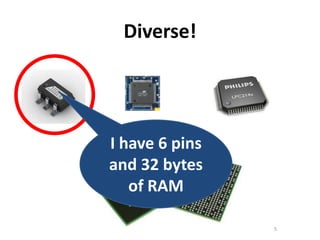
Diverse!I have 6 pins and 32 bytes of RAM5
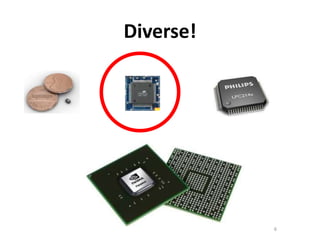
Diverse!6
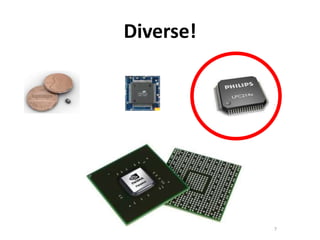
Diverse!7
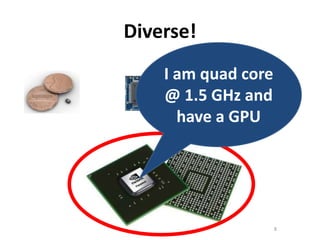
Diverse!I am quad core @ 1.5 GHz and have a GPU 8
Usually there are multiple processorsOn-chip networksIn-device networksDistributed systemsResource constraints are…Severe – to minimize unit costHard – failure if system runs out of…TimeRAM – stack or heapEnergy9
Continuously interact with the world through I/O devicesMay be little abstraction of HWProbably using both interrupt handlers and threadsOften there are fault tolerance and security requirements10
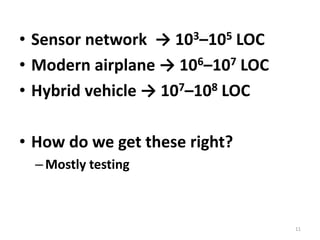
Sensor network  -> 103–105 LOCModern airplane -> 106–107 LOC Hybrid vehicle -> 107–108 LOCHow do we get these right?Mostly testing11
Software on many individual processors is smallPermits aggressive analysis and testingConstrained domain simplifies testingEmbedded systems are (by definition) special-purpose devices12
The “Real System Problem”Many interesting embedded codes are proprietaryNecessary tools may be expensive or nonexistentCompilers, debuggers, simulatorsMay not be able to run it in the labOften lacks specifications and oracles13
Consequently, academic embedded work may be…Forced to use small, contrived examplesOut of tune with industry14
Consequently, academic embedded work may be…Forced to use small, contrived examplesOut of tune with industry15Solution: Ubiquitous open embedded platforms
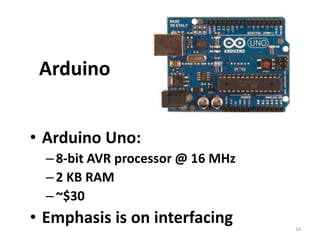
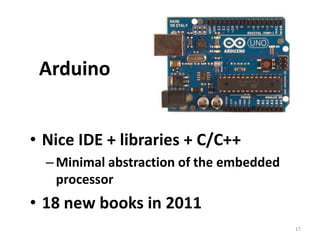
ArduinoArduino Uno:8-bit AVR processor @ 16 MHz2 KB RAM~$30Emphasis is on interfacing16
ArduinoNice IDE + libraries + C/C++Minimal abstraction of the embedded processor18 new books in 201117
 Simulators and model checkers for AVR code exist
 Very few Arduino tool papers exist
 This is a big opportunityArduinoNice IDE + libraries + C/C++Minimal abstraction of the embedded processor18 new books in 201118
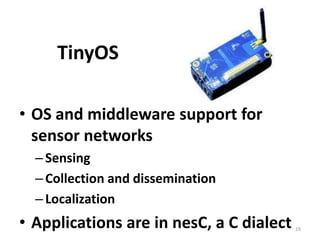
TinyOSOS and middleware support for sensor networksSensingCollection and disseminationLocalizationApplications are in nesC, a C dialect19
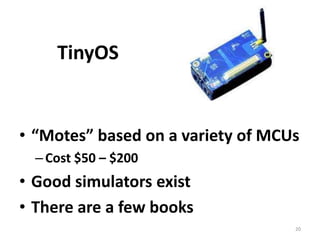
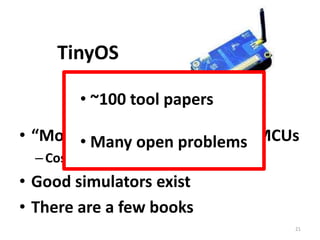
TinyOS“Motes” based on a variety of MCUsCost $50 – $200Good simulators existThere are a few books20
TinyOS ~100 tool papers
 Many open problems“Motes” based on a variety of MCUsCost $50 – $200Good simulators existThere are a few books21
AndroidOS + middleware for smart phones / tabletsARM based hardware running LinuxMuch less constrained than motes and Arduino22
AndroidApplication code in JavaGreat toolsTons of books23
Android < 100 tool papers
 Most are very recent
 This is not a scary platformApplication code in JavaGreat toolsTons of books24
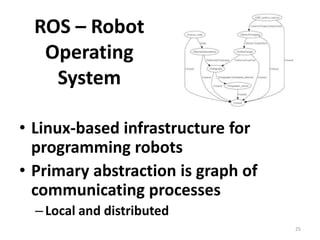
ROS – Robot Operating SystemLinux-based infrastructure for programming robotsPrimary abstraction is graph of communicating processesLocal and distributed25
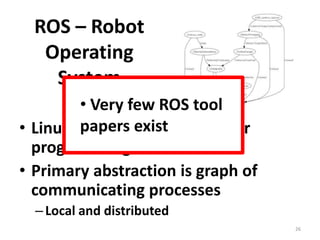
ROS – Robot Operating System Very few ROS tool papers existLinux-based infrastructure for programming robotsPrimary abstraction is graph of communicating processesLocal and distributed26
Plenty of other open embedded platforms existFreeRTOSContikiPacemaker ChallengeEtc.Embarrassment of richesStill, huge room for improvementWhere’s the open automobile?27
So, let’s test some embedded softwareBut what are we testing for?28
Properties / OraclesTemporal safetyDeadlinesOr just responsivenessMemory safetyContracts / assertionsReference implementation29
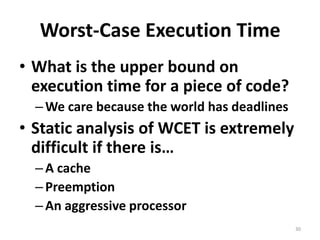
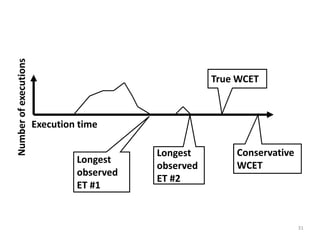
Worst-Case Execution TimeWhat is the upper bound on execution time for a piece of code?We care because the world has deadlinesStatic analysis of WCET is extremely difficult if there is…A cachePreemptionAn aggressive processor30
True WCETNumber of executionsExecution timeConservative WCETLongest observed ET #2Longest observed ET #131
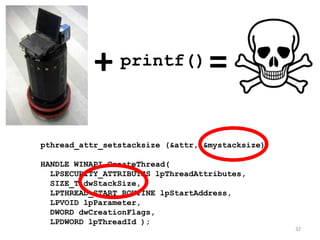
32+=printf()pthread_attr_setstacksize (&attr, &mystacksize);HANDLE WINAPI CreateThread(   LPSECURITY_ATTRIBUTES lpThreadAttributes,   SIZE_T dwStackSize,   LPTHREAD_START_ROUTINE lpStartAddress,   LPVOID lpParameter,   DWORD dwCreationFlags,   LPDWORD lpThreadId );
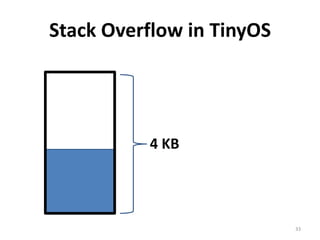
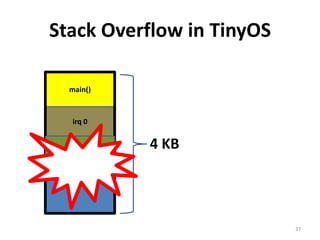
Stack Overflow in TinyOS334 KB
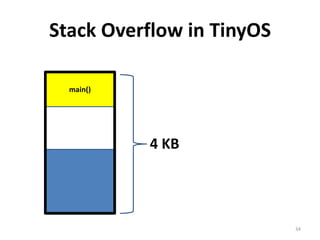
Stack Overflow in TinyOS34main()4 KB
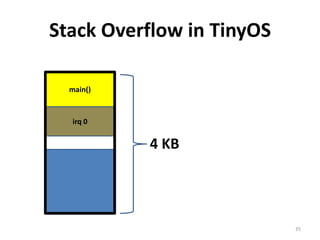
Stack Overflow in TinyOS35main()irq 04 KB
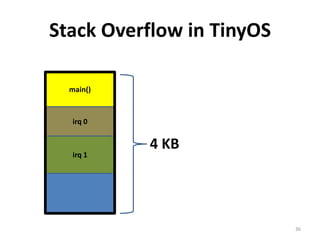
Stack Overflow in TinyOS36main()irq 04 KBirq 1
Stack Overflow in TinyOS37main()irq 04 KBirq 1
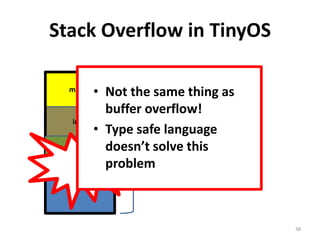
Stack Overflow in TinyOS38Not the same thing as buffer overflow!Type safe language doesn’t solve this problemmain()irq 04 KBirq 1
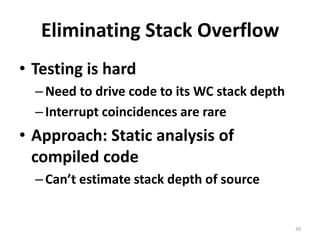
Eliminating Stack OverflowTesting is hardNeed to drive code to its WC stack depthInterrupt coincidences are rareApproach: Static analysis of compiled codeCan’t estimate stack depth of source39
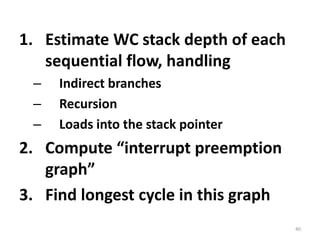
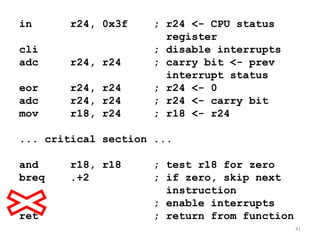
Estimate WC stack depth of each sequential flow, handlingIndirect branchesRecursionLoads into the stack pointerCompute “interrupt preemption graph”Find longest cycle in this graph40
41in      r24, 0x3f    ; r24 <- CPU status                        registercli                  ; disable interruptsadc     r24, r24     ; carry bit <- prev                       interrupt statuseor     r24, r24     ; r24 <- 0adc     r24, r24     ; r24 <- carry bitmov     r18, r24     ; r18 <- r24... critical section ...and     r18, r18     ; test r18 for zerobreq    .+2          ; if zero, skip next                        instructionsei                  ; enable interruptsret                  ; return from function
Stack analysis tool deployed in the TinyOS distributionResults are typically much larger than worst observed stack depthsBut, we validated its results by randomly firing interrupts42
Need… more… oracles…43
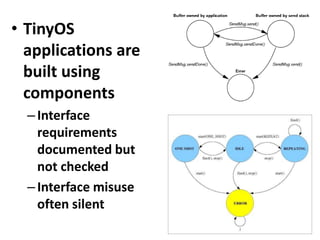
TinyOS applications are built using componentsInterface requirements documented but not checkedInterface misuse often silent44
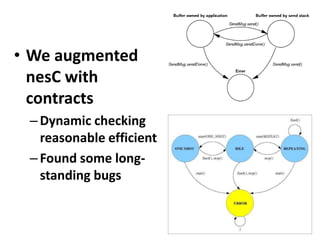
We augmented nesC with contractsDynamic checking reasonable efficientFound some long-standing bugs45
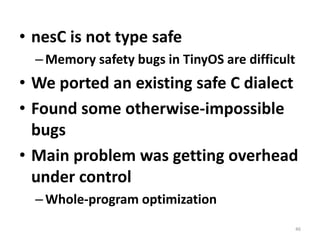
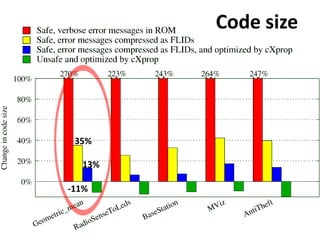
nesC is not type safeMemory safety bugs in TinyOS are difficultWe ported an existing safe C dialectFound some otherwise-impossible bugsMain problem was getting overhead under controlWhole-program optimization46
47Code size35%13%-11%

Issta11

  • 1.
  • 2.
    “Over 15 billionARM based chips shipped to date”[ARM web site, 2011]“The microcontroller market is forecast to reach over $16 billion worldwide in 2011”[Microcontroller Market Tracker, 2011]2
  • 3.
  • 4.
  • 5.
    Diverse!I have 6pins and 32 bytes of RAM5
  • 6.
  • 7.
  • 8.
    Diverse!I am quadcore @ 1.5 GHz and have a GPU 8
  • 9.
    Usually there aremultiple processorsOn-chip networksIn-device networksDistributed systemsResource constraints are…Severe – to minimize unit costHard – failure if system runs out of…TimeRAM – stack or heapEnergy9
  • 10.
    Continuously interact withthe world through I/O devicesMay be little abstraction of HWProbably using both interrupt handlers and threadsOften there are fault tolerance and security requirements10
  • 11.
    Sensor network -> 103–105 LOCModern airplane -> 106–107 LOC Hybrid vehicle -> 107–108 LOCHow do we get these right?Mostly testing11
  • 12.
    Software on manyindividual processors is smallPermits aggressive analysis and testingConstrained domain simplifies testingEmbedded systems are (by definition) special-purpose devices12
  • 13.
    The “Real SystemProblem”Many interesting embedded codes are proprietaryNecessary tools may be expensive or nonexistentCompilers, debuggers, simulatorsMay not be able to run it in the labOften lacks specifications and oracles13
  • 14.
    Consequently, academic embeddedwork may be…Forced to use small, contrived examplesOut of tune with industry14
  • 15.
    Consequently, academic embeddedwork may be…Forced to use small, contrived examplesOut of tune with industry15Solution: Ubiquitous open embedded platforms
  • 16.
    ArduinoArduino Uno:8-bit AVRprocessor @ 16 MHz2 KB RAM~$30Emphasis is on interfacing16
  • 17.
    ArduinoNice IDE +libraries + C/C++Minimal abstraction of the embedded processor18 new books in 201117
  • 18.
    Simulators andmodel checkers for AVR code exist
  • 19.
    Very fewArduino tool papers exist
  • 20.
    This isa big opportunityArduinoNice IDE + libraries + C/C++Minimal abstraction of the embedded processor18 new books in 201118
  • 21.
    TinyOSOS and middlewaresupport for sensor networksSensingCollection and disseminationLocalizationApplications are in nesC, a C dialect19
  • 22.
    TinyOS“Motes” based ona variety of MCUsCost $50 – $200Good simulators existThere are a few books20
  • 23.
  • 24.
    Many openproblems“Motes” based on a variety of MCUsCost $50 – $200Good simulators existThere are a few books21
  • 25.
    AndroidOS + middlewarefor smart phones / tabletsARM based hardware running LinuxMuch less constrained than motes and Arduino22
  • 26.
    AndroidApplication code inJavaGreat toolsTons of books23
  • 27.
    Android < 100tool papers
  • 28.
    Most arevery recent
  • 29.
    This isnot a scary platformApplication code in JavaGreat toolsTons of books24
  • 30.
    ROS – RobotOperating SystemLinux-based infrastructure for programming robotsPrimary abstraction is graph of communicating processesLocal and distributed25
  • 31.
    ROS – RobotOperating System Very few ROS tool papers existLinux-based infrastructure for programming robotsPrimary abstraction is graph of communicating processesLocal and distributed26
  • 32.
    Plenty of otheropen embedded platforms existFreeRTOSContikiPacemaker ChallengeEtc.Embarrassment of richesStill, huge room for improvementWhere’s the open automobile?27
  • 33.
    So, let’s testsome embedded softwareBut what are we testing for?28
  • 34.
    Properties / OraclesTemporalsafetyDeadlinesOr just responsivenessMemory safetyContracts / assertionsReference implementation29
  • 35.
    Worst-Case Execution TimeWhatis the upper bound on execution time for a piece of code?We care because the world has deadlinesStatic analysis of WCET is extremely difficult if there is…A cachePreemptionAn aggressive processor30
  • 36.
    True WCETNumber ofexecutionsExecution timeConservative WCETLongest observed ET #2Longest observed ET #131
  • 37.
    32+=printf()pthread_attr_setstacksize (&attr, &mystacksize);HANDLEWINAPI CreateThread( LPSECURITY_ATTRIBUTES lpThreadAttributes, SIZE_T dwStackSize, LPTHREAD_START_ROUTINE lpStartAddress, LPVOID lpParameter, DWORD dwCreationFlags, LPDWORD lpThreadId );
  • 38.
    Stack Overflow inTinyOS334 KB
  • 39.
    Stack Overflow inTinyOS34main()4 KB
  • 40.
    Stack Overflow inTinyOS35main()irq 04 KB
  • 41.
    Stack Overflow inTinyOS36main()irq 04 KBirq 1
  • 42.
    Stack Overflow inTinyOS37main()irq 04 KBirq 1
  • 43.
    Stack Overflow inTinyOS38Not the same thing as buffer overflow!Type safe language doesn’t solve this problemmain()irq 04 KBirq 1
  • 44.
    Eliminating Stack OverflowTestingis hardNeed to drive code to its WC stack depthInterrupt coincidences are rareApproach: Static analysis of compiled codeCan’t estimate stack depth of source39
  • 45.
    Estimate WC stackdepth of each sequential flow, handlingIndirect branchesRecursionLoads into the stack pointerCompute “interrupt preemption graph”Find longest cycle in this graph40
  • 46.
    41in r24, 0x3f ; r24 <- CPU status registercli ; disable interruptsadc r24, r24 ; carry bit <- prev interrupt statuseor r24, r24 ; r24 <- 0adc r24, r24 ; r24 <- carry bitmov r18, r24 ; r18 <- r24... critical section ...and r18, r18 ; test r18 for zerobreq .+2 ; if zero, skip next instructionsei ; enable interruptsret ; return from function
  • 47.
    Stack analysis tooldeployed in the TinyOS distributionResults are typically much larger than worst observed stack depthsBut, we validated its results by randomly firing interrupts42
  • 48.
  • 49.
    TinyOS applications arebuilt using componentsInterface requirements documented but not checkedInterface misuse often silent44
  • 50.
    We augmented nesCwith contractsDynamic checking reasonable efficientFound some long-standing bugs45
  • 51.
    nesC is nottype safeMemory safety bugs in TinyOS are difficultWe ported an existing safe C dialectFound some otherwise-impossible bugsMain problem was getting overhead under controlWhole-program optimization46
  • 52.
  • 53.
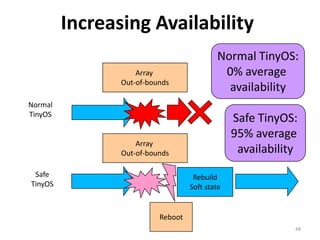
    48Increasing AvailabilityNormal TinyOS:0%average availabilityArray Out-of-boundsNormalTinyOSSafe TinyOS:95% average availabilityArray Out-of-boundsRebuildSoft stateSafeTinyOSReboot
  • 54.
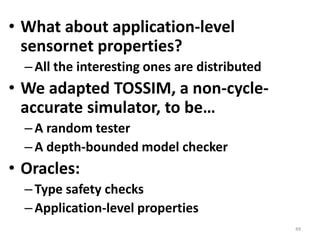
    What about application-levelsensornet properties?All the interesting ones are distributedWe adapted TOSSIM, a non-cycle-accurate simulator, to be…A random testerA depth-bounded model checkerOracles: Type safety checksApplication-level properties49
  • 55.
    Application-Level PropertiesEventually…Each sendbuffer is unlockedNo cycles in the routing treeAll nodes become part of the collection treeAll nodes have consistent values6 out of 8 of these properties require global knowledge50
  • 56.
    Found 12 previouslyunknown bugs in TinyOS 2.010 safety, 2 livenessRandom testing outperformed depth-bounded model checkingEven after a lot of work on PORBut required work to shorten long error traces51
  • 57.
    ConclusionsOpen embedded platformsexistSome have steep learning curvesFinding oracles is hardGenerating valid input is hardEmbedded systems are fun and important and rewarding52