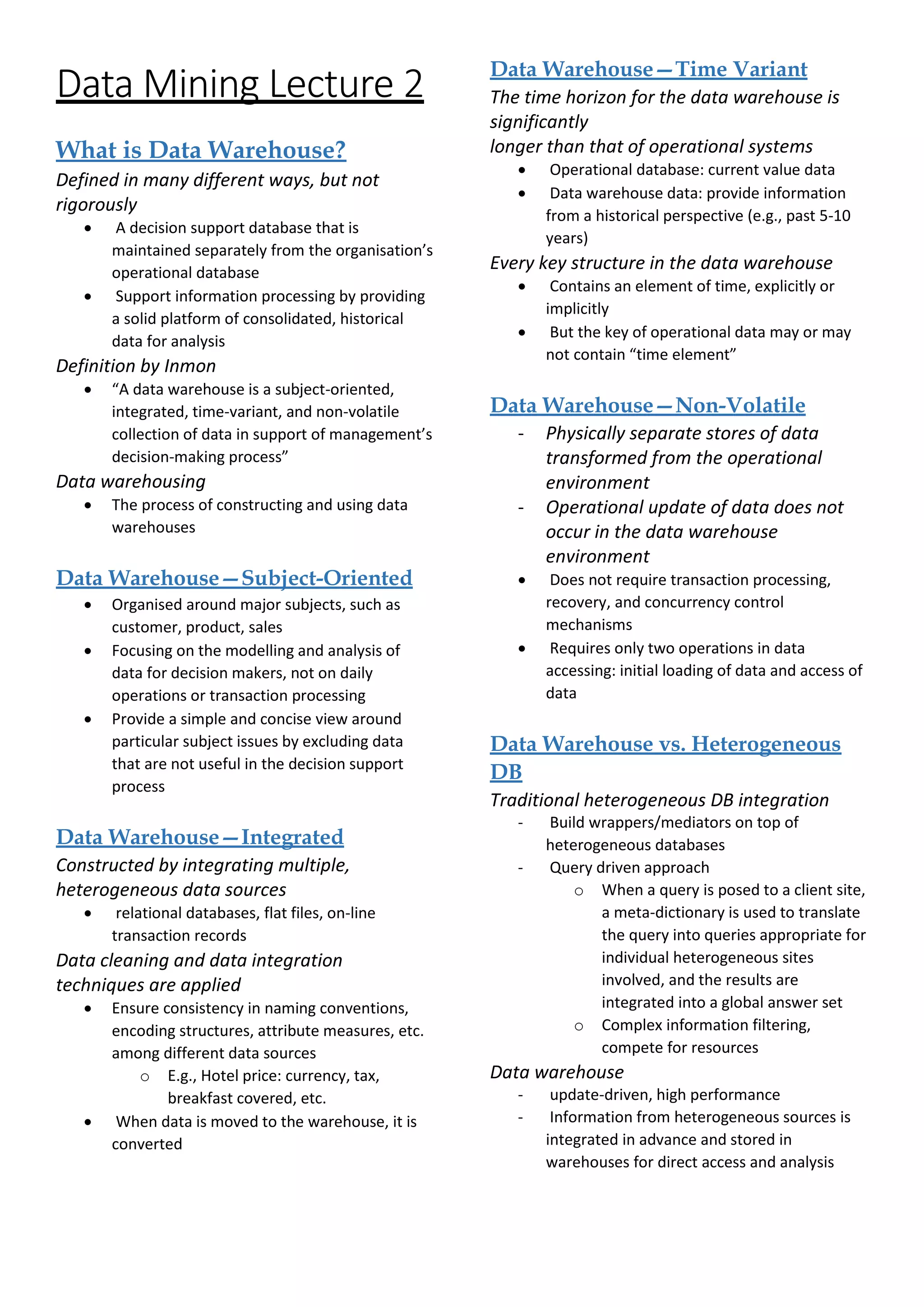
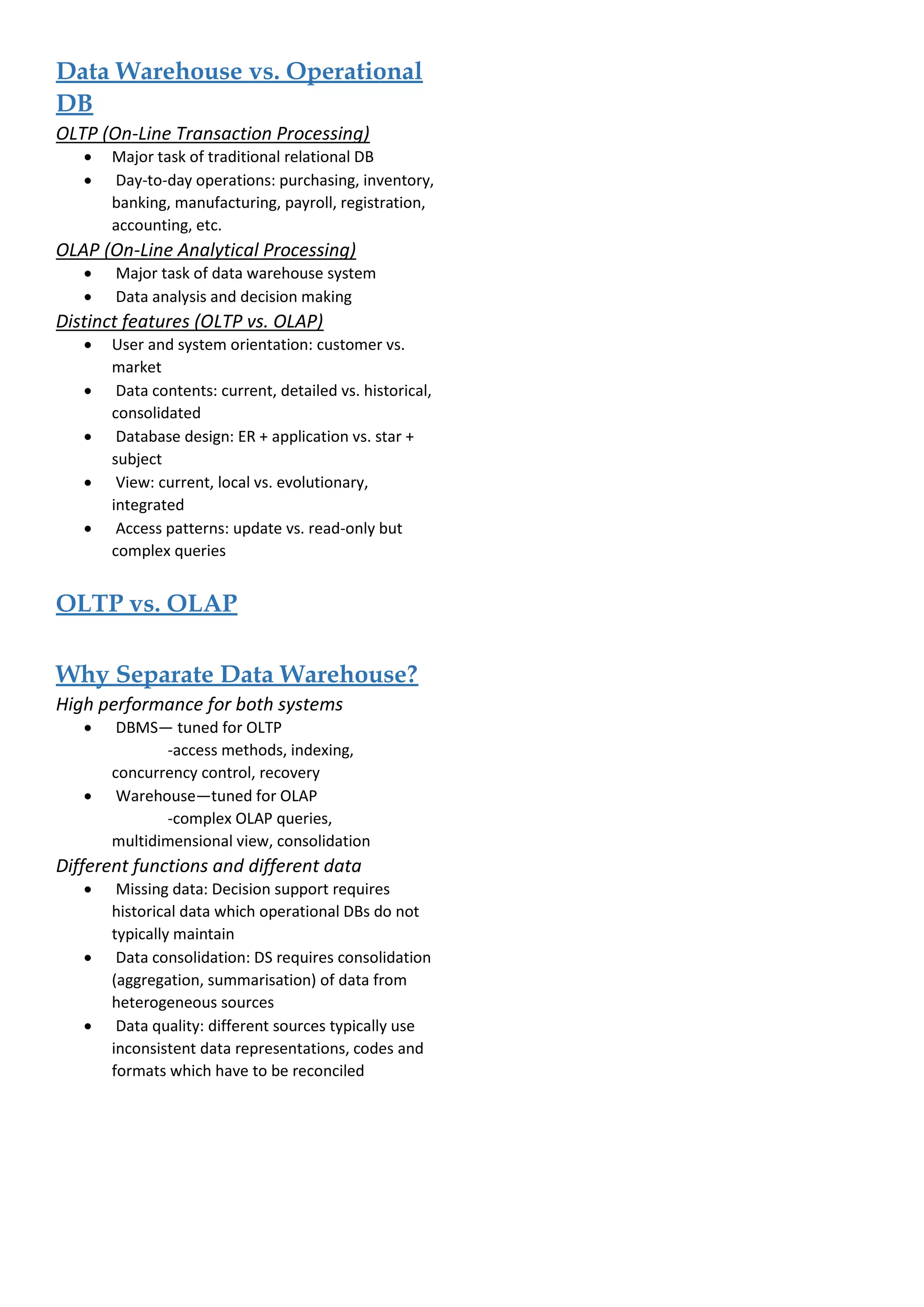
Data Mining Lecture 2
What is Data Warehouse?
Defined in many different ways, but not
rigorously
 A decision support database that is
maintained separately from the organisation’s
operational database
 Support information processing by providing
a solid platform of consolidated, historical
data for analysis
Definition by Inmon
 “A data warehouse is a subject-oriented,
integrated, time-variant, and non-volatile
collection of data in support of management’s
decision-making process”
Data warehousing
 The process of constructing and using data
warehouses
Data Warehouse—Subject-Oriented
 Organised around major subjects, such as
customer, product, sales
 Focusing on the modelling and analysis of
data for decision makers, not on daily
operations or transaction processing
 Provide a simple and concise view around
particular subject issues by excluding data
that are not useful in the decision support
process
Data Warehouse—Integrated
Constructed by integrating multiple,
heterogeneous data sources
 relational databases, flat files, on-line
transaction records
Data cleaning and data integration
techniques are applied
 Ensure consistency in naming conventions,
encoding structures, attribute measures, etc.
among different data sources
o E.g., Hotel price: currency, tax,
breakfast covered, etc.
 When data is moved to the warehouse, it is
converted
Data Warehouse—Time Variant
The time horizon for the data warehouse is
significantly
longer than that of operational systems
 Operational database: current value data
 Data warehouse data: provide information
from a historical perspective (e.g., past 5-10
years)
Every key structure in the data warehouse
 Contains an element of time, explicitly or
implicitly
 But the key of operational data may or may
not contain “time element”
Data Warehouse—Non-Volatile
- Physically separate stores of data
transformed from the operational
environment
- Operational update of data does not
occur in the data warehouse
environment
 Does not require transaction processing,
recovery, and concurrency control
mechanisms
 Requires only two operations in data
accessing: initial loading of data and access of
data
Data Warehouse vs. Heterogeneous
DB
Traditional heterogeneous DB integration
- Build wrappers/mediators on top of
heterogeneous databases
- Query driven approach
o When a query is posed to a client site,
a meta-dictionary is used to translate
the query into queries appropriate for
individual heterogeneous sites
involved, and the results are
integrated into a global answer set
o Complex information filtering,
compete for resources
Data warehouse
- update-driven, high performance
- Information from heterogeneous sources is
integrated in advance and stored in
warehouses for direct access and analysis
Data Warehouse vs. Operational
DB
OLTP (On-Line Transaction Processing)
 Major task of traditional relational DB
 Day-to-day operations: purchasing, inventory,
banking, manufacturing, payroll, registration,
accounting, etc.
OLAP (On-Line Analytical Processing)
 Major task of data warehouse system
 Data analysis and decision making
Distinct features (OLTP vs. OLAP)
 User and system orientation: customer vs.
market
 Data contents: current, detailed vs. historical,
consolidated
 Database design: ER + application vs. star +
subject
 View: current, local vs. evolutionary,
integrated
 Access patterns: update vs. read-only but
complex queries
OLTP vs. OLAP
Why Separate Data Warehouse?
High performance for both systems
 DBMS— tuned for OLTP
-access methods, indexing,
concurrency control, recovery
 Warehouse—tuned for OLAP
-complex OLAP queries,
multidimensional view, consolidation
Different functions and different data
 Missing data: Decision support requires
historical data which operational DBs do not
typically maintain
 Data consolidation: DS requires consolidation
(aggregation, summarisation) of data from
heterogeneous sources
 Data quality: different sources typically use
inconsistent data representations, codes and
formats which have to be reconciled

Data mining 2 - Data warehouse (cheat sheet - printable)

  • 1.
    Data Mining Lecture2 What is Data Warehouse? Defined in many different ways, but not rigorously  A decision support database that is maintained separately from the organisation’s operational database  Support information processing by providing a solid platform of consolidated, historical data for analysis Definition by Inmon  “A data warehouse is a subject-oriented, integrated, time-variant, and non-volatile collection of data in support of management’s decision-making process” Data warehousing  The process of constructing and using data warehouses Data Warehouse—Subject-Oriented  Organised around major subjects, such as customer, product, sales  Focusing on the modelling and analysis of data for decision makers, not on daily operations or transaction processing  Provide a simple and concise view around particular subject issues by excluding data that are not useful in the decision support process Data Warehouse—Integrated Constructed by integrating multiple, heterogeneous data sources  relational databases, flat files, on-line transaction records Data cleaning and data integration techniques are applied  Ensure consistency in naming conventions, encoding structures, attribute measures, etc. among different data sources o E.g., Hotel price: currency, tax, breakfast covered, etc.  When data is moved to the warehouse, it is converted Data Warehouse—Time Variant The time horizon for the data warehouse is significantly longer than that of operational systems  Operational database: current value data  Data warehouse data: provide information from a historical perspective (e.g., past 5-10 years) Every key structure in the data warehouse  Contains an element of time, explicitly or implicitly  But the key of operational data may or may not contain “time element” Data Warehouse—Non-Volatile - Physically separate stores of data transformed from the operational environment - Operational update of data does not occur in the data warehouse environment  Does not require transaction processing, recovery, and concurrency control mechanisms  Requires only two operations in data accessing: initial loading of data and access of data Data Warehouse vs. Heterogeneous DB Traditional heterogeneous DB integration - Build wrappers/mediators on top of heterogeneous databases - Query driven approach o When a query is posed to a client site, a meta-dictionary is used to translate the query into queries appropriate for individual heterogeneous sites involved, and the results are integrated into a global answer set o Complex information filtering, compete for resources Data warehouse - update-driven, high performance - Information from heterogeneous sources is integrated in advance and stored in warehouses for direct access and analysis
  • 2.
    Data Warehouse vs.Operational DB OLTP (On-Line Transaction Processing)  Major task of traditional relational DB  Day-to-day operations: purchasing, inventory, banking, manufacturing, payroll, registration, accounting, etc. OLAP (On-Line Analytical Processing)  Major task of data warehouse system  Data analysis and decision making Distinct features (OLTP vs. OLAP)  User and system orientation: customer vs. market  Data contents: current, detailed vs. historical, consolidated  Database design: ER + application vs. star + subject  View: current, local vs. evolutionary, integrated  Access patterns: update vs. read-only but complex queries OLTP vs. OLAP Why Separate Data Warehouse? High performance for both systems  DBMS— tuned for OLTP -access methods, indexing, concurrency control, recovery  Warehouse—tuned for OLAP -complex OLAP queries, multidimensional view, consolidation Different functions and different data  Missing data: Decision support requires historical data which operational DBs do not typically maintain  Data consolidation: DS requires consolidation (aggregation, summarisation) of data from heterogeneous sources  Data quality: different sources typically use inconsistent data representations, codes and formats which have to be reconciled