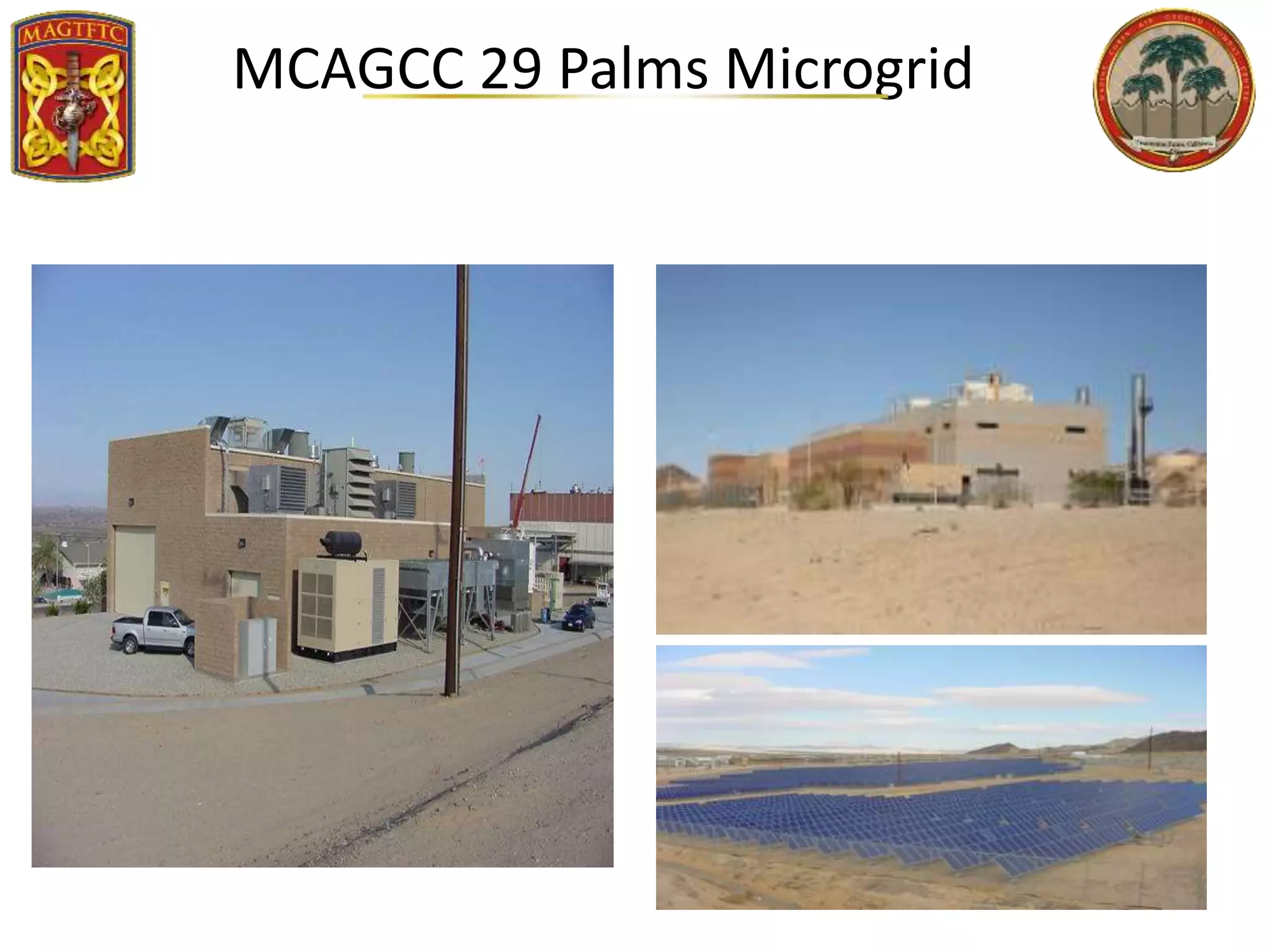
MCAGCC 29 Palms Microgrid
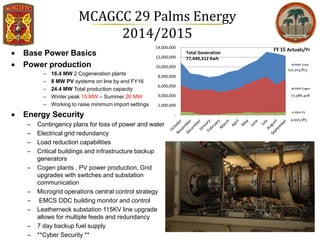
MCAGCC 29 Palms Energy
2014/2015
 Base Power Basics
 Power production
– 16.4 MW 2 Cogeneration plants
– 8 MW PV systems on line by end FY16
– 24.4 MW Total production capacity
– Winter peak 15 MW – Summer 26 MW
– Working to raise minimum import settings
 Energy Security
– Contingency plans for loss of power and water
– Electrical grid redundancy
– Load reduction capabilities
– Critical buildings and infrastructure backup
generators
– Cogen plants , PV power production, Grid
upgrades with switches and substation
communication
– Microgrid operations central control strategy
– EMCS DDC building monitor and control
– Leatherneck substation 115KV line upgrade
allows for multiple feeds and redundancy
– 7 day backup fuel supply
– **Cyber Security **
-
2,000,000
4,000,000
6,000,000
8,000,000
10,000,000
12,000,000
14,000,000
KWH Used
KWH Cogen
KWH PV
122,204,873
77,986,408
4,945,583
FY 15 Actuals/Yr
Total Generation
77,449,312 Kwh
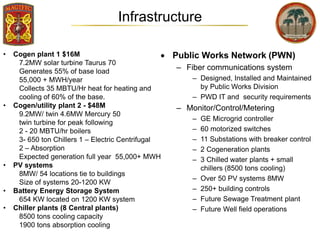
Infrastructure
 Public Works Network (PWN)
– Fiber communications system
– Designed, Installed and Maintained
by Public Works Division
– PWD IT and security requirements
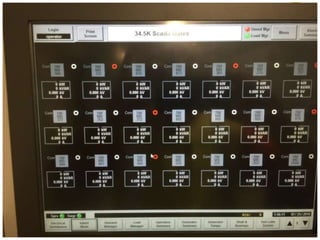
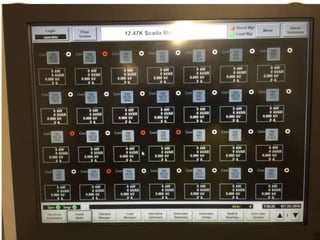
– Monitor/Control/Metering
– GE Microgrid controller
– 60 motorized switches
– 11 Substations with breaker control
– 2 Cogeneration plants
– 3 Chilled water plants + small
chillers (8500 tons cooling)
– Over 50 PV systems 8MW
– 250+ building controls
– Future Sewage Treatment plant
– Future Well field operations
• Cogen plant 1 $16M
7.2MW solar turbine Taurus 70
Generates 55% of base load
55,000 + MWH/year
Collects 35 MBTU/Hr heat for heating and
cooling of 60% of the base.
• Cogen/utility plant 2 - $48M
9.2MW/ twin 4.6MW Mercury 50
twin turbine for peak following
2 - 20 MBTU/hr boilers
3- 650 ton Chillers 1 – Electric Centrifugal
2 – Absorption
Expected generation full year 55,000+ MWH
• PV systems
8MW/ 54 locations tie to buildings
Size of systems 20-1200 KW
• Battery Energy Storage System
654 KW located on 1200 KW system
• Chiller plants (8 Central plants)
8500 tons cooling capacity
1900 tons absorption cooling
Smart Grid/Microgrid
• DOD OSD effort: ESTCP contract
–GE systems identified as the contractor for
install
–2 year $2M contract for installation and
testing
–Limited scope using existing points
already installed to expand controls
–Scope includes
– Controller/server,
– Capacitor bank,
– power factor control
– Battery Energy Storage
–Can be disabled for manual control
• MCAGCC systems long range plan parallels
scope
–Will combine all systems into a single
control network capable of monitoring,
control, and load shedding
– Generation- Automatic function to switch
from normal to renewable and island base
– Substation- monitoring, load shedding
• Way ahead
–EMCS Fiber network must be upgraded to a
hybrid Fiber/RF configuration Completed
–New smart switches for overlapping network
Completed
–New network for substations/switches
Completed
–Power factor controls on Cogen 1 Completed
–Project P1232 - New infrastructure upgrades
for whole base island mode FY 16
• Microgrid Controller project
- Tested for initial programming
- Base had multiple changes
- Updating program with P1232
project to incorporate all
generation and electrical grid
changes
• Base currently has one of the largest
DOD type 2B Microgrid system using
Cogeneration
- Current operation automatically
picks up about 10MW of load in
utility loss and sheds as
necessary
Lessons Learning and Learned
• Keep it simple
– Simple design
– Simple operations
– Redundancy
• Personnel
– Training
– Technical
– Supervision
• Maintenance
– Contracts support
• Communications
• Support tools and equipment
• Cyber security!!!!!
• Installation of equipment
– MILCON
– Local funding
• Keep it simple
– Ongoing process to keep
• Maintenance
– No M no work!
• Communications
– Critical for functionality
• Personnel
– Experience counts!
– No training
– IT required
• Support tools
• Involve local utilities!
• Cogeneration makes it larger and
easier
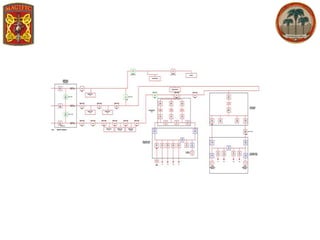
Microgrid Basic Design
Microgrid Features
• Bulk Grid Connected or Islanded
• Tri-Gen System
• CHP, Diesel & PV
• Building Loads as a Resource
• Wireless local area network
• Fiber to substations
• Load as a Resource
• Control loads substation/switch level
Cogen Plant 1 – 7MW
Building Loads/PV
• Next phase combine Cogen
plants into a basewide system
capable of 24 MW. P1232
Building Loads/PV
Cogen plant 2 - 8MW
Co-Gen
PLC
Microgrid
Controller
Ethernet Switch RF AntennaeBuilding Loads
2 MW PV
SCE Grid Tie
LTC
Ocotillo Switching
Station Protection /
Metering Relay
Existing
Fiber Network
Fiber
Network
MDS 3650
Radio
13 Substations
Islanded Loads/PV 10 MW
Building Loads/PV
1.2 MW PV
Building Loads/PV Building Loads/PV
Islanded Loads/PV 4 MW
• Base has islanded 14 Hrs on
one Cogen plant in winter Manual
ops
1.3. MCAGCC 29 Palms Microgrid_Morrissett_EPRI/SNL Microgrid

1.3. MCAGCC 29 Palms Microgrid_Morrissett_EPRI/SNL Microgrid

  • 1.
    MCAGCC 29 PalmsMicrogrid
  • 2.
    MCAGCC 29 PalmsEnergy 2014/2015  Base Power Basics  Power production – 16.4 MW 2 Cogeneration plants – 8 MW PV systems on line by end FY16 – 24.4 MW Total production capacity – Winter peak 15 MW – Summer 26 MW – Working to raise minimum import settings  Energy Security – Contingency plans for loss of power and water – Electrical grid redundancy – Load reduction capabilities – Critical buildings and infrastructure backup generators – Cogen plants , PV power production, Grid upgrades with switches and substation communication – Microgrid operations central control strategy – EMCS DDC building monitor and control – Leatherneck substation 115KV line upgrade allows for multiple feeds and redundancy – 7 day backup fuel supply – **Cyber Security ** - 2,000,000 4,000,000 6,000,000 8,000,000 10,000,000 12,000,000 14,000,000 KWH Used KWH Cogen KWH PV 122,204,873 77,986,408 4,945,583 FY 15 Actuals/Yr Total Generation 77,449,312 Kwh
  • 3.
    Infrastructure  Public WorksNetwork (PWN) – Fiber communications system – Designed, Installed and Maintained by Public Works Division – PWD IT and security requirements – Monitor/Control/Metering – GE Microgrid controller – 60 motorized switches – 11 Substations with breaker control – 2 Cogeneration plants – 3 Chilled water plants + small chillers (8500 tons cooling) – Over 50 PV systems 8MW – 250+ building controls – Future Sewage Treatment plant – Future Well field operations • Cogen plant 1 $16M 7.2MW solar turbine Taurus 70 Generates 55% of base load 55,000 + MWH/year Collects 35 MBTU/Hr heat for heating and cooling of 60% of the base. • Cogen/utility plant 2 - $48M 9.2MW/ twin 4.6MW Mercury 50 twin turbine for peak following 2 - 20 MBTU/hr boilers 3- 650 ton Chillers 1 – Electric Centrifugal 2 – Absorption Expected generation full year 55,000+ MWH • PV systems 8MW/ 54 locations tie to buildings Size of systems 20-1200 KW • Battery Energy Storage System 654 KW located on 1200 KW system • Chiller plants (8 Central plants) 8500 tons cooling capacity 1900 tons absorption cooling
  • 4.
    Smart Grid/Microgrid • DODOSD effort: ESTCP contract –GE systems identified as the contractor for install –2 year $2M contract for installation and testing –Limited scope using existing points already installed to expand controls –Scope includes – Controller/server, – Capacitor bank, – power factor control – Battery Energy Storage –Can be disabled for manual control • MCAGCC systems long range plan parallels scope –Will combine all systems into a single control network capable of monitoring, control, and load shedding – Generation- Automatic function to switch from normal to renewable and island base – Substation- monitoring, load shedding • Way ahead –EMCS Fiber network must be upgraded to a hybrid Fiber/RF configuration Completed –New smart switches for overlapping network Completed –New network for substations/switches Completed –Power factor controls on Cogen 1 Completed –Project P1232 - New infrastructure upgrades for whole base island mode FY 16 • Microgrid Controller project - Tested for initial programming - Base had multiple changes - Updating program with P1232 project to incorporate all generation and electrical grid changes • Base currently has one of the largest DOD type 2B Microgrid system using Cogeneration - Current operation automatically picks up about 10MW of load in utility loss and sheds as necessary
  • 5.
    Lessons Learning andLearned • Keep it simple – Simple design – Simple operations – Redundancy • Personnel – Training – Technical – Supervision • Maintenance – Contracts support • Communications • Support tools and equipment • Cyber security!!!!! • Installation of equipment – MILCON – Local funding • Keep it simple – Ongoing process to keep • Maintenance – No M no work! • Communications – Critical for functionality • Personnel – Experience counts! – No training – IT required • Support tools • Involve local utilities! • Cogeneration makes it larger and easier
  • 6.
    Microgrid Basic Design MicrogridFeatures • Bulk Grid Connected or Islanded • Tri-Gen System • CHP, Diesel & PV • Building Loads as a Resource • Wireless local area network • Fiber to substations • Load as a Resource • Control loads substation/switch level Cogen Plant 1 – 7MW Building Loads/PV • Next phase combine Cogen plants into a basewide system capable of 24 MW. P1232 Building Loads/PV Cogen plant 2 - 8MW Co-Gen PLC Microgrid Controller Ethernet Switch RF AntennaeBuilding Loads 2 MW PV SCE Grid Tie LTC Ocotillo Switching Station Protection / Metering Relay Existing Fiber Network Fiber Network MDS 3650 Radio 13 Substations Islanded Loads/PV 10 MW Building Loads/PV 1.2 MW PV Building Loads/PV Building Loads/PV Islanded Loads/PV 4 MW • Base has islanded 14 Hrs on one Cogen plant in winter Manual ops