Roadmap formulation for Grid Integration of
Renewable Energy through Large Scale Energy Storage
for Puducherry SMART GRID Pilot Project
Presenter: Partha Deb
SMART GRID Dept.- POWER GRID
&
Great Lakes Institute of Energy Management
Background of the Project
• NAPCC’s ambitious target of 15% Renewable Energy by 2020
• But Grid is already facing tough time in assimilating highly
intermittent RE Power
• PowerGrid is determined to set up a SMART Transmission
GRID
• Special Task Force-Smart Grid Department of Power Grid has
taken initiative of seamless integration of RE into the Grid.
• Solutions to be Tested in India’s First SMARTGRID PILOT
PROJECT in Puducherry.
“Last year’s grid failure was primarily due to lack of grid discipline. A lot of
work has since been done. With the narrowing of frequency band & application
of Energy Storage-the load management will be strengthened and become
stricter,” said R.N. Nayak, chairman and managing director of Power Grid
Corp. of India Ltd (PGCIL).
Need Of The Project: RE Integration to the Grid
• Intermittency of RE and its corresponding
impact on prices;
• Transmission availability and cost of
transmission expansion;
• Timing of generation and correlation of RE with
the demand (essentially the net demand in the
system);
• Impact on plant load factors(PLF) of other
resources in the system (and hence the average
costs of such resources);
• Step changes in generation and corresponding
impact on grid management;
• Risks on account of the above and its
corresponding impact on the investment climate
for RE.
Intermittency
Grid Security
Low Capacity
Utilization
Enabling RE
forecasting
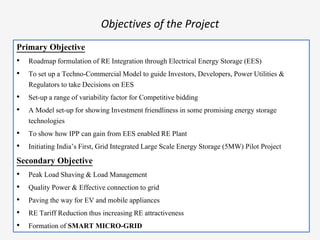
Objectives of the Project
Primary Objective
• Roadmap formulation of RE Integration through Electrical Energy Storage (EES)
• To set up a Techno-Commercial Model to guide Investors, Developers, Power Utilities &
Regulators to take Decisions on EES
• Set-up a range of variability factor for Competitive bidding
• A Model set-up for showing Investment friendliness in some promising energy storage
technologies
• To show how IPP can gain from EES enabled RE Plant
• Initiating India’s First, Grid Integrated Large Scale Energy Storage (5MW) Pilot Project
Secondary Objective
• Peak Load Shaving & Load Management
• Quality Power & Effective connection to grid
• Paving the way for EV and mobile appliances
• RE Tariff Reduction thus increasing RE attractiveness
• Formation of SMART MICRO-GRID
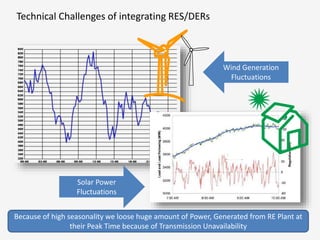
Wind Generation
Fluctuations
Solar Power
Fluctuations
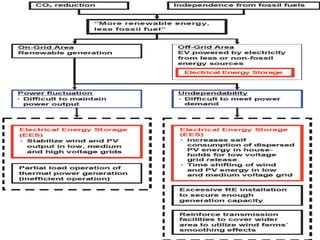
Technical Challenges of integrating RES/DERs
Because of high seasonality we loose huge amount of Power, Generated from RE Plant at
their Peak Time because of Transmission Unavailability
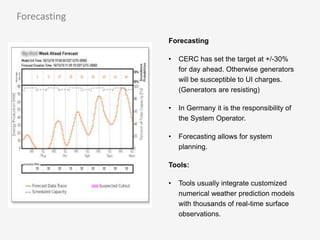
Forecasting
• CERC has set the target at +/-30%
for day ahead. Otherwise generators
will be susceptible to UI charges.
(Generators are resisting)
• In Germany it is the responsibility of
the System Operator.
• Forecasting allows for system
planning.
Tools:
• Tools usually integrate customized
numerical weather prediction models
with thousands of real-time surface
observations.
Forecasting
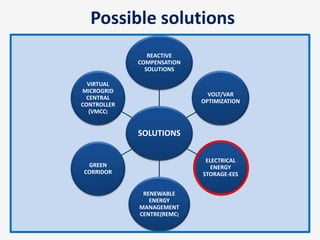
Possible solutions
SOLUTIONS
REACTIVE
COMPENSATION
SOLUTIONS
VOLT/VAR
OPTIMIZATION
ELECTRICAL
ENERGY
STORAGE-EES
RENEWABLE
ENERGY
MANAGEMENT
CENTRE(REMC)
GREEN
CORRIDOR
VIRTUAL
MICROGRID
CENTRAL
CONTROLLER
(VMCC)
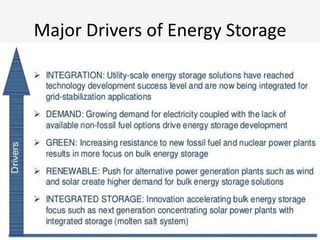
Major Drivers of Energy Storage
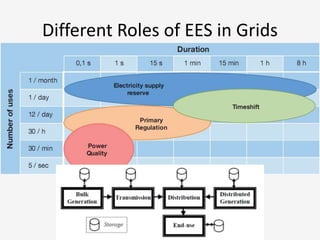
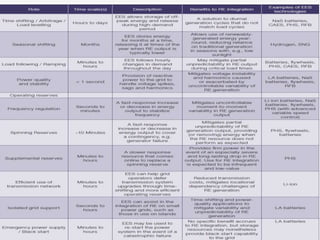
Different Roles of EES in Grids
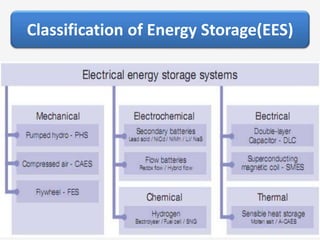
Classification of Energy Storage(EES)
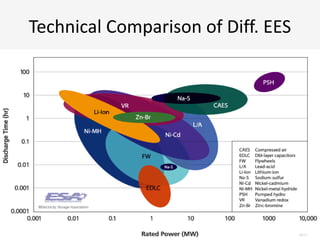
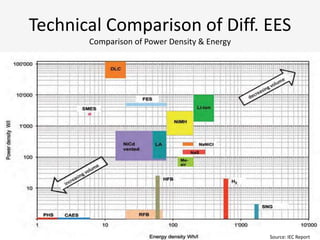
Technical Comparison of Diff. EES
Comparison of Power Density & Energy
Source: IEC Report
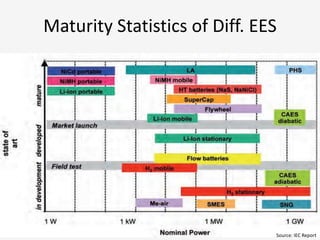
Maturity Statistics of Diff. EES
Source: IEC Report
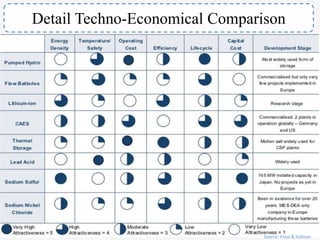
Source: Frost & Sullivan
Detail Techno-Economical Comparison
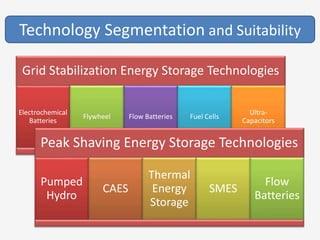
Grid Stabilization Energy Storage Technologies
Electrochemical
Batteries
Flywheel Flow Batteries Fuel Cells
Ultra-
Capacitors
Peak Shaving Energy Storage Technologies
Pumped
Hydro
CAES
Thermal
Energy
Storage
SMES
Flow
Batteries
Technology Segmentation and Suitability
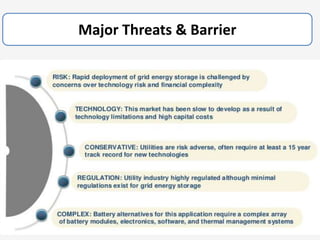
Major Threats & Barrier
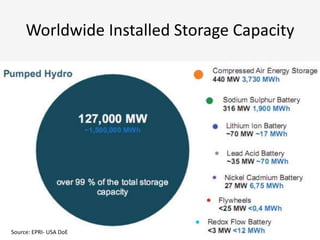
Worldwide Installed Storage Capacity
Source: EPRI- USA DoE
INTERNATIONAL CASE
STUDY
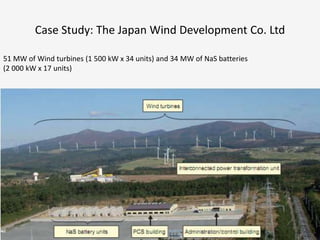
Case Study: The Japan Wind Development Co. Ltd
51 MW of Wind turbines (1 500 kW x 34 units) and 34 MW of NaS batteries
(2 000 kW x 17 units)
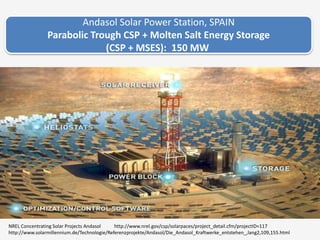
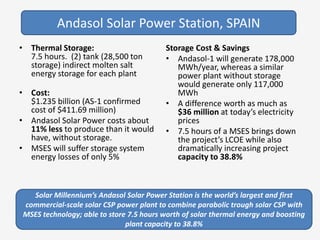
Andasol Solar Power Station, SPAIN
Parabolic Trough CSP + Molten Salt Energy Storage
(CSP + MSES): 150 MW
NREL Concentrating Solar Projects Andasol http://www.nrel.gov/csp/solarpaces/project_detail.cfm/projectID=117
http://www.solarmillennium.de/Technologie/Referenzprojekte/Andasol/Die_Andasol_Kraftwerke_entstehen_,lang2,109,155.html
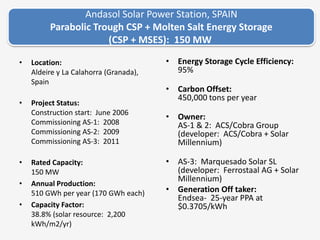
• Location:
Aldeire y La Calahorra (Granada),
Spain
• Project Status:
Construction start: June 2006
Commissioning AS-1: 2008
Commissioning AS-2: 2009
Commissioning AS-3: 2011
• Rated Capacity:
150 MW
• Annual Production:
510 GWh per year (170 GWh each)
• Capacity Factor:
38.8% (solar resource: 2,200
kWh/m2/yr)
• Energy Storage Cycle Efficiency:
95%
• Carbon Offset:
450,000 tons per year
• Owner:
AS-1 & 2: ACS/Cobra Group
(developer: ACS/Cobra + Solar
Millennium)
• AS-3: Marquesado Solar SL
(developer: Ferrostaal AG + Solar
Millennium)
• Generation Off taker:
Endsea- 25-year PPA at
$0.3705/kWh
Andasol Solar Power Station, SPAIN
Parabolic Trough CSP + Molten Salt Energy Storage
(CSP + MSES): 150 MW
• Thermal Storage:
7.5 hours. (2) tank (28,500 ton
storage) indirect molten salt
energy storage for each plant
• Cost:
$1.235 billion (AS-1 confirmed
cost of $411.69 million)
• Andasol Solar Power costs about
11% less to produce than it would
have, without storage.
• MSES will suffer storage system
energy losses of only 5%
Storage Cost & Savings
• Andasol-1 will generate 178,000
MWh/year, whereas a similar
power plant without storage
would generate only 117,000
MWh
• A difference worth as much as
$36 million at today’s electricity
prices
• 7.5 hours of a MSES brings down
the project’s LCOE while also
dramatically increasing project
capacity to 38.8%
Solar Millennium’s Andasol Solar Power Station is the world’s largest and first
commercial-scale solar CSP power plant to combine parabolic trough solar CSP with
MSES technology; able to store 7.5 hours worth of solar thermal energy and boosting
plant capacity to 38.8%
Andasol Solar Power Station, SPAIN
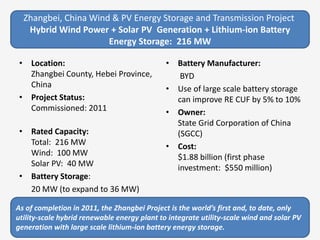
• Location:
Zhangbei County, Hebei Province,
China
• Project Status:
Commissioned: 2011
• Rated Capacity:
Total: 216 MW
Wind: 100 MW
Solar PV: 40 MW
• Battery Storage:
20 MW (to expand to 36 MW)
• Battery Manufacturer:
BYD
• Use of large scale battery storage
can improve RE CUF by 5% to 10%
• Owner:
State Grid Corporation of China
(SGCC)
• Cost:
$1.88 billion (first phase
investment: $550 million)
Zhangbei, China Wind & PV Energy Storage and Transmission Project
Hybrid Wind Power + Solar PV Generation + Lithium-ion Battery
Energy Storage: 216 MW
As of completion in 2011, the Zhangbei Project is the world’s first and, to date, only
utility-scale hybrid renewable energy plant to integrate utility-scale wind and solar PV
generation with large scale lithium-ion battery energy storage.
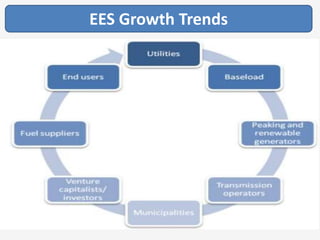
EES Growth Trends
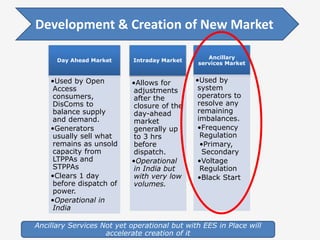
Day Ahead Market
•Used by Open
Access
consumers,
DisComs to
balance supply
and demand.
•Generators
usually sell what
remains as unsold
capacity from
LTPPAs and
STPPAs
•Clears 1 day
before dispatch of
power.
•Operational in
India
Intraday Market
•Allows for
adjustments
after the
closure of the
day-ahead
market
generally up
to 3 hrs
before
dispatch.
•Operational
in India but
with very low
volumes.
Ancillary
services Market
•Used by
system
operators to
resolve any
remaining
imbalances.
•Frequency
Regulation
•Primary,
Secondary
•Voltage
Regulation
•Black Start
Ancillary Services Not yet operational but with EES in Place will
accelerate creation of it
Development & Creation of New Market
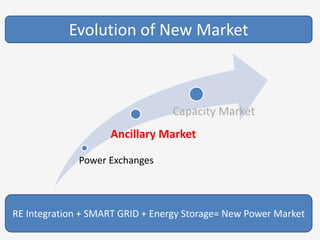
Evolution of New Market
Power Exchanges
Ancillary Market
Capacity Market
RE Integration + SMART GRID + Energy Storage= New Power Market
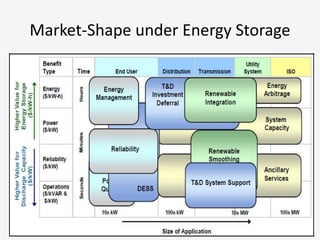
Market-Shape under Energy Storage
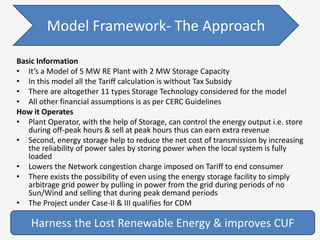
Basic Information
• It’s a Model of 5 MW RE Plant with 2 MW Storage Capacity
• In this model all the Tariff calculation is without Tax Subsidy
• There are altogether 11 types Storage Technology considered for the model
• All other financial assumptions is as per CERC Guidelines
How it Operates
• Plant Operator, with the help of Storage, can control the energy output i.e. store
during off-peak hours & sell at peak hours thus can earn extra revenue
• Second, energy storage help to reduce the net cost of transmission by increasing
the reliability of power sales by storing power when the local system is fully
loaded
• Lowers the Network congestion charge imposed on Tariff to end consumer
• There exists the possibility of even using the energy storage facility to simply
arbitrage grid power by pulling in power from the grid during periods of no
Sun/Wind and selling that during peak demand periods
• The Project under Case-II & III qualifies for CDM
Model Framework- The Approach
Harness the Lost Renewable Energy & improves CUF
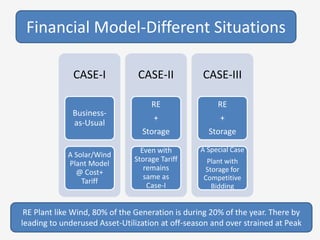
CASE-I
Business-
as-Usual
A Solar/Wind
Plant Model
@ Cost+
Tariff
CASE-II
RE
+
Storage
Even with
Storage Tariff
remains
same as
Case-I
CASE-III
RE
+
Storage
A Special Case
Plant with
Storage for
Competitive
Bidding
RE Plant like Wind, 80% of the Generation is during 20% of the year. There by
leading to underused Asset-Utilization at off-season and over strained at Peak
Financial Model-Different Situations
Li-ion
Lead
Acid VRB
Ni Metal
Hydride
Na
SulphurVRLA Zn/Br
Pumped
Hydro CAES Flywheel
Ultra
Capacitor
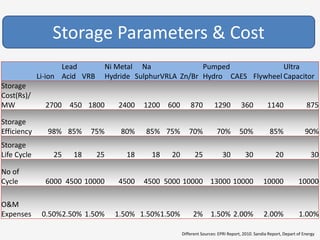
Storage
Cost(Rs)/
MW 2700 450 1800 2400 1200 600 870 1290 360 1140 875
Storage
Efficiency 98% 85% 75% 80% 85% 75% 70% 70% 50% 85% 90%
Storage
Life Cycle 25 18 25 18 18 20 25 30 30 20 30
No of
Cycle 6000 4500 10000 4500 4500 5000 10000 13000 10000 10000 10000
O&M
Expenses 0.50%2.50% 1.50% 1.50% 1.50%1.50% 2% 1.50% 2.00% 2.00% 1.00%
Storage Parameters & Cost
Different Sources: EPRI Report, 2010. Sandia Report, Depart of Energy
0
2
4
6
8
10
12
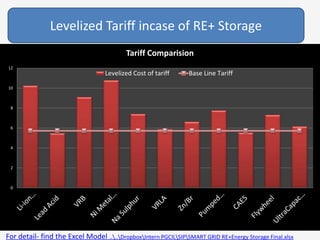
Tariff Comparision
Levelized Cost of tariff Base Line Tariff
Levelized Tariff incase of RE+ Storage
For detail- find the Excel Model ....DropboxIntern PGCILSIPSMART GRID RE+Energy Storage Final.xlsx
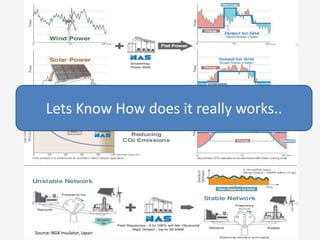
Source: NGK Insulator, Japan
Lets Know How does it really works..
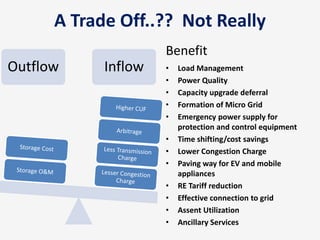
A Trade Off..?? Not Really
Benefit
• Load Management
• Power Quality
• Capacity upgrade deferral
• Formation of Micro Grid
• Emergency power supply for
protection and control equipment
• Time shifting/cost savings
• Lower Congestion Charge
• Paving way for EV and mobile
appliances
• RE Tariff reduction
• Effective connection to grid
• Assent Utilization
• Ancillary Services
Outflow Inflow
Recent News on the Same Frontline
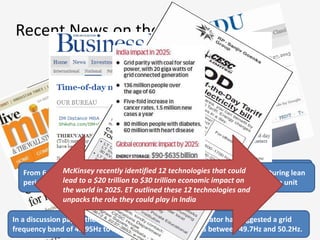
In a discussion paper, the country’s apex power sector regulator has suggested a grid
frequency band of 49.95Hz to 50.05Hz. The current band is between 49.7Hz and 50.2Hz.
State like Tamilnadu has already got 41% of the Power from
RE whereas Germany Targets 50% RE by 2050
From 6 p.m. to 10 p.m., Rs 7.80 per unit, which is 20% more than normal. During lean
period from 10 p.m. to 6 a.m. pay only 90 per cent of the normal, i.e. Rs 5.85 a unit
McKinsey recently identified 12 technologies that could
lead to a $20 trillion to $30 trillion economic impact on
the world in 2025. ET outlined these 12 technologies and
unpacks the role they could play in India
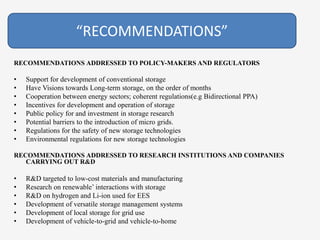
RECOMMENDATIONS ADDRESSED TO POLICY-MAKERS AND REGULATORS
• Support for development of conventional storage
• Have Visions towards Long-term storage, on the order of months
• Cooperation between energy sectors; coherent regulations(e.g Bidirectional PPA)
• Incentives for development and operation of storage
• Public policy for and investment in storage research
• Potential barriers to the introduction of micro grids.
• Regulations for the safety of new storage technologies
• Environmental regulations for new storage technologies
RECOMMENDATIONS ADDRESSED TO RESEARCH INSTITUTIONS AND COMPANIES
CARRYING OUT R&D
• R&D targeted to low-cost materials and manufacturing
• Research on renewable’ interactions with storage
• R&D on hydrogen and Li-ion used for EES
• Development of versatile storage management systems
• Development of local storage for grid use
• Development of vehicle-to-grid and vehicle-to-home
“RECOMMENDATIONS”
RECOMMENDATIONS ADDRESSED TO THE
PRINCIPAL STANDARD MAKING AGENCY
• Cooperation needed for EES standards.
• Architecture and structure of EES systems
• Users’ guide on planning and installing storage
• Interface, control and data element standards
• Standards for systems to relieve transmission congestion
• Standards for unit size and other factors affecting costs
• Safety of new storage technologies
• Compatibility of EES with the environment
THANK YOU
Contact-
ankansrc@gmail.com
parthad.pgpme14@greatlakes.edu.in

Renewable Integration & Energy Strage Smart Grid Pilot Project

  • 1.
    Roadmap formulation forGrid Integration of Renewable Energy through Large Scale Energy Storage for Puducherry SMART GRID Pilot Project Presenter: Partha Deb SMART GRID Dept.- POWER GRID & Great Lakes Institute of Energy Management
  • 2.
    Background of theProject • NAPCC’s ambitious target of 15% Renewable Energy by 2020 • But Grid is already facing tough time in assimilating highly intermittent RE Power • PowerGrid is determined to set up a SMART Transmission GRID • Special Task Force-Smart Grid Department of Power Grid has taken initiative of seamless integration of RE into the Grid. • Solutions to be Tested in India’s First SMARTGRID PILOT PROJECT in Puducherry. “Last year’s grid failure was primarily due to lack of grid discipline. A lot of work has since been done. With the narrowing of frequency band & application of Energy Storage-the load management will be strengthened and become stricter,” said R.N. Nayak, chairman and managing director of Power Grid Corp. of India Ltd (PGCIL).
  • 3.
    Need Of TheProject: RE Integration to the Grid • Intermittency of RE and its corresponding impact on prices; • Transmission availability and cost of transmission expansion; • Timing of generation and correlation of RE with the demand (essentially the net demand in the system); • Impact on plant load factors(PLF) of other resources in the system (and hence the average costs of such resources); • Step changes in generation and corresponding impact on grid management; • Risks on account of the above and its corresponding impact on the investment climate for RE. Intermittency Grid Security Low Capacity Utilization Enabling RE forecasting
  • 4.
    Objectives of theProject Primary Objective • Roadmap formulation of RE Integration through Electrical Energy Storage (EES) • To set up a Techno-Commercial Model to guide Investors, Developers, Power Utilities & Regulators to take Decisions on EES • Set-up a range of variability factor for Competitive bidding • A Model set-up for showing Investment friendliness in some promising energy storage technologies • To show how IPP can gain from EES enabled RE Plant • Initiating India’s First, Grid Integrated Large Scale Energy Storage (5MW) Pilot Project Secondary Objective • Peak Load Shaving & Load Management • Quality Power & Effective connection to grid • Paving the way for EV and mobile appliances • RE Tariff Reduction thus increasing RE attractiveness • Formation of SMART MICRO-GRID
  • 5.
    Wind Generation Fluctuations Solar Power Fluctuations TechnicalChallenges of integrating RES/DERs Because of high seasonality we loose huge amount of Power, Generated from RE Plant at their Peak Time because of Transmission Unavailability
  • 6.
    Forecasting • CERC hasset the target at +/-30% for day ahead. Otherwise generators will be susceptible to UI charges. (Generators are resisting) • In Germany it is the responsibility of the System Operator. • Forecasting allows for system planning. Tools: • Tools usually integrate customized numerical weather prediction models with thousands of real-time surface observations. Forecasting
  • 7.
  • 8.
    Major Drivers ofEnergy Storage
  • 10.
    Different Roles ofEES in Grids
  • 11.
  • 12.
  • 13.
    Technical Comparison ofDiff. EES Comparison of Power Density & Energy Source: IEC Report
  • 14.
    Maturity Statistics ofDiff. EES Source: IEC Report
  • 15.
    Source: Frost &Sullivan Detail Techno-Economical Comparison
  • 17.
    Grid Stabilization EnergyStorage Technologies Electrochemical Batteries Flywheel Flow Batteries Fuel Cells Ultra- Capacitors Peak Shaving Energy Storage Technologies Pumped Hydro CAES Thermal Energy Storage SMES Flow Batteries Technology Segmentation and Suitability
  • 18.
  • 19.
    Worldwide Installed StorageCapacity Source: EPRI- USA DoE
  • 20.
  • 21.
    Case Study: TheJapan Wind Development Co. Ltd 51 MW of Wind turbines (1 500 kW x 34 units) and 34 MW of NaS batteries (2 000 kW x 17 units)
  • 22.
    Andasol Solar PowerStation, SPAIN Parabolic Trough CSP + Molten Salt Energy Storage (CSP + MSES): 150 MW NREL Concentrating Solar Projects Andasol http://www.nrel.gov/csp/solarpaces/project_detail.cfm/projectID=117 http://www.solarmillennium.de/Technologie/Referenzprojekte/Andasol/Die_Andasol_Kraftwerke_entstehen_,lang2,109,155.html
  • 23.
    • Location: Aldeire yLa Calahorra (Granada), Spain • Project Status: Construction start: June 2006 Commissioning AS-1: 2008 Commissioning AS-2: 2009 Commissioning AS-3: 2011 • Rated Capacity: 150 MW • Annual Production: 510 GWh per year (170 GWh each) • Capacity Factor: 38.8% (solar resource: 2,200 kWh/m2/yr) • Energy Storage Cycle Efficiency: 95% • Carbon Offset: 450,000 tons per year • Owner: AS-1 & 2: ACS/Cobra Group (developer: ACS/Cobra + Solar Millennium) • AS-3: Marquesado Solar SL (developer: Ferrostaal AG + Solar Millennium) • Generation Off taker: Endsea- 25-year PPA at $0.3705/kWh Andasol Solar Power Station, SPAIN Parabolic Trough CSP + Molten Salt Energy Storage (CSP + MSES): 150 MW
  • 24.
    • Thermal Storage: 7.5hours. (2) tank (28,500 ton storage) indirect molten salt energy storage for each plant • Cost: $1.235 billion (AS-1 confirmed cost of $411.69 million) • Andasol Solar Power costs about 11% less to produce than it would have, without storage. • MSES will suffer storage system energy losses of only 5% Storage Cost & Savings • Andasol-1 will generate 178,000 MWh/year, whereas a similar power plant without storage would generate only 117,000 MWh • A difference worth as much as $36 million at today’s electricity prices • 7.5 hours of a MSES brings down the project’s LCOE while also dramatically increasing project capacity to 38.8% Solar Millennium’s Andasol Solar Power Station is the world’s largest and first commercial-scale solar CSP power plant to combine parabolic trough solar CSP with MSES technology; able to store 7.5 hours worth of solar thermal energy and boosting plant capacity to 38.8% Andasol Solar Power Station, SPAIN
  • 25.
    • Location: Zhangbei County,Hebei Province, China • Project Status: Commissioned: 2011 • Rated Capacity: Total: 216 MW Wind: 100 MW Solar PV: 40 MW • Battery Storage: 20 MW (to expand to 36 MW) • Battery Manufacturer: BYD • Use of large scale battery storage can improve RE CUF by 5% to 10% • Owner: State Grid Corporation of China (SGCC) • Cost: $1.88 billion (first phase investment: $550 million) Zhangbei, China Wind & PV Energy Storage and Transmission Project Hybrid Wind Power + Solar PV Generation + Lithium-ion Battery Energy Storage: 216 MW As of completion in 2011, the Zhangbei Project is the world’s first and, to date, only utility-scale hybrid renewable energy plant to integrate utility-scale wind and solar PV generation with large scale lithium-ion battery energy storage.
  • 26.
  • 27.
    Day Ahead Market •Usedby Open Access consumers, DisComs to balance supply and demand. •Generators usually sell what remains as unsold capacity from LTPPAs and STPPAs •Clears 1 day before dispatch of power. •Operational in India Intraday Market •Allows for adjustments after the closure of the day-ahead market generally up to 3 hrs before dispatch. •Operational in India but with very low volumes. Ancillary services Market •Used by system operators to resolve any remaining imbalances. •Frequency Regulation •Primary, Secondary •Voltage Regulation •Black Start Ancillary Services Not yet operational but with EES in Place will accelerate creation of it Development & Creation of New Market
  • 28.
    Evolution of NewMarket Power Exchanges Ancillary Market Capacity Market RE Integration + SMART GRID + Energy Storage= New Power Market
  • 29.
  • 30.
    Basic Information • It’sa Model of 5 MW RE Plant with 2 MW Storage Capacity • In this model all the Tariff calculation is without Tax Subsidy • There are altogether 11 types Storage Technology considered for the model • All other financial assumptions is as per CERC Guidelines How it Operates • Plant Operator, with the help of Storage, can control the energy output i.e. store during off-peak hours & sell at peak hours thus can earn extra revenue • Second, energy storage help to reduce the net cost of transmission by increasing the reliability of power sales by storing power when the local system is fully loaded • Lowers the Network congestion charge imposed on Tariff to end consumer • There exists the possibility of even using the energy storage facility to simply arbitrage grid power by pulling in power from the grid during periods of no Sun/Wind and selling that during peak demand periods • The Project under Case-II & III qualifies for CDM Model Framework- The Approach Harness the Lost Renewable Energy & improves CUF
  • 31.
    CASE-I Business- as-Usual A Solar/Wind Plant Model @Cost+ Tariff CASE-II RE + Storage Even with Storage Tariff remains same as Case-I CASE-III RE + Storage A Special Case Plant with Storage for Competitive Bidding RE Plant like Wind, 80% of the Generation is during 20% of the year. There by leading to underused Asset-Utilization at off-season and over strained at Peak Financial Model-Different Situations
  • 32.
    Li-ion Lead Acid VRB Ni Metal Hydride Na SulphurVRLAZn/Br Pumped Hydro CAES Flywheel Ultra Capacitor Storage Cost(Rs)/ MW 2700 450 1800 2400 1200 600 870 1290 360 1140 875 Storage Efficiency 98% 85% 75% 80% 85% 75% 70% 70% 50% 85% 90% Storage Life Cycle 25 18 25 18 18 20 25 30 30 20 30 No of Cycle 6000 4500 10000 4500 4500 5000 10000 13000 10000 10000 10000 O&M Expenses 0.50%2.50% 1.50% 1.50% 1.50%1.50% 2% 1.50% 2.00% 2.00% 1.00% Storage Parameters & Cost Different Sources: EPRI Report, 2010. Sandia Report, Depart of Energy
  • 33.
    0 2 4 6 8 10 12 Tariff Comparision Levelized Costof tariff Base Line Tariff Levelized Tariff incase of RE+ Storage For detail- find the Excel Model ....DropboxIntern PGCILSIPSMART GRID RE+Energy Storage Final.xlsx
  • 34.
    Source: NGK Insulator,Japan Lets Know How does it really works..
  • 35.
    A Trade Off..??Not Really Benefit • Load Management • Power Quality • Capacity upgrade deferral • Formation of Micro Grid • Emergency power supply for protection and control equipment • Time shifting/cost savings • Lower Congestion Charge • Paving way for EV and mobile appliances • RE Tariff reduction • Effective connection to grid • Assent Utilization • Ancillary Services Outflow Inflow
  • 36.
    Recent News onthe Same Frontline In a discussion paper, the country’s apex power sector regulator has suggested a grid frequency band of 49.95Hz to 50.05Hz. The current band is between 49.7Hz and 50.2Hz. State like Tamilnadu has already got 41% of the Power from RE whereas Germany Targets 50% RE by 2050 From 6 p.m. to 10 p.m., Rs 7.80 per unit, which is 20% more than normal. During lean period from 10 p.m. to 6 a.m. pay only 90 per cent of the normal, i.e. Rs 5.85 a unit McKinsey recently identified 12 technologies that could lead to a $20 trillion to $30 trillion economic impact on the world in 2025. ET outlined these 12 technologies and unpacks the role they could play in India
  • 37.
    RECOMMENDATIONS ADDRESSED TOPOLICY-MAKERS AND REGULATORS • Support for development of conventional storage • Have Visions towards Long-term storage, on the order of months • Cooperation between energy sectors; coherent regulations(e.g Bidirectional PPA) • Incentives for development and operation of storage • Public policy for and investment in storage research • Potential barriers to the introduction of micro grids. • Regulations for the safety of new storage technologies • Environmental regulations for new storage technologies RECOMMENDATIONS ADDRESSED TO RESEARCH INSTITUTIONS AND COMPANIES CARRYING OUT R&D • R&D targeted to low-cost materials and manufacturing • Research on renewable’ interactions with storage • R&D on hydrogen and Li-ion used for EES • Development of versatile storage management systems • Development of local storage for grid use • Development of vehicle-to-grid and vehicle-to-home “RECOMMENDATIONS”
  • 38.
    RECOMMENDATIONS ADDRESSED TOTHE PRINCIPAL STANDARD MAKING AGENCY • Cooperation needed for EES standards. • Architecture and structure of EES systems • Users’ guide on planning and installing storage • Interface, control and data element standards • Standards for systems to relieve transmission congestion • Standards for unit size and other factors affecting costs • Safety of new storage technologies • Compatibility of EES with the environment
  • 39.

Editor's Notes

  • #3 Pilot Project
  • #6 Renewable energy is extremely intermittent which means that it is not only difficult to forecast but the variation in availability affects the frequency and therefore the overall stability of the grid.
  • #7 Everyone knows that due to it’s fluctuating availability it is almost impossible to forecast the dispatching potential of renewable energy. CERC has not stated that developer are to start forecasting their dispatchable power. Thankfully there are now tools available that monitor weather patterns and history in order to forecast on a day ahead basis.
  • #10 It’s a TEPCO Model, Japan.
  • #26 Source: http://www.windpowerintelligence.com/article/moVDsdDZ0Q2/2011/10/21/china_wind_turbines_online_at_zhangbei_national_demonstratio/
  • #34 Base line tariff is the one when on the same financial configuration LCOE Tariff is considered under Case-I- it is Rs. 5.72/kWh
  • #35 Technically How we gonna do it