



Utility Microgrids:
Integration and Implementation Challenges
Utility-owned Public
Purpose Microgrids
August 2016
Contents
• ComEd Microgrid Pilot Program
• Microgrid Controller
• Microgrid-Integrated Solar-Storage Technology (MISST)
2
In May 2016, ComEd proposed the Next Generation Energy Plan to the Illinois General Assembly which
would allow the company to invest up to $250 million in the development of five public purpose microgrids
within its service territory
Illinois Medical District (IMD)
• Cluster of major hospitals
within a small footprint in the
City of Chicago.
• Supports the major health
care facilities that provide
services to a large number of
people within ComEd service
territory.
Bronzeville Community
• Provides a representative
cross-section of the City of
Chicago
• Includes a diverse mixture of
facilities and critical loads:
Chicago Police Headquarters,
health care facilities
educational facilities, and
private residences.
Chicago Heights Water
• Resilient supply to water
pumping and treatment facilities
in a small footprint
• Supports water infrastructure
for the southern suburbs of
Chicago including Chicago
Heights, Ford Heights,
Homewood, Park Forest, South
Chicago Heights, Steger and
Crete
DuPage County Complex
• Includes administrative
buildings, youth home, county
health department, judicial
building, sheriff department,
highway department, county
jail, and emergency
management offices
• Provides resilient power
supply to support critical
operations of a major county
Rockford International
Airport
• Support critical facilities for
cargo and transportation.
• Rockford airport is a major
hub for air cargo and
disruption to its operations
could have an impact on
the economy in Northern
Illinois.
ComEd utilized a holistic data driven approach and developed a resiliency metric to evaluate its entire service
territory for microgrid pilot installation locations.
For analysis, the service territory was
divided into one-mile by one-mile
sections outside the city of Chicago
and into half-mile by half-mile sections
inside the city of Chicago. Each
section was then analyzed with a
resiliency metric
ComEd Microgrid Pilot Program 3
Bronzeville Pilot Area
The Bronzeville Community:
• Bronzeville provides a
representative cross-section of
different customers within the
City of Chicago
• Supplied by 9 feeders from 4
different substations.
• Includes a diverse mixture of
facilities and critical loads
• Opportunity to cluster the
proposed microgrid with Illinois
Tech existing microgrid through
a Microgrid Controller
• Opportunity to integrate Solar
generation and storage through
MISST solution.
4
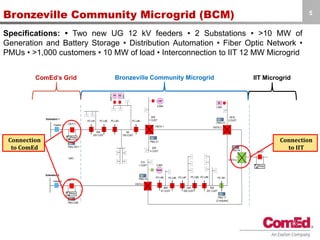
Bronzeville Community Microgrid (BCM)
Specifications: • Two new UG 12 kV feeders • 2 Substations • >10 MW of
Generation and Battery Storage • Distribution Automation • Fiber Optic Network •
PMUs • >1,000 customers • 10 MW of load • Interconnection to IIT 12 MW Microgrid
5
PC-L#1 PC-L#2 PC-L#3 PC-L#4
CB-F11
PC-T#1
Substation 1
CB-IIT
ComEd’s Grid
Gen
Relay
Feeder 11
Bronzeville Community Microgrid IIT Microgrid
VISTA 1
Vista Switch
Switch PC-L
Switch PC-T
Circuit Breaker
Red: Normally Close
Green: Normally Open
VISTA 3
VISTA 4
PC-L#8 PC-L#9PC-L#7PC-L#6PC-L#5
VISTA 2
CB-F9
Substation 2
Relay
Feeder9
New Feeder
29A
324 CUST
9A
155 CUST
96A
91 CUST
24A
255 CUST
50A
251 CUST
PMU-CB11 20A
4 CUST
PMU-V1
PMU T1
(2 modules)
PMU-CB9
Relay
43A
1 CUST
281A
2 CUST
21A
1 CUST
PMU-V2
PMU-V3
PMU-V4
12KV
CHP
5 MW
PV ES
ES
1 MW
1MW
1.5MW
Diesel
2 MW
CHP
Diesel
PV
ES
Generation (CHP)
Generation (Diesel)
Generation (PV)
Generation
(Energy Storage)
Connection
to ComEd
Connection
to IIT
ComEd’s Grid Bronzeville Community Microgrid IIT Microgrid
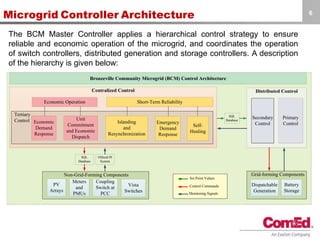
Microgrid Controller Architecture
The BCM Master Controller applies a hierarchical control strategy to ensure
reliable and economic operation of the microgrid, and coordinates the operation
of switch controllers, distributed generation and storage controllers. A description
of the hierarchy is given below:
Distributed ControlCentralized Control
Grid-forming ComponentsNon-Grid-Forming Components
Tertiary
Control
Bronzeville Community Microgrid (BCM) Control Architecture
Economic Operation Short-Term Reliability
Economic
Demand
Response
Unit
Commitment
and Economic
Dispatch
Islanding
and
Resynchronization
Emergency
Demand
Response
Self-
Healing
Primary
Control
Secondary
Control
Dispatchable
Generation
Battery
Storage
PV
Arrays
Meters
and
PMUs
Coupling
Switch at
PCC
Vista
Switches
Set Point Values
Control Commands
Monitoring Signals
SQL
Database
SQL
Database
OSIsoft PI
System
OSIsoft PI
System
SQL
Database
SQL
Database
6
OperationalControlFunctions
Disconnection:
Capability for disconnection from the main grid due to
disturbances or outages
Re-synchronization and reconnection:
Capability for resynchronization and reconnection to the main
grid after the main grid restoration
Power quality control:
Providing required responses to PQ issues during ride-through
transients and/or after stabilizing in islanded mode
Protection:
Applying basic protection schemes for detection and clearing
internal and external faults
Generation dispatch:
Adequate dispatch of all generation resources to maintain power
and energy balances at all times
7
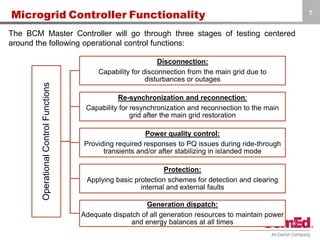
Microgrid Controller Functionality
The BCM Master Controller will go through three stages of testing centered
around the following operational control functions:
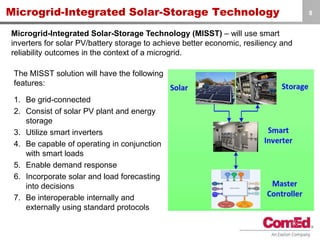
8Microgrid-Integrated Solar-Storage Technology
The MISST solution will have the following
features:
1. Be grid-connected
2. Consist of solar PV plant and energy
storage
3. Utilize smart inverters
4. Be capable of operating in conjunction
with smart loads
5. Enable demand response
6. Incorporate solar and load forecasting
into decisions
7. Be interoperable internally and
externally using standard protocols
Microgrid-Integrated Solar-Storage Technology (MISST) – will use smart
inverters for solar PV/battery storage to achieve better economic, resiliency and
reliability outcomes in the context of a microgrid.
9
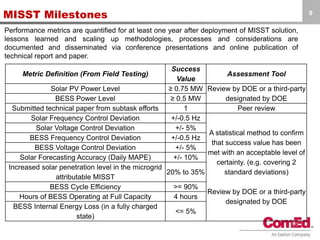
MISST Milestones
Performance metrics are quantified for at least one year after deployment of MISST solution,
lessons learned and scaling up methodologies, processes and considerations are
documented and disseminated via conference presentations and online publication of
technical report and paper.
Metric Definition (From Field Testing)
Success
Value
Assessment Tool
Solar PV Power Level ≥ 0.75 MW Review by DOE or a third-party
designated by DOEBESS Power Level ≥ 0.5 MW
Submitted technical paper from subtask efforts 1 Peer review
Solar Frequency Control Deviation +/-0.5 Hz
A statistical method to confirm
that success value has been
met with an acceptable level of
certainty. (e.g. covering 2
standard deviations)
Review by DOE or a third-party
designated by DOE
Solar Voltage Control Deviation +/- 5%
BESS Frequency Control Deviation +/-0.5 Hz
BESS Voltage Control Deviation +/- 5%
Solar Forecasting Accuracy (Daily MAPE) +/- 10%
Increased solar penetration level in the microgrid
attributable MISST
20% to 35%
BESS Cycle Efficiency >= 90%
Hours of BESS Operating at Full Capacity 4 hours
BESS Internal Energy Loss (in a fully charged
state)
<= 5%

10.2_Utility-owned Public Purpose Microgrids_Avendano_EPRI/SNL Microgrid Symposium

  • 1.
    Utility Microgrids: Integration andImplementation Challenges Utility-owned Public Purpose Microgrids August 2016
  • 2.
    Contents • ComEd MicrogridPilot Program • Microgrid Controller • Microgrid-Integrated Solar-Storage Technology (MISST) 2
  • 3.
    In May 2016,ComEd proposed the Next Generation Energy Plan to the Illinois General Assembly which would allow the company to invest up to $250 million in the development of five public purpose microgrids within its service territory Illinois Medical District (IMD) • Cluster of major hospitals within a small footprint in the City of Chicago. • Supports the major health care facilities that provide services to a large number of people within ComEd service territory. Bronzeville Community • Provides a representative cross-section of the City of Chicago • Includes a diverse mixture of facilities and critical loads: Chicago Police Headquarters, health care facilities educational facilities, and private residences. Chicago Heights Water • Resilient supply to water pumping and treatment facilities in a small footprint • Supports water infrastructure for the southern suburbs of Chicago including Chicago Heights, Ford Heights, Homewood, Park Forest, South Chicago Heights, Steger and Crete DuPage County Complex • Includes administrative buildings, youth home, county health department, judicial building, sheriff department, highway department, county jail, and emergency management offices • Provides resilient power supply to support critical operations of a major county Rockford International Airport • Support critical facilities for cargo and transportation. • Rockford airport is a major hub for air cargo and disruption to its operations could have an impact on the economy in Northern Illinois. ComEd utilized a holistic data driven approach and developed a resiliency metric to evaluate its entire service territory for microgrid pilot installation locations. For analysis, the service territory was divided into one-mile by one-mile sections outside the city of Chicago and into half-mile by half-mile sections inside the city of Chicago. Each section was then analyzed with a resiliency metric ComEd Microgrid Pilot Program 3
  • 4.
    Bronzeville Pilot Area TheBronzeville Community: • Bronzeville provides a representative cross-section of different customers within the City of Chicago • Supplied by 9 feeders from 4 different substations. • Includes a diverse mixture of facilities and critical loads • Opportunity to cluster the proposed microgrid with Illinois Tech existing microgrid through a Microgrid Controller • Opportunity to integrate Solar generation and storage through MISST solution. 4
  • 5.
    Bronzeville Community Microgrid(BCM) Specifications: • Two new UG 12 kV feeders • 2 Substations • >10 MW of Generation and Battery Storage • Distribution Automation • Fiber Optic Network • PMUs • >1,000 customers • 10 MW of load • Interconnection to IIT 12 MW Microgrid 5 PC-L#1 PC-L#2 PC-L#3 PC-L#4 CB-F11 PC-T#1 Substation 1 CB-IIT ComEd’s Grid Gen Relay Feeder 11 Bronzeville Community Microgrid IIT Microgrid VISTA 1 Vista Switch Switch PC-L Switch PC-T Circuit Breaker Red: Normally Close Green: Normally Open VISTA 3 VISTA 4 PC-L#8 PC-L#9PC-L#7PC-L#6PC-L#5 VISTA 2 CB-F9 Substation 2 Relay Feeder9 New Feeder 29A 324 CUST 9A 155 CUST 96A 91 CUST 24A 255 CUST 50A 251 CUST PMU-CB11 20A 4 CUST PMU-V1 PMU T1 (2 modules) PMU-CB9 Relay 43A 1 CUST 281A 2 CUST 21A 1 CUST PMU-V2 PMU-V3 PMU-V4 12KV CHP 5 MW PV ES ES 1 MW 1MW 1.5MW Diesel 2 MW CHP Diesel PV ES Generation (CHP) Generation (Diesel) Generation (PV) Generation (Energy Storage) Connection to ComEd Connection to IIT ComEd’s Grid Bronzeville Community Microgrid IIT Microgrid
  • 6.
    Microgrid Controller Architecture TheBCM Master Controller applies a hierarchical control strategy to ensure reliable and economic operation of the microgrid, and coordinates the operation of switch controllers, distributed generation and storage controllers. A description of the hierarchy is given below: Distributed ControlCentralized Control Grid-forming ComponentsNon-Grid-Forming Components Tertiary Control Bronzeville Community Microgrid (BCM) Control Architecture Economic Operation Short-Term Reliability Economic Demand Response Unit Commitment and Economic Dispatch Islanding and Resynchronization Emergency Demand Response Self- Healing Primary Control Secondary Control Dispatchable Generation Battery Storage PV Arrays Meters and PMUs Coupling Switch at PCC Vista Switches Set Point Values Control Commands Monitoring Signals SQL Database SQL Database OSIsoft PI System OSIsoft PI System SQL Database SQL Database 6
  • 7.
    OperationalControlFunctions Disconnection: Capability for disconnectionfrom the main grid due to disturbances or outages Re-synchronization and reconnection: Capability for resynchronization and reconnection to the main grid after the main grid restoration Power quality control: Providing required responses to PQ issues during ride-through transients and/or after stabilizing in islanded mode Protection: Applying basic protection schemes for detection and clearing internal and external faults Generation dispatch: Adequate dispatch of all generation resources to maintain power and energy balances at all times 7 Microgrid Controller Functionality The BCM Master Controller will go through three stages of testing centered around the following operational control functions:
  • 8.
    8Microgrid-Integrated Solar-Storage Technology TheMISST solution will have the following features: 1. Be grid-connected 2. Consist of solar PV plant and energy storage 3. Utilize smart inverters 4. Be capable of operating in conjunction with smart loads 5. Enable demand response 6. Incorporate solar and load forecasting into decisions 7. Be interoperable internally and externally using standard protocols Microgrid-Integrated Solar-Storage Technology (MISST) – will use smart inverters for solar PV/battery storage to achieve better economic, resiliency and reliability outcomes in the context of a microgrid.
  • 9.
    9 MISST Milestones Performance metricsare quantified for at least one year after deployment of MISST solution, lessons learned and scaling up methodologies, processes and considerations are documented and disseminated via conference presentations and online publication of technical report and paper. Metric Definition (From Field Testing) Success Value Assessment Tool Solar PV Power Level ≥ 0.75 MW Review by DOE or a third-party designated by DOEBESS Power Level ≥ 0.5 MW Submitted technical paper from subtask efforts 1 Peer review Solar Frequency Control Deviation +/-0.5 Hz A statistical method to confirm that success value has been met with an acceptable level of certainty. (e.g. covering 2 standard deviations) Review by DOE or a third-party designated by DOE Solar Voltage Control Deviation +/- 5% BESS Frequency Control Deviation +/-0.5 Hz BESS Voltage Control Deviation +/- 5% Solar Forecasting Accuracy (Daily MAPE) +/- 10% Increased solar penetration level in the microgrid attributable MISST 20% to 35% BESS Cycle Efficiency >= 90% Hours of BESS Operating at Full Capacity 4 hours BESS Internal Energy Loss (in a fully charged state) <= 5%